
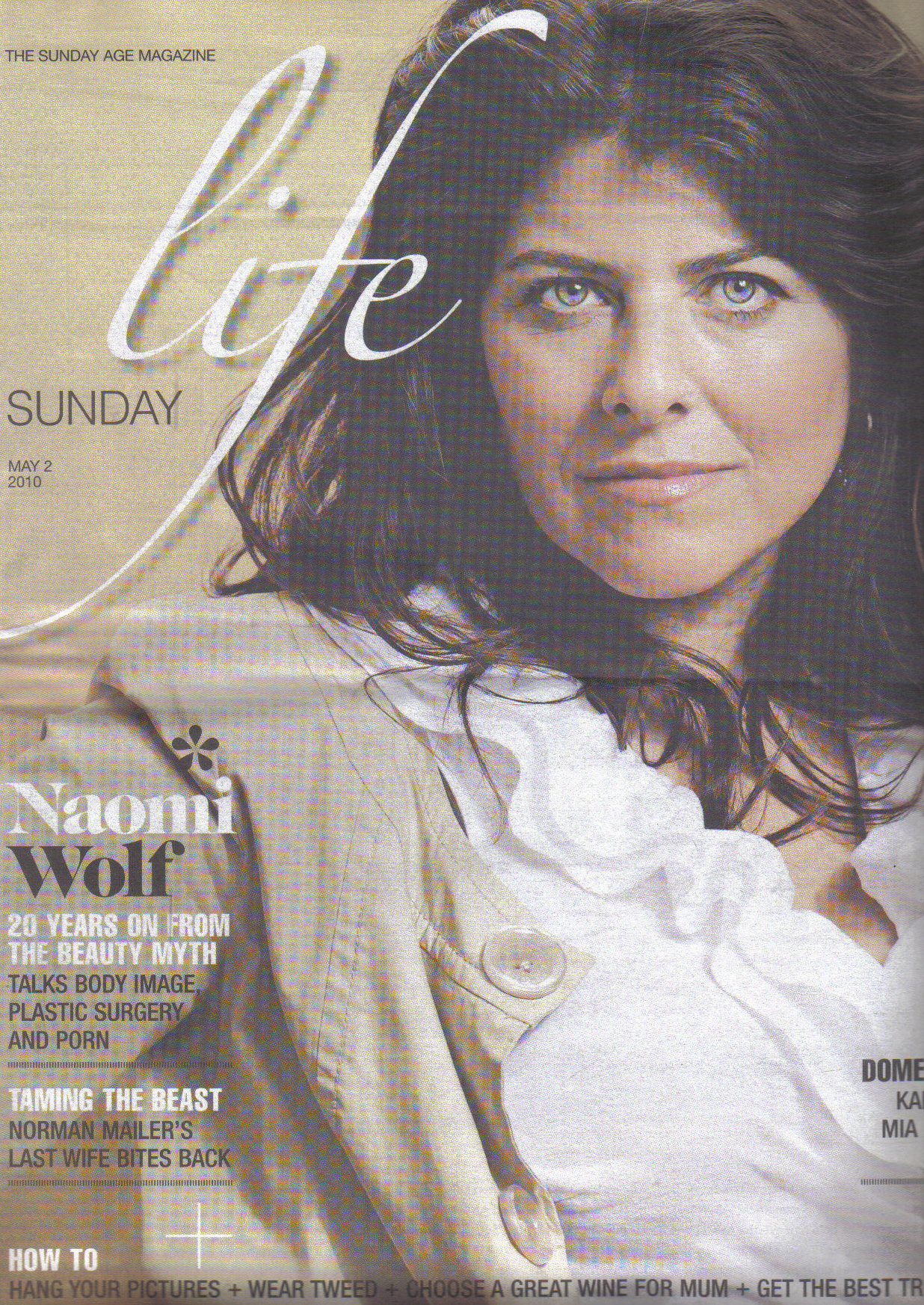
Following on from Tuesday’s earth-moving post about beautiful women and heart health, last night I went to see prolific feminist author Naomi Wolf speak on her book, The Beauty Myth, and how images of beauty in the media are used against women at the Wheeler Centre for Books, Writing & Ideas in Melbourne.
The common perception about “feminists” is that they’re all—to borrow a quote from Bring It On—“big, dikey losers” who burn their bras and don’t shave under their arms. But at the risk of sounding cliché, I don’t believe you can be female and not be a feminist.
There was an overwhelming amount of people packed into the Capitol Theatre, off Swanston Street, and the majority were your average woman on the street, most coming from work or uni, with the odd flanny-wearing, mullet-rocking stereotype. And a few men, too, one of whom posed the question as to whether women’s magazines facilitate the media’s ideal of what a woman should look like. (More on that later.)
I also don’t like the notion, and nor does Wolf, that to be a “feminist”, or to even be interested in the topic without adopting the extremist views that some “second-wave feminists” espouse—Catharine MacKinnon, I’m talking to you—is to be a Germaine Greer tome-thumping man-hater. She touched on this when she mentioned that whenever there’s a move forward for women (ie. the right to vote, the availability of the birth control pill meaning women could have “sex without the punishment of pregnancy”, Jennifer Hawkins posing nude and unairbrushed on the cover of Marie Claire), there is the inevitable backlash.
It was interesting to note the fact that that the three most important pieces of literature on feminism—The Second Sex by Simone de Beauvoir, Greer’s The Female Eunuch, and The Beauty Myth—each have twenty-one years between their publication dates, a “coming of age” of sorts in understanding the “lexicon of feminism”, the MC said.
Another point of interest was the beauty and vivacity of the author herself, not to mention her fab shoes!
Wolf said she loved Australia because we’re so candid and unselfconscious in our responses to the issues she raises, and that nowhere else do “visiting feminists get treated like rock stars.”
Speaking of rock stars, an certain icon in history has been not only a rock star, but a gymnast, teacher, astronaut and mother, amongst many other occupations. This icon is Barbie, and she was a hot topic on the night.
Barbie represents the “universal ideal” of “transcendental beauty”, in the Western world in particular and, according to Wolf, she is a valuable media tool in the cosmetics, dieting and plastic surgery industries.
Wolf asked why we never see women who are not under 40, thin, tanned, blonde, blue-eyed and Caucasian (ie. Barbie) in the media (which I personally disagree with; Penelope Cruz, Salma Hayek, Ellen DeGeneres, Christina Hendricks, Kim Kardashian, Meryl Streep, Oprah Winfrey and the Grey’s Anatomy women are a few examples that counter this theory). Here is the one word answer: advertisers. They are the reason the Barbie-stereotype is on the cover of magazines every month.
Sure, magazines get most of their revenue from the advertisers, and if they think their brand ideal will be jeopardised by running an ad in Glamour magazine, which has been running a lot of plus-sized photo shoots recently and garnering a lot of attention for it, for example, they will not give their ad money to that magazine. So therefore, Glamour has a lower budget to promote itself to readers every month. Then its loyal readers receive less of the content they keep coming back for, ie. women who look like them, and will stop buying that magazine.
On the other hand, as Mia Freedman talks about in her memoir, Mama Mia: A Memoir of Mistakes, Magazines & Motherhood, and editor of Shop Til You Drop magazine Justine Cullen writes in this month’s issue, women don’t buy the Ellens, Meryls and Kims, they buy the Jennifers and Kates. So, Wolf said last night, “it’s something you’re doing” as media consumers.
So it’s a double-edged sword. We complain that we want to see more “real women” in magazines, however we’re not willing to shell out for them, therefore sales go down, advertisers move elsewhere, and “we don’t know what we’re missing” because “women doing interesting things are omitted” from the mainstream media, and instead we get another story on Jennifer Aniston’s desperation over Brad and Angelina’s marriage, or some crap. I think Wolf is right in saying that we need to consciously refuse to buy into those kinds of stories and look towards other instances of women in the media.
However, I don’t agree—and this seems to be the consensus, especially amongst those who don’t actually consume women’s magazines on a regular basis—with the belief that all women’s magazines try to sell us are diets, $350 beauty products that don’t actually work, and low self-esteem. To people with this view, I say, try picking up a copy of Cosmopolitan, Frankie or Girlfriend magazines. These are all publications that are geared towards different demographics of females—sexually active and assertive women in their late teens to mid-to-late twenties; alternative, crafty women, most likely studying design or politics; and the teenage set, respectively—that DO NOT run diets, do recommend fashion and beauty products at the affordable end of the spectrum, and present women of all shapes and sizes in a positive light. Not all women’s magazines are at the crux of this “beauty myth”.
Another major point in Wolf’s theory is the abundance of pornography in today’s society, which she also talks a lot about in this past weekend’s Sunday Life supplement in Melbourne’s The Age and The Sydney Morning Herald. She argues that this lowers the sexual confidence of both men and women, but young women, in particular, feel they have to offer an array of sexual activities they’re not necessarily comfortable with in order to “feel competitive in the sexual marketplace”. Because men, in particular, have such “strong, Pavlovian responses” to porn, excessive consumption can lead to desensitisation to the real thing, which is why there is such a surge in impotence in young men.
Where once it were supermodels who determined the sexual ideal of women, it is now female porn stars, with their svelte, childlike torsos, fake breasts and meticulously trimmed pubic region, society uses as the benchmark. Bodies that share similarities with— who else?!— Barbie.
One could argue that Brazilian and XXX waxing is a way for the male-geared porn industry to beat women into submission, so that they become childlike and are able to be dominated. Another intriguing point Wolf puts forward can be traced back to the dieting industry, in that striving to look the way of the porn star, with a super-slim body and low body mass index actually diminishes the libido. Is this really what society wants whilst pushing such a sexual culture? Or is it in tune with the subservient nature of females in porn?
Wolf also addressed the perception that women with eating disorders and negative body image are “crazy”. As an anorexic in her teens, Wolf debunked this, saying that “physiologically, low calorie count causes mental impairment,” and is a “form of control” by the dieting industry, the media, and society to control and suppress women’s ambitions. Because when you’re thinking about food and exercising and the way you look, you’re not thinking about education and work and your future.
She added that a way to counteract this is to form “active critical thought” about images of beauty, which apparently 33% of women do. Another 18% become obsessed by these images, which in turn leads to eating disorders and body dysmorphia. The rest of us hover somewhere in between.
During question time, one audience member asked why she—who comes from an educated, loving and supportive background; is surrounded by encouraging and non-judgemental friends and family; who does form critical opinions about the media’s portrayal of women—feels ugly, fat, not good enough and constantly compares herself to other women, in the media or no, and how “active critical thought” can really alter this.
I thought this was a very brave and fascinating question put to Wolf, however her response was more disheartening. In a nutshell, she basically said that at the end of the day, if being open to different images of beauty, both from the mainstream and non-mainstream media worlds, and being able to confidently and objectively realise that not everyone looks like that and that is not the real-life ideal, still makes you feel like crap, there may be some underlying issues that only a therapist can fix.
Which poses another question: how far have we really come? From the 1920s “flapper body style” that emerged when women first won the vote and somehow felt they had to look more masculine to adapt to this, to an auditorium full of beautiful, successful, smart and “critically thinking” independent women in 2010, does this notion of the “beauty myth” really exist? Is there a beauty myth that we have to expose?
0.000000
0.000000
 The Scarlett Woman