VCE Top Designs—frankie Editor Jo Walker Talks to Media Students.


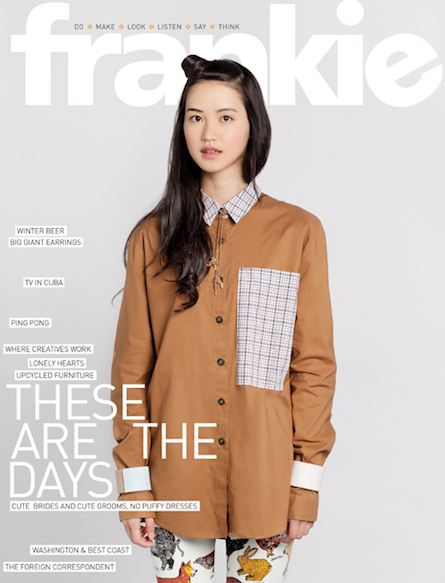
Last Thursday frankie editor Jo Walker spoke to VCE students studying media and design at Melbourne Museum, as part of their annual VCE Top Designs exhibition.

The forum was also headed by two VCAA State Reviewers, who got the event off to a promising start when they asked the students if any of them read magazines as inspiration for their projects, and a tumbleweed blew by.

But you know what high school kids can be like: in the words of Matilda’s Miss Trunchbull, “I’m glad I never was one!”

Walker can count me as one of her loyal subjects, and I hung on her every word.

Granted, a lot of it is stuff I’ve heard before, as it’s been five and a half years since I graduated from high school, but interesting nonetheless.

She spoke about frankie’s humble beginnings, the founding editors Louise Bannister, who left not long after the mag’s inception to backpack around Canada, and Lara Burke, who’s still there as creative director today.

Walker described frankie as a “general interest magazine for hipsters”, which I have to say was a turn off, as I can’t stand hipsters! But, like my friend Zoe, who looks like a hipster on the outside, but is really just a normal, cool, great person on the inside, frankie is similar.

Walker said it’s easier to describe what frankie isn’t than what it is: it’s not a colourful, mainstream mag about how to please your boyfriend in bed. frankie readers already know how to do that, according to Walker!

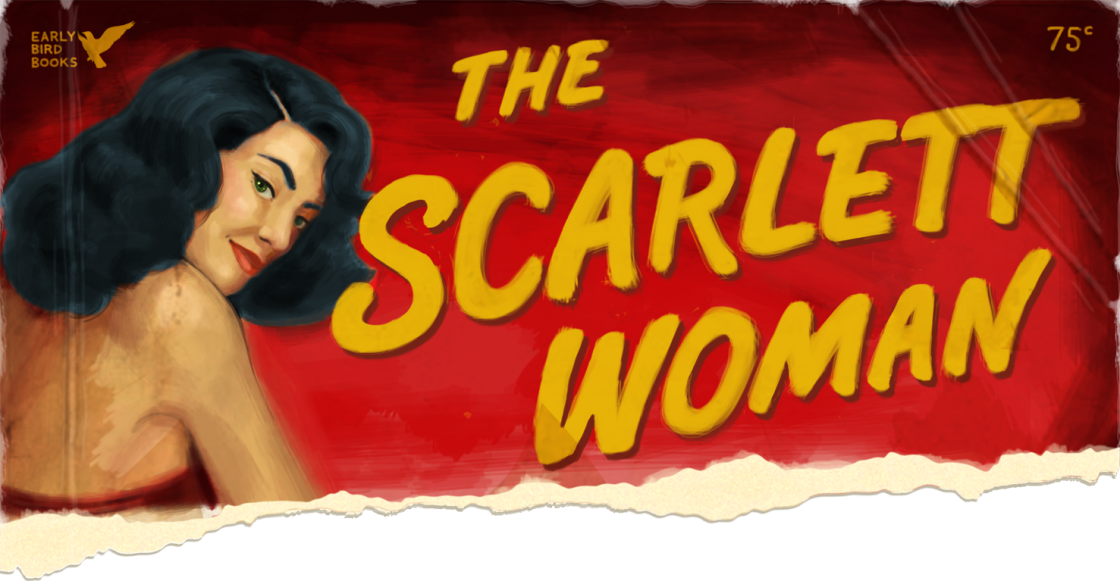
The mag is inspired by “random conversations in pubs”, bookstores, news shows like ABC’s Australian Story, the internet, social media and frankie staff’s favourite blogs (no word on if The Scarlett Woman is one of them!). But essentially, if editors Walker and Burke  like it, it goes to print.

frankie has stopped using models for its fashion shoots (though not for the cover evidently), instead using musicians in what could be seen as a token gesture to silence its critics.

Stepping away from the typical frankie-esque story, this month has a “frankie weddings” special, which Walker described as “not just another [Cosmo Bride] wedding story”.

Ultimately, Walker says she looks to give each issue the balance, flow and rhythm of a “mixtape” (though I don’t think many of the kids knew what one is; “an iPod playlist”, if you will.)

I was so inspired by the talk and the amount of references to the current issue, I went out and bought a copy, even though I don’t get paid til next week and had already exhausted my magazine allowance!

Related: George Michael Paper Dolls in Independent Zine ZINm.

 frankie Review: January/February 2011.

Elsewhere: [Musings of an Inappropriate Woman] Why It’s Worth Talking About frankie Magazine.

Image via Girl with a Satchel.

Magazines: Who Thinks Jackie O’s Parenting Style is Beautiful?


A couple of weeks ago, Jackie O was vilified by the Minister for Families, Pru Goward, for feeding her baby Kitty whilst crossing the road, and most women everywhere jumped to her defence.

As one of Who’s “Most Beautiful People” for 2011, she explains her role as a mother:

“… I think for me the most beautiful thing is the bond you share [with your child]—I know all mothers say that, but you just can’t explain the love you feel. You honestly would die for your child without a moment’s hesitation. You put yourself second and it’s a really nice feeling to be rid of that vanity, to not be so self-obsessed. I love watching other mothers with their babies, too…”

Given the outrage Goward’s comments sparked by women in the media, it seems very timely that Who chose O as one of their finalists this year, and chose instead to focus on the wonderful things about motherhood, as opposed to the mistakes—according to Goward, at least—a new mum is bound to make.

Related: “Cultural Talking Points”: How Does Jackie O’s “Bad Parenting” Relate to Hunting?

Elsewhere: [MamaMia] Jackie O & the Twisted Politics of Being a Bad Mother.

[Girl with a Satchel] Jackie O, Michael Clarke & the Pillorying of Pretty People.

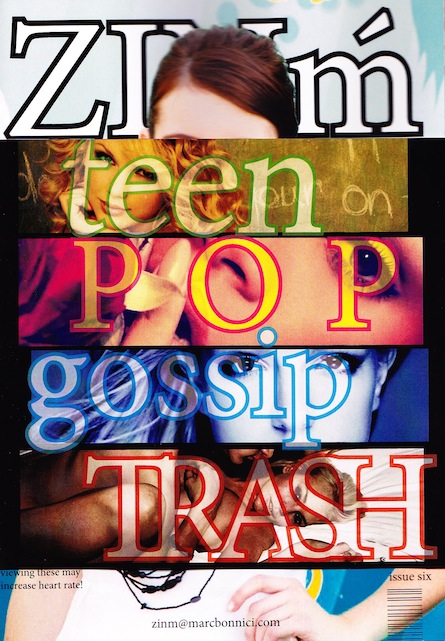
Magazine Review: ZINm, Issue Six.


With issue six released a couple of weeks ago, independent zine, ZINm, by Melbournian Marc Bonnici, is really hitting its stride.

The “Teen, Pop, Gossip, Trash” issue takes a page out of Famous’s book mag, with a snarky, funny and pop-culturally heavy tone.

On the “From the Editor” page (p. 5), Bonnici ponders the first world problems of “Britney VS. Katy: product placement in their new music videos” and “what colour scarf shall I wear to go check the mail…?”

The issues features a spread of Selena Gomez’s ever-changing hairdo (p. 6), how to correctly apply make-up (p. 9), Kellan Lutz’s obsession with exercise and long sports socks (p. 10–11), a “dear Christina Aguilera/Metro trains/couples walking in the city” letter in regular feature “Burn Book” (p. 18), and a Dolly Doctor-esque sexual advice column entitled “Doctor Chorizo” (p. 21).

Melissa George, Ryan Reynolds and Emma Roberts also make appearances.

It’s a good thing this issue comes with a “may contain possibly false information” disclaimer, ’cause the truly riotous celeb scandals in this issue couldn’t possibly be true!

The newsstand glossies should take heed: goodness knows a lot of their material is based on possibly false info!

Related: George Michael Paper Dolls in Independent Zine ZINm.

Independent Zine ZINm Preview.

First World Problems.

Elsewhere: [Marc Bonnici] Homepage.

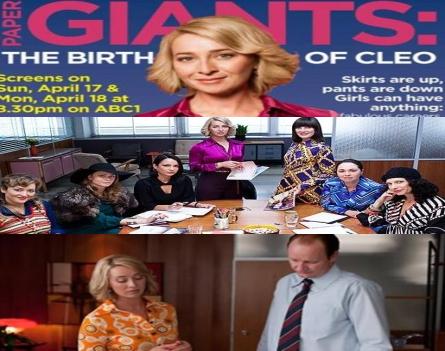
TV: Paper Giants–The Birth of Cleo Review.


Asher Keddie has never been my favourite actress. So I wasn’t particularly looking forward to her portrayal of magazine mogul Ita Buttrose in ABC’s Paper Giants.

However, after watching both episodes online on Good Friday, I’m now a Keddie convert.

If you’ve read any of the myriad of positive reviews of the miniseries, you’ll know that Keddie gets the Ita lisp down perfectly.

But Keddie gives off a different air to Ita (granted, I’m only really familiar with The Morning Show and etiquette Ita, not the golden age of magazines Ita), though, and really makes the role her own.

Film-wise, the imagery embodies the ’70s perfectly (’cause I was alive then and all!) and harkens back to simpler times, when the printers baulked at having to change their formatting to accommodate the patented Cleo sealed section, saying it couldn’t be done!

Though the role of women was going through an upheaval at the time, and Cleo paved the way for women of that generation.

I found it funny and quite poignant that women like Ita and her assistant Leslie, played by Jessica Tovey, were working to change the status of women through their magazine, while privately their lives were in shambles: Leslie tries to take on the role of sexually empowered woman, experimenting with role play, fantasy and sex toys, but still stays with her unenlightened fiancé Muz, while maintaining an affair with a senior co-worker, who refuses to leave his wife for her. And before Ita’s husband, Mac, leaves her raising one child and pregnant with another, the film juxtaposes Ita arriving home from a long day at the office that included being rebuffed for a loan without the permission of her husband with asking Mac if he’d like onions with his steak, which she immediately begins making.

At this juncture, the Cleo girls raise the notion of Superwoman, and if she actually exists; a debate modern feminists are still grappling with.

My favourite parts of the miniseries, apart from Keddie as Ita, and Rob Carlton as Kerry Packer, was its ability to poke fun at the present day, such as a dig at Time Out magazine, and how it will “never take off” and a Cleo girl asking, “Who’s Paul Keating?”

Related: “Cultural Talking Points”: How Does Jackie O’s “Bad Parenting” Relate to Hunting?

Has Feminism Failed?

Images via Facebook, ABC.

Magazines: Who Condemns Baby-Body Bullying…


… But when the celebs in question aren’t actually pregnant, it raises the skinny- vs. fat-shaming debate, and whether people in the public eye’s bodies should be public property, too.

Kudos to Nicole Richie, who has come out with this statement:

“To publicly point out a change in anyone’s body is mean-spirited and cruel.”

God knows Richie’s had her fair share of body-bashing in the media. You go, girl!

Khloe Kardashian is another celeb who’s wrestled with both her weight (being perceived as the “fat”, “ugly” sister in comparison to siblings Kim and Kourtney probably doesn’t help) and her struggle to get pregnant:

“The media makes me feel like I’m barren and why can’t you get pregnant? I am 26 years old… When it happens, it’s going to happen.”

American Idol winner Carrie Underwood goes on to say that, “When I wear something a little baggier, I’m like, nope, people are going to think I’m hiding something.”

I’d better stop going out in public in baggy jumpers and layered shirts, then! But thankfully, I’m not a celebrity whose body, actions and shopping list is scrutinised by all manner of media.

Elsewhere: [Jezebel] Who Says There Has To Be An “Ugly Sister”?

Magazines: Man Up.

“Manning up” seems to be a common theme on The Scarlett Woman this past week.

I don’t agree with the term, as it implies that simply being a man is equivalent to being courageous. Not to toot my own horn (okay, I am!), but I feel like I “man up” a whole hell of a lot more than most of my male friends. But it is a good descriptive phrase, along with “grow some balls” and “don’t be a pussy”, to which the same above critique applies.

Last weekend’s Sunday Life ran a story entitled “You’ve Got Males”, about the conundrum of raising males, which could be a good article if it wasn’t so sexist and traditional-man bashing.

Some such examples are:

“… Mum went through a feminist phase where the various pitfalls of male behaviour were outlined to me early and often, boot-camp style: think The Biggest Loser if they were trying to create metrosexuals instead of skinny people”—most feminists will tell you that it isn’t a phase; children should be allowed to grow in their own ways, whilst being gently guided by their caregivers.

“Such a boy thing to do” —what, exactly? Playing with trucks and being destructive? I have observed plenty of male children being more mellow, whilst girls go ahead and trash their cubbies after they’ve been lovingly tidied by moi (true story). It comes down to being an individual, not a stereotype. And at aged three, should we really be pushing stereotypes on our children?!

“Our first-born liked babychinos and was more artsy than fartsy. But our second boy was a full-blown bloke (‘Finally, a male in the family,’ said my wife)” —liking babychinos means your parents are pretentious, not that you’re going to grow up to be a SNAG. And what’s so wrong with that anyway?

The article also discusses the pack mentality of “groups of men behav[ing] in a more blokey fashion”, which was briefly touched on at the Wheeler Centre’s “The Sentimental Bloke” discussion, in the form of a solitary wine vs. group beers, and how to “deprogram” this.

Personally, I’m not a fan of “blokey behaviour” in the stereotypical sense, but nor to I agree with the parenting style—or typical Australian attitudes—this article attempts to push: that it’s one (bloke) or the other (SNAG), with no regard for the myriad of options in between, or what’s best for the individual child.

Related: Unfinished Business at the Melbourne International Comedy Festival.

“Who the Bloody Hell Are We?”: The Sentimental Bloke at the Wheeler Centre.

Magazines: Vo-Gaga.

Lady Gaga claims to be a misfit; the mother monster of the birth of a new race of misfits, according to “Born This Way”. So why is she on the cover of Vogue?:

“‘I want for people in the universe, my fans and otherwise, to essentially use me as an escape… I am the jester to the kingdom. I am the route out. I am the excuse to explore your identity. To be exactly who you are and to feel unafraid. To not judge yourself, to not hate yourself. Because, as funny as it is that I am on the cover of Vogue—and no one is laughing harder than I am—I was the girl in school who was most likely to walk down the hallway and get called a slut or a bitch or ugly or big nose or nerd or dyke. “Why are you in the chorus?”’ (She’s more Glee than Gary Glitter in some ways.)”

Or , “why did you wear a meat dress?”, for that matter.

“‘Ugh, the meat dress’… she rolls her eyes. ‘People just want to figure it out or explain it. The truth is, the mystery and the magic is my art. That is what I am good at. You are fascinated with precisely the thing that you are trying to analyze and undo.’”

Related: Who’s the Copycat Now, Katy Perry?

Image via Fabulous Buzz.

UPDATED: Lady Gaga—Taking Inspiration from The Wizard of Oz.

Lady Gaga on her influences, from Vogue, March 2011:

“Gaga herself is very open about her influences. ‘It’s not a secret that I have been inspired by tons of people,’ she says. ‘David Bowie and Prince being the most paramount in terms of live performance.’ She also seems to have made peace with the fact that she is compared to—or, less charitably, accused of ripping off—nearly every artist of the last 50 years. ‘I could go on and on about all of the people I have been compared to—from Madonna to Grace Jones to Debbie Harry to Elton John to Marilyn Manson to Yoko Ono—but at a certain point you have to realise that what they are saying is that I am cut from the cloth of performer, that I am like all of those people in spirit’… ‘She was born this way.'”

With the release of “Born This Way”, critics are wondering if Lady Gaga isn’t as original as they once thought she was. The song blatantly rips off takes inspiration from Madonna’s “Express Yourself”, and a lot of Gaga’s past works are heavily influence by Her Madgesty.

But Lady Gaga has always been about much more than just her music. It’s all about the fashion, hello?!

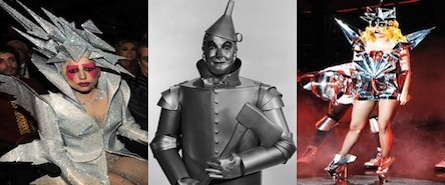
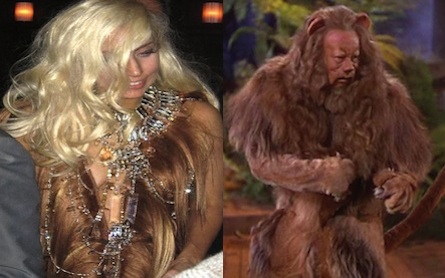
But even her outrageous outfits—bar the meat dress and a couple of others—aren’t that original when you come to think of it. Juxtaposed against The Wizard of Oz‘s Cowardly Lion, Good Witch of the South, Tin Man et al., Gaga proves that imitation is the sincerest form of flattery.

Related: Lady Gaga: Taking Inspiration from The Wizard of Oz.

Pop Culture Role Models.

Chase You Down Until You Love Me, Paparazzi…

Lady Gaga’s “Telephone” & 21st Century Noise.

Katy P. VS. Lady G.

Lady Most Likely: Time Magazine’s 100 Most Influential People.

Images via Amy Grindhouse, Wired, Billboard, Just Nuggets, The Examiner, Leopard Print & Lace, Pony & Pink, Pollsb, TV Tropes, Beauty & the Feast, Wikia, Wendy’s World of Oz.

Magazines: George Michael Paper Dolls in Independent Zine ZINm.


Check out my friend Zoe Meagher’s George Michael paper doll that appeared in the latest issue of independent zine, ZINm, by Marc Bonnici. Choose between a “Choose Life” t-shirt clad “Wake Me Up Before You Go Go” era George, a jukebox and skin-tight jeans George in the “Faith” video, or community service George! I especially love the ’80s mullet attachment!

Watch this space for more Zoe goodness to celebrate The Scarlett Woman‘s one year blogosphere anniversary with a redesign!

Related: Independent Zine ZINm Preview.

Kate Middleton is Nothing But an Accessory.


From “Falling Stars: The Plight of the Windsors” by Peter Conrad in The Monthly, February 2011:

“Some feminist critics complain that during the decade Kate spent waiting for William to propose, she worked only one year, as an accessories buyer for the fashion label Jigsaw. I’d say this was astute training for her role, since she is to function as an accessory.”

Image via This Memphis Belle.