Event: Melbourne Writers Festival — In Conversation with Zoe Foster.

Former Cosmo and Harper’s Bazaar beauty writer turned “chick lit” novelist Zoe Foster has always been someone I’ve looked up to: since reading Comso from age 15, her and Mia Freedman are two writers I’ve tried to emulate, not so much career-wise but more style-wise.

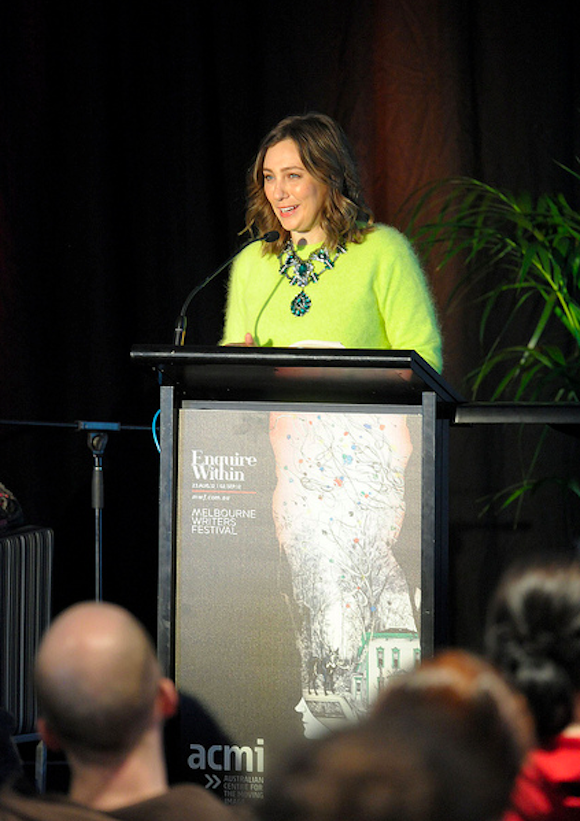
Foster appeared at one of the first events of the Melbourne Writers Festival on Friday morning, in conversation with freelancer and Crikey literary columnist, Bethanie Blanchard.

Dressed in pink sparkly pants and looking flawless as usual, Foster, who now writes from home and whom I remember writing about spending a “working” holiday in New York City a few months (or maybe it was a year? Time flies!) ago, managed to make me believe that there is hope for me as a successful, stay-at-home writer yet.

Granted, Zoe writes the kind of prose I try to avoid: beauty and chick lit. Foster explained how she got the job as beauty editor of Cosmo because Freedman liked that Foster had no beauty knowledge whatsoever and that she’d be writing from a readers’ perspective. Zoe said she never reads the beauty pages, and I have to concur with her there: unless it’s written by Zoe, beauty is the most mundane thing in the world to me.

But where chick lit is concerned, Foster gave an anecdote from Puberty Blues author Kathy Lette who, when Foster told her that she writes in that genre, spat her drink out and said, “No, don’t ever call it that. It’s commercial first-person narrative.”

I have to admit, when I see that phrase or a book cover with a suspiciously chick litty-esque cover, I steer clear. However, when I heard Foster read from her latest effort, The Younger Man, the following morning at The Morning Read (from which the above photo was taken), along with the hilarious Sloane Crosley, I had a hankering to pick it up and give it a whirl. From the excerpt Zoe read, her fiction writing sounds exactly like her beauty columns for MamaMia and her dating advice for Cosmo.

But that’s something I have a whole different issue with: in this month’s Cosmo, Zoe advises not to make an effort in the early stages of courtship: it’s his job to chase you. Firstly, this advice doesn’t work for me because I much prefer the chase (maybe I should take some of Zoe’s advice and perhaps I wouldn’t be single!). And secondly, it’s a bit backwards, which Foster concedes to in the article. She also mentioned that she sometimes “cops a bit of shit” for her… traditional would be a nice way of putting it… views on dating.

Finally, another valuable thing I got out of the session was a glimpse into Zoe’s writing schedule and how she plans her day. While she doesn’t read in the genre she writes in whilst she’s in the drafting process lest she start writing another version of 50 Shades of Grey, she does get up at 6am to get a few hours of non-interrupted fiction time in before email, Twitter and other distractions hit. Ahh, I remember those days. You know, when I was bright eyed and bushy tailed and responsible. Interestingly, Zoe also favours a solitary drafting process in which she doesn’t let anyone read her work before the first draft is submitted to her editor. One conscientious audience member asked how, or more pertinently why, she only relies on herself and doesn’t seek outside insight. Zoe replied that she’s on her fourth novel at the moment, so she’d kind of an old hand and should know what she’s doing by this point. But also, I think, some people are just better at assessing their own work than others. I know I don’t like to have any input from anyone, or even tell people what I’m working on. Once it’s out there, I know it’s mine and mine only; good or bad. The writers’ life is a solitary one, after all.

Images via The Vine, MWF Flickr.

Event: Bendigo Writers Festival.

The month of August is chock full of writers festivals (okay, two, but I’m going to a lot of sessions!), so much so that I’ve taken time off paid work to further my currently unpaid writing career.

Over the weekend I ventured to Bendigo for their writers festival, which boasted big names like Ita Buttrose. I decided to give her talk a miss as it coincided with another talk I wanted to go to about blogging and writing online which is more relevant to me, and frankly, some of the things Ita’s said recently have really rubbed me the wrong way. I think I like her better as portrayed by Asher Keddie than in real life!

While Megan Burke (my new idol) and ABC Open’s Jane Curtis were great speakers (and great bloggers), I felt the audience were all middle aged aspiring mummy bloggers and the content was relevant to them, who are interested in starting a blog, not me. Maybe three years ago, but not now.

The second talk I went to on Saturday was “Are We There Yet?”, featuring Indigenous writer Alexis Wright, astrophysicist turned lawyer turned writer Sulari Gentill, Muslim writer Hanifa Deen, and author Arnold Zable, and facilitated by Shannon Kerrigan, was promising in theory but failed to live up to the hype in practice. I thought all the writers were great and had valuable things to say about how writing contributes to social change but the format of the session was all wrong: I’m not a fan of each speaker telling a story about their take on the subject for a third or a quarter of the time and then it’s over. I much prefer pre-determined questions being posed to the panel and then opening them up for discussion. Suggestion for further panels: use social media to tally up the questions and thought threads attendees want to hear about and incorporate those into the talk, instead of stuffing them into a ten minute question and answer session at the end.

Speaking of, the last talk I went to on Sunday afternoon was about “His & Hers” writing, which had the potential to really delve into the notion that women write about shopping and sex and men write about serious things. When the facilitator, Sofia Ahlberg, asked if women can write a “great Australian novel” and insinuated that they can’t (not because that’s her personal view, I don’t think, but because our society just doesn’t allow for that with, perhaps, the exception of Kate Grenville), a man from the audience and his wife audibly retorted and rudely told Ahlberg to open the discussion up to questions from the audience.

What I got out of the session was an interest in 50 Shades of Grey that I didn’t have before, thanks to John Flaus’ comments that he didn’t think it was written by a woman due to its “clinical”, “outsider” perspective on sex. Either that, or an incredibly narcissistic woman. Interesting.

Also on Sunday was the “What Makes a Hero” session, with Janine Bourke, sports writer Gideon Haigh (sportspeople as heroes is one of my pet topics), Ned Kelly biographer Ian Jones and Hanifa Deen, who asked where minorities get their heroes from if they’re a primarily “conservative construct”, as Haigh asserted. Deen also talked about “cultural amnesia” which I found interesting as we so often put people on a pedestal after—and sometimes despite—committing indiscretions (Ned Kelly, Chopper Reid, and countless football players, to name some Australian “heroes”): “we remember and admire the things we want to”.

Finally, there was a horror panel featuring horror writers Brett McBean and Cameron Oliver, reviewer Lucy Sussex and president of the Australian Horror Writers Association, Geoff Brown. This was probably the best panel in terms of actually addressing the topic and opening the discussion up to questions and comments about “what scares us”. Interestingly, Bendigo is one of the most haunted cities in the world, with more ghosts per person than anywhere else! They talked about the canonical horror films of the late ’70s and ’80s like Carrie, The Shining and The Exorcist and how filmmakers are “scared to scare people” now and that the current zombie, vampire and werewolf trend reflects our xenophobia and fear of the “other”; more so, that they will “turn us into them”. If that doesn’t some up what we’re scared of, I don’t know what does.

Related: Paper Giants: The Birth of Cleo Review.

In Defence of Mia Freedman.

Elsewhere: [MamaMia] Was “Girls on Show” Slut-Shaming?