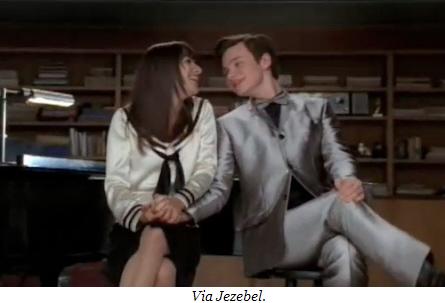
TV: In Defence of Rachel Berry.


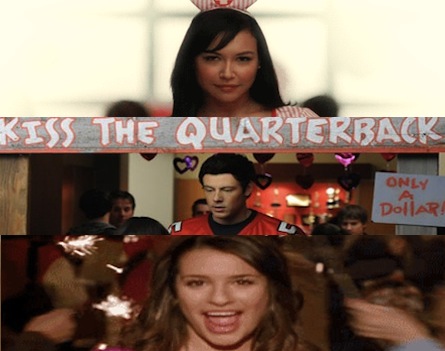
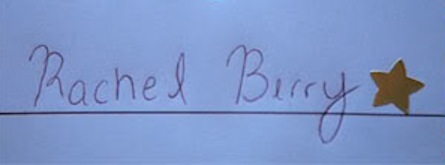
In the first season of Glee, Rachel Berry was introduced as an attention- and approval-seeking know-it-all diva, who sticks a gold star next to her name on the New Directions’ sign-up sheet because that’s what she sees herself as. Season two showed the glee clubber soften her resolve a bit, realising that she’s still only in high school, and has her post-high school years to carve out a Broadway career and have the world see her as the star she knows she is. The season final saw her choose a relationship with Finn Hudson in her senior year at McKinley High, despite having to leave him to head to New York when she graduates.

Not all young girls have to wrangle their feelings for the school jock whilst contemplating a move to the big city to make their dreams come true, but many of Rachel’s problems are shared by the show’s audience.

In the most recent Lady Gaga-themed episode, Rachel struggles to accept her “Jewish nose” and considers rhinoplasty. She also strives for the acceptance of her New Directions band mates, and to be seen as fashionable and popular.

It’s in the character’s nature to be highly-strung, goal-oriented and ambitious, so it’s not likely she’ll change any time soon. And why should she? While there are certainly other young women out there who identify more with the saccharine Quinn Fabray, the sassy soul sisters Santana Lopez and Mercedes Jones, or badass Lauren Zizes, there are plenty who see Rachel as their Glee counterpart, myself included.

A recent New York Times article by Carina Chocano praised the “relatable” and “realistically weak female character”, like Kristen Wigg’s Annie in Bridesmaids—“a jumble of flaws and contradictions”—over the “strong” one. “We don’t relate to [the weak character] despite the fact that she is weak, we relate to her because she is weak,” Chocano writes.

But what exactly does she mean by “weak”?

Pop culture commentator Dr. Karen Brooks notes that talented, beautiful, popular and successful female characters need to be broken down before they can be seen as relatable. “The more talented and beautiful you are, the greater the threat you pose and so ‘things’ are introduced to reduce that threat,” she says. Just look at the “women falling down” video on YouTube.

While Rachel’s had her fair share of setbacks, it seems Glee’s audience is finally beginning to understand her. “We’ve been given time to understand Rachel’s initially painful personality and to identify both her strengths and weaknesses. Her ambitions and drive haven’t shifted, but the context for understanding them has,” Brooks says.

“Rarely are unpleasant characters redeemed, they are simply ‘punished’, while the ‘good’ characters soar to impossible heights, not on the back of hard-work and self-belief, but usually [because of] a love interest and wishing hard. Rachel is a healthy and welcome exception to that,” Brooks continues.

So she’s an unlikely heroine we can all get behind, you might say? “A girl who reminds you of you,” as Chocano opines. An everywoman, if you will?

If Rachel Berry encourages more young women to see themselves as gold stars striving to have their accomplishments recognised, then so be it!

Related: The Underlying Message in Glee’s “Born This Way” Episode.

Do “Strong Female Characters” Remind You of You?

Elsewhere: [The New York Times] A Plague of Strong Female Characters.

Image via Noelle’s Means of Escape.
TV: Glee Gets Down on Friday at the Prom.


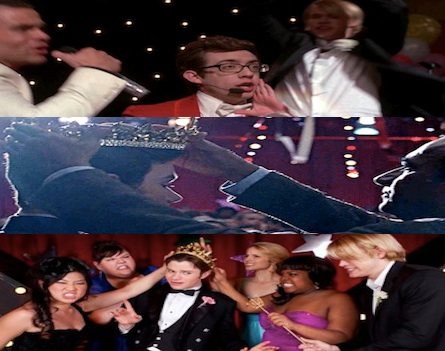
So Rebecca Black has officially permeated the zeitgeist, with “Friday” being performed by Puck, Artie and Sam at McKinley High’s junior prom on last night’s episode of Glee.

And despite Quinn’s monotonous efforts to be crowned prom queen, along with Finn as her king, she lost out to “queen” Kurt.

Kurt’s date Blaine told Kurt of what happened to him at his last prom (he and another gay friend were set on by the school homophobes and gang bashed) and that he wasn’t 100% comfortable with attending, but he went for Kurt anyway.

Kurt’s dad, Burt, was concerned that Kurt’s “royal wedding-inspired” tux, which he handmade himself, wasn’t appropriate and that Kurt shouldn’t draw any extra attention to himself and Blaine.

Kurt thinks, despite Santana and Karofsky escorting him to and from classes as part of their Bully Whips anti-bullying squad, that McKinley is really coming around to the idea of gay acceptance, because he hasn’t been physically or verbally abused since returning from Dalton Academy.

Hatred builds up inside if we can’t let it out, and it seems that the kids at McKinley let it out sneakily and quietly, by “secret ballot” for prom queen.

But you know Kurt: he sucked it up and went out there in front of the school to tell them… “Kate Middleton, eat your heart out.” Okay, I was expecting something a little more inspirational than that, considering the “gay prom” issue is one that’s rampant in the U.S., and also here, as a recent episode of SBS’s Insight will attest.

But I suppose we have Chris Colfer’s Golden Globes speech to comfort us.

And, as is Glee’s trademark, the controversy was wrapped up nicely into one 42-minute episode and McKinley’s homophobia will live to fight another day.

Until then, let’s get down on “Friday”!

Related: The Underlying Message in Glee’s “Born This Way” Episode.

The Underlying Message in Glee’s “Original Song” Episode.

Gwyneth Paltrow Addresses Tabloid Culture & Her Haters.

Glee “Sexy” Review.

The Underlying Message in Glee’s “Blame it on the Alcohol” Episode.

How to Make a Woman Fall in Love With You, Glee Style.

Glee “Silly Love Songs” Review.

The Underlying Message in Glee’s “Furt” Episode.

The (Belated) Underlying Message in Glee’s “Never Been Kissed” Episode.

The Underlying Message in Glee’s “The Rocky Horror Glee Show” Episode.

The Underlying Message in Glee’s “Duets” Episode.

The Underlying Message in Glee’s “Grilled Cheesus” Episode.

The Underlying Message in Glee’s “Britney/Brittany” Episode.

Elsewhere: [SBS] Gay in School: SBS Insight.

Images via Showbiz Nest, I Am Thea 07, Maurissa Weiner.

TV: The Underlying Message in Glee’s “Original Song” Episode.


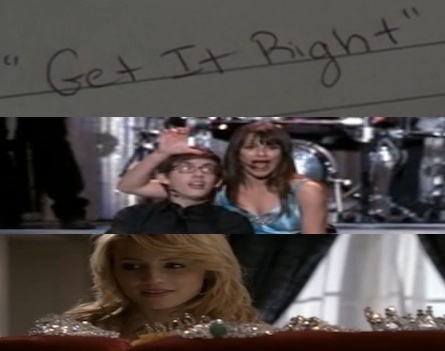
Firstly, just let me say, what’s up with the pathetic episode title? Perhaps the writers could have taken a leaf out of the glee club’s fictional book and called the episode “Get it Right” or “Loser Like Me”, the names of the episodes two, um, original songs.

*

Quinn has brought up the whole prom thing with Finn a couple of times in recent episodes, but last night her plan to take out the title of prom queen and king with Finn was put into full force.

I found it very odd that Quinn, the girl who last season was ostracised from the Cheerios, the “cool group” and her own family when she became pregnant, reverted to the vapid character we were introduced to in the early days.

I’m not a big fan of Quinn’s in general, but I felt that she grew tremendously as a character over the course of a year, while characters like Mr. Shue and Rachel Berry (who—coincidentally?—happen to be Glee’s two most annoying characters) remain stagnant. But, as I said in last week’s review, this is Glee, and when have we ever expected storyline consistency from it?

When Quinn befriends Rachel in an effort to keep her away from Finn, we see her true aspirations: Quinn claims she wants Rachel to realise her full potential and become a star, while she manages a real estate company and Finn takes over Burt Hummel’s mechanics business. Quinn believes there’s nothing outside of Lima for her and Finn (I wonder how Finn feels about this; knowing his girlfriend thinks he has no potential?), which I don’t buy. I thought Quinn’s pregnancy changed her for the better; part of the reason she gave up her baby was because she couldn’t give it the life it deserved. Doesn’t Quinn deserve a good life, too?

Quinn’s pregnancy also proved she’s just a loser like the rest of New Directions, which was the theme for their regionals set. Blowing Sue’s Oral Intensity (what ever happened to Vocal Adrenaline?) and the Warblers out of the water with their original songs, the first of which was written and performed by Rachel, who finally grasped the craft of songwriting (but not without an initial slip-up this episode with the song “Only Child”. On the plus side, Brittany said “My Headband” was her favourite song!), using Quinn’s taunts about starving for a “schoolgirl fantasy happy ending” with Finn as fodder.

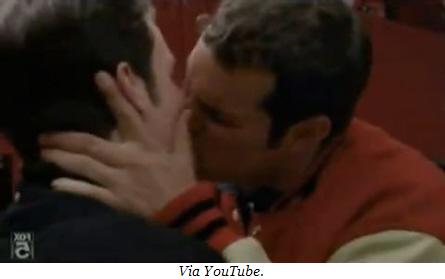
What started out with an irritating voiceover from wannabe queen bee Quinn and some fantastic digs at Blaine’s monopoly over the Warblers’ solos, ended nicely with some “original songs” for Glee to make a mint from, instead of giving all the royalties to the initial artists; the underlying message that we’re all just losers; and Blaine’s epiphany that Kurt’s “the one”—with a gay kiss to boot!

Related: The Underlying Message in Glee’s “Blame it on the Alcohol” Episode.

How to Make a Woman Fall in Love With You, Glee Style.

Glee “Silly Love Songs” Review.

The Underlying Message in Glee’s “Furt” Episode.

The (Belated) Underlying Message in Glee’s “Never Been Kissed” Episode.

The Underlying Message in Glee’s “The Rocky Horror Glee Show” Episode.

The Underlying Message in Glee’s “Duets” Episode.

The Underlying Message in Glee’s “Grilled Cheesus” Episode.

The Underlying Message in Glee’s “Britney/Brittany” Episode.

Images via MegaVideo.

TV: The Underlying Message in Glee’s “Blame it on the Alcohol” Episode.


Blame it on the alcohol, indeed.

This week’s episode deals with McKinley High’s Alcohol Awareness Week, after Principal Figgins exclaims that there have been six alcohol-related suspensions in the past week due to the alcopop phenomenon and pop music promoting the consumption of alcohol.

So what better time for Finn and Puck to convince Rachel to have an unsupervised party at her house, right?

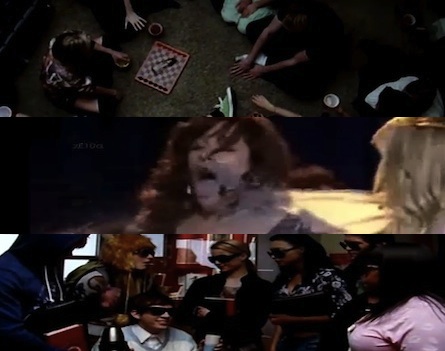
Body shots, Brittany getting her kit off, karaoke and spin the bottle ensue, creating a drunken love triangle between Rachel, Kurt and Blaine, where someone is bound to get hurt. And you can’t blame that on the alcohol.

In my experience, people don’t do things drunk that they don’t already want to do sober. It gives them liquid courage, if you will. Which, funnily enough, is what “Blame it on the Alcohol” is all about. Who knew that listening to Jamie Foxx would pay off?

But “the alcoholic teen-vomit fetishist” (Sue’s words, not mine!) Mr. Shuester doesn’t approve of their rendition of the song, so instead they perform “Tik and also Tok, by Key dollar sign Ha,” as Principal Figgins introduces it at the school assembly. And that’s so much better how?

But for all their seemingly sexual acceptance (Kurt, Blaine, Brittany and Santana and their “scissoring”), Kurt’s comment about bisexuality made me question how accepting the show really is:

“‘Bisexual’ is a term gay guys in high school use when they wanna hold hands with girls and feel like a normal person for a change.”

Sounds a bit like Miranda’s reasoning that bisexuality is a blanket term for guys who turn out to be gay and girls who turn out to be straight, thus explaining the man-drought, on Sex & the City.

But it wouldn’t be the first time Glee’s ostracised their characters and potential audience members who may identify with them.

Related: How to Make a Woman Fall in Love With You, Glee Style.

Glee “Silly Love Songs” Review.

The Underlying Message in Glee’s “Furt” Episode.

The (Belated) Underlying Message in Glee’s “Never Been Kissed” Episode.

The Underlying Message in Glee’s “The Rocky Horror Glee Show” Episode.

The Underlying Message in Glee’s “Duets” Episode.

The Underlying Message in Glee’s “Grilled Cheesus” Episode.

The Underlying Message in Glee’s “Britney/Brittany” Episode.

Elsewhere: [Jezebel] Glee: New Directions’ Alcohol-Fuelled Bisexual Awakening.

[Jezebel] Glee: Everyone’s Duetting It (Except Kurt).

[Jezebel] Why Glee Still Needs to Work on Diversity.

Images via YouTube.

TV: Lumberjack Chic on Glee.

Geek chic, celebrity incognito and lumberjack chic are three of my favourite styles of dress. What are they, you ask? Allow me to explain.

Geek chic, noun. Combining a preppy style of dress with grunge. Think Marc Jacobs and Tavi Gevinson. NOT Rachel Berry. (Last night’s episode of Glee assured us that Rachel will never be seen as a fashion icon.)

Celebrity incognito, noun. Used to describe someone who is dressed like a celebrity on the run from the paparazzi. Any combination of oversized sunglasses, large takeaway coffee, layering à la Mary-Kate Olsen, and objects to obscure the face. Essentially, this is a term that cannot be described.

Lumberjack chic, noun. The advancement of traditional lumberjack garb, such as plaid and fur trimming, from the timber yard to the runway. DSquared² are a major proponent of this look.

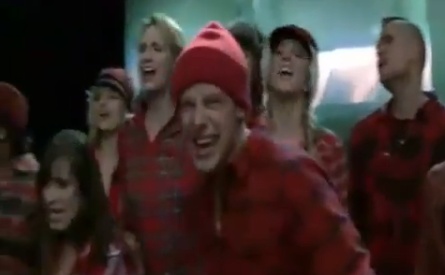
Lumberjack chic, in particular, graced our screens on Glee last night as Rachel, Finn et al. belted out the “anthem” “Sing” by My Chemical Romance. Even Sue Sylvester got in on the action with a tartan version of her trademark tracksuit. Although I’m not so sure about Finn channelling his stepdad Burt Hummell with that red beanie…

Oh well; you can’t hold the plaid down.

[Girl with a Satchel] Cute & Chic This Week: Check, Mate!

Image via YouTube.

TV: Glee “Silly Love Songs” Review.


Last night’s episode of Glee had some semblance of a storyline, unlike most of its companion episodes this year.

Santana was ousted by the glee club as a bitch, Puck serenaded Lauren, who refused to be wooed by his misogynistic rendition of  “Fat Bottomed Girls”, and Finn attempted to court Quinn at his Valentine’s Day kissing booth.

By far the best song of the night was Artie and Mike’s collaboration on Michael Jackson’s “P.Y.T.”, which I have taken the liberty of embedding below.

Another key story arc was Kurt’s continued infatuation with Blaine, who serenades another man with Robin Thicke’s “When I Get You Alone” (again, below), another standout. Not to worry; although Blaine is rebuffed by his love interest, and Kurt confesses his feelings for his, the two are back being besties before the night’s through.

Don’t you just love how life on Glee comes packaged up nicely with a pretty ribbon on top after forty minutes…?

Related: The Underlying Message in Glee‘s “Furt” Episode.

The (Belated) Underlying Message in Glee’s “Never Been Kissed” Episode.

The Underlying Message in Glee’s “The Rocky Horror Glee Show” Episode.

The Underlying Message in Glee’s “Duets” Episode.

The Underlying Message in Glee’s “Grilled Cheesus” Episode.

The Underlying Message in Glee’s “Britney/Brittany” Episode.

Images via Shulman Says, Soul88, TV Hamster.

TV: The Underlying Message in Glee’s “Furt” Episode.


Last night’s episode of Glee marked the final in a three-episode arc about bullying.

In Sue’s final act as principal before she resigns at the end of the episode, she expels Dave Karofsky for bullying Kurt. Jezebel notes that “rather than yelling, ‘William, my hands are tied!’ she promises to stop Karofsky once they have proof that he’s harassing Kurt”but not before Sue takes to calling Kurt Porcelain, which could be seen as an act of bullying in itself.

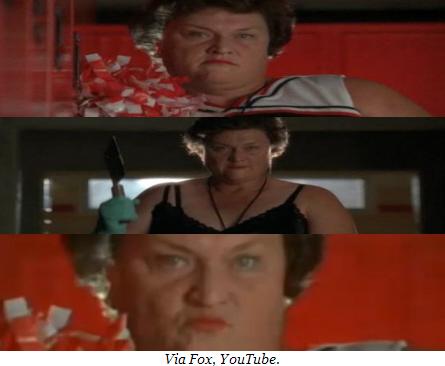
Carol Burnett makes an appearance as Sue and Jean’s absentee mother, Doris, who in addition to being Sue’s own “bully”, left the girls to be a Nazi hunter. While Doris doesn’t appear all that bad, it does give some insight into Sue’s present-day behaviour as McKinley High’s student body tormenter. Why was Sue’s mother in the episode, you ask? Because Sue was getting married… to herself! But that’s a whole other can of worms.

In other bullying news, the glee guys start a fight with Karofsky in the football team’s locker-room in defence of Kurt, but stepbrother to be, Finn, doesn’t partake. Even when it is revealed that the attack was Rachel’s idea, “setting the feminist movement back fifty years”, according to Quinn. (It’s no secret that I can’t stand Rachel, but a strong woman like her needs an equally strong man.) In what seems to be another instalment in Finn’s tour of whimping out, he doesn’t want to be perceived as being a homo-sympathiser. But not to worry, he makes up for it at his mum and Kurt’s dad’s wedding, by making a speech about standing up for “Team Furt” (in the tradition of celebrity couplings like Brangelina). And then they “dance their troubles away”.

The wedding also serves as a catalyst for Kurt to break out this memorable one-liner: “I’ve been planning weddings since I was two!”

Oh Kurt, we’ll miss you when you transfer to Dalton Academy…

Related: The (Belated) Underlying Message in Glee’s “Never Been Kissed” Episode.

The Underlying Message in Glee’s “The Rocky Horror Glee Show” Episode.

The Underlying Message in Glee’s “Duets” Episode.

The Underlying Message in Glee’s “Grilled Cheesus” Episode.

The Underlying Message in Glee’s “Britney/Brittany” Episode.

Women in Fiction: Are Our Favourite Fictional Females Actually Strong, or Stereotypes?

Elsewhere: [Jezebel] Glee: Three Weddings & a Furt.

TV: The (Belated) Underlying Message in Glee’s “Never Been Kissed” Episode.


I was unable to catch up on Glee when it aired last week, so I decided not to write about the latest episode’s “underlying meaning”. However, after watching it over the weekend, I think there is an important message that needs to be talked about; just like every other episode this season!

While Glee can sometimes turn into an after-school special, “Never Been Kissed” was more of an “hour long ‘It Gets Better’ video”, as Jezebel puts it, focussed around Kurt’s struggles with being the target of homophobia and Coach Beiste’s sexual inexperience and objectification as an anti-sex symbol.

It will be interesting to see if the usually lacklustre writers will continue the storyline in which Kurt’s bully and member of the football team, Dave Karofsky, is tormenting Kurt because in actual fact, Dave is confused about his own sexual orientation. But what I found most interesting about the episode was Beiste’s storyline.

When Sam asks Finn how to “cool down” when making out with “chaste” Quinn, Finn relays his story of running down a postman with his car. Sam decides to use a mental image of Beiste in lingerie, and passes this on to the other guys. Somehow, Tina gets hold of this information and also uses a mental image of Beiste when making out with Mike. When Sam and Tina accidentally let slip Beiste’s name during make-out sessions with their significant others, it somehow gets back to Mr. Schuester, who “says [that] Beiste can never find out, though he winds up telling her himself in the very next scene”!

I can’t imagine how hurtful that must have been for Coach Beiste (yes, I am aware Glee is fictional and the characters DON’T ACTUALLY HAVE FEELINGS), especially when it is revealed that she’s “never been kissed”, hence the title of the episode, and never made to feel beautiful.

But the glee clubbers make good by dedicating their mash-up of “Stop! In the Name of Love” and “Free Your Mind” to Beiste, which ends in an inappropriate group hug, not to mention Will attempting to kiss Beiste’s insecurities away. It’s not that easy, Mr. Inappropriate Glee Teacher!

Related: The Underlying Message in Glee’s “The Rocky Horror Glee Show” Episode.

The Underlying Message in Glee’s “Duets” Episode.

The Underlying Message in Glee’s “Grilled Cheesus” Episode.

The Underlying Message in Glee’s “Britney/Brittany” Episode.

Elsewhere: Kurt Gets Kissed in Hour-Long “It Gets Better” Video.

TV: The Underlying Message in Glee’s “The Rocky Horror Glee Show” Episode.


Who would’ve thought that an episode of Glee centring around The Rocky Horror Picture Show could be a catalyst for discussing male body image?

Not me, but that seems to be the underlying message in this week’s episode.

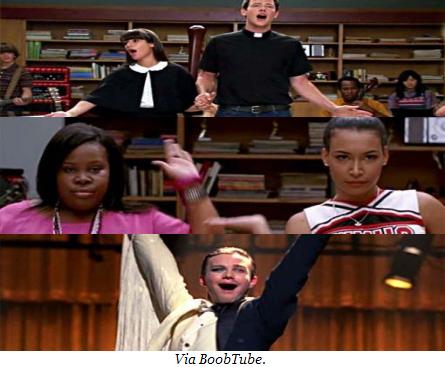
When Mr. Schuester announces to the glee club that they will be performing Rocky Horror after Emma tells him she went to see it with her new beau Carl, Rachel is quick to announce that she and Finn will be playing Janet and Brad. Finn is all for this until he realised he’ll have to perform much of the show in his “tighty-whiteys”. Santana and Brittany comment on this, saying they can’t wait to see Finn’s “hot mess” of a body as a result of eating sloppy joes for lunch everyday, in comparison to Sam’s rippling abs accompanied by gold hot pants in his role as Rocky. (If Cory Monteith had put on weight to give Finn an actual “hot mess” of a body, it might’ve lent his storyline more credibility.)

Finn voices his concerns to Rachel who, in her usual selfish ways, tells him that she doesn’t look like Brittany or Santana, but she’s still stripping down to her underwear, and she loves his body just the way it is.

In the locker-room, Finn broaches the subject again with Sam and Artie. As Sam is donning hot pants, he obviously doesn’t have many body image issues (until later in the episode, when Schuester suggests he play another character as the role is too risqué for a high schooler, which Sam misinterprets as him being too fat to pull off his costume), however Artie blames porn for warping females’ perceptions of male bodies:

“I personally blame the internet. Once internet porn was invented, girls could watch without having to make that embarrassing trip to the video store. Internet porn altered the female brain chemistry, making them more like men, and thus, more concerned with our bodies.”

Sounds an awful lot like Naomi Wolf’s argument about porn and its affect on the male brain chemistry, making them more concern with the female body and what it can do for them.

Elsewhere, at the beginning of the episode when the kids are choosing their roles, everyone thinks it would be fitting to have Kurt play Frank N. Furter, to which Kurt replies:

“There’s no way I’m playing a transvestite in high heels and fishnet wearing lipstick,”

as apparently being the only gay man in the club means automatically defaulting to play the tranny. This is particularly poignant, as there is still a lot of misunderstanding in the mainstream about gay, bi, trans etc. people and what exactly their gender roles entail.

Related: Is There Really a Beauty Myth?

The Underlying Message in Glee’s “Duets” Episode.

The Underlying Message in Glee’s “Grilled Cheesus” Episode.

The Underlying Message in Glee’s “Britney/Brittany” Episode.

Elsewhere: [MamaMia] Male Models: Inside Their Straaaange World.

[Jezebel] Glee: Sexy & Scary In All The Wrong Ways.

[Boob Tube] Glee in Pictures: Rocky Horror Glee Show.

TV: The Underlying Message in Glee’s “Duets” Episode.


Following on from last week’s controversial episode, this week’s Glee deals with the students pairing off into couples for “Duets”. All except Kurt, of course, who is unable to find a partner, not only to sing with, but also to be with in the romantic sense.

This theme is timely after the suicide of gay teen Tyler Clementi, who was filmed having sex with another man by his roommate, who was then going to broadcast the footage online, and the subsequent campaigning by Ellen DeGeneres and her fellow celebrities to stop gay bullying, and that life does get better.

Kurt expresses interest in duetting with the new kid, Sam, but Finn warns him against it, as the “ensuing beatings” will force Sam out of glee. Of course, Kurt thinks Finn still has issues with his homosexuality, but Finn retorts that they live in a (homophobic) man’s, man’s, man’s world, and breaks out the “no means no” shtick.

Later on, Burt Hummel, who is out of the hospital after last week’s stint in ICU, reiterates Finn’s sentiments, and Kurt asks, “So a gay guy can’t be friendly to a straight guy without it being predatory… You’re saying I shouldn’t sing with this Sam guy because it might upset a couple [of] homophobes?”

The episode also deals with the other kinds of pairings the glee club members engage in. There’s Brittany and Santana, whose lesbian relationship is taken to new levels this week when they’re shown kissing on screen; the proverbial straights, Rachel and Finn and Sam and Quinn; the (perhaps stereotypical) strong black women, Mercedes and Santana, singing “River Deep, Mountain High”; the “Asians”, Tina and Mike, who are having relationship issues and will attend “Asian couples therapy”; and the sensitive issue of Artie’s disability, how it relates to his sex life, and his deflowering by Brittany in this episode.

Thus, this leaves us with loner Kurt, who has more than enough personality and pizzazz to pull off “‘Le Jazz Hot!’ from Victor/Victoria” and steals the show.

Kurt is a strong enough character that he doesn’t let his peers’ (albeit not is glee club peers) discrimination get to him, and thus he comes across as a teenager who has the courage of his convictions to stay true to himself, a stance which can only serve to encourage and enable other young people struggling with their sexuality to stand up and own it.

Oh, and in a rare show of compassion, Rachel offers to do a duet with Kurt in the final scene, asserting that they’re more alike than they think. Perhaps a straight wife-gay husband relationship to rival Carrie Bradshaw and Stanford Blatch is blooming?

Related: The Underlying Message in Glee’s “Grilled Cheesus” Episode.

Elsewhere: [Jezebel] Everyone’s Duetting It (Except Kurt).

[Jezebel] Why Glee’s Brittany & Santana Are My Queer Icons.