The Beautiful, Bigmouthed Backlash Against Katherine Heigl & Megan Fox.


Recently, there has been a bit of a backlash against Megan Fox, whothe consensus seems to beshould keep her mouth shut and be grateful for her break in Transformers. Much the same could be said about Katherine Heigl, who left Grey’s Anatomy amidst a storm of controversy earlier this year, when she complained about 17 hour days, which were allegedly scheduled around her movie filming and new mum timetable.

New York magazine went as far to give a “definitive… analysis” on both women, and whether their stock in Hollywood amounts to “buy, sell or hold.”

While Heigl managed to escape with a “hold” verdict, due to her ability to “get a project green-lit just by signing on” (the other four actresses in this category are Julia Roberts, Reese Witherspoon, Sandra Bullock and Angelina Jolie, out of which “Heigl is the only one who will work in a young romantic comedy”), Fox’s future is cloudy (“sell”).

I actually like both ladies, who also happen to be two of the most beautiful women on the planet. But apparently being beautiful and outspoken do not a feminist heroine make.

New York notes that some see Heigl as “refreshingly outspoken”. Others? “A headstrong, self-immolating, gaffe-spewing, headache-inducing diva freak.” Or, perhaps, she’s both?

She has stood up for her co-star T.R. Knight after fellow Grey’s Anatomy doc Isiah Washington dissed him with homophobic slurs. She also called her big-break film Knocked Up sexist, which I wholeheartedly agree with. Then there was the whole withdrawing-her-name-from-Emmy-contention debacle, due to insufficient storylines for her character, Izzie Stevens, on the show. Finally came her David Letterman rant about working seventeen hour days, and that the Grey’s producers should be “embarrassed”.

Some of these things perhaps weren’t the smartest, nor correct, things to say in the public arena, at the risk of coming off as a “diva freak”, but who the freak cares?! It takes a pretty gutsy woman to speak up about those kinds of things, as a lot of people would want to in any workplace; it just so happens that when Heigl does it, the world hears it.

Speaking of smart, Fox isn’t really known for espousing intelligent quid pro quos, but she is arguably Hollywood savvy, as “Fox’s appeal is all about simultaneously exaggerating her sexuality and then downplaying it as just Hollywood silliness.”

The exaggeration? Writhing around in denim cut-offs on a motorcycle in Transformers 2, girl-on-girl makeout sessions with Amanda Seyfried in Jennifer’s Body and lingerie ads, which is what she’s known for.

A recent Jezebel article asserts that “people really, really hate Megan Fox” (apparently, there’s a Tumblr hate-blog, “the description of which reads, ‘Fuck you, Megan Fox. No, really. Keep your trap shut’”) purely for the fact that she’s outspoken. (I’m a goner, then!)

When she criticised Transformers director Michael Bay for being a sexist “jerk”, he laughed it off, and this exchange of words carried on for the good part of a year, until she was let go from the franchise in May.

But in dismissing her from Transformers 3 and casting Victoria’s Secret model Rosie Huntington-Whiteley as her replacement (who’s “most notable acting role was as “Woman in Underpants” in Michael Bay’s own Victoria’s Secret commercial”), this should give Fox “a sense of how she’s viewed”, by Bay, at least.

This is further reiterated by the fact that Bay allegedly made her wash is car in her bikini in place of an audition (casting couch, much?), to which Jezebel says:

“Which she should apparently be really, really grateful for, since whenever people talk about her, they like to throw in the ‘don’t bite the hand that feeds you’ admonishment. To which I say, what if that hand is also trying to grab your ass?

(Perhaps she’s asking for it then, because of the way she looks? But that’s material for a whole different blog post.)

Unfortunately, though I think she’s awesome and has much more to offer, I see Fox going the way of so many sex-pots who are no longer relevant: Tara Reid, Carmen Electra, Denise Richards.

So it seems you can’t win either way. Either shut up, sit tight and look pretty. God forbid you speak your mind, as you run the risk of being labelled an outspoken, ungrateful harpy worthy of your own hate brigade.

Elsewhere: [Vulture] The Definitive Vulture Analysis of Divisive Rom-Com Queen Katherine Heigl.

[Vulture] What is Professional Provocateur Megan Fox’ Valuation in Hollywood?

[Jezebel] Women Who Want Attention.

[Musings of an Inappropriate Woman] Guest Post: Video, Consent & Kendra Wilkinson.
Is There Really a Beauty Myth?

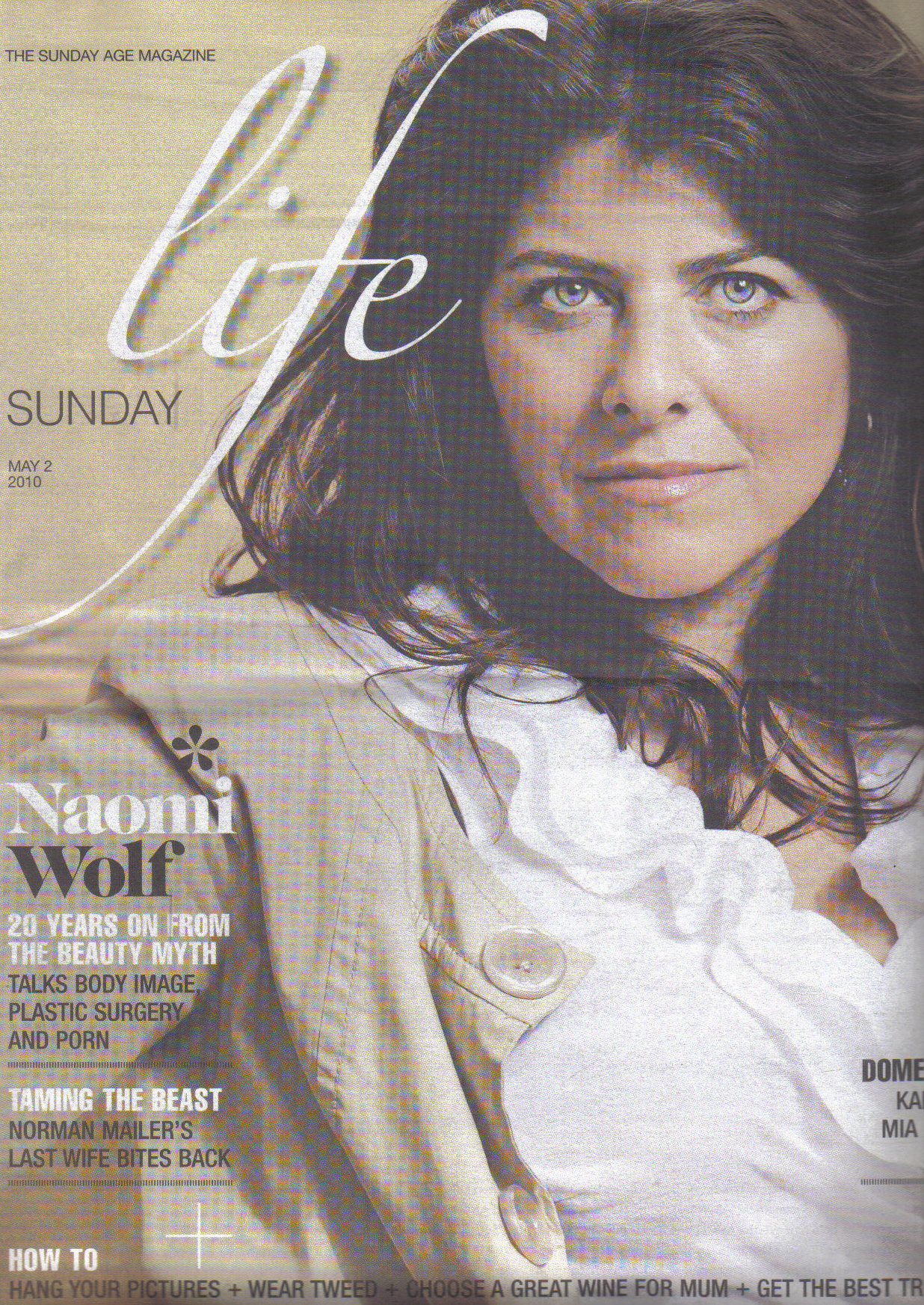
sunday-life-naomi-wolf

Following on from Tuesday’s earth-moving post about beautiful women and heart health, last night I went to see prolific feminist author Naomi Wolf speak on her book, The Beauty Myth, and how images of beauty in the media are used against women at the Wheeler Centre for Books, Writing & Ideas in Melbourne.

The common perception about “feminists” is that they’re allto borrow a quote from Bring It On“big, dikey losers” who burn their bras and don’t shave under their arms. But at the risk of sounding cliché, I don’t believe you can be female and not be a feminist.

There was an overwhelming amount of people packed into the Capitol Theatre, off Swanston Street, and the majority were your average woman on the street, most coming from work or uni, with the odd flanny-wearing, mullet-rocking stereotype. And a few men, too, one of whom posed the question as to whether women’s magazines facilitate the media’s ideal of what a woman should look like. (More on that later.)

I also don’t like the notion, and nor does Wolf, that to be a “feminist”, or to even be interested in the topic without adopting the extremist views that some “second-wave feminists” espouseCatharine MacKinnon, I’m talking to youis to be a Germaine Greer tome-thumping man-hater. She touched on this when she mentioned that whenever there’s a move forward for women (ie. the right to vote, the availability of the birth control pill meaning women could have “sex without the punishment of pregnancy”, Jennifer Hawkins posing nude and unairbrushed on the cover of Marie Claire), there is the inevitable backlash.

It was interesting to note the fact that that the three most important pieces of literature on feminismThe Second Sex by Simone de Beauvoir, Greer’s The Female Eunuch, and The Beauty Mytheach have twenty-one years between their publication dates, a “coming of age” of sorts in understanding the “lexicon of feminism”, the MC said.

Another point of interest was the beauty and vivacity of the author herself, not to mention her fab shoes!

Wolf said she loved Australia because we’re so candid and unselfconscious in our responses to the issues she raises, and that nowhere else do “visiting feminists get treated like rock stars.”

Speaking of rock stars, an certain icon in history has been not only a rock star, but a gymnast, teacher, astronaut and mother, amongst many other occupations. This icon is Barbie, and she was a hot topic on the night.

Barbie represents the “universal ideal” of “transcendental beauty”, in the Western world in particular and, according to Wolf, she is a valuable media tool in the cosmetics, dieting and plastic surgery industries.

Wolf asked why we never see women who are not under 40, thin, tanned, blonde, blue-eyed and Caucasian (ie. Barbie) in the media (which I personally disagree with; Penelope Cruz, Salma Hayek, Ellen DeGeneres, Christina Hendricks, Kim Kardashian, Meryl Streep, Oprah Winfrey and the Grey’s Anatomy women are a few examples that counter this theory). Here is the one word answer: advertisers. They are the reason the Barbie-stereotype is on the cover of magazines every month.

Sure, magazines get most of their revenue from the advertisers, and if they think their brand ideal will be jeopardised by running an ad in Glamour magazine, which has been running a lot of plus-sized photo shoots recently and garnering a lot of attention for it, for example, they will not give their ad money to that magazine. So therefore, Glamour has a lower budget to promote itself to readers every month. Then its loyal readers receive less of the content they keep coming back for, ie. women who look like them, and will stop buying that magazine.

On the other hand, as Mia Freedman talks about in her memoir, Mama Mia: A Memoir of Mistakes, Magazines & Motherhood, and editor of Shop Til You Drop magazine Justine Cullen writes in this month’s issue, women don’t buy the Ellens, Meryls and Kims, they buy the Jennifers and Kates. So, Wolf said last night, “it’s something you’re doing” as media consumers.

So it’s a double-edged sword. We complain that we want to see more “real women” in magazines, however we’re not willing to shell out for them, therefore sales go down, advertisers move elsewhere, and “we don’t know what we’re missing” because “women doing interesting things are omitted” from the mainstream media, and instead we get another story on Jennifer Aniston’s desperation over Brad and Angelina’s marriage, or some crap. I think Wolf is right in saying that we need to consciously refuse to buy into those kinds of stories and look towards other instances of women in the media.

However, I don’t agreeand this seems to be the consensus, especially amongst those who don’t actually consume women’s magazines on a regular basiswith the belief that all women’s magazines try to sell us are diets, $350 beauty products that don’t actually work, and low self-esteem. To people with this view, I say, try picking up a copy of Cosmopolitan, Frankie or Girlfriend magazines. These are all publications that are geared towards different demographics of femalessexually active and assertive women in their late teens to mid-to-late twenties; alternative, crafty women, most likely studying design or politics; and the teenage set, respectivelythat DO NOT run diets, do recommend fashion and beauty products at the affordable end of the spectrum, and present women of all shapes and sizes in a positive light. Not all women’s magazines are at the crux of this “beauty myth”.

Another major point in Wolf’s theory is the abundance of pornography in today’s society, which she also talks a lot about in this past weekend’s Sunday Life supplement in Melbourne’s The Age and The Sydney Morning Herald. She argues that this lowers the sexual confidence of both men and women, but young women, in particular, feel they have to offer an array of sexual activities they’re not necessarily comfortable with in order to “feel competitive in the sexual marketplace”. Because men, in particular, have such “strong, Pavlovian responses” to porn, excessive consumption can lead to desensitisation to the real thing, which is why there is such a surge in impotence in young men.

Where once it were supermodels who determined the sexual ideal of women, it is now female porn stars, with their svelte, childlike torsos, fake breasts and meticulously trimmed pubic region, society uses as the benchmark. Bodies that share similarities with who else?! Barbie.

One could argue that Brazilian and XXX waxing is a way for the male-geared porn industry to beat women into submission, so that they become childlike and are able to be dominated. Another intriguing point Wolf puts forward can be traced back to the dieting industry, in that striving to look the way of the porn star, with a super-slim body and low body mass index actually diminishes the libido. Is this really what society wants whilst pushing such a sexual culture? Or is it in tune with the subservient nature of females in porn?

Wolf also addressed the perception that women with eating disorders and negative body image are “crazy”. As an anorexic in her teens, Wolf debunked this, saying that “physiologically, low calorie count causes mental impairment,” and is a “form of control” by the dieting industry, the media, and society to control and suppress women’s ambitions. Because when you’re thinking about food and exercising and the way you look, you’re not thinking about education and work and your future.

She added that a way to counteract this is to form “active critical thought” about images of beauty, which apparently 33% of women do. Another 18% become obsessed by these images, which in turn leads to eating disorders and body dysmorphia. The rest of us hover somewhere in between.

During question time, one audience member asked why shewho comes from an educated, loving and supportive background; is surrounded by encouraging and non-judgemental friends and family; who does form critical opinions about the media’s portrayal of womenfeels ugly, fat, not good enough and constantly compares herself to other women, in the media or no, and how “active critical thought” can really alter this.

I thought this was a very brave and fascinating question put to Wolf, however her response was more disheartening. In a nutshell, she basically said that at the end of the day, if being open to different images of beauty, both from the mainstream and non-mainstream media worlds, and being able to confidently and objectively realise that not everyone looks like that and that is not the real-life ideal, still makes you feel like crap, there may be some underlying issues that only a therapist can fix.

Which poses another question: how far have we really come? From the 1920s “flapper body style” that emerged when women first won the vote and somehow felt they had to look more masculine to adapt to this, to an auditorium full of beautiful, successful, smart and “critically thinking” independent women in 2010, does this notion of the “beauty myth” really exist? Is there a beauty myth that we have to expose?

Books: All Eyes on Marilyn.

Following on from yesterday’s Marilyn Monroe anecdote, news broke last week that Farrar, Straus and Giroux publishing house will be releasing Monroe’s writings in the northern autumn, called Fragments.

Turns out Monroe wasn’t just tragically beautiful and beautifully tragic, but also a pretty smart cookie, according to editor Courtney Hodell. “She was a great reader and someone with real writing flair.”

Perhaps being married to playwright Arthur Miller rubbed off on her. Although, I think Monroe had to have had her head screwed on straight to orchestrate a career that has endured the sands of time, making her one of pop culture’s most relevant icons.

Many people can relate to being trapped in your own skin and never being seen as good enough by the people around you. Lindsay Lohan, please stand up. (Not ironically, Lindsay has posed numerous times as her idol, and has the Monroe quote “Everyone’s a star and deserves the right to twinkle” tattooed on her wrist.) Just how much Monroe felt “trapped in her famous body”, is partly revealed in The Genius & the Goddess: Arthur Miller & Marilyn Monroe by Jeffrey Meyer, which houses an appendix detailing the illnesses and operations of Monroe. She had thirteen abortions, eight alleged suicide attempts and hated her body. Everyone around her wanted to “take pieces of her, like she was less than a person”, until the day she died. After death, it is much the same.

Even if we see her as a beautiful woman who lead a tragic life at the very least, I think Fragments will prove that she was so much more than that.

Elsewhere: [Los Angeles Times] Marilyn Monroe, In Her Own Words.

[Book Slut] Genius, Goddess: Reading Theatre.

Beautiful Women Cause Earthquakes AND Heart Attacks, Apparently.

I’ve heard of the odd Eva Herzigova Wonderbra billboard-related car crash, but earthquakes? Seriously?!

Last night I was reading the current issue of Grazia, which publishes a quote from an Iranian cleric, who claims that “women who do not dress modestly lead young men astray, corrupt their chastity and spread adultery in society, which”get this!“(consequently) increases earthquakes” (p. 74)! If that’s not a Sheikh al-Hilaly uncovered meat-esque comment, I don’t know what is!

For my money, there is not always a direct correlation between being beautiful and dressing provocatively. Audrey Hepburn is considered one of Hollywood’s most classically beautiful stars, yet she favoured classy, covered up clothing. Paris Hilton, on the other hand, is often scantily clad, however a lot of people don’t think of her as beautiful. At the other end of the spectrum, you have Marilyn Monroe, who was both sexy and physically stunningif anyone could prove this theory correct, it would be Marilyn!

Then this morning, I was reading a study by a Spanish university, which asserts that courting a beautiful woman is “equivalent to jumping from a plane” stress-wise! Not only does the study show “trying to woo a beautiful woman could be bad for a man’s heart and even increase the risk of heart attacks and strokes,” but actually getting the girl proves to be even worse! The study goes on to claim that the stress of being in a long-term relationship with said stunner “could cause ‘chronic’ levels of cortisol, leading to impotence”.

Where is all this hating on the females coming from? If a woman is not perceived as conventionally beautiful, or pretty at the very least, by society, she is chastised. If she does happen to satisfy social norms in terms of the way she looks, she apparently causes natural disasters and ill heart health.

It seems like the ladies just can’t win!

Stay tuned later this week for more beauty debate, as I will be reporting on The Beauty Myth author Naomi Wolf’s talk in Melbourne on Thursday night. Get your tickets here.

The Plastic Backlash.

famous plastic surgery

This week’s Famous runs a promising story on the decline of plastic surgery in Hollywood or, at least, the fact that “casting directors and producers are increasingly refusing to hire actresses who display signs of obvious surgery”.

The article on page 6, making it one of the magazines top stories this week, offers a pictorial display of the stars who may be facing unemployment due to the new movement, including Heidi Montag, Audrina Patridge, Ashlee Simpson and Megan Fox, along with the contention that casting directors are moving towards “Oz and the UK” because we have “more natural-looking actresses”, such as Teresa Palmer, Isabel Lucas and Rachel Taylor.

It’s a welcome and comforting change to read this kind of article, hot on the heels of Pirates of the Caribbean producers sending out a casting call with the express condition that actresses with “natural breasts only” need apply.

However, the article signs off with a quote from Pirates casting agent Sande Alessi:

“I don’t really mind if these stars do a tiny bit of something, but it just can’t be obvious”.

Maybe we still have a ways to go?

On a side note, the very next page features a spread on the numerous (alleged) surgeries of the Kardashian family. Last week’s cover girl and guest editor is this week’s before-and-after exemplar.