Book Review: Animal Farm by George Orwell


There has been a lot of talk of Animal Farm on the internet lately, so I thought, what better time to post a review of the 1945 George Orwell classic than now?

For those of you not familiar with the story of Animal Farm, here is a quick low-down (spoiler-alert):

After an uprising from the animals of Manor Farm, it is renamed Animal Farm as it’s “four legged” residents run its human owners out, representing the events prior to World War II in Stalin-led Russia.

During this revolt, Old Major (who is said to channel Karl Marx or perhaps Vladimir Leninalthough Christopher Hitchens notes that “there is a Stalin pig and a Trotsky pig, but no Lenin pig… Nobody appears to have pointed this out at the time [sic] and if I may say so, nobody but myself has done so since; it took me years to notice what was staring me in the face”) the farm’s boar leader, comes up with the Seven Commandments of Animalism (mirroring Communism), which young pigs Snowball and Napoleon put into practice after Old Major’s death. These Commandments are:

  • Whatever goes upon two legs is an enemy.
  • Whatever goes upon four legs, or has wings, is a friend.
  • No animal shall wear clothes.
  • No animal shall sleep in a bed.
  • No animal shall drink alcohol.
  • No animal shall kill any other animal.
  • All animals are equal.

At first the residents of Animal Farm are happy and embrace the Seven Commandments, but turmoil quickly ensues. Snowball and Napoleon (meant to represent Leon Trotsky and Joseph Stalin, respectively) become drunk with power, challenging the other residents of the farm and each other.

Snowball suggests building a windmill, but Napoleon opposes it and has Snowball run out of the Farm. Napoleon takes over leadership, and he and his army of pigs, including right-hand man Squealer, declare that Snowball stole the idea for the windmill from Napoleon, and that they will go ahead with the erection of it.

After a violent storm, the windmill is found destroyed and Napoleon accuses Snowball of sneaking in and demolishing it. Anyone believed to be consorting with Snowball is killed off, and Napoleon brainwashes the poor residents into believing that Animal Farm is better than the human-run Manor Farm. Meanwhile, the pigs adopt human characteristics and begin to walk upright.

As the novella comes to a close, the Seven Commandments have been changed to accommodate Napoleon and his pigs; “no animal shall sleep in a bed” becomes “no animal shall sleep in a bed with sheets”, and “but some animals are more equal than others” is added to the final commandment. After the sacrifice of many of the Farm’s residents, the final scene describes a dinner party held by Napoleon for the residents of the area, both human and porcine, between which the other animals cannot tell the difference.

That’s the premise of Animal Farm crammed into as small a nutshell as I could find!

I loved that the book was simply written, yet the themes and messages were still easily deciphered. I highly recommend acquiring the book, as most editions come with several Orwell-written Appendices which highlight the political undertones of the story.

I also recently watched the 1999 film version, starring Kelsey Grammar as the voice of Snowball and Julia Louis-Dreyfus voicing horse Mollie. While Andrew O’Hagan writes that “art involving talking animals is often deeply political”, I chose to bypass the 1954 animation as the newer adaptation was more readily available for hire and more closely resembles the book.

One major difference, though, is that the role of border collie Jessie is heightened in the movie, and she plays narrator and the maternal voice of reason. Snaps to the dog’s trainer, as Jessie is very lovableas all dogs areand believable. It’s those puppy dog eyes, I tell ya.

Speaking of animal authenticity, the pigs chosen to play Napoleon and Squealer were appropriately repugnant, whereas Snowball’s onscreen incarnation garnered much more sympathy from me than he did in print.

The film version moved along much quicker, and I thought the use of propaganda films starring Napoleon and Squealer to address the animals of the farm was very smart. These films showed the pubic hangings of rats and hens, à la Stalin, and amendments to the commandments.

All in all, the movie was likeable, and served as a motion picture compliment to better illustrate the ideas and goings on in the book.

But book over movie every time, baby!

Elsewhere: [The Guardian] Andrew O’Hagan on Fiction’s Talking Animals.
Taking a Leaf Out of Amazon’s Book: GOOD Customer Reviews

After last week’s soul crushing compilation of the worst Amazon reviews on my favourite books, I feel it’s time for a more uplifting account of each book, from some not-so-biased sources.

So here, primarily to build up my wounded book-reviewing pride, are the best reviews of my favourite books.

To Kill a Mockingbird by Harper Lee.

The majority of reviews on this classic were positive, so it’s just a matter of picking the best. Put simply, by Mrliteral, To Kill a Mockingbird is “a true classic”. But Bett Norris articulates her feelings beautifully: “I have always liked books better than people. Some books are better friends than many people I know… To Kill a Mockingbird will remain a treasured, dear old friend.”

The Catcher in the Rye by J.D. Salinger.

1,703 people gave this book top marks, including A Customer, who calls it “a brilliant coming-of-age novel.”

James Tyler says he “can remember enjoying this book the first time I read it. But I had no idea that with each subsequent reading I would find more and more to enjoy…”

Finally, B. Michini says Catcher is “a timeless, honest, controversial, superbly written tale” because protagonist Holden Caulfield “made me feel like there were others in this predicament that we call adolescence.”

Valley of the Dolls by Jacqueline Susann.

It seems most reviewers enjoyed this book, too, if only for it’s so-bad-it’s-good qualities. Childof80s—naturally—says it’s “more addictive than the pills its heroines take. Sure, it’s trashy, but trash is by far the most entertaining form of literature.” Thankyou for proving my point.

DevJohn01 goes as far as to say that “this cult classic is just what the doctor ordered,” while Timothy R. Wilkins says it’s “a classic and necessary primer for all lovers of pure camp!”

The Historian by Elizabeth Kostova.

Feelings about this vampire tale were split fairly evenly across the board. Nancy B. Miller summarises it nicely, saying “Kostova has crafted a slow-building story that blends scholarship and the supernatural in a unique and fascinating way.”

When this book was released in 2006, it was compared to The Da Vinci Code, as so many works with an historical mystery plotline are. I probably enjoyed The Da Vinci Code more than The Historian, but just by a hair. 340bookfan is having none of this, calling The Historian “a real writer’s answer to The Da Vinci Code.” I will agree that The Historian is written in a more complex manner, and the author spent ten years bringing the pieces of Dracula’s puzzle together, so Kostova’s practically an historian herself!

Tietam Brown by Mick Foley.

Much like The Catcher in the Rye, Tietam Brown is a coming-of-age tale that deals with controversial subject matter. R. A. Ward has “a hard time quantifying it for this review,” and I had a similar reaction to it, too.

Big-noter Aaron J. Palmer, with a multitude of MAs, and BAs and PhDs, who has “read a lot of [novels]” calls Tietam Brown “without a doubt, one of the best novels I’ve ever read.” Finally, Charles E. Henry commends Foley for “some great character development” and the way the book “manages to be funny, disturbing, sad and hopeful all at the same time.”

I will agree that its appeal is very hard to put into words, but I think it is a novel that almost anyone would enjoy.

Watership Down by Richard Adams.

Richard Adams’ tale of talking bunnies gets an “A+ rating” from B. Merritt, who thanks the publishers for taking a chance on a novel that “really wasn’t a children’s tale, nor adult literature”, because “if they hadn’t, we surely would have been denied a true literary classic.

A common theme here is Watership Down’s nostalgic presence in the reviewers’ lives. David Huber and Lawrance M. Bernabo both recall coming of an intense J.R.R. Tolkien ride, thinking nothing they would ever read could live up to the standard set by Lord of the Rings. They both admit how wrong they were, with Huber marvelling at “how one person can actually produce such lovable characters… that actually make [sic] you feel various emotions for each of them.” Now I want to revisit this classic (bunny) tale!

I’ll add you to my list, Watership

A Lion’s Tale by Chris Jericho.

If I can refer back to last week’s post regarding this title, it is not hard to find positive reviews on this one. Ranging from being “the best wrestling book I’ve ever read” (C. Sawin) to a “book wrestling fans can honestly recommend to non-wrestling fans about wrestling” (S. Albert) to, plain and simple, “the best wrestling [auto]biography ever!” (Pwa Y. Soo), I pretty much agree with all of them.

Another City, Not My Own by Dominick Dunne.

This is my Achilles heel; it just so happens that my favourite book ever is universally panned by critics—which is not uncommon for a Dominick Dunne book—and the general public alike!

But there are a few good ones, which is not as disheartening as going through all the negative ones! Cecilia Sheppard shares my sentiments in saying she “devour[s] this man’s books like fine chocolates.”

A Customer pinpoints the strange feeling I had after completing this “novel in the form of a memoir”, calling it “unnerving”, while jtj3 says he “was an O.J. trial junkie”, just as I became after reading this book. He “literally could not put the book down” and believes it is “Dunne’s fictionalised autobiography”, as so much of his career centred around O.J. Simpson.

Related: Taking a Leaf Out of Amazon’s Book: Bad Customer Reviews.

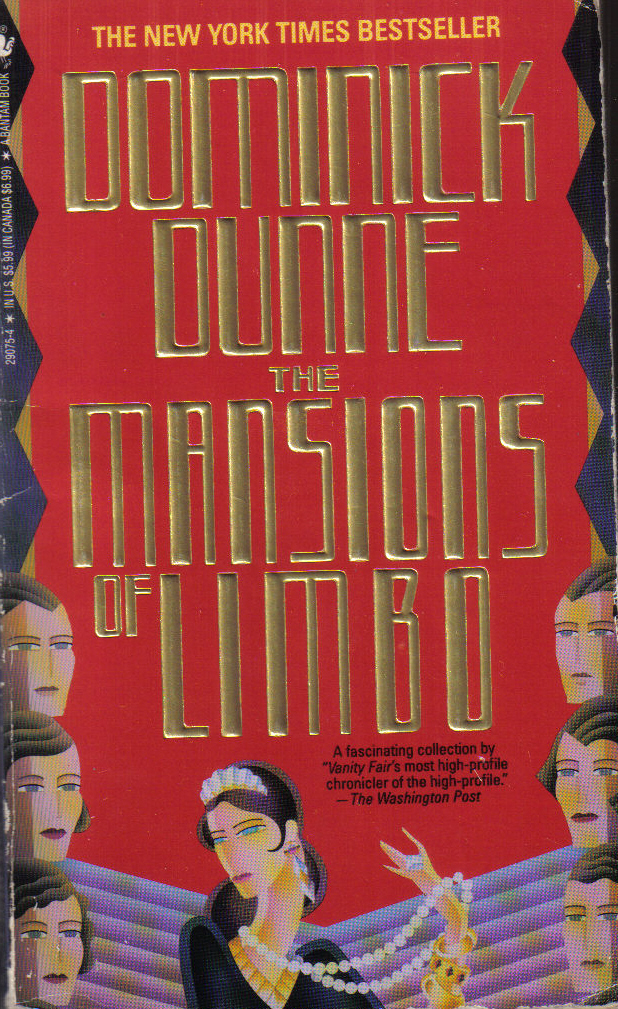
Book Review: The Mansions of Limbo by Dominick Dunne


The author states in the introduction that the phrase “the mansions of limbo” came to him “years ago, reading a book whose title I no longer remember.”

If you are familiar with Dominick Dunne (if you’re familiar with this blog, you’re familiar with Dunne; he is my favourite author and I will jump at any chance to drop his name. Funnily enough, the subtitle of his memoir is Recollections of a Well-Known Name Dropper), you will know that he profiled the lifestyles of the rich and famous for twenty five years in Vanity Fair. But more interestingly, he focussed on the justice, or rather injustice, system in relation to celebrities, such as the Menendez brothers, O.J. Simpson and the murder of his daughter, Poltergeist star Dominique Dunne, in 1982.

His award-winning account of the murder of Jose and Kitty Menendez by their sons, Lyle and Erik Menendez, “Nightmare on Elm Drive” opens the tome, while Dunne’s majestic profile of Queen Noor al Hussein of Jordan wraps it up. In all honesty, as blasphemous as it is to say, those are probably the only two articles worth reading in this out-of-print collection. There is also a humorous write-up on the Collins sisters, Joan and Jackie, but the majority were written before I was born or in my early years of life, about subjects who have gone down in little-known infamy.

However, I do recommend Dunne’s work to anyone who will listen.

I first became familiar with him after reading the O.J. Simpson confessional If I Did It, which is well worth your money/library card. I then stumbled across his fictional account of the double murder, Another City, Not My Own which I can confidently say changed my life and immediately became my favourite book. (I will be posting a review here in the not-too-distant future; but don’t let last week’s negative Amazon reviews turn you off!)

Elsewhere: [Marie Claire] Dominick Dunne: Hollywood’s Diarist.

[Vanity Fair] Nightmare on Elm Drive.

Taking a Leaf Out of Amazon’s Book: Bad Customer Reviews

Jeanette Demain recently wrote for Salon.com an article on “amateur critics” bemoaning the plotlines of her favourite books, most of them canonical.

At the end of her Amazon search-related compilation of readers’ negative comments on classics from “The Grapes of Wrath to 1984”, she urges readers to peruse Amazon’s customer reviews of their favourite books.

So, I thought I might take a stab at this, and compiled my very own list of attacks on the books that “changed my life forever”.

To Kill a Mockingbird by Harper Lee.

One of the finest pieces of modern American literature, I was hard pressed to find bad reviews on this one. The harshest was from three-star-rater Jane A. Marshall, who said To Kill a Mockingbird was “a good book but not as good as the movie. The exact ending as to how the attacker was killed left too much doubt as to who actually was the killer—I don’t think this was a good way to end the book.” Mmm, good, good, good. And more good.

Seriously, though, for my money Harper Lee crafted one of the best endings of all time. So much so that I defaced my copy by highlighting the passage for easy retrieval when I want to marvel at the beauty and power a good writer can wield.

The Catcher in the Rye by J.D. Salinger.

One Amazon discussion thread was titled “Catcher in the Rye should be banned”, and continued with “not because it’s obscene or perverse”—ever read Bret Easton Ellis, my friend?—“but…because it’s a lousy book.” Eloquently put.

The general consensus in response to that thread was a) who are you to judge whether a book should be banned based on it’s lousy-ness, and b) we are not in favour of censorship. My sentiments exactly.

Valley of the Dolls by Jacqueline Susann.

While I will agree that this book is somewhat fluffy compared to the others on this list, I wouldn’t say that it was “a huge disappointment,” according to A Customer. They go on to say that, “I have loved the movie version of Valley of the Dolls for a long time. Admittedly, it is a BAD movie, but its camp sensibility and generally over-the-top style make it a classic of the ‘bad movie’ genre.”

Put a different way, Wayne M. Malin calls it a “silly soap opera that follows three women… [through] death, suicide, lesbianism, cancer, marriages, tons of drug abuse, institutionalisation, etc…” Yes, but isn’t that the appeal of the thing?!

I will agree on one of the most common allegations, that protagonist Anne Welles “ is perhaps the dullest character ever created,” said QueensGirl.

The Historian by Elizabeth Kostova.

The author of this book, whose “plot unfolds through three points of view—a 16-year-old girl in search of her father who disappeared into vampire land in 1972 and reveals himself through letters to her, the father who was searching sixteen years earlier for his abducted thesis advisor who secondarily reveals himself through a trail of letters, and the thesis advisor who was searching for Dracula through historical research,” has apparently “committed an act of such brutality that it rivals any atrocity that Vlad Tepes [aka Dracula] ever committed,” reviewer Carlos asserts. (Thanks for the plot summation, William J. Meggs!)

Meggs goes on to say that “if you would enjoy the tedium of being an historian digging through old libraries, you might enjoy the tedium of reading this book.” I would, and I did, thankyou very much!

Tietam Brown by Mick Foley.

It was difficult to find a bad review for this novel, “because only wrestling fans read it.” Which is probably 90% true, but even non-wrestling fan reviewers found it a struggle to comment negatively on it.

But lo and behold, I found the diamond in the rough in A Customer’s (again—take credit for your opinions, people!) response: “The dialogue is painfully bad, I’d rather be stuck in the ring with Mick for ten minutes than be subjected to reading another ten minutes of this book.” With Foley’s trademark barbed wire-encased baseball bat and thumbtacks? That is a fate worse than death.

Harsh.

Watership Down by Richard Adams.

Mostly light-hearted fun-poking to be found in the Customer Reviews section for this book. Caraculiambro says, “I suppose my threshold for silliness for books with talking animals (particularly bunnies) is The Wind in the Willows. Anything more sophisticated than that is preposterous, I think… on the whole, it’s hard to take it seriously unless you’re a pre-teen girl. But if you are, good luck with the language.” Touché.

Much in the same vein, Lucy the Bargain Hunter says, “this book is really boring, but since there was no bad language or sex, I didn’t have any excuse for not trying to get through it.” She then goes on to ask, as I have many a time after ploughing through a Jane Austen or Stephenie Meyer, “everyone else loves this book. Maybe there is something wrong with me[?].” To borrow a phrase from the late Brittany Murphey’s Tai in Clueless, “everyone’s entitled to their own opinion, a’ight?”

A Lion’s Tale by Chris Jericho.

Again, another WWE alumnus’ tome, so it is geared towards a very niche audience with mostly glowing reviews. The most damning assessment comes from Sean M. Hurley, who says the autobiography doesn’t live up to that of Mick Foley’s debut, Have a Nice Day, or even “The Heartbreak Kid” Shawn Michaels’ ghost-written memoir. “My main gripe with the book is that Chris doesn’t get as personal with the reader as one would have enjoyed. Mick really exposes himself and allows himself to be vulnerable, while Chris still seemed to be holding back…” he says. Funny, as I found A Lion’s Tale to be on par, if not better, than Have a Nice Day

Another City, Not My Own by Dominick Dunne.

Dredging through page after page after page of one star reviews hurt, as this is my absolute favourite of all the books on this list.

To dig the knife in even further, A Customer says “I had to rate the book at least one star for the review to be kept. Actually, it’s worth zero.” Show your face, nameless hater!

Next week, the positive reviews! Yay!

Elsewhere: [Salon] Amazon Reviewers Think This Masterpiece Sucks.

Books: All Eyes on Marilyn.

Following on from yesterday’s Marilyn Monroe anecdote, news broke last week that Farrar, Straus and Giroux publishing house will be releasing Monroe’s writings in the northern autumn, called Fragments.

Turns out Monroe wasn’t just tragically beautiful and beautifully tragic, but also a pretty smart cookie, according to editor Courtney Hodell. “She was a great reader and someone with real writing flair.”

Perhaps being married to playwright Arthur Miller rubbed off on her. Although, I think Monroe had to have had her head screwed on straight to orchestrate a career that has endured the sands of time, making her one of pop culture’s most relevant icons.

Many people can relate to being trapped in your own skin and never being seen as good enough by the people around you. Lindsay Lohan, please stand up. (Not ironically, Lindsay has posed numerous times as her idol, and has the Monroe quote “Everyone’s a star and deserves the right to twinkle” tattooed on her wrist.) Just how much Monroe felt “trapped in her famous body”, is partly revealed in The Genius & the Goddess: Arthur Miller & Marilyn Monroe by Jeffrey Meyer, which houses an appendix detailing the illnesses and operations of Monroe. She had thirteen abortions, eight alleged suicide attempts and hated her body. Everyone around her wanted to “take pieces of her, like she was less than a person”, until the day she died. After death, it is much the same.

Even if we see her as a beautiful woman who lead a tragic life at the very least, I think Fragments will prove that she was so much more than that.

Elsewhere: [Los Angeles Times] Marilyn Monroe, In Her Own Words.

[Book Slut] Genius, Goddess: Reading Theatre.

Book Review: Dog Boy by Eva Hornung

I’d been wanting to read the award-winning Dog Boy ever since it was published early last year, and I was lucky enough to pick it up half-price at my trusty second-hand bookstore some months later. Only recently did I fish it from the mounting pile of books to read and it was well worth the wait.

The book begins with four-year-old Romochka waking up to an abandoned apartment he shares with his mother and uncle in Moscow. For the next few days he stays in his dilapidated building, following his mother’s orders to “Don’t go near people. Don’t talk to strangers”, until that is no longer an option and he is forced to fend for himself in the outside world.

Romochka soon stumbles across a street dog, and follows her to her lair, christening her Mamochka. There he becomes part of the dog family, consisting initially of Mamochka, Black Dog, Golden Bitch and a litter of puppies who Romochka names White Sister, Black Sister, Grey Brother and Brown Brother. Another litter, the death of Brown Brother and, unbelievably enough, a new “dog boy”, a baby Romochka calls Puppy, fill out the 290 page novel.

Romochka forms a special kinship with White Sister as they spend two blistering winters roaming the streets for food, enduring the abduction and torture by privileged (at least in comparison to Romochka or the “bomzhi” [street kids]) “house boys”, until he and Puppy are captured and taken under the wing of doctor Dmitry and his partner Natalya.

Hornung’s gruesomely described accounts of Romochka’s life with the pack, which made me cringe in anticipation whilst devouring it on public transport, really give the reader a sense of the connection between not just Romochka and his dogs, but man and dog in general.

This is a fantastic book, and I would recommend it to anyone, but especially animal and dog lovers. As my friend Tess, a fellow animal and booklover said: “This is definitely my kind of book… but I’ll have to wait til uni holidays to read it!” In exchange for True Blood DVDs and Dog Boy, she has lent me A Clockwork Orange and George Orwell’s Animal Farm, so stay tuned for upcoming reviews on both of those and their big screen adaptations.