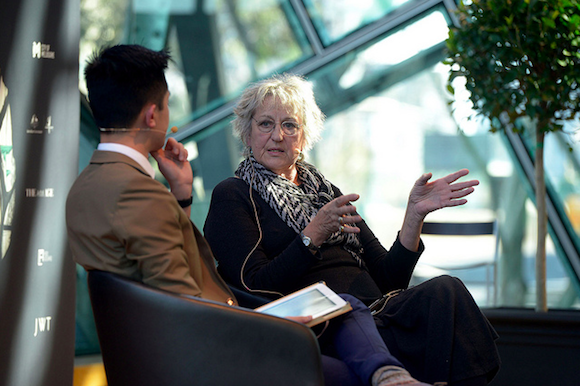
Event: Melbourne Writers Festival — In Conversation with Germaine Greer.

Germaine Greer is an Aussie feminist icon who’s kind of passed me by. After the whole “Julia Gillard has a fat arse” debacle earlier in the year, I officially declared her irrelevant to a friend when the opportunity to buy a book of hers came up.

Nonetheless, I attended her talk at the Melbourne Writers Festival, hosted by Germaine’s new bestie Benjamin Law, whom she met at that infamous episode of Q&A, in the hopes that she would address some of those issues in more depth.

I wasn’t wrong, but instead of Greer herself admitting she was, she dug a deeper hole for herself, both at the session and on 60 Minutes the week prior, where she was interviewed in relation to Samantha Brick’s months-ago comments that women find her threatening because she’s beautiful and she enjoys being a “trophy-wife” to her chauvinistic French husband.

Sometimes I just wish public figures would admit it when they’ve said the wrong thing, instead of trying to justify or cover it up (Todd Akin, I’m looking at you). Where Germaine could have taken the opportunity to own up to speaking out of turn about Julia Gillard’s appearance, a snarky phenomenon that most women—and, indeed, most feminists—succumb to at some stage or another, and use it to start a dialogue about how we treat female politicians based on their looks and not their policies, she just said “women have fat asses” and “a woman is not her jacket”. Greer’s a smart woman, no doubt, but I think she needs to think more before she speaks, as her comments on cosmetic surgery, genital mutilation and the morning after pill on Q&A will attest.

However, Germaine did make some good points about her past, present, our ecological future, and “what turned her into a feminist” (a question I was asked at the work watercooler a few weeks ago when I revealed I write about gender studies and feminism. That co-worker is so misogynistic he now avoids me. One less woman-hater I have to make nice with on a daily basis: score!), citing her work on the 1974 university porn magazine she helped create, Screw. After concluding that the name “screw” was too “sadistic” and implied that a woman was “ruined” after she’d been “screwed”, they changed the name to Suck, which connotes a more female-friendly vibe.

Germaine talked about her willingness to get her gear off for the magazine in an effort to portray women differently in porn magazines. She was offered money to pose for Playboy and she insisted her pose be standing with her body away from the camera, bent over, and looking at the photographer through her legs, her vagina and anus on show. They rejected the image, obviously, which turned up in Suck, an alternate copy of which someone in the audience had brought along!

She also had some interesting things about our definition of consent and SlutWalk to say and, to my surprise, they weren’t out of step with current feminist notions of the two. She championed women who take their rapists to court and show their faces to the public to lend support to the wider anti-slut-shaming movement.

Those who still follow Greer’s work know that she now leans towards writing about Australian culture and the environment as opposed to being the authority on all things feminism (see abovementioned irrelevance), and she concluded with a conversation with an audience member, who probed her in overtime about recognising the similarities between feminism and vegan-/vegetarianism. Indeed, feminism these days is about human rights, and most people I know who are for feminism are for human rights, animal rights and practice vegetarianism. I, myself, am a budding ecotarian.

These days, Germaine Greer is someone to be hated, feared or admired, as Law contended in his introduction of the great Australian thinker. While these women don’t necessarily practice feminist acts or even call themselves feminists, Madonna and Lady Gaga are two iconic females Greer mentioned during her sermon. They’re also two icons who polarise almost as much as Greer. I don’t think she’s that different to them, really… They’re all outspoken, brash females who have undoubtedly contributed so much to the plight of women, and culture as a whole, some more recently than others.

Related: Should Meat Be Off the Menu?

Images via TheVine, Flickr.

Event: Melbourne Writers Festival—Notes on Women in Culture.

The panel was chaired by the director of feminist publishing house, Spinifex Press, Susan Hawthorne, and the speakers were Tamil writer CS Lakshmi, and feminist fiction and non-fiction writers Emily Maguire and Sophie Cunningham.

I saw Cunningham speak at last year’s festival, and some of her comments on third and/or fourth wave feminism really rubbed me the wrong way. This year she spoke again about the discrepancies between the pay rates of men and women and where that money goes. While only $0.40 for every dollar earned of men’s income goes to the family, $0.90 of women’s money goes to the family. Therefore, “women need to work or our culture falls apart.”

Cunningham also spoke about her pet project, women in literature. As the chair of the Literature Board of the Australia Council and of the Stella Prize, she knows her stuff. Apparently when the representation of women in literature hits 30%, people think it’s about half. (I believe she mentioned it’s at about that percentage currently, in terms of how many books by women are reviewed and how many books are reviewed by women in major publications.) This reminds me of the 33%–66% division of labour rule in male–female households: that women will do up to 66% of housework before they start to think they’re doing too much, while men will do 33% before they start to think they’re doing too much.

I think both of the following quotes came from a piece Lakshmi read to the audience. They’re poignant no matter who wrote them and where they appeared:

“Women pretend to conform whilst they’re breaking the rules.”

“Sit still otherwise you’ll rock the boat.”

That last quote reminds me of 50 Shades of Grey, in which Christian makes Anastasia “sit still” and not move when he’s performing sexual acts on her. I don’t know many men who prefer a woman to be physically non-responsive to their touch, but there are a lot of things about the book I don’t understand.

Speaking of 50 Shades (at this point in time, when it’s the highest selling book ever, who isn’t?!), in another panel I attended on Saturday about writing about sex (featuring Susan Johnson, Chris Flynn and another appearance by Maguire) it was brought up. Nothing of note was added to the discussion really (sex and gender roles are conservative, defined; the sex is clinical, etc.), but Johnson did, it’s worth noting, spoil the ending for me! Not that I was planning on reading the next two installments (one’s enough!), but there were a few audible groans from the audience when she revealed that *spoiler alert* Christian married Anastasia in the end.

Johnson has a piece on the trend of the trilogy in this weekend’s Q Weekend magazine, for which she is the senior features writer. She mentioned how she finds the book like a sexed up version of Beauty & the Beast, which made my heart yearn for a simpler time, when feminism and Stockholm syndrome and abusive relationships were not at the forefront of my mind when examining my favourite Disney movie. Sigh… I’ll never be able to enjoy it like I once did thinking about the Beast forcing Belle to eat and suspending her from the ceiling of his Red Room of Pain if she doesn’t do as she’s told!

But back to the panel at hand.

The notion of positive female representation in science fiction and fantasy came up, an issue about which I’m quite passionate, but which I’d like to know more about, too. Maguire says it’s easier to write a “strong female character” in sci-fi because you “don’t have to have the rules of this world” posed onto the character. I think it was Cunningham who then mentioned that that’s why a lot of sci-fi is set in post-apocalyptic worlds where the restraints of our current notions of society and culture are abolished so writers can explore different aspects of the characters that they might not have should they exist in this world.

Author John Banville was brought up, who has said he’s “never understood women… Don’t want to… I’m in love with all of them, always have been fascinated by them… They always do the unexpected—at least I don’t expect what they do. They say: ‘We’re ordinary, we’re just like you.’ I say: ‘You’re not. You’re magical creatures.’”

While that’s a lovely gesture on the surface, do we really want to be seen as otherworldly? At the end of the day, everyone’s just a person. And, at the end of the panel, Lakshmi told a story with the theme that gender has “no specific qualities”. So how can one be “ordinary” and one be “magical”? Reverse sexism on Banville’s part, perhaps?!

Related: Melbourne Writers Festival 2011: A Long, Long Way to Go—Why We Still Need Feminism.

Bendigo Writers Festival.

Sexism in Fantasy.

Image via TheVine.

In Defence of Lara Bingle.

Not since Nicole Kidman and Delta Goodrem have we seen an Aussie woman polarise the population like Lara Bingle.

Traditionally, we don’t respond well to reality television and its stars who get too big for their britches: remember the Heidi Montag–10 plastic surgeries in one day hullabaloo? Or the whole Kardashian family, especially after Kim’s 72-day marriage and subsequent divorce proceedings. While there are some reality stars who’ve come out on top of the collective consciousness (Nicole Richie, the MasterChef contestants, and mostly those who participate in shows based on talent and skill and from which a winner is chosen based on these things), most are destined for a life of C-list celebrity and/or the descent of their career. Being Lara Bingle so far would indicate the latter.

Almost one million tuned in to the premiere episode, in which the nude-pics-on-the-balcony violation was dealt with, but since then, the show has failed to return to these numbers, with last night’s final coming in last place amongst the three big networks. My party line when it came to watching the show was that “it’s for research”, but despite the inanity that was Being Lara Bingle, I actually like—and have some sympathy for—the show’s namesake for this reason: what has Bingle done to incite such hatred?

On a train ride home on a Tuesday night which meant I’d miss the show (that’s what the Ten video player is for), I raised this issue with friends. One shriveled his face in disgust while the other proclaimed that she didn’t like the way Bingle dragged Michael Clarke’s name through the mud. Upon further inspection, I couldn’t find any evidence to support this assertion; in fact, everything I’ve read and seen on the show indicates that Bingle and Clarke split amicably, and Bingle still speaks of him fondly.

So what did my friend mean by saying that Bingle tarnished Clarke’s image? I dare say what everyone else means when they talk smack about Bingle: that she’s “not good enough” for Clarke. That she’s an untalented famewhore who trades on her looks for money. How this is any different from the career of someone like Gisele Bündchen or Heidi Klum, who also has several of her own reality shows, I don’t know.

What I do know, however, is that the bullying of Bingle is about misogyny. We don’t like her because she’s a young, attractive woman who uses her looks and body to get ahead and is unapologetic about it. What troubles me is that we dedicate countless column inches, a trend which I’m no doubt contributing to with this article, to berating or defending Bingle, whilst male celebs like Ashton Kutcher, his Two & a Half Men predecessor Charlie Sheen, and Bingle’s former lover Brendan Fevola, get away with murder… or what could be seen as attempted murder, in the multiple intimate partner assault allegations against Sheen. (Just look at the Kristen Stewart-cheating scandal. Sure, she’s just as much to blame as her married-with-children car-sex buddy, but we seem to be heaping the shame onto only her.)

Maybe it’s because before all the sex, drugs and debauchery surrounding Sheen, he was once a good actor. Maybe it’s despite—or perhaps because of—Kutcher’s cheating, he’s a very successful businessman as well as actor. Maybe, according to Roger Franklin writing in Good Weekend, Fevola is just a “lovable larrikin” gone down the wrong path. But how are histories riddle with drugs, violence, infidelity, gambling problems, abuses of power and lewd behavior, amongst other things, spread across these three men better—or at least more acceptable—than Bingle’s relatively mundane existence?

Like Kim Kardashian, who rose to notoriety via a sex scandal and not much else, Bingle is apparently trading on her status as a “celebrity” or “personality” as opposed to hard work and talent. The quintessential tall poppy, you might say.

Funnily enough, for those who tuned out after the first few episodes and those who never tuned in at all, they missed out on seeing the “real” Lara Bingle—as the reality effort was so often touted as attempting to show—as the series drew to a close. As friend and fashion designer Peter Morrissey told Bingle last night, “you need to show people the real you,” not the perception of Lara the media presents that they initially expect to meet.

Obviously, no reality show is ever going to project a true image of someone. I dare say we can never truly project a true image of ourselves to even our nearest and dearest, as no one really knows us better and can understand our idiosyncrasies and contradictions better than ourselves. But Lara Bingle isn’t exactly the worst—or most un-real—person to grace our television screens. She may be pretty boring in that girl-next-door way, but at least hasn’t hurt anyone, which is more than I can say for some others.

Related: Shaming Lara Bingle. 

Why Are Famous Men Forgiven for Their Wrongdoings, While Women Are Vilified for Much Less? 

Guilty Until Proven Innocent: Charlie Sheen’s Witness. 

Was Kristen Stewart’s Public Apology Really Necessary? 

Lara Bingle in Who: A Prized Tall Poppy Who Polarises.

Elsewhere: [MamaMia] Why Does Nicole Kidman Inspire Such Vitriol? Seriously, Why? 

[MamaMia] Enough With the Delta Hate. Be Better Than That. 

[TheVine] No One Watched the Finale of Being Lara Bingle.

[TheVine] All Dogs go to Seven. 

Image via PedestrianTV.

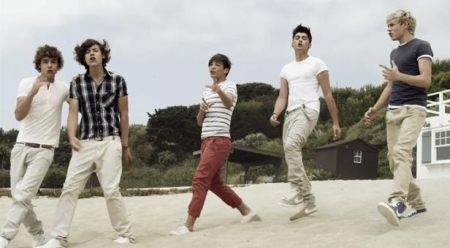
One Direction: Thanks for Telling Me What Makes Me Beautiful, ’Cause I Just Wasn’t Sure.

“What Makes You Beautiful” is probably one of the catchier songs of the year, but for one that’s geared almost primarily to tweens and teens, it sends a troubling message.

Sure, “What Makes You Beautiful” is all about self-acceptance and loving the way you look despite not being a supermodel on the outside, but it’s pure men-policing-women’s-bodies on the inside.

I like to light up someone’s world like nobody else, but I like to do it because I know I’m awesome, not because you think me staring at the ground means I don’t know I’m beautiful and you must inform me immediately. I’m probably looking at the ground because assholes like you insist on making comments about just how beautiful or non-beautiful you find me.

What happened to the notion that men find confident women sexy? And yes, One Direction are far from being men and their audience is teens and tweens, not confident, sexy women (although this would attest otherwise), so they’re playing into their insecure girls in need of a saviour fanbase well.

Modesty is all well and good, but remember that saying, “no one will love you til you love yourself”? One Direction fans need not apply.

Call me crazy, but I would imagine people who don’t find themselves attractive and don’t want to draw attention to themselves won’t flip their hair, certainly not to get you overwhelmed. But the nature of the self-entitled “nice guy” who needs to let you know you’re beautiful despite yourself is that they think women are there for them to consume, regardless of whether they want to be.

No one likes an insecure droll in need of validation regardless of their gender, but the fact that One Direction (okay, they’re robots; the music masterminds behind One Direction) needs to tell you you’re beautiful without any regard for what you think and feel about this and, furthermore, that a song all about what men think of women has permeated so far into the zeitgeist that everyone thinks it’s about empowerment and the beauty of all women is telling: apparently, women still need the patriarchy to tell them what their worth is. And guess what? It’s based on how you look.

Elsewhere: [Jezebel] Ultimate “Nice Guy” Suspended from School for Giving Letter on Inner Beauty to Female Classmates.

[MamaMia] Confessions of an Immature Adult.

Image via Feed Limmy.

TV: Shaming Lara Bingle.


Lara Bingle: she can’t catch a break, can she?

She was called a whore for her affair with Brendan Fevola, fat when she put on weight after her breakup with Michael Clarke, and an attention-seeking diva when it was revealed channel Ten would air her reality show, Being Lara Bingle, which premiered last night.

I actually like Lara Bingle and thought her show would be an opportunity for her to commentate on how she’s been treated by the media for being an attractive young woman who happens to trade on her looks as her job. TheVine wrote this in anticipation for what the show could be:

“After another vicious attack on her intelligence and relevance by the tabloids, Lara Bingle delivers a thirty minute long piece-to-camera about how she is the ultimate personification of the misogyny that is still inherent in Australian culture, particularly surrounding our sporting ‘heroes’. In this monologue, she will argue that she has been torn down for exactly the qualities that first made her famous—her youth, beauty and privilege. Drawing on the groundbreaking work by Anne Summers, Damned Whores and God’s Police, Bingle will suggest that our simultaneous adoration and condemnation of these qualities speak more to our view of women in this country as objects of either moral upright (or uptight)ness or sexual depravity, but never as fully rounded beings for themselves. She will tie this in to her own journey as a cultural artefact from covetable innocent on a virgin beach to disgraced, discarded mistress. Finally, she will conclude that as a beautiful young woman, she is a shiny scapegoat that is in many ways the opposite of those who are really disenfranchising and frustrating everyday, working Australian families. These puppet masters, who would throw her to the dogs to distract from their own shortcomings are typically ugly, old men.”

Like the one who was allegedly behind the naked pictures of her in her new apartment that were sold to the media a few weeks (months?) ago. Paparazzo Darryn Lyons, formerly Bingle’s friend, was said to be shopping images of Lara around, lending doubt to the credibility of Bingle’s violation.

This isn’t the first time nude pictures of the model have emerged. Remember the one in the shower taken by her ex Fevola, or the publication of unused photos from a German GQ shoot when she was an unknown model in Zoo Weekly once she’d hit the big time? Yes, Lara’s posed nude before in high fashion editorials, but that’s different; she consented to those. It’s plain to see that she did not consent to the tacky shower shot of her captured on Fev’s phone. No matter, the general public will still shame her for being a young, beautiful woman who loves the skin she’s in.

And even when she puts on a bit of weight, which she did last year and is sporting a more voluptuous figure these days, Bingle’s not free from public torment. In a Who cover story late last year, Bingle had this to say about her others’ battles with her body:

“Tread carefully, because it doesn’t just affect me, it affects all women who read it… They have to ask themselves, would they do that to their wives, girlfriends or sisters? It’s just a negative message that doesn’t help anyone… If I’m fat, how does that make a girl who is a size 12–14 feel, and that’s the size of an average Australian woman? It’s ridiculous.”

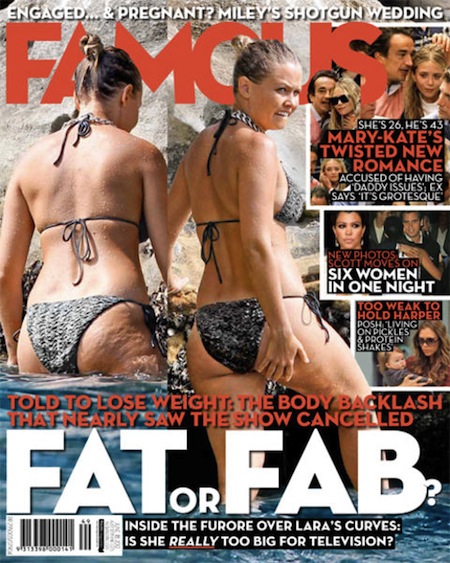
Also cashing in on the Bingle-hoopla is this week’s Famous, which has published months-old shots of Bingle on the beach showing a bit of cellulite and asking, is she “Fat or Fab?”

Lara attempted to address all this on last night’s episode, which conveniently dealt with the fallout of the Lyons balcony pics. Her bestie/roomie/manager-ie, Hermoine, tells Lara she needs to be more careful and show a “sense of responsibility” about her own body:

“You don’t just walk around naked.”

Um, in your own home you do. Hermoine confesses she doesn’t even walk around nude in her own bedroom, which I think reveals some deep-seated issues about sex and nudity. One thing Bingle’s got going for her is that she is unashamed of her body; my thinking is that if you’re in your own home and feel the desire to get nekkid, then why the fuck not?! If the paparazzi happen to use a zoom lens and trespass on private property to capture this, then that’s on them. But misogynists will always find a way to blame women for the unwanted attention their bodies generate: uncovered meat, amiright?

At the end of the day, “This is a world that everyone makes fun of, but… it’s my life.”

Related: Who the Bloody Hell is Body-Bullying Lara Bingle?

Elsewhere: [TheVine] 5 Things We Hope Happen on Being Lara Bingle Tonight.

Image via Famous.

Mama’s Boys & Women’s Work.

My male housemate isn’t the greatest when it comes to household duties. He claims he “forgets” to hang the shower curtain up after a shower and turn the fan on during it in our mold-susceptible bathroom after nine months of it being part of our daily routine. He also “doesn’t notice” the rack of clean dishes waiting there for him to put them away, two days after washed them. When I complain about this to friends, colleagues and mutual acquaintances, the inevitable response—even from the supposedly progressive ones— is, “Oh, he’s a guy; you can’t expect him to remember to do those things.” While said semi-daily occurrences infuriate me to no end, I refuse to believe he does them because of his gender.

Rachel Hills wrote about mama’s boys last week on Daily Life and had this to say:

“It is not an excess of emotional intimacy and support that breeds a man who can’t take care of himself, after all… It’s a society that says that men shouldn’t need to know how to take care of themselves, and that puts women in constant competition for male attention and validation.”

A friend commented on Facebook that the patriarchy is to blame for the mama’s boy phenomenon:

“… [Mothers’] value to their family is generally based around being the main homemaker and not teaching their son any independent life skills because they assume they will marry someone in the same defined gender role who will do the same thing… [M]others who treat their sons this way often do not treat their daughters the same.”

Which, in turn, got me thinking about an article Sarah Ayoub-Christie wrote a while ago about her struggles marrying a traditional Lebanese upbringing in which the women lived to serve the men with her modern marriage.

My argument that all men aren’t household-hopeless dolts and all women don’t thrive in domesticity isn’t held up by any men I know personally, but (in addition to the foundation of my feminism essentially being that the genders aren’t alien to each other; we’re all just people) it is by a lot of women I know, whose homes, apartments and (let’s be honest; most of my friends still live at home!) bedrooms look like a bomb’s hit where cleanliness and hygiene aren’t top priorities.

I just refuse to believe that 1) women are inherently better at homemaking whilst men shun all domestic responsibility, and 2) that this is because of their relationship with their mother. If this is a gender-exclusive trope, then the fact that my mum used to be my “slave”, as I semi-affectionately called her, waiting on me hand and foot certainly flies in the face of my modern-day incarnation as domestic goddess in comparison with my housemate. Mum is somewhat of a Martha Stewart herself, though…

Elsewhere: [Daily Life] Myth of the Mama’s Boy.

[MamaMia] “I’m Not the Partner I Thought I’d Be.”

TV: 2 Broke & Tampon-less Girls.


Bravo to 2 Broke Girls, the show which, last night, dealt with that time of the month and how ridiculous it is that men seem to be trying to regulate it.

Granted, in Australia, our tampons come without the applicator and are relatively government regulation-free (though hella expensive; the irony of two broke girls not being able to afford a “200% price increase”, as Caroline puts it, is not lost. It is a show about hipsters, after all.), but in the U.S., not so much. The war against women and their reproductive rights is raging, and Max has something to say about it.

When the owner of the diner, Han, raises the price of tampons from a quarter to 75 cents in the ladies bathroom, Max and Caroline lose their shit, and Max begins handing out free tampons to lady diners lest they find themselves stuck without them when Auntie Flow comes to town. (Did you know that Auntie Flow was actually Earl’s, the diner’s cool cashier, auntie?!)

While the subplot to Extreme Couponing (a real reality show!) was a throwaway moment of clarity for the hit-and-miss offensiveness of 2 Broke Girls, I do hope a show about two likeable Brooklynites weaves more women’s issues into its tapestry.

Elsewhere: [Jezebel] “If Men Were the Ones Who Got Periods, Tampons Would be Thrown Free From Floats Like Mardi Gras Beads.”

Image via Putlocker.

Magazines: A Farewell to Feminism.


Ahh, Nicole Kidman. You either love her or you hate her.

In her most recent magazine interview, for W, in which she is featured alongside her co-star in Hemingway & Gellhorn, Clive Owen, she discusses the HBO movie about the tumultuous love life of two of America’s greatest writers. Kidman also had this to say about her marriage to Keith Urban:

“He says I’m raw… He thinks the world is not a great place for me because he fears that I’ll be hurt. He says, ‘That’s my job: I’ll protect you’.”

Yes, because one of the most lauded and famous actresses of our time, who was married to the basket case that is Tom Cruise and played such tortured souls as Virginia Woolf, a war activist (Vietnam) and a mother who has lost her son in a car accident needs to be sheltered from the world. And let me guess? She needs her husband’s approval before she buys anything with her millions and must always have dinner on the table for him (which is a bit hard when he’s currently in Australia for The Voice while she’s fiming Grace of Monaco). Because we’re still living in the time Hemingway & Gellhorn is set, didn’t you know?

Image via Pop Sugar.

Mansplaining: I Got Served.

The other morning at work I was embroiled in a conversation about feminism with two male coworkers, one of whom I am very close with and whom I describe as a feminist even though he feels uncomfortable identifying as one, and the other who just started working with us.

The latter had been a stay at home dad to three young children until recently, and I got the feeling he wanted to brag about that. He recounted a story about how he was at the supermarket with said children and an old woman complimented him on pitching in to help with the kids and give mum a break (funny how women are never complimented for this; it’s just out duty). Somehow the conversation moved on to feminism, and my friend joked that he’d be a feminist’s worst nightmare. He then clarified, saying that he’d actually been called a feminist. The new guy scoffed, asking who called him that and if they knew what a feminist was. I butted in, saying it was me who called him a feminist and, yes, I know what one is. My friend attempted to defend my honour by saying that I’m a feminist blogger so of course I know what a feminist is. The conversation then somehow moved on to Popeye, of all things, and my colleague asked if my friend thought Olive Oyl was a victim or a slut because she kept flitting between an obsessed Popeye and the abusive Bluto. My friend ummed and ahhed his way out of the predicament while I stood there reeling.

I couldn’t stop thinking about the conversation for the rest of the day. I didn’t know why, all I knew was that I felt about 100 shades of discomfort during and after the interaction.

Then I realised: when I was scoffed at for calling a man a feminist, I was being mansplained to.

From the background info above, this guy seems to subscribe to the virgin/whore dichotomy when it comes to women and that feminism is only the concern of someone who has a vagina. Perhaps because of his stay-at-home status he feels like he lives in a post-feminist society with his wife as the breadwinner being proof of this. I really don’t know, and I don’t care to. I’m uncomfortable around this guy, and I don’t want to have to justify my feminism to him. He obviously comes from a different generation and probably thinks he knows all there is to know about feminism because he took a gender studies class at uni that one time or read a book on the topic.

I know I’m being a bit harsh here, but he really got my back up over this. Do you think I’m overreacting or does being mansplained to make your blood boil, too?

Elsewhere: [Tiger Beatdown] Chronicles of Mansplaining: Professor Feminism & the Deleted Comments of Doom.

Hugo Schwyzer’s Ousting from the Feminist Community.

I must have been living under a feminist rock for the past couple of months, because when I saw some sentences that jumped out at me in this blog post about Hugo Schwyzer’s abusive past and resignation from The Good Men Project (I wondered why I was never seeing new posts from him on there), I was shocked.

I’ve recently been embroiled in a staunch disagreement with one of my friends over the Chris Brown, Michael Fassbender et al. debacle, in which I’ve attempted to personally boycott all things related to wifebeaters and horrible people in general, and she’s attempted to justify her support of projects they’re involved in because of all the other people it affects (a film crew of hundreds of people, for example).

But what happens when someone I openly admire (Scwhyzer) is revealed to have attempted a murder-suicide on his girlfriend in the past?

I’d have to call myself somewhat of a hypocrite, then. I still think Schwyzer produces some of the most apt feminist and gender-based musings out there. I also think that that incident was 13 years ago and, as far as we know, Schywzer got help and hasn’t relapsed. He’s taken his mistake, learned from it, and used it to add to the feminist and gender discourse. Which is more than I can say for Brown at this point. To play devil’s advocate (because I’m still adamant that Brown is a wifebeater through and through and will definitely strike a woman again), he’s still young and perhaps hasn’t woken up to the full scope of his actions and how they have hurt both Rihanna and himself.

This whole kafuffle has brought forth these questions, as asked by Raphael Magarik in The Atlantic:

Can men be feminist leaders?

Yes, they can. I’m not someone who thinks men can’t be feminists because they don’t have a vagina. Where does that leave trans women, then? How about the many gay men who have faced prejudice and champion the feminist movement? I’ve always thought Schwyzer has valid points to make (admittedly he’s really the only male feminist I read), and I think male voices can aid in the reconciliation of equality between men and women.

What role—if any—should men’s personal experiences play in feminist discussions?

I have a couple of male friends who, when presented with talk of feminism, will undermine and devalue what I’m trying to say with the straight white male reverse-racism bullshit. But, I think, as long as men are willing to listen to what feminists have to say without diminishing it with their white male privilege, personal experiences can aid in the discourse. For example, men who’ve grown up with strong women in their lives, men who’ve been abused, men who’ve abused and are aware of why they did it and are immensely sorry.

And how should feminists treat repentant former abusers?

I know a repentant former abuser who I’ve all but removed from my life, so I’m probably too biased about the situation to be completely inclusive of them. However, I think those who’ve experienced abuse are the ones who have to be having the conversation with former abusers and be okay with them jumping on the feminist bandwagon. If they are truly sorry, have a demonstrated history of non-abuse since they last abused, and can use that history to add value to female-male relations, then I think it might be okay. But the trust is still eroded…

How [do] men feel, what [do] they think about gender, [and] what [do] they need to change?

This is what Schwyzer is concerned with in his writings: how feminism relates to men. I hate the idea of feminism as this exclusive club (an idea which has been doing the rounds since noted second-wave feminists like Gloria Steinem, Betty Friedan and Naomi Wolf stepped on the scene, and was recently reignited with the whole Melinda Tankard Reist business) that you can only gain entry to if you’re the “right” kind of woman. To me, feminism is about equality and inclusion of voices other than the “right” kind of woman.

How do you feel about men in feminism and Schwyzer’s abusive past potentially delegitimising his feminist voice?

Related: My Thoughts on Chris Brown.

Conservative Feminist Melinda Tankard Reist for Sunday Life.

Elsewhere: [The Atlantic] Exile in Gal-Ville: How a Male Feminist Alienated His Supporters.

[Hugo Schwyzer] Why I Resigned from The Good Men Project.

[Feministe] Sex, Drugs, Theology, Men & Feminism: Interview with Hugo Schwyzer.

[GenderBitch] You Don’t Get to Tell Us Who Our Enemies Are.