Toy Story 3’s Barbie—Not as Dumb as She Looks.


I recently re-watched Toy Story 3 after seeing it originally in cinemas last year. Barbie never ceases to amaze me, and I, like, really relate to her bubbly air-head exterior and smart and assertive interior. Here, her exact words on Lot-So’s dictatorship, which could totes be applied to Muammar Gaddafi and the situation in Libya:

“Governments are instituted among men, deriving their just powers from the consent of the governed.”

Elsewhere: [Free Frank Warner] Barbie’s Words on “The Consent of the Governed”.

Image via Free Frank Warner.

Movie Review: Sucker Punch.


“If you don’t stand for something, you’ll fall for anything.”

This is what the main character’s, Babydoll, David Carradine-esque wise fairy godfather tells her midway through her pointless journey to find a map, a knife, fire, a key and… something else (which *spoiler alert* is when Babydoll realises the story is not about her, but Abbie Cornish’s Sweat Pea, and sacrifices herself to what is alluded to as gang rape in order for Sweat Pea to escape. On a side note, WTF is Cornish doing in this movie? She’s, like, a serious actress and stuff.).

Well Sucker Punch didn’t stand for anything (if you exclude the exercise in how bad movies are made, and the kinder-whore schoolgirl images in director Zack Snyder’s spank bank, which I have), and fell for every gratuitous slow-mo’ up-skirt shot in the book.

The film commences with an attempted rape scene, a trademark of Snyder’s. (Pop culture website The Vine suggests that Carla Gugino, who plays Polish psychiatrist/burlesque madame in Sucker Punch and the Silk Spectre in Watchmen, look into “an AVO against Snyder, given she has appeared in two of his films and her characters sexually assaulted in both”.) Babydoll is framed for the murders of her mother and sister, and is dragged away to an insane asylum in “skin-coloured, rain soaked PJs”.

There her father requests a lobotomy, which will go ahead in a few days. During that time, Babydoll escapes to the Inception-like double dreamland in her mind, where the asylum and its exclusively female inhabitants morphs into a burlesque club.

The only way she can—again—escape this fantasy land (if it’s Zac Snyder’s your fantasy, why would you want to escape it?) and entrance her subjects is by dancing, which then turns to a post-apocalyptic “ancient Japan (or maybe China; all look [the] same, right?)” where Babydoll and her insane/burlesque/warrior troupe meet the wise man espousing useless proverbs at every turn as they accumulate the four items they need.

Sucker Punch actually has potential; if not for the excessive violence, hideous sexualisation and the non-plotline, it could have been good.

The story eventually returns to the real life of the asylum when the lobotomist/High Roller (an out of place Jon Hamm) “comes for” Babydoll, which is the most interesting five minutes of the film.

The Vine says, “We don’t really give a shit about any of our heroines [three of which *spoiler alert* are murdered], because neither does the film: they have no inner-life, no story beyond ‘they are sex slaves in foxy pin-up outfits’.” I found myself daydreaming about an alternative mask I could wear to a masquerade party a few nights later; to me that was more interesting than sitting through the pointlessness.

Give me a pen and a copy of the script and I think even I could do the remnants of an okay storyline and Abbie Cornish justice. I will now be boycotting all future Snyder efforts. No emphasis on “effort”.

Elsewhere: [Jezebel] Why Sucker Punch Really, Truly Sucks.

[io9] Sucker Punch Goes Beyond Awful, to Become Commentary on the Death of Moviemaking.

[The Vine] Sucker Punch Movie Review.

Images via The Vine.

So Misunderstood.

Do you ever feel like you’re misunderstood?

Rachel Hills does, in “Lessons in Feminist Activism, From Someone Who Has Been on Both Sides”:

“I felt like I was being mischaracterised… by 20 I was well and truly a feminist. A bottle-blonde, Elle Woods style feminist with a penchant for pink, perhaps, but very definitely a feminist nonetheless.”

And I certainly do sometimes. The other day I was called a “closet feminist”, which I found as offensive as if I had been homosexual and called closeted. Or, just because I take pride in my appearance and like me a new clothing purchase here or there, the copious amounts of blogs, articles, books and non-fashion-related magazines I read mean nothing, because people think all I read about is fashion. (To be honest, I find nothing more boring than reading about fashion.) Or, when I asked to borrow a copy of a friend’s Time magazine when they were done with it, they retorted with “why?! There’s no fashion or celebrity items in there!” (It was the 100 Most Influential People issue with Lady Gaga on the cover, so technically, there were celebrity items in there!)

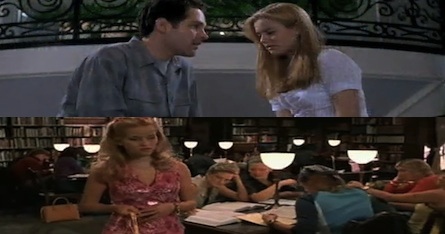
Sometimes I feel like my life is one big Clueless repeat. When Cher cracks it with Josh for telling her not to worry about her dad’s business going under and to go shopping instead, that is a constant conversation I seem to have with people in my life.

Or, in Legally Blonde, which Hills refers to, when Elle is shunned from Enid Wexler’s study group when she approaches them in her signature uniform of pink, bearing a basket of muffins; I can’t say an incident like that has ever happened to me, but I can definitely empathise with Elle’s dejected feeling when she’s deemed not worthy (or not smart) enough to join their group.

Not everybody makes me feel like this: I have a handful of very close friends who know me inside and out, and know that what I present myself as on the outside is not necessarily a reflection of what’s on the inside.

My defense mechanism is to put on a cold, ditzy, Valley Girl-esque persona, which is why most people don’t like me when they meet me. But at the end of the day, it’s not about what people who don’t know you think about you; as long as you, and the people close to you, are happy with who you are, not what you wear or what you choose to do in your own time, that’s all that matters.

Related: It’s All About Popular… Lar, Lar, Lar, Lar.

Women in Fiction: My Favourite Fictional Females.

What’s the Use of Being Supergirl if I Can’t Even Get a Date?

Pop-Culture Power Women.

Elsewhere: [Musings of an Inappropriate Woman] Lessons in Feminist Activism, From Someone Who Has Been on Both Sides.

[Musings of an Inappropriate Woman] Have You Ever Seen Yourself Through Someone Else’s Eyes?

Images via YouTube.

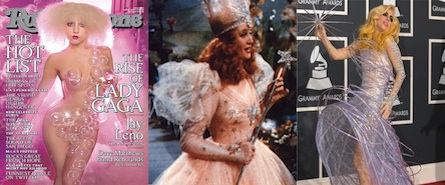
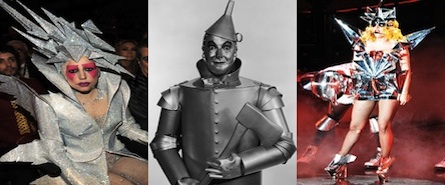
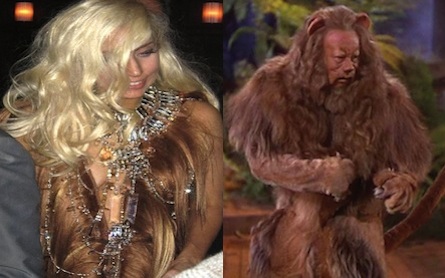
UPDATED: Lady Gaga—Taking Inspiration from The Wizard of Oz.

Lady Gaga on her influences, from Vogue, March 2011:

“Gaga herself is very open about her influences. ‘It’s not a secret that I have been inspired by tons of people,’ she says. ‘David Bowie and Prince being the most paramount in terms of live performance.’ She also seems to have made peace with the fact that she is compared to—or, less charitably, accused of ripping off—nearly every artist of the last 50 years. ‘I could go on and on about all of the people I have been compared to—from Madonna to Grace Jones to Debbie Harry to Elton John to Marilyn Manson to Yoko Ono—but at a certain point you have to realise that what they are saying is that I am cut from the cloth of performer, that I am like all of those people in spirit’… ‘She was born this way.'”

With the release of “Born This Way”, critics are wondering if Lady Gaga isn’t as original as they once thought she was. The song blatantly rips off takes inspiration from Madonna’s “Express Yourself”, and a lot of Gaga’s past works are heavily influence by Her Madgesty.

But Lady Gaga has always been about much more than just her music. It’s all about the fashion, hello?!

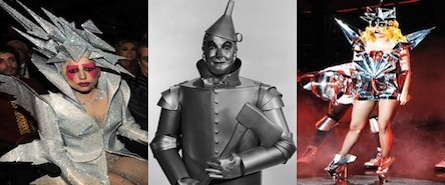
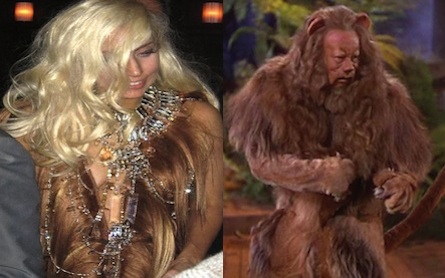
But even her outrageous outfits—bar the meat dress and a couple of others—aren’t that original when you come to think of it. Juxtaposed against The Wizard of Oz‘s Cowardly Lion, Good Witch of the South, Tin Man et al., Gaga proves that imitation is the sincerest form of flattery.

Related: Lady Gaga: Taking Inspiration from The Wizard of Oz.

Pop Culture Role Models.

Chase You Down Until You Love Me, Paparazzi…

Lady Gaga’s “Telephone” & 21st Century Noise.

Katy P. VS. Lady G.

Lady Most Likely: Time Magazine’s 100 Most Influential People.

Images via Amy Grindhouse, Wired, Billboard, Just Nuggets, The Examiner, Leopard Print & Lace, Pony & Pink, Pollsb, TV Tropes, Beauty & the Feast, Wikia, Wendy’s World of Oz.

Lady Gaga: Taking Inspiration from The Wizard of Oz.

With the release of “Born This Way”, critics are wondering if Lady Gaga isn’t as original as they once thought she was. The song blatantly rips off takes inspiration from Madonna’s “Express Yourself”, and a lot of Gaga’s past works are heavily influence by Her Madgesty.

But Lady Gaga has always been about much more than just her music. It’s all about the fashion, hello?!

But even her outrageous outfits—bar the meat dress and a couple of others—aren’t that original when you come to think of it. Juxtaposed against The Wizard of Oz‘s Cowardly Lion, Good Witch of the South, Tin Man et al., Gaga proves that imitation is the sincerest form of flattery.

Images via Amy Grindhouse, Wired, Billboard, Just Nuggets, The Examiner, Leopard Print & Lace, Pony & Pink, Pollsb, TV Tropes, Beauty & the Feast, Wikia, Wendy’s World of Oz.

Beauty & the Beast Remains Relevant.


From Beastly’s False Fairytale” by Alex Leo on Jezebel:

“Unlike Ariel giving up her voice for love or Sleeping Beauty being woken by Prince Charming, this story has immediate and practical implications for our culture—especially for young girls trying to figure out who they are and what they ‘have to do’ to be accepted. The problem is that while the story sets the goal that the Beast stop judging people based on their looks and learn to see the beauty within, the male lead always ends up with a hot woman. It’s right there in the title! She’s a beauty and he’s a monster and I am confused. If the point is that he truly change and accept that looks are merely skin-deep, then shouldn’t he end up with a less-than-stunning partner?”

Elsewhere: [Jezebel] Beastly’s False Fairytale.

The Allure of the Co-Star.


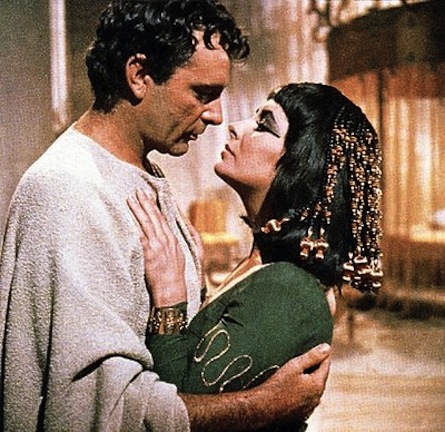
From “Rashida Jones on the Lure of the Co-Star” by Irin Carmon on Jezebel:

“You kind of fall in love with yourself in the eyes of this other person… You’re in a cold place and you want to connect with somebody, you’re not near your husband or wife, and you’ll want to connect with somebody else.

“It’s hard for actors to distinguish between those feelings, and it’s hard to tell your body to communicate these things physiologically and yet it’s just acting and nothing else. With emotional stuff like that, it’s like a weird, short, unaccounted-for affair.”

Just ask Elizabeth Taylor!

Elsewhere: [Jezebel] Rashida Jones on the Lure of the Co-Star.

Image via Station Hollywood.

Mirror Mirror.


From Black Swan & Bathrooms” by Kartina Richardson on Mirror Motion Picture Commentary:

“For those of us not living or working in solitude, the bathroom offers the sole moments in our day when we may escape the gaze of others.

“Think of all the odd things you’ve done in a bathroom in your lifetime. What child hasn’t secretly explored the substance of their waste. What pre-teen hasn’t masturbated nervously. What person hasn’t escaped to the bathroom during a business meeting and made a weird face in the mirror to say to the world: ‘You don’t know I’m doing this right now. Oh there’s so much you don’t know.’

“No other moment can so clearly reveal that our public life is all, in fact, an act. An act with a purpose, but an act all the same.”

While I am still yet to see Black Swan (pathetic, I know, but I’ve never been an Oscar-winning movie kind of gal. More of a Razzie-winning one!), Richardson’s commentary reminded me of Hugo Schwyzer’s take on webcams in the bathrooms and bedrooms of young, impressionable girls. See here for my musings on the subject.

Related: Picture Perfect.

Elsewhere: [Mirror Motion Picture Commentary] Black Swan & Bathrooms.

[Hugo Schwyzer] No Refuge: How Webcams & Cell Phones Ratchet Up the Pressure To Be Perfect.

Images via Mirror Motion Picture Commentary.

Cherchez La Femme (Fatale).


From “What Happened to the Femme Fatale”, originally excerpted from “Cherchez La Femme Fatale” by Kevin Nance on Obit, by Sadie Stein on Jezebel:

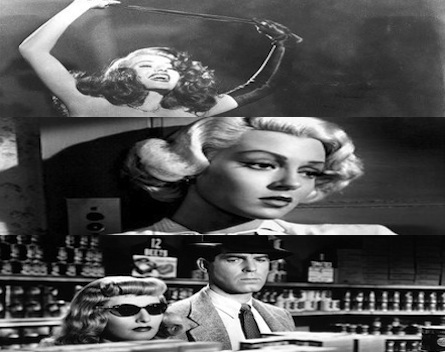
“The femme fatale isn’t passive, waiting for her life to improve on its own. Instead she takes the initiative, attacking the problem with nerve, drive and intelligence. Yes, she uses cat’s-paws, rather than her own paws, to accomplish her goals. But whose fingerprints do you want on the smoking gun, yours or someone else’s? Yes, she uses her sexual power over a man to get what she wants, but power is power. She is the actor, he the acted upon. It’s she who controls her destiny, for better or worse.”

Elsewhere: [Jezebel] What Happened to the Femme Fatale.

[Obit] Cherchez La Femme Fatale.

Images via Doctor Macro, Warwick, Dazzling Divas.

The Wizard of Oz VS. Wicked.

Many of my friends ask how I can love Wicked, yet hate the musical it was spawned from, The Wizard of Oz. Easily.

The Wizard of Oz is creepy, clichéd and fairly boring. Wicked is innovative, original (or as original as a semi-spinoff can get) and riddled with “underlying meaning”. Sure, Wicked tells the story of what happened “before Dorothy dropped in” and runs somewhat parallel to the events of The Wizard of Oz, but is a stand-alone story that blows its predecessor out of the water.

There are so many similarities and differences and storyline quirks to put into words, not to mention those between the book and the stage show, so I’m going to attempt to unravel some of them in a pictorial format. Feel free to join the discussion and change my “wicked ways”.
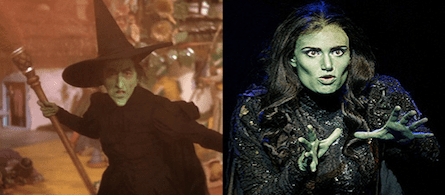
The Wicked Witch of the West VS. Elphaba.

In The Wizard of Oz, the Wicked witch is the epitome of Hollywood villain and has the appearance to match, whereas in Wicked, Elphaba’s friends are able to find beauty in her despite and in spite of the colour of her skin.

Glinda the Good Witch of the North VS. Galinda.

There are more similarities between the film and musicals’ versions of Glinda/Galinda than the “wicked” witches, as they both come across as superficial and somewhat ditzy, but their intellect and ability to see the good in people come out as both stories progress. Galinda, however, is far more three-dimensional than her Wizard of Oz counterpart.

The Scarecrow VS. Fiyero.

In Wicked, Fiyero goes undercover as a scarecrow in order to run away with Elphaba as the angry mob comes after her. In The Wizard of Oz, the Scarecrow accompanies Dorothy in search of a brain, which is echoed in Fiyero’s performance of “Dancing Through Life” in the play. The song deals with Fiyero’s depreciation of school and that the students of Shiz should follow his lead and dance “mindlessly” and “brainlessly” through life, thus harkening back to his transformation into the Scarecrow.
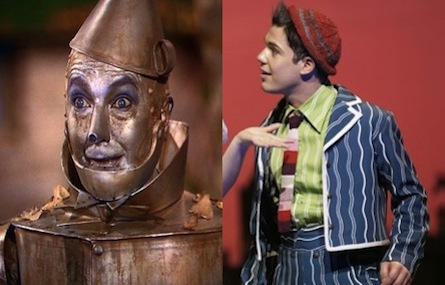
Boq VS. The Tin Man.

The Tin Man is an underdeveloped character to say the least, as is Boq in the musical. Boq is in love with Galinda, who doesn’t give him the time of day, so settles for the disabled Nessarose, who goes on to become the Governor of Munchkinland. Nessarose becomes so upset when Boq threatens to leave her that she casts an ill-fated spell on him which causes his heart to shrink. Elphaba, coming to the rescue, is able to save him, but he will never have a heart, and thus becomes the Tin Man.

Dorothy and the Cowardly Lion.

The two principle characters in The Wizard of Oz are merely extras in Wicked, with Elphaba saving the lion cub from an experiment at school, and Dorothy “dropping in” on Nessarose and killing her. While Dorothy’s appearance in Wicked stays true to the storyline of The Wizard of Oz, Elphaba’s act of kindness in saving the cub contributes to his cowardice in later life.
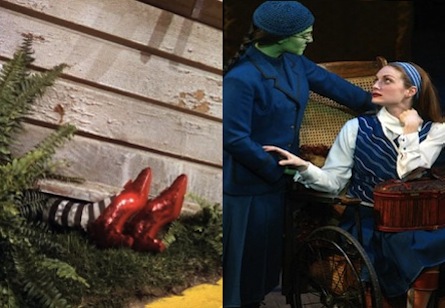
The Wicked Witch of the East VS. Nessarose.

As previously mentioned, Nessarose is wheelchair bound and later assumes her father’s role as Governor of Munchkinland. She is also Elphaba’s sister and dubs herself “The Wicked Witch of the East” after condemning Boq to a life as a tin woodsman. The famous ruby slippers don’t turn up til later in the play, when Elphaba enchants them to give Nessarose the ability to walk. Then Dorothy ruins it all by crash landing her house on Nessarose.

The Wizard of Oz VS. erm… the Wizard of Oz.

In both the film and the musical, the Wizard of Oz is revealed to be a bumbling fraud. In The Wizard of Oz, he represents the finish line of the metaphorical journey the four musketeers embark on to get their respective wishes granted, whereas in Wicked, the wizard is a puppet for Madame Morrible and is revealed as Elphaba’s birth father.

While The Wizard of Oz is a story of the comforts of home, the oppression faced in small country towns, and the politics of 1890s America, Wicked hits much closer to home with its themes of beauty, racism, acceptance, good and evil, and friendship. Perhaps Wicked is a new story for a new generation that isn’t so concerned with the “fairytale” offered by last century’s The Wizard of Oz?

Related: Women in Fiction: My Favourite Fictional Females.

Elsewhere: [Wikipedia] Political Interpretations of The Wonderful Wizard of Oz.

Images via Michael Boykin, Lisa Galek, Andrew Garvey, Daddy Catchers Realm, Culture Guide, Parody Files, Aussie Theatre, Centre Portal, Christopher’s Mark, Courier Mail, Acidemic, Persnickety Penelope.