Movie Review: Sleeping Beauty*.


I usually don’t care for indie, artsy films with an “underlying message”. Give me fluff and fun any day.

So it was unusual for me to want to see Sleeping Beauty, the latest Cannes Film Festival effort by Julia Leigh, starring Sucker Punch’s Emily Browning.

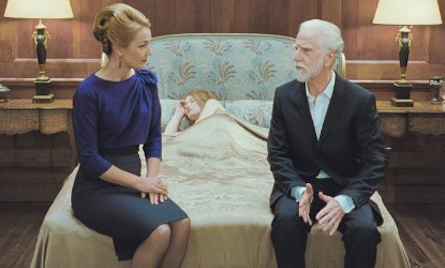
Let’s just say I should have left well enough alone and left it to the creative/hipster Nova Carlton crew to nod understandingly along with the quiet and confronting scenes, while I scoffed at the pretension and a group of girls up the front laughed at the copious amounts of nudity.

This was something I took issue with. Normally, nudity doesn’t bother me so long as it’s not gratuitous and lends itself to the story. Browning’s naked body in almost every scene was an integral part of the story when she becomes the titular “sleeping beauty”. However, she also slept naked, went topless at the request of her dying friend, and basically hung around in her natural state. Which is all well and good if this were real life, but the stunted acting and unrealistic dialogue made it clear that the storyline certainly wasn’t realistic. I counted nine instances of Browning’s nudity, not to mention the bondage party at the beginning of the film, which introduces Browning’s character, Lucy, to the underground perversion club she’ll now be working for, and the three old man peens who try to have their wicked and disturbing way with Lucy. But, as madam of the House of Sleeping Beauties, a novella by Nobel prize-winning author Yasunari Kawabata on which Sleeping Beauty is allegedly based, says, “there will be no penetration”. That’s comforting, then!

While I felt that at some point during the movie, Browning’s nudity went from being artistic to exploitative, the same could be said for the men of the movie. Only the older patrons of madam Clara were seen in all their glory, which didn’t take away from Leigh’s commentary on the youth and beauty of Lucy, but was perhaps an effort to objectify the men who objectify Lucy.

*It has come to my attention that I give away too much in my movie reviews, so the asterisk will now serve as a blanket *spoiler alert* from now on.

Related: Sucker Punch Review.

Sucker Punch’s Emily Browning on Slut-Shaming in Hollywood.

Image via IMDb.

Megan Fox Too “Spicy” for Transformers?


A few weeks ago I caught a snippet from a Shia LaBeouf interview in the back pages of Famous, claiming that “Megan [Fox] developed this Spice Girl strength, this woman-empowerment [stuff] that made her feel awkward about her involvement with Michael [Bay] who some people think is a very lascivious filmmaker, the way he films women,” but wasn’t able to locate it again til this week.

Love her or hate her (personally, I lurrrrve her!), you’ve got to admire Fox for her outspokenness and, if that means, in this day and age, that she’s “Spice Girl”-esque, then so be it.

It’s kind of sad, actually, that to stand up to a cretinous misogynist and say “actually, no, I don’t want to be involved in a film where all my character does is lay about on a motorcycle while you direct the cameraman to get up-skirt shots of me” equates to being a caricature of pop-feminism from fifteen years ago.

I think LaBeouf was trying to remain loyal to both sides of the coin, but he has been critical of Transformers director Bay in the past. It’s just that he’s a guy and the star of the film, so they look the other way, whereas Fox is an apparently replaceable sex object who’ll never work in this town Hollywood again.

At least, that’s according to this week’s Famous, which has a somewhat-outdated story on Fox’s firing from the franchise, her replacement with Victoria’s Secret model Rosie Huntington-Whiteley, and her allegedly anti-Semitic remarks against Bay. The article references a 2009 interview with Wonderland magazine, and an open anonymous letter posted on Bay’s website, which was written at least a year ago.

When talking about the release of the latest Transformers flick with a male friend, he said Fox was an idiot for trash-talking Bay and expecting not to get fired for it. (There is no evidence to suggest Fox did think that, FYI.) I wondered why Fox is the scapegoat to illustrate not biting the hand that feeds you in standing up for herself and refusing to be objectified in such a “way that appeals to a 16-year-old’s sexuality”, while Bay is lauded for his special effects and partnership with Steven Spielberg.  He said he didn’t care; having a car with a button that you could press which turns it into your very own gigantic friend was cooler. Right: who cares how horrible the people making movies are, as long as the end product is good fulfills some boyish childhood fantasy, right?

Related: The Beautiful, Bigmouthed Backlash Against Katherine Heigl & Megan Fox.

“She Just Wants Attention.”

Gay Chicken: Latent Homophobia in “Why Would You Go Gay For?”

“With a Gun Between Her Legs”: Why “Strong” (AKA “Sexy” Whilst Being “Strong”) Female Characters Are Bad for Women.

Minus Two & a Half Men.

Elsewhere: [IndieWire] Shia LaBeouf Claims Megan Fox’s “Spice Girl Strength” Got Her Fired From New Transformers Movie.

Image via Semaj Blogeater.

Does Pop Culture Glamourise Our Carbon Footprint?

Carbon tax. It’s got everyone in a tizzy, and has given Julia Gillard the lowest approval rating of any Prime Minister since Paul Keating. Oh Julia, you had so much potential… but that’s another blog post for another day.

What I want to write about here is the factors that have caused us to need a carbon tax, the front runner being popular culture!

I know, it seems like an odd thing to deduce, but hear me out.

On the nights when I get home from work or being out with friends and my housemate is home before me, oftentimes I’ll walk into the apartment to be greeted by every light in the place blaring, the heater and TV on, and I wonder why my housemate feels the need to make our home look like it belongs in a decor magazine or, at the very least, a television show. But if you’re looking to television and movies to guide your lifestyle, no wonder Australia (not to mention America, the beacon of all things consumerist and anti-environmental) is up shit creek without a paddle.

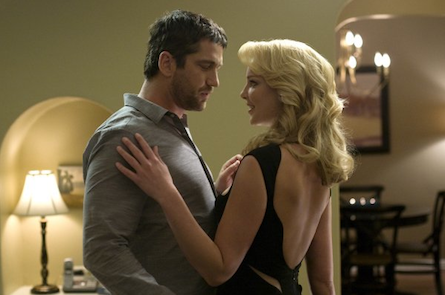
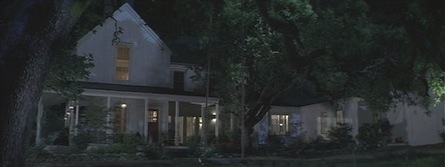
Look at any major mainstream TV show or movie staged in an affluent location: every single light is on, adding to the unrealistic “ambiance” of the place. Below are just a few screenshot examples:

Charmed.

The Ugly Truth.

Sex & the City.

Scream.

Also, inhabitants of houses/apartments/sheds/any building one can reside in onscreen have a penchant for leaving their blinds open. This is a pet hate of mine and one I’ll never understand. Not only does it practically invite psycho killers into your home (okay, I’ve been watching too much Scream), but in winter, it completely undoes all the good work of your trusty little heater. (I see this not only in movies and TV, but in real life, too. My friend Katrina recounted to me how she once saw her neighbour walking around topless in her bedroom without the blinds drawn!)

And hard-yakka Aussies wonder why they’re being asked to fork out for a carbon tax.

Girl with a Satchel Erica Bartle put it well when she wrote that we’re “not so hard up, are we?” when it came to light that “the average Aussie household now has multiple computers, wireless broadband internet, a Nintendo Wii or similar game console and a plasma TV”. Also, how much are the media contributing to our carbon footprint when they’re firing up the chopper to get aerial views of Cate Blanchett’s eco-mansion whilst condemining her for deigning to support the tax. (I read this on The Drum  or The Punch or one of those sites, but can’t seem to find the link, sorry.)

Can you think of any other TV shows and movies that perpetuate this lights on = glamour at the expense of practicality and our carbon footprint?

Elsewhere: [Girl with a Satchel] “Carbon Cate” for T Magazines & the Prius Effect.

Images via YouTube, IMDb, Film in America.

Movie Review: Bridesmaids*.


*It has come to my attention that I give away too much in my movie reviews, so the asterisk will now serve as a blanket *spoiler alert* from now on.

Diarrhea, vomit, the c-word, (Judd) Apatovian-esque.

Those are the plot points, along with Maya Rudolph’s character, Lillian, getting married, as her best friend, Annie, played by writer Kristen Wiig, struggles to come to terms with it, that have been floating around in the lead-up to the most anticipated “chick flick” of the year.

Let me say, straight off the bat, that I hate Judd Apatow movies. I find them crass and full of sophomoric toilet humour. Knocked Up was the worst movie I saw in 2007, and that was also the year of the first Transformers and License to Wed, so that’s really saying something!

So I was a bit apprehensive that the film was being compared to Apatow’s The 40-Year-Old Virgin and The Hangover. So if Bridesmaids was just going to be equating the feeling of sandbags to breasts and and showing crowning from a female’s point of view, you could count me out.

I’d been hearing about the hype surrounding the film for a few months on Jezebel and, in turn, the Australian media as its June release date came closer and closer.

I’m here to tell you that it does live up to said hype.

Bridesmaids deals with besties Annie and Lillian, and how their friendship begins to change—not for the better, in Annie’s mind—once Lillian gets engaged and fellow bridesmaid Helen comes on the scene.

Helen is played by Rose Byrne, who I’m not biggest fan of, but after seeing her in this, I have to acknowledge her acting chops. Byrne made my blood boil with her portrayal of Helen, an entitled Stepford wife who takes over the planning of Lillian’s hens weekend, bridal shower and—eventually—her wedding, too.

I audibly grunted every time she was on screen, each time more infuriating than the last, making her a contender for villain of the year, in my book.

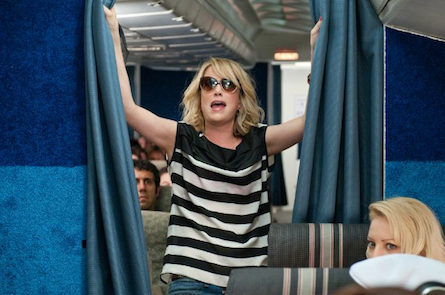
Wiig was so endearing as Annie; someone you would want as your own best friend. Until she starts to let Helen get to her, subsequently ruining Lillian’s hens weekend with her drunken airplane shenanigans, and trashing her French-themed bridal shower, the idea for which Helen stole from Annie and claimed as her own… with take-home Labrador puppies as party favours! Animal cruelty, much?!

It is very easy to empathise with Annie. She dates a jerk who puts her down all the time and won’t commit, but is drop dead gorgeous (Jon Hamm, please stand up), so doesn’t realise it when an actual good guy comes into her life and is encouraging and supportive. She “opened a bakery in a recession” and went bankrupt thereafter, so she really can’t afford weekend getaways to Las Vegas or $800 (“on sale!” as Helen exclaims) bridesmaids dresses. She gets fired from her job in a jewellery store for calling a teen customer a c*nt, evicted from her shitty, housing-commission-esque apartment she shares with British brother-and-sister odd-couple, played by Little Britain’s Matt Lucas, and Australia’s own Rebel Wilson, and eventually ends up moving in with her mum. All of this on top of the end of her friendship with Lillian because of Helen’s interference. Or so Annie thinks, and whiles away her unemployed days watching Castaway and feeling sorry for herself.

The movie is worth it for the aeroplane scene alone, in which the funniest joke of the movie resides. I won’t give it away as I’m pretty confident most everyone—men and women alike—will go to see it. It’s like the Hangover for girls, don’t you know?

Not all chick flicks have to suck!

Images via IMDb.

Movie Review: Super 8.


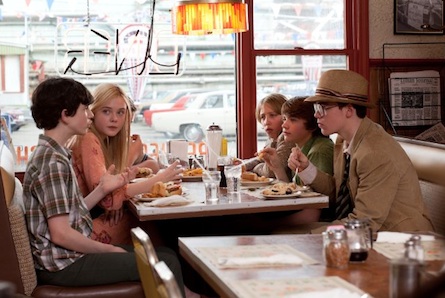
E.T. meets Tomorrow, When the War Began meets Signs meets The Goonies. That’s how I would describe Super 8.

Going into it on Tuesday night, I didn’t have much of a clue what the Steven Spielberg-produced, J. J. Abrams-written-and-directed effort, named for the type of film used in the late 1970s, was about. I saw a review in Who that looked promising, and I was intrigued by the almost all-kid cast.

The alien aspect, which is introduced when the kids are filming a zombie movie over the summer and they witness a purposeful train derailment, is neither here nor there to the actual story, which is a “coming of age” tale of Joe Lamb, whose mother died in a workplace accident a few months prior.

Joe’s dad, the town deputy, is struggling to deal with the death of his wife and being a more present father to Joe than before the accident. He holds a grudge against the man whose shift his wife took the day of her death, who just so happens to be Joe’s friend Alice’s drunk father. Joe and Alice are forbidden from seeing each other, but that doesn’t stop them from working together on their friend Charles’ Super 8 film about zombies, the full version of which can be seen in the credits.

After the train derailment, which is caught on film by the kids, they seek out the truck that caused the accident, driven by their biology teacher, Dr. Woodward. He tells the kids not to mention a word of the accident to anyone or risk death.

Strange things start happening in the town, like abductions, lost dogs and power lines disappearing into thin air. My friend Eddie had the theory that the “alien aspect” had something to do with the Soviet space dogs used in experiments in the 1950s and ’60s. Personally, I liked this notion very much, but it wasn’t to be.

I’m not a big fan of supernatural films, especially those with aliens, and some parts of the movie were scarier than I expected. In all honesty, the movie could have done better to not be centered around aliens.

The kids and Deputy Lamb independently piece together the mystery as the Air Force arrives in the town for the clean-up. Dr. Woodward has been killed by Colonel Nelec, the man in charge of the investigation, when he didn’t offer up the information they wanted.

The kids break into the school to access Woodward’s files, which reveal him as a researcher with the Air Force in 1958, when an extraterrestrial crashed on Earth. The government captured and tortured the creature in an effort to understand more about it. Woodward was empathetic to the alien’s plight, and wanted to set it free so it could return to its home planet. That’s what he was doing on the train tracks that night.

The E.T. parts of the film got a bit convoluted at times, and my friend Sallie commented on aspects of the storyline that didn’t add up.

But the inclusion of the endearing troupe of kids and their adventures made up for any inconsistencies. Think Stand By Me, but with aliens.

Related: Who Speculates About Domestic Violence in the Affleck/Garner Household.

Tomorrow, When the War Began by John Marsden Review.

Images via IMDb.

Sucker Punch’s Emily Browning on Slut-Shaming in Hollywood.


From an interview with the cast of Sucker Punch, “Fight Club”, in NYLON:

“I had a very tame and mild love scene with Jon Hamm. It was like, heavy breathing and making out. It was hardly a sex scene. Baby Doll has been sexually taken advantage of by her stepfather, and the idea of the scene is that, at the end, she’s finally taking control of her own sexuality because she’s realised how she needs to find her own freedom. And it correlates with that sex scene. It’s her essentially coming on to him.

“[Jenna Malone, who plays Rocket in the movie says] ‘She’s in control!’

“Exactly! And I think that it’s great for this young girl to actually take control of her own sexuality. Well, the MPAA [Motion Picture Association of America] doesn’t like that. They don’t think a girl should ever be in control of her own sexuality because they’re from the Stone Age…”

The scene was cut.

Maybe if it had remained, Sucker Punch could have lived up to its girl-power hype and not amounted to what it did.

Related: Sucker Punch Review.

Image via IMDb.

“With a Gun Between Her Legs,” Take 3.


From “Gosh, Sweetie, That’s a Big Gun”, a dialogue between The New York Times’  chief film critics, A.O. Scott and Manohla Dargis, on The New York Times website:

“The question is why are so many violent girls and women running through movies now, especially given that the American big screen hasn’t been very interested in women’s stories, violent or not, in recent decades, an occasional Thelma, Louise and Jodie Foster character notwithstanding. There are other exceptions, of course, usually romantic comedies that are so insipid and insulting I want to kill everyone on screen. Wait a minute—is it female rage fueling this trend?

“It is interesting how frequently the violence of these girls is overseen or inculcated by a father figure who is not always a literal dad: Nicolas Cage in Kick-Ass, training his killer pixie to use sharp blades, big-caliber guns and foul language; Scott Glenn in Sucker Punch, urging his girl warriors into battle; and Eric Bana in Hanna, sending his darling out to fight the wicked witch (Cate Blanchett). Are these paternal figures reassuring or creepy?

“The bad seed isn’t new, but what seems different is that young women and girls can kill today without being necessarily and fatally pathologised.

“It used to be easier to make movies with women. You could put them on a pedestal and either keep them there (as revered wives, virginal girls) or knock them down, as with femmes fatales.

“[David Fincher’s The Girl with the Dragon Tattoo]… movie will be better than the Swedish model because he’s the superior director, but I also hope he will more forcefully engage the theme that was blatant in Larsson’s book, as evident in its blunt original title: Men Who Hate Women.

“I think the first [Lisbeth] Salander movie ran into a serious problem when it tried to translate Larsson’s anger about pervasive sexual violence into cinematic terms. It is in the nature of the moving image to give pleasure, and in the nature of film audiences—consciously or not, admittedly or not—to find pleasure in what they see. So in depicting Salander’s rape by her guardian in the graphic way he did, the director… ran the risk of aestheticizing, glamorizing and eroticizing it…

“The risk is not dissolved but rather compounded when the answering, avenging violence is staged and shot in almost exactly the same kind of gruesome detail, since the audience knows it is supposed to enjoy that. In other words, even though the earlier violation can be said to justify the later revenge, that logic turns out to be reversible. You could call this the I Spit on Your Grave paradigm. It is definitely at work in Sucker Punch, which gains in sleaziness by coyly keeping its rape fantasies within PG-13 limits and fairly quivering with ecstasy as it contemplates scenes of female victimization.

“The gun-toting women and girls in this new rash of movies may be performing much the same function for the presumptive male audience: It’s totally ‘gay’ for a guy to watch a chick flick, but if a babe is packing heat—no worries, man!

“Jean-Luc Godard posited that all he needed to make a movie was a girl and a gun… To put the gun in the hands of the girl may be a way to cut out the middleman, as it were, and also, as you suggest, to maximize commercial potential by providing something for everyone…”

Related: Sucker Punch Review.

“With a Gun Between Her Legs,” Take 2.

“With a Gun Between Her Legs”: Why “Strong” (AKA “Sexy” Whilst Being “Strong”) Female Characters Are Bad for Women.

Elsewhere: [NY Times] Gosh, Sweetie, That’s a Big Gun: Women as Violent Characters in Movies.

Images via The Independent, The New York Times.

I Scream, You Scream, We All Scream for Feminism!


Scream 4 marked the most recent installment of the horror franchise, which ended in much the same similar way as the past three chapters.

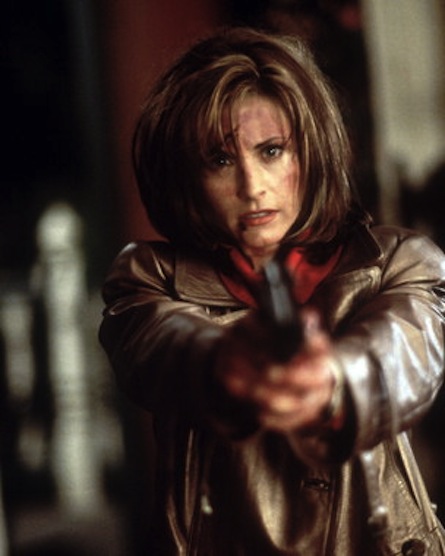
The killer comes back from the dead, gun-wielding Gale Weathers fires a bullet and central scream queen Sidney Prescott gets the last laugh, with fellow original Woodsboro survivor Dewey fumbling around on the sidelines.

Fifteen years after the original, it is still unbelievable as to how Dewey is on the police force, Gale is still a ball-busting rogue sleuth, albeit with a lot more Botox than the last time we saw her, and Sidney has finally wiped that weepy-eyed look off her face and is kicking ass and taking names.

In the first instalment, Sidney is an ineffectual twit who berates horror movie starlets for “running up the stairs when they should be going out the front door” when, only moments later, she does exactly the same thing!

But as I watched each movie, I slowly started to root for Sid. Not only was she dealing with the fallout of her mother’s death and the wrongful allegation against Cotton Weary for the crime in the first film, but she was also dealing with a rat of a boyfriend, Billy, friends, high school and trying not to crumble under the pressure of it all. So I’ll cut her a break.

In the second film, Sidney undergoes remarkable growth due, in part, to going off to college, but the audience can see in the way Sidney carries herself that she believes the murders are over. Oh, how wrong she was! I especially love the final scene in Scream 2, with Sidney outsmarting (one of) the killer(s), Mrs. Loomis, with the help of Cotton. Gale’s there, too, holding on til the bitter end.

The Scream franchise, after all, is about the women. It could be argued that most horror movies are about the women; female victims make for easy targets and garner more of a reaction from the audience. But Scream was one of the first mainstream horrors to advocate for equal-opportunity killing: where the men are as fair game as the girls, and two out of the seven killers have been women. More than that, they’ve been the masterminds of the whole operation; using the clueless and fame-hungry men as pawns in their bloody chess game.

Traditional horror operates on the premise that “she alone looks death in the face”. Not Scream, though.

Ashley Smith in “Final Girl(s) Power: Scream, writes of not only Sidney, but Gale and Dewey, staring death in the face:

“The success of the narrative is predicated now on not an individual woman, extraordinary and significantly boyish, but on the cooperation of two women who together stab, shoot and electrocute the two killers into oblivion. This moment is also notable because it is one of the many instances in Scream that utilizes very self-referential language, not only does it rework the figure of the Final Girl, it talks about itself reworking the figure of the Final Girl. This moment is an example of how the film explicitly works on behalf of the female spectator. Sydney/Campbell is speaking for and speaking as one of the girls in the horror audience who want to see active female characters fighting for each other, and significantly not even bound by a sentimentalised friendship.”

Sidney and Gale start out as sworn enemies (as murdered bestie Tatum Riley says after Sidney punches Gale: “‘I’ll send you a copy.’ Bam! Bitch went down! Sid: super bitch! You’re so cool!”), but I suppose bonding over the murders of pretty much everyone you know will solidify your connection, whether or not it’s one of mutual affection for each other, or mutual hatred for the killer(s).

And then there’s Dewey. He’s a funny character and David Arquette plays him to perfection, but the sum of his survival involves him always arriving to the party 10 seconds late and missing all the action. Sure, he’s been stabbed a few times, but he’s more of the token surviving male than a fully well-rounded character. As Smith writes, “the text allows for powerful and active female figures [that] it compensates [for] with weak, ineffective male ones”.

Before Scream, to survive as a “final girl” you had to be a virgin. This works well for high school victims, as a lot of high school students are virgins. And hey, this is the movies, so so what if it doesn’t reflect real life?

The first Scream begins with Sidney as a virgin, but in the height of the killings, she throws caution her virginity to the wind and has sex with Billy. In any other horror film, this would mean she dies. (Casey Becker, Drew Barrymore’s character, and her boyfriend, Steve, die in the opening scene, as does Tatum, girlfriend of Stu, later on in the movie in the doggy-door scene, above. You might imagine these kids to be non-virgins, as they’re in seemingly committed, loving relationships, but this is never directly addressed.) But Scream, being the “meta-text” that it is, takes a page out of Buffy’s book, and the non-virgin fights to live another day.

But the exemplar of a strong female character in Scream is Gale. She’s not only a ball-busting, high-powered tabloid journalist who fights to see an innocent man go free but, as I mentioned above, she’s always the last one standing, alongside reluctant partner-in-crime Sidney.

In Scream 4, she’s a struggling stay-at-home novelist with writer’s block, so when Sidney—and the subsequent murders—return to Woodsboro, she jumps at the chance to help with the investigations. Dewey, and his lovesick underling Deputy Judy, don’t want her interfering with the case, so Gale goes rogue.

It is Gale who uncovers most of the developments in the case, including who the killer is. And, according to Melissa Lafsky at The Awl, she’s breaking a lot of other ground, too :

“She [Courteney Cox] slashes her way out of the 40-something female stereotype, and takes over this movie with a flick of her scorn-ready… brow. Let’s face it: Few film archetypes are more brutal than the ‘older woman in a horror movie’—either you’re the psycho nutcase… or you’re the pathetic victim… And no matter what, you’re ALWAYS an obsessive mother.

“Cox pulls off a pretty impressive coup, upstaging not only the cute flouncing teens, but also her 15-years-younger self. Her character—now successful, childless(!), and utterly bored with the ‘middle-aged wife’ role—shrugs off all orders to ‘stay out of it’ and leaps back into the murderous fray, husbands, younger blondes and kitchen knives be damned. She takes nothing for granted, and thinks not a second about sneaking into dark corners to catch homicidal fruitcakes (and bitch is 47!!!). While Arquette and Campbell slide into their ’90s cliché groove, Cox reinvents and one-ups, kicking this meta-fest to life and providing the only sexy thing onscreen, gelatinous lips and all. Gale Weathers is shrewd, aggressive, cunning, but never heartless; despite it all, she still loves that stupefied ass clown Dewey. And she does it all while sporting a better ass than the 20-somethings. And… she doesn’t even have to die for it!”

You go, Gale!

Related: Scream 4 Review.

Elsewhere: [Girl Power: Feminism, Girlculture & The Popular Media] Final Girl(s) Power: Scream.

[Wikipedia] Scream Queen.

[Wikipedia] Final Girl.

[The Awl] Scream 4: The First Mainstream Feminist Horror Film.

Images via The Mary Sue, Dinoray, IMDb.
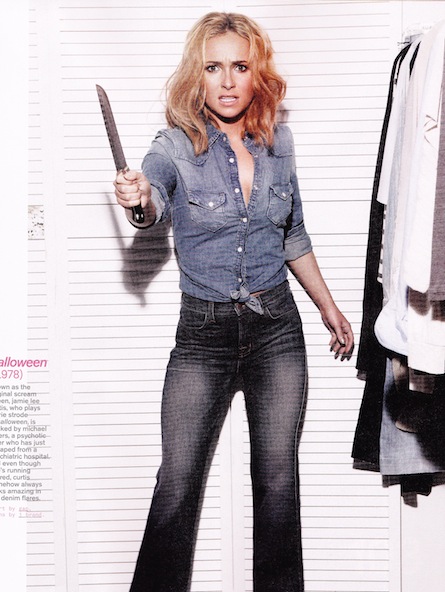
Hayden Panettiere Brushes Up On Her Horror Hottie History.


While Hayden’s got a long way to go before she reaches scream queen territory (her character, Kirby, *spoiler alert* dies in Scream 4, so she’ll have to achieve that feat elsewhere), she does a fine job of emulating horror heroines Carrie White (from Carrie, duh!), Drew Barrymore’s Casey Becker from Scream 1 and, especially, Laurie Strode—played by the “original scream queen”, Jamie Lee Curtis—from Halloween, in Nylon’s May issue, with Hollywood heirs and Scream 4 stars, Emma Roberts and Rory Culkin on the cover.

They say imitation is the sincerest form of flattery…

Related: Scream 4 Review.

Movie Review: Scream 4.


Of the reviews I’d read of Scream 4, I wasn’t expecting a good movie. If, by good, I mean critically acclaimed. But since when is the fourth sequel of a horror movie ever critically acclaimed?

I like my movies unrealistic, fluffy and so-bad-they’re-good. (Think Burlesque, not Sucker Punch.) Usually those are the ones with the poor ratings. And usually they’re my favourite.

Scream 4 certainly lived up to its bad review=good movie hypothesis. Dare I say it trumped the first one, even?

In essence, that’s what Scream 4 was trying to do. It was a “meta-text”, as my friend Eddie pointed out to me.

Like, in the first film, when central scream queen Sidney Prescott is unknowingly talking to Ghostface on the phone, and she says horror movies are insulting because “the girl is always running up the stairs when she should be going out the front door” (even though Sidney does exactly that only moments later!) This occurs in the third part of the first scene of Scream 4, which sees the “blonde haired, big boobed” victim, who has a very high GPA, FYI, running up the stairs when she can’t get the front door unlocked.

The precursors to that scene feature 90210’s Shenae Grimes and Pretty Little Liars’ Lucy Hale in the opening scene, which is actually the opening scene of Stab 6, followed by Anna Paquin and Kristen Bell watching that scene, which then feeds into the opening scene of Stab 7! Phew! It makes much more sense when you’re actually watching it!

Eddie also highlighted the meta-text in Scream 1, when Randy is watching Halloween and is warning Jamie Lee Curtis’s character, the original final girl, to look behind her, when his very own psycho killer is standing right behind him!

It has been said that the original Scream is for horror film lovers, like Randy, Scream 2 is for horror film makers, and Scream 3 is for those in the business (obviously, because it was set on the Hollywood back lot, but it didn’t pack the punch the other Scream’s did). You really have to be a Scream devotee to unravel all the “underlying meaning” in the fourth installment, which is designed to either be the first instalment of a new trilogy, or a re-do of the first film, depending on box-office success. As a pillow-lipped Gail notes at a police press conference, the killer is mirroring the original spate of killings. But it is so well done, movie-goers could commit to it without having a prior knowledge of the Scream franchise.

Scream 4 centres around Sidney’s return to Woodsboro on the final stop of her book tour, to promote her debut publication, Out of Darkness. Ghostface number four and/or five sees this as the perfect opportunity to seek revenge on Sidney for deserting Woodsboro in the aftermath of the first wave of killings, and leaving its residents to clean up her mess. Or so the killer says in a phone call to the main character, leading the audience to believe the killer is either Sidney’s aunt—Emma Roberts’ character’s, Jill, mum—or Deputy Judy (a throwback to Dewey’s derogatory nickname in the first film), who has a massive crush on Dewey, whom she bakes lemon squares that “taste like ass”, according to jealous wife Gail. When Deputy Judy approaches Sidney in the stairwell of Jill’s house after a neighbour is murdered, asking if Sidney remembers her from high school, it seems very likely that the killer could be her. But we know well enough by now that it’s never that obvious…

Eddie noted that Scream 3 was meant to have two killers, one of which being an old classmate of Sidney’s who felt she left her and Woodsboro behind. Maybe Judy’s not so unlikely after all…

The killer takes to filming their conquests after a suggestion from Gail, who totally kicks butt in this version, gravity-defying forehead and all. What am I talking about? Gail kicks butt in every film, almost always getting in the last shot (Billy in Scream 1 and Mickey in Scream 2. Who will it be in Scream 4?) Except for the fact that she seeks advice from high school kids when “going rogue”, and hunting for the killer herself when Dewey brushes her off. Didn’t she live through four killers herself? I’m sure she knows more than a bunch of 16-year-olds.

If New York City is the fifth character in Sex & the City, then technology certainly plays a major role in Scream 4. So the inclusion of said bunch of 16-year-olds lends itself to this notion, with YouTube, Facebook, Twitter, text, GPS and a whole host of other teen techno gadgets playing a role in the killer’s quest to become famous.

In this day and age, you don’t even have to do anything to become famous. Just ask Snooki and the cast of Jersey Shore. And, as the killer says, “everyone loves a victim”. But none better than the original…

Related: Burlesque Review.

Sucker Punch Review.

Elsewhere: [Wikipedia] Final Girl.

Images via IMDb. And a special thanks to Eddie, for helping me with this post.