TV: Girls Just Want to Have Realistic Experiences.


The racial issues the interwebs has with Girls made me feeling trepidation about the show. I think the fact that I had such low expectations was a good thing, as I actually ended up loving it.

I’m yet to warm to Lena Dunham as a person, but I love her as her alter-ego, Hannah Horvath, who, in the series’ opening scene, is cut off by her parents who have been supporting her in the two years since she finished college. Her mother rightfully calls her a spoiled brat (Hannah responds with, “Whose fault is that?!”) expecting them to fund her New York lifestyle while she pursues her “art” in an unpaid internship. Initially, I wanted to throttle Hannah for being entitled and selfish (I despise people who leech of their parents), but I can also understand her disbelief that her pretty well-off parents won’t extend their good fortune to her.

I grew up in a low-income home so I didn’t always get everything I wanted or needed. At the time, and even sometimes now when my pensioned mum will shout my minimum wage sister a coffee but not me, I thought it was so unfair; why should I be punished for my parents’ poor life choices? But at the end of the day, it has made me fight for the things I want instead of having them handed to me, gives me empathy for other people doing it tough and reminds me how I don’t want my life to turn out.

I also really related to Hannah’s gorgeous roommate Marnie, played by Allison Williams, whose perfect boyfriend is just too… everything. She “accidentally” sleeps in Hannah’s room when he stays over to avoid him. She suggests a sexy roleplay where he’s the stranger to avoid having tender, loving sex with him. She laments that she feels like such a bitch because he’s so nice to her and it just infuriates her. I feel her pain: most of the guys I’ve dated in the past have either been too nice or too assholish. Where’s the happy medium?

But back to the race thing. There has been a lot of umming and ahhing about the fact that there are no characters of colour apart from the techie Asian and the homeless crazy black guy tropes. Even the background extras aren’t that diverse for a show set and filmed in New York. Dunham has copped some flack for this, as Girls is completely her brainchild. But doesn’t that mean that she’s just being true to her experience as a privileged white girl who probably didn’t come into contact with many non-white people during her college and post-college years, some are wondering. I think it’s unfortunate that her ignorance is the reason Girls is so whitewashed, but hopefully the criticisms she’s faced since the show’s release will see more people of colour integrated into it. Girls may not show people of different races, but they sure talk about it (Jessa says she’ll have many different babies to many different men of many different races, and Hannah is admonished for a distasteful joke on a job interview because issues of race and deviant sex don’t have a home in the workplace).

Speaking of sex, in the second episode Jessa  is faced with her abortion, which is handled in a very feministy way. Hannah insinuates that accompanying Jessa to her appointment isn’t a big deal, but her fuck buddy, Adam, says it’s a heavy situation. I am want to agree with Hannah, but she is eager to please and changes her opinion to more accurately reflect Adam’s.

Not to discount the opinion of those who think abortion is “one of the most traumatic experiences a woman can go through”, which Marnie does. Hannah is nothing but supportive throughout all of this, asking about the emotions Jessa must be feeling. Even little, innocent Shoshanna is surprisingly open-minded about the whole thing. While her insistence on Hannah and Jessa reading a self-help book on the perils of dating was annoying—the dialogue between Hannah and Jessa after the fact only added to the show’s pro-woman vibe—I’m actually really beginning to like Shoshanna.

While a lot of girls might not see themselves reflected on the television screen in terms of looks (although Dunham’s body diversity is refreshing), I think every girl will see a little bit of themselves and their friends reflected in Girls.

Elsewhere: [Jezebel] Why We Need to Keep Talking About the White Girls on Girls.

Image via Badass Digest.

TV: Dermot Mulroney is New Girl’s Knight in Shining Armour.


One could argue that a rich guy helping out a girl whose car has broken down is the act of a good Samaritan. But when the friend of said girl whose car has broken down suggests she should be open to the fact that his display of kindness could have been a ploy to pick her up and she should want to date him because he can take care of her instead of her always having to take care of the guys she dates, you might argue that he could be seen as a knight in shining armor coming to rescue her from her broken-down-car-ridden existence.

I’m all for a bit of Dermot Mulroney, and I would totally hit that if I was in Jess’ position, but I’m having problems with his introduction into the series.

Mulroney’s character, Russell, is a wealthy philanthropist and the father of one of Jess’ students. He’s also the polar opposite of Jess’ other potential love interest, Nick, who is becoming the male version of Jess more with each episode.

Now, I also love me a man with a job and some career direction, but to suggest that a man who possesses these things will “rescue” you from your troubles is patriarchal and gross. It seems everyone in Jess’ life tries to coax her away from marching to the beat of her own manic pixie dream girl drum, but does she really need rescuing?

Related: Sexual Harassment is Just a Myth. You Just Need to Give People a Chance to Show You How Good They Are.

Manic Pixie Dream Girly Girls & Not-So-Girly Girls.

New Girl Should Attend a SlutWalk Sometime…

Body Acceptance on New Girl.

Who’s That Girl? It’s the New Girl.

Image via Zimbio.

TV: Private Practice—“Rape is Rape”.


While at times it felt like Violet and Sheldon were reading from press releases regarding sexual assault in the military and the sexual assault of men (the episode was shot in partnership with RAINN, the Rape Abuse Incest National Network), you have to applaud Private Practice for being the most progressive of Shonda Rimes creations, what with last season’s rape of Charlotte and Addison’s speech about being one of only 1700 abortion providers in the United States.

Last night, Sheldon treated a soldier who’d been raped by his supervisor while on a tour of duty in the Middle East. There’s always stigma attached to male victims of sexual assault, and Rick questions his masculinity and his inability to fight his attacker off. As Sheldon says, “If a man doesn’t fight back, it makes him question whether he’s really a man.”

Rick hasn’t told his wife, Kelly, about his assault, but she knows he’s suffering from some kind of PTSD because he flinches at her touch and their sex life is non-existant.

When Rick finally gets the courage to confess what happened to Kelly, with Sheldon’s support, she pulls away from him, asking if he’s trying to tell her he’s gay because he didn’t escape the assault.

“How is that [being raped by one man] even possible? You’re a soldier,” Kelly marvels, as if the two are mutually exclusive. “Why didn’t you stop him?”

Selfishly, Kelly confesses to Sam, a friend of the family, that Rick is supposed to protect her; yeah, ’cause I’m sure that’s the first thing that ran through his mind when he was ambushed from behind and sodomised.

Credit to a show that is often overlooked in favour of its older sister show, Grey’s Anatomy (how else do you explain Seven pushing the show back to an 11:15 start time on a Thursday night? Some people have to work on Friday morning!), for a sensitive, realistic and non-judgemental portrayal of a not-often-discussed topic: male rape in the military.

Related: Top 11 TV Moments of 2011.

Private Practice: Pro-Choice?

Image via Pop Talk.

TV: Glee—“Props” for the Body-Switching Dream Sequence.


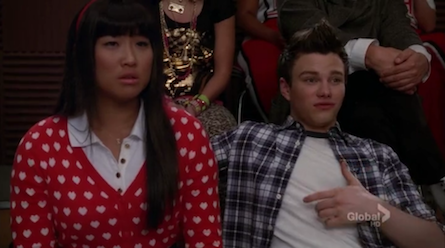
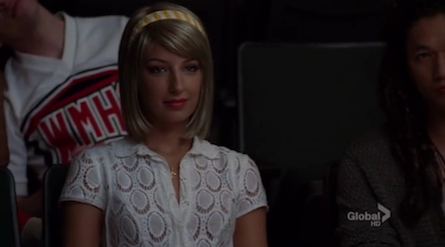
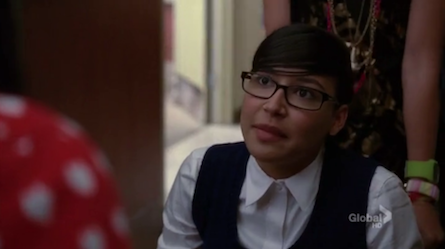
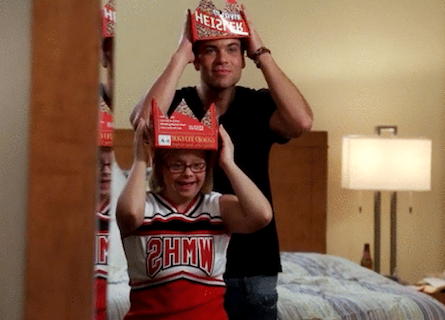
In a rare moment of actual self-awareness (none of this Sue-hiring-racially-diverse-midgets-for-New-Directions-to-perform-with-at-Nationals-in-a-show-of-inclusivity—or something—stuff), Glee dared to put Tina in a dream sequence in which she was Rachel and everyone else had swapped bodies, too.

In the “here’s what you missed on Glee” intro, the narrator (who sounds a lot like Finn, but have we ever really been told who it is?) draws attention to Tina’s status as a “prop” at best, so of course the episode was going to be all about her, like the first episode back after Quinn’s accident and the wedding-that-wasn’t was all about Quinn, and then the character is never to be seen or heard from again. I’m not sure what the show has planned for next season, when Rachel, Finn, Kurt et al. head off to college, but perhaps they were trying to introduce Tina as the main player next year.

Anyway, Tina cracks it after having to sit through one too many of Rachel’s solo tantrums. Afterwards, when she’s shopping for fabric for Rachel’s Nationals costume, Tina slips and falls into a fountain at the mall, hitting her head.

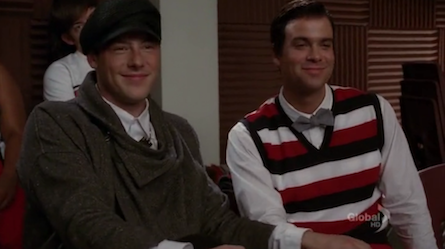
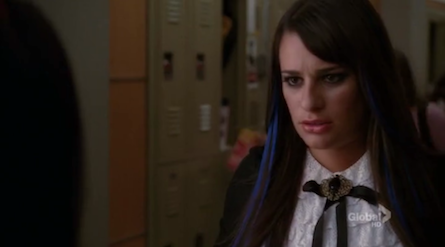
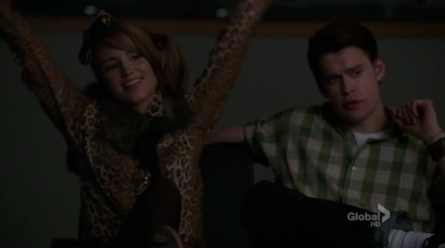
For ten glorious minutes, Glee is transformed into an alternate reality, where Finn is Kurt and Puck is Blaine (here’s the homoerotic moment we’ve all been waiting for!) and so on and so forth. With some spot on performances by Naya Rivera as Santana as Artie and Vanessa Lengies as Sugar as Quinn, I’m actually disappointed that Glee didn’t carry this scene on for the rest of the episode! But then Glee’s never been one for pushing the boundaries…

In other, storyline continuity-related Glee news, Shannon Beiste’s domestic violence arc was tied up when she got the courage from, of all people, Puck, to leave Cooter for good.

What did you think of the body-switching experiment? Yay or nay?

Related: The Underlying Message in Glee’s “Choke” Episode.

Images via Putlocker.

TV: 2 Broke Girls Aren’t So Broke That They’d Turn to Sex Work.


You know, ’cause hookers are gross and have herpes. Caroline thinks she’d make a horrible prostitute because, “I have a heart and soul and dreams and wanna fall in love and have a family,” and sex workers don’t and won’t have any of these things. Never mind that many sex workers don’t have any other prospects due to the cycle of poverty and abuse and sex trafficking. And what of those in the industry who—shock, horror!—actually want to be in it and enjoy what they do? Does this mean their heart, soul, hopes, dreams and love life go down the drain?

Just to throw in some racism for good measure, Max and Caroline’s upstairs neighbour, Nirham Shadouri (excuse my abhorrent spelling. I was sounding it out.), dies, and Max remarks that “she wasn’t even on the right continent” when guessing his name. Oh, and Jennifer Coolidge (who, if you’ve ever seen Legally Blonde or American Pie, you know is American) plays a Polish suspected madam. Not well, might I add.

Related: 2 Broke & Tampon-less Girls.

I Went to See American Reunion & I Didn’t Hate It…

Image via Putlocker.

TV: Adoption, Men’s Rights & Desperate Housewives.


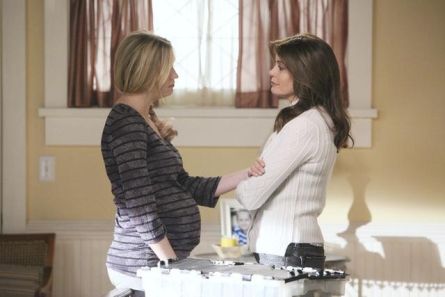
The moment Susan’s daughter Julie rocked up pregnant and with the intent to give the baby up for adoption, I knew there was trouble in the air. Susan tries to sabotage Julie’s efforts to find an adoptive family and, last night, she found out rambunctious little Porter Scavo from across the street is the father.

While initially Susan was appalled at the prospect of having a part-Scavo grand-offspring, she changes her tune when Porter decides he’d like to raise the baby. Susan offers her help to get Porter a lawyer and look after the baby when it comes. Susan expressly goes against Julie’s wishes and tells Julie that “birth fathers have rights”.

Well, in the current political climate of the U.S. (which has been popping up a lot on television in recent weeks), I had to double check that the foetus residing in a woman’s womb in the Western world is subject to her wishes, not the baby daddy’s.

While in some developing countries, men do have the legal backing to request their baby not be aborted or given up for adoption, this is certainly not automatically true in the U.S. I suppose Porter could apply for custody of the baby and relieve Julie of all her responsibilities but, as she puts it, how do you think she’ll feel having the baby she gave up for adoption living across the street and being babysat by her overbearing mother?!

I really feel for Julie here: last week she told her mother she doesn’t want to raise a child as a single mother as she’s seen what Susan went through. My reasoning is that she should have just got an abortion, but if that doesn’t align with her values (or she found out about the pregnancy too late), I understand her wanting to give it up to a family that can take care of the baby and give it the love it needs.

But I cannot believe (actually, Susan’s kind of flakey, so I can) that Susan is advocating for her daughter to lose her right as a woman to chose what happens to her body and what comes out of it in favour of upholding the patriarchy. Look, I don’t think that Porter’s feelings shouldn’t be heard and that they’re not valid, but at the end of the day, the father is young, unemployed and undereducated, living at home with his mum who doesn’t want another baby around and the mother doesn’t want the child, so who do you think the courts will side with?

Related: 2 Broke & Tampon-less Girls.

Grey’s Anatomy: “You Killed Our Baby”.

Image via The Voice of TV.

TV: Grey’s Anatomy—“You Killed Our Baby”.


Owen has always struggled with Cristina’s decision to have an abortion at the end of last season, and it seems he’s still holding it over her head halfway into this one.

From the point of view of Owen, this is fair enough: Cristina never allowed him a say in the termination, and he struggled with her exerting her right to choose.

On the other hand, though: it’s just an abortion. It’s not like Cristina killed an actual living, breathing human with a personality and autonomy outside the womb. She killed his hopes and dreams that he projected onto something that could have been. Tragic on both counts for both characters who can’t seem to grasp where the other is coming from.

Cristina takes the position I do: a foetus is not a human. It doesn’t have rights. It’s subject to whatever the woman whose body it’s residing in chooses to do. Cristina had an operation to get rid of unwanted matter in her body, and now she’s moving on with her life.

I don’t pretend to really understand how the pro-life side, to which Owen evidently belongs, can get so hung up on the (non-existent) rights of the foetus which, at the time of Cristina’s abortion, would have been none the wiser.

Owen seems to think that Cristina committed murder, when he shouts at her during an argument in Meredith and Derek’s kitchen whilst Zola’s birthday/Richard’s 10,000th surgery party is happening in the next room, “you killed our baby!”

Personally, if you have the view that abortion is murder, then I don’t think you should be a doctor. A pro-life campaigner/terrorist out the front of an abortion clinic, perhaps? It’s less dangerous that way.

Related: Grey’s Anatomy Final Asks “When Does Life Begin?”

Cristina Yang as Feminist.

Private Practice: Pro-Choice?

Image via YouTube.

TV: The Underlying Message in Glee’s “Prom-asaurus” Episode.


Three episodes before the end of the season, the issue of Brittany’s class presidency is finally addressed, because she the show seems to have forgotten she was elected earlier in the season. Brittany addresses this herself, when she says she’s been a bit out of the loop this year, and “even stopped speaking” for a period.

In her first prom committee meeting, for which the board has sent Brittany ten prior memos, she fires the team and monopolises the choosing of the theme (she did like the unicorns featured in the diorama for the original Castle in the Sky theme): dinosaurs.

When explaining her choices to New Directions, she compares her presidency to the corrupt nature of the U.S. government, and is determined hers won’t turn out that way. She also imposes a ban on hair gel, sending Blaine into meltdown!

Last year, Kurt was humiliatingly crowned prom queen, a memory he still struggles with in this episode. It seems Glee has learned nothing from the tokenisation of gay people as somehow not being of the gender they identify as, as Brittany is nominated as prom king. Maybe it’s that undercut that had people confused…

Also troublingly, the show pitted the two “disabled” girls, Becky and Quinn, against each other. Becky was sure she’d get a nomination as prom queen, but when Quinn gets one in place of her, Coach Sylvester tells her there’s only room for one “sympathy vote”. Helen Mirren’s voice (shoutout to The Queen) makes another cameo as Becky’s inner monologue, adding to the “difference” between her and the other characters on the show. (That Quinn manages to walk at the prom after months of intense physical therapy widens this gap.)

Becky wonders why no one realises that not all prom queens “have to look the same; they can be different.”

And Glee tries to tie Becky’s concerns up nicely in a bow of equality with Puck crowning her “the anti-prom queen” and the boys of New Directions crooning One Direction’s “What Makes You Beautiful”.

Related: The Underlying Message in Glee’s “I Am Unicorn” Episode.

Glee Gets Down on Friday at the Prom.

Image via Gleerific News Stop.

TV: 2 Broke & Tampon-less Girls.


Bravo to 2 Broke Girls, the show which, last night, dealt with that time of the month and how ridiculous it is that men seem to be trying to regulate it.

Granted, in Australia, our tampons come without the applicator and are relatively government regulation-free (though hella expensive; the irony of two broke girls not being able to afford a “200% price increase”, as Caroline puts it, is not lost. It is a show about hipsters, after all.), but in the U.S., not so much. The war against women and their reproductive rights is raging, and Max has something to say about it.

When the owner of the diner, Han, raises the price of tampons from a quarter to 75 cents in the ladies bathroom, Max and Caroline lose their shit, and Max begins handing out free tampons to lady diners lest they find themselves stuck without them when Auntie Flow comes to town. (Did you know that Auntie Flow was actually Earl’s, the diner’s cool cashier, auntie?!)

While the subplot to Extreme Couponing (a real reality show!) was a throwaway moment of clarity for the hit-and-miss offensiveness of 2 Broke Girls, I do hope a show about two likeable Brooklynites weaves more women’s issues into its tapestry.

Elsewhere: [Jezebel] “If Men Were the Ones Who Got Periods, Tampons Would be Thrown Free From Floats Like Mardi Gras Beads.”

Image via Putlocker.

TV: Has Smash Jumped the Shark with This Bollywood Number?

My reaction to the above scene is equal parts cringe and intrigue. While it could be seen to be pushing the boundaries, and it does tie in with Dev’s Indian heritage and movie star Rebecca Duvall’s racial ignorance, it could also very well be the moment when Smash jumped the shark. What do you think?

Related: The Problem with Smash.