Music Videos: Who’s the Copycat Now, Katy Perry?

Lady Gaga copped a lot of flak for reappropriating everything from Madonna’s “Express Yourself” to Hieronymus Bosch to Michael Jackson’s white gloves, but at least she waited more than five minutes to use them as inspiration. What’s Katy Perry’s excuse for blatantly ripping off Gaga’s “Born this Way” video, replete with mythical equine figures, rebirth and alien-esque cheekbones, for her “E.T” video?

And so the feud between Perry and Gaga rages on.

Related: Lady Gaga: Taking Inspiration from The Wizard of Oz.

Whipped Cream Feminism: The Underlying Message in Katy Perry’s “California Gurls” Video.

Katy P. VS. Lady G.

Elsewhere: [FlavorWire] A Guide to Signs & Symbols in Lady Gaga’s “Born This Way” Video.

Images via YouTube.

“Chains & Whips Excite Me…”—The Underlying Message in Music Videos.


From L’s comment on “Deconstructing 2011’s Girl Anthems” by Emma Plant on Girl with a Satchel:

“…It’s scary to think that very few people are thinking critically about what song lyrics really say, or how the video can change a meaning of a song. Look at Rihanna tied to the bed in that Eminem video with him singing out lighting the house on fire to watch her burn… this from a young woman who was previously in an abusive relationship.
What is the music we listen to really saying about us and how is it shaping our opinions and values?”

Related: Rihanna’s “S&M”: Is It Really So Much Worse Than Her Other Stuff?

Elsewhere: [Girl with a Satchel] Deconstructing 2011’s Girl Anthems.

Images via YouTube.

The Underlying Message in Madonna’s “Like a Prayer” Video.

About a month ago, I posted a quick revision of a presentation I did at uni on Madonna’s most controversial videos. In it, I wished to go into further detail on “Madonna’s influence on the music video and religion in pop culture”. Here I attempt to do so.

Another pop culture icon who’s had a big influence on modern religion is Oprah, who pushes her brand of “pick and mix religion” to her millions of followers. Funnily enough, Shmoop comes to a similar conclusion about the “Like a Prayer” video:

“The blending of Italian American and African American traditions and cultures should also be considered a postmodern choice. It resists interpretation. Where a critic might try to understand the video as an endorsement of Catholicism, the blending of Catholicism with the African Methodist Episcopal choir Madonna meets in her dream prevents such a simple interpretation. The video is neither here nor there on particular religions, only communicating the power of some force of faith to empower her.”

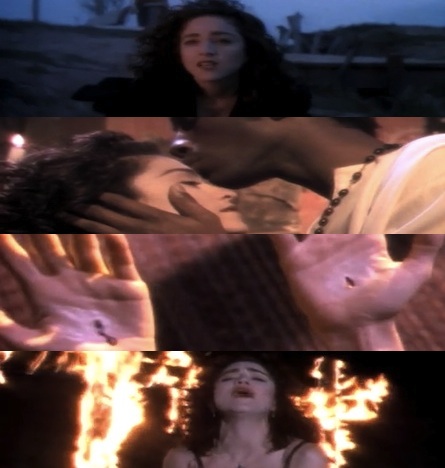
But when the video was released in 1989, that was the least of its critics’ problems. Perhaps it was the rape scene at the beginning, the depicition of a “black Christ”, who was in actuality the black Saint Martin de Porres, to critique racism, or—my pick—the burning crosses in the field behind Madonna, who prances around in black negligee. It could have been any combination of these factors that made Pepsi back out of its $5 million deal with the star in the aftermath of the video’s release.

Granted, the film clip was made more than twenty years ago, and it was groundbreaking for its time. However, fast-forward to 2011, and what we’ve seen since then makes “Like a Prayer” seem positively tame.

Madonna herself has been responsible for some of these, like her clip the following year for “Justify My Love”, her Sex book or, on the tamer side of things, kissing Britney Spears and Christina Aguilera onstage at the MTV Video Music Awards in 2003, which seems to be an enduring image of ranch culture in this day and age.

But you don’t go about these things without thinking of them seriously, and that’s why Madonna’s legacy has persisted all these years. She knew exactly what she was doing in that clip, and all other clips that followed. The fact that at the end of the song the events of the clip are revealed to be a performance indicates that “we all play a part in this little scenario”. What part, exactly?

While religious groups trying to get the video banned could be interpreted as the Church being unwilling to accept square pegs that don’t fit into round holes, Pepsi backing out of their deal with the star is an example of big conglomerates being scared to buck the system and take a risk less they lose customers.

Someone who isn’t afraid to buck the system and is accepting of all walks of life (except, perhaps, those whose body parts were used in the assembling of her meat dress) is Lady Gaga, who is a huge Madonna fan, if some of her recent videos are anything to go by. Last year I blogged about Gaga’s film clip for “Alejandro” and how it emulated “Like a Prayer” and other Madonna videos almost to a tee.

While we would like to think that we have grown as a society and have become more accepting of different people in the twenty years since “Like a Prayer” was banned, “Alejandro”’s critical reception from religious and parenting groups may indicate otherwise…

Related: More Madonna.

Katy P. VS. Lady G.

Madonna (and Her Brand of “Feminism”) On the Rocks.

Elsewhere: [Shmoop] Like a Prayer Meaning.

Images via YouTube.
Rihanna’s “S&M”: Is it Really So Much Worse Than Her Other Stuff?

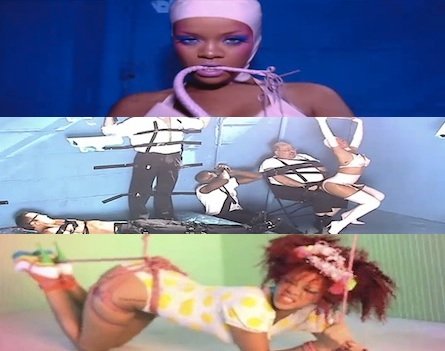
Rihanna said it herself: “They watched ‘Umbrella’… I was full nude.”

So why so much fuss about her latest offering, “S&M”?

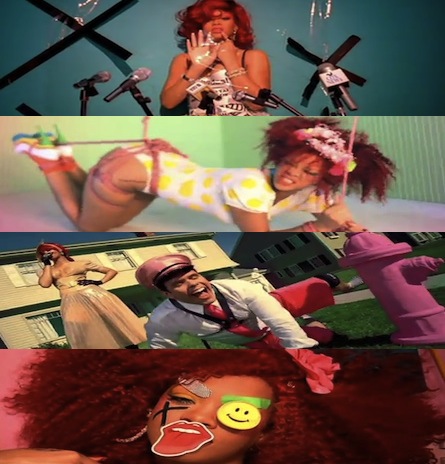
Sure, the title, lyrics and film clip are controversial at best, but once they are unwrapped and their true meaning is revealed, the song is more a dig at the press and Rihanna’s sadomasochistic relationship with them, hence Perez Hilton’s appearance.

The video does deal with sexual violence also, which Rihanna is no stranger to, but this time around it’s consensual violence. Jezebel explains:

“It’s notable, though, following her assault by Chris Brown, that in the video for ‘S&M,’ she’s interested in exploring consensual acts of violence and aggression, and finding pleasure in pain. Although she does appear bound in the video (as well as literally restrained by the media), mostly she plays the role of a dominant, perhaps to prove (or remind us) that she’s the one in control. Is this the desire of one who’s been called a victim? To recast oneself as authoritative and commanding?”

The film clip—the aspect of the song that has drawn the most controversy—is actually not that bad, in my opinion. It’s got a bright, pop-arty feel (a direction which the singer seems to be heading in these days), and “shows us a bright, vivid, eye-popping adult playground of her own imaginative making, exciting chains and whips [just happen to be] included.”

Where “Madonna and Lady Gaga have cornered the market on the black pleather and whips on white backgrounds of the S&M-themed music-video world… Rihanna is refusing to cede them the entire territory: She’ll do S&M if she wants to, she’s just going to make it really, really goofy.”

Granted, both Madonna and Lady Gaga’s videos and music are a cut above Rihanna’s, who is somewhere between Katy Perry’s “California Gurls” and Gaga’s “Telephone”, but you’ve got to admit: “S&M” is something a bit different, and something that’s getting people talking. And that’s the aim of the game, right?

Think of Rihanna’s other videos for a moment: “Te Amo” featured Laetitia Casta as Rihanna’s lesbian love interest; “Rude Boy” shows the singer peeking down the pants of a male dancer; her collaboration with Eminem in “Love the Way You Lie” dealt with domestic violence; and the aforementioned “Umbrella” marked her transition from “good girl” to “gone bad”.

Lyric-wise, “S&M” (Sex in the air, I don’t care, I love the smell of it/Sticks and stones may break my bones/But whips and chains excite me) is probably equally as graphic as “Rude Boy” (Come here rude boy, boy, can you get it up?/Come here rude boy, boy, is you big enough?). But officials in the UK don’t think so, with the song being completely reworked and renamed (“Come On”) so it can get radio play.

I do see their point—that they’re trying to protect the children or something—but if that’s the case, just don’t play the video on Video Hits; save it for cable television or late-night music programs. But that’s also the combined beauty and curse of the internet age: tech-savvy kids are just going to access the video online.

Related: Whipped Cream Feminism: The Underlying Message in Katy Perry’s “California Gurls” Video.

Elsewhere: [Digital Spy] Rihanna Video Labeled Inappropriate.

[Billboard] Sneak Peak of Rihanna’s “S&M” Video.

[Jezebel] Rihanna’s New Video Celebrates Ball-Gags, Whips & Latex.

[The New Gay] Yes, Master: Rihanna’s S&M World.

[New York Magazine] Rihanna Gets Tied Up in Technicolour for S&M Video.

Images via YouTube.

Whipped Cream Feminism: The Underlying Message in Katy Perry’s “California Gurls” Video.

I’d been wanting to break out a whipped cream bra for a future Halloween, but seeing as I’ve already got my costumes planned for the next five years, my friend April suggested I bust it out (get it?) for our friend Eddie’s bad taste themed birthday this past weekend, thus keeping it relevant.

I was enormously nervous about it, as it’s probably one of the most attention-seeking costumes I’ve ever worn—and that’s saying something! Also, the party was held at a pub in Melbourne Central! Luckily, I had the company of Joel Monaghan to share the humiliation with.

But, there was a message behind the madness; well, several actually. Allow me to elaborate.

#1. Though not related to the underlying message of Katy Perry’s video, in essence, my costume was totes an oxymoron. Because although it was derived from the worst taste film clip of the year, thus making it perfect bad taste party fodder, the costume actually tasted good (as photos of partygoers sampling my cans will attest).

#2. While “California Gurls” is highly sexualised, Perry is literally using her sexuality as a weapon: taking down Snoop Dogg’s “troop of gangsta gummis” with her whipped cream cans. In some ways, she is subverting the common perception of woman as sex object and turning her into a subject. It’s just heavily sugar coated and therefore easy to miss.

#3. As someone who is not such a fan of Perry’s (love her music; hate her), I tend to lean more towards shock value and über-sexuality as the means behind the video as opposed to the above argument.

Laura Money mentions in her guest post “On Stripping” the notion of “lipstick feminists”; I would argue that Perry is very much the “lipstick feminist”, though in this case she could be labelled a “whipped cream feminist”; using her sexuality purely for entertainment and shock value—and thus record sales and YouTube views.

So, Perry’s video and my costume were both making a statement; the former shock value and the latter best (worst?) bad taste costume (yes, I did win the unofficial vote!). While I tried to incorporate the above points into my costume to make a statement on feminism and to provide blog ammo, somehow I’m not so sure Perry did the same thing…

Related: Bad Taste Foxymorons.

The Witching Hour: Halloween/My Birthday at Witches in Britches Cabaret.

On Stripping.

’Tis the Season…

Beauty & the Bestiality.

Elsewhere: [SodaHead] Is Katy Perry’s “California Gurls” Video Exploitation or Feminism?