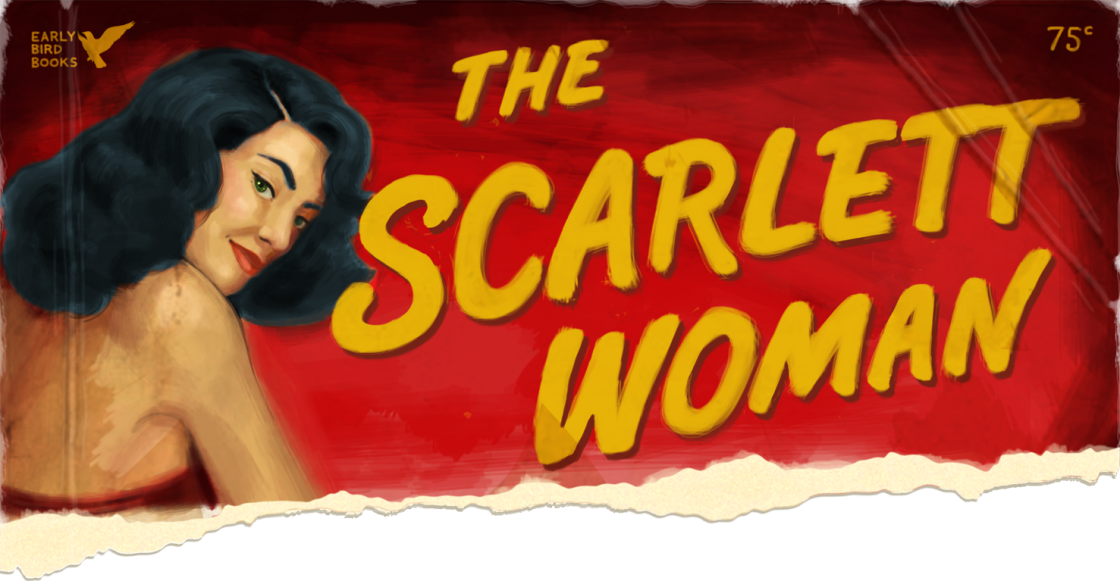
Pretty Girl Bullshit.


White Girl Problems is the latest Twitter phenomenon to sweep the pop culture world, with such gems as “Fine, if that’s the way you’re going to act, then you’re uninvited to my Elizabeth Taylor memorial cocktails” and “I’m sorry you think I’m being a bitch”; the passive-aggressive “apology” heard in relationships the world over.

While the Twitter profile is poignantly taking the piss out of the problems of the privileged, there is the issue of race there, also.

Like, why is it called White Girl Problems? Why not Privileged Girl Problems? Or Rich Girl Problems? But even with that, it would be feeding into the classism debate. Whichever way you look at it, White Girl Problems is a double entrendre of racism and classism.

It also highlights the body image battle a lot of young girls face, be they white, black, rich, poor, or whatever. Here are a couple of examples:


While I’m not personally offended by the Twitter feed (I am a white girl with [first world] problems, after all), I can understand why some might be.

Racialicious, actually writing about the Alexandra Wallace/“Asians in the Library” scandal, says that it all comes down to “white female privilege”, meaning “you can say more outrageous shit because you’re a pretty white lady”.

That may be so (I have been known to voice my opinion on all manner of topics that may be deemed controversial: the baptism of babies being bullshit, pretentious parenting, and abortion [more to come on that last one in coming weeks]), but how long have men—of all races but, yes, particularly Caucasian ones—been getting away with it? And still are. Charlie Sheen and Chris Brown are two names that spring to mind…

Related: First World Problems.

Rihanna’s “S&M”: Is It Really So Much Worse Than Her Other Stuff?

Guilty Until Proven Innocent: Charlie Sheen’s Witness.

Why Are Famous Men Forgiven for Their Wrongdoings, While Women Are Vilified for Much Less?

Elsewhere: [Twitter] White Girl Problems.

[Racialicious] Go After the Privilege, Not the Tits: Afterthoughts on Alexandra Wallace & White Female Privilege.

Images via TV.IGN, Anu News, Film Junk.
Rihanna’s “S&M”: Is it Really So Much Worse Than Her Other Stuff?

Rihanna said it herself: “They watched ‘Umbrella’… I was full nude.”

So why so much fuss about her latest offering, “S&M”?

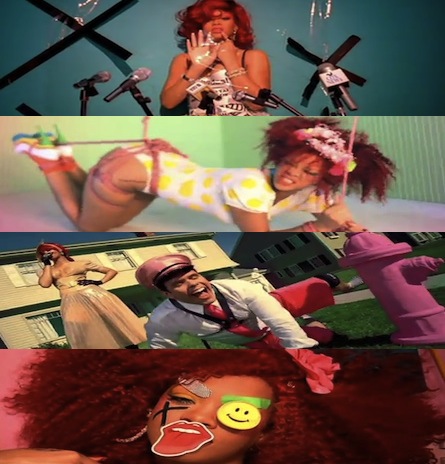
Sure, the title, lyrics and film clip are controversial at best, but once they are unwrapped and their true meaning is revealed, the song is more a dig at the press and Rihanna’s sadomasochistic relationship with them, hence Perez Hilton’s appearance.

The video does deal with sexual violence also, which Rihanna is no stranger to, but this time around it’s consensual violence. Jezebel explains:

“It’s notable, though, following her assault by Chris Brown, that in the video for ‘S&M,’ she’s interested in exploring consensual acts of violence and aggression, and finding pleasure in pain. Although she does appear bound in the video (as well as literally restrained by the media), mostly she plays the role of a dominant, perhaps to prove (or remind us) that she’s the one in control. Is this the desire of one who’s been called a victim? To recast oneself as authoritative and commanding?”

The film clip—the aspect of the song that has drawn the most controversy—is actually not that bad, in my opinion. It’s got a bright, pop-arty feel (a direction which the singer seems to be heading in these days), and “shows us a bright, vivid, eye-popping adult playground of her own imaginative making, exciting chains and whips [just happen to be] included.”

Where “Madonna and Lady Gaga have cornered the market on the black pleather and whips on white backgrounds of the S&M-themed music-video world… Rihanna is refusing to cede them the entire territory: She’ll do S&M if she wants to, she’s just going to make it really, really goofy.”

Granted, both Madonna and Lady Gaga’s videos and music are a cut above Rihanna’s, who is somewhere between Katy Perry’s “California Gurls” and Gaga’s “Telephone”, but you’ve got to admit: “S&M” is something a bit different, and something that’s getting people talking. And that’s the aim of the game, right?

Think of Rihanna’s other videos for a moment: “Te Amo” featured Laetitia Casta as Rihanna’s lesbian love interest; “Rude Boy” shows the singer peeking down the pants of a male dancer; her collaboration with Eminem in “Love the Way You Lie” dealt with domestic violence; and the aforementioned “Umbrella” marked her transition from “good girl” to “gone bad”.

Lyric-wise, “S&M” (Sex in the air, I don’t care, I love the smell of it/Sticks and stones may break my bones/But whips and chains excite me) is probably equally as graphic as “Rude Boy” (Come here rude boy, boy, can you get it up?/Come here rude boy, boy, is you big enough?). But officials in the UK don’t think so, with the song being completely reworked and renamed (“Come On”) so it can get radio play.

I do see their point—that they’re trying to protect the children or something—but if that’s the case, just don’t play the video on Video Hits; save it for cable television or late-night music programs. But that’s also the combined beauty and curse of the internet age: tech-savvy kids are just going to access the video online.

Related: Whipped Cream Feminism: The Underlying Message in Katy Perry’s “California Gurls” Video.

Elsewhere: [Digital Spy] Rihanna Video Labeled Inappropriate.

[Billboard] Sneak Peak of Rihanna’s “S&M” Video.

[Jezebel] Rihanna’s New Video Celebrates Ball-Gags, Whips & Latex.

[The New Gay] Yes, Master: Rihanna’s S&M World.

[New York Magazine] Rihanna Gets Tied Up in Technicolour for S&M Video.

Images via YouTube.