Music Videos: Who’s the Copycat Now, Katy Perry?

Lady Gaga copped a lot of flak for reappropriating everything from Madonna’s “Express Yourself” to Hieronymus Bosch to Michael Jackson’s white gloves, but at least she waited more than five minutes to use them as inspiration. What’s Katy Perry’s excuse for blatantly ripping off Gaga’s “Born this Way” video, replete with mythical equine figures, rebirth and alien-esque cheekbones, for her “E.T” video?

And so the feud between Perry and Gaga rages on.

Related: Lady Gaga: Taking Inspiration from The Wizard of Oz.

Whipped Cream Feminism: The Underlying Message in Katy Perry’s “California Gurls” Video.

Katy P. VS. Lady G.

Elsewhere: [FlavorWire] A Guide to Signs & Symbols in Lady Gaga’s “Born This Way” Video.

Images via YouTube.

So Misunderstood.

Do you ever feel like you’re misunderstood?

Rachel Hills does, in “Lessons in Feminist Activism, From Someone Who Has Been on Both Sides”:

“I felt like I was being mischaracterised… by 20 I was well and truly a feminist. A bottle-blonde, Elle Woods style feminist with a penchant for pink, perhaps, but very definitely a feminist nonetheless.”

And I certainly do sometimes. The other day I was called a “closet feminist”, which I found as offensive as if I had been homosexual and called closeted. Or, just because I take pride in my appearance and like me a new clothing purchase here or there, the copious amounts of blogs, articles, books and non-fashion-related magazines I read mean nothing, because people think all I read about is fashion. (To be honest, I find nothing more boring than reading about fashion.) Or, when I asked to borrow a copy of a friend’s Time magazine when they were done with it, they retorted with “why?! There’s no fashion or celebrity items in there!” (It was the 100 Most Influential People issue with Lady Gaga on the cover, so technically, there were celebrity items in there!)

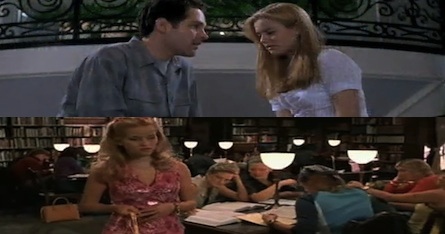
Sometimes I feel like my life is one big Clueless repeat. When Cher cracks it with Josh for telling her not to worry about her dad’s business going under and to go shopping instead, that is a constant conversation I seem to have with people in my life.

Or, in Legally Blonde, which Hills refers to, when Elle is shunned from Enid Wexler’s study group when she approaches them in her signature uniform of pink, bearing a basket of muffins; I can’t say an incident like that has ever happened to me, but I can definitely empathise with Elle’s dejected feeling when she’s deemed not worthy (or not smart) enough to join their group.

Not everybody makes me feel like this: I have a handful of very close friends who know me inside and out, and know that what I present myself as on the outside is not necessarily a reflection of what’s on the inside.

My defense mechanism is to put on a cold, ditzy, Valley Girl-esque persona, which is why most people don’t like me when they meet me. But at the end of the day, it’s not about what people who don’t know you think about you; as long as you, and the people close to you, are happy with who you are, not what you wear or what you choose to do in your own time, that’s all that matters.

Related: It’s All About Popular… Lar, Lar, Lar, Lar.

Women in Fiction: My Favourite Fictional Females.

What’s the Use of Being Supergirl if I Can’t Even Get a Date?

Pop-Culture Power Women.

Elsewhere: [Musings of an Inappropriate Woman] Lessons in Feminist Activism, From Someone Who Has Been on Both Sides.

[Musings of an Inappropriate Woman] Have You Ever Seen Yourself Through Someone Else’s Eyes?

Images via YouTube.

UPDATED: Lady Gaga—Taking Inspiration from The Wizard of Oz.

Lady Gaga on her influences, from Vogue, March 2011:

“Gaga herself is very open about her influences. ‘It’s not a secret that I have been inspired by tons of people,’ she says. ‘David Bowie and Prince being the most paramount in terms of live performance.’ She also seems to have made peace with the fact that she is compared to—or, less charitably, accused of ripping off—nearly every artist of the last 50 years. ‘I could go on and on about all of the people I have been compared to—from Madonna to Grace Jones to Debbie Harry to Elton John to Marilyn Manson to Yoko Ono—but at a certain point you have to realise that what they are saying is that I am cut from the cloth of performer, that I am like all of those people in spirit’… ‘She was born this way.'”

With the release of “Born This Way”, critics are wondering if Lady Gaga isn’t as original as they once thought she was. The song blatantly rips off takes inspiration from Madonna’s “Express Yourself”, and a lot of Gaga’s past works are heavily influence by Her Madgesty.

But Lady Gaga has always been about much more than just her music. It’s all about the fashion, hello?!

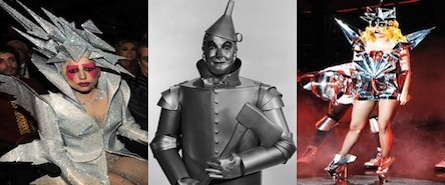
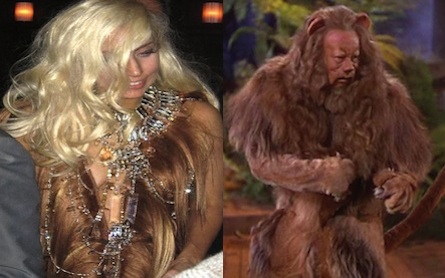
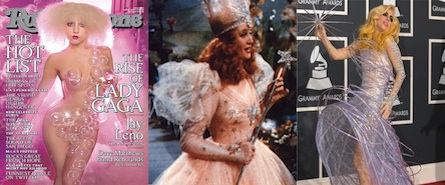
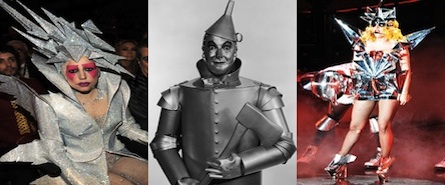
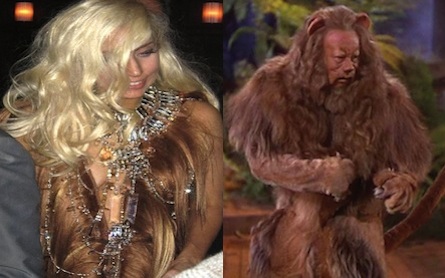
But even her outrageous outfits—bar the meat dress and a couple of others—aren’t that original when you come to think of it. Juxtaposed against The Wizard of Oz‘s Cowardly Lion, Good Witch of the South, Tin Man et al., Gaga proves that imitation is the sincerest form of flattery.

Related: Lady Gaga: Taking Inspiration from The Wizard of Oz.

Pop Culture Role Models.

Chase You Down Until You Love Me, Paparazzi…

Lady Gaga’s “Telephone” & 21st Century Noise.

Katy P. VS. Lady G.

Lady Most Likely: Time Magazine’s 100 Most Influential People.

Images via Amy Grindhouse, Wired, Billboard, Just Nuggets, The Examiner, Leopard Print & Lace, Pony & Pink, Pollsb, TV Tropes, Beauty & the Feast, Wikia, Wendy’s World of Oz.

Lady Gaga: Taking Inspiration from The Wizard of Oz.

With the release of “Born This Way”, critics are wondering if Lady Gaga isn’t as original as they once thought she was. The song blatantly rips off takes inspiration from Madonna’s “Express Yourself”, and a lot of Gaga’s past works are heavily influence by Her Madgesty.

But Lady Gaga has always been about much more than just her music. It’s all about the fashion, hello?!

But even her outrageous outfits—bar the meat dress and a couple of others—aren’t that original when you come to think of it. Juxtaposed against The Wizard of Oz‘s Cowardly Lion, Good Witch of the South, Tin Man et al., Gaga proves that imitation is the sincerest form of flattery.

Images via Amy Grindhouse, Wired, Billboard, Just Nuggets, The Examiner, Leopard Print & Lace, Pony & Pink, Pollsb, TV Tropes, Beauty & the Feast, Wikia, Wendy’s World of Oz.

Born This Way.


From “If We’re Born Gay, How Would We Know?” by Lisa Wade on Jezebel:

“It is a specifically American belief that gay men act feminine and lesbians act masculine.  But, in fact, gay men and lesbians have a wide range of gender performances, as do straight and bisexual people.  In fact, most of us could probably find a picture or two in our histories showing gender non-conformity.  Meanwhile, most gay men and lesbians could probably find pictures of themselves conforming.  That gender performance is associated with sexual orientation in our society is a belief in U.S. culture, but it’s not somehow inevitable or biological.”

Elsewhere: [Jezebel] If We’re Born Gay, How Would We Know?

Images via YouTube.

Pop Culture Role Models.


From “Ita Rap & Tyra Parody Clips (and Girl Culture Stereotypes)” by Erica Bartle on Girl with a Satchel:

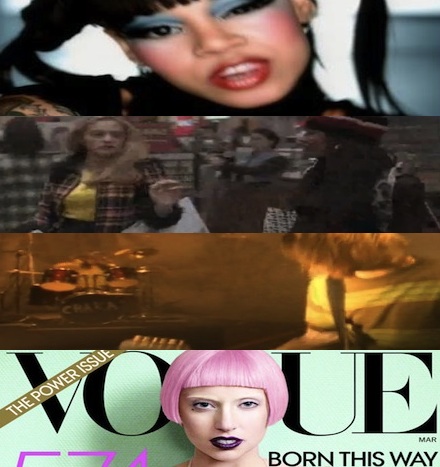
“In my teens, I played the R’n’B Boyz II Men/TLC lover, the shopping-mad Clueless girl, the Waves reading surfer girl, the Converse-wearing/Nirvana listening grunge girl (way before ’emo’ became a sub-culture of its own)—experimenting with these identities helped me forge social connections; pop culture informed the dialogue with my friends (we spoke in song lyrics and TV show-isms) and clothing help me fit in.

“Sub-culture identities fulfilled a purpose at the time: giving us something to cling to in the name of social approval. And there are plenty of readily available stereotypes, processed by the pop-culture machine, waiting to capture the attention (and money) of eager participants looking for some way to feel a legitimate part of the world. Lady Gaga’s tribe of Little Monsters being a case in point.

“But do they know, do they realise, that while freeing themselves from the scary terrain of the ‘outcast’, by buying into these social structures with their lingo and uniforms and Facebook groups, that they are actually binding themselves up, beholden to group approval based on one’s ability to play to type? And how many years it takes to strip all that superficiality away—with its various image-friendly accouterments—before you can truly say that you are free from artifice?”

Elsewhere: [Girl with a Satchel] Ita Rap & Tyra Parody Clips (and Girl Culture Stereotypes).

Images via YouTube, The Central Box, Oh the Scandal.

On the (Rest of the) Net.


“A Brief History of the Bump Watch.”

And for any preggo Scarlett Women out there, this one’s also for you: “What You NEVER, Not in a Million Years, Expect When You’re Expecting”.

Dodai Stewart discovers the benefits of jeggings.

In the wake of St. Kilda’s most recent sex scandal (Ricky Nixon and the same underage girl who released damaging nude photos of St. Kilda players Nick Riewoldt and Nick Dal Santo in December, for those of you who have been under a rock the last week or so), Hawthorn’s Lance Franklin has released a sexist line of t-shirts.

Also with the St. Kilda Schoolgirl Scandal, Round 2, Mia Freedman writes:

“… I think it’s extremely interesting how she is indeed redressing the power imbalance between a 17-year-old girl and high profile AFL players and managers. She’s using social media and traditional media in ways that have been both surprising and disturbing to watch.”

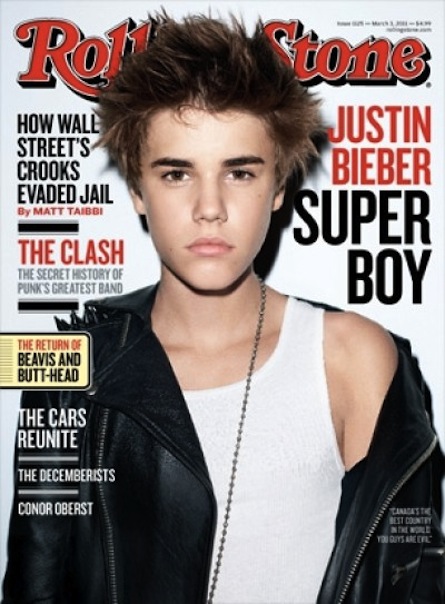
Freedman shares her views on Justin Bieber’s recent abortion comments, as well. More on this to come next week.

For all the single ladies (put your hands up!), “10 More Reasons You’re Not Married”, which include such gems as “you’re not good enough at fellatio or you’re too good at fellatio,” “you are too fat or too skinny” and “you want children too much and/or not enough”. It seems we can’t (or can) win.

Guest Girl with a Satchel blogger, Georgie Carroll of Frangipani Princess, talks teen magazines. “… My favourite day of the month is still when the newest issues hit the stand”; mine too.

On femme fatales.

Jenna Sauers attends a Fashion Week PETA party and “talks about animals with Tim Gunn”. Interesting stuff.

Are Lady Gaga and Rihanna really original, or “stealing other artists’ work”?

Are you a fan of kangaroo meat? Read this; it might change your mind:

“Like the seal trade, it’s brutal, but it happens away from our view, at night in the bush. According to the law, adult kangaroos should be killed by a single shot to the brain.  But in reality, many are injured in the neck or the body, and flee into the bush where they die slowly and painfully.

“What’s even less known is the terrible fate of joeys, just like the one Ray waded into turbulent flood waters to save: over a million a year are killed each year along with their mothers. How? The hunter stomps on the pouch joey’s head, or bludgeons him or her with a metal pipe.  This is enough to make you think twice about ever putting roo on the menu. The young outside the pouch are shot through the heart or head.”

Images via Romantic Dreaming, Juciytings.

The Underlying Message in Madonna’s “Like a Prayer” Video.

About a month ago, I posted a quick revision of a presentation I did at uni on Madonna’s most controversial videos. In it, I wished to go into further detail on “Madonna’s influence on the music video and religion in pop culture”. Here I attempt to do so.

Another pop culture icon who’s had a big influence on modern religion is Oprah, who pushes her brand of “pick and mix religion” to her millions of followers. Funnily enough, Shmoop comes to a similar conclusion about the “Like a Prayer” video:

“The blending of Italian American and African American traditions and cultures should also be considered a postmodern choice. It resists interpretation. Where a critic might try to understand the video as an endorsement of Catholicism, the blending of Catholicism with the African Methodist Episcopal choir Madonna meets in her dream prevents such a simple interpretation. The video is neither here nor there on particular religions, only communicating the power of some force of faith to empower her.”

But when the video was released in 1989, that was the least of its critics’ problems. Perhaps it was the rape scene at the beginning, the depicition of a “black Christ”, who was in actuality the black Saint Martin de Porres, to critique racism, or—my pick—the burning crosses in the field behind Madonna, who prances around in black negligee. It could have been any combination of these factors that made Pepsi back out of its $5 million deal with the star in the aftermath of the video’s release.

Granted, the film clip was made more than twenty years ago, and it was groundbreaking for its time. However, fast-forward to 2011, and what we’ve seen since then makes “Like a Prayer” seem positively tame.

Madonna herself has been responsible for some of these, like her clip the following year for “Justify My Love”, her Sex book or, on the tamer side of things, kissing Britney Spears and Christina Aguilera onstage at the MTV Video Music Awards in 2003, which seems to be an enduring image of ranch culture in this day and age.

But you don’t go about these things without thinking of them seriously, and that’s why Madonna’s legacy has persisted all these years. She knew exactly what she was doing in that clip, and all other clips that followed. The fact that at the end of the song the events of the clip are revealed to be a performance indicates that “we all play a part in this little scenario”. What part, exactly?

While religious groups trying to get the video banned could be interpreted as the Church being unwilling to accept square pegs that don’t fit into round holes, Pepsi backing out of their deal with the star is an example of big conglomerates being scared to buck the system and take a risk less they lose customers.

Someone who isn’t afraid to buck the system and is accepting of all walks of life (except, perhaps, those whose body parts were used in the assembling of her meat dress) is Lady Gaga, who is a huge Madonna fan, if some of her recent videos are anything to go by. Last year I blogged about Gaga’s film clip for “Alejandro” and how it emulated “Like a Prayer” and other Madonna videos almost to a tee.

While we would like to think that we have grown as a society and have become more accepting of different people in the twenty years since “Like a Prayer” was banned, “Alejandro”’s critical reception from religious and parenting groups may indicate otherwise…

Related: More Madonna.

Katy P. VS. Lady G.

Madonna (and Her Brand of “Feminism”) On the Rocks.

Elsewhere: [Shmoop] Like a Prayer Meaning.

Images via YouTube.

Rihanna’s “S&M”: Is it Really So Much Worse Than Her Other Stuff?

Rihanna said it herself: “They watched ‘Umbrella’… I was full nude.”

So why so much fuss about her latest offering, “S&M”?

Sure, the title, lyrics and film clip are controversial at best, but once they are unwrapped and their true meaning is revealed, the song is more a dig at the press and Rihanna’s sadomasochistic relationship with them, hence Perez Hilton’s appearance.

The video does deal with sexual violence also, which Rihanna is no stranger to, but this time around it’s consensual violence. Jezebel explains:

“It’s notable, though, following her assault by Chris Brown, that in the video for ‘S&M,’ she’s interested in exploring consensual acts of violence and aggression, and finding pleasure in pain. Although she does appear bound in the video (as well as literally restrained by the media), mostly she plays the role of a dominant, perhaps to prove (or remind us) that she’s the one in control. Is this the desire of one who’s been called a victim? To recast oneself as authoritative and commanding?”

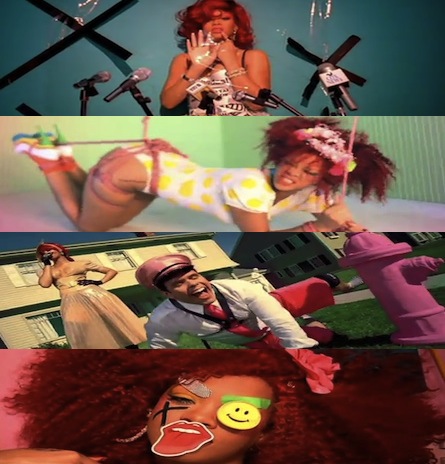
The film clip—the aspect of the song that has drawn the most controversy—is actually not that bad, in my opinion. It’s got a bright, pop-arty feel (a direction which the singer seems to be heading in these days), and “shows us a bright, vivid, eye-popping adult playground of her own imaginative making, exciting chains and whips [just happen to be] included.”

Where “Madonna and Lady Gaga have cornered the market on the black pleather and whips on white backgrounds of the S&M-themed music-video world… Rihanna is refusing to cede them the entire territory: She’ll do S&M if she wants to, she’s just going to make it really, really goofy.”

Granted, both Madonna and Lady Gaga’s videos and music are a cut above Rihanna’s, who is somewhere between Katy Perry’s “California Gurls” and Gaga’s “Telephone”, but you’ve got to admit: “S&M” is something a bit different, and something that’s getting people talking. And that’s the aim of the game, right?

Think of Rihanna’s other videos for a moment: “Te Amo” featured Laetitia Casta as Rihanna’s lesbian love interest; “Rude Boy” shows the singer peeking down the pants of a male dancer; her collaboration with Eminem in “Love the Way You Lie” dealt with domestic violence; and the aforementioned “Umbrella” marked her transition from “good girl” to “gone bad”.

Lyric-wise, “S&M” (Sex in the air, I don’t care, I love the smell of it/Sticks and stones may break my bones/But whips and chains excite me) is probably equally as graphic as “Rude Boy” (Come here rude boy, boy, can you get it up?/Come here rude boy, boy, is you big enough?). But officials in the UK don’t think so, with the song being completely reworked and renamed (“Come On”) so it can get radio play.

I do see their point—that they’re trying to protect the children or something—but if that’s the case, just don’t play the video on Video Hits; save it for cable television or late-night music programs. But that’s also the combined beauty and curse of the internet age: tech-savvy kids are just going to access the video online.

Related: Whipped Cream Feminism: The Underlying Message in Katy Perry’s “California Gurls” Video.

Elsewhere: [Digital Spy] Rihanna Video Labeled Inappropriate.

[Billboard] Sneak Peak of Rihanna’s “S&M” Video.

[Jezebel] Rihanna’s New Video Celebrates Ball-Gags, Whips & Latex.

[The New Gay] Yes, Master: Rihanna’s S&M World.

[New York Magazine] Rihanna Gets Tied Up in Technicolour for S&M Video.

Images via YouTube.

On the (Rest of the) Net.

Flavorwire celebrates the Chinese New Year with “40 Culturally Relevant Rabbits”.

Ryan Gosling as feminist icon?

Jennifer Aniston controversially embraces her inner Lolita for Allure.

Speaking of… The allure of Mormon housewife blogs.

Chad Woody on “The Oprahverse”:

“This gets at my perennial problem with Oprah. She’s all about the self-determined destiny. This comes from hanging out constantly with celebrities, the cultural lottery winners of the world, and asking them about their origins and beliefs. Sure, some of them say they were lucky in some way, but what Oprah really digs for is that little gold nugget of ego in everyone that says, “I did it my way, and I always knew I would!” But success woven from big dreams is an easy pattern to discern if you’re only interviewing winners…”

While I don’t agree with Erica Bartle’s comments—I believe that Stefani Joanne Angelina Germanotta was “born this way” as Lady Gaga, and everything she does is an extension of herself—the girl with the satchel raises some interesting points about not needing “an alter ego when you’re happy with who you really are”.

Also at GWAS, Bartle laments the demise of The Saturday Age’s A2 supplement in favour of “the more generic Fairfax Life & Style moniker). I feel your pain :(.

“Why I (Really, Seriously, Truly) Hate Carrie Bradshaw”:

“…If I ever saw a woman dressed like that either here in the city, or anywhere else in the world, I’d throw a Twinkie at them, tell them to take a long look in the mirror and eat a damn carb for a change. Yes, I keep Twinkies on me for such occasions… Carrie once threw a Big Mac at Big, so throwing things have been all the rage ever since, right?”

Not only do strong women get branded “the bitch” for knowing what they want and standing up for themselves (if I can be so cavalier, I consider myself a strong woman who is often called “bitch”), but apparently it’s hardest for us to find equally as strong, if not stronger, men in the dating market. Woe is us.

Some more thoughts from Sarah Wilson:

“… Men aren’t happy because they’re not being real men. They’re denied the opportunity to pursue, to go after the woman they reckon is perfect for them. That’s because they’re being pursued by women. Why? Cos everything is out of whack (women are used to chasing things and get impatient when men don’t approach, but also because the men aren’t pursuing… cos they don’t have to… and it goes around and around). And so men feel emasculated by this. Because men are meant to be the hunters.  The peacocks who do dances and display their prowess to women, to earn female trust and affection. Since the cost of partnering is higher for women, they must be fussier and sit back and weigh up their options. This is a biological imperative.”

In a similar vein, “The Sexual Cost of Female Success”:

“…What’s important is getting women to question every decision they make on the grounds of what insecure men might potentially think about it, men you’d never want to date anyway because their insecurities would make the relationship hell. And, more importantly, because you’re not physically attracted to them—something no amount of data or bullshit studies on the internet will ever change. Yes, women are ruining everything by not planning their lives expressly according to men’s biological clocks and wishes.”

Gender Agenda and Melinda Tankard-Reist get their wordplay on in the fight against Kanye West’s Monster video.

Can everyone get over Michelle Obama’s clothing choices already?:

“Michelle Obama is a Princeton and Harvard-educated lawyer and former executive at the University of Chicago Hospitals system who happens to dress pretty well and be married to the president of the United States of America. But what are the stories about her that have dominated the media? They’re not about her skills, her experience, her mind, or even about her almost disgustingly uncontroversial pet issue, fighting childhood obesity. The Michelle Obama News is about whether her eyebrows are ‘angry.’ Whether her clothes mark her as a ‘new Marie Antoinette’… [or a] ‘new Jackie Kennedy.'”

The straight guy’s guide to Glee.

In response to Natasha Vargas-Cooper’s “Hardcore”, Tana Ganeva debunks “The Anti-Male, Anti-Sex Falsehoods That Rule Discussions About Porn and Sexuality”.

Shut up, Mark Latham!

I disagree with most of Miranda Devine’s views in “Buying a Baby—Not a Pair of Shoes”, but one thing’s for sure: Nicole Kidman’s surrogacy is one contentious issue.

The secret diary of a call girl.

The private lives of Pippa Lee public people.

The dating game according to the ladies of the Jersey Shore.

“The Baby-Sitters Club: Where Are They Now?”

Image via Sassi Sam.