Magazines: Poor Little Rich Girl—Who Cover Girl Heidi Montag.


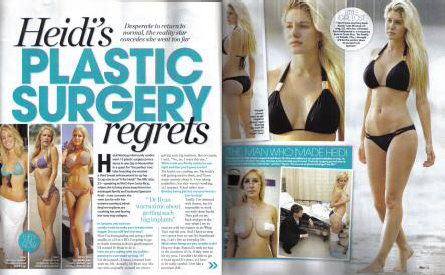
I’ve blogged in the past about how sorry I feel for Heidi Montag. And now, apparently, she feels sorry for herself after undergoing ten completely unnecessary plastic surgery procedures in one day.

It was only a matter of time before regret seeped into her consciousness and , once again, Montag’s expressing it publicly.

Seen on the cover of Who with bandages covering her nose, Michael Jackson-style (whom she references in the accompanying article, saying “I don’t want my face to fall off like Michael Jackson’s), and dark roots (“I’m just done worrying about my looks. I haven’t died my hair for months and I hardly even put on makeup anymore.”), it seems Montag has had a change of heart.

Unfortunately, there’s no going back, and with her plastic surgeon, Dr. Ryan, dying in a car accident last month, it looks like there’ll be no amending the work of her beloved surgeon by the man who created Heidi 2.0 (well, actually, 3.0, as she had a nose and boob job a few years ago after she first started on The Hills and, incidentally, met über-douche estranged husband Spencer Pratt).

Related: Why Are Famous Men Forgiven for Their Wrongdoings, While Women Are Vilified for Much Less?

The Hills Have (Dead) Eyes.

In Defence of Barbie.

Last week I posted a story about my favourite fictional females, and Barbie was one of them.

Granted, she’s not exactly fictional, but she’s by no means “real”, and doesn’t represent real women in any way. So much so that if Barbie were alive, she would be so underweight she wouldn’t be able to menstruate, and so out of proportion that she would fall over.

These factors aside, I loved Barbie as a kid. Still do. Being as innocent and ignorant as children are, I was oblivious to the fact that Barbie is allegedly a bad role model for kids. Sure, I often wished I was blonde haired and blue eyed like Barbie (which probably stemmed from both my mother and younger sister possessing these traits, and me feeling like the odd one out), but mostly Barbie instilled in me the ideal that I could be anyone I wanted to be.

Hello?! Barbie has had such occupations as a teacher (in nine different subjects, no less!), doctor, police and army officer, astronaut, ballerina, gymnast and even a McDonald’s employee, amongst many, many others (see the full list here).

Of course, some of these occupations required Barbie to rely on her looks (Baywatch lifeguard, model), but most of her occupations require legitimate skills in real life. And also in real life, some jobs do depend on workers’ appearances.

Barbie also acts as a blank canvas for young girls (and boys) to project their ideals onto her. Most times I played Barbies with my sister, we often put our dolls in high school situations. When the aforementioned Baywatch Barbie came out, with an accompanying dolphin toy, we transformed the bathroom into the beach. Even as I got older, my teenage friends and I used our Barbies as art projects and pop culture experiments. I remember a certain Michael Jackson version of Ken that totally kicked butt!

I changed my mind several times as I grew up about what I wanted to be when I actually did grow up, and Barbie came on that journey with me. From violinist, to vet, to actress to journalist (I wonder if there will be a blogger Barbie in the future…?), Barbie was there, helping me craft out my ambitions and, like, what I would wear.

Yes, Barbie is unrealistically beautiful and thin and leads a charmed life, but this doesn’t govern how she is perceived by little girls (and, again, boys) and how they play with her. She may serve as a guinea pig for Toy Story’s Sid-like torture, a model for the latest buzz-cut á la an aspiring hair-dresser, “a happy hetero, a lipstick lez, or a bitchin’ CEO” (my preference was for the power-suited latter), a way to express juvenile sexual interest while her owner remains a “good girl” (which perhaps contributes to the negative perception surrounding the doll), or remain exactly as Mattel intended her to be: an immaculate representation of femininity. And that’s okay.

Primarily, I think, again, that Barbie allows girls to be whoever they want to be. I don’t necessarily think young girls have a clear-cut perception of the perfection Barbie represents in the grown-up world; for them, she’s just a cool doll with a fab convertible, ever-changing wardrobe and a resume that will get her where she wants to go. Importantly, too, Ken is not a deciding factor in her life, and Barbie will do whatever she wants with or without the approval of the man in her life. And now that she’s divorced, perhaps she doesn’t need or want a man in her life at all.Maybe I’m just lucky; the presence of Barbie and exposure to pop-cultural representations of “traditional” femininity in my life at a young and susceptible age, I feel, has enriched my life rather than hindered the development of a healthy body image. Who can say what factors contribute to food, weight and body image issues in young (and old) women alike? I know I definitely can’t put my finger on the defining aspects in my life that have allowed me to think critically and actively about such things. But I do think a little too much emphasis is conveniently placed on Barbie as the culprit.

Related: Women in Fiction—My Favourite Fictional Females.

Is There Really a Beauty Myth?

Elsewhere: [Yahoo! Answers] What Would Barbie’s Measurements Be If She Were a Real Person?

[Wikipedia] Barbie’s Careers.

[Greteman] In Defence of Barbie.

Book Review: Another City, Not My Own by Dominick Dunne.

Two weeks ago I reviewed the lacklustre The Mansions of Limbo by Dominick Dunne. But as my favourite author, Dunne can do no wrong in my eyes. This time around, I’m reviewing the book that changed my life, Another City, Not My Own.

There’s nothing in particular that makes it a life changing book for probably anyone other than myself, but after I’d read it, there was no going back. I picked up the “novel in the form of a memoir” in mid 2009 after reading O.J. Simpson’s confessional, If I Did It. I had become fascinated and obsessed with the case, and Dunne’s commentary in the afterword was my first encounter with the famous name dropper.

I’m sure I Wikied him, as I do all new authors and books I come across to better familiarise myself with their writing and whether I want to commit to a book by them, and found out that Dunne was a Hollywood producer whose drug and alcohol fuelled lifestyle caused his wife to divorced him and the industry to shun him. Dunne became a recluse, penning his first New York Times Bestseller, The Winners, in a cabin in Oregon.

The murder of his daughter, Poltergeist star Dominique Dunne, and the subsequent “slap on the wrist” her killerand boyfriendreceived drew Dunne out of the woodwork and into the public glare once again. He became an advocate for victims rights and justice brought against rich and famous offenders, covering such high-profile cases as the trial of Claus von Bülow, charged with attempted murder as his estranged wife Sunny lay in a vegetative state after an alleged insulin overdose; Kennedy relatives Michael Skakel and William Kennedy Smith, serving time for the murder of teenage neighbour Martha Moxley (on which the 1993 novel, A Season in Purgatory, is based) and acquitted of rape charges, respectively; the Menedez murders; and, of course, the O.J. Simpson trial, for Vanity Fair. I could not get enough of his storied history and fascinating accounts of the dark side of Hollywood.

While I have only read a small sampling of Dunne’s published books, as they are quite hard to get a hold of, I just knew from the first self-deprecating paragraphs denouncing his credibility as a crime reporter and mention of the notorious footballer cum alleged murderer cum black hero O.J., as with all good books, that this was going to be one to remember.

Another City, Not My Own chronicles Dunne’s alter ego Gus Bailey’s return from New York back to the city that ruined his life, Los Angeles, for the murder trial of O.J. Simpson. It’s hard to tell what’s real and what’s fictionalised (Dunne’s real son Griffin is now Bailey’s son Grafton; A Season in Purgatory is the narrator’s book-turned-miniseries), and such famous names as Elizabeth Taylor, Frank Sinatra, the Spellings, Michael Jackson and Heidi Fleiss make guest appearances, if only in the form of dinner table gossip fodder. In addition, the larger-than-life main players, O.J., Nicole Brown Simpson, the Goldman family, Kim, Khloe and Kourtney’s dead daddy Robert Kardashian, pool boy Kato Kaelin, racist cop Mark Furhman, Nicole’s drug addicted friend, Faye Resnick, and super-lawyers, prosecutor Marcia Clark, and the arrogant Johnnie Cochran for the defence, make Another City, Not My Own read like a salacious gossip mag or blockbuster movie.

This book boats a twist, turn and pop culture reference on every page, making your eyes race to keep up as your mind tries to savour the action, because once you’ve read the shock ending, which links to another high profile ’90s murder, there’s no going back.

Related: The Mansions of Limbo by Dominick Dunne Review.

Lady Most Likely: Time Magazine’s 100 Most Influential People

Every time I turn on the readio, it seems like there’s a Will.I.Am collaboration (“3 Words” with Cheryl Cole; Usher’s “OMG”; “Imma Be” with Black Eyed Peas) or Will.I.Am sounding collaboration (“Nothin’ on You” by B.o.B.; “If We Ever Meet Again” by former über-producer Timbaland and Katy Perry) getting airtime. The BEP front man may indeed be the new Timabland, so I was surprised he didn’t make it onto the list. There’s always next year, I suppose…

Someone who did make it on, though, is Lady Gaga.

Cyndi Lauper, Gaga’s partner-in-crime for the MAC AIDS Fund, profiles her for possibly the most talked about ranking this year. I have no doubt Gaga is the most influential person in entertainment today, as she’s collaborating with and inspiring the fashion, beauty, art, advertising, music and film worlds with her own performance artas Lauper writes, “she is inspiring other artists to go further in their own work”and striking up water cooler conversation with her boundary pushing antics, both onstage and off.

Time is spot on in naming Marc Jacobs the only influential fashion figure. Jacobs, who is profiled by fellow fashionista and friend, Victoria Beckham, glamorised grunge, began the bag lady chic movement, and is now championing voluptuousness in his new season looks for Louis Vuitton and his titular line. Perhaps Karl Lagerfeld and Anna Wintour would have made welcome additions, but Jacobs certainly has the respect of all facets of the fashion world his peers, his models, his muses and his loyal subjects.

I am utterly dumbfounded to not see George Clooney on the list. Not only did he single-handedly organise the Hope for Haiti Now telethon but, like a fine wine, he only gets better with age.

In other “Artists” notes, shoe in Oprah is profiled by Phil Donahue, while her partner, “Mr Oprah” Stedman Graham makes the Least Influential list (more on that below); Robert Pattinson is bafflingly included (for influencing legions of teens and, worryingly, tweens ready and willing to let Pattinson bite them? Perhaps Brad and Angelina would have been better choices, as they actually contribute something to societyas well as being really, really ridiculously good looking. Or even Stephenie Meyer, without whom Pattinson wouldn’t have an Edward Cullen to broodingly portray); and “new media mogul” Ashton Kutcher, whom I was pleasantly surprised to see on the list.

Of course, President Obama makes an appearance as one of, if not the most influential leaders. While he certainly is the most well-known leader on the list, whether he’s been as influential as he could have during his first year in the presidency is a point of contention for a lot of politicos and American citizens.

My second favourite President (after Obama, George W. Bush is the only other President whose reign I was [un]lucky enough to grow up during, so Clinton wins via default), I find Bill Clinton funny, charming and smartalthough, hey may not have been utilising the latter during Lewinskygate. Nonetheless, he’s making positive change, and that’s all that matters here.

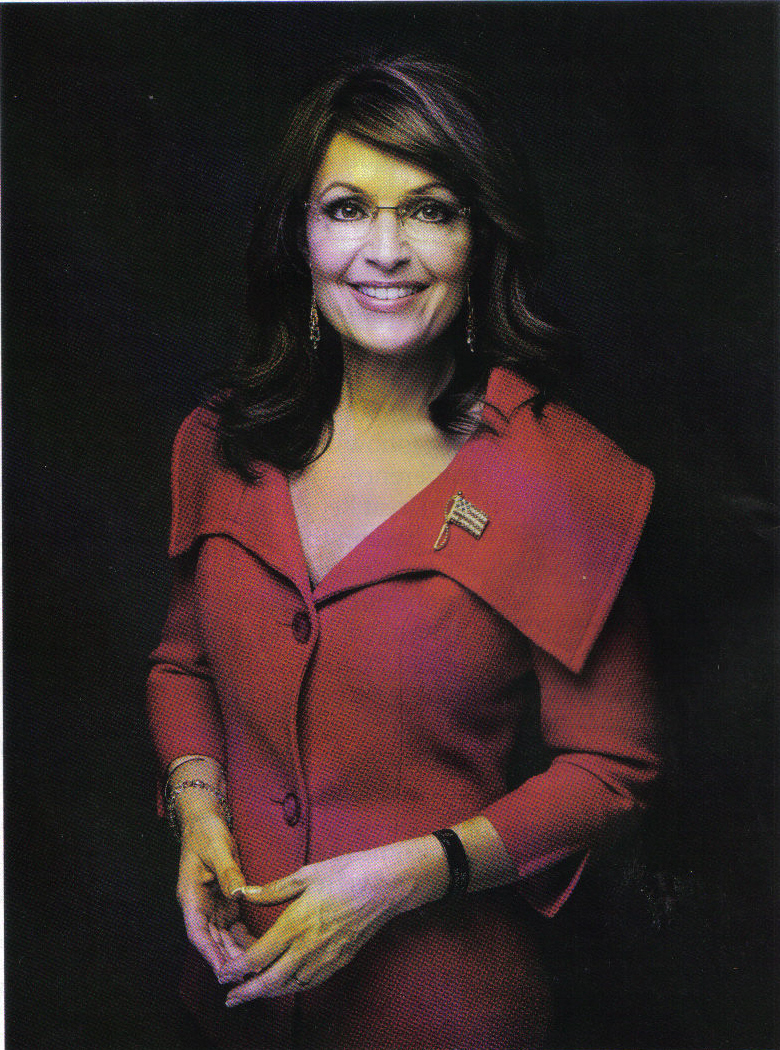
On the other hand, former vice-presidential candidate Sarah Palin makes the list. She is certainly fascinating and controversial, but I wouldn’t call her influential. Perhaps she would be more at home on Barbara Walters’ annual most fascinating people list?

Speaking of other lists, on page 96 you will find Joel Stein’s “The Time Bum Hundred”, relaying how he chronicled the 100 least influential people of 2010, split into “four categories… Losers, Flameouts, Morons and Slimy Bastards”. The complete list is not available in the mag, but it is on Time’s website.

Here is a sneak peak of “the Least Influential People Who Used to or Ought to Have Influence”, not including babies (who really are the least influential people in the world!), “the tattooed chick who messed up Sandra Bullocks’ marriage” (negative influence), and Tiger Woods, who just had a “bad year”, but is “still immensely influential, only now his influence lies in preventing men from texting their mistresses”: the Tom Tom GPS navigation system; “We Are the World 25 for Haiti”; Paula Adbul; Michael Jackson’s doctor, Dr. Conrad Murray who, unfortunately, was influential enough last year to play a key role in the death of Michael Jackson; Joaquin Phoenix; gay-disapprover, sex tape “without any sex” star and Former Miss California Carrie Prejean; “first dog” Bo Obama; George Clooney’s ex, Sarah Larson; former MTV TRL host Carson Daly; questionably, The Doors, who “actually sucked and just had a handsome lead singer”; Grover; Carrot Top; news anchor Katie Couric; John Edwards; the quintessential douche bag reality show dropout, Jon Gosselin; keeping it in the familyLindsay and Michael Lohan; Jersey Shore outcast Angelina Pivarnick; Bernie Madoff; Levi Johnston; Tila Tequila; Nicollette Sheridan; witches (“Charmed was like, ten years ago. It’s all about vampires, werewolves and zombies now”); anddrum roll pleaseSpencer Pratt and Heidi Montag, collectively known as Speidi. Let’s hope Heidi truly is uninfluential, especially for The Hills‘ primarily teen audience’ssake, or we could have an army of over-inflated, frozen-foreheaded Barbie clones on our hands.