Kate Spencer responds to an insulting op-ed in the New York Post about women who move to New York City only being interested in an image-based, money-obsessed Sex & the City lifestyle. But it’s the Post, what do we expect? [The Frisky]
Queensland’s new Premier, Campbell Newman, vetoes the state’s Literary Awards, in the Year of Reading and in a time when 1 in 5 Indigenous children are illiterate. This is why you don’t vote Liberal. [Courier Mail]
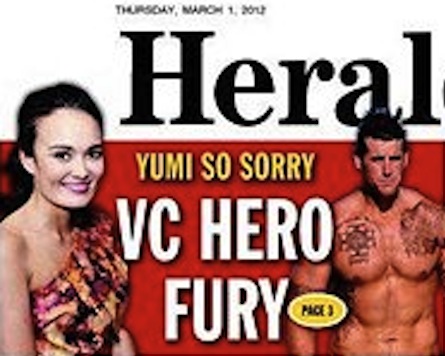
I know I only wrote about this earlier in the week, but since then, Mia Freedman has published a great article on MamaMia calling for an end to the torrent of abuse being hurled at Yumi Stynes for her comments about Corporal Ben Roberts-Smith last week.
And because Stynes is part Asian, you can bet much of the abuse is centered around her race.
This great article on ABC’s Ramp Up talks about a Herald Sun headline that stated “Yumi So Sorry”; where’s the public moral outcry surrounding that?!
But what really gets me is how all these people who are saying these horrible things about Stynes were initially outraged about her saying an apparently horrible thing. Isn’t that the pot calling the kettle black? It reminds me of militant pro-lifers blowing up abortion clinics and murdering abortion providers; um, hello?!
What do you think of the blatant double standards of political correctness in this country (which the Ramp Up article talks about pitch perfectly) and what’s happened to Stynes?
Finally! Glee acknowledges the racist stereotypes it’s perpetuating, and Santana had the guts to stand up and say it:
“You went from ‘La Cucaracha’ to a bullfighting mariachi. Why don’t you just dress up as the Taco Bell chihuahua and bark the theme song to Dora the Explora? You don’t even know enough [about Latin culture] to be embarrassed about these stereotypes you’re perpetuating.”
Well, kind of.
But let’s backtrack.
When Mr. Shue realises he doesn’t actually know enough about the Spanish language and culture to confidently call himself a Spanish teacher, he enrolls in Spanish night class, run by guest star Ricky Martin as David Martinez. “How did I become so out of touch?” Will wonders.
Firstly, become out of touch? Despite the New Directions kids’ undying devotion for him, Mr. Shue has been out of touch from day one. Not to mention his inappropriate relationships with his students.
And secondly, there’s a lot more to Latin culture than dressing up as a matador and singing “La Cucaracha”, as Santana and Mr. Martinez soon school him in.
But it wasn’t just the South American racial stereotypes who got their fair share of airtime last night. The black prejudice was out in full force, although not acknowledged by Glee. Cutting off their Latin nose to spite their black face?
Synchronised swim coach Roz Washington is one of the most racist characters on the show, in my opinion. She speaks in African American colloquialisms such as “bajonkajonk”. When she challenges Sue Sylvester for leadership of the Cheerios, she tells Sue her “stale white bread moves” aren’t working for the team anymore, insinuating that black girls dance better than white girls and buying into the stereotype that they do.
Also, Miss Pillsbury is on a mission to have her pamphlets infiltrate McKinley High and hands out some to Mercedes and Sam when they come to her about their relationship problems. The pamphlet that Mercedes receives is entitled, “So You’re a Two-Timin’ Ho?” whilst Sam’s reads, “So You’re Dating a Two-Timin’ Ho?” Do you think the show would have given such a racist and sexist title to a pamphlet received by Quinn, for example? They might as well have made the girl on the cover of the pamphlet black because that’s pretty much what they were insinuating: that Merecedes is the sassy, fat, angry, sex-crazed woman of colour.
It remains to be seen whether Glee will actually make an effort in the future to abolish the stereotypes it so readily holds up to its viewers…
Wow, where do I start? Last night’s episode of Glee focusing on Becky’s newfound interest in Artie and Mr. Shue asking Emma to marry him was one of the most offensive yet.
Let’s begin with Becky: I found it weird that Becky’s internal monologue was spoken in a British accent (Helen Mirren’s to be exact). She claims that it’s her head and she can sound however she wants, but how many “abled” characters have a different voice in their heads and make that justification for it? I though it was singling Becky out because of her disability.
She and Artie go on a date and, at first, Artie feels uncomfortable with it, but begins to get to know and like Becky. It came across as platonic on Artie’s end, but his fellow glee clubbers gave him the third degree about what kind of message he was giving Becky.
They urged him not to lead Becky on or give her the wrong idea, and Artie called them out on their hypocritical ways: “You guys talk a good game” about acceptance, but at the end of the day, they’re just as narrow minded as the rest of McKinley High, which pretty much sums up Glee. They think just because they’ve got black and Asian characters and characters in wheelchairs and with Down’s syndrome and characters who are gay they’re being “inclusive”, but really, they show is just using them as token gestures.
Take Kurt, for example: he hasn’t been the focus of many storylines of late, and the writers seem to just slot him in to the background. In the opening scene, Mercedes and Sam channel Sandy and Danny of Grease, while the rest of the glee club stand around imploring them to “tell me more, tell me more”. Kurt belongs to the girls’ group in this instance while his equally gay boyfriend, Blaine, is hanging with the boys on the bleachers. Furthermore, when Puck, Finn and Blaine act as backup singers to Artie, Will and Mike in their rendition of “Moves Like Jagger”, mashed up with “Jumpin’ Jack Flash”, Kurt is nowhere to be seen. Is it because he’s not sexy or masculine enough? Let’s remember that this isn’t the first time Glee has ostracised Kurt from the gender group he belongs to because of his sexuality. Didn’t Glee get the memo: gender and sexuality are not the same thing.
But back to Becky: when Artie takes into consideration what the rest of New Directions are trying to tell him, he asks Coach Sue, of all people, for advice.
It is revealed that Becky sent Artie a sexy photo and he feels weird about it. Sue asks if he felt the same when Brittany, no doubt, sent him similar pictures of herself. Artie replies no, but those were different circumstances. So even Artie, a man with disabilities himself, thinks someone with Down’s can’t be sexy. Hypocritical, much?
The other storyline driving this episode is Will and Emma’s relationship being taken to the next level in the form of marriage. Emma is so desperate for Will to propose that she fantasises about doing it herself. Funnily enough, Coach Beiste and Sue become her bridesmaids in the dream sequence, wearing Princess Eugenie and Beatrice’s royal wedding hats, respectively. They called Kate Middleton “Waity Katie” and I think that’s what the writers were playing into with Emma’s patient wait for Will to propose.
Will finally decides to propose and asks Finn to be his best man as apparently he has no grown up friends and because he thinks Finn has showed him what it means to be a good man. Pah!
Finn is the whiniest, most cowardly and simpering character on the show! He feels sorry for himself, has an unrealistic idea of what Rachel and women in general should be, is (or has been) embarrassed by Kurt’s sexuality and only stands up for those he loves after the fact. He also thinks that joining the army will fill the void that college football has left and make him more of a man.
To further illustrate Finn’s insecurity, he decides to ask Rachel to marry him because he’s got nothing else going for him!
I was also a bit disturbed by Sam’s inclusion in the synchronised swimming team, called the “Guppies” and lead by bronze Olympic medalist, Roz Washington, who is of African American descent. She also comments that Sam’s “trouty mouth” is one she’s never seen on a white kid. This, in addition to Becky’s dig at the possibility of dating Mike Chang (“I’m no rice queen”), makes “Yes/No” one of the worst episodes of Glee yet.
“This isn’t just a random channel 5 program anymore. Suddenly, this is feminism and misogyny in microcosm.” [Libertarian Lou’s Blog]
The leggings-as-pants debate continues, this time at feminaust. While MsElouise does make some good points about admonishing others for wearing leggings as pants being akin to fat-shaming and sexual harassment, I still maintain that if you’re going to go there, you should go there sans underwear. I’m all for a legging-as-workout pant or legging-as-costume (I regularly wear both options), but please, opt out of the VPL. Or at least wear a really long t-shirt.
Thank you, Sasha Pasulka, for writing this hard-hitting and just plain brilliant admonition of Chris Brown’s Grammys “comeback”. More to come on the abomination that is Brown next week. [HelloGiggles]
Why the Marilyn meme does more harm than good for body love:
“I would prefer the focus be on health, rather than appearance. The Monroe Meme seems about the furthest thing from healthy. This is a woman who abused alcohol and sleeping pills later in her life, this is a woman who (probably) died due to depression. But, hey, as long as someone thinks she looks good, I guess that’s what matters.” [Shameless Magazine]
The media-perpetuated myth of the bad man. Interestingly, substitute the words “bad” and “aggressive” for “weak” and “victim”, and you pretty much have the media-perpetuated myth of the good woman. No one can win in this game. [The Good Men Project]
Apparently conservatives are dumber than progressives. For the amount of Facebook arguments I’ve had on the topics of abortion and asylum seekers, this doesn’t surprise me. [HuffPo]
“‘God, you really don’t like being a woman, do you?’
“In two short moves we’d leapt from his infidelity to my ostensible gender dysmorphia and/or self-loathing…
“What struck me was that both Rex and the attorney had delivered ill-timed, emotionally charged information, and when I’d expressed proportionate anger or irritation, the blame somehow boomeranged back onto me. I’d been expected to remain amiable… [y]et their reaction was still confusion and rancor when I pointed out their inanity.
“How do we alter the notion that a woman who stands up for herself, her loved ones, or her beliefs is the one who’s causing trouble? By accepting once and for all that legitimate female anger isn’t the hallmark of a bitch, cunt, ballbuster, or drama queen.”
It’s amazing how some things we loved as children fail to live up to the hype as adults.
When I saw the ads for Space Jam on Go! last week, I just had to watch it. I haven’t seen it in a good ten or fifteen years, but it’s one of those childhood classics—like Home Alone or Mrs. Doubtfire—that you just have to watch given the opportunity.
And let me tell you, I haven’t seen such a sexist and racist kids movie in a very long time!
Firstly, there’s only one female in the whole movie that isn’t a wife, mother, child or housekeeper, and even those roles are very minor ones, appearing onscreen for less than five minutes in total. You can rest assured that Lola is objectified as the sexy, albeit sporty, “don’t-call-me-Doll” rabbit who wears short shorts and a midriff top, while everyone else wears actual basketball attire. On a side note, Pepé Le Pew makes a cameo in the film, which prompted my housemate to refer to him as the poster boy for sexual harassment. With his love interest, Penelope Pussycat, being one of only a few female Looney Tunes, Pepé is well within his rights to stalk and harass her til his heart’s content for deigning to be an attractive female in a male dominated world.
In the race department, the Looney Tunes aren’t really known for their fair portrayal of those who aren’t white and/or American. Look at Speedy Gonzales, Pepé, and the episodes featuring Ali Baba, blackface and Native Americans. But I found it shocking that the premise of Space Jam, which escaped me at a younger age, is capturing Michael Jordan to be a slave—replete with chains—at Moron Mountain theme park. A cartoon sequence that shows Moron Mountain’s owner, Mr. Swackhammer, fantasising about having Jordan as a side show attraction was a particularly low point of the movie.
Not only is Space Jam sexist and racist, but the plot has major holes in it. In one way I’m glad that I was able to see Space Jam for what it truly is, but on the other, I kind of wish it had stayed in childhood and remembered for its nostalgia.
In the spirit Christmas, I’ve decided to revisit some of my favourite posts of the year in the twelve days leading up to December 25th.
I’m taking this final 12-Posts-of-Christmas opportunity to squeeze two Rachel Berry-related posts into the one. Think of it as one last Scarlett Woman gift to you.
The first post was written “In Defence of Rachel Berry”, while the second explores the character as a feminist one. You can access the original posts here and here, respectively.
In the first season of Glee, Rachel Berry was introduced as an attention- and approval-seeking know-it-all diva, who sticks a gold star next to her name on the New Directions’ sign-up sheet because that’s what she sees herself as. Season two showed the glee clubber soften her resolve a bit, realising that she’s still only in high school, and has her post-high school years to carve out a Broadway career and have the world see her as the star she knows she is. The season final saw her choose a relationship with Finn Hudson in her senior year at McKinley High, despite having to leave him to head to New York when she graduates.
Not all young girls have to wrangle their feelings for the school jock whilst contemplating a move to the big city to make their dreams come true, but many of Rachel’s problems are shared by the show’s audience.
In the most recent Lady Gaga-themed episode, Rachel struggles to accept her “Jewish nose” and considers rhinoplasty. She also strives for the acceptance of her New Directions band mates, and to be seen as fashionable and popular.
It’s in the character’s nature to be highly-strung, goal-oriented and ambitious, so it’s not likely she’ll change any time soon. And why should she? While there are certainly other young women out there who identify more with the saccharine Quinn Fabray, the sassy soul sisters Santana Lopez and Mercedes Jones, or badass Lauren Zizes, there are plenty who see Rachel as their Glee counterpart, myself included.
A recent New York Times article by Carina Chocano praised the “relatable” and “realistically weak female character”, like Kristen Wigg’s Annie in Bridesmaids—“a jumble of flaws and contradictions”—over the “strong” one. “We don’t relate to [the weak character] despite the fact that she is weak, we relate to her because she is weak,” Chocano writes.
But what exactly does she mean by “weak”?
Pop culture commentator Dr. Karen Brooks notes that talented, beautiful, popular and successful female characters need to be broken down before they can be seen as relatable. “The more talented and beautiful you are, the greater the threat you pose and so ‘things’ are introduced to reduce that threat,” she says. Just look at the “women falling down” video on YouTube.
While Rachel’s had her fair share of setbacks, it seems Glee’s audience is finally beginning to understand her. “We’ve been given time to understand Rachel’s initially painful personality and to identify both her strengths and weaknesses. Her ambitions and drive haven’t shifted, but the context for understanding them has,” Brooks says.
“Rarely are unpleasant characters redeemed, they are simply ‘punished’, while the ‘good’ characters soar to impossible heights, not on the back of hard-work and self-belief, but usually [because of] a love interest and wishing hard. Rachel is a healthy and welcome exception to that,” Brooks continues.
So she’s an unlikely heroine we can all get behind, you might say? “A girl who reminds you of you,” as Chocano opines. An everywoman, if you will?
If Rachel Berry encourages more young women to see themselves as gold stars striving to have their accomplishments recognised, then so be it!
I wrote that audiences have come to know and love Rachel not because her obnoxious know-it-all persona has changed, but because “We’ve been given time to understand Rachel’s initially painful personality and to identify both her strengths and weaknesses. Her ambitions and drive haven’t shifted, but the context for understanding them has,” as Dr. Karen Brooks reiterates.
“I… have trouble with the vilification of Rachel Berry on a feminist level. How often do we dismiss women as ‘bossy,’ ‘know-it-all[s],’ or ‘control-freaks’ when their behavior would be interpreted as leadership, assertiveness, or courage if they were men?
“… In the right context, Rachel Berry’s personality would not seem ‘intolerable’ or ‘annoying’ so much as bad-ass, renegade, and hardcore.”
And Lady T, who used Rachel as her “Female Character of the Week” on The Funny Feminist, said:
“… The show wanted us to root for a girl who was ambitious, daring, and driven.”
It might be because I have been known to be seen as bossy, a know-it-all, a control-freak (just ask my new housemate!) and ambitious that I’m standing up for her, but just think of another feminist heroine in modern pop culture who could also be described using these words: Hermione Granger. The only difference is, she isn’t vilified for these attributes.
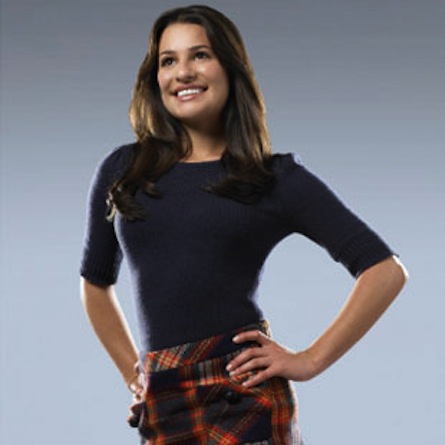
If you look back to the beginning of Glee, especially, Rachel was often deemed ugly. Now, anyone who’s seen Lea Michele knows she’s not exactly unconventionally attractive, but Rachel is characterised as this because she’s annoying. And she’s annoying because she stands up for herself, knows what she wants and how to get it. (From a racial point of view, she could also be seen as being “ugly” because of her Jewishness.)
Despite these inherently “unattractive” qualities, Rachel manages to snag her man, Finn, in what can be seen as typical Glee sexism and discrimination:
On the other hand, it can be seen as a poignant take on teenage life that the underdog is always being compared to the most popular girl in school: Quinn Fabray.
If Rachel is Glee’s feminist heroine, Quinn is her polar opposite. She has had next to no character development, which leads to her motivations changing week to week.
In “Original Song” she tore Rachel down, telling her to get over her “schoolgirl fantasy happy ending” with Finn, who would never leave Lima, taking over Burt Hummel’s mechanics business, with Quinn, a real estate agent.
But in “Born This Way”, she was “broken down” by her fat past coming back to haunt her, to come across as more “relatable”.
Sure, Rachel’s had her fair share of being “broken down” (being dumped and subsequently egged by Jesse St. James, being publicly broken up with by Finn, getting slushied… I sense a food theme here.), but in the grand Glee scheme of things, she’s actually doing pretty well for a female character.
In lieu of a new episode of Glee last week, I attended a debate about the pros and cons of McKinley High and its glee club.
I was super excited, because I assumed the debate would entail a for Glee side, and an against. And it did. But while I thought the against side, consisting of Clem Bastow and Jess McGuire, would discuss the blatant sexism, racism, homo/transphobia, ableism, fatism and the many other phobias and -isms the show incorporates (feel free to add them in the comments), both panelists ultimately praised Glee for it’s inclusiveness and handling of the tough issues.
I’ve heard this rationalisation about Glee before. When my tuba-playing gay friend finally got into the show this season and fell hard for it, he thought I would sing its praises with him because he knew I watched it. (Evidently, he does not read this blog as he would know the main reason I like Glee is because I know I’ll always get a blog post out of it!) When I invited him to the debate, he had something else on but wondered what they would be debating, exactly. I referred to the list of problems I have with it (above and elaborated on below) and he replied, “But I thought Glee was about acceptance.” That’s what it wants you to think, and it blinds you to all the other issues with Katy Perry songs. As panelist for the “pro-Glee” side, Mel Campbell, said, “It’s best not to ask questions.”
While McGuire did touch on Glee’s pro-gay stance, and perhaps its best, and most underutilised, storyline of Brittany and Santana’s forbidden love, I was expecting SlutWalk Melbourne organiser and noted feminist Bastow to knock Glee out of the park for its anti-women portrayals. I was also sorely disappointed, as Bastow, a keen musical aficionado, chose to focus on the shows’ butchering of classic musical numbers.
So, I thought I’d take this opportunity to write about the issues I wished the panel had discussed last Thursday night.
Sexism.
I’ve written about feminism in Glee before, specifically as it’s embodied in the character of Rachel Berry. It annoys me to no end that Rachel is deemed “ugly” (though Lea Michele is anything but) because she’s annoying. And she’s annoying because she eschews traditional gender roles that are perhaps embodied by Quinn by being ambitious, voicing her opinions and unapologetically going after what she wants.
Finally, I wouldn’t say sexism is the main problem in Mercedes’ perpetual (okay, she seems to have a boyfriend this season, but more on that later) bachelorettehood, rather some other issues I will address later in the piece.
Racism.
Now is as good a time as any to discuss Mercedes’ aforementioned singleness. Was she literally the only character in season two who didn’t have a significant other because she’s black? (Or because she’s fat?) Sure, she dated Sam for all of a few minutes in the season two final, but before that the only action she got was Kurt condescendingly suggesting she should date one of the guys on the football team because he was black and, like, they’d probably have heaps in common.
If that’s not enough proof of Glee’s insensitivity to race, all you need to do it look at any one episode for a myriad of references to Tina and Mike’s “Asianness”, Roy Flanagan’s “Irishness” (or leprechaunnes, as Brittany might refer to it) and Puck and Rachel’s “Jewishness” (though that also falls under religious prejudice as well).
Homophobia & Transphobia.
Sure, Glee’s pretty much a vehicle for Kurt and, increasingly, Blaine, to showcase their voices, fashion sense and flamboyance. McGuire chose to speak at length about how sensitively the show handled Kurt coming out to his dad and Kurt and Blaine’s first time, and I have to agree with her. And yes, seeing two men make gay love (okay, the implication of them making gay love) on primetime network television without a stink being kicked up is pretty groundbreaking, as panelist for Glee and MC, Tim Hunter, noted. But they still single out Kurt for his gayness (“Single Ladies [Put a Ring on It]” and “Le Jazz Hot!”, anyone?), not to mention how Finn went about outing Santana in “Mash Off”.
They’ve handled the Brittany/Santana thing the best out of every relationship in the show, so that’s one point for lesbianism, but at the expense of other sexual orientations and gender identities, perhaps?
Just look at “The Rocky Horror Glee Show”, for example. Not only to Mike’s parents make him pull out because they don’t want him associated with a “tranny” musical, but the show even substitutes the lyrics “I’m just a sweet transvestite from transsexual Transylvania” for “sensational Transylvania”. Pardon me, but I don’t see what all the fuss is about in using the word “transsexual”.
Finally, we can’t forget Coach Beiste. When she debuted on the show, her sexuality and gender was thrown up in the air, when she’s really just an unconventionally attractive, masculine straight woman who happens to coach a men’s football team. But of course attention is drawn to her 40-year-old virgin status every time there’s a virginity-themed episode. Because, you know, she’s old and funny-looking and has never been on a date! Riotous!
Ableism.
Where do I start? There’s Emma’s OCD, which is made fun of by everyone from Gwyneth Paltrow’s Holly Holiday to her own parents (not to mention Will trying to come to her rescue by attempting to “cure” her). Artie’s wheelchair-bound way of life, which was even pointed out during the debate, only for the panelists to laugh at Artie wanting to give Blaine a standing ovation, “because he can’t”, and a whole episode, “Wheels”, insensitively dedicated to his disability.
Puck’s rendition of “Fat Bottomed Girls” was a clip played at the talk, and was received by audible groans. To see Lauren so uncomfortable as Puck serenaded her was awkward for the audience, and the patronisation was palpable. Like, oh Glee has a plus-sized girl who doesn’t hate herself and is being chased by the hottest guy in school; we’ve come so far.
But when Mercedes is relegated to backing vocals in favour of the slim lined Rachel, can’t get a date and suffers from an alleged eating disorder which is swept under the rug with some sage advice and a granola bar from Quinn, it’s all just tokenism.
So there you have it: the debating of the issues I wished had’ve been brought up by the panel. As my friend, housemate and fellow debate-goer put it: “It was just like Glee: it slightly touched on the issues, but ultimately didn’t add anything new to the discourse.” So feel free to add anything I, or the panel, didn’t cover in the comments.
“I think… that a lot of men believe they prefer long hair—and wrong in that when it comes down to it, they don’t actually care all that much.
“I’m sure there are plenty of straight men who truly, inherently prefer long hair on women. But in my experience, the bulk of straight men who default to liking long hair on women just like women.” [Jezebel, via The Beheld]
“What I think is ‘holy shit is this hot!’ I notice the varieties in taste during certain parts of a girl’s cycle. It tastes sort of tart right after her period ends, gets musky around ovulation and then has full blown feminine sex scent right before her period. I loved doing it from the first time I tried it. In fact, I came without touching myself the first time I went down on a girl. There is no learning to like it. Heck, it puts me even closer to pussy than fucking does. How could a guy who likes girls possibly not like it. Overall it’s my favorite sexual experience. You don’t have the pressure of ‘fuck if I get too into this I’m going to cum too soon and disappoint her but if I hold off and take forever to cum I’m going to end up boring her/making her sore/making her think I’m not that into it’ that you get from intercourse. You just to get to dive into the best smell and taste in the world and be there until you see, feel, hear and taste her having an orgasm. It’s a powerful feeling. I think oral sex is awesome and the best form of contraception mankind has ever come up with. Same great orgasms, no risk of changing diapers down the line.” [Jezebel]
“The filmmakers missed a chance to bring a truly new perspective to the story by integrating it. Snow White is a made-up story, taking place in a made-up land. Why can’t the handsome prince be black? Why can’t the queen be black? There seems to be an Asian dwarf in the Mirror Mirror project, but none of the major characters in either film are of colour.” [Jezebel]
“There is an enormous problem in this world in regards to female body shaming, and not solely in regard to fat women, but all women. A size 2 woman who sees this ad sees the message: ‘If I don’t stay small, he will cheat’. A size 12 woman might see this ad and think “if I don’t lose 30lbs, he will cheat”. A size 32 woman could see this ad, and feel ‘I will never find love’. It’s horrific. Not all women are necessarily insecure, but it’s no secret that body insecurity is endemic, regardless of size. This kind of message is extremely damaging to self worth. Eating disorders may have lost their place in the media spotlight, but continue to effect people of all ages, especially teens. This sort of behavior can easily be triggered from the careless cruelty of advertisements like the one in question.” [Jezebel]








 The Scarlett Woman