Magazines: Scarlett Johansson on THOSE Photos.


I haven’t had a chance to pick up the new Vanity Fair yet, but after reading Scarlett Johansson’s comments on the nude photos of her that have surfaced in recent months, I can’t wait to see what else she’s got to say on sexting and slut-shaming (sext-shaming?):

“‘I know my best angles,’ she says with her trademark insouciance. ‘They were sent to my husband,’ now ex Ryan Reynolds. ‘There’s nothing wrong with that. It’s not like I was shooting a porno.’ She adds saucily, ‘Although there’s nothing wrong with that either.’”

Jezebel goes on to say:

“We appreciate Scarlett reminding the world that the only person who did something wrong in this situation is the guy who violated her privacy, not the adult woman who sent sexy photos to her partner.”

Amen to that!

Elsewhere: [Jezebel] Scarlett Johansson Would Like That Nude Pic Slut-Shaming to End.

Image via Daily Stab.

Slut-Shaming in Romantic Relationships: It’s Not On Unless It’s Not On.

Last week I upheld my tradition of throwing a Halloween party for my birthday.

Ahh, Halloween: the penchant for flesh-baring costumes has emerged as one of the most enduring aspects of the American holiday in recent years, heralding it, perhaps more appropriately, Slut-O-Ween.

Now, everyone (should) know that just because a woman wears a “slutty” or sexy costume, doesn’t mean she’s easy or is “asking for it”. It just means she likes her body and wants to show it off or is—consciously or not—buying into the whole sexy-feminine debacle modern women are so often faced with, or sometimes both.

You’d think this way of thinking would be abolished in long-term relationships, in which one of my friends who attended the party is embroiled in. I think she’s been with her boyfriend for about three or four years now, certainly before I met her two-and-a-half years ago.

All her friends and family knows she’s pretty shy, a bit quirky, and has been known to attend costume parties in full drag king regalia! If anyone has trepidations about dressing sexily, it’s her.

So her costume this year was a bit out of the ordinary: she was showing more skin than I was, and that’s saying something!

But this obviously upset and threatened her boyfriend, who I’ve made no secrets about not liking, and the feeling’s mutual. He accused her of dressing like a “slut”, and being one, essentially: he thought she cheated on him at my party, and that I was egging her on!

Now, I’ve had people dislike me before, but this takes the cake!

My friend had recently added a new male colleague—who, in the interest of full disclosure, is gay—to her Facebook friends. This, coupled with her “skanky” outfit and attending a party he wasn’t invited to and didn’t want her to attend, is enough ammo to jump to cheating conclusions in his mind. Anyone else think this is a bit out of whack?!

Firstly, there are obviously major problems in their relationship, which I’ve voiced to my friend. The problems are mainly his, but she’s enabling them by accepting his apologies when he realises he’s stuffed up. The amount of times I’ve witnessed her crying over him are too numerous to count…

And, as I mentioned above, if anyone should know her inside and out like the back of their hand, it’s her significant other. Clearly he knows nothing about her to think that just because she wore a revealing outfit and dared to have some fun, it automatically means she cheated on him. There’s a sexual assault defence if ever I saw one.

Furthermore, he has no idea about women, relationships and intimacy if he jumps to jealous conclusions like these.

Perhaps he’s threatened because she’s going out and having fun to celebrate someone’s birthday he doesn’t like without him. This is one of the first times my friend has dressed so risquély, and costume parties were a thing of far off, mythical lands before she met me. So, friend he doesn’t like + Slut-O-Ween + coming out of her shell + doing it without him = CHEATING! Hmm, I can see a few holes in that analogy.

But there is one outcome of the equation that I didn’t see coming: he gave her an ultimatum. Choose him and fix their relationship (although how he expects her to do this is beyond me. SHE DIDN’T DO ANYTHING WRONG!), or choose me. Now, I know which one I would choose (;)), but this is eleven kinds of wrong.

Clearly, he has mental problems (and, in all seriousness, he actually does. Fast forward from this calamity and he’s agreed he acted like a douchebag and will get professional help.) that aren’t representative of men today, I don’t think.

His attitudes reflect a bygone era, where men shackled their women to them (when they weren’t shackled to the kitchen, of course), and having sex with the lights on was the most suggestive a woman was allowed to get.

Now, not all modern men have eschewed these archaic attitudes, but almost none of the men I have in my life and of a similar age to me think like this. Costumes and short skirts are just a way to have a little fun and act (be?) a little sexy.

Whether the options are open to making a little love and getting down tonight is entirely up to the consenting adults involved, regardless of what they’re wearing.

Related: Slut-Shaming as Defence Mechanism.

Ain’t Nothin’ Gonna Break My Slutty Stride.


TV: Is Jersey Shore Anti-Abortion?


For all their gender-stereotype-busting, Jersey Shore equally upholds the sexual status quo.

They slut-shame, “cock block” and are anti-abortion, apparently.

On last night’s episode, Deena thought she might be pregnant as she’d missed her last period. Instead of weighing up her options and realising she’s too young and irresponsible for a child, she got upset about how angry her family would be and lamented that she didn’t know how to take care of a baby.

I’ve said it before, and I’ll say it again: if the stigma of abortion were removed, Deena would have realised that she had an option other than going through with the pregnancy, and wouldn’t have hesitated to schedule herself an abortion if she had in fact been pregnant. Because, yes; having a baby is a huge responsibility, and with no job, no partner, no family support (from the way she describes how upset her parents would be), and a party-hard lifestyle—not to mention the binge drinking her and Snooki had partaken in during their time in Italy whilst Deena might have been growing a bun in the oven, thus endangering the health of the foetus—she certainly isn’t ready for it.

The fact that these Jersey Shore guidos/ettes relish their single, carefree, eternal alcohol-fuelled childhoods (“Don’t fall in love at the Jersey Shore” is their motto) makes it all the more likely that they should view abortion as a guilt-free, necessary and legal procedure to make a woman not pregnant.

Thoughts?

Related: Snooki & the Jersey Shore Girls as Feminists?

Images via Megavideo.

Movies: What’s Your Number Breaks Some Boundaries, Upholds Others*.


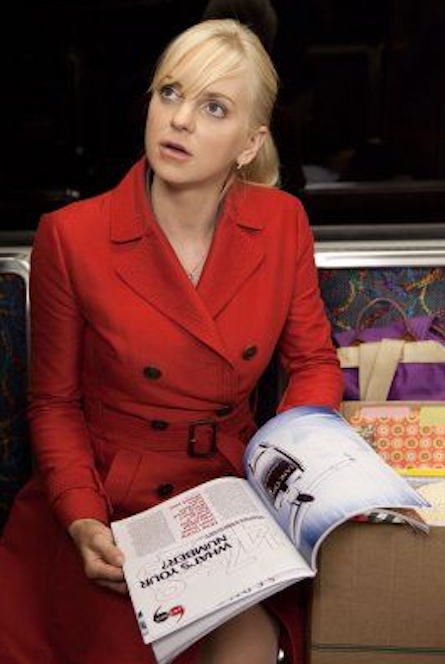
I’d been looking forward to What’s Your Number for a while; Anna Faris is not someone you always see in a leading role in a mainstream, big box office rom com with Chris Evans; there’s a whole host of up-and-coming actors and established comedians (Joel McHale, Andy Samberg); and it deals with the issue of slut-shaming, the first in my memory to do so since Easy A, to name but a few reasons.

But if 20 lovers is the be all and end all in a woman’s quest to get married, then Faris’ character, Ally Darling, is up shit creek without a paddle.

When she discovers after reading a women’s magazine article that she’s slept with 19 men, thus significantly lowering her chances of getting married, she vows not to sleep with one more man until she’s sure he’s the one. One drunken bachelorette party later, and she’s slept with her ex-boss (played by McHale).

During her quest to seek out all her exes so she doesn’t have to go above 20, she meets her across-the-hall neighbour, Colin (Evans). And you can guess what happens next…

While I did enjoy the storyline, and I do love me some Faris and Evans, I was sorely disappointed in two aspects of the climax: that Ally clichély falls down when she runs out of her sister’s wedding to find Colin (see the Women Falling Down video for just how cliché this really is), and that after she’s slept with Colin she gets a phone call from one of her past lovers claiming they never slept together, just that she got really drunk, gave him a mediocre lapdance and handjob, and then passed out in the shower. So yay, right?! Ally’s back to 20 and a) will get married, and b) isn’t a whore!

I particularly liked it, though, when the guy Ally dumps Colin for—her high school sweetheart-turned-big time philanthropist, Jake—discovers she didn’t lose her virginity to him in high school, straying when he was out of town. He says, “Big deal. So you’ve only slept with two guys in your life.” I laughed out loud at this point. I’m not sure how old Ally is meant to be (considering she says she didn’t go to her high school reunion at the beginning of the movie, my guess is she’s around 30), but Jake—or any guy, for that matter—is deluded if they think a 30-year-old woman is going to remain celibate from her first sexual encounter in high school til she meets her husband later in life. Sure, there are some women who this is true for, but it’s the exception, not the norm.

Jake then proceeds to judge Ally on how many people she’s slept with, evening saying “Eww!”

On the other hand, Colin in the embodiment of a modern man. He couldn’t care less how many people Ally’s slept with, just as long as she sleeps with him, I suppose! But really, who does care? Why is your “number” so important?

*Blanket spoiler alert.

Related: Easy A Review.

In Defence of Rachel Berry.

Elsewhere: [YouTube] Women Falling Down in Romantic Comedies.

Image via FanPix.

TV: Snooki & the Jersey Shore Girls as Feminists?


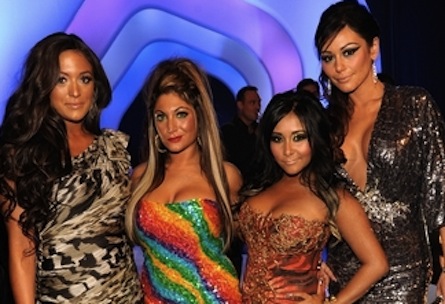
This notion has been on my mind since the start of the year, and watching season three of Jersey Shore got me thinking about it again. So, are the fake-tanned, fake-boobed and fake-nailed women of Seaside feminists?

On the one hand, while Vinny, Pauly D, Mike “The Situation” and Ronnie spend 20 minutes blowdrying their hair and plucking their eyebrows each morning (okay, if they’ve been out clubbing the night before, it’s the afternoon), followed by GTL (gym, tan, laundry), and frequently cook “family” dinners, the girls lie around the house, get in fights and try to score with guys at the club. If this isn’t throwing gender norms on their head, I don’t know what is.

As Tracie Egan Morrissey writes:

“… so much of what these people do actually challenges old school notions about gender-appropriate behavior: Men who wax their eyebrows? Men who place that much of an importance on hair products? Women who fistfight? Women who drink so heavily?”

But on the other, JWoww, for example, subscribes to the stereotypical sexualised female body: fake boobs, fake hair, and done up to the nines when she hits the clubs. If she’s got it, should she flaunt it?
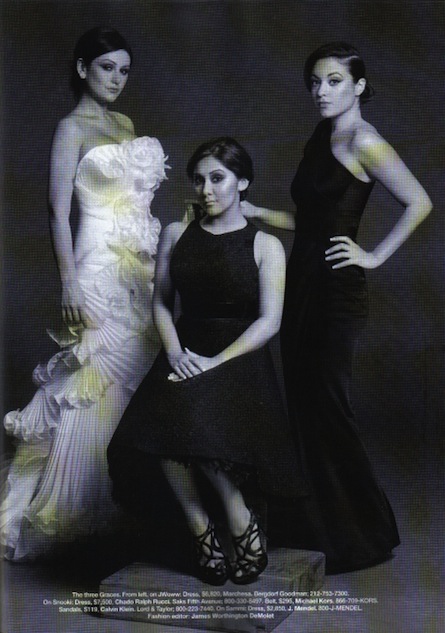
I’ve always been a big believer in this, so more power to her. In fact, despite their meteoric rise to fame in the last two years or so, the guidettes haven’t changed a thing about themselves. They’re still the trash-talking, ugg-boot-in-public-wearing, pussy-flashing white Italian trash they always were, even after Harper’s Bazaar attempted to make them over under. The problem with that was that millionairess socialite Tinsley Mortimer acted as the guidette’s teacher, insinuating that “richer… mean[s] ‘classier’ or better or nicer”. Especially considering “… the socialites of the last ten years have done everything they can to prove that ‘trashiness’ appears at every income level.”

Paging Paris Hilton, who’s never been accused of being classy or well dressed.

If being a feminist means not changing to reflect the views of mainstream society and The Patriarchy, then so be it. After all, Snooki “seems real precisely because we can’t believe that anyone would actually try to look that awful.”

In strapping their boobs up and wedging their short-shorts further into their buttcracks, the mating dance the guidettes perform each night (which has nothing on the aforementioned regimen of the boys!) seems to subvert the very look their trying to achieve: sexiness. I don’t believe this is done purposefully, so in that sense it’s not very feminist-like, however the brazen bedroom talk the girls engage in—or rather, lamenting the lack of bedroom action, especially when it comes to Snooki—makes them highly relatable. As Sady Doyle writes, “we are all Snooki”.

I’m sure all women can relate to slut-shaming, regardless of how many sexual partners they’ve had, and that’s something the Jersey Shore females have to deal with on a seemingly episodic basis. Egan Morrissey puts it best, after Pauly D voices his views on sexual double standards (“She’s [Angelina] brought all these random people home. She’s a girl. You don’t do that. That’s a guy thing. Guys do that, not girls.”):

“Shouldn’t Pauly and The Situation be grateful for sluts? If there were no sluts then they would never be able to have sex. Do they think for one minute that they would even want to live in a world in which all girls acted the way that they’re ‘supposed’ to?”

Still with sex, feminists are either viewed as sex-negative man-haters, or insatiable sex machines who throw away men once they’ve got theirs. JWoww certainly falls into the latter category, who says in the opening credits, “I’m like a Praying Mantis: after I’ve had sex with a guy, I will rip their head off.” If Jersey Shore were a scripted show, JWoww’s bad breakup with Tom, who steals her hard drive, which contained naked pictures of the reality star, amongst other things, would be payback for her independent woman status. How dare a woman step outside of the stringent guidelines The Patriarchy has set for her?!

Speaking of bad breakups, if there’s one guidette who falls furthest from the feminism tree, it’s Sammi. While she finally plucked up the courage to leave Ronnie after their tumultuous on-off relationship ended in a very realistic fight in season three, in which Ronnie trashed Sammi’s bedroom and her belongings, including breaking her spectacles, reports about the fourth season seem to indicate that Sammi took Ronnie back.

While we can never understand the dynamics of each individual abusive relationship, and feminism can’t realistically be applied to them when a woman (sometimes a man, but mostly women) has had all of her resources—family, friends, employment, finances, access to a car etc.—taken away from her and therefore has limited means to escape, Ronnie and Sammi’s relationship may have some benefits to viewers of the show. Because Jersey Shore is marketed as “reality TV” (although, after The Hills and the revelation this week that one of the “geeks” on Australia’s version of Beauty & the Geek is an actor, its dubious how “real” the show is), female viewers who may be involved in an abusive relationship at some stage in their life can see that the relationship is being portrayed in a negative light, that Sammi’s housemates, friends and family are telling her it’s not healthy, and that she should get out. We can only hope that the one in four women who will have an abusive partner will take heed.

A little too deep? How can we derive all that from something as asinine as Jersey Shore, a show that, grammatically, should have a “The” at the beginning of its title?

Take what conclusions you want from the overtly sexual show, but one thing’s for sure: the guidettes are “empowered sexually, that’s what I’m seeing on Jersey Shore… The women seem to be making their own decisions about who they sleep with [Scarlett Woman note: or don’t sleep with] and when.

“Almost by definition ‘guidette’ is a derivative term. It is a male-based subculture… The women were always defined as sex objects. And I think that’s something that they’re reversing.”

So, guidettes as sex subjects? If talking about “hairdos, shoes and body image snafus” and “preen[ing] and put[ting] on lipgloss” is a stereotypically female—and therefore weak—trait, then the guidos are certainly the background characters of Jersey Shore.

Related: Extreme Makeover: Jersey Girls.

The Mystery of Snooki Revealed.

In Defence of Rachel Berry.

The Hills: All Good Things Must Come to an End.

Elsewhere: [Salon] Jersey Shore’s F’ed Up Brand of Feminism.

[Jezebel] If Men Can Wax Their Eyebrows, Why Can’t Women Sleep Around?

[Jezebel] Snooki & Her Boyfriend Break Up Over Her Pussy.

[Jezebel] Bazaar Gives Jersey Shore Guidettes Elegant Makeovers.

[Jezebel] JWoww’s Terrible, Horrible, No Good, Very Bad Ex.

[The Atlantic] We Are All Snooki.

Images via The Gossip Wrapup, Harper’s Bazaar.
Guest Post: On Stalking.

I am standing at a tram stop in Brunswick waiting when a poster catches my eye. Someone has stuck it over the City of Moreland sign—a prominent place. Its headline screams: “Women Should Be Careful.” I’m hooked.

Upon reading the article I become increasingly angered as it goes on to explain how women should cover up and not expose their bodies to men as men can’t help but be attracted to that “provocative attire.” Not only should women expect to be sexually assaulted if showing skin, they are actually “asking for it.” I am outraged and start tearing the poster down but the man (I would assume and hope) has stuck it on with liquid nails. I manage anyway, throwing the wad of paper in the bin with a satisfying clunk. A woman is sitting on the bench near me also waiting for the tram. She turns to me and asks, “Didn’t like what it said?” No, I didn’t like it at all.

*

The idea that a woman is asking for it if she wears revealing clothing is repugnant. Not only is it outdated in 2011, it also allows men to get off scot-free. Whatever the length of my skirt, I refuse to be an excuse for a man’s behaviour. It is a common misconception that most women are harassed, attacked and stalked because of their provocative clothing or behaviour.

When I asked a group of friends to define the look of a stalking victim the consensus was a young (18–25) woman, thin, attractive, large breasts and, most importantly, wearing “slutty” clothing. It was also decided that most of these women will be stalked by men who had seen them out at a club/pub and followed home at very late hours. This profile is not true. According to California State University, 77% of female victims and 64% of male victims know their stalker and 59% of female victims and 30% of male victims are stalked by an intimate partner. This changes the image of a creepy guy hanging out in your garden after watching you dance at a party.

In a study by the Australian Centre for the Study of Sexual Assault it was revealed that only 1% of women surveyed were raped by a stranger. Clearly there is a different representation of this in the media. Still, even if most cases of stalking and rape will be carried out by someone who knows the victim, there are still instances when a stranger will take a shine to them.

*

I am on the train, coming home from work. I’m wearing a black dress, black stockings and a black coat and holding a bag of groceries. I sit down and accidentally knock the man in front of me with my bag.

“Sorry,” I say giving him a small apologetic smile.

“That’s okay,” he says, looking me up and down. “Are you coming home from work?”

“Yes.” I reply, not impolitely.

He then asks me where I work, what I do etc. I proceed to tell him, being polite but not particularly inviting. He then brags about working in an industry with a lot of money and invites me to join him at his work one day soon. I decline and then get off at my stop. He also gets off at my stop and I feel a tug at my bag of groceries. He offers to carry them for me and asks if I am married. I say no but that I have a boyfriend and he tells me that “we could always break up.”

He then asks where I live and follows me home. At this point I am pretty scared. It isn’t dark, it’s not isolated, I’m not wearing anything revealing… this isn’t how I expect the stalking story to play out. I panic and actually walk down my street before common sense kicks in and I stop two houses down from mine, pretending that it is my house, even going so far as to fumble with the letterbox pretending to check for mail. I get out my keys and ask him to leave. He then tries to invite himself in for coffee, then dinner, then a chat. I say no and am rude to him for the first time.

“Aren’t you going to go inside?” he asks, as if calling my bluff.

“Not until you are down the end of this street,” I say.

Then he says the words that stop me cold: “That’s ok, I know where you live. I can come anytime.”

The problem I had after this occurred was that I felt that it had been my fault. I shouldn’t have spoken to him, I shouldn’t have smiled at him, I should have been wearing a sack… all sorts of irrational thoughts went through my mind. Actually, the only thing I should regret is practically leading him to my door. That was stupid. When I told people, I was actually asked by one friend what I was wearing. Another told me I shouldn’t have used my “devastating” smile. The most common feedback I got, however, was that I’m just too nice. I shouldn’t be so polite and friendly to men because they take it as a sign that I’m flirting. This isn’t right! It just confirms what the poster said, that it’s the woman’s responsibility not to be stalked or get raped. I’m getting quite sick of men being blameless in these situations. It is the narrative that is constantly being touted by the media, in ads like the Razzamatazz stockings where you only see a woman’s legs in Razzamatazz and in the background are the men’s reactions to her sexy legs, implying they can’t help it. One of them spills a coffee, another trips over and a third is slapped by his girlfriend for looking. Unless ads like this stop then we will forever live in a sexist society that backs up the theory that the sexualisation of women is innate and part of our evolutionary journey.

At this point, I would like to say that I was living in fear every time I got on a train. I switched to the tram, I started calling my boyfriend to meet me at the station so we could walk home together and told all of my friends what had happened.

*

I am at work, re-entering the building after a break. He’s there in the foyer greeting me like an old friend. My colleague thinks we know each other, so walks ahead and leaves us alone. I am scared. I tell him I am busy and that I finish at 5pm. Why do I say that? The fear makes me irrational.

I try to tell him I’m busy after work and not to meet me, but he just smiles and says he’ll see me at five. I walk into the administration area, call my boss and start hyperventilating. Security sees me out at 5pm. I am flanked by two friends but I don’t see him. I can only hope that he is bothering another girl instead, then feel terrible for inflicting him on someone else.

*

I haven’t seen him since. I do live with the idea of him in that back of my mind, though. I just wish that other victims of stalking don’t blame themselves. Whatever I wear, wherever I go, yes means yes and no means no.

—Laura Money.

Related: Ain’t Nothin’ Gonna Break My Slutty Stride.

The Taboos of Sexual Harassment.

On Stripping.

Elsewhere: [California State University Department of Police Services] Stalking, Threats & Annoying/Harassing Calls.

[Australian Centre for the Study of Sexual Assault] Statistical Information.


On the (Rest of the) Net.


Spice World as metatext madness! [Thought Catalog]

Are we living in the post-ideas age? [New York Times]

“The Opposite of ‘Man’ is ‘Boy’, Not ‘Woman’” by Hugo Schwyzer:

“… Men who long for a vanished world of all-male preserves are making a fundamental mistake about masculinity. They think that the opposite of ‘man’ is ‘woman’ and that in order to prove oneself the former they must do (perform) things that no woman can. But it makes good sense to suggest that the better antonym of ‘man’ is ‘boy.’ To ‘perform masculinity’ isn’t about doing what women don’t. It’s about doing what boys lack the will or the maturity to do.

“If we really are in a ‘man crisis’ in America, I suspect it’s rooted as much as anything else in this fundamentally mistaken belief that manhood needs to be about rejecting anything that smacks of the feminine.” [The Good Men Project, via Jezebel]

How they got Osama bin Laden. [The New Yorker]

“Talking to an Abortion Clinic Protester.” [Jezebel]

The “proper etiquette” for drunk Jersey Shore sluts. [Jezebel]

Cutting off your animal cruelty to spite your feminism. Feminaust’s Ms Elouise on PETA’s latest anti-animal cruelty porn site:

“Is using Pamela Anderson’s body as a sex object and comparing it with a piece of meat an acceptable way of drawing attention to the plight of animals in the meat industry?

“PETA’s use of women’s bodies as a means to furthering their animal rights activism undermines their claims to ‘we all have the same parts’ because they’re saying the exact opposite, they’re saying:

“‘LOOK BOOBIES! Now that we have your attention, meat is bad.’”

While this is a great article, I don’t agree with its sentiments 100%. Yes, some of PETA’s campaigns have been unnecessarily focused on the female form, illustrating no real point, but I do think the “I’d rather go naked than wear fur” and the Pamela Anderson campaigns use it in a positive way. Both for women and animals. What do you think?

“Do You Prefer ‘Fashion Victim’ or ‘Ensembly Challenged’?” Squee! All of Cher Horowitz’s outfits in less than 60 seconds! [Worn Fashion Journal]

Questions for “perfect-looking women”, if there is such a thing. [Thought Catalog]

A letter to Gloria Steinem. [Ms. Magazine]

Rachel Rabbit White on “femme-guilt, beauty-privilege and the phenomenon of girls slut-shaming other girls.”

Everything Sarah Hepola learned about New York City. [The Morning News]

The victim-blaming of Lara Logan for deigning to be hot, bare cleavage and get raped. [Broad Street Review]

“Feminism, Colonialism and Islamophobia” at Qantara.

Image via Fan Pop.

TV: Male Rape on True Blood.


True Blood is known for pushing the boundaries when it comes to sex scenes. Graveyard rape fantasies, BDSM, and head-turning vampire sex. But let’s get one thing straight; last night’s gang rape of Jason Stackhouse by the Hot Shot werepanther women was not a sex scene, as some reviewers have been calling it.

But, while it is most definitely a glorified rape scene, it is also an exercise in slut-shaming and male-rape denying.

When asked about the scene, True Blood creator Alan Ball said,

“It’s kind of interesting to see the kind of guy who really gets his sense of worth from his sexual prowess to all of a sudden to be kind of objectified and sort of [laughs] used against his will.”

Slut-shaming by any other name.

The idea that someone who is sexually promiscuous isn’t really raped because they’re just getting their “comeuppance” is horrifying.

Jason even echoes Ball’s perspective, perfectly portraying how some rape victims feel as thought their attack was their fault. And why wouldn’t they? Unless you’re a young virginal woman dressed head to toe in a burqa walking alone down an alley at night and are attacked by a man in a mask and report it immediately, you’re not really raped. Jason says:

“As much as I love it, every bad thing that has ever happened to me is because of sex, [he enumerates on his fingers] jealous boyfriends, becoming a drug addict, being accused of murder… Maybe God’s punishing me for having too much sex. He’s like ‘Jason Stackhouse you have fucked too many hot women, now let’s see how you like it.’”

Hoyt goes on to compare his relationship problems with Jessica to “kind of” being like Jason’s sexual assault—and let’s not forget his potential werepanther turn!

You wouldn’t catch (most) women trying to compare their relationship problems to a friend’s rape; maybe that’s because in a lot of peoples’ eyes, and Ball’s, apparently, male-rape doesn’t exist.

Sure, Jason was drugged with Mexican Viagra, but it is still possible for a man to become physically aroused whilst not being mentally aroused, just as it is for women.

Bitch magazine puts it best:

“… When a rape clearly occurs onscreen and we call it something else, that contributes to a culture that says straight men can’t be victims of rape, especially if they’re young and attractive and enjoy sex with women.”

It will remain to be seen whether True Blood handles the aftermath of Jason’s attack realistically, or if he lapses back into his fun-loving, iron-pumping, consensually women-fucking ways, without any acknowledgement of what happened to him. Oh, and there’s that whole werepanther thing…

Elsewhere: [Bitch Magazine] True Blood: A Werepanther Rape is Not a “Sex Scene”.

[Feministe] True Blood Season Four & Female-on-Male Rape.

[Thought Catalog] On Rape in True Blood.

[Jezebel] Ass-Kicking, Rape & Fairy Godmother Murder.

[Tumblin Feminist] HBO’s True Blood, Rape & Sexual Slavery.

Image via Bitch, Jezebel.

The Taboos of Sexual Harassment.

The other day at work I was sexually harassed by a customer.

I was just standing there, and a short (probably around my height), bald, fat man in a dirty navy blue polo shirt, who was about 50–55, came up to me and asked me where the toilets were. I told him, then he asked “how’ve you been”, with a tone that implied he knew me. I said fine, and he looked me up and down and said in a sleazy voice, “Ooo, I’d like to take you home.” I immediately walked away and told three of my colleagues who were stationed nearby. As I left, he said something to the effect of, “I probably shouldn’t have said that.”

No, he shouldn’t have.

Now, sexual harassment probably isn’t anything new to a lot of women. It’s just something we have to face because we have a vagina.

I’ve been harassed at work before, not as blatantly as Sunday’s episode, but I’ve never felt comfortable enough to eject myself from the situation. As someone who works in customer service, I think I placed not being rude above keeping myself safe. But, post-SlutWalk, I now have the confidence not to put up with that shit.

But I didn’t report it.

I told a few colleagues, until I eventually mentioned it several hours later to a security guard, who also happens to be a close friend of mine. He sternly asked me if I’d reported it to my manager. I told him no, and he asked me what I would do if he came back? If he stalked me? If he attacked me? If he attacked someone else? His older-brother protectiveness made me decide to report it.

It’s funny that I didn’t think to report it the moment it happened. I guess that’s the stigma of sexual harassment (and don’t even get me started on the stigma of sexual assault!). I think I thought that because I can handle myself and I won’t put up with that shit, that it wasn’t a big deal.

It was.

I filed a report with my manager, security know about it and have footage of the man, and it’s been forwarded to the appropriate department.

The responses I got from fellow colleagues were at each end of the spectrum. Some expressed outrage and encouraged me to report it, others asked me if he touched me, as if that would be the only thing to warrant filing a report. No, he didn’t, because that would be sexual assault. (Why do we not bat an eyelid when verbal harassment occurs, but are quick to leap into action when the physical barrier is breached? Both are violations of a person based on the fact that their harasser thinks they’re public property, or available for them to make comments on/touch.)

But these responses really illustrate the abovementioned taboo of sexual harassment. That boys will be boys. That as a young, pretty woman, you just have to suck these things up. That it doesn’t really count because you were only verbally violated.

I am somewhat ashamed that I was so quick to brush it off. (Let’s be clear: I’m not ashamed that I was harassed. I’m ashamed that I didn’t take it seriously to begin with. Rape is my biggest fear, but if I was ever raped, you can be damn sure I wouldn’t keep quiet about it because I was ashamed.) This is 2011. This kind of thing shouldn’t be happening. But it does. So as modern women, we should be able to say that making comments about our physical appearance without our consent is a no-go. Just like making physical contact with our bodies without our consent is.

Related: I Ain’t No Hollaback Girl: Street Harassment in CLEO.

Ain’t Nothin’ Gonna Break My Slutty Stride.

So a Tattoo Makes Me Public Property, Huh?

Will Boys Be Boys When it Comes to Objectifying Women?

TV: Rachel Berry as Feminist.


Last week I wrote in defence of Rachel Berry.

This week, I wanted to explore the character as a feminist one.

While Glee isn’t exactly known for its positive portrayals of women, people of colour, the disabled, or the gays, Rachel has managed to grow in spite of all this, and become somewhat of a feminist icon.

I wrote that audiences have come to know and love Rachel not because her obnoxious know-it-all persona has changed, but because “We’ve been given time to understand Rachel’s initially painful personality and to identify both her strengths and weaknesses. Her ambitions and drive haven’t shifted, but the context for understanding them has,” as Dr. Karen Brooks reiterates.

Other bloggers have come to similar conclusions.

Leah Berkenwald at Jewesses With Attitude writes:

“I… have trouble with the vilification of Rachel Berry on a feminist level. How often do we dismiss women as ‘bossy,’ ‘know-it-all[s],’ or ‘control-freaks’ when their behavior would be interpreted as leadership, assertiveness, or courage if they were men?

“… In the right context, Rachel Berry’s personality would not seem ‘intolerable’ or ‘annoying’ so much as bad-ass, renegade, and hardcore.”

And Lady T, who used Rachel as her “Female Character of the Week” on The Funny Feminist, said:

“… The show wanted us to root for a girl who was ambitious, daring, and driven.”

It might be because I have been known to be seen as bossy, a know-it-all, a control-freak (just ask my new housemate!) and ambitious that I’m standing up for her, but just think of another feminist heroine in modern pop culture who could also be described using these words: Hermione Granger. The only difference is, she isn’t vilified for these attributes.

I have also been called ugly and a slut, not because I am ugly and a slut, but because these qualities are removed from the “‘good’ [female] character… [who] soars to impossible heights, not on the back of hard-work and self-belief, but usually [because of] a love interest and wishing hard.”

If you look back to the beginning of Glee, especially, Rachel was often deemed ugly. Now, anyone who’s seen Lea Michele knows she’s not exactly unconventionally attractive, but Rachel is charactertised as this because she’s annoying. And she’s annoying because she stands up for herself, knows what she wants and how to get it. (From a racial point of view, she could also be seen as being “ugly” because of her Jewishness.)

Despite these inherently “unattractive” qualities, Rachel manages to snag her man, Finn, in what can be seen as typical Glee sexism and discrimination:

“‘I love her even though she’s shorter than Quinn and has small boobs and won’t put out and is loud and annoying.’ 

“The show wanted to make me believe that Finn was doing Rachel some grand favor by simply being with her at all.”

On the other hand, it can be seen as a poignant take on teenage life that the underdog is always being compared to the most popular girl in school: Quinn Fabray.

If Rachel is Glee’s feminist heroine, Quinn is her polar opposite. She has had next to no character development, which leads to her motivations changing week to week.

In “Original Song” she tore Rachel down, telling her to get over her “schoolgirl fantasy happy ending” with Finn, who would never leave Lima, taking over Burt Hummel’s mechanics business, with Quinn, a real estate agent.

But in “Born This Way”, she was “broken down” by her fat past coming back to haunt her, to come across as more “relatable”.

Sure, Rachel’s had her fair share of being “broken down” (being dumped and subsequently egged by Jesse St. James, being publicly broken up with by Finn, getting slushied… I sense a food theme here.), but in the grand Glee scheme of things, she’s actually doing pretty well for a female character.

Now, if only we can get Mercedes a boyfriend

Related: In Defence of Rachel Berry.

The Problem with Glee.

The Underlying Message in Glee’s “Original Song” Episode.

Brown Eyed Girl.

The Underlying Message in Glee’s “The Rocky Horror Glee Show” Episode.

The Underlying Message in Glee’s “Duets” Episode.

The Underlying Message in Glee’s “Born This Way” Episode.

Sookie as Feminist? Hear Her Roar.

Do “Strong Female Characters” Remind You of You?

SlutWalk.

Slut-Shaming as Defence Mechanism.

Elsewhere: [Bitch] The Transcontinental Disability Choir: Glee-ful Appropriation.

[Jewesses with Attitude] Why Rachel Berry Deserves Our Compassion.

[Huffington Post] Hermione Granger: The Heroine Women Have Been Waiting For.

[Feministing] Pretty Ugly: Can We Please Stop Pretending That Beautiful Women Aren’t Beautiful?

[The Funny Feminist] Female Character of the Week: Rachel Berry.

[Jezebel] Why Won’t Glee Give Mercedes a Boyfriend?

Image via Wet Paint.