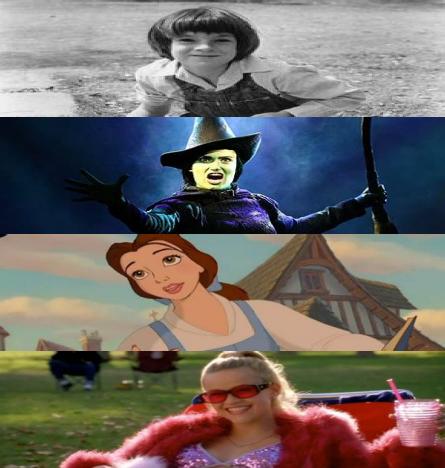
The Wizard of Oz VS. Wicked.

Many of my friends ask how I can love Wicked, yet hate the musical it was spawned from, The Wizard of Oz. Easily.

The Wizard of Oz is creepy, clichéd and fairly boring. Wicked is innovative, original (or as original as a semi-spinoff can get) and riddled with “underlying meaning”. Sure, Wicked tells the story of what happened “before Dorothy dropped in” and runs somewhat parallel to the events of The Wizard of Oz, but is a stand-alone story that blows its predecessor out of the water.

There are so many similarities and differences and storyline quirks to put into words, not to mention those between the book and the stage show, so I’m going to attempt to unravel some of them in a pictorial format. Feel free to join the discussion and change my “wicked ways”.

The Wicked Witch of the West VS. Elphaba.

In The Wizard of Oz, the Wicked witch is the epitome of Hollywood villain and has the appearance to match, whereas in Wicked, Elphaba’s friends are able to find beauty in her despite and in spite of the colour of her skin.

Glinda the Good Witch of the North VS. Galinda.

There are more similarities between the film and musicals’ versions of Glinda/Galinda than the “wicked” witches, as they both come across as superficial and somewhat ditzy, but their intellect and ability to see the good in people come out as both stories progress. Galinda, however, is far more three-dimensional than her Wizard of Oz counterpart.

The Scarecrow VS. Fiyero.

In Wicked, Fiyero goes undercover as a scarecrow in order to run away with Elphaba as the angry mob comes after her. In The Wizard of Oz, the Scarecrow accompanies Dorothy in search of a brain, which is echoed in Fiyero’s performance of “Dancing Through Life” in the play. The song deals with Fiyero’s depreciation of school and that the students of Shiz should follow his lead and dance “mindlessly” and “brainlessly” through life, thus harkening back to his transformation into the Scarecrow.

Boq VS. The Tin Man.

The Tin Man is an underdeveloped character to say the least, as is Boq in the musical. Boq is in love with Galinda, who doesn’t give him the time of day, so settles for the disabled Nessarose, who goes on to become the Governor of Munchkinland. Nessarose becomes so upset when Boq threatens to leave her that she casts an ill-fated spell on him which causes his heart to shrink. Elphaba, coming to the rescue, is able to save him, but he will never have a heart, and thus becomes the Tin Man.

Dorothy and the Cowardly Lion.

The two principle characters in The Wizard of Oz are merely extras in Wicked, with Elphaba saving the lion cub from an experiment at school, and Dorothy “dropping in” on Nessarose and killing her. While Dorothy’s appearance in Wicked stays true to the storyline of The Wizard of Oz, Elphaba’s act of kindness in saving the cub contributes to his cowardice in later life.

The Wicked Witch of the East VS. Nessarose.

As previously mentioned, Nessarose is wheelchair bound and later assumes her father’s role as Governor of Munchkinland. She is also Elphaba’s sister and dubs herself “The Wicked Witch of the East” after condemning Boq to a life as a tin woodsman. The famous ruby slippers don’t turn up til later in the play, when Elphaba enchants them to give Nessarose the ability to walk. Then Dorothy ruins it all by crash landing her house on Nessarose.

The Wizard of Oz VS. erm… the Wizard of Oz.

In both the film and the musical, the Wizard of Oz is revealed to be a bumbling fraud. In The Wizard of Oz, he represents the finish line of the metaphorical journey the four musketeers embark on to get their respective wishes granted, whereas in Wicked, the wizard is a puppet for Madame Morrible and is revealed as Elphaba’s birth father.

While The Wizard of Oz is a story of the comforts of home, the oppression faced in small country towns, and the politics of 1890s America, Wicked hits much closer to home with its themes of beauty, racism, acceptance, good and evil, and friendship. Perhaps Wicked is a new story for a new generation that isn’t so concerned with the “fairytale” offered by last century’s The Wizard of Oz?

Related: Women in Fiction: My Favourite Fictional Females.

Elsewhere: [Wikipedia] Political Interpretations of The Wonderful Wizard of Oz.

Images via Michael Boykin, Lisa Galek, Andrew Garvey, Daddy Catchers Realm, Culture Guide, Parody Files, Aussie Theatre, Centre Portal, Christopher’s Mark, Courier Mail, Acidemic, Persnickety Penelope.

It’s All About Popular… Lar, Lar, Lar, Lar!

From this weekend’s Good Weekend in The Age, in an article by Tom Ballard entitled “Too Cool for School”:

“If Footyheads are the oafish kings of high school, Popular Girls are assuredly the vapid queens. Deemed ‘The Plastics’ in the 2004 film Mean Girls, this clique is made up of attractive females who are attractive and wear make-up and are attractive and giggle and are attractive and fully hot.

“The members of this group are often the first among their peers to produce any inkling of breast and to discover foundation. Their classroom catch cry“So, like… what are we doing?”is well known and feared.

“Popular Girls enjoy chewing gum, looking vacant and protesting about the confiscation of jewellery. They feed on expensive formal dresses. They’re really, really popular.”

Examples of the Popular Girl in Popular Culture include, as Ballard mentioned, the Plastics in Mean Girls; Cher Horowitz of Clueless, who sees the light in the end; Louise from ’80s cheese fest Teen Witch, who gains popularity from a supernatural amulet; and “good” witch Galinda from Wicked, who tries to make over the self-conscious and “green” Elphaba during the musical’s “Popular” tune, from which the title of this post was derived.

Related: Women in Fiction: My Favourite Fictional Females.

Women in Fiction: Are Our Favourite Fictional Females Actually Strong, or Stereotypes?

Women in Fiction: Are Our Favourite Fictional Females Actually Strong, or Stereotypes?

I’ve been wanting to write a post on Overthinking It’s “Female Character Flowchart” since I saw it on both Jezebel and Musings of an Inappropriate Woman about two weeks ago, and the time has finally come I’ve finally gotten around to compiling a list of my favourite fictional female characters and whether they qualify as “strong” ones.

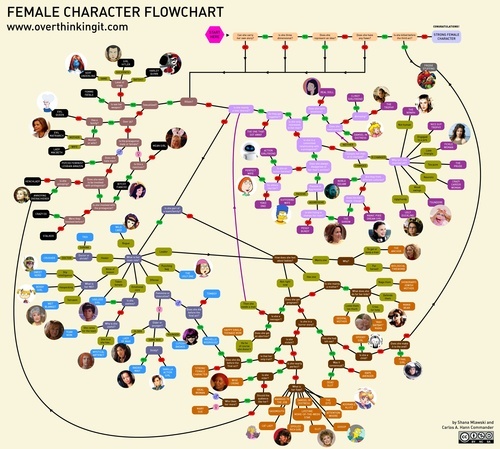
Without compromising the quality of the image, I wasn’t able to enlarge the chart, nor add my own annotations as per the below characters of my choosing. Instead, I’ve reproduced their equations below, as well as Mean Girls’ Regina George, who appears on the chart, and Blair Waldorf, whom Rachel Hills believes is a “girl Hitler”, but who I find to be much more of a genuine strong female character.

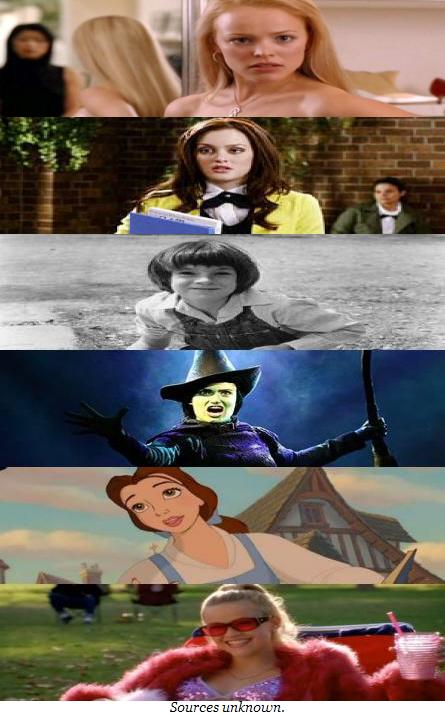
Regina George (Mean Girls): Can she carry her own story? YES. Is she three dimensional? NO. Villain? YES. Sexualised? NO. (I would argue yes. Hello? Have you seen her Halloween getup?) Over 35? NO. Is the protagonist male or female? FEMALE. Is this a rom/com? NO=Mean Girl.

Blair Waldorf (Gossip Girl): Can she carry her own story? YES. Is she three dimensional? YES. Does she represent an idea? NO. Does she have any flaws? YES. Is she killed before the third act? NO=Strong female character.

Belle (Beauty & the Beast): Can she carry her own story? YES. Is she three dimensional? NO. Villain? NO. Is she mainly a love interest? YES. Do they get together? YES. Is she only interested in her man? NO. Is she in a committed relationship with a protagonist? NO. Changes her man or is changed? CHANGES. Are they from different cultures? YES=Nobel Squan, whatever the hell that is! (Looks like something out of Avatar, though.)

Scout Finch (To Kill a Mockingbird): Can she carry her own story? YES. Is she three dimensional? YES. Does she represent an idea? YES. Villain? NO. Is she mainly a love interest? NO. Is she part of a team/family? YES. What is her main role? LEADER. How does she feel about babies? NOT RIGHT NOW. Does she get pregnant? NO. Is she in a horror story? NO. Is she violent? NO. Is she nearly perfect? NO. What is her flaw?=sassmouth, which I guess is true, but Scout is so much more.

Elphaba (Wicked): Can she carry her own story? YES. Is she three dimensional? YES. Does she represent an idea? YES, many. Villain? NO. Is she mainly a love interest? NO. Is she part of a team/family? YES. What is her main role? ROGUE=wildcard.

Elle Woods (Legally Blonde): Can she carry her own story? YES. Is she three dimensional? YES. Does she represent an idea? YES. Villain? NO. Is she mainly a love interest? NO. Is she part of a team/family? YES. What is her main role? LEADER. How does she feel about babies? NOT RIGHT NOW. Does she get pregnant? NO. Is she in a horror story? NO. Is she violent? NO. Is she nearly perfect? YES. Is she older? NO. Should the audience like her? YES. Who likes her more? WOMEN=Mary Sue.

Related:  Women in Fiction: My Favourite Fictional Females.

Elsewhere: [Overthinking It] The Female Character Flowchart.

[Overthinking It] Why Strong Female Characters Are Bad for Women.

[Jezebel] Flowchart: Know Your Female Character Stereotypes.

[Musings of an Inappropriate Woman] Flowchart: Know Your Female Character Stereotypes.

Women in Fiction: My Favourite Fictional Females.

A recent post on Girl with a Satchel (which was reblogged here) inspired me to assess my favourite fictional female characters.

One of my favourite books is To Kill a Mockingbird, and protagonist Scout Finch is one of my favourite characters of the written word. Her innocence and naivety are super-endearing, and her past-tense narrating allows the reader to put themselves in her shoes easily.

Wicked is a niche book and musical that theatre buffs can’t get enough of, but the general public are a bit oblivious to because it hasn’t derived from/been made into a movie, like Melbourne’s current season of musicals, West Side Story, Mary Poppins and Hairspray, all of which are on my theatre-going agenda in the coming months.

I’ve seen the production three times in Melbourne, and many a friend has seen it in its various international incarnations on Broadway and the West End… oh, and Sydney! I was so touched by the story and its messages of friendship, good versus evil and judging a book by its cover, and even more so by Elphaba, better known as The Wicked Witch of the West from The Wizard of Oz. Unlike in the original story, Wicked’s Elphaba is fiercely loyal to her disabled sister Nessarose, and those who become close to her like Glinda, Doctor Dillamond and Fiyero, misunderstood because of the colour of her skin and the slander spread about her when she discovers the Wizard of Oz is a fraud and seeks revenge.

In the vein of fairytale musicals, Beauty & the Beast (which is being re-released in selected theatres in 3D from 2 September) is by far my favourite, and I love its heroine Belle so much, I have been known to fight with my friends and children alike over the fact that I AM BELLE! Hello, I have brown hair, like burly men, read a lot and have a penchant for yellow gowns! While there have been arguments circulating that the Disney princesses are beacons of anti-feminism, I maintain my stance that Belle doesn’t need a man to rescue her (in fact, she does the rescuing, helping the Beast when he is attacked by wolves, attempting to make the townspeople see the error of their ways in going after him, and ultimately, setting his heart free) and sees the Beast for who he truly is, not for what he looks like or what he can do for her. She’s a kick-ass beauty in the vein of Buffy, The Vampire Slayer and Angelina Jolie’s Lara Croft: Tomb Raider.

I’ve blogged (or reblogged) a little bit lately about Elle Woods. She’s an everywoman. Rachel Hills identifies with her, as does Satchel Girl Erica Bartle. A law-studying friend of mine recently compared herself to Miss Woods, also. And I won’t lie; I’ve fantasised about wearing a Playboy bunny suit whilst purchasing an Apple Mac! Elle Woods proves that you can take pride in your appearance and have fun whilst pursuing your dreams and making a name for yourself separate from the name of the man in your life.

There are plenty of other made-up women who I have an affinity for, including the aforementioned Buffy Summers, and Daria Morgendorffer for their kick-ass feminist mentalities; ditto for the Charmed sisters; Gossip Girl’s Blair Waldorf, who can be a psycho bitch at times, but she’s THE psycho bitch; for similar reasons as Elle Woods, Cher Horowitz; and Barbie.

Related: Guest Post—Pop Culture Power Women.

In Defence of To Kill a Mockingbird.

Event: The Way We Wear Vintage Market.

Elsewhere: [Girl with a Satchel] Women of Pop Culture & the Unashamed Use of Cutesy Clichés.

[Musings of an Inappropriate Woman] Have You Ever Seen Yourself Through Someone Else’s Eyes?