Movie Review: Scream 4.


Of the reviews I’d read of Scream 4, I wasn’t expecting a good movie. If, by good, I mean critically acclaimed. But since when is the fourth sequel of a horror movie ever critically acclaimed?

I like my movies unrealistic, fluffy and so-bad-they’re-good. (Think Burlesque, not Sucker Punch.) Usually those are the ones with the poor ratings. And usually they’re my favourite.

Scream 4 certainly lived up to its bad review=good movie hypothesis. Dare I say it trumped the first one, even?

In essence, that’s what Scream 4 was trying to do. It was a “meta-text”, as my friend Eddie pointed out to me.

Like, in the first film, when central scream queen Sidney Prescott is unknowingly talking to Ghostface on the phone, and she says horror movies are insulting because “the girl is always running up the stairs when she should be going out the front door” (even though Sidney does exactly that only moments later!) This occurs in the third part of the first scene of Scream 4, which sees the “blonde haired, big boobed” victim, who has a very high GPA, FYI, running up the stairs when she can’t get the front door unlocked.

The precursors to that scene feature 90210’s Shenae Grimes and Pretty Little Liars’ Lucy Hale in the opening scene, which is actually the opening scene of Stab 6, followed by Anna Paquin and Kristen Bell watching that scene, which then feeds into the opening scene of Stab 7! Phew! It makes much more sense when you’re actually watching it!

Eddie also highlighted the meta-text in Scream 1, when Randy is watching Halloween and is warning Jamie Lee Curtis’s character, the original final girl, to look behind her, when his very own psycho killer is standing right behind him!

It has been said that the original Scream is for horror film lovers, like Randy, Scream 2 is for horror film makers, and Scream 3 is for those in the business (obviously, because it was set on the Hollywood back lot, but it didn’t pack the punch the other Scream’s did). You really have to be a Scream devotee to unravel all the “underlying meaning” in the fourth installment, which is designed to either be the first instalment of a new trilogy, or a re-do of the first film, depending on box-office success. As a pillow-lipped Gail notes at a police press conference, the killer is mirroring the original spate of killings. But it is so well done, movie-goers could commit to it without having a prior knowledge of the Scream franchise.

Scream 4 centres around Sidney’s return to Woodsboro on the final stop of her book tour, to promote her debut publication, Out of Darkness. Ghostface number four and/or five sees this as the perfect opportunity to seek revenge on Sidney for deserting Woodsboro in the aftermath of the first wave of killings, and leaving its residents to clean up her mess. Or so the killer says in a phone call to the main character, leading the audience to believe the killer is either Sidney’s aunt—Emma Roberts’ character’s, Jill, mum—or Deputy Judy (a throwback to Dewey’s derogatory nickname in the first film), who has a massive crush on Dewey, whom she bakes lemon squares that “taste like ass”, according to jealous wife Gail. When Deputy Judy approaches Sidney in the stairwell of Jill’s house after a neighbour is murdered, asking if Sidney remembers her from high school, it seems very likely that the killer could be her. But we know well enough by now that it’s never that obvious…

Eddie noted that Scream 3 was meant to have two killers, one of which being an old classmate of Sidney’s who felt she left her and Woodsboro behind. Maybe Judy’s not so unlikely after all…

The killer takes to filming their conquests after a suggestion from Gail, who totally kicks butt in this version, gravity-defying forehead and all. What am I talking about? Gail kicks butt in every film, almost always getting in the last shot (Billy in Scream 1 and Mickey in Scream 2. Who will it be in Scream 4?) Except for the fact that she seeks advice from high school kids when “going rogue”, and hunting for the killer herself when Dewey brushes her off. Didn’t she live through four killers herself? I’m sure she knows more than a bunch of 16-year-olds.

If New York City is the fifth character in Sex & the City, then technology certainly plays a major role in Scream 4. So the inclusion of said bunch of 16-year-olds lends itself to this notion, with YouTube, Facebook, Twitter, text, GPS and a whole host of other teen techno gadgets playing a role in the killer’s quest to become famous.

In this day and age, you don’t even have to do anything to become famous. Just ask Snooki and the cast of Jersey Shore. And, as the killer says, “everyone loves a victim”. But none better than the original…

Related: Burlesque Review.

Sucker Punch Review.

Elsewhere: [Wikipedia] Final Girl.

Images via IMDb. And a special thanks to Eddie, for helping me with this post.
TV: Glee “Silly Love Songs” Review.


Last night’s episode of Glee had some semblance of a storyline, unlike most of its companion episodes this year.

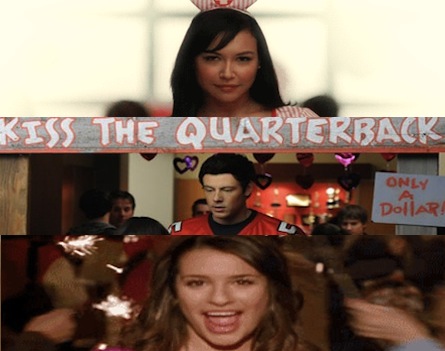
Santana was ousted by the glee club as a bitch, Puck serenaded Lauren, who refused to be wooed by his misogynistic rendition of  “Fat Bottomed Girls”, and Finn attempted to court Quinn at his Valentine’s Day kissing booth.

By far the best song of the night was Artie and Mike’s collaboration on Michael Jackson’s “P.Y.T.”, which I have taken the liberty of embedding below.

Another key story arc was Kurt’s continued infatuation with Blaine, who serenades another man with Robin Thicke’s “When I Get You Alone” (again, below), another standout. Not to worry; although Blaine is rebuffed by his love interest, and Kurt confesses his feelings for his, the two are back being besties before the night’s through.

Don’t you just love how life on Glee comes packaged up nicely with a pretty ribbon on top after forty minutes…?

Related: The Underlying Message in Glee‘s “Furt” Episode.

The (Belated) Underlying Message in Glee’s “Never Been Kissed” Episode.

The Underlying Message in Glee’s “The Rocky Horror Glee Show” Episode.

The Underlying Message in Glee’s “Duets” Episode.

The Underlying Message in Glee’s “Grilled Cheesus” Episode.

The Underlying Message in Glee’s “Britney/Brittany” Episode.

Images via Shulman Says, Soul88, TV Hamster.

Whipped Cream Feminism: The Underlying Message in Katy Perry’s “California Gurls” Video.

I’d been wanting to break out a whipped cream bra for a future Halloween, but seeing as I’ve already got my costumes planned for the next five years, my friend April suggested I bust it out (get it?) for our friend Eddie’s bad taste themed birthday this past weekend, thus keeping it relevant.

I was enormously nervous about it, as it’s probably one of the most attention-seeking costumes I’ve ever worn—and that’s saying something! Also, the party was held at a pub in Melbourne Central! Luckily, I had the company of Joel Monaghan to share the humiliation with.

But, there was a message behind the madness; well, several actually. Allow me to elaborate.

#1. Though not related to the underlying message of Katy Perry’s video, in essence, my costume was totes an oxymoron. Because although it was derived from the worst taste film clip of the year, thus making it perfect bad taste party fodder, the costume actually tasted good (as photos of partygoers sampling my cans will attest).

#2. While “California Gurls” is highly sexualised, Perry is literally using her sexuality as a weapon: taking down Snoop Dogg’s “troop of gangsta gummis” with her whipped cream cans. In some ways, she is subverting the common perception of woman as sex object and turning her into a subject. It’s just heavily sugar coated and therefore easy to miss.

#3. As someone who is not such a fan of Perry’s (love her music; hate her), I tend to lean more towards shock value and über-sexuality as the means behind the video as opposed to the above argument.

Laura Money mentions in her guest post “On Stripping” the notion of “lipstick feminists”; I would argue that Perry is very much the “lipstick feminist”, though in this case she could be labelled a “whipped cream feminist”; using her sexuality purely for entertainment and shock value—and thus record sales and YouTube views.

So, Perry’s video and my costume were both making a statement; the former shock value and the latter best (worst?) bad taste costume (yes, I did win the unofficial vote!). While I tried to incorporate the above points into my costume to make a statement on feminism and to provide blog ammo, somehow I’m not so sure Perry did the same thing…

Related: Bad Taste Foxymorons.

The Witching Hour: Halloween/My Birthday at Witches in Britches Cabaret.

On Stripping.

’Tis the Season…

Beauty & the Bestiality.

Elsewhere: [SodaHead] Is Katy Perry’s “California Gurls” Video Exploitation or Feminism?

In Appreciation of Mick Foley.


For long-time readers of this blog (does six months qualify as a long-term blog-reading relationship?), you will be familiar with my fondness for professional wrestler turned author, Mick Foley.

When I first started watching World Wrestling Entertainment (then still WWF) in 2001, Foley had a sporadic recurring role, after resigning as fictional “commissioner” of the company. Little did I know just how affecting he had been to the hardcore wrestling scene.

In a nutshell, Foley started out in the independent wrestling scene, then gradually made his way through the ranks, beginning in squash matches (where a bigger star beats a newcomer or unknown in very little time and with very little effort) in WWE, then World Championship Wrestling (WCW) and finally Extreme Championship Wrestling (ECW), where he made a namewell, technically, three namesfor himself.

As an unorthodox professional wrestler, with an out of shape body and not a lot technical mat moves, Foley needed that extra something, which he came up with in the form of his three alter egos: Mankind, Dude Love and Cactus Jack.

Mankind is the one many wrestling fans would be most familiar with, with Foley wearing a Hannibal Lector-esque mask and brandishing a personified sock on his hand, affectionately known as Mr. Socko, which would be used in his Mandible Claw move. Mankind teamed up with The Rock in The Rock n’ Sock Connection in the late ’90s.

Dude Love favours tie-die and espouses the 1960’s hippie frame of mind, and is probably the least well-known of the three.

Finally, Cactus Jack is quintessential “Hardcore Legend”, using thumbtacks and Barbie (a baseball bat encased in barbed wire, oftentimes set on fire), wearing leopard print leggings and a flanny, and is often invoked in matches such as Hell in a Cell and especially his Last Man Standing matches in his feud with Triple H, again in the late ’90s.

After some time in Japan, where a lot of professional wrestlers believe you need to spend time if you wish to be taken seriously as an athlete, Foley debuted in the WWE, where he had some of his most memorable matches, mentioned above.

While my forbidden love for wrestling introduced me to many sub-categories (like my favourite band, Our Lady Peace, American geography, and my obsession an subsequent research articles and blog posts on the Chris Benoit double murder-suicide), none is more dear to my heart than discovering Mick Foley as a memoirist, children’s storybook writer, and novelist.

I own all three of his memoirs, Have a Nice Day: A Tale of Blood & Sweatsocks, Foley is Good: And the Real World is Faker Than Wrestling, and The Hardcore Diaries, as well as his first novel, Tietam Brown (watch this space to see if I can muscle a review out of a friend who’s had my copy on loan for months), which I serendipitously found in a second-hand book store and could barely contain my excitement. Yes, I love rare and obscure authors, okay?!

Foley has recently published his fourth memoir, Countdown to Lockdown: A Hardcore Journal, which I can’t wait to get my grubby little mitts on. In addition, Foley’s much publicised computer illiteracy has been conquered, with the advent of his blog, Countdown to Lockdown, and Jezebel has cottoned on to the awesomeness that is Mick Foley”, with two feature articles on the Hardcore Legend in the past week.

Foley paved the way for wrestlers with brains to parlay into other areas they could be useful in, with Chris Jericho (memoirist, musician, actor/host, commentator) and Edge (memoirist) springing to mind. And now he is speaking out for sexual assault victims in a category that has traditionally been termed “women’s issues”.

Foley is a truly smart, talented, funny, inspiring and admirable man, and if you like what you’ve read here, I urge you to pick up one of his books (or if reading’s not your thing, YouTube a match of his; but reading probably is your thing if you’re looking at this here blog) and prepare to have your lifeor at the very least, your perception of professional wrestlingchanged.

Elsewhere: [Countdown to Lockdown] Homepage.

[Jezebel] Wrestling Star Mick Foley Blows Our Collective Mind.

[Jezebel] The Day I Beat Down Mick Foley.

[Slate] The Wrestler & the Cornflake Girl.

The Awesomeness That is James Van Der Beek.


As Dawson Leery on late ’90s teen angst television staple, Dawson’s Creek, James Van Der Beek was a whiny pushover who always lost the girl to the sexy and witty and aptly-named Pacey Witter. With the exception of getting drunk and singing the blues with Andy on his birthday, Dawson’s Creek perhaps would’ve been better without its titular character.

Van Der Beek hasn’t done a whole lot since Dawson’s Creek ended in 2003, but what he has done has been a far more apt use of his acting talents.

I recently watched the movie adaptation of Bret Easton Ellis’s Rules of Attraction, in which Van Der Beek plays Sean Bateman, American Psycho’s Patrick Bateman’s little brother. While the film, like the book, is quite left of centre and something not everyone is likely to have seen, Van Der Beek is chilling as a narcissistic, drug-taking/dealing, death-faking rich college boy, alongside Ian Somerhalder in a similarly affecting performance.

And anyone who watches Criminal Minds would be hard pressed to forget the formerly innocent Dawson as Tobias Hankel, the serial killer who was so damaged by his abusive father, that he took on said father’s demeanour in order to carry out his killings. In addition, he injected everyone’s favourite agent, Spencer Reid, with heroin, causing Reid to struggle with his newfound addiction in later episodes.

Angus, Van Der Beek’s debut film role in 1995, is a much lauded cult teen movie in which he plays the popular jock to Angus’s overweight outcast. I haven’t seen the film personally (I plan to watch it during my convalescence from wisdom teeth surgery at the end of the week), Jezebel seems to like it, and that’s good enough for me!

Van Der Beek is not unfamiliar to parodying himself, either, with cameos in Scary Movie and Jay & Silent Bob Strike Back (worst movie ever, but the running Ben Affleck joke is a cracker!), and comedic turns in Ugly Betty and How I Met Your Mother.

If you’re indifferent to James Van Der Beek, like I was until I really paid attention to his acting life after Dawson’s Creek, I suggest you take a look at his post-Dawson’s résumé to truly understand the awesomeness that is Van Der Beek.

Related: American Psycho by Bret Easton Ellis Review.

Elsewhere: [Jezebel] Important Life Lessons From B-List Teen Movies of the ’90s.