Mansplaining: I Got Served.

The other morning at work I was embroiled in a conversation about feminism with two male coworkers, one of whom I am very close with and whom I describe as a feminist even though he feels uncomfortable identifying as one, and the other who just started working with us.

The latter had been a stay at home dad to three young children until recently, and I got the feeling he wanted to brag about that. He recounted a story about how he was at the supermarket with said children and an old woman complimented him on pitching in to help with the kids and give mum a break (funny how women are never complimented for this; it’s just out duty). Somehow the conversation moved on to feminism, and my friend joked that he’d be a feminist’s worst nightmare. He then clarified, saying that he’d actually been called a feminist. The new guy scoffed, asking who called him that and if they knew what a feminist was. I butted in, saying it was me who called him a feminist and, yes, I know what one is. My friend attempted to defend my honour by saying that I’m a feminist blogger so of course I know what a feminist is. The conversation then somehow moved on to Popeye, of all things, and my colleague asked if my friend thought Olive Oyl was a victim or a slut because she kept flitting between an obsessed Popeye and the abusive Bluto. My friend ummed and ahhed his way out of the predicament while I stood there reeling.

I couldn’t stop thinking about the conversation for the rest of the day. I didn’t know why, all I knew was that I felt about 100 shades of discomfort during and after the interaction.

Then I realised: when I was scoffed at for calling a man a feminist, I was being mansplained to.

From the background info above, this guy seems to subscribe to the virgin/whore dichotomy when it comes to women and that feminism is only the concern of someone who has a vagina. Perhaps because of his stay-at-home status he feels like he lives in a post-feminist society with his wife as the breadwinner being proof of this. I really don’t know, and I don’t care to. I’m uncomfortable around this guy, and I don’t want to have to justify my feminism to him. He obviously comes from a different generation and probably thinks he knows all there is to know about feminism because he took a gender studies class at uni that one time or read a book on the topic.

I know I’m being a bit harsh here, but he really got my back up over this. Do you think I’m overreacting or does being mansplained to make your blood boil, too?

Elsewhere: [Tiger Beatdown] Chronicles of Mansplaining: Professor Feminism & the Deleted Comments of Doom.

On the (Rest of the) Net.


A roundtable interview with the women of Community. “They all cried… And they got their periods simultaneously!” [The Daily Beast]

Death of the porn star? [Daily Beast]

In the wake of the Rush Limbaugh slut-shaming debacle, Yasmin Nair writes “In Defence of Sluts.” [Jezebel]

And ode to Ryan Gosling. [HelloGiggles]

“Strip Club Feminism.” [MamaMia]

A Valentine’s letter to all girls from a boy who “likes you just the way you are” without “dress[ing] in revealing clothing… [and] try[ing] to fit in with the crowd” isn’t really a Valentine’s letter. It’s just “another guy telling girls how they should act in a world full of guys telling girls how to act.” [Jezebel]

Hating Madonna for the sake of hating Madonna. [The Guardian]

Like, OMG you guys? Have you heard about “uptalk” and “vocal fry”? It’s totally, like, awesome? (And yes, all those question marks are there for a reason. Click through to the article to find out why.) [NYTimes]

In defence of men’s magazines. [MamaMia]

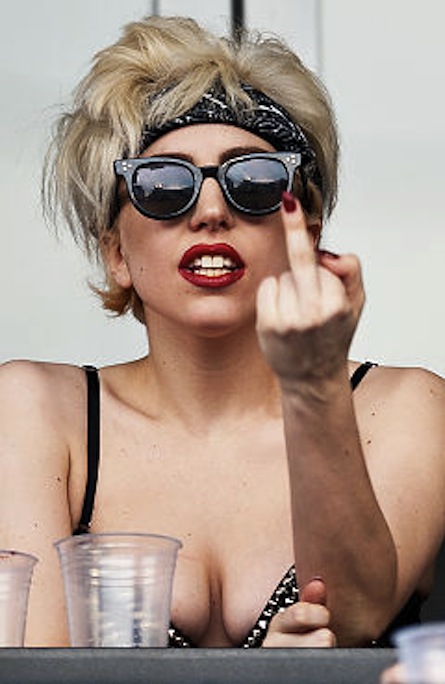
Lady Gaga on baseball. [V Magazine]

More Madonna: she’s the difference between second- and third-wave feminism. [The Sisterhood, via Jezebel]

“When Women Don’t Want Daughters.” [Jezebel]

We’ve heard the argument that atheists have no moral compass, now being pro-choice means you apparently don’t have a conscience. [Jezebel]

Camilla Peffer writes on reverse sexism and being scared of men. Meanwhile, here are some tips for men on how to come across as less threatening to women on a dark street at night. [Girls Are Made From Pepsi, Jezebel]

What makes internet trollers tick? [News.com.au]

Images via Dan Harmon Poops, Metatron’s Trunk.

Sorry Seems to Be the Hardest Word Revisited.


I know I only wrote about this earlier in the week, but since then, Mia Freedman has published a great article on MamaMia calling for an end to the torrent of abuse being hurled at Yumi Stynes for her comments about Corporal Ben Roberts-Smith last week.

Freedman’s no stranger to this kind of abuse, which she asserts is exclusive to women, in which their appearance, sexuality, sensuality and family are attacked. Where’s the similarly-themed attack on George Negus?

And because Stynes is part Asian, you can bet much of the abuse is centered around her race.

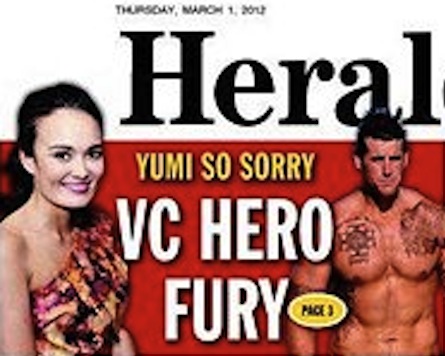
This great article on ABC’s Ramp Up talks about a Herald Sun headline that stated “Yumi So Sorry”; where’s the public moral outcry surrounding that?!

But what really gets me is how all these people who are saying these horrible things about Stynes were initially outraged about her saying an apparently horrible thing. Isn’t that the pot calling the kettle black? It reminds me of militant pro-lifers blowing up abortion clinics and murdering abortion providers; um, hello?!

What do you think of the blatant double standards of political correctness in this country (which the Ramp Up article talks about pitch perfectly) and what’s happened to Stynes?

Related: Sorry Seems to Be the Hardest Word.

In Defence of Mia Freedman.

I Think I’m Beginning to Understand This #MenCallMeThings Thing. Except It’s Not Just Men & It’s Not Really Me.

Elsewhere: [MamaMia] Why the Abuse of Yumi Stynes Must Stop.

[ABC Ramp Up] Right Wing Political Correctness & “Outrage” Double Standards.

Image via Ramp Up.

Magazines: Rachel Bilson Jumps on the Slut-Shaming Bandwagon.


Rachel Bilson has been caught slut-shaming in the latest issue of Lucky magazine. From Jezebel:

“It would appear that Rachel Bilson has taken up some part-time work with the purity police after she took a dig at any woman who dare expose her slutty back, chest and thigh skin. Sitting down to discuss the important things in life with Lucky magazine – shopping, of course! – she confessed that she’s not a fan of wearing dresses that are short and backless with a plunging neckline because she’s afraid of looking like a filthy harlot. ‘I guess I’m not too crazy about slutty dresses,’ she said. ‘You try something on, and if you feel like a slut, you probably look like one.'”

Mmm, because the dress she’s wearing above isn’t slutty at all…*

*I don’t actually think the dress Bilson is wearing in the picture above is “slutty” at all, whatever that means. I think she looks very nice and classy, but it was the “sluttiest” picture of her I could find in which she was representing herself, not a character or a brand for a magazine.

Elsewhere: [Jezebel] Rachel Bilson Thinks Women Who Wear Revealing Dresses Are Total Sluts.

Image via Short Skirt.

Angelina Jolie’s Right Leg & What it Tells Us About Youth & Beauty.


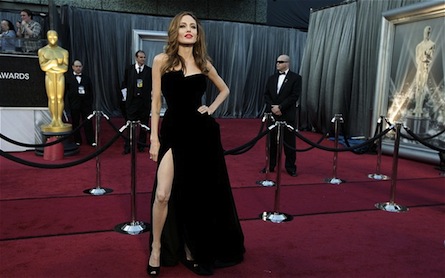
One of my sleazeball colleagues asked me who I thought was the best dressed at the Oscars, pretty much as an excuse to fill me in on his “hot for teacher” J.Lo feelings. Inevitably, the subject of Angelina Jolie and her right leg came up. Some coworkers who joined in the conversation were sure she knew what she was doing. I wagered that if she did, she was probably making a tongue-in-cheek statement about her standing as a sex object. Perhaps that’s just how she felt comfortable (after all, all we heard was how comfortable the black velvet Atelier Versace dress was), or knew she was rocking it and wanted to show off.

Whatever Jolie’s reasoning, apparently she’s “too old” to be showing off her legs like that, according to abovementioned coworker. “It’s not like she’s 16,” he said. No, because if she was sixteen it would be highly inappropriate. “36 is just too old” to be wearing a dress like that. Not only are there some deep-seated pedophilic tendencies coming to light here, but it just reiterates society’s predilection for youth and its sexism. We’ve all heard about that study that says women don’t feel comfortable wearing a miniskirt over the age of 35. Paging Jolie…

Personally, I think my legs are my worst feature, but many women love their legs. They’re one of the only body parts that don’t sag too much with age, and can be bared when tuck shop lady arms and age spots apparently set in. My grandma will be 90 this year and she still maintains her legs are her best feature. Obviously I didn’t inherit varicose veins from her!

And 35 being too old to flash some leg, even if you are one of the world’s sexiest women, is bullocks, indeed!

I think Jolie looked bangin’, if a little staged, and should continue to rock the flesh-baring gowns til the cows come home. You go, girl!

Elsewhere: [MamaMia] 47 is Too Old to be Wearing a Bikini. Oh Bullocks.

Image via The Telegraph.

Sorry Seems to be the Hardest Word.


So I know Yumi Stynes and George Negus’ comments about Corporal Ben Roberts-Smith’s brain capacity and skill in the sack were so last week (heads up: tomorrow’s post is equally last week’s news. Hint: Angelina Jolie’s leg.), but I haven’t read much in the media about the aftermath.

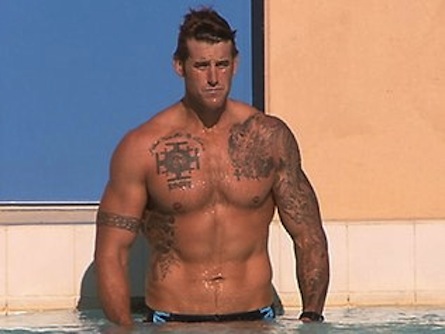
For those of you not familiar with what happened, Victoria Cross recipient Corporal Ben Roberts-Smith appeared on Sunday Night where he revealed he and his wife used IVF to conceive their twin daughters. In the days following, the story was picked up by Ten’s morning show, The Circle, in which Stynes commented on the above image on Roberts-Smith in the pool, asking if he was looking for his brain on the bottom of it. Now, Roberts-Smith is a pretty impressively ripped guy and we all know the trope goes that if you’re a beautiful person, you can’t be smart as well. Negus followed that up by this ambiguous statement:

“I’m sure he’s a really good guy, nothing about poor old Ben… But that sort of bloke, and what if they’re not up to it in the sack?”

To me, that insinuates that not only might Roberts-Smith be dumb, but that he’s obviously on steroids and we all know how that can affect performance “in the sack”. Stynes went on to summarise: “… he could be a dud root?”

Last Wednesday night, Negus and Stynes went on The Project to publicly apologise, and reveal that they also spoke to Roberts-Smith via telephone to apologise and that all is good between the three parties. I thought Stynes came across as genuinely embarrassed (rightly so) and apologetic. Negus… not so much.

The friend I was watching it with at the time said Negus is apparently a big proponent of free speech and it was clear he was only apologising because the higher-ups wanted him to save face. Fair enough if what he said was actually something he believed in and didn’t feel the need to apologise, but it was pretty obvious that the presenters on The Circle were just engaging in some mindless banter and they probably don’t actually believe what they said.

But one headline I read or saw on TV (can’t remember which one) asked “is [saying sorry] enough?” Well it has to be, doesn’t it?

If someone is genuinely sorry, like Stynes and, to a lesser extent, Negus, seemed to be, and they’ve made amends with the person they’ve upset and have learned from the situation and will, in future, think before opening their mouths, then there’s nothing else to be done.

This could be seen as a bit hypocritical coming from me who, two weeks ago, wrote that Chris Brown should be expunged from society for what he did to Rihanna, even though he has publicly apologised to the public and Rihanna. The difference is, his apology was orchestrated from above (arguably, so was Stynes and Negus’) and read from a teleprompter, and his behaviour hasn’t changed one bit since then. Just last week, he snatched a phone out of a fan’s hand for taking a photo of him and drove off with it! Also, he brutally beat his intimate partner, someone who loved and trusted him. He didn’t just make some thoughtlessly flippant comments about someone in the media he doesn’t know, as Stynes and Negus did. (There are some major double standards when it comes to this issue. For example, where was Daniel Craig’s apology when he said the Kardashians were “fucking idiots”? Meanwhile, Usher was forced to issue an apology when he was caught on tape saying he thought Brown should have some remorse over his attack on Rihanna when he was photographed jet skiing in Miami.) Sure, it was offensive to Roberts-Smith, his family, people in the military and many others, but they were just words. And a remorseful apology and promise not to say it again has to be enough.

Related: My Thoughts on Chris Brown.

FuckWalk: The Floodgates Have Opened.

Elsewhere: [MamaMia] Why Call a War Hero a Dud Root?

[Jezebel] Chris Brown Stole an iPhone from One of His Fans, Could End Up in Jail.

[Hello Giggles] I’m Not Okay with Chris Brown Performing at the Grammys and I’m Not Sure Why You Are.

Image via MamaMia.

TV: The Underlying Message in Glee’s “The Spanish Teacher” Episode.


Finally! Glee acknowledges the racist stereotypes it’s perpetuating, and Santana had the guts to stand up and say it:

“You went from ‘La Cucaracha’ to a bullfighting mariachi. Why don’t you just dress up as the Taco Bell chihuahua and bark the theme song to Dora the Explora? You don’t even know enough [about Latin culture] to be embarrassed about these stereotypes you’re perpetuating.”

Well, kind of.

But let’s backtrack.

When Mr. Shue realises he doesn’t actually know enough about the Spanish language and culture to confidently call himself a Spanish teacher, he enrolls in Spanish night class, run by guest star Ricky Martin as David Martinez. “How did I become so out of touch?” Will wonders.

Firstly, become out of touch? Despite the New Directions kids’ undying devotion for him, Mr. Shue has been out of touch from day one. Not to mention his inappropriate relationships with his students.

And secondly, there’s a lot more to Latin culture than dressing up as a matador and singing “La Cucaracha”, as Santana and Mr. Martinez soon school him in.

But it wasn’t just the South American racial stereotypes who got their fair share of airtime last night. The black prejudice was out in full force, although not acknowledged by Glee. Cutting off their Latin nose to spite their black face?

Synchronised swim coach Roz Washington is one of the most racist characters on the show, in my opinion. She speaks in African American colloquialisms such as “bajonkajonk”. When she challenges Sue Sylvester for leadership of the Cheerios, she tells Sue her “stale white bread moves” aren’t working for the team anymore, insinuating that black girls dance better than white girls and buying into the stereotype that they do.

Also, Miss Pillsbury is on a mission to have her pamphlets infiltrate McKinley High and hands out some to Mercedes and Sam when they come to her about their relationship problems. The pamphlet that Mercedes receives is entitled, “So You’re a Two-Timin’ Ho?” whilst Sam’s reads, “So You’re Dating a Two-Timin’ Ho?” Do you think the show would have given such a racist and sexist title to a pamphlet received by Quinn, for example? They might as well have made the girl on the cover of the pamphlet black because that’s pretty much what they were insinuating: that Merecedes is the sassy, fat, angry, sex-crazed woman of colour.

It remains to be seen whether Glee will actually make an effort in the future to abolish the stereotypes it so readily holds up to its viewers…

Related: The Underlying Message in Glee’s “Yes/No” Episode.

Glee: The Right & Wrong of It.

Elsewhere: [TV Tropes] Sassy Black Woman.

[Jezebel] Why Latina’s Aren’t Allowed to Get Angry.

Image via Channel 131.

On the (Rest of the) Net.

Elizabeth Nolan Brown writes in defence of Hugo Schwyzer’s inclusion in feminism. Brilliant; it’s kind of what I wish I had written.

On Katherine Heigl’s failed career and women in Hollywood:

“Much has been said… about how Heigl herself has created the fiasco that has become her career—her alleged difficult behaviour on set, her unpopular public statements about the projects she’s involved in, her perceived irritability—but this has more to do with media gender bias than Heigl herself. For instance, Daniel Craig and Matt Damon have recently taken to making increasingly brash public statements about projects they’ve worked on, their personal politics and views on modern society—and no one has criticized them, questioned their box-office viability or used their gender to explain their remarks. Like Sean Penn, they’re men in an industry dominated by men—and unless they’re saying something overtly racist, they can say just about whatever they like, and in the case of Charlie Sheen, they might even be applauded for it.” [HuffPo]

Rick Morton attempts to dissect the “frothy mixture of lube and fecal matter that is sometimes the byproduct of anal sex” that is Rick Santorum. [MamaMia]

Madonna and black culture. [Steven Stanley]

The latest trend in YouTubing: asking viewers if you’re ugly. [Jezebel]

Rachel Hills on the launch of Sunday Life’s daily website, Daily Life, its viral pet name #DailyWife, and how women’s issues are relegated to the “lifestyle” pages:

“… I’ve wondered why everything pertaining to women is classified under ‘Life and Style’, and I’ve wondered why ‘lifestyle journalism’ is so often boiled down to advertorial for fashion and beauty products (answer: probably because the associated advertising is what pays for writers like me). I’ve wondered if the fact that writing related to gender politics is usually published in ‘Life and Style’ or colour magazine supplements contributes to the perception that… female journalists write pointless ‘pap’.” [Musings of an Inappropriate Woman]

Why atheism is akin to being a pariah in the U.S. [Slate]

And now for the Chris Brown portion of the program…

Russell Simmons is a Brown apologist and compares his assault on Rihanna to the problems of Disney kids. Yeah, except Britney Spears, Lindsay Lohan and Demi Lovato never hurt anyone but themselves. [Global Grind]

Why Brown’s behaviour sucks, this time from a psychological point of view. [Slate]

We failed the young ladies who tweeted they’d let Chris Brown beat them:

“We failed you when Charlie Sheen was allowed and eagerly encouraged to continue to star in movies and have a hit television show that basically printed him money after he shot Kelly Preston ‘accidentally’ and he hit a UCLA student in the head when she wouldn’t have sex with him and he threatened to kill his ex-wife Denise Richards and he held a knife to his ex-wife Brooke Mueller’s throat. We failed you when Roman Polanski received an Oscar even though he committed a crime so terrible he hasn’t been able to return to the United States for more than thirty years. We failed you when Sean Penn fought violently with Madonna and continued a successful, critically acclaimed career and also received an Oscar.

“We fail you every single time a (famous) man treats a woman badly, without legal, professional, or personal consequence.” [The Rumpus]

One of my favourite professional wrestlers, straightedger CM Punk, challenges Brown to fight someone his own size. [Jezebel]

And ANOTHER stand up guy challenges Brown to a fight! [Deadspin]

Happy Leap Day! Heterosexual Ladies, Today You Can Freely Ask Your Significant Other to Marry You And Only Endure the Shame Once Every Four Years!

Today is February 29th, a date which only occurs every four (Olympic) years. Apparently, tradition has it that women can freely propose to their partners—sorry, non-heterosexual partnerships need not apply—on this day and only be reminded of the shame of taking their own destiny into their hands and not waiting around for a man to determine it once every four years! Super!

Perhaps instead of using the extra 24 hours to uphold gender norms we could use it to do something meaningful like, I don’t know, work towards marriage equality. Or adopt a pet. Sign up to volunteer. Work on asylum seeker activism. Something other than reiterating that until you’re married, life is meaningless.

Manning Up.

This post originally appeared on The Good Men Project.

“Man up, mate.” “Don’t be a pussy.” “Grow some balls.”

How many times have we heard these phrases—hell, sometimes we’ve been the ones dishing them out—aimed at the men we know and love?

I’ve been guilty of it myself, when a male friend cries to me on the phone about a failed relationship or bemoans a difficult co-worker/friend/family member and won’t just confront them about the problem. I don’t always say, “Just man up and do something about it!” Sometimes I just think it, which still isn’t ideal.

A recent spate of shows in the U.S. are cottoning on to this “masculinity” crisis, where men use “pomegranate body wash” and are at the mercy of the women in their lives:

“Among them are How to be a Gentleman, in which a metrosexual writer hires a trainer to dewussify him; Last Man Standing, with Tim Allen as a sporting-goods-company executive beset by girly men; Man Up, in which a group of male friends worry they’ve lost touch with their inner warriors; and Work It, in which two guys dress in drag to land jobs as pharmaceutical reps.”

This is nothing new, though. Scholars have long been lamenting “The War Against Boys”, which is also the title of Christina Hoff Sommers’ book on the topic.

But when we/society tell men to “stop being such sissies,” we’re sending the message that anything associated with “femaleness… [is] so insulting that men should react with full outrage,” Jill Filipovic writes on Feministe.

So how are these messages affecting actual men, not just those on fictional American TV shows?

When I asked a couple of my guy friends how they feel when told to “man up,” they replied as follows.

Eddie, 25, says because he “still does kiddy stuff like collect comics, people tend to think one of my faults is being a pushover. I also tend to be pretty open with my emotions. I can’t tell you the true meaning of ‘man up’, because everyone carries different reasons as to what makes someone a ‘man’. I, myself, will not ‘man up’ because I don’t think I need to and haven’t for a long time.”

Andrew, also 25, says, “I think there are men and women who, no doubt, find ‘man up’ offensive, because there are plenty of women who embody courage, fortitude and strength more than plenty of men. By the same token I think there are plenty of men who would find being told to ‘man up’ harrowing, because they lack confidence in their masculinity or cannot even define what the term means to them.”

As I wrote on this here blog last year, I have a real problem with the term “as it implies that simply being a man is equivalent to being courageous.” I, like Andrew, know a lot of women with more “balls” than their sack-packing counterparts. But talking about the role-reversal of women who possess “courage, fortitude and strength” as if they are purely masculine traits is damaging, too. We need to get over this gender stereotyping business and accept individuals for who they are, regardless of gender. (This way of thinking applies to the understanding of transgender people, too.)

We also need to get rid of this “disconcerting… focus on dominance and submission” in gender relations. On the other side of the coin, “stop being such a girl” comes to mind.

Hugo Schwyzer recently bemoaned the “real women” trope and how that has now been transferred onto men:

“Men are not immune from the pressure to be ‘real’. It’s been nearly 30 years since the tongue-in-cheek bestseller Real Men Don’t Eat Quiche spoofed an earlier generation’s Guy Code. But today, the ‘real men’ trope is everywhere. ‘Real Men Don’t Buy Girls’ is Ashton and Demi’s campaign to shame pedophiles, replete with the unspoken implication that ‘real men’ never have to pay for sex with women of any age …

“When I ask my students at the beginning of my Men & Masculinity course about ‘real men’, I get responses like, ‘real men aren’t afraid to show affection,’ or ‘real men like to dance,’ or ‘real men can cry in public and not care what anyone else thinks.’ My students want to subvert the traditional ‘sturdy oak’ model of masculinity. They mean well. But all they’re doing is swapping one unattainable ideal for another. Just as ‘real women have curves’ delegitimises countless slim women, ‘real men aren’t afraid to cry’ shames those men who for any number of reasons are awkward about public displays of emotion. The contemporary ‘real man’ ideal presents itself as inclusive, but it’s just another cultural straightjacket.”

So what is a “real man” according to… erm… real men?

Eddie thinks there’s a difference between being a “good man” and a “real man”:

“‘Man up’, for me, means being the best man you can be. Being selfless, being kind, being adult enough to handle responsibility while never taking yourself too seriously.”

While those traits may be what Eddie views as “good man qualities”, for the next guy they could be polar opposites. Being a good man is in the eye of the beholder, it would seem.

For me, respecting people and, especially, your significant other is paramount to “manning up” (or “human[ning] up”, as Irin Carmon puts it): being able to exert your opinion and standing up for what you believe in without the use of violence.

As Filipovic continues: “There is something very, very wrong with a masculinity premised on violence.” Where are men getting these messages that violence and aggression = machismo? (Um, years of socialisation and the media come to mind…)

For the founders of The Man Up Campaign, a “global initiative that engages youth to stop gender-based violence”, this ideal seems to be the consensus. “‘Our call to action challenges each of us to “man up” and declare that violence against women and girls must end,’ its mission statement reads.”

As recent as 50, 20, even ten years ago, being a “man” involved a large portion of physical aggression. And, despite feminism’s and gender equality’s best efforts, a look at many mainstream representations of men in the media, that stereotype still rings true today.

But if we can, through initiatives such as The Man Up Campaign, make it so that being called a “pussy”, like being called “gay,” is nothing to be ashamed of, even just for one person, then I think it’s a job well done.

After all, pussies push small humans out of them so they can’t be all that weak!

Related: Newspaper Clipping of the Week: Man Up.

Elsewhere: [The Good Men Project] Manning Up.

[Jezebel] Why Are Men Feeling So “Manxious” About The Rise of Women?

[Time] High Manxiety.

[Feministe] Masculinity Crisis.

[Jezebel] Stop Telling Men to “Man Up”.

[Jezebel] Real Women Have… Bodies.

[The Man Up Campaign] Homepage.

[New York Times] On Language: The Meaning of “Man Up”.