
Geraldine Doyle, the inspiration for the WW2-era Rosie the Riveter poster, has died aged 86.
Her likeness was a huge part of the second-wave feminism movement, and her death marks “the end of an era”.
R.I.P.
Geraldine Doyle, the inspiration for the WW2-era Rosie the Riveter poster, has died aged 86.
Her likeness was a huge part of the second-wave feminism movement, and her death marks “the end of an era”.
R.I.P.

“A striptease is an erotic or exotic dance in which the performer gradually undresses, usually to music, either partly or completely, in a seductive and sexually suggestive manner.”—Richard Wortley, A Pictorial History of Striptease (1976).
Well, I guess someone forgot to tell the one I saw that it was supposed to be a subtle gradation of undress.
But let’s back up: I am a feminist and proud of it. As a feminist, I am mature enough to recognise that women have control over their bodies and can do as they please with them. But, when asked recently to a friend’s birthday celebration culminating in seeing a stripper in a private hotel room, I must admit, it did not sit well with me.
For the week prior to “The Big Exposure”, as I like to call it, I debated between endorsing the empowerment of the stripper and condemning the voyeurism of myself and my friends. I tried to look at it from the point of view of a “lipstick feminist”, as Ariel Levy mentions in Female Chauvinist Pigs, who believes that stripping is empowering for women and that “putting on a show to attract men, e.g. through make-up, doing girl-on-girl physical contact, is not contrary to the goals of feminism.” Still, no matter how hard I tried to see it as empowering, I could see nothing empowering about gyrating up and down in front of men whose eyes were popping out of their sockets. I couldn’t help but feel that women who objectify their own bodies for others had no respect for themselves or other women. How could we possibly advance as respectable members of society when we are endorsing nude gymnastic moves in a spectator arena?
With all these things in mind, and a pit in my stomach, I went to the hotel room with my friends. I’d like to point out that the friend whose birthday it was is a lesbian. So, I guess we were in more progressive company. Not really.
The ratio was still bizarre: seven straight girls, three lesbians, five straight guys and one gay man. It was even. Only 50% of the crowd was supposed to be stereotypically aroused by this performance.
When she arrived, I was surprised to see her “manager”, a man in his forties wearing a tracksuit looking more like a swimming coach than an accomplice to a stripper. (What was I expecting, a pimp?) He proceeded to lay blankets and an ominous shower curtain over the carpet and plugged in the CD player. After blasting us with Lady Gaga, she arrived.
She wasn’t what I expected; tall, long black-dyed hair, a face like Layne Beachley—but with none of the talent—complete with one grey tooth, tattoos all over and quite small breasts. I must admit, I was disappointed! I was picturing a Marilyn Monroe-esque bombshell, or at least a healthy, glowing Jennifer Hawkins type.
The complete lack of sex appeal of this particular stripper made it a lot easier to find stripping degrading. I wondered how conflicted I would have felt if I found her attractive; because, in my eyes, someone who is sexy and confident is also empowered.
There was no element of teasing, of gradually taking clothes off, as Wortley describes above. She walked in wearing a school-girl costume, with a skirt so short I could see her breakfast, and immediately bent over in front of the birthday girl. So much for the game.
From there it continued to be a sordid and debasing mixture of gyrating and splits with each layer of clothing being unceremoniously ripped off and thrown towards the manager who was “keeping an eye on us.”
I felt weird. I knew that my gaze (masculine) was objectifying her body (feminine) but, by the same token, I felt that I was being objectified by the manager’s gaze.
Once all clothing had been removed, it was time for interaction. I can tell you, there is nothing empowering about having whipped cream licked off of your breasts by a pair of lesbians—one at each breast!
A memorable act of horror occurred when one of the guys was whipped with his own belt… he very quickly stopped her and sat down again. It was interesting, as I guess everyone felt that it was okay for her to debase herself, as she’s “just a stripper” and therefore an object, but the festivities crossed the line when a man was forced to feel degraded and objectified by the gaze of his peers.
The culmination of the evening was when she proceeded to insert a man’s spectacles into her vagina… proving that she was nothing but a spectacle herself under the scrutiny of the male gaze. It almost felt like a (horror) movie moment to be discussed in a feminist studies lecture!
Mary Wollstonecraft wrote in The Vindication of the Rights of Women, the “public [male] fixation upon the female person [body] has entailed and sustained the subjection of women,” and I agree. If we didn’t live in a society that objectified women and perpetuated the notion that we are only sexy when playing to masculine fantasies, we wouldn’t be watching strippers in hotel rooms, or at all.
For me though, that’s the last time I say “whatever you want, it’s your birthday” to a friend!
—Laura Money.
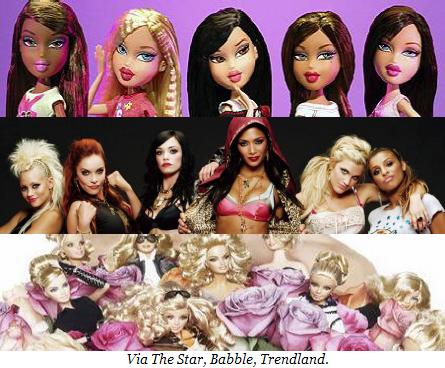
From “The Tyranny of Self-Perfection” by Anne Summers on The Australian website:
“… voicing her concerns that, overall, women were slipping backwards from the promise of equality that she, the daughter of a feminist, had grown up with. Another guest demurred: ‘Young women now have good role models, they are forging ahead,’ Anne McElvoy, deputy editor of the London Evening Standard told her ‘Why do you think things are bad for them?’
“It is entirely possible that McElvoy had never seen a Bratz doll or watched a Lady Gaga video. Unless she has young daughters or other close relatives she might not be aware of the ubiquity of pink or the Playboy logos that are now de rigueur adornments on the pencil cases of the pre-teen set.
“This reviewer has to confess a comparable ignorance. Sure, I’ve seen little girls dressed inappropriately for travel in pink tutus at airports. I’ve checked myself from disapproving of the skimpy outfits sported by 10-year-old daughters of friends. Gee, I still thought Barbie was bad.
“It’s partly that she now has daughters and has discovered that the ‘slutty and sultry’ Bratz with its wardrobe for clubbing and shopping has displaced innocent blonde Barbie as the top-selling doll for girls. It’s partly the growing use of the language of liberation—most often the word ‘empowering’—to describe the new sexual thraldom. And it’s also the realisation that ‘the rhetoric of choice may have burgeoned in this generation, but in many ways the range of female characters and role models available for young girls has narrowed’.
“Girls want to be WAGS, ‘glamour models’ (pose naked without displaying genitals) or even prostitutes because they have been led to believe that these vocations will deliver them the celebrity lifestyle so relentlessly documented in magazines and on television…”
… and in the aisles of toy stores, too, if the Bratz pack has anything to do with it.
… for office Christmas parties.
As opposed to the boring lunches a few of my friends have mentioned their workplaces hold, my employer happens to go all out on the Christmas party front.
Last year’s theme was horror (odd for that time of the year, I know), and I came up with a Bride of Chucky costume, complete with doll. However, I was struck down with the flu a few days beforehand and was unable to attend. The fact they had a dance instructor teaching partygoers “Thriller” just added insult to injury.
This year, however, the theme is pirates.
As a member of the planning committee, I fought tirelessly (and by I, I mean my friend Laura, as I was in the midst of a wisdom-tooth haze when the theme was being chosen) to push through our original idea of cartoons, and failing that, 1920s/’30s swing.
Unfortunately, misogyny won out, and a pirate theme it was.
Talk about unoriginality, though. There are about three options of pirates in popular culture to use as a reference point: Pirates of the Caribbean (how many Jack Sparrow-wannabe’s but could-never-be’s will there be walking around?), Pirates of Penzance, and Peter Pan. If someone were to really think outside the box, they could get a party of five (pardon the pun) or six together and go as The Wiggles and Dorothy the Dinosaur, with Captain Feathersword as the MVP of the group.
Notice that these three ensembles have very limited roles for women. And as a workplace that employs just as many women as men, pirates is very limiting to the fairer sex.
Serendipitously, I happened to happen upon a three-year-old post by Rachel Hills discussing exactly this.
“‘I didn’t realise the boys were meant to come as pirates and the girls were meant to come as skanks,’” Hills’ friend laments at a pirate-themed party.
My point exactly; pirates is all well and good for men who are young-at-heart, and men who perhaps want to get their gear off and go shirtless, and men in general, but women are faced with exactly two options: slutty pirate or slutty wench.
Now I’ve got some co-workers who are happy to go as more masculine pirates. (One friend, Lana, sent me a picture the other day of her costume, and you can hardly tell it’s her and she looks great.) I haven’t come across many friends who are going as wenches, which may be a testament to my own views (and thus the changing views of society?) on the topic, but that doesn’t mean there won’t be plenty of buxom babes letting the stress of the year off their chests. In what was a poignant throwback-forward, perhaps, from my friend and former co-worker Tess, she came dressed as a pirate for my Halloween-themed birthday party this year, and managed to retain her dignity.
Sure, wenches are traditionally slutty by name and by nature, as noted in the comments of Hills’ abovementioned article, but that’s not the problem I have with them.
I’m the first to put my hand up (whilst simultaneously holding my skirt down) to embrace my inner sartorial slut when it comes to hitting the town (Hello?! Have you seen my Halloween costume?), and while I will not be attending my Christmas party as a wench, there will still be a hefty dose of slut in my outfit (pictures to come next week).
The problem I have with the limiting theme is that there is no room for originality or diversity, particularly for the female members of the payroll. It’s one slut fits all.
Related: The Witching Hour: Halloween/My Birthday at Witches in Britches Cabaret.
Elsewhere: [Musings of an Inappropriate Woman] Attractive = Hot = Not Much Clothing On?
[Rabbit White] In Defence of Slut-O-Ween.
[Rabbit White] Defence of Slut-O-Ween II: Straight People’s Pride?
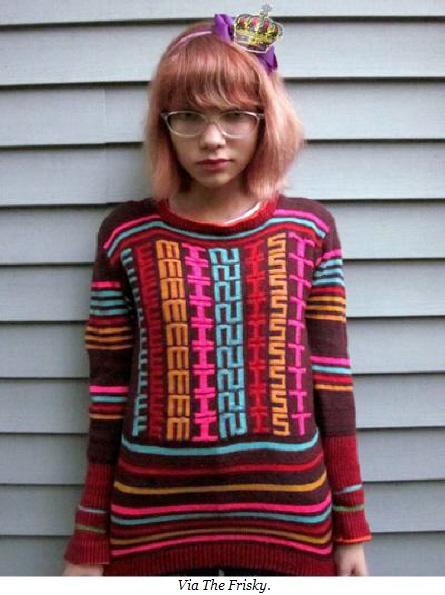
14-year-old fashion blogger extraordinaire, Tavi Gevinson, in her “Feminist” sweater, given to her by Bikini Kill frontwoman, Kathleen Hanna.

From “Party & Punishment”, published in The New York Times Magazine, 22nd October, by Virginia Heffernan.
“Right after 9/11, Muslim regimes were depicted as tyrannical in part because they demonised Western fun-loving culture in the name of a misogynistic ideology. Slowly but surely we’ve been doing the same thing with our most visible good-time girls, making villains of women who are dangerous almost exclusively to themselves. We point cameras into their darkened cars and literally up their skirts to find cellulite or evidence of immodesty that wouldn’t exist without the cameras. When they start drinking and doing drugs, just as many celebrities before them have done, we become incensed, agitating for them to go to jail.”
Heffernan’s contention rings true when it comes to Lindsay Lohan, who has been to jail four times (two in quick succession in recent months), rehab on five (or is that six?) occasions, and demonised in the media countless more. But do we demand the same of drug-addled famous men who are a danger to others, ie Charlie Sheen? For what he’s done to the women in his life, not to mention himself, perhaps it is time for Sheen to see the inside of a prison cell. Or at the very least, be taken off the show on which he earns the highest salary on television until he gets his shit together.
Related: Poor Little Rich Girl: Lindsay Lohan in Who.
Why Are Famous Men Forgiven for Their Wrongdoings, While Women Are Vilified for Much Less?
Bad Boys, Whatcha Gonna Do? Host a Seven Family Show.
Lindsay Lohan: Marilyn, Eat Your Heart Out.
Elsewhere: [The New York Times Magazine] Party & Punishment.
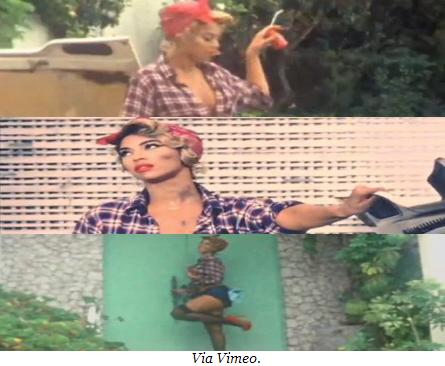
“… It is true: Beyonce does in fact dress as the iconic proto-feminist industrial worker when she has a particularly tough mechanical project to attend to. And she is, in fact, wearing hot pants! However… for those who take issue with the accuracy of her costume, remember: We only ever saw Rosie the Riveter from the waist up. We don’t know what kind of pants she was wearing. Rosie the Riveter may not have worn pants at all.”
If this is true, I’m totes going as her for Halloween next year. And no, it’s not too early to start planning my outfit! We can do it!
Related: The Witching Hour: Halloween/My Birthday at Witches in Britches Cabaret.
Elsewhere: [Tiger Beatdown] Why Don’t You Love Beyonce? An Inquiry.
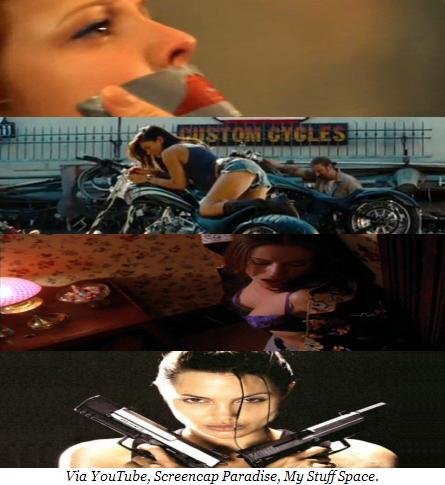
There has been a bit of talk throughout the blogosphere recently (and not so recently) about how “strong” (ie. butt-kicking but looking hot whilst doing it) female characters are detrimental to women.
From Overthinking It:
“… The trouble is, although these characters were marginally better than the original Damsels in Distress, they still ended up having to be saved in the final act by the male hero. There would usually be a scene (or three) where the ‘Strong Female Character’ would be trapped by the villain and put into sexy clothing.”
Here are a few examples: Drew Barrymore in Charlie’s Angels (in a satirical hyper-sexualised way), Rose McGowan and Alyssa Milano in Charmed, and Megan Fox in Transformers, which Overthinking It explicitly references.
Furthermore:
“And even when she was being strong, she was always doing it in the sexiest way possible. She’d never, say, get a black eye or a broken nose in a fight. Her ability to fix cars (a powerful, masculine trait) would basically allow her to get sexy grease all over her slippery body. Her ability to shoot a gun was so the film’s advertisers could put her on a poster wearing a skimpy outfit with a big gun between her legs. All in all, the ‘strength’ of her character was just to make her a better prize for the hero at the end—and for the horny male audience throughout.”
Again, Fox in Transformers with the grease, but also Angelina Jolie in Lara Croft: Tomb Raider and even Strong Female Character Buffy, who always looks good kicking vampire butt.
Related: Are Our Favourite Fictional Females Actually Strong, Or Stereotypes?
Elsewhere: [Overthinking It] Why Strong Female Characters Are Bad for Women.

In last week’s Gossip Girl, Serena van der Woodsen was quick to forfeit her Psychology of Business class in order to date the teacher who runs it, Colin Forrester, who is also the man she spent the night before with, who is also the suave businessman who puts a different girl into a cab that Serena hails each morning, thus making her late for class.
Like, get a backbone, girl! Stand up for your right to get an education and become successful in your own right instead of being on the arm of a man who is. (Strong words, yes, but I stand by them. Maybe that’s why I’m still single?!)
Serena’s mother, Lily Humphrey, when she learns that Serena’s dropping the class for a man, even went as far as to ask why Serena’s even bothering with an education when she can use her looks to snag a man like Colin. (FYI, she was using “reverse psychology”, which she picked up from Colin’s book.)
Related: Surfing the Third Wave: Second Wave VS. Third Wave Feminism on Gossip Girl.
Elsewhere: [MamaMia] Do Women Really Use University as an Excuse to Avoid Starting a Family?
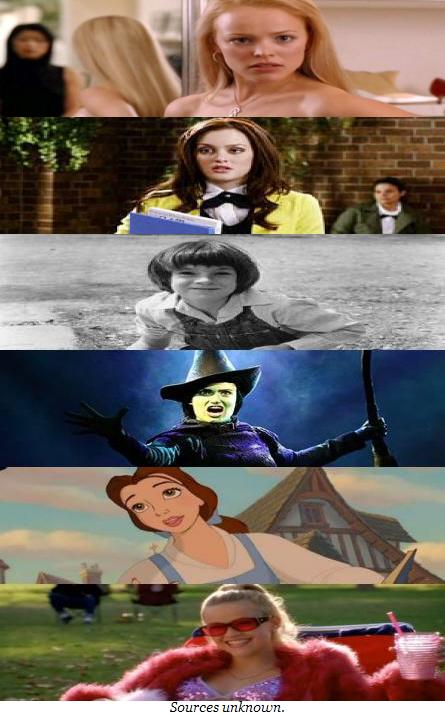
I’ve been wanting to write a post on Overthinking It’s “Female Character Flowchart” since I saw it on both Jezebel and Musings of an Inappropriate Woman about two weeks ago, and the time has finally come I’ve finally gotten around to compiling a list of my favourite fictional female characters and whether they qualify as “strong” ones.
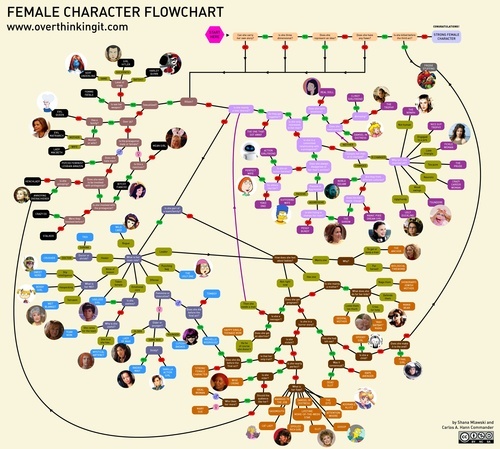
Without compromising the quality of the image, I wasn’t able to enlarge the chart, nor add my own annotations as per the below characters of my choosing. Instead, I’ve reproduced their equations below, as well as Mean Girls’ Regina George, who appears on the chart, and Blair Waldorf, whom Rachel Hills believes is a “girl Hitler”, but who I find to be much more of a genuine strong female character.
Regina George (Mean Girls): Can she carry her own story? YES. Is she three dimensional? NO. Villain? YES. Sexualised? NO. (I would argue yes. Hello? Have you seen her Halloween getup?) Over 35? NO. Is the protagonist male or female? FEMALE. Is this a rom/com? NO=Mean Girl.
Blair Waldorf (Gossip Girl): Can she carry her own story? YES. Is she three dimensional? YES. Does she represent an idea? NO. Does she have any flaws? YES. Is she killed before the third act? NO=Strong female character.
Belle (Beauty & the Beast): Can she carry her own story? YES. Is she three dimensional? NO. Villain? NO. Is she mainly a love interest? YES. Do they get together? YES. Is she only interested in her man? NO. Is she in a committed relationship with a protagonist? NO. Changes her man or is changed? CHANGES. Are they from different cultures? YES=Nobel Squan, whatever the hell that is! (Looks like something out of Avatar, though.)
Scout Finch (To Kill a Mockingbird): Can she carry her own story? YES. Is she three dimensional? YES. Does she represent an idea? YES. Villain? NO. Is she mainly a love interest? NO. Is she part of a team/family? YES. What is her main role? LEADER. How does she feel about babies? NOT RIGHT NOW. Does she get pregnant? NO. Is she in a horror story? NO. Is she violent? NO. Is she nearly perfect? NO. What is her flaw?=sassmouth, which I guess is true, but Scout is so much more.
Elphaba (Wicked): Can she carry her own story? YES. Is she three dimensional? YES. Does she represent an idea? YES, many. Villain? NO. Is she mainly a love interest? NO. Is she part of a team/family? YES. What is her main role? ROGUE=wildcard.
Elle Woods (Legally Blonde): Can she carry her own story? YES. Is she three dimensional? YES. Does she represent an idea? YES. Villain? NO. Is she mainly a love interest? NO. Is she part of a team/family? YES. What is her main role? LEADER. How does she feel about babies? NOT RIGHT NOW. Does she get pregnant? NO. Is she in a horror story? NO. Is she violent? NO. Is she nearly perfect? YES. Is she older? NO. Should the audience like her? YES. Who likes her more? WOMEN=Mary Sue.
Related: Women in Fiction: My Favourite Fictional Females.
Elsewhere: [Overthinking It] The Female Character Flowchart.
[Overthinking It] Why Strong Female Characters Are Bad for Women.
[Jezebel] Flowchart: Know Your Female Character Stereotypes.
[Musings of an Inappropriate Woman] Flowchart: Know Your Female Character Stereotypes.
 The Scarlett Woman