Magazines: Is Lea Michele Too Sexy?


Earlier in the year, Glee star Lea Michele, who plays the uptight perfectionist lead singer in knee-high socks of William McKinley High School’s glee club, posed for a sexy cover shoot for US Cosmopolitan.

On the cover of the March issue, Michele looks sultry in a low cut black top, but it’s nothing compared to her racy, and downright inappropriate, pictorial with fellow Glee clubbers, Diana Agron and Cory Monteith, for GQ last year. Sure, it was shot by the notorious Terry Richardson, so expectations weren’t that high to begin with. But the vacant, open-mouthed stare of Michele as she sits, legs akimbo, on a locker-room bench, or suggestively sucks on a lollypop, are confronting to say the least.

I have briefly blogged about this “disturbing” photo shoot, to which I can understand the public outcry.

However, Michele’s Cosmo shoot is tamely vanilla in comparison, but drew an almost equal uproar from parental groups:

“I think Lea Michele is sending the wrong message. She plays such a ‘good girl’ on Glee, and a lot of kids look up to her persona. Then she poses very provocatively on two magazine covers… I find it frustrating as a parent who is trying to teach right from wrong to their kids and then you have things like this happen which is showing middle schoolers things like sex sells and all that goes along with that.”

To my mind, Michele is 24 years old; an adult who seemingly has her head screwed on right and is in control of her own life. Her idea of the perfect night is a bath, Skype and a glass of wine, which is a far cry from the extracurricular activities of other starlets her age. Lindsay Lohan, anyone?

But, on the other hand, we have to ask the question: why does Michele feel the need to sex-up her image when, by her own admission, that is not the way she sees herself.

Dr. Karen Brooks explains, in relation to the GQ pictorial:

“I think they’re attempting to draw the line between their young characters and the fact they’re sexual adults and they feel that the way to this, rightly or wrongly, is by being hypersexual. It’s a graphic announcement to the public not to confuse or conflate the fiction of their onscreen persona with their real life; [they’re saying] ‘I may play a child’, but, in what’s almost an unintentional parody of the Helen Reddy feminist anthem, ‘I am woman, hear me roar’, they’re saying, ‘I am woman, see my score!’ It’s extreme, it gets attention (for the show, the character and the actor) and therefore, sadly, works.”

Ultimately it is her choice to get a bit sexy but, when I asked Erica Bartle of Girl with a Satchel for her thoughts on this topic, she wondered if maybe Michele’s just “conforming to the status quo?”:

“How much say does a star really have in how she’s portrayed?”

As Jezebel notes, “it isn’t as if Lea’s doing Playboy.” Cosmo is a magazine for women, and the cover isn’t as threatening as, say, the GQ one, or Rihanna’s Rolling Stone cover, in which her butt cheeks hung out of mesh shorts. There are a lot of magazines for women out there, like Yen, The Gentlewoman, and Brigitte, which cater to needs other than “how to please your boyfriend in bed”, and don’t require their cover star to, as Coco Chanel once said, take something off. In most cases, it’s their bra. (One argument for Michele’s down-to-there black top might be that *cue sarcasm* she really bares her heart and soul.)

But at the end of the day, it’s just a magazine cover. For mature adults like ourselves, we can make the decision to buy or not to buy into the sexy image of Michele on the cover of Cosmo, Rihanna in chain mail shorts for Rolling Stone, or the flesh-baring on the blue carpet at the Brownlows on Monday night. As educated, critical thinkers, we also realise that because Michele is dressed provocatively, it doesn’t make her any less of a singer, actor or seemingly normal 24-year-old when the makeup comes off and the spotlight goes down.

Related: Lea Michele Just Can’t Win.

Disturbing Behaviour: Terry Richardson Does Glee.

In Defence of Rachel Berry.

Rachel Berry as Feminist.

VCE Top Designs: frankie Editor Jo Walker Talks to Media Students.

Is There Really a Beauty Myth?

Elsewhere: [Jezebel] Righteous Moms Just Can’t Let Lea Michele Be Sexy.

Images via Reality by Rach, Twenty2.OnSugar.

Magazines: I Ain’t No Hollaback Girl—Street Harassment in CLEO.


I recently moved to Kensington, on the west side of Melbourne, from Richmond.

I’ve been out of the house only a few times since then, jogging, going to the supermarket, train station etc., and I’ve already been honked at twice.

I haven’t been honked at for awhile. I think the last time was in Craigieburn (an outer suburb north west of Melbourne) when I was going to the dentist. Or maybe it was back in my hometown in country Victoria.

It was about 6:30am on a summer morning so it was already quite light and I wanted to get my jog out of the way before it got too hot. There’s a lake near my mum’s house, and there were ducks all over the bridge. There weren’t many people around—pedestrians or drivers—but some hoon came around the corner, saw me jogging, and decided to show off, revving his car. I looked back because he was heading in the direction of the lake, but he must have thought I was looking back at him, which only encouraged his sophomoric antics, and he sped off, right into the congregation of ducks. After he was gone, I went back to see if he’d hit any. He had. With such velocity that the body of the duck was on one side of the bridge; its sack of internal organs on the other.

Street harassment is not only juvenile and sexist, but a danger to animals, too!

CLEO’s latest issue has a feature on this very phenomenon.

It runs with the premise of the website Hollaback, which got its start in New York City in 2005, and charts areas where women most experience street harassment. You can also upload photos of offenders, who are monitored for repeat indiscretions.

The article, by deputy features editor Rebecca Whish, also asks if kicking up a stink over street harassment is “an overreaction”. According to 12% of CLEO readers polled, they feel flattered when yelled or honked at on the street.

While I don’t feel offended when men leer, honk or yell at me (with the exception of animal endangerment and pure objectification by friends/coworkers), I don’t particularly see it as a compliment either. The type of guys who do these things aren’t the type I’m seeking compliments from. If anything, it’s more about having the right to go about your daily business without being harassed while doing it.

Is that too much to ask?

Related: Will Boys Be Boys When it Comes to Objectifying Women?

Elsewhere: [Hollaback] Homepage.

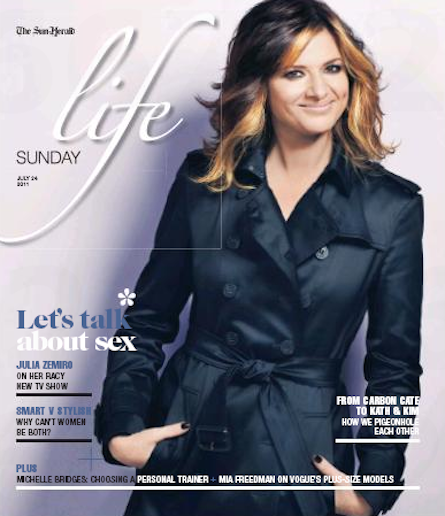
Magazine Review: Sunday Life, 24th July 2011.


You’d better duck into your nearest newsagent and hope they have a spare copy of The Sunday Age/Sydney Morning Herald, as its weekly insert, Sunday Life, is a must-read.

In addition to the usual fabulous columns by Mia Freedman and Sarah Wilson, who talk about the hullabaloo surrounding the recent plus-sized (and scantily clad) cover of Vogue Italia (p. 7), and being “deliberately” and uncomfortably vulnerable (p. 10), respectively, Rachel Hills writes on classism in Australia (p. 16–17) and deputy editor Natalie Reilly ponders the magazine’s recent Kate Ellis cover (p. 19).

What with the recent carbon tax being slammed for not being affordable for lower income earners and “Wayne Swan and Tony Abbott… falling over themselves to defend the livelihoods of ‘battlers’ earning more than $150,000 a year—an income more than double the median for Australian families,” class is more of an issue in Australia than ever before, but talking about it “just isn’t cool”.

It’s a very interesting issue, one that has somewhat reared its head in SBS’s Go Back to Where You Came From, the still-to-be aired Housos, a satirical take on life in a housing commission, and the backlash against Cate Blanchett backing the carbon tax.

I have written a little bit here and there about such things, but ultimately, it’s hard to take the “cashed-up bogan” seriously when they say they can’t afford to pay the carbon tax: if they just turned off their $2000 flat-screen TV that they bought with their baby bonus, we might not be in this mess. (Harsh, yes, but it is an anecdotal example!)

Hills quotes Housos, Pizza and Swift & Shift Couriers producer Paul Fenech, who likens the uproar over Housos as “a rich wanker test. The truth is, when we show this comedy to people who live it, they love it.” This could also be applied to the carbon tax and the public reception of shows like Angry Boys: you can always count on the conservative, upper-to-middle class right to become uproarious about such things. Could it be because “talking about class makes us nervous… because it suggests that we might not be as equal as we’d like to think we are—and that’s threatening”? I’d bet it is.

I saw this first hand when I brought up Go Back to Where You Came From with a right-leaning friend. Then I told him I was going to vote Greens next election. Then he called me a communist.

But what’s so wrong with believing everyone should receive the same civil rights? Abbott would argue, “why ‘screw over… people who want to get ahead’?” Indeed; but does it mean that we have to step on the little man to do so?

In “What’s Wrong With This Picture?”, Reilly addresses the age old conundrum of serious women not being able to be taken seriously if they’re dressed in anything remotely “sexy”.

Apparently, there was an outcry from Sunday Life readers regarding the June 26 issue, which featured Minister for the Status of Women, Kate Ellis, dressed in a pink high-necked blouse, red pencil skirt (above the knee, but I wouldn’t call it a mini) and killer turquoise heels. And therein lies the problem:

“When a female politician wears anything other than a sensible suit, outrage ensues.”

Yet, when Prime Minister Julia Gillard wears an unflattering get-up, she’s criticised for not being fashionable enough. Seems a girl just can’t win.

Related: My Response: Go Back to Where You Came From.

Does Pop Culture Glamourise Our Carbon Footprint?

Conservativism Reigns Supreme in The Sunday Age’s Opinion Section.

It’s Not Easy Being Green: The Latest Trend in Discrimination.

Elsewhere: [MamaMia] $150,000 Doesn’t Make You Rich. Discuss.

[MamaMia] The Four Reactions to This Magazine Cover.

[Sarah Wilson] How Do You Get “Deliberate” About Your Life?

[Girl with a Satchel] “Carbon Cate” for T Magazine & the Prius Effect.

[Sydney Morning Herald] Go Back to Where You Came From Strictly for the Gullible.

[Heathen Scripture] The Other Reason Why Raquel Was Wrong.

Image via Sydney Morning Herald.

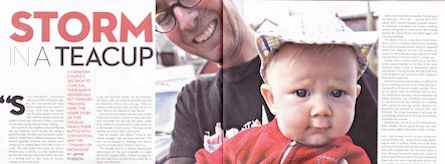
Gender Bending Babies.

Gender-neutral baby Storm, son/daughter of Canadian couple Kathy Witterick and David Stocker, who have two other children whose genders are known, is the subject of Good Weekend’s “Newspaper Clipping of the Week”.

The article is a very interesting one, for those who have and haven’t heard of the baby whose gender has been kept a secret from the rest of the world in a bid to let Storm grow up making choices about who he/she wants to be without the confines of gender.

While I think gender-neutral parenting is a good idea, to an extent—letting your child choose whatever they want from the toy store, as opposed to letting them choose whatever they want from the boys/girls section—one has to wonder what effect being genderless will have on Storm as he/she grows older. It’s hard not to think that this is just a social experiment on the part of the parents, with no regard for the child.

What do you think? Would you ever consider keeping your child genderless to the outside world?

Magazines: Katie Holmes in Who—Do Celeb Bodies Makes Us Feel Better About Our Own?


The first thing I noticed when I flipped open to the Katie Holmes story in the latest issue of Who were her stretchmarks. But I was really glad they weren’t pointed out to me: I’m not a fan of body-shaming (though, admittedly and ashamedly, I sometimes succumb to it).

But, looking at Katie’s faded stretchmarks on her taut and toned abs, it made me feel better about my own. (Also, it proves the naysayers wrong: Katie was pregnant with Suri; the Cruises didn’t order her in from some Scientology farm.)

Who, however, does do their fair share of scrutinising, comparing Katie’s current bikini body with her bloated stomach in a shoe store in early May.

As I said above, I don’t like to see others’ bodily “shortcomings” pointed out to me; I’m perfectly capable of noticing them myself, and promptly ignoring them. My own bodily “shortcomings”? It’s touch and go.

The one thing I dislike about myself is my skin. It’s very susceptible to scarring and marking, and my acne scars, stretchmarks, spider veins and cellulite will attest to that. Bad skin runs in my family. But, after several years of struggling with my skin, especially on my upper legs and face, I’ve come to terms with it. You hide the areas you’re not a fan of and flaunt your best assets. I’ve embraced the ’50s silhouette in summer, and mostly wear A-line skirts that end just at the knee or mid-calf. For my money, I think I look better in clothes than I do out of them.

However, I think the only way you can become comfortable with your body is to walk around in your underwear. Or better yet, naked. Frequently. I do this all the time, and I love my body more for it. It helps you understand what you look like in all your glory, and better revel in yourself when it comes time to get naked with someone new. I can’t recommend this enough.

But back to celeb bodies. One the one hand, it would be a horrible thing to be subjected to as a person in the public eye. You would have to have a very thick (yet supple, and wrinkle/scar/pimple free, and perfectly tanned, and…) skin to deal with the scrutiny of celebrity life. But on the other hand, in this day and age, people don’t get into music/TV/film without being well aware what they’ll be subjected to. It’s not fair, but it’s a fact.

And the celebs who are open about their body struggles—Kate Winslet and her weight woes, Khloe Kardashian’s inadequacy when compared to her sisters—or even just celebs who refuse to conform to the skinny-mini stereotype—Kate Winslet (again), Pink and her baby body on the beach—give us someone to hold up as a beacon of hope when we don’t all look like the one-size-fits-all cookie-cutter mould.

While Katie still looks slim in her beach holiday photos (attention is drawn to her protruding—and, in one case, inverted—shoulder blades), her stretchmarks are what I’m looking at. And they look beautiful.

Related: Skinny-Shaming VS. Fat-Shaming.

My Name’s Scarlett, And I’m a Fat-Shamer.

Is There Really a Beauty Myth?

Who Condemns Baby-Body Bullying…

The Hills Have (Dead) Eyes.

Elsewhere: [MamaMia] These Are the Un-Retouched, Un-Fake Breasts of a 33-Year-Old Woman Who Has Breast Fed Two Babies. God Bless You Kate Winslet.

[MamaMia] What a Human Body Looks Like After a Baby.

Magazines: Who Speculates About Domestic Violence in the Affleck/Garner Household.


While garnishing the article with a “Rumour Patrol” disclaimer softens the blow a little (both puns intended!), I’m not sure Who’s doing anyone any favours by insinuating that Jennfer Garner may have given Ben Affleck the black eye he’s sporting in this paparazzi pic of the family in the wake of the “Blake Lively” nude photo scandal.

Feel free to speculate, as Who has surely done…

Related: Picture Perfect.

Magazines: You Say It Enough, It Loses Its Meaning.


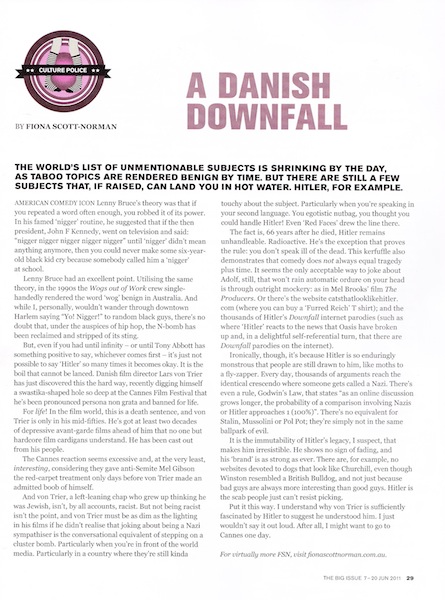
“N*gger.” “Wog.” “Hitler?”

According to Fiona Scott-Norman in this fortnight’s Big Issue, Hitler is still a word thats “boil… cannot be lanced”.

N*gger has been reappropriated by African American’s in hip hop and rap music. Wog is a common utterance in Australian society that I don’t personally feel comfortable using, but just flick over to any Aussie comedy and you’ll hear it.

But the same doesn’t go for Hitler, whose reference at the Cannes Film Festival recently by avant-garde Danish film director, Lars von Trier, has seen him banned from the festival for life. “For life!” Scott-Norman reiterates.

von Trier was joking when he said he could relate to the “enduringly monstrous” Hitler. There’s no question it was in bad taste, but banning for life? Really? I’m sure they could focus on banning people like Roman Polanski, who’s a U.S. fugitive wanted for sexual assault, or Arnold Schwarzenegger, whose marital indiscretions have come to the forefront in recent weeks. But racism is viewed more harshly than sexism. On one hand, I think both should be treated equally. On the other, at least there is a no-tolerance policy on racism in France. John Galliano is testament to that. Mel Gibson’s—who’s been caught on tape espousing racist and sexist vitriol—inclusion on the red carpet at this year’s Cannes not so much.

Related: FuckWalk: The Floodgates Have Opened.

Ain’t Nothin’ Gonna Break My Slutty Stride.

Minus Two & a Half Men.

The Big Issue, 1–14 March 2011 Review.

Magazines: Ivanka Thinks Her Dad Trumps Obama.


From Ivanka Trump’s interview with Harper’s Bazaar magazine:

“ ‘Of course [once he (President Obama) was elected] I wanted him to succeed, but he’s proven to be a very ineffective leader. He has just not risen to the occasion. He doesn’t have business experience or a business mind.

“ ‘He’s [Donald Trump] the best equipped to deal with the most important issues this nation has, which is ultimately that we’re suffering under a massive burden of debt. We need a very acute financial mind to get us out of this mire.

“ ‘America is the largest corporation on the planet.

“ ‘You wouldn’t hire a novice to run a similarly sized company in the private markets.

“Donald Trump thinks his daughter would be ‘a huge asset’ if he prevails. ‘There’s never been anybody like Ivanka in the White House. I think she’d be an amazing addition,’ he says, although he declines to speculate if she’d have an official position. ‘That’s so far in the future,’ he demurs.”

Since Donald Trump called off his over-before-it-started bid for the 2012 presidency, it might be very far in the future. Like 2016.

Elsewhere: [Harper’s Bazaar] Ivanka Trump Interview.

Image via Harper’s Bazaar.

Sucker Punch’s Emily Browning on Slut-Shaming in Hollywood.


From an interview with the cast of Sucker Punch, “Fight Club”, in NYLON:

“I had a very tame and mild love scene with Jon Hamm. It was like, heavy breathing and making out. It was hardly a sex scene. Baby Doll has been sexually taken advantage of by her stepfather, and the idea of the scene is that, at the end, she’s finally taking control of her own sexuality because she’s realised how she needs to find her own freedom. And it correlates with that sex scene. It’s her essentially coming on to him.

“[Jenna Malone, who plays Rocket in the movie says] ‘She’s in control!’

“Exactly! And I think that it’s great for this young girl to actually take control of her own sexuality. Well, the MPAA [Motion Picture Association of America] doesn’t like that. They don’t think a girl should ever be in control of her own sexuality because they’re from the Stone Age…”

The scene was cut.

Maybe if it had remained, Sucker Punch could have lived up to its girl-power hype and not amounted to what it did.

Related: Sucker Punch Review.

Image via IMDb.

Magazines: All the Single Ladies.


I’m in the process of shopping around a freelance article on Coupledom VS. Singledom. Partly because I actually believe in the benefits of flying solo, and partly to make myself feel better as a long-term single!

But reading Georgia Clark’s article in Sunday Life this weekend was just what I needed to hear. Or see. You know what I mean.

She quotes the poster-girl for single life, Carrie Bradshaw (God help us all!), who once said, “Being single used to mean that nobody wanted you. Now it means you’re pretty sexy and you’re taking your time deciding how you want your life to be and who you want to spend it with.” Wise words indeed.

But Clark raises another very interesting and valid point: what makes someone’s single status gossip fodder for everyone they know?

She writes:

“We know that when you tell us we must be too smart, or too funny, or even too damn attractive for most men—to the point it sends them running screaming in fear—you are trying to flatter us.

“But the majority of such comments are rooted in the assumption that there’s something wrong with us. We’re too picky. We’re too independent. We’re not out there enough. Or we’re out there too much—we need to relax and let it happen. We’re not doing that. We’re not letting it happen.

“You know what? There’s nothing wrong with us. Actually, we’re just fine.”

Personally, I think long-term singles make the coupled up, or the perpetually-boyfriended (jumping from one boyfriend to the next), nervous. We’re not “normal”, according to someone’s warped idea of what constitutes “normal”. We don’t conform to societal norms, and quite frankly, we’ve got more important things going on in our lives than who’s going to keep us warm at night. I keep my own damn self warm at night!

But if you really want to get back at those who seem so invested in your personal (read: love) life, why don’t you try what Clark suggests:

“So while single people may not have a partner, this means we have time to excel in other areas: pursuing our dream job, hobby or bod. (Anecdotally, it seems that singles hit the treadmill more often than their coupled-up counterparts.)

“If you’re still convinced that our singledom needs to be constantly referenced and lamented, imagine this: svelte Liz joins you at lunch, and in the whisper of a co-conspirator says, ‘I just don’t know why you’re a little pudgy.’ Her brunette head shakes in disbelief. ‘You just don’t seem like a size 14. So, really, when do you think you’ll lose those few extra kilos?’ You glance nervously at the Kit Kat in your hand and stutter out, shocked, that you don’t know.

“‘Don’t worry,’ Liz says, patting your hand gently. ‘It’ll probably happen when you least expect it.’”

Cruel, but oh so effective!

Related: My Name’s Scarlett, And I’m a Fat-Shamer.