On the (Rest of the) Net.

The feminising sexuality of 50 Shades of Grey. [ThinkProgress]

Pinkwashing: are breast cancer awareness campaigns and their associated pink products causing breast cancer? [Jezebel]

The feminist perils of Halloween costumes. [Thought Catalog]

Is there a new Steubenville? [Jezebel]

The underreporting of the gang rape of a student by a high-profile young man in China highlights the racial, class and sex issues surrounding another recent gang-rape in India. [Daily Life]

The penis as a weapon (NSWF). [Sociological Images]

Chris Brown’s rape perpetuates the myth that men are unrapeable. [Olivia Cole]

The Problem with Sex & the City 2.

sex and the city 2 carrie book review

I’ve been thinking and wanting to write about Sex & the City 2 for quite some time, but I was never sure of the right angle to take. Having just rewatched the whole series, culminating in the arguably ill-fated films, I think I’m ready to dip my toe in the shark-infested waters that surround Sex & the City 2.

SATC2 picks up where the first film left off: the franchise’s ascent into affluence but its decent of integrity. And where better to splash some new money than the “new” Middle East: Abu Dhabi.

I stand by the series and even the first movie, but Carrie and the girls are pressing my loyalty with their Arabian adventure. Samantha throwing condoms around the souk in an effort to assert her empowerment (a sentiment I don’t disagree with, but can we please respect multiculturalism?) followed by some covered Muslim women revealing their gaudy designer garb under their abayas and hijabs because FASHUN = the end of gender inequality could certainly have been omitted from the second cinematic outing and it still would have been a semi-palatable film. While these antics blatantly show how out of touch SATC has become, the girls’ ignorance is echoed throughout the film when Charlotte gets sucked into having “the Forbidden Experience” (purchasing black market designer wares) and questions what the call to prayer means. You’d think that before jetting off to the land of “desert moons, Scheherazade and magic carpets” women who are as free as they are would be a little more in touch with the culture and what’s expected of them there. Smart Traveller, hello?!

What I do like about the Middle Eastern flair of the film, though, is the thematic parallels between women wearing veils to silence their voices and the question of whether Carrie, after five books and countless “I couldn’t help but wonder”’s (literally; I lost count after about ten when I rewatched the series. Repetition, much?!), should shut up.

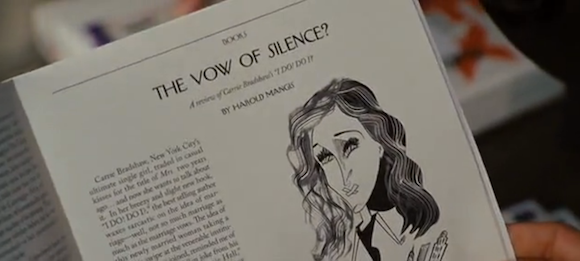
This seems to be the consensus, as New York magazine’s review of her latest book, I Do! Do I?, is titled “The Vow of Silence”. And in the accompanying illustration, Carrie is drawn with tape across her mouth, to echo the silencing of their Middle Eastern counterparts: “It’s like they don’t want them to have a voice,” Carrie observes. Synergy!

The concept of women’s voices is echoed elsewhere in the films’ storylines, with Miranda quitting her job because her misogynist boss didn’t respect her “strong female voice”, and Charlotte blaming Samantha for “open[ing] her big mouth” about her hot, braless nanny being a distraction for Harry.

Looking back on enlightenment of the series, it makes me sad that the insight into women’s lives, sex and otherwise, that it was so famous for has been completely erased from Sex & the City 2 in the name of capitalism and cultural insensitivity.

Related: In Defence of Sex & the City.

On the (Rest of the) Net.

“If Men Could Menstruate” by Gloria Steinem. [Haverford]

Speaking of menses, if you like to wear your heart on your sleeve there’s now a t-shirt to celebrate getting your rocks off whilst on your period. Too bad it’s from the dubious American Apparel… [Birdee]

I’m going to Washington, D.C. in six weeks (New York in two and a bit!) and if the U.S. federal government shutdown is still in effect, Alyssa Rosenberg has compiled a list of non-governmental things to do in the city. [ThinkProgress]

Preorder your copy of Filmme Fatales issue three, in which I write about sex work in For a Good Time, Call…, along with many surely great pieces on feminism in film.

The season of the witch is upon us, what with The Witches of East End and American Horror Story: Coven premiering in the U.S. this week. The New Inquiry‘s latest issue is all about these supernatural ladies; subscribe for only $2 a month for all their witchy goodness. Some of the features are also available on their homepage.

Chris Brown was raped as a child; he was not “raring to go” and it was not “every boy’s fantasy”. [Feministing, Flavorwire]

Texas Governor Rick Perry claims his doddering wife “misspoke” and “put the wrong word in the wrong place” when she admitted that she thinks abortion should—or “could”—be the choice of a woman. It make me sick that Perry feels the need to infantilise and “correct” his wife for her apparent conversational faux pas because it doesn’t jive with his policies. Luckily there may be a new Governor on the rise for Texas, the unquestionably pro-choice filibustering Wendy Davis! [Feministing]

To rape-joke or not to rape-joke, that is the question. [Bitch Magazine]

Pop stars and “Naked Hot Body Fatigue”. [Jezebel]

Women in the World also discuss the feminism of Britney Spears’ “Work, Bitch”.

Image via Birdee.

Event: Anne Summers in Conversation with Julia Gillard.

julia gillard melbourne conversation anne summers

Of course Sydney had to go and rain on Melbourne’s parade with all the newsworthy items from Julia Gillard’s first public interview since she was ousted as Prime Minister on 27th June this year coming out of her conversation with Anne Summers at the Opera House last Monday night.

But, from some of the reports I read (I didn’t watch the live broadcast on ABC News 24 as I wanted to be surprised for Tuesday night in Melbourne), the Sydney event was more of a girly advice session than a discussion of her time in the top job and what her future entails.

Luckily, Melbourne took the latter route, with #JuliaTalks(ing) about her sexist treatment (which spawned Anne Summers’ The Misogyny Factor) by the media, her colleagues in parliament and the general public. While the exasperated woman sitting next to me kept groaning every time sexism was brought up (seriously, considering the tone of her time in the top job, why would you go to a Julia Gillard talk with one of Australia’s most prominent feminists and not expect to hear about this?), I was pleased with the topics discussed.

Gillard talked about how she was working towards a “Labor government focussed on women and girls” but that’s now shot to shit along with the in-power government’s view of women. When asked how she feels about Tony Abbott assigning himself the portfolio of the Status of Women, Gillard reiterated her Sydney sentiments in that he should rely heavily on Tanya Plibersek and that she hopes “he finds it the most character building task of his prime ministership”.

On her famous misogyny speech—one year old today—Gillard certainly didn’t foresee it “going off on social media” but, to be fair, she certainly “didn’t foresee the level of misogyny” that marred her prime ministership, either. While on one hand, Gillard relayed an anecdote of her time as a lawyer with Slater & Gordon (“You may have heard about my time with the firm,” she joked) and the bitter clients she encountered to illustrate that she isn’t going to have that outlook on what transpired—“You can have a crap rest of your life or you can move on”, she was surprised at the “benign” reaction to her sexist treatment by the media. If the “Ditch the Witch” and “Bob Brown’s Bitch” signs and slurs had been geared towards a black politician, the media and the general public would rightly be uproarious, she said. She was also disappointed that no politicians from parties other than her own reached out to her to offer their support during the height of her misogynist treatment. (Who could really say what the “height” was? It lasted all throughout her run.)

Another high profile person she was disappointed in who criticised her unfairly and irrelevantly was Germaine Greer, who made those inappropriate comments about the way she dresses and the size of her ass. I, along with so many others, I’m sure, wish she would just admit that she said the wrong thing instead of repeatedly defending her comments.

But Gillard could take a page out of that playbook when it comes to her views on marriage equality. If Gillard truly believes that there are “different ways of acknowledging love and personal commitment than marriage”, hence why she doesn’t advocate same-sex unions, then that’s fine (except not really). But I have a sneaking suspicion that she really does believe in equality, both in marriage and otherwise. (Though her asylum seeker policies left much to be desired, and she did express sorrow for the current discourse on refugees.) I just wish she would come out and say it.

Much of Gillard’s prime ministership was steeped in disdain, but audience member Evie, 11, asked if she had “any fun being Prime Minister?” Gillard replied that she gets a kick out of the fact that her treatment whilst leading the country means that 11-year-olds know the word “misogyny”. In all seriousness, though, Gillard does hope that “more inspiration than anxiety is passed on to [the next] generation.”

Related: The Misogyny Factor by Anne Summers Review.

In Conversation with Germaine Greer.

In Defence of Sex & the City.

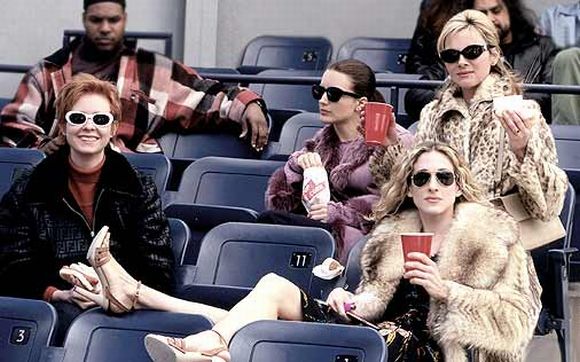
carrie-and-the-girls-baseball

Earlier this year there was somewhat of a resurgence of appreciation for the art of SexSex & the City, that is.

In the wake of the death of Sopranos star James Gandolfini and the culmination of decade-defining Breaking Bad, the apparent age of the anti-hero is upon us. The Sopranos was no doubt a watershed moment for cable network HBO, but what about another HBO show that aired six months prior and also elucidated a generation: Sex & the City?

TV critic Emily Nussbaum was thinking along the same lines when she wrote her own defence of the series earlier this year for The New Yorker. A sample:

“But Sex and the City, too, was once one of HBO’s flagship shows. It was the peer of The Sopranos, albeit in a different tone and in a different milieu, deconstructing a different genre. Mob shows, cop shows, cowboy shows—those are formulas with gravitas. Sex and the City, in contrast, was pigeonholed as a sitcom. In fact, it was a bold riff on the romantic comedy: the show wrestled with the limits of that pink-tinted genre for almost its entire run. In the end, it gave in. Yet until that last-minute stumble it was sharp, iconoclastic television. High-feminine instead of fetishistically masculine, glittery rather than gritty, and daring in its conception of character, Sex and the City was a brilliant and, in certain ways, radical show. It also originated the unacknowledged first female anti-hero on television: ladies and gentlemen, Carrie Bradshaw.”

Carrie Bradshaw—like the anti-heroine Hannah in the apparent anti-SATC of this generation, Lena Dunham’s Girls—is not someone to look up to. She’s mind-numbingly selfish (“This can’t be the day I was broken up with by a Post-It!” No, Carrie, it was the day your friend Charlotte got engaged. But, by Charlotte’s own admission, it would be her second marriage so it’s not that important, right?); lives in a rent-controlled pre-war brownstone on the “gated island for the wealthy”, as Nussbaum puts it, apparently paid for by a $400-a-week-if-she’s-lucky-freelance-gig; and cheated on Aidan with Big. (In the ill-fated second movie, Carrie then cheats on Big with Aidan.)

While Carrie may not be a wholly identifiable character, the friendships she shares with Miranda, Samantha and Charlotte certainly are. Carrie is obviously everyone’s best friend who is asked to be maid of honour at their weddings and pick them up from the hospital when they’re sick, but the dynamics between the other women are interesting. Samantha and Charlotte can certainly clash over their differing ideologies on sex and relationships—the season three episode, “Frenemies”, perfectly illustrated the virgin-whore dichotomy between the two, but I love the maternal side Samantha shows around Charlotte, supporting her in “The Baby Shower” when she discovers the mum-to-be stole her future daughter’s name. I most strongly identify with Miranda, who often clashes with Carrie due to her whimsical attitude about things like money and men. For example, when Carrie reveals she’s going to lunch with Big after countless heartbreak in the season three finale, Miranda becomes exasperated at Carrie’s masochism and storms out of a vintage store they were shopping at. On the other side of the coin, Carrie disapproves of Miranda unquestioningly cutting ties with Steve for cheating on her in the original movie.

And let’s not forget the ground SATC broke in terms of women and talking about sex and TV. Looking back on it now, some of the attitudes the girls share about gender (Samantha’s treatment of the transgendered sex workers outside her apartment), sexuality (Miranda comments that bisexuality isn’t a valid orientation because the women end up with men and the men end up with men) and sex work (when everyone finds out Stanford’s boyfriend, Marcus, was a sex worker); but, at that time, can you recall many other shows that were so open and frank about sex and how women feel about it?

So while the show might be called Sex & the City—and let’s be clear, there’s a hell of a lot of it!—it’s very much about women and friendships in New York City.

Elsewhere: [The New Yorker] Difficult Women.

Image via Musings of the Girl Who Was Death.

On the (Rest of the) Net.

carrie bradshaw writing

Was Sex & the City all in Carrie’s head? [Salon]

Follow the parody Twitter account, Sex & the City 3, by the same author. (While you’re at it, follow me, and stay tuned for some more SATC musings.)

Playboy: thanks for the memories (SFW). [Daily Life]

Bleak, but inspiring: “Freelancing & the Mythical Work/Life Balance.” [This Ain’t Livin’]

Why do they hate us? Christos Tsiolkas on Australia’s asylum seeker problem. [The Monthly]

Femen from the perspective of its activists (NSWF). [Vice]

I reviewed Domestic Warfare at Gasworks Arts Park as part of the Melbourne Fringe Festival for TheatrePress.

Image via I’m Charming You.

Magazines: Covers Worth Talking About.

i.2.miley-cyrus-rolling-stone-cover-interview

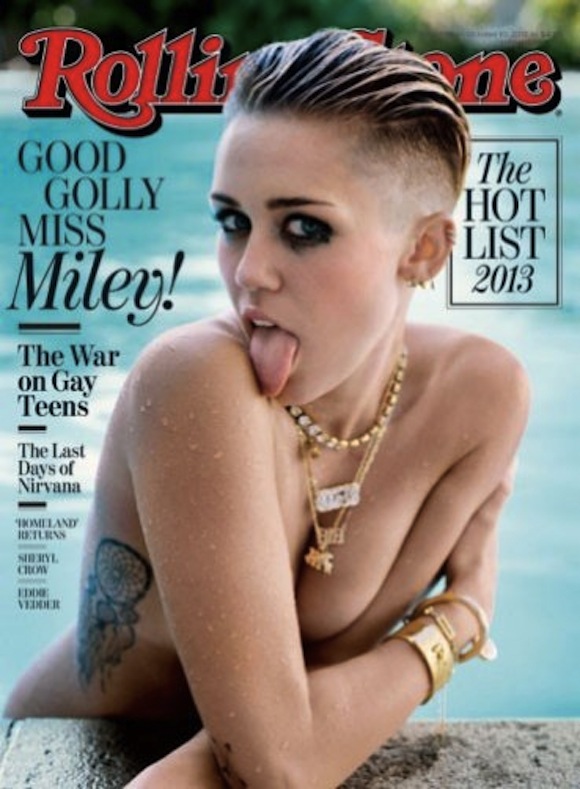
The first cover listed here to grab my attention was Hillary Clinton for New York magazine, but then Miley came along and blew that out of the (pool) water as she is wont to do.

The accompanying interview for her Rolling Stone cover was done in the days following her much-talked-about MTV VMAs performance, which is discussed at length inside. And rest assured, there are lots of scantily clad shots to compliment her tongue-thrusting on the cover.

Next comes Chris Brown for Jet, a cover which doesn’t necessarily grab the eye as the others do, but it’s what Brown says inside, a snippet of which is captured on the cover, that’s noteworthy. He who is a perpetuator of violence himself identifies with Trayvon Martin, the teen who was shot dead a year and a half ago in Florida in an alleged self-defence. His killer, neighbourhood watchman George ZImmerman, was acquitted of his murder in July this year, and was involved in an apparent domestic violence incident with his estranged wife earlier this month. His wife later refused to press charges.

Now, I’m not saying that Brown can’t identify with a fellow young black man who has been victimised, but equating murder with justified criticism for intimate partner violence and a lack of remorse for said violence is a bit rich.

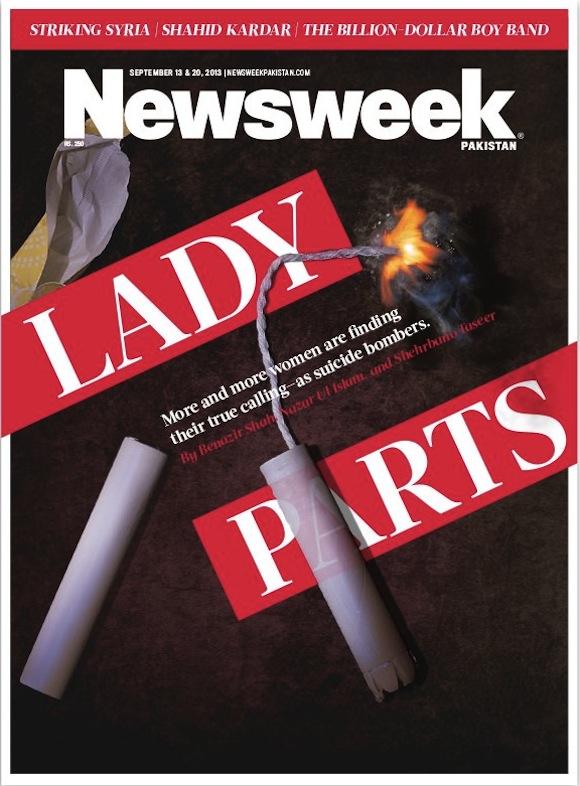
Finally, in the wake of the mall massacre in Nairobi which, it is believed, had a woman at the helm of the terrorist operation, Pakistan’s Newsweek has a cover story on the rise of female terrorist. I think alternative cover art would have conveyed their message just as well as explosive-tampons…

xchris-brown-jet-cover.jpg.pagespeed.ic.a0znAGRltM

clinton23n-2-web

Newsweek_Pakistan_Illustrates_Female_Suicide-deba0d671a7b8ca1dcf430b6642516f9

Images via The Hollywood GossipVanity FairNY Daily NewsYahoo! Finance.

On the (Rest of the) Net.

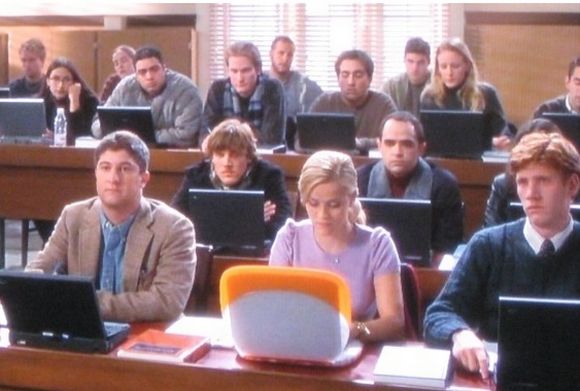
legally blonde harvard

Where are all the educated rom-com heroines? [Thought Catalog]

While we’re on the topic of locating certain female characters, what about all the superheroines? [ThinkProgress]

And, the problem with female sitcom characters. [Women & Hollywood]

Who was the real Jessica Rabbit? [Messy Nessy Chic]

On zoos. [Meajin]

Attempting to use the female condom. [TheVine]

Still with contraception, the pull-out method is an increasing form of it. [Daily Life]

Image via Southwestern.

Music: “Work, Bitch” as Feminist Anthem*.

britney spears work bitch rosie the riveter

Like Destiny’s Child’s “Independent Women, Part 1” and “Bills, Bills, Bills” before her, Britney Spears’ latest single, “Work, Bitch”, professes female autonomy and financial independence as supreme. A sampling:

“You wanna hot body
You wanna Bugatti
You wanna Maserati
You better work bitch
You wanna Lamborghini
Sip martinis
Look hot in a bikini
You better work bitch
You wanna live fancy
Live in a big mansion
Party in France.

“You better work bitch.”

Now, Britney and her songs have long stopped being coherent, and just as “Work, Bitch” could be seen as a feminist anthem for earning your possessions and accomplishments instead of waiting for a significant other to give them to you, it’s also a nonsensical club hit that could just as much be about getting your groove on on the dance floor. It does give off flavours of “Gimme More”, but less fully-realised.

But as with the abovementioned Destiny’s Child songs, there’s more to feminism than money. It’s great to be able to “buy my own diamonds and… my own rings”, and poverty is a major feminist issue, but it’s so easy to put a musical call out to women who make their own money to “throw your hands up at me” and disguise it as feminism.

Obviously I’m giving Britney and the hitmakers behind her far too much credit; her songs have never pushed an agenda other than being infectious ditties that get everybody up off their asses, with the exception perhaps of “Piece of Me”, a musing on the insatiable nature of the media and paparazzi. But appropriation, cultural and otherwise, is the trend du jour, so why not reimagine “Work, Bitch” as a feminist anthem?

*Written with tongue firmly in cheek.

Elsewhere: [Thought Catalog] Cultural Appropriation is a Bigger Problem Than Miley Cyrus.

[Jezebel] Robin Thicke Calls “Blurred Lines” A “Feminist Movement Within Itself”.

Image via Instagram.

On the (Rest of the) Net.

rape robin thicke blurred lines

Robin Thicke’s “Blurred Lines” lyrics, as said by rapists. [Sociological Images]