On the (Rest of the) Net.

Channing Tatum is People magazine’s Sexiest (White) Man Alive. [Daily Beast]

What Tony Abbott could learn from Mitt Romney. [TheVine]

Rachel Hills on Jessica Valenti’s new book, Why Have Kids? and the “motherhood mystique”:

“‘The relationship you have with your child is certainly impactful. It’s one of the most important relationships you’ll have in your life,’ Valenti says. ‘But a good relationship doesn’t necessitate you losing your identity. In fact, most people would call that a bad relationship. A good relationship is supposed to make you the best version of yourself, happier and more active. So that’s what I’m aiming for.’”

Makes sense. [Daily Life]

Unpacking what it means to be a woman with tattoos. [MamaMia]

On the gym clothes as regular clothes phenomenon and why women are the only ones who can pull it off. [TheVine]

The allure of hate-watching, -reading, -listening, and just plain -ing. [Daily Life]

A junior feminist takes Hasbro to task for gender inequality in Guess Who? [Jezebel]

Which US TV shows have the most and least racial diversity? [TV Equals]

Cameron Diaz wants to be objectified. [Daily Life]

Maybe you should try being a woman on the internet before you proclaim the web has a certain “new niceness” about it. [Jezebel]

My old suburb Richmond makes the news on Jezebel for all the wrong reasons: playing host to a “comedy debate” about whether or not rape is funny. Facepalm.

Rookie talks cultural appropriation:

“I’m uncomfortable saying ‘you can do this if you are ethnically Indian’ (even if you are culturally something else, like American), because then it gets into the very kind of essentialism that racism is made of. Like, is it OK for me to wear native Iraqi Arab garb, even though I have never set foot in Iraq, because my parents are from there? I don’t think so, but a lot of the arguments about this subject reduce it to a matter of ‘you can wear things from your personal heritage but no one else’s,’ which, again, is essentialist… [a]nd bordering on dangerous? Because then you get into people deciding if someone LOOKS ‘ethnic’ enough to wear ‘ethnic’ signifiers and you start trying to read skin colour…

“… As long as there’s black-people stuff and white-people stuff and Indian-people stuff, can we really talk about being seen as just PEOPLE?”

“The cult of the selfie.” [Daily Life]

Feminism VS. Fashion. [Bullet]

Image via People.

Book Review: Gone Girl by Gillian Flynn.

For the last few months, literary circles and feminist blogs have been raving about Gillian Flynn’s latest mystery, Gone Girl. I recommended it to a friend after reading a favourable review of the book, and it’s been sitting on my pile of “to read” tomes since she finished it.

With all the abductions of young, pretty women of late (Jill Meagher, Sarah Cafferkey), Flynn hits what we want to read on the head, both figuratively and literally speaking.

Gone Girl deals with the disappearance of a thirty-something wife in Missouri and the husband is the prime suspect amid marriage and money troubles. One chapter is written from the point of view of the disappeared Amy, the titular character of her parents’ iconic series of child psychology books several decades ago and all around “cool girl”, while the next is written by the husband-in-question, Nick Dunne, and so on and so forth.

There’s not much more I can say without giving away the myriad twists and turns up until the last third of the book, when the mystery seems to stall and the ending lacks the lustre of the rest of Gone Girl.

In the acknowledgements at the end of the story, Flynn thanks her editor for pushing her to move beyond being “82.6 per cent done” forever, and I have to say that doesn’t surprise me. The rest of the book is so well crafted, both from a plot and character point of view, that it seems like Flynn couldn’t figure out how to end the story or just rushed through it in order to meet deadline.

It’s disappointing because Gone Girl really had me thinking about the acts women put on and how sometimes we never realise who we truly are and what we want; how men see women; and whether the book was a feminist or anti-feminist one.

While some of the language used by Nick denoted a deep-down hatred of women despite his best efforts to be a “good man”, unlike his father, and Amy’s slut-shaming, rape-crying, graphic descriptions of sex and violence and her obsession with revenge questions whether victims are completely blameless, I think Flynn ultimately painted a picture of just how ugly humanity can sometimes be.

There’s a difference between writing misogyny for misogyny’s sake and pointing out that misogyny exists and is as insidious in fiction as it is in the real world, and that’s what Gone Girl gets right.

Related: Sexual Assault, Moral Panic & Jill Meagher.

Image via Good Reads.

TV: Gossip Girl Returns to Form as it Takes Inspiration from its First Season.

Finally, Gossip Girl is slowly but surely returning to its so-bad-its-good dramatic roots, taking inspiration from its first season as the show did in its fifth season finale: Blair struggling to stay on top, Rufus and Lily at loggerheads, and Dan and Serena rekindling their flame on a Vespa!

Nelly Yuki is finally getting the last laugh against her high school nemesis Blair who, try as she might, can’t seem to find a way to revive her mother’s struggling clothing line. Eleanor Waldorf returns to make sense of the mess Blair has left, what with Sage Spence’s penchant for stripping off Blair’s designs, and shames her daughter for being a sexual deviant. While I’m not a fan of the slut-shaming, Eleanor makes a good point when brings up that the plotting and scheming that we all know and love Blair for is so high school, and urges Blair to embrace her “Grace Kelly side”, not her “Grace Jones side” in order to save Waldorf designs.

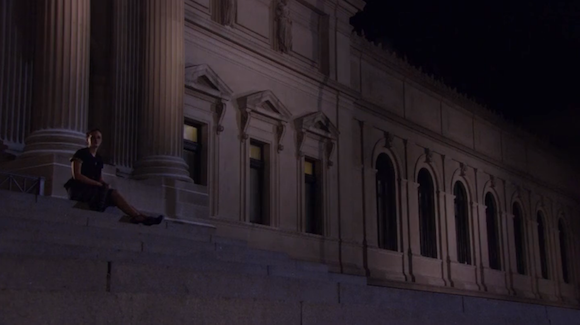
Enter Nelly, who is now a Women’s Wear Daily reporter, much to Blair’s chagrin. Reverting to their high school selves, Nelly finds Blair contemplating her navel on the Met steps, a location GG die hards will know from the early days of the show that Blair and her minions frequented. When Nelly insinuates that Blair—wearing a headband to boot—is essentially still stuck in high school, she has an epiphany: Blair needs to embrace her striking-fear-in-the-hearts-of-teens attitude in order to be a tastemaker for the 12-25 set of young fashionistas. Ahh, the Met steps: inspiring people everywhere.

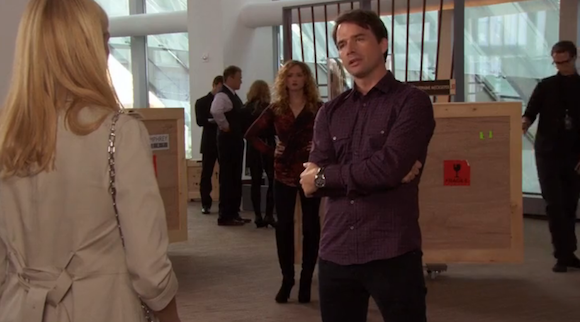
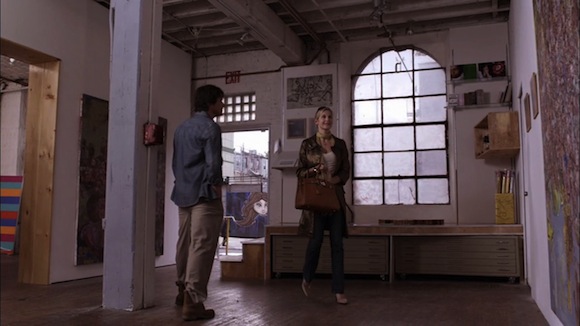
Just like in the inaugural episode of the show, Lily and Rufus are fighting in an art gallery. Rufus’ gallery opening is all set, but when Ivy checks the RSVPs, it turns out everyone’s going to a charity art benefit that Lily’s hosting. Ivy, using CeCe’s money gifted to her by Lola, buys all of Lily’s art and replaces it with the artwork from Rufus’ gallery. Meanwhile, Chuck is trying to prevent the sale of one of the works Lily has donated as he thinks Bart has hidden evidence of his illegal oil dealings in it. He has, but Ivy buys the painting off Lily and intercepts Bart’s documents before Chuck can get a hold of them. Phew! Got that?

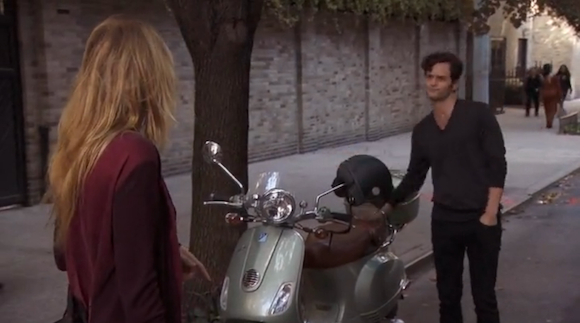
Finally, it seems the love between former step-siblings Dan and Serena has reignited, after Serena offers to take Dan apartment hunting. Conveniently, Dan has bought a Vespa after his summer in Italy, and, his and Serena’s first date five long years ago. From the photos leaked from the set of the final episode (wedding!), it looks like this time around their relationship is for keeps…

Related: Gossip Girl Season 5 Finale—What Goes Around Comes Around…

Alexa Chung, It Girls & Gossip Girl.

Images via Sockshare, Hello Giggles, Gossip Girl Screencaps, Internet Movie Cars Database.

On the (Rest of the) Net.

Sesame Street tells its viewers that “being a princess isn’t a career”. Indeed! [Jezebel]

Should Obama not have called his daughters “beautiful” during his acceptance speech? [The Oxonian Globalist]

“Can Smart Women Enjoy Hip Hop?” [Daily Life]

The Turnaway Study: assessing the mental health, wellbeing and overall quality of life of women who obtain abortions versus women who are turned away from terminations. Spoiler alert: those who wanted and recieved abortions are better off for it. [io9]

The perils of having female body hair in summer. To remove or not to remove, that is the question… [Feminaust]

Was it really necessary for Jezebel to publish the names and high schools of the racist teens who tweeted about Obama after his re-election? I’m a bit in two minds about this. Was it shoddy journalism? Perhaps. But I also think people with damaging ideologies should be called out on them, no matter their age. That’s how we create change and start a discourse about polarising issues. [Musings of an Inappropriate Woman]

Eating to stop men harassing you. [Jezebel]

Taylor Swift: The Perfect Victim.

Her songs may be catchy—even I can’t stop singing her latest, “We Are Never Ever Getting Back Together”—but Taylor Swift is one of the most detrimental-to-young-peoples’-self-esteem artists out there in my opinion.

I know a lot of people who would beg to differ: but she’s not overtly sexy, so therefore she’s portraying a healthy message to young girls. And she actually writes her own songs and plays instruments, so that’s positive for young people to see, too. But I liken her to pop cultural phenomenons like Glee and 50 Shades of Grey: on the surface they give off the impression of acceptance for the former and empowerment for the latter. When I’ve expressed disdain for these things I’ve literally had people feed me these lines of reasoning. And just like Swift is feeding the messages of the fairytale of young love and not to settle for second best to her fans, what she’s really espousing is an attitude to the opposite sex and to relationships that is toxic.

For example, she waffles on about princes and castles and Romeo, but anyone who’s been in a relationship for more than five minutes (just how long have Swift’s high-profile partners stuck around?) knows that it doesn’t really work like that. Swift is 22 years old and is still singing about relationships and boys as if she were 17, the age she was when her first album was released.

Natalie Reilly writes in the article that inspired me to muse on Swift:

“What if he doesn’t look at you in the right way at the right time of day when the dappled sunlight is falling just the right way across your face? Well, you’re going to WANT TO DIE. Is it any wonder Swift’s songs contain so much wounded anger when her expectations are so teeteringly high? Which guy could ever live up to this Instagram-worthy narrative and still be considered a human?”

I know a girl who loves Swift, has all her albums and went to her concert in Melbourne earlier this year. Recently, she started dating her first boyfriend. I quietly observed that their relationship seemed to progress as if it were taking place on a teen soap or movie: have sex after three dates, publicly announce the progression from “dating” to “boyfriend and girlfriend” after a month… And after two months the relationship fizzled because one party apparently wasn’t making enough “grand gestures” to satisfy the Swiftian ideal of what a relationship should be.

And that’s one of my many problems with Swift: she perpetuates the notion that men are the arbiters of happiness in relationships and unless they are standing outside your bedroom window with a boombox, riding off into the sunset on a lawnmower or sneaking into your room to watch over you as you sleep then there’s some crucial romantic element missing in your union. Why must Swift insist on portraying these archaic heteronormative notions of men being the “doers” and women are just there?

Because Taylor Swift hates feminism. An article a few weeks ago asked Swift whether she viewed herself as a feminist, a key question in most interviews with successful women who haven’t already come out as a women’s libber. Here’s her answer:

“I don’t really think about things as guys versus girls. I never have. I was raised by parents who brought me up to think if you work as hard as guys, you can go far in life.”

Paging Taylor Swift: that’s exactly what feminism is. And as I originally commented, if Swift is about nothing else, she is about guys versus girls. Her prime song lyric generator is breaking up with men who’ve wronged the poor, innocent Taylor. You know, when she’s not slut-shaming the popular girl who’s the girlfriend of the boy she wants for herself, and if only he could look past her sluttiness he would see Swift is the one he’s really supposed to be with. See: the “You Belong With Me” video for which, handily enough, Swift was awarded best female video at the 2009 MTV VMAs in the infamous Kanye West-“Beyonce had one of the best videos of all time” incident. Poor little Taylor cast as the victim yet again.

Swift really is the perfect victim (Reilly notes Swift is a key proponent in the “‘lover as victim’ trope”), though, because she manages to hide the playing up of the victim status so well. Sure, she writes songs teens can relate to, but the self-absorbed, angsty and tormented world of a teenager is a far cry from the real world a 22-year-old should be inhabitating. There comes a time when you need to stop blaming other people for relationships gone awry and maybe look inside yourself for the cause of the problem.

As Reilly asks, is Swift’s ideal of relationships “the narrative we want for young women? For any women?” Certainly not.

Related: 50 Shades of Grey by E L James Review.

Elsewhere: [Daily Life] The Problem with Taylor Swift’s Love Songs.

[Jezebel] Don’t Go Calling Taylor Swift a Feminist, Says Taylor Swift.

Image via Jezebel.

On the (Rest of the) Net.

The “slut vote” is the reason why Mitt Romney didn’t win the presidency and instead Barack Obama was reelected to a second term. On a side note: WOO HOO! [Christian Men’s Defence Network]

And not only that, but the “black vote” kept that n-word in office. And some people have no shame in taking their racist views to Twitter to lament this supposed fact. [Jezebel]

Is Beauty & the Geek the most sexist show on TV? [MamaMia]

In defence of Caitlin Moran. [New Statesman]

Heterophobia in gay bars. [MamaMia]

Why Britney Spears needs a stylist. [TheVine]

The women of Friday Night Lights call out Mitt Romney for the unauthorized co-opting of the show’s “Clear eyes, full hearts, can’t lose” slogan. (Scarlett Woman note: apparently you can lose, Mitt!) [USA Today]

In the spirit of Halloween just passed and, you know, the persecution of women and minorities since the dawn of time, take this quiz to find out whether you would have been accused of witchcraft in ye olden times. [BBC History Magazine]

Misogyny at St. John’s College. [Daily Life]

Why do people (namely black, female people) hate Nicki Minaj? [Jezebel]

Gala Darling’s account of surviving the Frankenstorm, Hurricane Sandy.

Mia Freedman’s News Ltd. column has been axed amid many other newspaper axings. She should have stayed at Fairfax, where they actually appreciate good journalism and authentic voices. Oh well, this means more of her at her namesake site, MamaMia! Yay!

A letter to conservative politicians from Just Another Rapist (*trigger warning*). [Whatever]

Image via Twitter.

TV: The Underlying Message in Glee’s “Makeover” Episode.

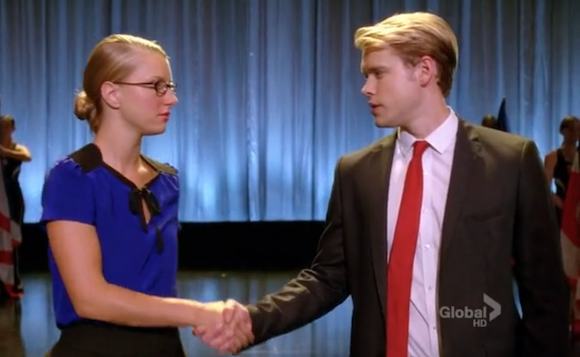
With the U.S. presidential election taking place one day before Glee’s “Makeover” episode—in which McKinley High’s class presidential election occurred—aired in Australia, Glee showed that it is capable of some self-awareness and social commentary every now and then.

Shades of Brittany’s bid for last year’s class presidency can be seen, but where that episode dealt more with the feminism of both the 2008 and McKinley’s elections, last night was about the celebrity culture that surrounds voting.

Blaine tries to make this clear when he admonishes Brittany for using her popularity to influence the glee club members to vote for her. “This isn’t a popularity contest; it’s about who’s got the best ideas.” That may be so, but the creators saw fit to milk this angle for all it’s worth with a “Celebrity Skin” by Hole montage.

While Brittany chooses to run with “part-robot” Artie, whom she forgot she dated several seasons ago and broke up with because he called her stupid, as her vice presidential candidate, a category which Sue Sylvester points out has been introduced “for no discernible reason whatsoever”, she suggests Blaine pick Sam as running mate. Sam assures Blaine he’ll bring in the “sympathy” and “not-gay vote[s]” because his family is on food stamps and he’s not gay: kind of like John McCain picked his “granddaughter” (according to Brittany) Sarah Palin as vice presidential candidate in 2008 to seemingly ensure the “female” vote to no avail.

Brittany’s influence on her opposition seemed to work to her disadvantage, as at the end of the episode we see Blaine and Sam (“Blam” as they are collectively called on the congratulations banner) celebrating their victory. Blaine is experiencing some self-doubt and displacement at McKinley when Kurt is more focused on his new intern-career at Vogue.com with guest star Sarah Jessica Parker (who herself is heavily involved in politics and the campaign to get Obama reelected, serendipitously enough) than him, but Sam says being the school’s “first gay-guy president” whose place of birth is brought into question by Brittany is something to be proud of, just like Obama was America’s first black president whose birthplace was also called into question by a fellow “celebrity” perhaps bitter about Obama’s influence in Hollywood: Donald Trump.

Related: The Underlying Message in Glee’s “Asian F” Episode.

Image via AllMyVideos.

Event: Legally Blonde—The Musical Review*.


Sydney is the host city for the Australian premiere of Legally Blonde: The Musical, and this time last week, a couple of friends and I came together from two other cities (Melbourne and Perth) to check out the latest import from Broadway.

I first became familiar with the musical version of the ditzy blonde from Bel Air with a heart of gold who makes good at Harvard a few years ago when I watched The Search for Elle Woods on MTV. I’m all over the pop-feminism of the Reese Witherspoon version (in fact, my friends and I gathered around my laptop the night before the stage show to watch the original as our hotel didn’t have a DVD player and the only thing I could fault about it eleven years on is the use of “spastic” and “retard”), and I’ve come to love musicals since seeing Wicked which I use as the benchmark for all theatre, so it was a no-brainer to make the jaunt to Sydney to see the Aussie version, starring Lucy Durack as Elle.

Let me start by saying the highlight of the night was the fact that we actually got to meet Durack, Rob Mills, who plays Warner, Cameron Daddo (Professor Callahan) and I Will Survive winner, Mike Snell as the UPS guy, after the show. Maybe because the theatre was only half full they encourage ticket holders to come to the stage door after the performance to meet the cast, but if you’re a fan of any of the above, you should pop along just for that little extra (or hang out in the back streets of the Lyric Theatre!).

I also thought the elaboration of Elle’s outing at a party dressed as a Playboy bunny was a genius addition to the play, but I might be a little biased: when a fellow party-goer tells Elle she looks like a skank in her costume, she comes up with the defence that she is actually dressed as Gloria Steinem when she went undercover at the Playboy club in 1963 and subsequently wrote the feminist manifesto “I Was a Playboy Bunny”, asking, “Would you call Gloria Steinem a skank?!” Token feminist/(ergo) lesbian Enid blurts out, “Who called Gloria Steinem a skank?!” We cheered and whistled from our third row seats and were pretty well the only ones who got the joke which was made a little more special for me personally as three days later I dressed as that exact incarnation of Gloria Steinem as a Playboy bunny for Halloween!

Perhaps watching the movie the night before the show wasn’t the best idea, as it made me appreciate the flawlessness of the former and the problematic nature of the latter, which I thought was rife with homophobia, racism and utter “what the?!” moments. Durack, Snell, Mills, Erika Heynatz as Brooke Wyndham and real live puppy dogs on stage were superb, but the clunkyness, out-of-place inclusions to the story and the abovementioned problems overshadowed the better aspects of the show.

Staying with the film, I think it’s a truly feminist piece of art because feminism isn’t really mentioned once, despite Enid’s blatant characterisation as a militant feminist, yet Elle exceeds the expectations placed on her based on her sex and sexiness. In the end you love her because she’s an awesome person, not because she’s hot, blonde, has a vagina and wears pink.

In the musical, however, feminism is almost shoved down the audience’s throat, but from an outsider’s perspective, as if the writers said, “Shit, we need to make this a bit more feministy. Quick, what do we think feminists value?” Whereas in the Witherspoon version, Elle truly does make it at Harvard on her own, on stage Emmett’s character features more heavily and he pretty much guides her through her trials and tribulations which Elle takes credit for solving all on her own. Not to worry, though: to really push the feminist point home, Elle proposed to Emmett because, you know, only feminists do those kind of newfangled pro-equality kinds of things.

If the dismal turn out in the session I bought tickets for is any indication, I don’t think Legally Blonde will continue its run to other Australian cities. Unless you live in Sydney, I wouldn’t recommend making the trip to see it.

*Blanket spoiler alert.

Image via Time Out Sydney.

TV: The Underlying Message in Glee’s “Britney 2.0” Episode.

Did Glee really need to do another Britney Spears episode? As Artie pointed out, “we’ve scraped the bottom of that Britney barrel” but Britney’s made a comeback as judge on The X Factor broadcast on the same channel as Glee—Fox—so both shows are running with the Britney theme no matter how uninspiring she’s become.

Apparently New Directions “really came into your own during the last Britney week”, according to Mr. Shue, and what he says goes. Coincidentally, Brittany S. Pierce is undergoing a meltdown the same week the glee club resurrects her idol and namesake’s back catalogue. She’s feeling rejected by her long-distance lady love Santana, was kicked off the Cheerios and subsequently lost her high pony. Channeling Britney circa 2008, Brittany says if she can’t have her high pony then she doesn’t want any hair at all, and attempts to shave it off before attacking McKinley High’s resident paparazzo, Jacob Ben Israel, with an umbrella.

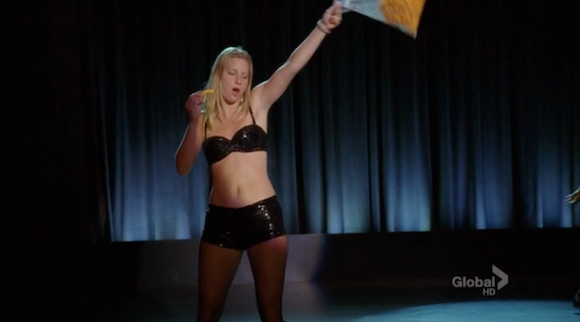
I appreciate the satire Glee is trying to undertake here, revealing that Brittany’s crisis—which culminates in Brittany getting busted for leading New Directions in a lip-syncing rendition of “Gimme More”, replete with Britney’s junk food of choice, orange soda and Cheetos—was her “intentionally hitting rock bottom… so I can make a comeback like Britney”, but they either push it too far bordering on racist, ableist, homophobic, sexist, inappropriate crap (case in point: resident Jesus-lover, Joe, singing Britney’s song about a threesome, “3”) or not far enough, as with last night’s episode as a whole.

Britney Spears’ tragic life is ripe for the picking—the recent revelation from former paparazzo turned Britney’s manager turned collaborator with Courtney Love on a musical about her and Kurt Cobain’s life together that Britney used to do crystal meth—so much so that Christie Whelan’s turn in Britney Spears: The Cabaret was the exemplar of how to do a Britney satire. Glee’s “Britney 2.0” was not.

Related: The Underlying Message in Glee’s “Britney/Brittany” Episode.

The Underlying Message in Glee’s “The Spanish Teacher” Episode.

The Underlying Message in Glee’s “Yes/No” Episode.

Glee: The Right & Wrong of It.

Glee: T.G.Inappropriate.F.

“This is a Story About a Girl Named Britney… I Mean Lucky!” Britney Spears: The Cabaret Review.

Images via Ch131.com.

TV: Has Smash Jumped The Shark With This Bollywood Number?

This post was originally published earlier in the year when Smash first aired on Foxtel’s W, now SoHo.

My reaction to the above scene is equal parts cringe and intrigue. While it could be seen to be pushing the boundaries, and it does tie in with Dev’s Indian heritage and movie star Rebecca Duvall’s racial ignorance, it could also very well be the moment when Smash jumped the shark. What do you think?

Related: Has Smash Jumped the Shark with this Bollywood Number?

The Problem with Smash.