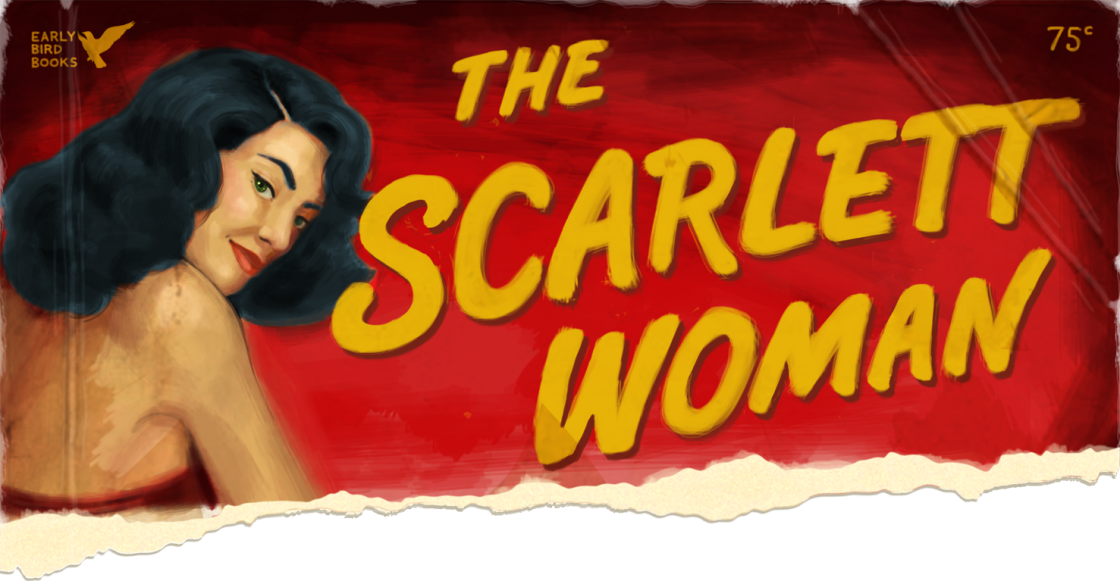
Event: The Reading Hour.

In celebration of the National Year of Reading, today marks the National Reading Hour. While the exact time frame for the event is sketchy, and anyone who knows me knows I’ll be spending much more than one hour reading today (or on any day, for that matter), the aim of the event is to instill the importance of reading in children. From my point of view, reading is important at all ages and it’s never too late to start. The only downside is there’s less time to read all the fantastic books out there.

So, I’ve decided to get in on the action by going over all the books I’ve read this year and whether I found them good, bad or otherwise and if you should read them, too.

I haven’t read this many books since my uni days, I don’t think, when I was traveling up to six hours a day from country Victoria to Deakin in Burwood. Needless to say, there were a lot of public transport hours that needed filling, and reading was the perfect way to do that. Aside from primary school, of course, when nightly “readers” were a must and I got through several, if not up to a dozen, books a week, uni really got me back in touch with my love for reading; a love without which I wouldn’t be who I am today.

So, without further ado…

My Booky Wook 2 by Russell Brand.

If I if I didn’t have to give this book back to a friend before she moved interstate at the start of the year, I think it would still be sitting in my stack of to-be-read books (like some other borrowed tomes). While it didn’t change my world, and I much preferred Brand’s first memoir, I’m glad to have read it and moved on. Much like Katy Perry. Burn!

The Barbie Chronicles: A Living Doll Turns 40 edited by Yona Zeldis McDonough.

While Barbie is now 53 and there is now thirteen more years of fodder for a compilation of feminist musings on the doll, I really enjoyed this book and ponder it often. Aforementioned interstate friend, Laura, currently has it in her possession. I believe it is out of print now, so I was quite lucky to have happened upon it at my local secondhand bookstore. Pick it up if you get the chance.

Big Porn Inc. edited by Melinda Tankard Reist & Abigail Bray.

I was so looking forward to reading this conservative collection on why porn is bad, and it didn’t disappoint. I didn’t agree with anything in the book, but it was an eye opening look at just how anti-sex (not to mention anti-choice, anti-feminism, anti-vaccination) some people can be. What scares me is that Tankard Reist and Bray’s ideologies could be rubbing off on the susceptible with the release of this book.

The Book of Rachael by Leslie Cannold.

Feminist crusader Cannold looks at what could have been the life of Jesus’ sister, Rachael. What’s more, the book focuses on her relationship with the ultimate betrayer, Judas. It wasn’t mind blowing, but if you’re looking for something to read and want to support local, female writers, this is one for you.

The Black Dahlia by James Ellroy.

To be honest, I had lots of things on my mind when I read this so it’s almost like I never read it at all. I found it really hard to get into and to focus on the words on the page. Maybe I’ll watch the movie in an effort to more fully understand the storyline. Shameful, I know.

We Need to Talk About Kevin by Lionel Shriver.

If you haven’t read this book yet, you need to get on it, like, yesterday! So well written, so emotional, so involving and with a massive twist at the end. And please, if you’re thinking about watching the movie (which I haven’t seen yet, so don’t take my word for it: it might even be better than the book), read the book first. Looking back, this is probably the best book I’ve read this year and, dare I say it, ever.

The Hunger Games by Suzanne Collins.

Not the worst teen trilogy out there (I’m looking at you, Twilight Saga), but not the greatest, either. I found the book easy to read and also well written which, again, is more than I can say for Stephenie Meyer.

Fragments by Marilyn Monroe, Bernard Comment & Stanley Buchthal.

This part-coffee table book, part-Marilyn musings tome had been sitting in my pile of to-be-reads for almost a year and a half before I decided to actually read about one of my favourite icons. I enjoyed a rare insight into the mind of the sex symbol herself, but honestly, I think there are probably better books about her out there.

Hitman: My Real Life in the Cartoon World of Wrestling by Bret Hart.

This is the book I spent the most amount of time reading; or rather, it took me the most amount of time to read. It is a hefty memoir, but it’s not exactly written in a challenging tone, either. I quite enjoyed it, all in all, and while you probably need a background knowledge of professional wrestling to get into the book, it was kind of sad reading about all the tragedies in Hart’s life.

Remarkable Creatures by Tracy Chevalier.

I love me some historical fiction and Remarkable Creatures didn’t disappoint. Easy to get into with a bit of fluff, but it has nothing on Girl with the Pearl Earring.

11.22.63 by Stephen King.

This was my first encounter with King, and I quite liked it. He obviously has the suspense/mystery/horror (though you won’t catch me dead with one of his books—nor the movie adaptations—in this genre. I hate horror!) formula down pat. While the title and cover lines were a bit misleading (JFK doesn’t come into it until right near the end, and even then it’s anticlimactic), I really liked it and found out some historical tidbits I didn’t know previously.

The Informers by Bret Easton Ellis.

Easton Ellis is one of those writers who is good in theory, not so good in practice. I still plan on reading all of his efforts, no matter how gory and gratuitously sexy and druggy they are (this one had a central theme of sex, drugs and rock ’n’ roll in ’80s L.A.… with a side-serving of vampirism!), but sometimes I think he’s a bit over hyped. As was The Informers.

Fables: The Deluxe Editions Volumes 1 & 2 by Bill Willingham.

These are the comics Once Upon a Time is allegedly inspired by, and let me tell you, these are much better than the show. I’m not usually a fan of the comic book format, but I really enjoyed these two. Bring on the next two installments!

Drowned by Therese Bowman.

When I read Drowned, I actually had no idea what the storyline was. I remembered reading an enticing review in The Age a month or two before I convinced a friend to buy it in order for me to borrow it, but other than that, I was clueless. After reading it, it seemed there was no storyline; it was more high-concept literary fiction to my mind. But it was very evocative. Short and sweet.

Never Let Me Go by Kazuo Ishiguro.

I just finished this one on a trip away and I loved it. Similarly to The Black Dahlia, it took me awhile to get into it, concentration-wise, but once I did I found it very enjoyable. The storyline is unique and interesting, and the character development and style were some of the best I’ve had the pleasure of reading.

Music for Chameleons by Truman Capote.

So does reading one short story in the collection count as actually reading the whole of Music for Chameleons?! I bought this book from a secondhand store with the sole intention of reading the Marilyn Monroe chapter and that’s all. Kind of a waste, I suppose, but I like to support small, local businesses!

50 Shades of Grey by EL James.

I have oh-so-ashamedly left this one til last as it is by far the worst, but it’s also the one I’m currently reading. I always said I would never be caught dead reading this mediocre tripe, but after hearing John Flaus and Jess Anastasi (a coincidence her surname is practically the same as the first name of 50 Shades’ protagonist?) discuss the book at the Bendigo Writers Festival, I finally succumbed. The way I look at it, I’m approaching it with a critical eye for the purposes of research. It’s better to have an informed opinion, right? More to come.

What are you going to be reading for the National Reading Hour?

Related: Big Porn Inc. Edited by Melinda Tankard Reist and Abigail Bray Review. 
The Book of Rachael by Leslie Cannold Review.

Bendigo Writers Festival.

Magazines: Men Have Issues.

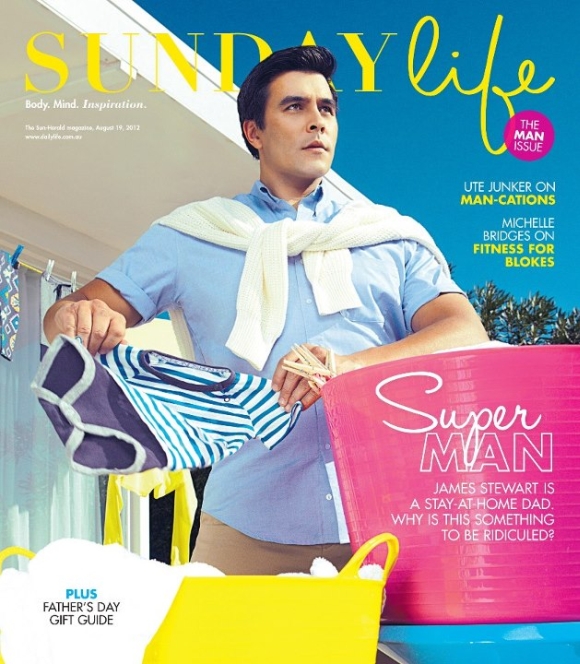
Last weekend’s edition of Sunday Life was dubbed “The Man Issue”, and it gives a forum to men to talk about the things that bother them: namely, stay-at-home fatherhood being seen as feminine and “what women should know about men”, with one clearly more profound and less satirical than the other.

Packed to the Rafters’ James Stewart covers the magazine and talks about his new role as stay-at-home dad to baby Scout, with partner and former Rafters star, Jessica Marais. He admirably says:

“I don’t want to be an absent father…  And now my partner—who has a much larger profile than me, can make five times as much money as me—is hot right now… So it was kind of easy for me to go, ‘Just stop what you’re doing, hang your boots up for a little bit, support her 100 per cent and learn to be a father.’ It was a no-brainer, you know?”

Swoon.

The article touts Stewart as “poster boy for modern-day ‘manism’” [quotations mine], a movement which “liberates” men “from their traditional masculine roles”. Um, I think we already have a movement that works to break the shackles of gender normativity and promote equality between the sexes and it’s called feminism.

In a rare moment of sense from Ita Buttrose, she tells the magazine that “We used to say to women, ‘Make your choice, don’t apologise.’ Well, I think those messages need to be given to men.”

Here, here.

But where The Age insert undoes all its equality talk is in an article that precedes the cover story, about the facts women need to know about men, by former Zoo Weekly editor Paul Merrill. He tells Sunday Life’s primarily female readership that “as hunter-gatherers, housework is not a priority” (how about you hunter-gather some washing?!), and that men prefer famous people who actually do stuff. You know, ’cause women aren’t capable of admiring anyone except the Kardashians. And speaking of that über-preened family, women must remember that “looks aren’t everything”:

“To a woman, the most important thing in any situation is how something looks—her hair, make-up, shoes and house… Who cares!… It’s not being slobby, it’s being less shallow.”

What do I think Merrill needs to know about women? We’d prefer to share the burden of housekeeping, we don’t only read if it’s a gossip mag or 50 Shades of Grey (which he infers in not so many words in the piece), and we don’t like to be called shallow for being well-presented. And where would Merrill be without the latter? Certainly not the editor of a lad’s mag.

Elsewhere: [MamaMia] Hot Pants & Slut-Shaming. Would You Like a Cardi With That?

Image via Sunday Life Facebook page.

Event: Bendigo Writers Festival.

The month of August is chock full of writers festivals (okay, two, but I’m going to a lot of sessions!), so much so that I’ve taken time off paid work to further my currently unpaid writing career.

Over the weekend I ventured to Bendigo for their writers festival, which boasted big names like Ita Buttrose. I decided to give her talk a miss as it coincided with another talk I wanted to go to about blogging and writing online which is more relevant to me, and frankly, some of the things Ita’s said recently have really rubbed me the wrong way. I think I like her better as portrayed by Asher Keddie than in real life!

While Megan Burke (my new idol) and ABC Open’s Jane Curtis were great speakers (and great bloggers), I felt the audience were all middle aged aspiring mummy bloggers and the content was relevant to them, who are interested in starting a blog, not me. Maybe three years ago, but not now.

The second talk I went to on Saturday was “Are We There Yet?”, featuring Indigenous writer Alexis Wright, astrophysicist turned lawyer turned writer Sulari Gentill, Muslim writer Hanifa Deen, and author Arnold Zable, and facilitated by Shannon Kerrigan, was promising in theory but failed to live up to the hype in practice. I thought all the writers were great and had valuable things to say about how writing contributes to social change but the format of the session was all wrong: I’m not a fan of each speaker telling a story about their take on the subject for a third or a quarter of the time and then it’s over. I much prefer pre-determined questions being posed to the panel and then opening them up for discussion. Suggestion for further panels: use social media to tally up the questions and thought threads attendees want to hear about and incorporate those into the talk, instead of stuffing them into a ten minute question and answer session at the end.

Speaking of, the last talk I went to on Sunday afternoon was about “His & Hers” writing, which had the potential to really delve into the notion that women write about shopping and sex and men write about serious things. When the facilitator, Sofia Ahlberg, asked if women can write a “great Australian novel” and insinuated that they can’t (not because that’s her personal view, I don’t think, but because our society just doesn’t allow for that with, perhaps, the exception of Kate Grenville), a man from the audience and his wife audibly retorted and rudely told Ahlberg to open the discussion up to questions from the audience.

What I got out of the session was an interest in 50 Shades of Grey that I didn’t have before, thanks to John Flaus’ comments that he didn’t think it was written by a woman due to its “clinical”, “outsider” perspective on sex. Either that, or an incredibly narcissistic woman. Interesting.

Also on Sunday was the “What Makes a Hero” session, with Janine Bourke, sports writer Gideon Haigh (sportspeople as heroes is one of my pet topics), Ned Kelly biographer Ian Jones and Hanifa Deen, who asked where minorities get their heroes from if they’re a primarily “conservative construct”, as Haigh asserted. Deen also talked about “cultural amnesia” which I found interesting as we so often put people on a pedestal after—and sometimes despite—committing indiscretions (Ned Kelly, Chopper Reid, and countless football players, to name some Australian “heroes”): “we remember and admire the things we want to”.

Finally, there was a horror panel featuring horror writers Brett McBean and Cameron Oliver, reviewer Lucy Sussex and president of the Australian Horror Writers Association, Geoff Brown. This was probably the best panel in terms of actually addressing the topic and opening the discussion up to questions and comments about “what scares us”. Interestingly, Bendigo is one of the most haunted cities in the world, with more ghosts per person than anywhere else! They talked about the canonical horror films of the late ’70s and ’80s like Carrie, The Shining and The Exorcist and how filmmakers are “scared to scare people” now and that the current zombie, vampire and werewolf trend reflects our xenophobia and fear of the “other”; more so, that they will “turn us into them”. If that doesn’t some up what we’re scared of, I don’t know what does.

Related: Paper Giants: The Birth of Cleo Review.

In Defence of Mia Freedman.

Elsewhere: [MamaMia] Was “Girls on Show” Slut-Shaming?

On the (Rest of the) Net.


Check out my second article for TheVine, about the male body objectification trend. More to come here next week.

Still with the sexualisation of male bodies, who knew there was so much to unpack when it comes to Magic Mike? Can I get a redo on the above article? [The Atlantic Wire]

And lastly, nudity in rom-coms. [Daily Life]

Why is a reality TV star worth a reported $3.5 million seeking funding on Indiegogo to put on a fashion show at New York Fashion Week? On the one hand, use your own fucking money. On the other, it is “the first-ever fan-supported fashion show”. Social experiment or effortless money-grab? [Jezebel]

Mitt Romney is a mansplainer! A Mittsplainer, if you will. [GQ]

Why Fifty Shades of Grey is a badly-written, misogynistic piece of shit that encourages women to stay in an emotionally abusive relationship. [Good Reads]

Cosmo’s international editions: feminist or not? [NYTimes]

Channel 9 aired an expose on girls dressing skimpily for nights out on the town. Ita Buttrose said dressing this way makes people assume you’re a “tart”, and men don’t take tarts home to mummy. Charlotte Dawson said girls need to be careful about “the consequences of dressing up like this could be”. Shitstorm ensues. [MamaMia]

Why girls don’t need to develop their self-esteem, they need to recognise that beauty is a tool of the patriarchy to beat women into submission. [The Nation]

Image via IMDb.