TV: “What? A Woman Can’t Rescue a Man?”


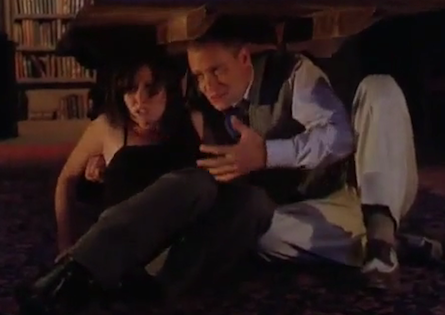
“I’m still waiting for it to happen,” warlock Malcolm replies to Prue when she gets herself transported into a painting in the season two episode “The Painted World”.

“Yeah, well keep waiting, pal!” she replies.

You’ll be seeing a bit more about Charmed over the next few months as I work my way through the seasons.

Related: Witch Trial: Burning at the Stake on Charmed.

Image via YouTube.

TV: Witch Trial—Burning at the Stake on Charmed.


2009: The year Michael Jackson died, 173 people perished on Black Saturday, and America’s first black president, Barack Obama, took office.

However, in Charmed’s imagining of a futuristic 2009, 1999’s flashforward episode “Morality Bites”, witches have been exposed and are now being burned at the stake.

Phoebe is set to burn for taking justice into her own hands and using her powers to avenge a friend’s death, “seeking to defy human nature with her way of life”.

Fastforward two years to 2011, and it’s not such a different place.

Uganda tried to push through the Kill the Gays bill, women still have to march in (Slut)walks to exert freedom of sexuality and reject blame for sexual assault, and Australia is still floundering over a carbon tax.

I’ve written on this here blog before that sometimes I get the feeling the world is regressing, especially in terms of the environment and reproductive rights.

We still vilify those who dare to lead a lifestyle outside the norm, whether it is viewed as a “choice” or not. In Charmed’s fictional world, witches could be seen as a metaphor for the “other”: people of colour, the gays, people with disabilities and, most pertinently in 2011, transpeople.

The episode could also be a metaphor for the death penalty.

When Phoebe kills baseballer Cal Greene for killing her friend, she takes the law into her own hands, and is therefore sentenced to death. An eye for an eye.

Before Phoebe accepts her fate and submits to burning alive, she tells her executioner, Nathaniel Pratt, that while she’s paying for her crime, there will come a day when he’ll have to pay for his, too. While the death penalty isn’t an issue in Australia (if it were I’d be—controversially, perhaps—for it. However, there seems to be something sickly satisfying for victims and their families to see a perpetrator rot in prison for life… Jaycee Duggard’s abductors, anyone?), the question of who decides if a person dies and who administers the lethal injection (or in this case, “gathers the kindling”) remains. And how can a person live with that on their conscience.

Charmed may be all fluff, unrealistic demon-fighting outfits and “nipple fats”, as my friend Eddie noted, but every now and then it does deal with the big issues, consciously or not.

Related: Ain’t Nothin’ Gonna Break My Slutty Stride.

Rihanna’s “Man Down”: Revenge is a Dish Best Served in Cold Blood.

Images via Wikia, Gamespot, PPP The Power of 3, Hopeless Obsession.

“With a Gun Between Her Legs”—Why “Strong” (AKA “Sexy” Whilst Being “Strong”) Female Characters Are Bad For Women.


There has been a bit of talk throughout the blogosphere recently (and not so recently) about how “strong” (ie. butt-kicking but looking hot whilst doing it) female characters are detrimental to women.

From Overthinking It:

“… The trouble is, although these characters were marginally better than the original Damsels in Distress, they still ended up having to be saved in the final act by the male hero. There would usually be a scene (or three) where the ‘Strong Female Character’ would be trapped by the villain and put into sexy clothing.”

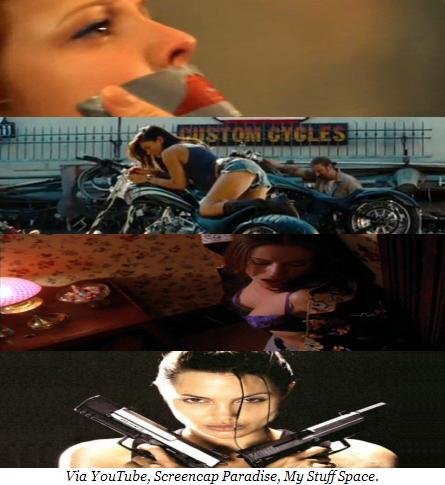
Here are a few examples: Drew Barrymore in Charlie’s Angels (in a satirical hyper-sexualised way), Rose McGowan and Alyssa Milano in Charmed, and Megan Fox in Transformers, which Overthinking It explicitly references.

Furthermore:

“And even when she was being strong, she was always doing it in the sexiest way possible. She’d never, say, get a black eye or a broken nose in a fight. Her ability to fix cars (a powerful, masculine trait) would basically allow her to get sexy grease all over her slippery body. Her ability to shoot a gun was so the film’s advertisers could put her on a poster wearing a skimpy outfit with a big gun between her legs. All in all, the ‘strength’ of her character was just to make her a better prize for the hero at the endand for the horny male audience throughout.”

Again, Fox in Transformers with the grease, but also Angelina Jolie in Lara Croft: Tomb Raider and even Strong Female Character Buffy, who always looks good kicking vampire butt.

Related: Are Our Favourite Fictional Females Actually Strong, Or Stereotypes?

Elsewhere: [Overthinking It] Why Strong Female Characters Are Bad for Women.

[Overthinking It] The Female Character Flowchart.

[Overthinking It] “Her Ability to Shoot a Gun Was So the Film’s Advertisers Could Put Her On a Poster Wearing a Skimpy Outfit With a Big Gun Between Her Legs.”

Women in Fiction: My Favourite Fictional Females.

A recent post on Girl with a Satchel (which was reblogged here) inspired me to assess my favourite fictional female characters.

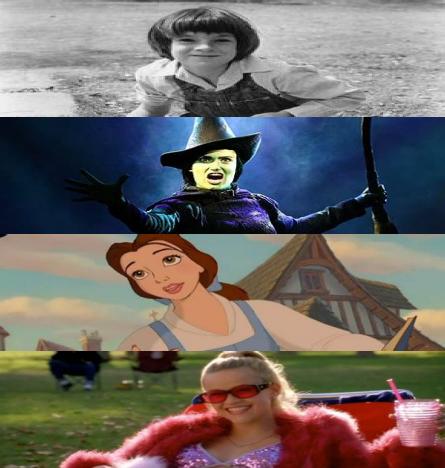
One of my favourite books is To Kill a Mockingbird, and protagonist Scout Finch is one of my favourite characters of the written word. Her innocence and naivety are super-endearing, and her past-tense narrating allows the reader to put themselves in her shoes easily.

Wicked is a niche book and musical that theatre buffs can’t get enough of, but the general public are a bit oblivious to because it hasn’t derived from/been made into a movie, like Melbourne’s current season of musicals, West Side Story, Mary Poppins and Hairspray, all of which are on my theatre-going agenda in the coming months.

I’ve seen the production three times in Melbourne, and many a friend has seen it in its various international incarnations on Broadway and the West End… oh, and Sydney! I was so touched by the story and its messages of friendship, good versus evil and judging a book by its cover, and even more so by Elphaba, better known as The Wicked Witch of the West from The Wizard of Oz. Unlike in the original story, Wicked’s Elphaba is fiercely loyal to her disabled sister Nessarose, and those who become close to her like Glinda, Doctor Dillamond and Fiyero, misunderstood because of the colour of her skin and the slander spread about her when she discovers the Wizard of Oz is a fraud and seeks revenge.

In the vein of fairytale musicals, Beauty & the Beast (which is being re-released in selected theatres in 3D from 2 September) is by far my favourite, and I love its heroine Belle so much, I have been known to fight with my friends and children alike over the fact that I AM BELLE! Hello, I have brown hair, like burly men, read a lot and have a penchant for yellow gowns! While there have been arguments circulating that the Disney princesses are beacons of anti-feminism, I maintain my stance that Belle doesn’t need a man to rescue her (in fact, she does the rescuing, helping the Beast when he is attacked by wolves, attempting to make the townspeople see the error of their ways in going after him, and ultimately, setting his heart free) and sees the Beast for who he truly is, not for what he looks like or what he can do for her. She’s a kick-ass beauty in the vein of Buffy, The Vampire Slayer and Angelina Jolie’s Lara Croft: Tomb Raider.

I’ve blogged (or reblogged) a little bit lately about Elle Woods. She’s an everywoman. Rachel Hills identifies with her, as does Satchel Girl Erica Bartle. A law-studying friend of mine recently compared herself to Miss Woods, also. And I won’t lie; I’ve fantasised about wearing a Playboy bunny suit whilst purchasing an Apple Mac! Elle Woods proves that you can take pride in your appearance and have fun whilst pursuing your dreams and making a name for yourself separate from the name of the man in your life.

There are plenty of other made-up women who I have an affinity for, including the aforementioned Buffy Summers, and Daria Morgendorffer for their kick-ass feminist mentalities; ditto for the Charmed sisters; Gossip Girl’s Blair Waldorf, who can be a psycho bitch at times, but she’s THE psycho bitch; for similar reasons as Elle Woods, Cher Horowitz; and Barbie.

Related: Guest Post—Pop Culture Power Women.

In Defence of To Kill a Mockingbird.

Event: The Way We Wear Vintage Market.

Elsewhere: [Girl with a Satchel] Women of Pop Culture & the Unashamed Use of Cutesy Clichés.

[Musings of an Inappropriate Woman] Have You Ever Seen Yourself Through Someone Else’s Eyes?

Lady Most Likely: Time Magazine’s 100 Most Influential People

Every time I turn on the readio, it seems like there’s a Will.I.Am collaboration (“3 Words” with Cheryl Cole; Usher’s “OMG”; “Imma Be” with Black Eyed Peas) or Will.I.Am sounding collaboration (“Nothin’ on You” by B.o.B.; “If We Ever Meet Again” by former über-producer Timbaland and Katy Perry) getting airtime. The BEP front man may indeed be the new Timabland, so I was surprised he didn’t make it onto the list. There’s always next year, I suppose…

Someone who did make it on, though, is Lady Gaga.

Cyndi Lauper, Gaga’s partner-in-crime for the MAC AIDS Fund, profiles her for possibly the most talked about ranking this year. I have no doubt Gaga is the most influential person in entertainment today, as she’s collaborating with and inspiring the fashion, beauty, art, advertising, music and film worlds with her own performance artas Lauper writes, “she is inspiring other artists to go further in their own work”and striking up water cooler conversation with her boundary pushing antics, both onstage and off.

Time is spot on in naming Marc Jacobs the only influential fashion figure. Jacobs, who is profiled by fellow fashionista and friend, Victoria Beckham, glamorised grunge, began the bag lady chic movement, and is now championing voluptuousness in his new season looks for Louis Vuitton and his titular line. Perhaps Karl Lagerfeld and Anna Wintour would have made welcome additions, but Jacobs certainly has the respect of all facets of the fashion world his peers, his models, his muses and his loyal subjects.

I am utterly dumbfounded to not see George Clooney on the list. Not only did he single-handedly organise the Hope for Haiti Now telethon but, like a fine wine, he only gets better with age.

In other “Artists” notes, shoe in Oprah is profiled by Phil Donahue, while her partner, “Mr Oprah” Stedman Graham makes the Least Influential list (more on that below); Robert Pattinson is bafflingly included (for influencing legions of teens and, worryingly, tweens ready and willing to let Pattinson bite them? Perhaps Brad and Angelina would have been better choices, as they actually contribute something to societyas well as being really, really ridiculously good looking. Or even Stephenie Meyer, without whom Pattinson wouldn’t have an Edward Cullen to broodingly portray); and “new media mogul” Ashton Kutcher, whom I was pleasantly surprised to see on the list.

Of course, President Obama makes an appearance as one of, if not the most influential leaders. While he certainly is the most well-known leader on the list, whether he’s been as influential as he could have during his first year in the presidency is a point of contention for a lot of politicos and American citizens.

My second favourite President (after Obama, George W. Bush is the only other President whose reign I was [un]lucky enough to grow up during, so Clinton wins via default), I find Bill Clinton funny, charming and smartalthough, hey may not have been utilising the latter during Lewinskygate. Nonetheless, he’s making positive change, and that’s all that matters here.

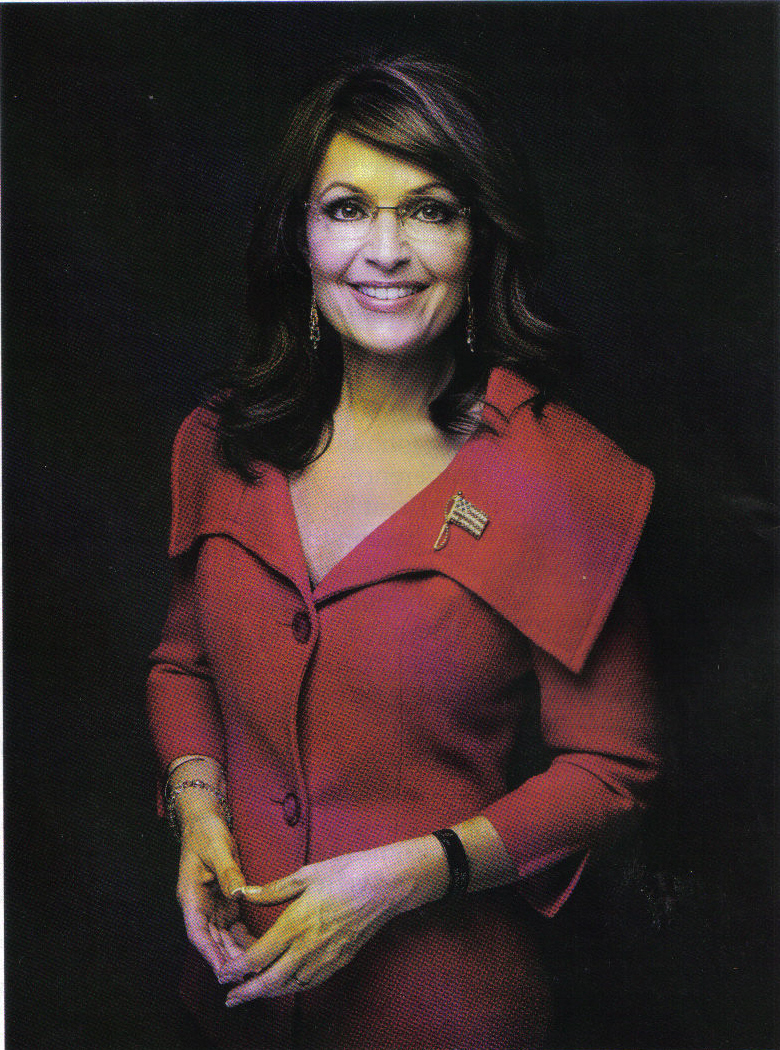
On the other hand, former vice-presidential candidate Sarah Palin makes the list. She is certainly fascinating and controversial, but I wouldn’t call her influential. Perhaps she would be more at home on Barbara Walters’ annual most fascinating people list?

Speaking of other lists, on page 96 you will find Joel Stein’s “The Time Bum Hundred”, relaying how he chronicled the 100 least influential people of 2010, split into “four categories… Losers, Flameouts, Morons and Slimy Bastards”. The complete list is not available in the mag, but it is on Time’s website.

Here is a sneak peak of “the Least Influential People Who Used to or Ought to Have Influence”, not including babies (who really are the least influential people in the world!), “the tattooed chick who messed up Sandra Bullocks’ marriage” (negative influence), and Tiger Woods, who just had a “bad year”, but is “still immensely influential, only now his influence lies in preventing men from texting their mistresses”: the Tom Tom GPS navigation system; “We Are the World 25 for Haiti”; Paula Adbul; Michael Jackson’s doctor, Dr. Conrad Murray who, unfortunately, was influential enough last year to play a key role in the death of Michael Jackson; Joaquin Phoenix; gay-disapprover, sex tape “without any sex” star and Former Miss California Carrie Prejean; “first dog” Bo Obama; George Clooney’s ex, Sarah Larson; former MTV TRL host Carson Daly; questionably, The Doors, who “actually sucked and just had a handsome lead singer”; Grover; Carrot Top; news anchor Katie Couric; John Edwards; the quintessential douche bag reality show dropout, Jon Gosselin; keeping it in the familyLindsay and Michael Lohan; Jersey Shore outcast Angelina Pivarnick; Bernie Madoff; Levi Johnston; Tila Tequila; Nicollette Sheridan; witches (“Charmed was like, ten years ago. It’s all about vampires, werewolves and zombies now”); anddrum roll pleaseSpencer Pratt and Heidi Montag, collectively known as Speidi. Let’s hope Heidi truly is uninfluential, especially for The Hills‘ primarily teen audience’ssake, or we could have an army of over-inflated, frozen-foreheaded Barbie clones on our hands.