On the (Rest of the) Net.


After my Mick Foley rant last week, I’ve started reading his blog, Countdown to Lockdown, and I’m loving it. Here are some choice articles:

Remembering female pro-wrestling pioneer, Luna Vachon, who passed away on August 27 this year.

“That Time I Met… Tina Fey… and Alec Baldwin!”

“That Time I Met… President William Jefferson Clinton!” (I really love this one; some heart-warming stuff.)

“Mick’s Favourite Things: Top Ten Matches”, three of whichCactus Jack VS. Randy Orton at Backlash 2004 (above), Mankind VS. The Undertaker in Hell in a Cell in June, 1998, and Mick Foley VS. Edge in a Hardcore Match at WrestleMania XXII (that’s WrestleMania 22 in 2006 for you wrestling laymen)I 100% agree with.

In defence of Buffy’s whining.

“To the Teenage Boy in Your Life”:

“An important thing to remember is that girls are not from a different planet, nor are they even a different species. They’re just people, they’re just like boys, except with vulvas instead of penises.

“Mainly you need to remember this when you’re trying to figure out what a girl is thinking. See, if you didn’t know what a BOY was thinking, how would you go about finding out? You might ask him, right? The same goes for girls.”

I’m a bit behind the eight-ball on this one, as No Make-Up Week was a month ago, but Alle Malice’s guest post on Rabbit Write goes over the reasons “Why We Wear Make-Up”. I especially like this one:

“It makes me look good in photos. Almost everything we do now is documented by someone and posted in Facebook albums for the world to see, because if you aren’t having fun on Facebook, you aren’t really having fun. And if you aren’t pretty on the internet, you aren’t pretty in real life. Enter makeup.”

Nick Sylvester, on Riff City, discusses “How Kanye West’s Online Triumphs Have Eclipsed Kanye West”:

“Maybe there are people working with him… but I get the sense that Kanye is generating the [sic] lot of these ideas. I imagine he likes being in control of every aspect of the production, the medium being the message and so on. Online he is a wise fool, first playing into people’s perceptions of ‘Kanye West’, then off those very perceptions, sending himself up, pulling back his own veil… Despite many attempts, Kanye West is incapable of being parodied, largely because Kanye West has already figured out a way to be a parody of Kanye West.”

Much like Megan Fox in this New York Times Magazine article. Could I even go as far as to say that blonde bombshell Pamela Anderson has employed this strategy? I believe I could. And for that matter, Lindsay Lohan sending herself up on Funny or Die and promos for the MTV VMAs are along the same lines.

Sylvester goes on to say that “artists like Kanye West have to be ‘good at Twitter’ in order to put a dent in the zeitgeist.”

Furthermore,

“‘Nowadays rappers, they like bloggers,’ is what Swizz Beatz says… Slowly the work itself becomes secondary, less ambitious; slowly people becomes ‘really proud of their tweets’.”

Is it “The End of Men”?

Disney’s latest offering, Tangled, based on the story of Rapunzel, takes us back to a time when the Disney Princess reigned supreme, according to io9.
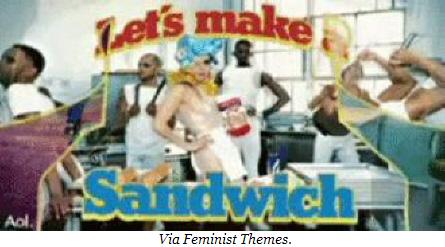
Feminist Themes examines Lady Gaga’s “Telephone” clip:

“… the objectification, glamorising of lesbian fetishism, and excessive girl-on-girl violence… [are aspects of the video that] feminist Gaga fans can try to justify… as another example of how she subversively turns what we usually find hot into something that leaves a nasty taste in our mouths and therefore makes a statement, but if any other artist (particularly any male artist) incorporated this much objectification and violence against women we would be outraged. Is it any different just because it’s a woman, or because it’s specifically Gaga?

“… What sets Gaga apart from other sexpot pop stars for me is that I just can’t imagine men being honestly turned on by hernot because she isn’t gorgeous (she is), but because she is so avant-garde, aggressive and self-driven which takes that arousal and turns it into something atypical, uncomfortable, and threatening.”

Also at Feminist Themes, the cause of the she-blogger in “Why I Blog”.

In other Gaga news, The Cavalier Daily reports that the University of Virginia is now running Lady Gaga classes! This sooo makes me want to re-enrol in university in a post-grad, transfer to UV, and take this kick-ass class!

The Daily Beast puts forth two differing opinions on Glee’s stereotypes: Andy Dehnart discusses the show’s “Harmful Simplicity”, while Thaddeus Russell applauds the walking stereotype that is Kurt Hummel, as “history tells us that those unafraid to be ‘too gay’ won far more freedomsfor all of usthan those who dressed the part of straights.”

Beautifully satiric The Frenemy reveals the recipe to “The Teen Romantic Comedy”, which “does not work for Mean Girls, 10 Things I Hate About You, or John Hughes films”, unfortunately. The truth about Disney Princes is also profiled, in which Eric from The Little Mermaid “wanted to kiss a girl who doesn’t speak words and doesn’t know how to use a fork. What the hell are you, caveman?”, while Mulan’s Captain Shang is in truth, a “gay liar” who made young, susceptible viewers the girls who have “crushes on a lot of her gay friends. [A] big Will & Grace fan.” Hey, that’s me!

Rachel Hills discusses intersectionality in feminism:

“For those of you who aren’t familiar with the term, ‘intersectionality’ is a way of talking about power and privilege that recognises that recognises that these things operate on multiple axes. People aren’t just female, or Black, or Asian, or straight, or working class, or trans, or a parent, or prone to depressioneveryone falls into a number of different categories that colours their experience of the world in specific ways. In the feminist context, it serves as a useful reminder that not all women have the same experiences, and calls into question the still dominant notion that the neutral ‘female’ experience is one that is white, heterosexual and middle-class.

“I’m also a fan because it just makes feminism a whole lot more interesting.”

Girl with a Satchel profiles Melissa Hoyer’s media career, which is a must-read for any budding wordsmith.

I am staunchly pro-choice when it comes to the abortion debate. In fact, I lean so far to the left that I’m borderline pro-abortion. (I’m sure that’ll ruffle some feathers!) But no matter what your feelings on the subject, MamaMia’s post, “The Couple Facing Jail Because They Tried To ‘Procure an Abortion’. Hello, Queensland? It’s 2010” is worth checking out.

Jezebel’s “5 Worst Mean (Little) Girls of All Time” includes Willy Wonka’s Veruca Salt and, from one of the most heart wrenching films of all time, A Little Princess, Lavinia, who looks a lot like modern-day mean girl, Angelina Pivarnick, from Jersey Shore.
“Why Strawberry Shortcake Was a Progressive Pioneer.”

On the (Rest of the) Net.


I’m filing all Mad Men titbits in one hit. I hope you can handle it.

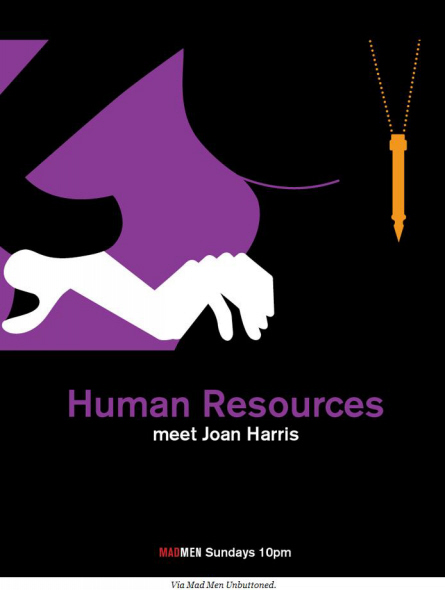
1. Love the latest promo posters designed by Christina Perry. The one with Joan’s likeness is, of course, the fiercest.

2. Damaged child of Don Draper and Betty Francis, Sally Draper, deserves “A Freudian Analysis”. And her fair share of Freudian therapy, I would guess.

3. And so does Betty, for that matter. Perhaps a therapist that doesn’t report back to her husband. For now, though, she’s content to make herself over.

Advice blogger Penelope Trunk tells us “How to Write About Your Life”:

“… [The] number one rule is that if you write about your life there must be a redemptive moment because people like that…

So, okay. I try to see that. I mean, I’ve read plenty of memoirs Girl, Interrupted, Smashed, Darkness Visible all good books. All very redemptive at the end, for sure. But I’ve also read Anna Karenina. Well, I haven’t, but I’m able to spoil the ending for you right now anyway… She gets hit by a train. I think she kills herself.

That seems redemptive to me. I mean, at least she doesn’t have to wake up to her same problems every day.

I have told this to my… agent. She said that people do not want to read about my fascination with suicide.”

Jill at Feministe writes of her “commitment to ending up an old maid” in the 2007 article, “I’m Never Getting Married”.

Diablo Cody asks the original “Misery Chick”, Daria Morgendorffer, if her crush, Trent Lane, and the other “Trents of the world are ever suited to long-term relationships…?”. Daria’s response?

“I always thought of Trent as being the Dave Navarro of high school… Considering a girl like Carmen Electra couldn’t maintain true love with Dave Navarro; and Sandra Bullock couldn’t whip Jesse James into commitment; and Pam Anderson couldn’t land Tommy Lee or Kid Rock or Tommy Lee. All epic fails.” How profound.

Since when did mobile phones cease to become telephones? “When my so-called phone rings, my first reaction is ‘Shit. What’s wrong now?’ [However] When I get an email or text message, I feel a tingle of optimism.” My feelings exactly.

Harkening back to the “Feminism Has Failed” debate, where my thoughts were that it hasn’t failed for me personally, but for a woman who is not able-bodied, perhaps it has. Disabled Feminists ask if there’s “A Place at the Table For Me?” when discussing body image. Very thought provoking.

Keanu Reeves just can’t catch a break. Now, “The 12 Most Depressing Keanu Reeves Quotes”. My favourite? See above.

More feminist goodness, this time from Echidne of the Snakes and touching on the “burqa debate” and how women dress in different societies and cultures.

Again, an old-school article from The New York Times entitled “What’s Wrong with Cinderella?”. This is (apparently) what’s wrong with Cinderella and the other Disney princesses:

“…‘I see girls expanding their imagination through visualising themselves as princesses, and then they pass through that phase and end up becoming lawyers, doctors, mothers or princesses, whatever the case may be.’

Mooney [who produced the above quote] has a point: There are no studies proving that playing princess directly damages girls’ self-esteem or dampens other aspirations. On the other hand, there is evidence that young women who hold the most conventionally feminine beliefswho avoid conflict and think they should be perpetually nice and prettyare more likely to be depressed than others and less likely to use contraception…

The infatuation with the girlie girl certainly could, at least in part, be a reaction against the so-called second wave of the women’s movement of the 1960s and ’70s (the first wave was the fight for suffrage), which fought for reproductive rights and economic, social and legal equality. If nothing else, pink and Princesses have resuscitated the fantasy of romance that that era of feminism threatened, the privileges that traditional femininity conferred on women despite its costsdoors magically opened, dinner checks picked up, Manolo Blahniks, Frippery. Fun. Why should we give up the perks of our sex until we’re sure of what we‘ll get in exchange? Why should we give them up at all? Or maybe it’s deeper than that: the freedoms feminism bestowed came with an undercurrent of fear among women themselvesflowing through Ally McBeal, Bridget Jones’s Diary, Sex & the Cityof losing male love, of never marrying, of not having children, of being deprived of something hat felt essentially and exclusively female.”

Following on from this, Rachel Hills of Musings of an Inappropriate Woman, writing in The Australian Literary Review in July 2008, untangles the sexualisation of children. Again, well worth the read.

We’ve gotta give the guys some attention, too, and Newsweek does just that with “Men’s Lib” and retrosexualisation:

“Since the 1950s, the image of American women has gone through numerous makeovers. But masculine expectations remain the same… The term ‘retrosexual’ has all but replaced ‘metrosexual’ in the lifestyle sections of national magazines, which are full of stories about affluent urbanites wearing hunting garb, buying designer axes and writing about the art of manliness on blogs with names like (ahem) The Art of Manliness.”

Jezebel with the quirky genius that is their movie reviews: and a double-whammy at that. Firstly, there’s “Important Life Lessons from B-List Teen Movies of the ’90s” like The Craft and Can’t Hardly Wait. And secondly, in the same vein, they profile Easy A and how it “… Tackles Slut-Shaming, Gossip & What We Expect from Girls Now”. Review to come next week.

Stylish Thought muses on “The Joys of Being Alone”, a concept which I am none-too-familiar with. I find people who don’t like being alone freaks, as does blogger Fajr. Love the accompanying pic, too.

After all that, this should have been called the jumbo edition!

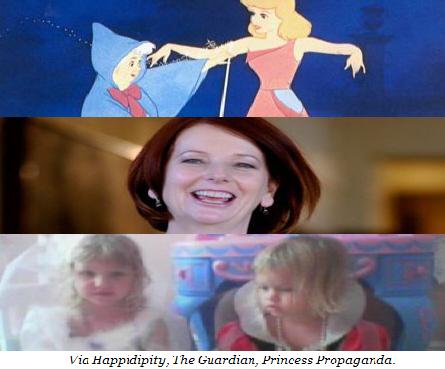
Julia Gillard as Feminist Fairy Godmother?

In an article about Disney Princesses and the effect they have on young girls, this paragraph really resonated with me:

“The princess as superhero is not irrelevant. Some scholars I spoke with say that given its post-9/11 timing, princess mania is a response to a newly dangerous world. ‘Historically, princess worship has emerged during periods of uncertainty and profound social change,’ observes Miriam Forman-Brunell, a historian at the University of Missouri-Kansas City.

“‘The original folk tales themselves,’ Forman-Brunell says, ‘spring from medieval and early modern European culture that faced all kinds of economic and demographic and social upheaval—famine, war, disease, terror of wolves. Girls play savoir during times of economic crisis and instability.’ That’s a heavy burden for little shoulders. Perhaps that’s why the magic wand has become an essential part of the princess get-up. In the original stories—even the Disney versions of them—it’s not the girl herself who’s magic; it’s the fairy godmother…”

While we may not be in times of “economic and demographic and social upheaval”rather, we’re just emerging from themPrime Minister Julia Gillard has certainly taken the reigns of our country and is steering it in a new direction.

Some of her policies (namely the outmoded same-sex marriage ban) I don’t agree with, but she is certainly a beacon of aspiration for young Australian girls, who now realise they could “end up becoming lawyers, doctors, mothers or princesses…”or Prime Minister.

In that way, Gillard surely is a feminist fairy godmother for us all.

P.S. Happy 49th Birthday, Julia!

Elsewhere: [NYTimes] What’s Wrong With Cinderella?

Men in Fiction: My Most Loved Made-Up Males.

Last week I featured my favourite fictional females, and this week I thought I’d give the guys a go.

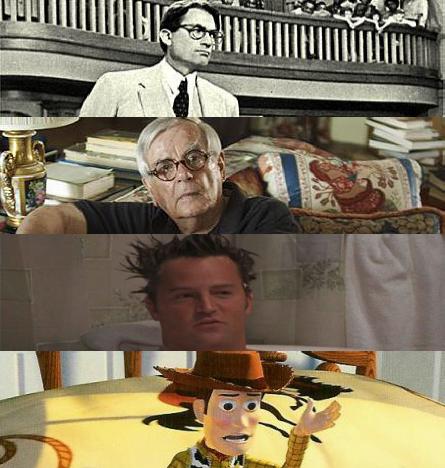
In the vein of Scout Finch from To Kill a Mockingbird, her father Atticus is way up there. He represents “the father figure I never had”, guiding Scout, her brother Jem, and their friend Dil through the last summer of their naïve childhood and how judging a book by it’s cover (or skin colour) is not the way to go. Plus, he has a kick ass name!

Similar to my obsession with To Kill a Mockingbird is my love of Dominick Dunne and any of his books, specifically Another City, Not My Own, in which Dunne’s alter-ego Gus Bailey acts as the fictional narrator of Dunne’s real-life O.J. Simpson trial experiences. It is hard to separate the two men, which is what I love about Dunne’s stories; a reader familiar with Dunne’s experiences doesn’t know where real-life ends and fiction begins.

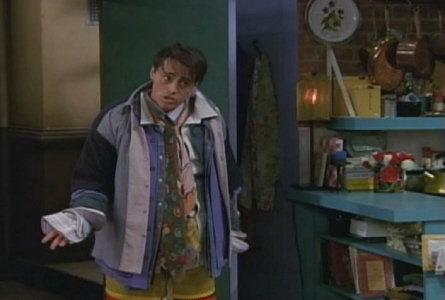
Every fan of Friends has a favourite character, and mine has always been Chandler Bing. He gets the funniest storylines, and Matthew Perry has great comedic timing. There are many episodes I could ramble on about, but my two favourite Chandler moments are when Phoebe attempts to seduce him into admitting his relationship with Monica, and when Chandler kicks up a stink about Joey stealing his chair before Ross’s benefit, and in a check-mate move, Joey puts on every item of clothing in Chandler’s possession, quipping in true Chandler fashion, “Could I be wearing any more clothes?”

It’s been a Disney-centric year, what with Beauty & the Beast about to be re-released in 3D, the Melbourne Symphony Orchestra performing Disney songs in December (which I’m so going to, FYI), the first African American Disney Princess in the lacklustre The Princess & the Frog, and the much anticipated release of Toy Story 3, with one of my all-time favourite characters, Woody. The pull-string sheriff is inspirational in that he’ll never “leave a man behind”, he exists primarily for the pleasure of his owner, Andy, but discovers that there’s more to life, like making friends and other people happy, than what he thought his true purpose was; to be with Andy. I loved the third instalment of the saga, but it can never top the first one. So quotable, so timeless, so child-at-heart. ♥

Other inspirational men of fiction include Dan Brown’s Robert Langdon; Shia LaBeouf’s character in Disturbia, and the character who inspired him, L.B. Jeffries from Alfred Hitchcock’s Rear Window; Fiver, Bigwig and Hazel from Watership Down; Woody’s space ranger counterpart, Buzz Lightyear; the Beast in Beauty & the Beast; and Holden Caulfield in A Catcher in the Rye.

Women in Fiction: My Favourite Fictional Females.

A recent post on Girl with a Satchel (which was reblogged here) inspired me to assess my favourite fictional female characters.

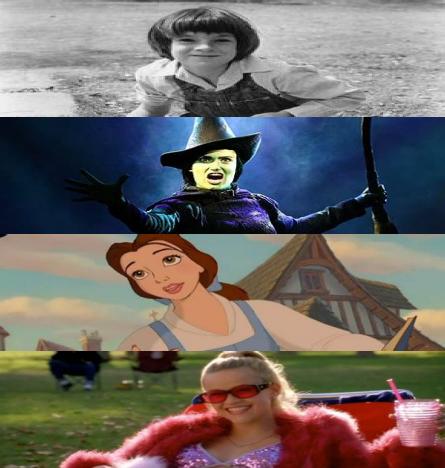
One of my favourite books is To Kill a Mockingbird, and protagonist Scout Finch is one of my favourite characters of the written word. Her innocence and naivety are super-endearing, and her past-tense narrating allows the reader to put themselves in her shoes easily.

Wicked is a niche book and musical that theatre buffs can’t get enough of, but the general public are a bit oblivious to because it hasn’t derived from/been made into a movie, like Melbourne’s current season of musicals, West Side Story, Mary Poppins and Hairspray, all of which are on my theatre-going agenda in the coming months.

I’ve seen the production three times in Melbourne, and many a friend has seen it in its various international incarnations on Broadway and the West End… oh, and Sydney! I was so touched by the story and its messages of friendship, good versus evil and judging a book by its cover, and even more so by Elphaba, better known as The Wicked Witch of the West from The Wizard of Oz. Unlike in the original story, Wicked’s Elphaba is fiercely loyal to her disabled sister Nessarose, and those who become close to her like Glinda, Doctor Dillamond and Fiyero, misunderstood because of the colour of her skin and the slander spread about her when she discovers the Wizard of Oz is a fraud and seeks revenge.

In the vein of fairytale musicals, Beauty & the Beast (which is being re-released in selected theatres in 3D from 2 September) is by far my favourite, and I love its heroine Belle so much, I have been known to fight with my friends and children alike over the fact that I AM BELLE! Hello, I have brown hair, like burly men, read a lot and have a penchant for yellow gowns! While there have been arguments circulating that the Disney princesses are beacons of anti-feminism, I maintain my stance that Belle doesn’t need a man to rescue her (in fact, she does the rescuing, helping the Beast when he is attacked by wolves, attempting to make the townspeople see the error of their ways in going after him, and ultimately, setting his heart free) and sees the Beast for who he truly is, not for what he looks like or what he can do for her. She’s a kick-ass beauty in the vein of Buffy, The Vampire Slayer and Angelina Jolie’s Lara Croft: Tomb Raider.

I’ve blogged (or reblogged) a little bit lately about Elle Woods. She’s an everywoman. Rachel Hills identifies with her, as does Satchel Girl Erica Bartle. A law-studying friend of mine recently compared herself to Miss Woods, also. And I won’t lie; I’ve fantasised about wearing a Playboy bunny suit whilst purchasing an Apple Mac! Elle Woods proves that you can take pride in your appearance and have fun whilst pursuing your dreams and making a name for yourself separate from the name of the man in your life.

There are plenty of other made-up women who I have an affinity for, including the aforementioned Buffy Summers, and Daria Morgendorffer for their kick-ass feminist mentalities; ditto for the Charmed sisters; Gossip Girl’s Blair Waldorf, who can be a psycho bitch at times, but she’s THE psycho bitch; for similar reasons as Elle Woods, Cher Horowitz; and Barbie.

Related: Guest Post—Pop Culture Power Women.

In Defence of To Kill a Mockingbird.

Event: The Way We Wear Vintage Market.

Elsewhere: [Girl with a Satchel] Women of Pop Culture & the Unashamed Use of Cutesy Clichés.

[Musings of an Inappropriate Woman] Have You Ever Seen Yourself Through Someone Else’s Eyes?