On the (Rest of the) Net.

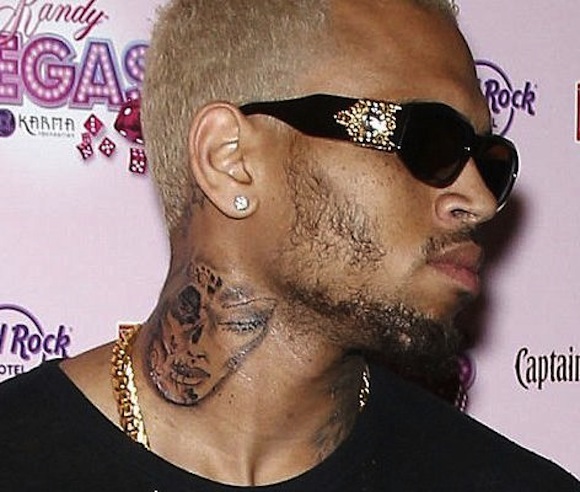
I’m not sure if it is an image of Rihanna’s post-domestic violence face, but here’s what Chris Brown’s neck tattoo says about intimate partner violence and sexual assault. [Pandagon]

The latest in a long line of unfavourable reviews of Naomi Wolf’s new “biography” – Vagina – Germaine Greer had her take on it published in The Age last weekend. I’m going to read Vagina: A New Biography regardless, but the high hopes I had for it have been dashed. [SMH]

In the lead up to the Presidential election, it’d do all Americans good to realise that reproductive health is an economic issue. [Jezebel]

The visceral fear this writer manages to evoke when she reveals her experience of being harassed on public transport is palpable. Hands up who’s ever experienced something similar whilst deigning to be female in public. [unWinona, via Jezebel]

The politics of Anna Wintour. [Daily Beast]

The gender imbalance in the opinion pages. [Daily Life]

Five police-sanctioned reasons why women “deserve” to be raped. Well, I’m guilty of all these things so apparently I “deserve” to be sexually assaulted, too! [Daily Life]

How to talk to kids about gay parents. [The Good Men Project]

This is why religious people shouldn’t work in medicine: one woman’s experience of being refused the morning after pill. [MamaMia]

Why is atheism so excluding of women? [Slate]

Image via Always A-List.

On the (Rest of the) Net.

Feminist Barack Obama! [Nerve]

Despite Everybody Dance Now being axed and the dismal ratings of Being Lara Bingle, The Shire and the relaunched Can of Worms, at least Channel Ten’s taking risks. [MamaMia]

Conservative rape-talk fatigue. [Jezebel]

Why “hookup culture” is good for women. [The Atlantic, via Jezebel]

Rihanna spoke to Oprah about forgiving and still having feelings for Chris Brown, but we shouldn’t shame her for keeping her abuser in her life. [Jezebel]

The Beheld’s Autumn Whitefield-Madrano on Helen Gurley Brown, beauty and effort. [The New Inquiry]

“The Official Guide to Legitimate Rape.” [Jezebel]

On the (Rest of the) Net.


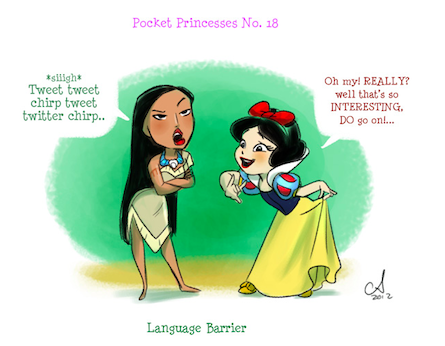
Check out Amy Mebberson’s series of Disney “Pocket Princesses”. Ever so on-point. [My Junk Drawer]

I never had a problem with the Lingerie Football League… until now. Did you know they have “accidental nudity” clauses in their contracts, meaning they can’t wear anything under their uniforms to prevent wardrobe malfunctions? Did you know the League refuses to unionise the players or give them health insurance? Did you know they don’t get paid because the League is classified as amateur and therefore they have to pay to play?! [Fit & Feminist]

Catherine Deveny on the new changes to domestic violence laws.

The make-up free celebrity TwitPic as marketing tool. [Daily Life]

Germaine Greer really threw herself under the bus with those Julia Gillard-jacket comments: she’s now writing about ugg boots. [The Age]

One blogger attempts to see how gross she can act on an online dating site before men will stop trying to get in her pants. [Jezebel]

Now this is compassion! The Christian abortion doctor who was formerly anti-abortion tells why he now performs late-term abortions for women in need. [Jezebel]

The orgasm and 18th century vibrators as tools against hysteria. [Jezebel]

Image via My Junk Drawer.

TV: The (Belated) Underlying Message in Glee’s “Choke” Episode.


As someone who has witnessed her mother being choked by her father, using that action as a metaphor for intimate partner violence on Glee is sick.

Not only that, but in desperately trying and dismally failing to, for some reason, raise awareness of domestic violence (actually, I’ve decided I hate that phrase, so I’m taking to using the more all-encompassing “intimate partner violence”), Glee has gone back to its old ways by being especially misogynistic and racist.

The intimate partner violence storyline opens with Santana observing Coach Beiste’s black eye and remarking that “it looks like Mr. Beiste went all Chris Brown on Mrs. Beiste… [Did] Cooter put the smackdown on [her] ’cause [she] wouldn’t let him be on top?” Troublingly, women of colour Mercedes and Tina, and LGBTQ woman Brittany, all snicker. I wonder if the writers were aware (oh wait, this is Glee: of course they weren’t!) that African American women are 35% more likely to experience intimate partner violence than white women, 60% of Korean women have been beaten by their partners, and violence in same-sex relationships is gravely underreported and misunderstood.

Enter Cheerios co-coach and “black Sue”, Roz Washington, who overhears Santana’s bad taste musings. She tells the girls that “violence against women” and “men hitting women” is never okay, buying into the perception that women are the only victims in intimate partner violence. Granted, women are the overwhelming victims, but that’s not giving equal opportunity to non-heterosexual relationships (for shame, considering the abundance of LGBTQ characters on the show) and the fact that a woman can hit a man. Instead of insinuating that it’s intimate partner violence only that we should be concerned about, how about violence against women in general? Including rape.

Anyway, I’m sure the writers wanted Roz to mean well, but her racial and sexist slurs directed at Mercedes (“Lil Oprah”), Tina (“Asian Horror Story”), Sugar (“Rojo Caliente”) and Santana (“Salsa Caliente”) undermine this.

In a following scene, Sue coins the aforementioned nickname, “Black Sue”, for Roz, telling her that “ivory poachers could make a fortune selling your enormous white teeth on the black market”, and refers to Coach Beiste as John Goodman, perhaps insinuating that Beiste’s masculinity should have prevented her from being a victim. This way of thinking seems to be adopted by Santana, too, when she says she doesn’t think Coach Beiste actually got hit because she’s “a wall”. What if the roles were reversed and Beiste had hit Cooter, who is considerably smaller than Shannon?

The racial stereotyping continues when Roz admonishes the girls for their joke. As Autostraddle points out, Glee gave the “‘my aunt got beat up by her man’” monologue to the one black woman on the show,” claiming it took her five years to escape the relationship. It took my mum nigh on thirty to get out.

Shannon initially denies her husband hit her, but uses her experience to inspire the girls, who—up until this point— have never really had anything to do with the Coach, to sing a song about empowering women to leave abusive relationships. According to Sue,

“The American songbook is chock full of songs making light about men hitting women.”

Chris Brown, anyone?

Beiste is so moved by the girls’—who, again, she’s had nothing to do with up to now—apathetic show of indifference to intimate partner violence, that she confesses to them—jeopardising her reputation at the school (remember what happened the last time she got too close to McKinley students?)—that she was actually the victim of intimate partner violence, and that they effectively “saved her life”, because she forgot to do the dishes all weekend. Yes, perpetrators of intimate partner violence can be set off by the slightest thing, and we all know that beating the person you love isn’t the means of someone who’s mentally balanced, but dishes?! Glee, really?! If you’re going to make one of your characters, perhaps the most underutilised, exploited and maligned of them all, the victim of a serious issue like intimate partner violence that will never be addressed again, can you at least make it for a reason less trivial than dishes?!

Two realistic things to come out of the storyline, though: that Shannon stays with Cooter and gives him a second chance, and lies about it to Sue and the girls. And finally, that Beiste fears that if she leaves him, “no one else will ever love me”. Painfully sad, true to actual victims of intimate partner violence who are made to feel worthless and unlovable by their abuser, and ties in with a past storyline on the show!

Related: The Underlying Message in Glee’s “Never Been Kissed” Episode.

My Thoughts on Chris Brown.

Elsewhere: [Women of Colour Network] Domestic Violence Facts & Stats Collection.

[Autostraddle] Glee Recap: Choke-a-Joke.

Image via Putlocker.

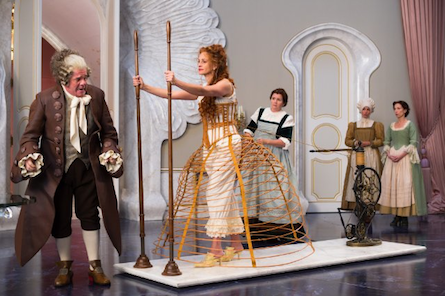
Movie Review: Mirror Mirror*.


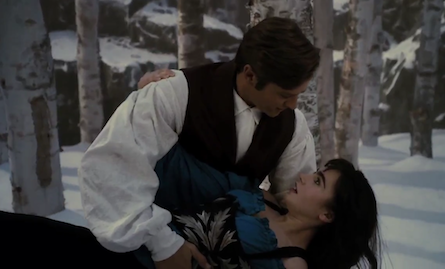
I’ll be honest: I didn’t have high hopes for Mirror Mirror, what could have been a fantastic feminist take (girl saves boy; a commentary on beauty) on the classic Snow White tale but ended up being an offensive Disney-esque been-there, done-that effort.

Actually, Mirror Mirror did incorporate some of the abovementioned themes, but not in the ways I would have liked.

Firstly, let’s start with beauty. As an older woman, Julia Roberts’ character, the Queen, believes the only way she’ll make an impression as an older woman on the newly discovered Prince Alcott (the delectable Armie Hammer) is to up the ante on her beauty regime, which includes bees stinging her lips and bird poo being massaged into her face. This is not unlike what many women do on a regular basis, but I didn’t put two and two together until later in the film, when Snow White is about to kiss the Prince to break the puppy love-for-the-Queen spell he’s under. One of her seven dwarf-bandit comrades, Napoleon, thinks she needs a bit of sprucing up before her first kiss. The message here is not only that, clearly, older women need to do more to their bodies and faces in order to compete with younger women and stay relevant, but that something along those lines also applies to younger women. If you’re engaging in intimate acts with a member of the opposite sex, you need to look and act a certain way. It seeks to cement the notion that beauty is the main virtue a woman can have. If she doesn’t have it, she’s deemed worthless. If she does, like Lily Collins’ Snow, she’s got to work even harder to maintain it and play it up.

This confining notion of beauty is also represented in the seven dwarves, who were banished from the village by the Queen for being “ugly” and “undesirable”. The film could have run with the whole non-able-bodied-people-being-excluded-from-everyday-able-bodied-society angle, but instead that was pretty much the last thing we heard about that.

There was a lot of emphasis on the Queen being “crazy” and “mad” because she clawed her way to the top and would do anything to stay there, including poisoning the Prince in order for him to fall in love with her. When Snow decides to run away from her castle prison and join the dwarves, and Prince Alcott discovers this he, too, calls her “crazy” and “mad”. So standing up for what you believe in, whether that is something that other people think is a noble pursuit or not, makes you crazy. Oh, clarification: this only applies if you’re female.

Because you won’t be taken seriously by your male nemesis if you deign to step outside the boundaries set for you by the patriarchy, don’t you know? When Prince Alcott is confronted with the militant Snow White, he refuses to “fight a girl”, much less one that also “throws like a girl” and whom he would kiss if she wasn’t trying to kill him. The Prince takes to spanking Snow with his sword as they engage in combat, which was a confusing amalgamation of offensiveness and sexiness. I mean, I wouldn’t say no to a spanking from Armie Hammer, but in a movie seemingly geared towards children with a superficial pro-heroine stance, I don’t think it was entirely appropriate nor crucial to the story.

Finally, let’s look at domestic violence and animal abuse. When the Prince is under the puppy love spell and captured by Snow and the dwarves for torture, he claims his “only pain is being absent from my wife[-to-be]”, who doesn’t treat him so well in the first place. That he’s essentially a dog in this scene makes a certain point about animal cruelty, I think: that no matter how badly you treat a dog, as man’s best friend, they’ll always come back to you. Much like battered-wife syndrome, wouldn’t you say?

On that, when one of the dwarves tries to claim that Prince Alcott is clearly in love with Snow, and another exclaims, “He tried to kill her today!” the defence is, “Of course! What do you think love is?” That kind of “love” is dubious at best.

And so was this movie.

*Blanket spoiler alert.

Image via YouTube, IMDb.

Magazines: The Justin Bieber Complex.


Heather Morris is just the most recent starlet in a long line to be involved in a domestic violence-themed photoshoot, and outrage appropriately ensued.

But where’s the outrage following Justin Bieber’s cover story for Complex magazine? While I’m sure I’m not the only one who takes some pleasure in seeing Bieber get knocked out, even if it is for entertainment purposes only, where’s the accountability?

Sure, he’s now an 18-year-old man (because we all know age has no bearing on maturity) who can pretty much do whatever he wants. So is it because he’s a man that there’s no outcry about the glorification of violence? And what about all the tweens who look up to him? Doesn’t he have a responsibility to them, to be a good role model?

I guess once you’ve done a duet with Chris Brown, it’s Never Say Never to everything else.

Related: Heather Morris Glee-ful About Domestic Violence?

My Thoughts on Chris Brown.

Elsewhere: [Complex] Justin Bieber Cover Story: Second Round KO.

Images via Complex.

On the (Rest of the) Net.

It’s a very MamaMia-and-Jezebel heavy edition of “On the (Rest of the) Net”, but variety is overrated.

The grey area of domestic violence: a wifebeater who left his partner blind in one eye and made her miscarry their child also saved an elderly woman from a fire in her home as a bravery award-receiving firefighter. [MamaMia]

Bob Katter is the scourge of our society. Just like Pauline Hanson! [MamaMia]

Forget sexting: it’s all about the webcam striptease now. [Jezebel]

MTV’s latest show, I Just Want My Pants Back, focuses on the lives of twenty-something hipsters in Brooklyn, where apparently abortion isn’t an option. [Jezebel]

To circumcise or not to circumcise, that is the question. [MamaMia]

Is porn star James Deen a feminist? [Jezebel]

Rihanna & Domestic Violence*.

I’ve written about the Rihanna-domestic violence dichotomy before, and how no matter what the public persona presented in her music videos and interviews is, it’s consensual and it’s her prerogative. What Chris Brown did to her wasn’t.

But what role do her songs play in the unfortunately common perception that she “deserved” to get beaten by Brown; that she must’ve liked it if she sings about “S&M”; that she might have been egging Brown on in the form of “Breakin’ Dishes”.

We’ve heard a lot about the former two assertions. What I’d like to focus on in this post is her lesser-known single from the Good Girl Gone Bad album, “Breakin’ Dishes”.

Personally, I love the song and it’s one of my favourites from her. But, ashamedly, until recently I’d never put two and two together: the lyric “I’ma fight a man tonight”, the disbelief that female-on-male domestic violence exists, and Brown and Rihanna’s altercation three years ago.

Now, just to reiterate, I don’t think that what Rihanna sings about has any bearing on what goes on in her personal life (hell, she doesn’t even write her own songs). “Whips and chains” in the bedroom does not mean biting and punching in a car. But what does the lyric “I’m not gonna stop until I see police lights” mean coming from the mouth of Rihanna? That hitting a man and destroying his property is okay if you suspect he’s cheating? That it’s okay because he hit her first (yes, I am aware that “Breakin’ Dishes” was recorded well before the 2009 assault)? That it’s not really domestic violence because a woman hitting a man doesn’t do as much damage as opposed to the opposite occurring?

I’m not going to pretend that there are right and wrong answers to these questions, but I do know that intimate partner violence is never okay, no matter what the gender of the people involved. This is a message that we need to be getting across to everyone, so that those who are victims of it are better informed and equipped to leave the situation, and that they won’t be blamed or questioned for their role in it.

By the same token, and again, I’m not condoning or excusing it, sometimes the partner who takes the brunt of the violence is somewhat guilty of baiting their lover. I’ve witnessed it firsthand. Someone might start saying things that they know are sensitive subjects for the violent party; maybe they’ll slap or shove them to see how far they can push them. Sometimes they thrive on the aftermath; having their partner comfort them and tell them how much they love them and that it’ll never happen again. But this is part of the cycle of violent relationships and the “grooming” that is done by the perpetrator. I don’t know what’s going on in the heads of those involved, but I can certainly sympathise.

*

I remember reading a comment on someone’s Facebook post about Chris Brown at the Grammys last week or the week before. The comment was saying that yes, what happened to Rihanna was bad, but her music and sexy image is also bad and is sending the wrong message to our children. (Will someone please think of the children?!) I’m sure the commenter wasn’t aware that what they were writing was essentially a domestic violence apologist statement, but that’s certainly how it came across to me. Like they were sorry Rihanna got hit, but what does she expect when she acts so sexy and independent all the time?

In 2012, we should be able to understand that “art” (however loosely that term is applied) is not always an imitation of life, and that humans are capable of critical thought to separate the two. Singing about consensual sadomasochism and a hypothetical violent fight between lovers, however tasteless and closely related they are, is never an excuse for actual intimate partner violence.

*Trigger Warning: This post deals with domestic violence and may be upsetting to some.

Related: My Thoughts on Chris Brown.

Rihanna’s “S&M”: Is it Really So Much Worse Than Her Other Stuff?

Rihanna Upholds Traditional Gender Roles.

Rihanna’s “Man Down”: Revenge is a Dish Best Served in Cold Blood.

“Chains & Whips Excite Me” Take 2.

Image via MamaMia.

Hugo Schwyzer’s Ousting from the Feminist Community.

I must have been living under a feminist rock for the past couple of months, because when I saw some sentences that jumped out at me in this blog post about Hugo Schwyzer’s abusive past and resignation from The Good Men Project (I wondered why I was never seeing new posts from him on there), I was shocked.

I’ve recently been embroiled in a staunch disagreement with one of my friends over the Chris Brown, Michael Fassbender et al. debacle, in which I’ve attempted to personally boycott all things related to wifebeaters and horrible people in general, and she’s attempted to justify her support of projects they’re involved in because of all the other people it affects (a film crew of hundreds of people, for example).

But what happens when someone I openly admire (Scwhyzer) is revealed to have attempted a murder-suicide on his girlfriend in the past?

I’d have to call myself somewhat of a hypocrite, then. I still think Schwyzer produces some of the most apt feminist and gender-based musings out there. I also think that that incident was 13 years ago and, as far as we know, Schywzer got help and hasn’t relapsed. He’s taken his mistake, learned from it, and used it to add to the feminist and gender discourse. Which is more than I can say for Brown at this point. To play devil’s advocate (because I’m still adamant that Brown is a wifebeater through and through and will definitely strike a woman again), he’s still young and perhaps hasn’t woken up to the full scope of his actions and how they have hurt both Rihanna and himself.

This whole kafuffle has brought forth these questions, as asked by Raphael Magarik in The Atlantic:

Can men be feminist leaders?

Yes, they can. I’m not someone who thinks men can’t be feminists because they don’t have a vagina. Where does that leave trans women, then? How about the many gay men who have faced prejudice and champion the feminist movement? I’ve always thought Schwyzer has valid points to make (admittedly he’s really the only male feminist I read), and I think male voices can aid in the reconciliation of equality between men and women.

What role—if any—should men’s personal experiences play in feminist discussions?

I have a couple of male friends who, when presented with talk of feminism, will undermine and devalue what I’m trying to say with the straight white male reverse-racism bullshit. But, I think, as long as men are willing to listen to what feminists have to say without diminishing it with their white male privilege, personal experiences can aid in the discourse. For example, men who’ve grown up with strong women in their lives, men who’ve been abused, men who’ve abused and are aware of why they did it and are immensely sorry.

And how should feminists treat repentant former abusers?

I know a repentant former abuser who I’ve all but removed from my life, so I’m probably too biased about the situation to be completely inclusive of them. However, I think those who’ve experienced abuse are the ones who have to be having the conversation with former abusers and be okay with them jumping on the feminist bandwagon. If they are truly sorry, have a demonstrated history of non-abuse since they last abused, and can use that history to add value to female-male relations, then I think it might be okay. But the trust is still eroded…

How [do] men feel, what [do] they think about gender, [and] what [do] they need to change?

This is what Schwyzer is concerned with in his writings: how feminism relates to men. I hate the idea of feminism as this exclusive club (an idea which has been doing the rounds since noted second-wave feminists like Gloria Steinem, Betty Friedan and Naomi Wolf stepped on the scene, and was recently reignited with the whole Melinda Tankard Reist business) that you can only gain entry to if you’re the “right” kind of woman. To me, feminism is about equality and inclusion of voices other than the “right” kind of woman.

How do you feel about men in feminism and Schwyzer’s abusive past potentially delegitimising his feminist voice?

Related: My Thoughts on Chris Brown.

Conservative Feminist Melinda Tankard Reist for Sunday Life.

Elsewhere: [The Atlantic] Exile in Gal-Ville: How a Male Feminist Alienated His Supporters.

[Hugo Schwyzer] Why I Resigned from The Good Men Project.

[Feministe] Sex, Drugs, Theology, Men & Feminism: Interview with Hugo Schwyzer.

[GenderBitch] You Don’t Get to Tell Us Who Our Enemies Are.

My Thoughts on Chris Brown*.


So the interwebs were all aflutter last week with talk of Chris Brown’s Grammy performance, nomination and subsequent win, starting with a Tweet (or several, as the screenshots will attest) from a young girl who didn’t know what Rihanna was complaining about: she’d love it if Brown punched her.

Wow, just wow.

Following on from this, I read this fabulous post from Sasha Pasulka on HelloGiggles on why she wasn’t okay with Brown performing at the Grammys and why you shouldn’t be either, and another great blog post in which Michael Fassbender was vilified for allegedly beating his girlfriend whilst simultaneously being lauded for his acting skills in the media.

Now, I’ve never seen anything Fassbender’s been in, but my housemate is (or was, until I linked him to this story about the assault) a fan, so I’m familiar with his work.

I linked the above news story (is TMZ considered news?!) on Facebook admonishing Fassbender, and a friend asked me if I was going to boycott everything anyone with a dubious personal life has been in, like David Boreanaz, for example. I replied that cheating may be immoral, but it’s not illegal, whereas Brown and Fassbender (along with my favourite, Charlie Sheen) are accused of intimate partner violence, which is never okay.

Now, I’m not really a fan of forgiveness and second chances, personally, but I do agree that Brown and Fassbender should be given second chances so that we can say they have when they inevitably fuck up again and then expunge them from society. Some could argue that Brown had his when he trashed a dressing room on Good Morning America and threw a chair out of a window. From experience, I know that violent men hardly ever only hit once and will always revert to their old ways.

The abovementioned friend who asked me if I will boycott all Brown, Fassbender, Sheen et al. projects (and so far I have successfully done so) said, after reading the TMZ piece, that Fassbender’s girlfriend should have left after he dragged her from a moving vehicle causing injuries to her knee, ankle and a blown ovarian cyst.

Sure, to anyone safely removed from that situation and reading about it from the comfort of their own home, the seemingly logical thing to do would be to leave after the first push, slap or abusive comment. But that reeks of victim blaming; abusers are highly skilled in manipulation and will make you feel like you have no other option but to stay. That it’s your fault. That they only hurt you because they love you so much. That they promise they’ll never do it again.

And, in the case of Brown, to allege that Rihanna deserved it because she sings about “S&M” and “Breaking Dishes” (more on this to come next week) is abhorrent! Those songs are what Rihanna does for a job. Furthermore, S&M is a consensual sexual act with “safe words and boundaries”, as one commenter on this MamaMia thread put it. Intimate partner violence is not consensual and there are no safe words. “Stop!” “You’re hurting me!” and “I can’t breathe!” are not enough to stop those who are mentally predisposed to hurting their lover with violence.

I thoroughly urge you to read the HelloGiggles piece if you haven’t already. In it, Pasulka uses quotes from the likes of Lindsay Lohan and Carrie Underwood, who said what a tragedy it was for both parties involved in the assault at the time. Oh yeah, it’s really tragic for Brown to have his name dragged through the dirt for a crime he actually committed. I guess it’s kinda tragic for Rihanna, too, as she was beaten to a bloody pulp by the man she loved and trusted and was then disparaged for it by the public.

Pasulka also cites the statement from the producers of the Grammys in which they insinuate that Brown’s attack on Rihanna the night before the awards three years ago was an inconvenience to them. Yeah, I’d say it was pretty inconvenient for Rihanna, too.

Also troublingly, going through the screenshots of all the Chris-Brown-can-beat-me-all-night-long-if-he-wants Tweets, they are primarily from young, white girls. To me, that signifies the trope of black-man-as-predator. Yes, this probably didn’t even cross the girls’ minds, but that they’re seemingly willing to be with someone who is a known wifebeater because he is attractive (personally, I find him ugly, but then I’m biased) not because of his race is a problem within itself.

In the comments thread on HelloGiggles some commenters raised the question of why is Brown being so vigorously vilified while other known/alleged wifebeaters such as Charlie Sheen and Mel Gibson go by unscathed. Is it because he’s black?

And they raise a good point. Personally, I don’t think it is, but it baffles me as to why people jumped at the chance to follow Sheen on Twitter, get tickets to his My Violent Torpedo of Truth tour and lament the fact that Two and a Half Men is apparently now less funny with fellow douchebag Ashton Kutcher at the helm. (Gibson suffered considerably more public scrutiny for his racist and anti-Semitic vitriol, but was still cast alongside one of his defenders, Jodie Foster, in The Beaver. That he was replaced in The Hangover with Mike Tyson is just as bad: substituting one violent racist, sexist alcoholic for a convicted rapist. Nice.)

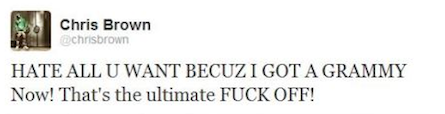
Brown responded to his haters after winning a Grammy with the above Tweet. Take from that what you will but, to me, that doesn’t sound like a man who’s remorseful for physically assaulting his girlfriend and deserving of a second chance.

*Trigger Warning: This post deals with domestic violence and may be upsetting to some.

Related: Why Are Famous Men Forgiven for Their Wrongdoings, While Women Are Vilified for Much Less?

Minus Two & a Half Men. 

Rihanna’s “S&M”: Is It Really So Much Worse Than Her Other Stuff?

Elsewhere: [HelloGiggles] I’m Not Okay With Chris Brown Performing at the Grammys & I’m Not Sure Why You Are.

[Feisty Feminist] There Are People on my Dash Posting About How They Think Michael Fassbender is Wonderful Etc.

[TMZ] Girlfriend Fears Inglorious Basterds Star.

[MamaMia] Chris Brown Performing at the Grammys is Not Okay.

Images via The Vine, MamaMia.