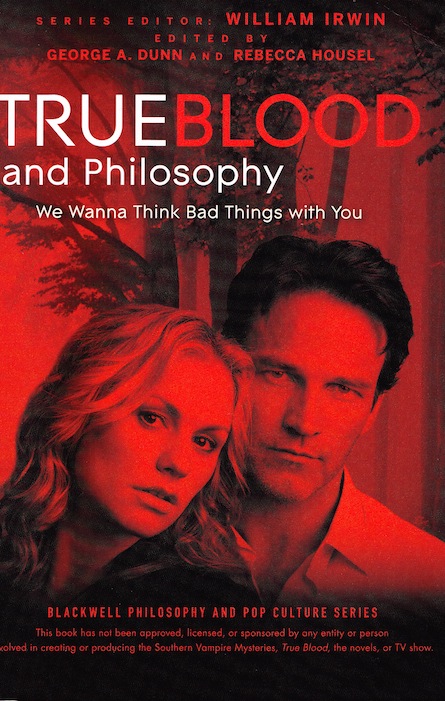
Book Review: True Blood & Philosophy by George A. Dunn & Rebecca Housel.


I bought this book last year around the time season three of True Blood was coming to an end, and the inspiration struck me to write a post on Sookie Stackhouse and feminism. Needless to say, that post has yet to come to fruition (watch this space next week), but I finally got around to reading the book in the past fortnight or so.

The great thing about the Pop Culture and Philosophy series is that you don’t need to be an avid fan of the topic each book deals with; most of the philosophical musings can be applied to everyday life. (I’m making a gross generalisation here, as True Blood & Philosophy is the first Pop Culture volume I’ve read!)

Anyone who’s familiar with the show and Charlaine Harris’ books will know that the way vampires are treated in the somewhat alternate universe of Bon Temps, Louisiana, is a metaphor for how gays and blacks have been treated for centuries.

True Blood and Philosophy delves into this throughout the book, but particularly in the “Eros, Sexuality & Gender” section, where the issue of “orientation” is raised: “Vampires seem to be unlike gays in that we can’t say that vampires are born that way… But there is still a parallel to being born either gay or straight, for once you become a vampire, there’s no returning to a human existence” (p. 98).

One way vampires and gays are different, though, is that “a homosexual predator” cannot “attack or coerce an unwilling person into homosexual acts”, whereas a vampire can take someone against their will (p. 99). You can’t “catch” homosexuality, but you can catch vampirism.

To take it a step further, there was a time when propaganda that the gays will give you AIDS was rife (some might argue that it still is), and were prohibited from participating in sports and other activities where blood could be spilled. This raises the question of the marginalisation of vampires in sports, as well as the use of their blood as medicine. (See “Coming Out of the Coffin & Coming Out of the Closet”, p. 93–108.)

My favourite chapter deals with the attitudes of humans towards vampires and vice versa, and how the way they treat each other amounts to the way non-fiction humans treat animals.

For example, Eddie Gauthier, the vampire whom Jason Stackhouse and Amy Burley take hostage and use as their own personal V vat, is a parallel for “the way millions of animals are treated every day on factory farms… Eddie, like the animals on factory farms, is exploited as a commodity with no regard for his suffering” (p. 36–37).

Furthermore, “… many… vampires actually regard human beings as lower forms of life ripe for exploitation, not much different from the way Aristotle and others regarded non-human species,” in “a classic example of speciesism” (p. 38–39).

Last year, I blogged about an article I read in Time, about how animals that we once thought to not be able to understand language, reasoning, fairness and pain, actually do experience these things. Vampires seem to have a similar attitude towards humans, whom they see only as a food source, and “incapable of feeling pain as we do”, according to the magister when ordering Bill to turn Jessica as punishment for killing one of their own to protect his “human pet”, Sookie (p. 44).

In a similarly intriguing chapter, William C. Curtis asks “can vampires be good citizens”?:

“Should there be a Truth and Reconciliation Commission to require vamps to come clean about their past murders in return for a grant of amnesty? How should vampires be taxed, especially since they don’t need many of the services that government provides, like Social Security, health care, and education? Can they join, or be drafted into, the armed forces?… Will their vulnerability to sunlight be treated as a disability under the Americans with Disabilities Act? Can vampire convicts be sentenced to life in prison, or would eternal incarceration violate the Eighth Amendment prohibition on cruel and unusual punishment?” (p. 65–66).

All these questions have been brought about by the advent of synthetic blood, allowing vampires to “come out of the coffin”, so to speak.

On this, an interesting footnote from the chapter “Un-True Blood: The Politics of Artificiality” by Bruce A. McClelland, refers to a 1927 study by Takeji Furukawa on the correlation between blood types and personality. Being a Japanese study, and the fact that synthetic TruBlood was developed by the Japanese; is there some connection? Or just a coincidence? The clot plot thickens…

A memorable event thus far on True Blood has been the introduction of Maryann the Maenad and her Dionysian debacle. “Let the Bon Temps Roll: Sacrifice, Scapegoats and Good Times” deals with the self-preservation of the Bon Temps residents in “not wanting to know what’s in the sausage”, as Lafayette Reynolds would say (p. 141–142). Or rather, not wanting to know what’s in Maryann’s “hunter’s soufflé”!

This ignorance is further symbolised by the black eyes of Maryann’s followers; they’re literally blind to her wicked ways (p. 142).

Of course this book is more suited to the True Blood fan, however it’s not a prerequisite. (I’m trying to force-feed my friend Laura this book in the hopes that she will cotton on to the sexy-smarts of the show. She’s doing the same to me with Mad Men.) Many of the thoughts discussed go much deeper than just Charlaine Harris’ Southern Vampire Mysteries and vampirism, and it’s quite a thought-provoking—yet still light—book.

Related: Time’s “What Animals Think” Issue: August 16, 2010.
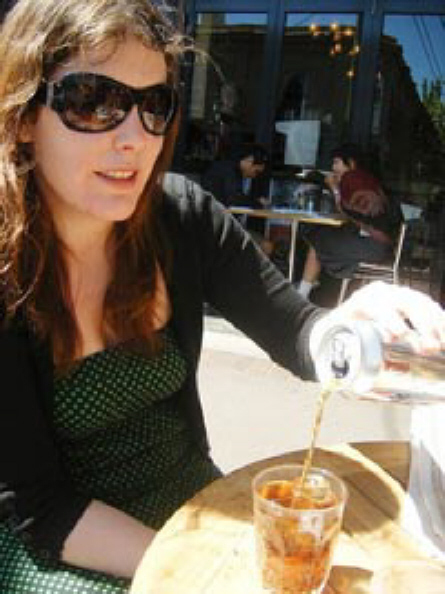
Profile: Rachel Hills of Musings of an Inappropriate Woman.

I’ve only become familiar with Rachel Hills, sex and gender blogger at Musings of an Inappropriate Woman, in the past few months, but she’s made her way to the top of my must-read blogs. Here, she answers questions about her inspiration, future writing goals and what she does in her spare time in a new city (she recently moved from Australia to begin a new chapter of her life in London).

Can you give us a quick run-down of your professional writing portfolio thus far?

I’ve been freelancing for six years now, and have written for (in alphabetical order) the ABC, The Age, The Australian, The Big Issue, The Bulletin, The Canberra Times, Cleo, Cosmopolitan, The Courier-Mail, Girlfriend, Girls’ Life (US), Glamour (UK), The Huffington Post, Jezebel, The Monthly, New Matilda, Russh, Sunday Life, Sunday Magazine, Sydney Morning Herald, Vogue, The Walkley Magazine and YEN, as well as a bunch of smaller, indie magazines and blogs.

I got my start writing opinion pieces for the Sydney Morning Herald. These days, I usually write “think piece” features on personal-is-political type issues, or women’s mag fare with smarts.

How long have you been blogging at Musings of an Inappropriate Woman and what made you decide to start a blog?

I just did a quick scan of my archives and discovered I just reached my three year anniversary on October 30.

I’ve written for the internet pretty much ever since it was possible to (I started my first website in 1998), but I was always kind of hesitant of writing publicly under my own name. As a teenager because of my secret pop music loving shame, as a university student because I was involved in student politics and that makes you extremely paranoid (not of people digging up info on you when you become a politician, but of people digging up info on you and putting it in the student newspaper), and then as an adult because I didn’t want to cannibalise my own story ideas.

I cracked through basically because I loved reading other people’s blogs, and because I was inspired by the way that other journalistsparticularly in the USwere using blogs to connect with their audiences. My blog was quite different when I first started writing it, thoughit was more a mix of political commentary, scrapbook and lifecast, as opposed to the more reflective, personal-is-political blog it is today.

What are some of your favourite blogs?

I have a soft spot for blogs which make you feel like you’re getting to know the person writing itblogs like Gala Darling, Girl With A Satchel, Wordsmith Lane, The Ch!cktionary, Emily Magazine, Garance Dore, Style Rookie and The Scarlett Woman [that’s me!] are often at the top of my Google Reader.

I also love blogs that make me think about thingsFeministe, Pandagon, The Awl, Tiara The Merch Girl, Rabbit White, Kapooka Baby, Jezebel, Hugo Schwyzer, Racialicious. And people like Chris Brogan, Seth Godin and Chris Guillebeau are like mentors I’ve never met when it comes to things like blogging and community building.

I’ve lost count of the number of blogs I subscribe to on Google Reader, though, so that’s really just scraping the surface of what I read.

What has been your proudest writing-related achievement to date?

I don’t think I actually have one! There are lots of stories I’m fond of, and I still get excited whenever I get a story up, but there isn’t one that stands out as being more significant than the others. I suppose the one I was most proud of at the time was that first opinion piece in the SMH. And I hope my book will be my proudest writing accomplishment in a couple of years.

And your proudest non-writing achievement?

In 2006, I travelled around the US meeting some of my favourite journalists and editors: people from The Economist, The New York Times, The Huffington Post, US Cosmopolitan and so on. Very nerdy, but also very gutsy lots of people at home thought I was a bit of a weirdo for attempting it (with a couple of notable exceptions). I’m quite proud of that.

Back to your book, to be titled The Sex Myth; how is it coming along?

Haha, it’s coming along okay. I’m dedicating a lot of time to it at the moment, and there are bits of it that I really like, which is nice. I’ve shown the overview to a few high profile people, and the response has been universally very positive. I’m just trying to get everything in place at the moment to translate that positivity into a kickass book deal.

You’ve written about workaholism and the work/life balance in the past. How do you balance all your commitments?

It was much, much harder when I was living in Australia and holding down a near full-time job. Now that I’m working for myself again, it’s much easier to fit in all the things I want to work on, and living with my partner means I still make plenty of time for myself. (When he’s away, I start working later, procrastinating more and sleeping less.)

That said, even working for myself, I’m still managing four main areas of workfreelancing, book, PhD and blogonly one of which pays. So finding time for all of them can be a bit tricky.

What is your favourite way to unwind?

Having spent the past two and a half years of my life reading books on the philosophy of sex, I’ve developed a bit of a fiction obsession recently. It’s so much easier and more relaxing to read than the academic stuff I’m usually buried in.

I’m also really enjoying getting to know London, and digging out all the interesting things there are to do here. My boyfriend often asks me how I manage to find all the things we check outphotographic treasure hunts, interactive theatre, art galleries, bars with secret passage ways.

And yoga. It’s clichéd, but it relaxes me, keeps me fit and keeps my bad neck (from too much time sitting in front of a computer) in proper alignment.

Because most bloggers write about things they’re passionate about, as I know both you and I do, do you find sometimes it’s a chore to churn out posts on, for example, mag-world musings or the happenings on your favourite TV show (you and I both share a penchant for Gossip Girl) and the like, as previously you would have done those things for pleasure? Because that’s definitely something I struggle with from time to time.

Because I write for a living, one thing I’m very careful to do is keep blogging a pleasure. The main way I do this is by writing when I’m feeling inspired: if the writing doesn’t flow easily, blogging starts to feel like an obligation… and while I have no concrete evidence of this, I suspect it makes the posts less interesting to read, too. If I’m not feeling inspired and haven’t updated much that week, I’ll try to find something else around the net that I think will be of interest to my audience and share that with them instead.

What advice do you have for other bloggers?

Don’t feel like you have to get it right immediately. Sure, the internet sticks around forever, so you want to think before you post, but blogging is something you learn by doing just like anything else, and chances are it will take you a while to find your best blogging voice. (It took me a while, and I’d been writing on the net for nearly 10 years and writing professionally for three when I started. And I’m still learning.) Experiment until you find that perfect intersection of what you love, what feels authentic for you, and what people respond to.

And finally, where do you see yourself, writing-wise, in the future?

I’d like to just keep on doing what I do now, only on a bigger and better level, with all the aspects of my work (journalism, blogging, books) feeding into one another.

[Musings of an Inappropriate Woman].