TV: The Underlying Message in Glee’s “Furt” Episode.


Last night’s episode of Glee marked the final in a three-episode arc about bullying.

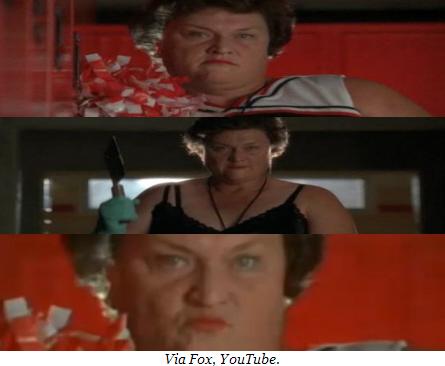
In Sue’s final act as principal before she resigns at the end of the episode, she expels Dave Karofsky for bullying Kurt. Jezebel notes that “rather than yelling, ‘William, my hands are tied!’ she promises to stop Karofsky once they have proof that he’s harassing Kurt”but not before Sue takes to calling Kurt Porcelain, which could be seen as an act of bullying in itself.

Carol Burnett makes an appearance as Sue and Jean’s absentee mother, Doris, who in addition to being Sue’s own “bully”, left the girls to be a Nazi hunter. While Doris doesn’t appear all that bad, it does give some insight into Sue’s present-day behaviour as McKinley High’s student body tormenter. Why was Sue’s mother in the episode, you ask? Because Sue was getting married… to herself! But that’s a whole other can of worms.

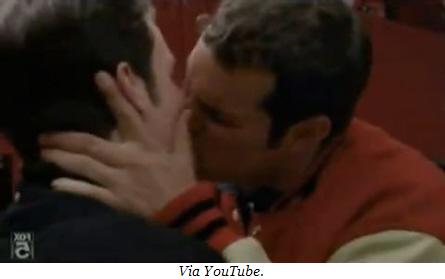
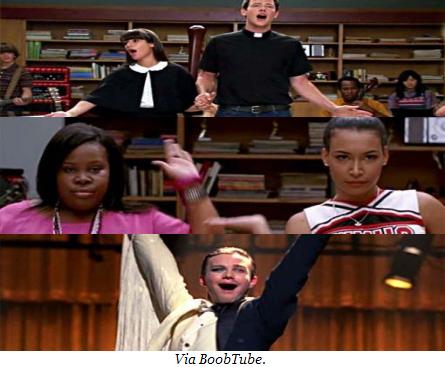
In other bullying news, the glee guys start a fight with Karofsky in the football team’s locker-room in defence of Kurt, but stepbrother to be, Finn, doesn’t partake. Even when it is revealed that the attack was Rachel’s idea, “setting the feminist movement back fifty years”, according to Quinn. (It’s no secret that I can’t stand Rachel, but a strong woman like her needs an equally strong man.) In what seems to be another instalment in Finn’s tour of whimping out, he doesn’t want to be perceived as being a homo-sympathiser. But not to worry, he makes up for it at his mum and Kurt’s dad’s wedding, by making a speech about standing up for “Team Furt” (in the tradition of celebrity couplings like Brangelina). And then they “dance their troubles away”.

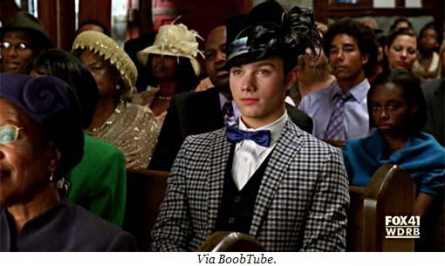
The wedding also serves as a catalyst for Kurt to break out this memorable one-liner: “I’ve been planning weddings since I was two!”

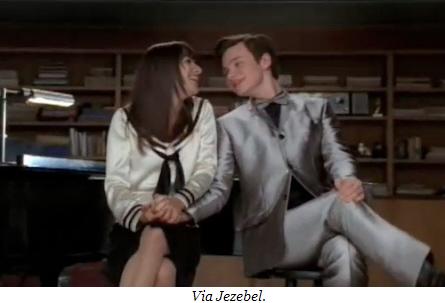
Oh Kurt, we’ll miss you when you transfer to Dalton Academy…

Related: The (Belated) Underlying Message in Glee’s “Never Been Kissed” Episode.

The Underlying Message in Glee’s “The Rocky Horror Glee Show” Episode.

The Underlying Message in Glee’s “Duets” Episode.

The Underlying Message in Glee’s “Grilled Cheesus” Episode.

The Underlying Message in Glee’s “Britney/Brittany” Episode.

Women in Fiction: Are Our Favourite Fictional Females Actually Strong, or Stereotypes?

Elsewhere: [Jezebel] Glee: Three Weddings & a Furt.

On the (Rest of the) Net.

How to “cure” a feminist.

Zoe Foster at her absolute best in her ode to “second day spaghetti”. Perhaps she should consider penning a food column in addition to relationship and beauty advice?

Overthinking It on the differences, but more so, similarities, of “California Gurls and California Girls”. One choice titbit: “The popsicle melting part means that California girls are sufficiently attractive that, under the right circumstances, they will cause men to ejaculate. Just in case Katy Perry didn’t make it obvious enough with her coy and artful wordplay, ‘popsicle’ means penis.”

More on Katy Perry and how she’s now claiming to be a gay icon. If you think back to her first song, before the success of “I Kissed a Girl” (“which panders to my least favourite cliché ever, that of the straight girls who make out at frat parties to turn on frat boys”), entitled “Ur So Gay”, it was insinuating that being gay “was the ultimate, be-all, end-all putdown to someone that treated her wrong.”

Matriarchy in Glee.

Also at Overthinking It, the likeability of male characters versus female characters is discussed. Hint: female characters aren’t likeable, even if the male characters they’re being compared to are sociopaths.

Jezebel on owning your sluthood:

“… Sluthood isn’t an action, it’s a state of mind.

“I’m telling you this because my sluthood saved me. Sluthood gave me the time and space to nurse a shattered heart. It gave me a place where I could exist in pieces, some of me craving touch, some of me still too tender to even expose to the light. Sluthood healed the part of me that felt my body and my desires were grotesque after two years in a libido-mismatched partnership. Now I felt hot, wanted, powerful. My desire and enthusiasm was an asset, not an unintended weapon.”

You go, girl!

Lifehacker offers up the “Top 10 Tips for Better Writing”.

Hugo Schwyzer on “The Problem With Being ‘Sexy But Not Sexual’”.

“The Televised Guide to Teen Girl Friendships”, featuring My So-Called Life, Full House and Popular.

Jezebel explains our (but not my) interest in the royal wedding by way of Disney:

“For me, an American pop-culture junkie, Prince William and Kate Middleton’s engagement means one thing: She gets to be a Princess. And seriously, some part of me, formed when I was three or four, believes that this means she will be dressed by birds, wear clothes sewn by tiny mice, and have woodland creatures as friends. Oh, sure, there’s a handsome Prince, but more important are the jewels! And the singing! And the castles! And the woodland creatures.”

Apparently positive people live longer. Good news for me, then!

“Do All of Us Need ‘The One’?” at The Ch!cktionary.

A rant on the annoyance of ignorance:

“… In our infoculture, it takes work not to expose yourself to interesting ideas, facts, news and points of view… the average person online spends seventy seconds a day reading online news. Ouch.”

New York, I Love Hate You:

“New York, I won’t miss your fierce morning halitosis exhaled from your subway grates along Third Avenue.

“I won’t miss you drooling on me from your high-rise air-conditioners in the burning heights of summer.

“I won’t miss how… to me you always smelled like Camel Lights, and warming urine, and the No. 14 busa perfume I never could quite embrace.

“New York, I’ll never forget how dating you made me so poor that when I wanted to read I had to unscrew a bulb from the bedroom and carry it to the living room.”

TV: The (Belated) Underlying Message in Glee’s “Never Been Kissed” Episode.


I was unable to catch up on Glee when it aired last week, so I decided not to write about the latest episode’s “underlying meaning”. However, after watching it over the weekend, I think there is an important message that needs to be talked about; just like every other episode this season!

While Glee can sometimes turn into an after-school special, “Never Been Kissed” was more of an “hour long ‘It Gets Better’ video”, as Jezebel puts it, focussed around Kurt’s struggles with being the target of homophobia and Coach Beiste’s sexual inexperience and objectification as an anti-sex symbol.

It will be interesting to see if the usually lacklustre writers will continue the storyline in which Kurt’s bully and member of the football team, Dave Karofsky, is tormenting Kurt because in actual fact, Dave is confused about his own sexual orientation. But what I found most interesting about the episode was Beiste’s storyline.

When Sam asks Finn how to “cool down” when making out with “chaste” Quinn, Finn relays his story of running down a postman with his car. Sam decides to use a mental image of Beiste in lingerie, and passes this on to the other guys. Somehow, Tina gets hold of this information and also uses a mental image of Beiste when making out with Mike. When Sam and Tina accidentally let slip Beiste’s name during make-out sessions with their significant others, it somehow gets back to Mr. Schuester, who “says [that] Beiste can never find out, though he winds up telling her himself in the very next scene”!

I can’t imagine how hurtful that must have been for Coach Beiste (yes, I am aware Glee is fictional and the characters DON’T ACTUALLY HAVE FEELINGS), especially when it is revealed that she’s “never been kissed”, hence the title of the episode, and never made to feel beautiful.

But the glee clubbers make good by dedicating their mash-up of “Stop! In the Name of Love” and “Free Your Mind” to Beiste, which ends in an inappropriate group hug, not to mention Will attempting to kiss Beiste’s insecurities away. It’s not that easy, Mr. Inappropriate Glee Teacher!

Related: The Underlying Message in Glee’s “The Rocky Horror Glee Show” Episode.

The Underlying Message in Glee’s “Duets” Episode.

The Underlying Message in Glee’s “Grilled Cheesus” Episode.

The Underlying Message in Glee’s “Britney/Brittany” Episode.

Elsewhere: Kurt Gets Kissed in Hour-Long “It Gets Better” Video.

On the (Rest of the) Net.

Millennials Magazine profiles the beauty of the to-do list, Daniel D’Addario gets nostalgic for Daria Morgendorffer, while Katie Baker wishes she was an orphan:

“Orphans are adored by their peers, but tormented by evil guardians, stay cool under pressure and abuse, and rarely fail to win true familial love and affection in the end.”

Also at Millennials Mag, the awesomeness of The O.C. was that “it was just fucking dramatic”:

“Kirsten’s an alcoholic. Marissa almost dies in an alley in Tijuana. Luke’s dad turns out to be gay. Luke and Julie Cooper hook up, grossly. Seth, who’s supposed to be this huge nerd, nabs the most popular girl in school. Summer gets into Brown, which is actually kind of realistic considering her money, but that’s another story. Obviously some lesbian stuff happens. Marissa shoots Trey. Marissa dies. Ryan and Taylor go into a parallel universe while in a coma. And yet everyone keeps on being rich and impossibly well dressed and extremely easy on the eyes.”

“The 9 Most Racist Disney Characters.”

Continuing with the “Why Don’t You Love Me?” theme, Tiger Beatdown discusses the cultural relevance of Beyonce’s anthem, in relation to buying access to a stripper’s body via a $10 lap dance:

“I was able to buy access to this woman’s body and (very convincing) pretend affections for less than I would spend picking up a couple of last-minute things at the grocery store. It was worth almost nothing. Less than an oil change. Less than someone cutting my hair. Less than getting a decent tailor to hem a pair of pants. Less than a bouquet of roses.

“And that’s the day that I realized we were all the victims of a sick joke. A despicable charade where so much is demanded of women, so much compliance and poking and prodding, so much effort to make ourselves beautiful and radiant and perfect, so much forcing of square pegs into round holes, just so we could meet it all, do it all, get close to the apex of perfection and still be worth nothing. We would be left with alienation from our own bodies, our bodies that we squeezed into stilettos and shaved and waxed and whittled into tiny silhouettes at the gym, always striving for more perfect, thinner, prettier, more alluring. Working so hard to satisfy the cultural imperative toward female perfection—how could we have time for our own desires except to be desired?

“Latoya Peterson writes about the video that ‘Once again, Beyoncé’s lyrics define her positive attributes in the context of why she should be desirable to some fool that doesn’t appreciate her. The video, however, is a lot more interesting since, with Beyoncé playing the role of “B.B. Homemaker”, it is openly mocking a lot of the ideals and tenets of womanhood’. I’d go much further than that. I’d say that the song and the video together form a radical critique of femininity, full stop. Because this is what femininity is about: making yourself appealing to men by adhering as closely possible to cultural ideals of perfect womanhood. Her lyric is not ‘when I am so damn easy to love’, but ‘when I make me so damn easy to love’. It’s effort, it’s a construct, it is something she does and not something that she is. It is performative.”

“Man up” seems to be a fairly frequently used phrase in my vernacular, and The New York Times ponders its true meaning:

“But man up isn’t just being used to package machismo as a commodity. Its spectrum of meanings runs from ‘Don’t be a sissy; toughen up’ all the way to ‘Do the right thing; be a mensch,’ to use the Yiddishism for an honourable or upright person. The Man Up Campaign, for instance, is a new global initiative that engages youth to stop gender-based violence: ‘Our call to action challenges each of us to “man up” and declare that violence against women and girls must end,’ its mission statement reads.”

Now that is something we can all certainly man up stand up for.

The top ten reasons why anyone follows anyone who’s anyone on Twitter.

Uplift Magazine on those Crystal Renn food photos.

In defence of books:

“Many books are screwy, a great many are dull, some are irredeemable, and there are way too many of them, probably, in the world. I hate all the fetishistic twaddle about books promoted by the chain stores and the book clubs, which make books seem as cozy and unthreatening as teacups, instead of the often disputatious and sometimes frightening things they are. I recognize that we now have many ways to convey, store, and reproduce the sorts of matter that formerly were monopolized by books. I like to think that I’m no bookworm, egghead, four-eyed paleface library rat. I often engage in activities that have no reference to the printed words. I realize that books are not the entire world, even if they sometimes seem to contain it. But I need the stupid things.”

The perils of HalloSlut-o-Ween, at Rabbit White.

Meet Me at Mike’s Pip Lincolne writes about what makes a successful blog.

More on the Glee/GQ photo shoot scandal, this time from NPR and the girls at Go Fug Yourself.

On the (Rest of the) Net.

Indeed, “What Is the Difference Between Charlie Sheen and Lindsay Lohan?”

Again, in the wake of Sheen’s “drug-alcohol-and-woman abusing” bender, Girl with a Satchel asks if men’s mags focussing on UFC and, alternatively, retro Mad Men style sensibilities is a result of the “soggy” men’s mag market trying to inject some much needed zest:

“In the current socio-cultural context, where women assert more power and influence, the ‘reality’ may be why more men are turning into Don Draper lookalikes and turning to UFC. It doesn’t take Two & a Half Men to work [sic] out that in magazines, men need escapism, inspiration and style tips, too. The appeal of men’s magazines is to service wants, needs and desires; I just wonder what men really aspire to.”

Tiger Beatdown’s response to Beyonce’s “Why Don’t You Love Me?” video is, in a word, hilarious (more on it to come next week):

“A blog post, we hear, should be short, and timely, and probably pegged to some manner of news item. This ensures that it can be part of the blog conversation on the Interwebs. Where immediate response is king! And that, of course, is why we write 3,000 to 5,000 word posts about long-running TV shows, and movies we rented from iTunes, and also, albums that came out when we were twelve.

“However, sometimes it only takes us weeks to respond to something! For example, a music video, of the sort that the kids enjoy today. A music video like this one!”

Joan Holloway’s Mad cartoon curves are poured into a Little Miss book.

In other Mad Men-related news, The Washington Post writes in defence of the show’s alleged sexism:

Mad Men’s writers are not sexist. The time period was.”

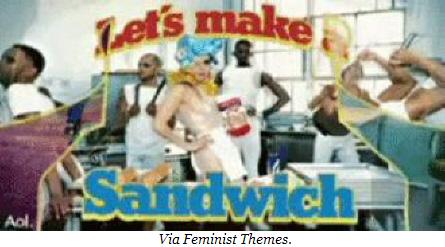
Feminist Themes on Lady Gaga and Beauty.

Slate asks “How Long Has the ‘Dumb Blonde’ Meme Been Around?”:

“The poet Propertius, for example, wrote: ‘All beauty is best as nature made it… In hell below may many an ill befall that girl who stupidly dyes her hair with a false colour!’ So while he didn’t connect blondeness with idiocy exactly, he implied that wish to be blondes, and contrive to be blondes using artificial means, don’t have much going on.

“As for why the dumb-blonde idea resonatesone idea is that it’s basically Propertius’ logic at work. It’s a fairly well-known fact that few adults are naturally blond[e], and that many apparent blondes actually die their hair. If you die your hair, you must be superficial or vapid, Q.E.D. There’s also a theory, outlined in The Encyclopedia of Hair, that blondeness connotes youth, since children are far more likely than adults to have naturally blond[e] hair. Blondeness, then, seems innocent but also naïve.”

Steve Pavlina discusses which aspects of your life are worthy of your attention, and which aren’t.

Organisational Post-It porn at MamaMia.

From The Awl, “How to Lose [Facebook] ‘Friends’” and alienate people:

“Christopher Sibona… explains the top reasons fro defrienestration: updating too frequently about boring things, posting about controversial subjects like politics or religion, and writing racist or sexist stuff. It’s a lot like life, although in life these people are actually friends and not some random body count you’ve assembled through networking or total availability.”

Godammit, I’m Mad profiles “Bloggers With Influence”, and has some particularly scathing words to say about Gala Darling. Ouch.

Along the same lines, The Feminist Breeder says not to “assume that more ‘fans’ or ‘followers’ means they’ll all be adoring. The truth is, the more people who read you, the more bullshit you’re going to have to put up with…”

In the wake of those controversial GQ photos and last week’s Rocky Horror episode, Glee is questioned as to whether it has a “Body Image Problem” or not.

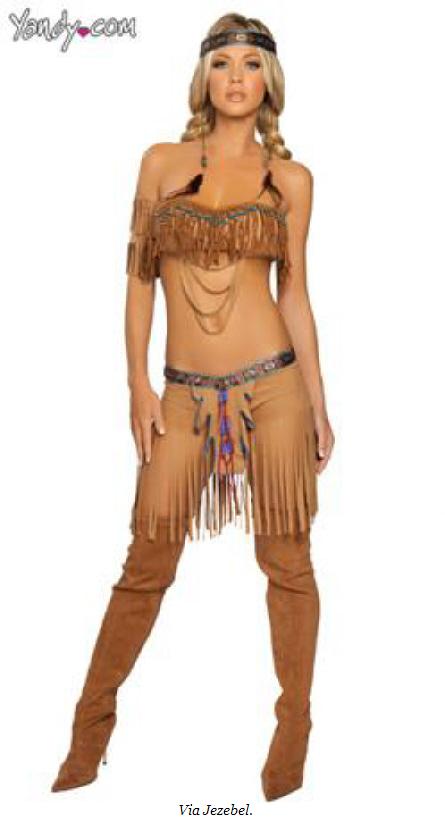
As Halloween is swallowed back into the underworld for another year, Gawker has some All Hallows Eve etiquette tips on how to tell if your costume is racist:

“… When the entirety of your costume is ‘I am a person of a different race, LOL,’ that qualifies as a racist costume.”

But is it racist if, like, you’re of Native American descent? (FYI, I actually am.) Paris Hilton, take note.

TV: The Underlying Message in Glee’s “The Rocky Horror Glee Show” Episode.


Who would’ve thought that an episode of Glee centring around The Rocky Horror Picture Show could be a catalyst for discussing male body image?

Not me, but that seems to be the underlying message in this week’s episode.

When Mr. Schuester announces to the glee club that they will be performing Rocky Horror after Emma tells him she went to see it with her new beau Carl, Rachel is quick to announce that she and Finn will be playing Janet and Brad. Finn is all for this until he realised he’ll have to perform much of the show in his “tighty-whiteys”. Santana and Brittany comment on this, saying they can’t wait to see Finn’s “hot mess” of a body as a result of eating sloppy joes for lunch everyday, in comparison to Sam’s rippling abs accompanied by gold hot pants in his role as Rocky. (If Cory Monteith had put on weight to give Finn an actual “hot mess” of a body, it might’ve lent his storyline more credibility.)

Finn voices his concerns to Rachel who, in her usual selfish ways, tells him that she doesn’t look like Brittany or Santana, but she’s still stripping down to her underwear, and she loves his body just the way it is.

In the locker-room, Finn broaches the subject again with Sam and Artie. As Sam is donning hot pants, he obviously doesn’t have many body image issues (until later in the episode, when Schuester suggests he play another character as the role is too risqué for a high schooler, which Sam misinterprets as him being too fat to pull off his costume), however Artie blames porn for warping females’ perceptions of male bodies:

“I personally blame the internet. Once internet porn was invented, girls could watch without having to make that embarrassing trip to the video store. Internet porn altered the female brain chemistry, making them more like men, and thus, more concerned with our bodies.”

Sounds an awful lot like Naomi Wolf’s argument about porn and its affect on the male brain chemistry, making them more concern with the female body and what it can do for them.

Elsewhere, at the beginning of the episode when the kids are choosing their roles, everyone thinks it would be fitting to have Kurt play Frank N. Furter, to which Kurt replies:

“There’s no way I’m playing a transvestite in high heels and fishnet wearing lipstick,”

as apparently being the only gay man in the club means automatically defaulting to play the tranny. This is particularly poignant, as there is still a lot of misunderstanding in the mainstream about gay, bi, trans etc. people and what exactly their gender roles entail.

Related: Is There Really a Beauty Myth?

The Underlying Message in Glee’s “Duets” Episode.

The Underlying Message in Glee’s “Grilled Cheesus” Episode.

The Underlying Message in Glee’s “Britney/Brittany” Episode.

Elsewhere: [MamaMia] Male Models: Inside Their Straaaange World.

[Jezebel] Glee: Sexy & Scary In All The Wrong Ways.

[Boob Tube] Glee in Pictures: Rocky Horror Glee Show.

TV: The Underlying Message in Glee’s “Duets” Episode.


Following on from last week’s controversial episode, this week’s Glee deals with the students pairing off into couples for “Duets”. All except Kurt, of course, who is unable to find a partner, not only to sing with, but also to be with in the romantic sense.

This theme is timely after the suicide of gay teen Tyler Clementi, who was filmed having sex with another man by his roommate, who was then going to broadcast the footage online, and the subsequent campaigning by Ellen DeGeneres and her fellow celebrities to stop gay bullying, and that life does get better.

Kurt expresses interest in duetting with the new kid, Sam, but Finn warns him against it, as the “ensuing beatings” will force Sam out of glee. Of course, Kurt thinks Finn still has issues with his homosexuality, but Finn retorts that they live in a (homophobic) man’s, man’s, man’s world, and breaks out the “no means no” shtick.

Later on, Burt Hummel, who is out of the hospital after last week’s stint in ICU, reiterates Finn’s sentiments, and Kurt asks, “So a gay guy can’t be friendly to a straight guy without it being predatory… You’re saying I shouldn’t sing with this Sam guy because it might upset a couple [of] homophobes?”

The episode also deals with the other kinds of pairings the glee club members engage in. There’s Brittany and Santana, whose lesbian relationship is taken to new levels this week when they’re shown kissing on screen; the proverbial straights, Rachel and Finn and Sam and Quinn; the (perhaps stereotypical) strong black women, Mercedes and Santana, singing “River Deep, Mountain High”; the “Asians”, Tina and Mike, who are having relationship issues and will attend “Asian couples therapy”; and the sensitive issue of Artie’s disability, how it relates to his sex life, and his deflowering by Brittany in this episode.

Thus, this leaves us with loner Kurt, who has more than enough personality and pizzazz to pull off “‘Le Jazz Hot!’ from Victor/Victoria” and steals the show.

Kurt is a strong enough character that he doesn’t let his peers’ (albeit not is glee club peers) discrimination get to him, and thus he comes across as a teenager who has the courage of his convictions to stay true to himself, a stance which can only serve to encourage and enable other young people struggling with their sexuality to stand up and own it.

Oh, and in a rare show of compassion, Rachel offers to do a duet with Kurt in the final scene, asserting that they’re more alike than they think. Perhaps a straight wife-gay husband relationship to rival Carrie Bradshaw and Stanford Blatch is blooming?

Related: The Underlying Message in Glee’s “Grilled Cheesus” Episode.

Elsewhere: [Jezebel] Everyone’s Duetting It (Except Kurt).

[Jezebel] Why Glee’s Brittany & Santana Are My Queer Icons.

Magazines: Disturbing Behaviour—Terry Richardson Does Glee.


Über-inappropriate fashion photographer Terry Richardson has done it again, using his magic creepy touch on the cast of Gleeor rather, the most vanilla cast members from Glee, Cory Monteith (Finn Hudson), Dianna Agron (Quinn Fabray) and Lea Michele (Rachel Berry)to turn them into “porny” high schoolers to rival Britney Spears in “Baby, One More Time” (which Michele did a cover of, complete with schoolgirl tartan and feathers in her hair, on the “Britney/Brittany” episode) for the November cover of GQ.

Seriously, when will people stop employing him to work with subjects who, granted, aren’t underage but portray underage characters on a family show, when he is a known predator of underage and vulnerable women?

And does anyone else find Michele extremely offputting, in more ways than one? Or is it just me?

Related: The Underlying Messages of Glee’s “Britney/Brittany” Episode.

Food Fight.

Elsewhere: [GQ] Glee Gone Wild.

[Jezebel] Terry Richardson Makes Glee All Porny.

On the (Rest of the) Net.


After my Mick Foley rant last week, I’ve started reading his blog, Countdown to Lockdown, and I’m loving it. Here are some choice articles:

Remembering female pro-wrestling pioneer, Luna Vachon, who passed away on August 27 this year.

“That Time I Met… Tina Fey… and Alec Baldwin!”

“That Time I Met… President William Jefferson Clinton!” (I really love this one; some heart-warming stuff.)

“Mick’s Favourite Things: Top Ten Matches”, three of whichCactus Jack VS. Randy Orton at Backlash 2004 (above), Mankind VS. The Undertaker in Hell in a Cell in June, 1998, and Mick Foley VS. Edge in a Hardcore Match at WrestleMania XXII (that’s WrestleMania 22 in 2006 for you wrestling laymen)I 100% agree with.

In defence of Buffy’s whining.

“To the Teenage Boy in Your Life”:

“An important thing to remember is that girls are not from a different planet, nor are they even a different species. They’re just people, they’re just like boys, except with vulvas instead of penises.

“Mainly you need to remember this when you’re trying to figure out what a girl is thinking. See, if you didn’t know what a BOY was thinking, how would you go about finding out? You might ask him, right? The same goes for girls.”

I’m a bit behind the eight-ball on this one, as No Make-Up Week was a month ago, but Alle Malice’s guest post on Rabbit Write goes over the reasons “Why We Wear Make-Up”. I especially like this one:

“It makes me look good in photos. Almost everything we do now is documented by someone and posted in Facebook albums for the world to see, because if you aren’t having fun on Facebook, you aren’t really having fun. And if you aren’t pretty on the internet, you aren’t pretty in real life. Enter makeup.”

Nick Sylvester, on Riff City, discusses “How Kanye West’s Online Triumphs Have Eclipsed Kanye West”:

“Maybe there are people working with him… but I get the sense that Kanye is generating the [sic] lot of these ideas. I imagine he likes being in control of every aspect of the production, the medium being the message and so on. Online he is a wise fool, first playing into people’s perceptions of ‘Kanye West’, then off those very perceptions, sending himself up, pulling back his own veil… Despite many attempts, Kanye West is incapable of being parodied, largely because Kanye West has already figured out a way to be a parody of Kanye West.”

Much like Megan Fox in this New York Times Magazine article. Could I even go as far as to say that blonde bombshell Pamela Anderson has employed this strategy? I believe I could. And for that matter, Lindsay Lohan sending herself up on Funny or Die and promos for the MTV VMAs are along the same lines.

Sylvester goes on to say that “artists like Kanye West have to be ‘good at Twitter’ in order to put a dent in the zeitgeist.”

Furthermore,

“‘Nowadays rappers, they like bloggers,’ is what Swizz Beatz says… Slowly the work itself becomes secondary, less ambitious; slowly people becomes ‘really proud of their tweets’.”

Is it “The End of Men”?

Disney’s latest offering, Tangled, based on the story of Rapunzel, takes us back to a time when the Disney Princess reigned supreme, according to io9.

Feminist Themes examines Lady Gaga’s “Telephone” clip:

“… the objectification, glamorising of lesbian fetishism, and excessive girl-on-girl violence… [are aspects of the video that] feminist Gaga fans can try to justify… as another example of how she subversively turns what we usually find hot into something that leaves a nasty taste in our mouths and therefore makes a statement, but if any other artist (particularly any male artist) incorporated this much objectification and violence against women we would be outraged. Is it any different just because it’s a woman, or because it’s specifically Gaga?

“… What sets Gaga apart from other sexpot pop stars for me is that I just can’t imagine men being honestly turned on by hernot because she isn’t gorgeous (she is), but because she is so avant-garde, aggressive and self-driven which takes that arousal and turns it into something atypical, uncomfortable, and threatening.”

Also at Feminist Themes, the cause of the she-blogger in “Why I Blog”.

In other Gaga news, The Cavalier Daily reports that the University of Virginia is now running Lady Gaga classes! This sooo makes me want to re-enrol in university in a post-grad, transfer to UV, and take this kick-ass class!

The Daily Beast puts forth two differing opinions on Glee’s stereotypes: Andy Dehnart discusses the show’s “Harmful Simplicity”, while Thaddeus Russell applauds the walking stereotype that is Kurt Hummel, as “history tells us that those unafraid to be ‘too gay’ won far more freedomsfor all of usthan those who dressed the part of straights.”

Beautifully satiric The Frenemy reveals the recipe to “The Teen Romantic Comedy”, which “does not work for Mean Girls, 10 Things I Hate About You, or John Hughes films”, unfortunately. The truth about Disney Princes is also profiled, in which Eric from The Little Mermaid “wanted to kiss a girl who doesn’t speak words and doesn’t know how to use a fork. What the hell are you, caveman?”, while Mulan’s Captain Shang is in truth, a “gay liar” who made young, susceptible viewers the girls who have “crushes on a lot of her gay friends. [A] big Will & Grace fan.” Hey, that’s me!

Rachel Hills discusses intersectionality in feminism:

“For those of you who aren’t familiar with the term, ‘intersectionality’ is a way of talking about power and privilege that recognises that recognises that these things operate on multiple axes. People aren’t just female, or Black, or Asian, or straight, or working class, or trans, or a parent, or prone to depressioneveryone falls into a number of different categories that colours their experience of the world in specific ways. In the feminist context, it serves as a useful reminder that not all women have the same experiences, and calls into question the still dominant notion that the neutral ‘female’ experience is one that is white, heterosexual and middle-class.

“I’m also a fan because it just makes feminism a whole lot more interesting.”

Girl with a Satchel profiles Melissa Hoyer’s media career, which is a must-read for any budding wordsmith.

I am staunchly pro-choice when it comes to the abortion debate. In fact, I lean so far to the left that I’m borderline pro-abortion. (I’m sure that’ll ruffle some feathers!) But no matter what your feelings on the subject, MamaMia’s post, “The Couple Facing Jail Because They Tried To ‘Procure an Abortion’. Hello, Queensland? It’s 2010” is worth checking out.

Jezebel’s “5 Worst Mean (Little) Girls of All Time” includes Willy Wonka’s Veruca Salt and, from one of the most heart wrenching films of all time, A Little Princess, Lavinia, who looks a lot like modern-day mean girl, Angelina Pivarnick, from Jersey Shore.

“Why Strawberry Shortcake Was a Progressive Pioneer.”

TV: The Underlying Message in Glee’s “Grilled Cheesus” Episode.


I have been quite impressed with Glee’s second season thus far, as evidenced by my last review of the show.

Last night’s episode, which aired two weeks ago in the States, due to Ten’s commitment to the Commonwealth Games, dealt with Kurt’s dad Burt having a heart attack and lapsing into a coma, and how the members of the glee club felt about using religion to comfort Kurt and themselves.

Unlike many of last season’s episodes, “a nuanced discussion of religion prevent[ed] Glee from slipping into After School Special mode,” with creator Ryan Murphy explaining that “every time somebody said something anti-religion, we made sure somebody said something pro[-religion]”.

While I’m not so pro-religion myself, and definitely took Kurt’s side when he said “… the reason I don’t go to church is because most churches don’t think very much of gay people. Or women. Or science,” the show “accomplished a prime-time first: an episode that was… sympathetic to both believers and non-believers” and didn’t risk potentially alienating a subset of its audience.

Surprisingly, though, Sue Sylvester was in agreement with Kurt’s plight, “because she finds signing religious songs on school property inappropriate” and believes that “pushing religion on Kurt is amoral,” needless to say, because of her own experiences being angry with God for her sister’s disability.

While I shared Kurt’s discomfort at having his friends pray for Burt in his hospital room without Kurt’s consent, and Mercedes luring him into God’s house with the promise of wearing a “fabulous hat”, the overall message was that even if you don’t believe in religion (can I get an amen?), you’ve got to believe in something.

And Kurt did realise that he believes in something: he believes in his father. Echoing his beautifuland dare I say, betterrendition of The Beatles’ “I Want To Hold Your Hand”, which harkened back to Burt holding Kurt’s hand at his mother’s funeral, Kurt takes his dad’s hand and, if by some sort of miracle, Burt’s hand twitches.

I suppose I should also mention that all this religion is brought about by Finn seeing Jesus’ likeness in his burnt grilled cheese sandwich, which he believes has magical powers because everything he wishes for comes true. But at this point, I’m so over Rachel and Finn; it’s all about Brittany, bitch!

Related: The Underlying Messages of Glee’s “Britney/Brittany” Episode.

Elsewhere: [Jezebel] Glee: You’ve Got to Have Faith… In Grilled Cheese.

[Jezebel] How Glee Can Save Itself Next Season.

[BoobTube] Glee in Pictures: Grilled Cheesus.