The Changing Face of Beauty.

I’ve been meaning to visit Modelinia for a while now, and their History of Models timeline got me thinking about beauty norms across the ages since models became mainstream. Modelinia’s timeline begins in 1928 and follows the top faces (and bodieshello, Elle “The Body” McPherson), such as Twiggy, Iman and Lauren Hutton, through to today’s most famous faces.

Modelinia’s timeline begins with society girls like Dorian Leigh, who was perhaps the “world’s first supermodel” and appeared on the cover of Vogue seven times in 1944 and earned $300,000, “an amount that was unheard of during that time”. Leigh’s partnership with famed photographer Richard Avedon paved the way for future “model as muse” photographer-model dynamics. Leigh was also one of the models who inspired the classic, Breakfast at Tiffany’s.

The late 1940s and ’50s ushered in the age of “Hollywood glamour”, when Leigh appeared on Broadway in The Fifth Season, and “Million Dollar Baby” Lisa Fonssagrives married photographer Irving Penn. These women also proved there was life after modelling, with Fonssagrives “designing a line of leisurewear for Lord & Taylor”, and Leigh opening her own modelling school in Paris, much like Tyra Banks and Heidi Klum today.

The period beginning in 1960 was known as the “awakening” and spawned the births of McPherson, Linda Evangelista, Paulina Porizkova, Cindy Crawford, Stephanie Seymour, Christie Turlington, and Naomi Campbell, the women who would later become known as the über-models of the ’90s.

The ’60s were the years of Twiggy, whose picture was discovered hanging in a hairdresser’s window, and in 1965 she appeared on the cover of Vogue in three separate countries, landing the American edition thrice. She was also the subject of three separate documentaries that year, following on from her radio debut, with the single “Beautiful Dream” in 1964.

Around this time, Hutton refused to close the gap in her teeth, paving the way for the gap-toothed everywhere, like Madonna and Aussie model Jessica Hart.

It was a period of firsts for Hutton, which carried over into the ’70s, who was the first model to front a fragrance campaign, the first to sign an “exclusive cosmetics contract” and the first to reach $1 million in earnings.

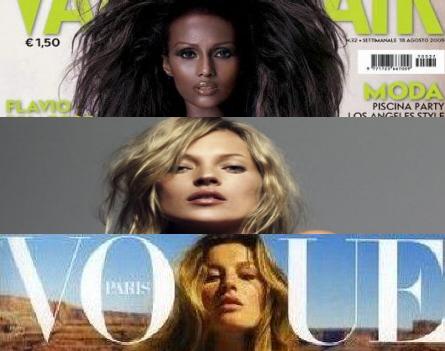
The days of disco saw the birth days of the second wave of ü ber-models, like Klum, Shalom Harlow, Banks, Kate Moss, and Laetitia Casta, and the juxtapositioning of the all-American girl next door, Christie Brinkley, with the exotic beauty of Iman. In 1974, Brinkley signed a cosmetics contract with Covergirl, which resulted in a 20-year partnership. Iman served as muse for Yves Saint Laurent, who released his African Queen collection in 1978. While Brinkley appeared on the cover of Sports Illustrated Swimsuit Edition three years in a row (19771979), Iman proved she has commercial appeal, fronting “the June cover of Italian Cosmopolitan” in 1978.

The era of the “poster girl” (commencing with Brinkley’s aforementioned Sports Illustrated cover in 1987 and culminating in the permeation of models in the mainstream) sees models on the covers of all major magazines, from Life to Cosmo to Vogue to Playboy.

And if the saturation of popular culture in the ’80s seemed extreme, the ’90s sought to solidify this with “the rise of the supermodel”, coinciding with “the waif” ideal popularised by Moss’s “heroin chic” look (or as we would find out in 2005, cocaine chic), which was perhaps named for Calvin Klein’s Heroin Kids campaign, which Moss fronted in 1994 .

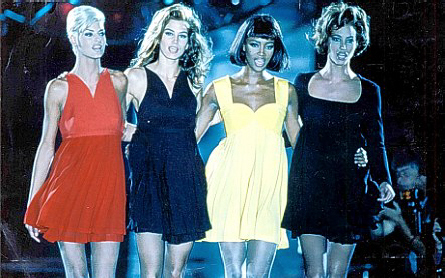
George Michael’s classic Freedom ’90 featured a bevy of supermodels, including Crawford, Turlington, Campbell, Evangelista, and Tatjana Patitz, in 1988. To accompany this, said models appeared on the cover of British Vogue, followed by the iconic group runway walk for Versace in 1989.
The rapid rise of Seymour began in 1989, when she appeared nude in Playboy, began dating Axl Rose of Guns N’ Roses and appeared in their “Don’t Cry” video clip, followed by “November Rain”. She became the first major model to sign with lingerie empire Victoria’s Secret in 1990, followed by her runway debut for Valentino.

It is interesting to note that the über-models of this time worked primarily in beauty campaigns and magazines before debuting on the runway, whereas now it’s the other way around. There are a lot of nameless and faceless models who walk on the runways and act solely as “clothes hangers” for the garments. It is rare that a model will move beyond that tag and permeate the zeitgeist, but those who have include Gisele Bündchen, Agyness Deyn, Daria Werbowy and Miranda Kerr.

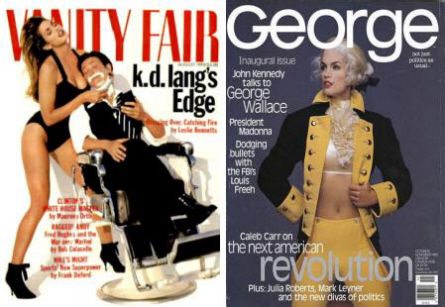
Crawford’s star also rose even higher during this period, with her marriage to Richard Gere and her constant presence on magazines cover of all kinds, including a sexy 1991 cover of Vanity Fair, in which a bathing suit-clad Crawford shaves k.d. lang in a barbers chair.

But Crawford had some competition rapidly rising alongside her: Moss. In 1991, Moss fronted the Calvin Klein Obsession for Men campaign, as well as the Calvin Klein jeans ad together with Mark Wahlberg.

1992 was also a year for sexy magazine covers, with Seymour gracing Playboy for a second time, and McPherson making her debut for the magazine.

In other mag news, Crawford was asked to posed for the cover of the groundbreaking first edition of John F. Kennedy Jr.’s publication, George, aswho else?George Washington.

19941995 was surely Harlow’s time, as she added to her resume of film roles in In & Out, as well as gracing the cover of February W, March’s Paris Vogue, and June Harper’s Bazaar US in 1994, and March W, and December Vogue with fellow model-turned-actress, Amber Valetta.

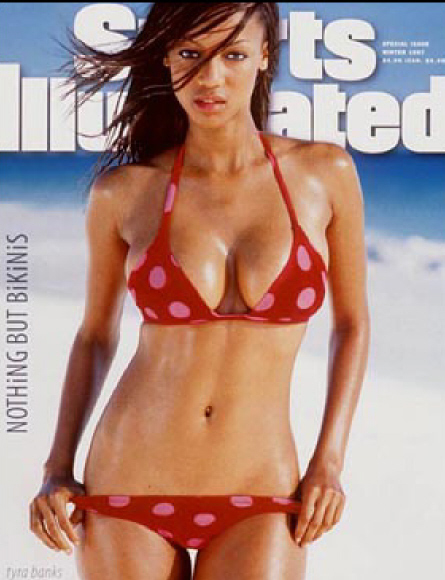
That year Banks appeared on the cover of Sports Illustrated Swimsuit Edition, the first black model to do so solo.
With Bündchen’s appointment to Vogue cover girl in July 1997 the “heroin chic” era allegedly ended, and the championing of healthy bodies like Bündchen’s began. Maybe in the modelling world, but the “heroin chic” movement has wrecked havoc on the notions of beauty, body image and popular culture.

On a side note, recently Playboy.com profiled the changing of women’s breasts over the years, and Jezebel was quick to counter that its not our breasts that have changed, but the media’sie. Playboybelief of what they should look like (NSFW). It is not dissimilar in the case of beauty magazines aimed at women.

By the turn of the millennium, the age of the supermodel subsided, which was noticeable on magazine covers across the world, which began to, and still do, feature actresses and singers on their covers.

With the retirement of the most beautiful faces and bodies in the business, models almost ceased to be relevant, and women who made achievements for something other than their looks were championed. Obviously, there is still a large gap between women on magazines and television and in advertising campaigns and movies in correspondence to how they look rather than what they do, but looking back on the dominance of beauty in the ’80s and ’90s, we are slowly starting to celebrate diversity.

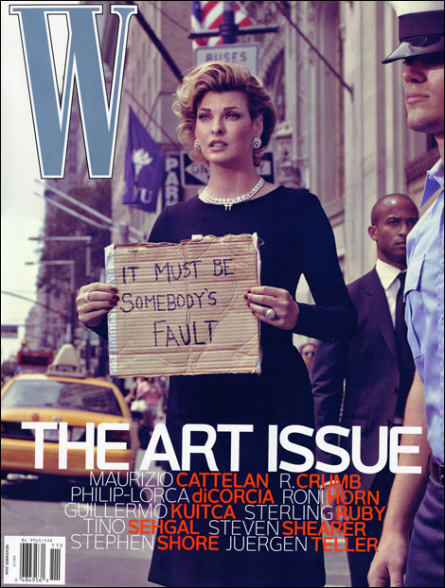
In addition, there’s the whirlwind surrounding plus-sized model Crystal Renn (is she plus-sized, isn’t she plus-sized?), and the model as somewhat of a prop for photographers, magazine editors and designers making a statement, as seen on Evangelista’s November 2009 cover for W magazine’s “The Art Issue”, or Claudia Schiffer (who, interestingly, was not featured in Modelinia’s timeline) and Karl Lagerfeld’s collaboration.
While it’s always nice to look a somethingone beautiful, it’s also nice to realise that there should be more to a model than what she looks like, and in a lot of cases, there is.

You only need to look at the aforementioned Banks and Klum’s careers in television (America’s Next Top Model and The Tyra Banks Show, and Project Runway and Germany’s Next Top Model, respectively), Erin Wasson’s foray into designing, and Kerr’s championing of a healthier life to see this in practice.

But I guess the question is, is this timeline representative of the success of certain types of models in response to our changing attitudes, or are our changing attitudes representative of the success of certain types of models?

On the (Rest of the) Net.

It’s shocking to know there are other blogs out there on the net besides this one! So I urge you to check out my favourite posts this week (and in the case of some, this year!). I hope you likey:

While I can’t exactly understand this site (it’s written in Dutch!), it’s oh-so-pretty to look at. And I love blogger Nenz’s links to other quirky sites. Below, she lists blogging as one of her fave pastimes (duh!) and THX THX THX blog for its sweet notes. More on this one coming soon!

“In Defence of Taylor Momsen”, over at Jezebel, tells us why we should just leave the 17-year-old the bloody well alone!

Jersey Shore’s Nicole “Snooki” Polizzi is subjected to a scathing profile by The New York Times.

I’ve been humming and hawing over whether to write a blog response to this article, but instead, check out Mark Sarvas’ blog, The Elegant Variation, and this article, “Advice for the Lovelorn… I Mean Writers”.

In other Momsen news, Jezebel reports on “the biggest feud of our time week” with Miley Cyrus.

One of my favourite bloggers, Rachel Hills, struggles to marry who she feels she is with who people perceive her to be. I feel ya, sister!

There’s been a bit of unrest in the Facebook ranks of late, and this Jezebel post“Why People Really Hate Facebook: It’s Complicated”asserts why it generates so much hate.

Sex & the City permeated the zeitgeist and defined a television-watching generation. Can Mad Men do the same?

US Vogue worked very hard in 2009 trying to boost its image, what with The September Issue and Fashion’s Night Out. Maybe “Vogue just might be culturally relevant” again?

Sarah Ayoub interviews impending Cleo editor, Gemma Crisp, about where she intends to steer the mag. Exciting!

And everybody’s been raving about Fashematics, which has been around for over a year, but is somehow only just coming to my attention now.

The Beautiful, Bigmouthed Backlash Against Katherine Heigl & Megan Fox.


Recently, there has been a bit of a backlash against Megan Fox, whothe consensus seems to beshould keep her mouth shut and be grateful for her break in Transformers. Much the same could be said about Katherine Heigl, who left Grey’s Anatomy amidst a storm of controversy earlier this year, when she complained about 17 hour days, which were allegedly scheduled around her movie filming and new mum timetable.

New York magazine went as far to give a “definitive… analysis” on both women, and whether their stock in Hollywood amounts to “buy, sell or hold.”

While Heigl managed to escape with a “hold” verdict, due to her ability to “get a project green-lit just by signing on” (the other four actresses in this category are Julia Roberts, Reese Witherspoon, Sandra Bullock and Angelina Jolie, out of which “Heigl is the only one who will work in a young romantic comedy”), Fox’s future is cloudy (“sell”).

I actually like both ladies, who also happen to be two of the most beautiful women on the planet. But apparently being beautiful and outspoken do not a feminist heroine make.

New York notes that some see Heigl as “refreshingly outspoken”. Others? “A headstrong, self-immolating, gaffe-spewing, headache-inducing diva freak.” Or, perhaps, she’s both?

She has stood up for her co-star T.R. Knight after fellow Grey’s Anatomy doc Isiah Washington dissed him with homophobic slurs. She also called her big-break film Knocked Up sexist, which I wholeheartedly agree with. Then there was the whole withdrawing-her-name-from-Emmy-contention debacle, due to insufficient storylines for her character, Izzie Stevens, on the show. Finally came her David Letterman rant about working seventeen hour days, and that the Grey’s producers should be “embarrassed”.

Some of these things perhaps weren’t the smartest, nor correct, things to say in the public arena, at the risk of coming off as a “diva freak”, but who the freak cares?! It takes a pretty gutsy woman to speak up about those kinds of things, as a lot of people would want to in any workplace; it just so happens that when Heigl does it, the world hears it.

Speaking of smart, Fox isn’t really known for espousing intelligent quid pro quos, but she is arguably Hollywood savvy, as “Fox’s appeal is all about simultaneously exaggerating her sexuality and then downplaying it as just Hollywood silliness.”

The exaggeration? Writhing around in denim cut-offs on a motorcycle in Transformers 2, girl-on-girl makeout sessions with Amanda Seyfried in Jennifer’s Body and lingerie ads, which is what she’s known for.

A recent Jezebel article asserts that “people really, really hate Megan Fox” (apparently, there’s a Tumblr hate-blog, “the description of which reads, ‘Fuck you, Megan Fox. No, really. Keep your trap shut’”) purely for the fact that she’s outspoken. (I’m a goner, then!)

When she criticised Transformers director Michael Bay for being a sexist “jerk”, he laughed it off, and this exchange of words carried on for the good part of a year, until she was let go from the franchise in May.

But in dismissing her from Transformers 3 and casting Victoria’s Secret model Rosie Huntington-Whiteley as her replacement (who’s “most notable acting role was as “Woman in Underpants” in Michael Bay’s own Victoria’s Secret commercial”), this should give Fox “a sense of how she’s viewed”, by Bay, at least.

This is further reiterated by the fact that Bay allegedly made her wash is car in her bikini in place of an audition (casting couch, much?), to which Jezebel says:

“Which she should apparently be really, really grateful for, since whenever people talk about her, they like to throw in the ‘don’t bite the hand that feeds you’ admonishment. To which I say, what if that hand is also trying to grab your ass?

(Perhaps she’s asking for it then, because of the way she looks? But that’s material for a whole different blog post.)

Unfortunately, though I think she’s awesome and has much more to offer, I see Fox going the way of so many sex-pots who are no longer relevant: Tara Reid, Carmen Electra, Denise Richards.

So it seems you can’t win either way. Either shut up, sit tight and look pretty. God forbid you speak your mind, as you run the risk of being labelled an outspoken, ungrateful harpy worthy of your own hate brigade.

Elsewhere: [Vulture] The Definitive Vulture Analysis of Divisive Rom-Com Queen Katherine Heigl.

[Vulture] What is Professional Provocateur Megan Fox’ Valuation in Hollywood?

[Jezebel] Women Who Want Attention.

[Musings of an Inappropriate Woman] Guest Post: Video, Consent & Kendra Wilkinson.

In Defence of To Kill A Mockingbird.


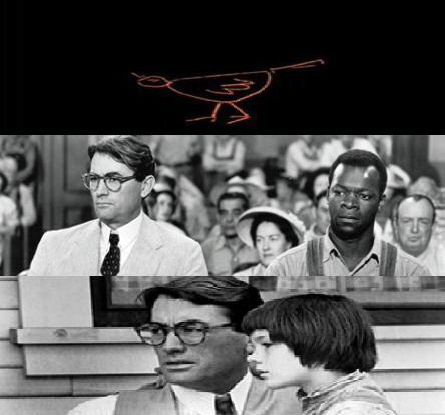
By now loyal Scarlett Woman readers will know my affection for To Kill A Mockingbird, so I couldn’t resist, after seeing a recap on Jezebel, responding to Allen Barra’s assertion in The Wall Street Journal that Harper Lee “doesn’t really measure up to the others in literary talent, but we like to pretend she does” and her Pulitzer-winning work is “virtuously dull”.

Well, I never!

Out of everyone I’ve ever spoken to about To Kill A Mockingbird, only one person said they didn’t like it, but she also didn’t finish the book, so she missed the part of the book I think is most poignant: the final paragraphs where Scout recounts the events of the summer from Boo Radley’s front porch, citing her father Atticus’ wise words that “you never really know a man until you stand in his shoes.” For Scout, “Just standing on the Radley porch was enough,” and I think that is one of the most beautiful pieces of imagery that brings the story full circle.

Atticus is the quintessential beloved father figure, and beacon of “all the best lines”, who, funnily enough, Lee crafted to oppose the attitudes of her own father, who allegedly “once remonstrated a preacher in the family’s hometown… for sermonising on racial justice”. Barra mocks Atticus’ juvenile explanation of the Ku Klux Klan (he is speaking to a CHILD, where a certain amount of sensitivity is required) and his dialogue, as seeming to have been written “to be quoted in high-school English papers”. God knows I had a field day with quotes from the book in my Year 11 English Literature essays, and perhaps the reason I feel so affectionately towards Atticus is that he reminds me of my grandfather, who passed away several days before I started Year 11. I don’t think I’m alone in saying that Atticus could be representative of the father figure I never had.

For Mockingbird’s haters, there is the defence that it is a novel for children (Barra quotes “fellow Southerner” and author Flannery O’Connor on her observation of To Kill A Mockingbird: “It’s interesting that all the folks that are buying it don’t know they are reading a children’s book.”) something that I was not aware of until reading the Jezebel article, which should say something about Lee’s writing skills (or my reading skills?).

Nonetheless, I stand by my belief that Mockingbird is one of the best books ever written. Barra might say that, “In all good novels there is some quality of moral ambiguity… There is no ambiguity… at the end of the book , we know exactly what we knew at the beginning: that Atticus Finch is a good man, that Tom Robinson was an innocent victim of racism, and that lynching is bad.” But I think there is some moral ambiguity: was it right of Atticus to “collaborate with the local sheriff to ‘obstruct justice in the name of saving their beloved neighbour…’”? And, as Jezebel asks, “Is Atticus’ evisceration of Mayella Ewell permissible because she is making a false rape claim in the knowledge that it will likely cost an innocent man his life? Is Mrs. Dubose a cranky old racist or ‘the bravest woman I have ever known,’ as Atticus says? Did Boo Radley truly kill Bob Ewell in self-defense? Are Atticus and the sheriff, in their willingness to protect the social status quo, contributing to the system of white male privilege that subjugates women and blacks—and the secrecy on which it depends?

And what did happen to Boo Radley, whom Scout “never saw again”?

Related: Taking a Leaf Out of Amazon’s Book: Bad Customer Reviews.

[Jezebel] Re-Evaluating To Kill a Mockingbird.

[Wall Street Journal] What To Kill a Mockingbird Isn’t.

(Sex) Ed Hardy


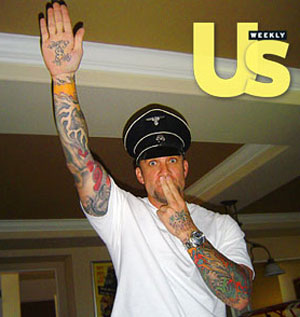
From our friends at Jezebel, comes the latest in bogan couture; the revelation that Christian Audigier, creator of the Ed Hardy monstrosity, has released a line of condoms.

As commenter SalutLaMiss says, “Anything that keeps the dudes I meet wearing Audigier (Ed Hardy, or Von Dutch) from reproducing is totally fine by me!”

Jon Gosselin, Mike “the Situation” Sorrentino; we’re talking to you!

TV: What Once Was LOST, Now is Found?—Lost Finale

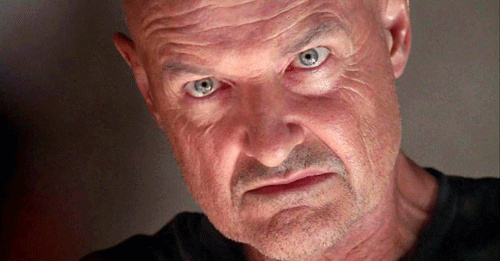
lost-eye

Last night was the television event of the year; the Lost finale.

And lo and behold, the theory most Losties held from the very beginning, that the island was some kind of purgatory, was semi-correct.

According to this article from Jezebel (because I need some outside sources to help me come to grips with the [trademark] confusion of the show), the sideways world we became familiar with this season was a “bardo”; a phase experienced by the deceased “between dying and rebirth” in Buddhism.

The article asserts that the sideways world was the bardo and the island the real world, however, it also states that Lost viewers can also draw their own conclusions. My conclusion is that the island was limbo, with Jacob and his brother acting as sort of archangels or guardians of the island to maintain the balance between good (the golden life force of the island) and evil (the smoke monster).

While Jack was initially chosen to replace Jacob as a guardian, he then passed the torch onto Hurley, whom I think is a much more fitting choice.

Hurley is then the new Jacob, and Ben his Richard, whom we see grow a grey hair and thus is able to move on and finally age.

Speaking of Ben, I never really bought him as the villain when he was introduced in season two as Kate, Jack and Sawyer’s hostage holder . He’s more like the misunderstood, not-so-bad guy; the one you love to hate. In the end, he was just a sad, “selfish and jealous” man who didn’t want to move on from the island, and now can’t.

Keeping in theme with the bardoa “place that the Losties had created to reconnect with each other after they had all died”all (and by all, I mean only the ones most relevant to the current plot) the Oceanic 815 passengers reunited, with Charlie, Jin, Sun, Sayid, Rose, Bernard, Libby, Shannon and Boone, and Juliet, Daniel Faraday, Charlotte and Penny all making appearances, in addition to Ana Lucia serving as police escort last week, and Frank found alive after the submarine blast.

The aforementioned Jezebel went full speed ahead with their Lost coverage in the lead up to the finale event, publishing an article on the top 10 already solved mysteries (Richard’s agelessness; the whispers of souls trapped on the island; the “donkey wheel” that Jacob’s brother built and Ben turned to move the island; the identity of Mocke/Smokey/whatever; Jacob’s “anointing” touch; the temple that housed the Kool-Aid that turned Sayid and Claire into zombies; the golden life-force of the island; the list that resided in Hurley’s guitar case; the “loophole” that protects twins Jacob and the Man in Black from killing each other, and their origins as twins), “10 questions to let go” of (Walt; Vincent the dog; Rose and Bernard; the creepazoid Other who tried to steal Claire’s baby, Ethan; Alex’s boyfriend Karl; the “food drops to the Hatch”; “Black Rock Journal”, which I, for the life of me, can’t remember in the show; the reason for Jack’s father Christian Shepherd’s numerous appearances on the island; and “why them?”) and “10 questions that must be answered” (what is Widmore’s deal?; why are all women doomed to miscarry if a child was conceived on the island; the statue at the foot of the island; Claire and Sayid’s zombie-esque transformations; “the sideways universe”; the revelation that the island was under water in the first episode of this season; who is Desmond?; who is Eloise Hawking?; what’s the go with “Jacob’s army”?; and the name of the Man in Black). Disappointingly, barely any of these mysteries were wrapped up in the finale. (Desmond, Vincent, Rose, Bernard, the reason for the parallel universe, why Hurley, the Kwon’s etc. were “chosen” and, surprisingly, Christian Shepherd’s role were the main arcs, with the rest going by the wayside.)

The willingness of most of the original cast, including Dominic Monaghan, Sonya Walger, Elizabeth Mitchelland Ian Somerhalder who were all working on other projects (albeit mostly flops; the ill-fated FlashForward and V, respectively, while Somerhalder’s Vampire Diaries enjoys more success), to return for the finale hints, perhaps, at a Lost movie to continue the saga. A much needed continuation of the saga, I might add.

In other news, the performances on the parts of Matthew Fox (Jack) and Terry O’Quinn (Locke), in particular, were stellar, and I loved how the focus was on the Darth vs. Luke, Lennon vs. McCartney, Lauren vs. Heidi-esque feud between those two characters as to what was best for the island and its inhabitants.

Also, the Jack/Sawyer/Kate love triangle was brought to a close, with Kate choosing Jack, and Sawyer pairing back up with Juliet. Kate was kickass in killing Mocke, whom I think was eliminated far too easily and early in the piece.

Ultimately, like any good series, it was as much about the bond between the characters and the “shared human experience” as it was about the hard-to-follow, unbelievable and sometimes downright convoluted plot points. But, all in all, while I liked the emotional aspects of the episode and the reunion of the Jack, Locke et al, especially with the disclosure of Christian and Desmond’s true purposes, I was very disappointed in the culmination, which I’m sure a lot of other Losties are too.

Elsewhere: [Jezebel] Lost Finale Recap: Case Closed.

[Jezebel] 10 Questions Lost Needs to Answer.

Why Are Famous Men Forgiven for Their Wrongdoings, While Women Are Vilified for Much Less?

In Perez Hilton’s words, “2010 has really been the year of the cheater”. First we had Tiger Woods’ cheating scandal, which broke late last year but has continued to be a headline grabbing story, then Jesse James’ spiral of shame, and now David Boreanaz, who went public a few weeks ago with news that he cheated on his wife of almost nine years, Jaime Bergman.

And last year was the year of the sports scandal, you might say, with the Matthew Johns group sex story coming to light in May.

What do all these men, with, perhaps, the exception of James, have in common? Their shady pasts have virtually been forgotten in favour of their more positive talents. Boreanaz plays the lead in hit TV series Bones, Johns now hosts his own self-titled show, and Tiger is back on the Masters tour.

While the wrongdoings of the Australian underworld are being glorified on Underbelly no one bats an eyelid. To take it even further, O.J. Simpson, although acquitted of double murder, was held up as a hero amongst African Americans in Los Angeles following his trial, despite being thought of as guilty in the court of public opinion.

Perhaps this is just a sign of the times changing; that our society has become so desensitised to notions of war, violence, drugs and sexual depravity that they are not longer taboo. I would argue that this is true to some extent it is not reflected on the other end of the spectrum.

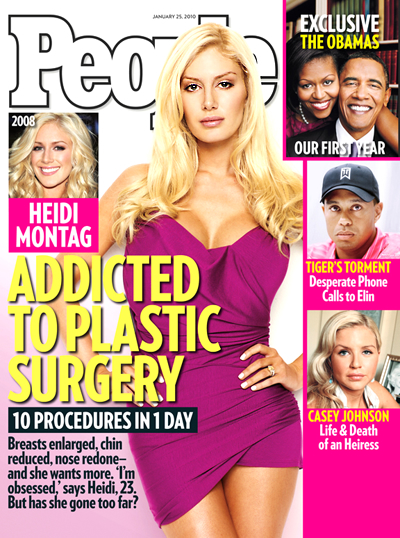
For example, a recently refurbished Heidi Montag admitted to undergoing 10 cosmetic surgical procedures in one day because she wasn’t happy with the way she looked. She obviously has deep-rooted body dysmorphic issues, however instead of helping and supporting her, the public has turned on her.

The same could be said of the Britney Spears’ and Lindsay Lohans’ of the world. A recent Jezebel article, “In Defence of Lindsay Lohan”, was in support of the former child star everyone loves to hate.

Sure, Lindsay has a father who “is a nightmare… and her mother is more of a friend than a parental figure. So perhaps she is lacking in guidance and role models. But who among us, in some way, is not? Her experience [of growing up in the spotlight]… is not one many people can relate to, anyway.”

The author surmises that the public’s fascination with Lindsay and their “build-you-up-to-take-you-down” mentality is much simpler: “She’s 23-years-old and being ripped to shreds in the press mostly because she goes out at night.”

Right. Someone like Colin Farrell has had a sex tape released, sexual misconduct allegations brought against him and has battled substance abuse problems, however he is still held up as a Golden Globe-winning actor. We all know Lindsay has the acting chops, it’s just a matter of her getting out of her own way. Double standard? In the words of Sarah Palin, you betcha!

The beautifully tragic Marilyn Monroe and Anna Nicole Smith were, and still are, vilified for being just that. Even in death, the girls can’t catch a break.

So that brings us back to the question, why do men get away with so much more than women can? Or, more to the point, why are men almost celebrated for their wrongdoings while women are banished into social oblivion?

I think, in a nation that celebrates sport as the highest level of achievement, especially, we want to give our sportsmen the benefit of the doubt. While I do think we focus too much on sport as the be all and end all of success in Australia, and the very nature of being “Australian”, it can be seen as admirable to offer someone a second chance. Johns, for example, could be seen as brave for coming forward and being the only one of his Cronulla Sharks teammates to own up to his mistake. But I do think it’s a bit soon to be running a television show off his back.

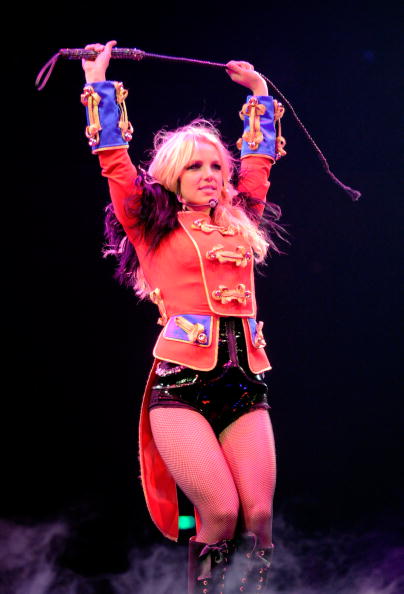
However, we also like to kick people when they’re down. Britney Spears, for example, was heralded as the princess of pop in her golden days, but when she started donning pink wigs, speaking to herself in a British accent in the gutter, and being carted off to the looney bin, we wanted nothing to do with her. Oh, I’m sorry, only to denigrate her on the cover of tabloid magazines.

Then last year she launched her comeback tour, and everyone was back on her side. That is, until, she lip synched (come on, it’s Britney! When has she ever not lip synched?) her way through Australia and out of our collective consciousness.

But how many second chances are we going to give these men, in particular? Charlie Sheen was embroiled in his latest domestic dispute over Christmas last year. But what of his past child pornography, prostitute and drug allegations? Not to mention the shooting of ex-girlfriend Kelly Preston in a domestic dispute. Do we just sweep them under the rug too so that Sheen can keep the $1.2 million per episode of Two & a Half Men coming?

When these mistakes are hurting people other than themselves, maybe it’s time to take a step back and look at the bigger picture. Do we really care if Lindsay, Britney or Mischa are off to rehab again? And shouldn’t we be caring that Jesse James allegedly ran dog fights out of his West Coast Choppers headquarters and is apparently a white supremacist? Or that Sheen is essentially being rewarded by the cash cow that is Hollywood for his reprehensible behaviour? Or that Tiger sleptand somehow found time to golfhis way across the country in a narcissistic bubble of admiration from his countrymenand women?

Related: All Eyes on Marilyn.

Elsewhere: [Jezebel] In Defence of Lindsay Lohan.