Andrew Chan on His New Book Why Mariah Carey Matters: “It’s Hard for People to Process That She’s a Singer-Songwriter”

This post originally appeared on Shondaland.

“Mariah Carey’s voice is a portal to the sublime,” says Andrew Chan, author of Why Mariah Carey Matters, a new book from University of Texas Press that examines the pop star’s life, career, and legacy in detail. “I know that sounds overwrought, but it’s melodramatic just like her music! There’s a reason that there’s a mythology around the voice and that certain vocalists become myths themselves because they are showing us what it can evoke and achieve when it’s used beyond its own limits.” Why Mariah Carey Matters seeks to unpack that myth.

Growing up, Chan split his time between the southern U.S. and Malaysia, where he was raised on Chinese pop divas. His appreciation for China’s pop stars led him to American pop divas, such as Whitney Houston, Celine Dion, and the apex, Mariah Carey. “At the time, I didn’t have the language to describe what her voice was doing for me, but it was a very visceral reaction for a child [to have],” Chan tells Shondaland during a recent interview.

Though at the time Carey was marketed as a white-coded, ethnically ambiguous pop star, it was her lyrics about searching for belonging and identity that Chan connected with. As a gay Asian boy growing up in the American South, who also felt out of place in Malaysia as an American, Chan felt he could relate to Carey.

“What she was able to articulate — not just lyrically but sonically — about the experience of being an outsider and living in between identities spoke to me even before I really knew that that was what was at stake in her music,” he says. That’s clear from the jump even in the titles of some of Carey’s later albums —The Emancipation of Mimi, E=MC2, Memoirs of an Imperfect Angel, and Me. I Am Mariah … The Elusive Chanteuse — as well as her 2020 memoir, The Meaning of Mariah Carey. But it’s also apparent as early as 1997’s Butterfly, which Chan believes is Carey’s best album and contains the song “Close My Eyes,” with the lyrics “I was a wayward child with the weight of the world that I held deep inside.”

At some point in Carey’s career, probably around the time she broke away from the adult contemporary genre and pioneered the art of the remix, Carey’s identity as a mixed-race woman — her father is Black, and her mother is white — came to the fore. Previously, what we thought of as a crossover artist was a regionally or culturally specific kind of musician, as Chan describes it, moving into mainstream pop. But Carey debuted in the early ’90s with No. 1 pop ballads “Vision of Love,” “Emotions,” and “Hero” before moving into remixes with 1993’s “Dreamlover” and, perhaps most famously, “Fantasy” in 1995, whose “Bad Boy Remix” version was named Pitchfork’s top song of the ’90s (“which would have been inconceivable in the ’90s for a publication like Pitchfork,” Chan adds). Since then, Carey’s music has been heavily and obviously influenced by the genres that she grew up with and loves. “She’s a genre chameleon,” Chan says.

But it hasn’t always been smooth sailing for the highly decorated diva. If you came of age in the early aughts, you would have been privy to Carey’s struggles in 2001 after the ill-timed and poorly received dual release of the movie Glitter, in which she starred, and the accompanying album of the same name. What makes her different from a lot of other famous women who experienced similar turmoil in that decade and have since been revisited by the culture is that Carey engineered her own comeback, with 2005’s The Emancipation of Mimi spawning the No. 1 single “We Belong Together.” Coupled with this is the playing up of her high-femme, camp image as the timeless Queen of Christmas, which Chan likens to a “shield” against scrutiny and other past traumas. Carey’s Christmas single “All I Want for Christmas Is You” hits the top 10 every holiday season, thus garnering her the accolade as the first and only artist with a Billboard No. 1 single in four consecutive decades.

Despite this, Carey is still underrated and underappreciated by the public, a space that she’s occupied since the beginning of her career. “You didn’t want to admit that you loved Mariah,” Chan offers. “But Mariah was simultaneously one of the most beloved and top-selling artists of her time as well as one of the most dismissed artists, partly because she was so popular, as if her success was purely generated by the prioritization of her record label.” 

People still don’t realize that Carey has co-written, co-produced, and arranged the vocals on 99 percent of her music. Chan says, “She has 19 No. 1 Billboard hits, which is the most achieved by any solo artist, and she co-wrote 18 of them. One of them was a cover. And these are just the number ones! She is an incredible musical mind, but as she herself will say, she doesn’t have the image attached to her of being behind a piano or holding a guitar. She isn’t like a Joni Mitchell or a Taylor Swift with the guitar, she isn’t behind the piano like Roberta Flack or Alicia Keys, so it’s hard for people to process that she’s a singer-songwriter. She is as much a singer-songwriter as anyone I just mentioned, and what’s remarkable about that is that she writes songs that are tailored to the uniqueness of her voice.”

What’s more, Chan says, is the ignorance of “the depth of her musicianship, and by that I mean the sound she created with the voice that is like no other; the style that is inimitable. You hear a Mariah song and immediately know it’s a Mariah song.”

So, what are Chan’s favorite songs then? “Breakdown” from 1997’s Butterfly, and “Candy Bling” from 2009’s Memoirs of an Imperfect Angel. He also name-checks “Always Be My Baby” (one of this writer’s favorite Mariah Carey songs) as no less “perfect of a pop song than ‘Yesterday’ by the Beatles.” Cue the outrage from those aforementioned music snobs.

For Chan, though, it all comes back to the famous five-octave vocal range, all the way up to the whistle register. “In her voice, I found escape, but I’m also brought back to the place that I was escaping from. In her music, people find a certain transcendence the same way one might find in religion.” And that’s why Mariah Carey matters.
In Defence of Pop & Rap’s “Unintelligent” Lyrics.

10_years_average_genres_logo

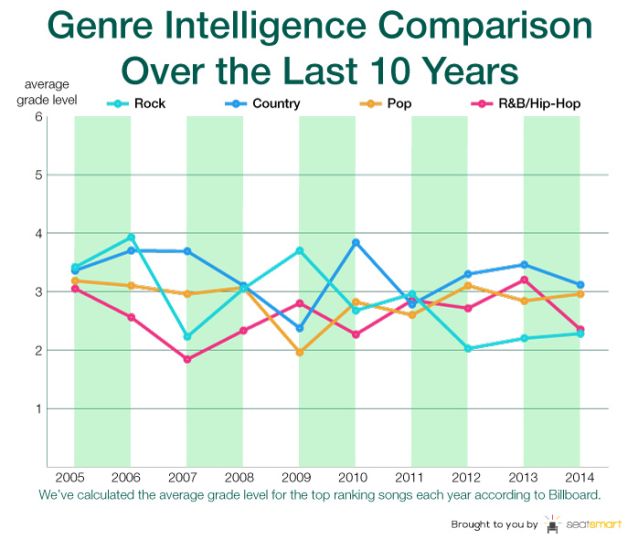
Last week I posted a link to a study by Seat Smart about the most unintelligent songs of the past decade in which the genres of pop and R’n’B/rap/hip hop featured heavily.

Word length and the amount of syllables therein were factors in pushing a song over the edge from unintelligence to intelligence. From the study:

“Country music is full of words like Hallelujah, cigarettes, hillbilly, and tacklebox. Add to that long place names like Cincinnati, Louisville, Mississippi, and Louisiana, and [c]ountry has a serious advantage over the competition.”

Country music coming out on top as the most intelligent genre is laughable; this is the inherently sexist genre that brought you such gems as “Thank God I’m a Country Girl” and Taylor Swift before she found feminism. Just because country originated in parts of America with really long names don’t mean jack. (I tried my hand at some country-esque parlance there.)

Though you wouldn’t think it from the flashy and oftentimes nonsensical rap styles of Pit Bull and Snoop Dogg phoning it in on tracks like Katy Perry’s “California Gurls”, rap and hip hop were spawned in some of the poorest and most downtrodden parts of major cities where their primarily black and Hispanic residents were oppressed and discriminated against and where drugs and crime were rampant. In his younger days, Tupac Shakur rapped about police brutality (“Trapped”, “Changes”), slut shaming, sexual assault and STDs (“Brenda’s Got a Baby”, “Keep Ya Head Up”, “Baby Don’t Cry”), and drugs (“Changes”), while N.W.A. produced songs with similar content.

As is evident in the popular music that the study chose to… erm… study, the rap that makes it to the top 40 charts isn’t necessarily an accurate depiction of the genre as a whole. Take, for example, Kendrick Lamar. I’m not super familiar with his work but I do know that the most commercial success he’s seen came with his recent cameo in Taylor Swift’s (of country music origins) video for “Bad Blood”. And while we all have an opinion on Kanye West, he raps intelligently—although this study would seek to disprove that—about fame, money, racism. (His inclusion on Katy Perry’s “E.T”, making it one of the past decade’s smartest songs, while Perry’s “Wide Awake” with no obligatory rap interlude makes it the 10th dumbest song of the decade should be indicative of rap’s—or at least Kanye’s—value.) This is not to mention the copious amounts of underground and unreleased rap out there.

When it comes to women, Mariah Carey (“We Belong Together” is finally getting its due as one of Mariah’s more artful arrangements) and Nicki Minaj (again, her unreleased stuff is far more sophisticated than “Anaconda” and “Starships”) are topping the intelligence scales while Beyonce makes an appearance in both intelligent and unintelligent lists. That the biggest and best artist in the world today could be described using the word “unintelligent” is a crime. It just goes to show that word length alone doesn’t demonstrate the myriad aspects that go into creating music.

hip_hop_logo

It’s also interesting that many of the artists who rank high in intelligence are appropriating the music of other cultures, ie. Eminem and Macklemore. (My mother recently said she thought Eminem was the best rapper, despite the high rotation of rappers of colour on my and my sister’s CD players in our youth.) On a related note, Iggy Azalea is nowhere to be found in this study.

pop_logo

country_logo

Sure, songs like “California Gurls” and “Tik Tok” may indicate our lowering intelligence as a culture (though, having said that, these are two of my favourite songs to get down on the dancefloor to, so do with that what you will), but artists like Lady Gaga, Beyonce and Taylor Swift (despite what the study says!) who are changing the game would suggest otherwise.

What do you think? Do you agree with the study’s assertions or would you counter them like I have?

Related: On the (Rest of the) Net: 29th May 2015.

Taylor Swift: The Perfect Victim.

Elsewhere: [Seat Smart] Lyric Intelligence in Popular Music: A Ten Year Analysis.

[Jezebel] Country Music Dude: In Radio, Female Performers Are Basically Garnishes.

[The Guardian] Taylor Swift: “Sexy? Not on My Radar.”

Images via Seat Smart.

The Changing Face of the Reality Singing Competition.

american idol judging panel jlo steven tyler randy jackson

There was a time, ten or so years ago, when American, and then Australian Idol, hit our screens and was judged by washed-up middle-aged music industry big wigs, like Simon Cowell, Mark Holden, Ian “Dicko” Dickson and the token women on the panel, Marcia Hines and Paula Abdul. These judges were mostly respected, if unfamiliar to Idol’s target demographic. Apart from Abdul’s “Opposites Attract”, I wouldn’t have known any of them from a bar of soap.

Not only was this before Britney, J.Lo, Mariah et al. demanded millions to sit in the judging chair, but it was also prior to the influx of talent shows; reality shows in general, really. Now we have myriad Got Talent’s, Voices’s, X-Factor‘s and the truckload of former and current stars it brings with it.

x factor australia judges

For every Britney and Christina, whose careers have been languishing in the pop wasteland for the last few years and could be helped by a judging role, there’s a Nicki Minaj, whose choice to judge the latest season of American Idol in the prime of her career baffles me. And we can’t forget Jennifer Lopez, who was the epitome of irrelevance prior to taking on the gig, and is now once again one of the highest earning performers in the industry (thanks, in no small part, to her franchise of perfumes) and deservedly so, as I saw her in concert last year and she is the consummate performer. Closer to home, Guy Sebastian, a reality singing competition winner himself, had a sprinkling of top ten and number one hits in the last few years, but really hit the big time with the Eve and Lupe Fiasco collaborations, “Who’s That Girl?” and “Battle Scars”, respectively, released after his turn as a judge on The X Factor.

x factor judging panel britney spears demi lovato simon cowell

So the “expert” record industry execs have pretty much gone the way of Dicko, albeit with the mainstays Cowell (The X Factor in the U.S.), L.A. Reid (ditto) and Randy Jackson from the original series of Idol, to make way for younger, sexier and more relevant judges, sometimes with an overhaul in between each season. And then there are the performers so out of place that were obviously hired ’cause everyone else turned them down: Demi Lovato, Khloe Kardashian (as a host) and, arguably, Nicki Minaj.

I think the new season of Idol’s focus on the feud between Mariah Carey and Minaj hinders not only the show (it’s about the TALENT), but also Nicki’s career in the long run. 2012 was perhaps Minaj’s strongest year to date, with “Superbass” being certified platinum, and “Starships” dominating the airways. While she’s never had a number one hit on the U.S. Billboard charts, Minaj was infiltrating pop culture at warp speed, so to her it might have seemed logical to dominate reality television as well. But, to me, singing competition judging panels are the domain of has-beens; people who’ve been down a similar road and can offer advice on the highs and lows of stardom. Who knows? Maybe Minaj will be the one to change that.

What do you think? Do you long for the no-frills early days of Idol, or are you all for big names on the judging panel overshadowing the talent?

Images via People, Wikipedia, Digital Spy.