Drug of Choice: The Disney Heroine.

Last weekend’s The Age supplement, A2, was jammed packed full of goodness , including a feature on the recent spate of fairytale-inspired exhibitions.

One of the exhibitions talked about in the article is the Bendigo Art Gallery’s “Looking for Faeries: The Victorian Tradition”, which I saw yesterday, and ACMI’s “Dreams Come True: The Art of Disney’s Classic Fairy Tales”, about the fairytales adapted for the screen by Walt Disney, with the groundbreaking (for the time) Snow White & the Seven Dwarves being a key component.

As you know, I can’t get enough of my Disney princesses, especially the constant discourse surrounding their affect on young girls, so this passage from the article took my fancy:

“In the past, and particularly in the 1950s, Disney fairytale heroes and, above all, heroines, were insubstantial figures, despite their predicaments, and energy and comedy were provided by the sidekicksthe dwarves in Snow White, for example. You can see a change in 1991’s witty, thoroughly engaging Beauty & the Beast: Belle was a more dynamic heroine than Snow White, and there was a character in the film who thought he was a handsome prince, but definitely wasn’tthe vain and vicious Gaston.

“[Tangled producer Roy] Conli credits John Lasseter, producer, director and chief creative officer at Disney/Pixar, for an insistence that central characters have to be the emotional and the comic core of a film. So, Rapunzel, the girl with 20 metres of blonde hairwho has been shut up in a tower her whole life, or, “like, grounded, like, forever”isn’t simply set free, end of story. In Tangled, she has a male counterpart, a foil, he says, a worldly, dashing thief called Flynn Rider whose adventure of discovery takes place alongside hers.

“… Whatever we make of these new fairytale dynamics, whether we regard them as retrograde or progressive, misguided or inventive… fairytales are often more appealing to adults than children.”

Perhaps that’s why I still can’t get enough of Belle… and it’s nice to see a modern-day Rapunzel adopting, like, a modern-day vernacular.

Related: Women in Fiction: Are Our Favourite Fictional Females Actually Strong, or Stereotypes?

Elsewhere: [Bendigo Art Gallery] Looking for Faeries: The Victorian Tradition.

[Australian Centre for the Moving Image] Dreams Come True: The Art of Disney’s Classic Fairy Tales.

On the (Rest of the) Net.

Frock & Roll asks “What Makes a Compelling Website?” Frequent updates, a unique writing style, an interesting story to tell and expertise (on things like “how to make a pillowcase from a DVD player”). Also, the final instalment of “The Blogger’s Guide to Hustling” is now online.

Darling of the magazine world, Frankie, is profiled on Pedestrian.TV.

A pro-hunting friend of mine put me on to this article featured in The Age, entitled “Men Who Kill”. The provocative title certainly reflects what a lot of animal-loving, vegetarian Greenies think about hunters (I, myself, have conflicting feelings about being a meat-eating, leather-wearing, zoo-goer versus being staunchly against animal cruelty, puppy mills/pet shops, fur, whaling etc.), but one quote from the article is particularly thought-provoking: “It’s [the rabbit] out and about and ‘bang’, the next thing it knows is nothing. It’s not tormented by a slaughter yard or fed hormones.”

In other Barbie news, Chloë Browne, guest blogging at Em & Lo, asserts that you can be a feminine feminist… and a Barbie connoisseur. Amen.

To celebrate season two of Jersey Shore, The Atlantic thinks that “We Are All Snooki”, the undisputed breakout star of the show, in terms of “crafting public selves”. Only Snooki’s public self is a whole lot more outrageous and famous than most of ours.

Bret Easton Ellis does The Babysitters Club? WTF? But he does it oh so well. For example, Kristy says, “Like, sorry that you have diabetes Stacey, but do we have to spend half the afternoon discussing it? And yeah, it really bums me out to watch Claudia snort up half those Pixie Stix when she is so blatantly trying to get attention to her sugar problem…” Speaking of Claudia, her chapter is far better; very passive aggressive, in the vein of BEE:

“We were going 30 in a 25 mph Stoneybrook crossing lane, my dad’s hands clenched white against the wheel while I could practically hear him grinding his teeth all the way in the backseat. I was sitting next to my older sister Janine, who had spent the last three days on some sort of cleanse diet because she was, in her words, ‘packing on the pounds like I was the one eating all the junk food.’ Or because someone had switched out her carefully hidden birth control pills with orange Tic Tacs last month. Either one.”

Sometimes it seems my sister and I are the only ones on the face of the earth who have seen/remember/love the ’80s teen movie, Teen Witch. Until Jezebel profiled it! Above, a choice rap clip from the film!

Erica Bartle has a discusses the perils of committing to a comprehensive review of all the September issues and promotes blog loving on Girl with a Satchel.

An oldie but a goodie: “The Self-Manufacture of Megan Fox” at The New York Times.

We can’t have “On the (Rest of the) Net” without the requisite Mad Men link. This week it’s “Mad Men’s Very Modern Sexism Problem” at The Atlantic.

Newspaper Clipping of LAST Week.

So I’ve been a bit behind the eight ball this week, what with moving to my new digs in Richmond and all. But I thought the time had come to stop staring out the window at my fabulous view of the city and catch up on some work.

This last week’s newspaper clipping comes from Sarah Wilson’s Sunday Life column. In it, she discusses the perils of sitting down with a good book and actually reading it, as opposed to skimming, which the internet has taught us, what with emails, blogs and the infinite amount of useless information out in cyberspace.

In the vein of “slow cooking”, “slow reading” doesn’t involve “reading words at a snail’s pace with a ruler”, but “reading fully… and allowing time for dissecting arguments and reflective response”.

This is something I sometimes struggle with, as I feel there is just so much knowledge to be absorbed, and I’m never going to take it all in. Recently, I had so much on my mind (read: moving house) I managed to read the whole of One Flew Over the Cuckoo’s Nest without actually comprehending any of it. Dismal review pending.

In other clippings news, I loved The Age’s resident “Bookmarks”compiler Jason Steger’s take on Bret Easton Ellis’ talk in Melbourne recently. Instead of asking about the “inspiration” behind is disturbed characters, which he famously prefers not to divulge, audience members asked such off-beat questions as, “Who… would win in a tag team wrestling match between Christian Bale and Patrick… Bateman [of American Psycho] and Ellis and James van der Beek, the actor who played Patrick’s brother in the film of Ellis’ novel, The Rules of Attraction.”

No wonder tickets sold out in seven minutes!

Newspaper Clipping(s) of the Week.

This week’s choice newspaper clippings come from The Age‘s Sunday Life supplement (Eye of the Beholder, August 8, 2010) and Good Weekend (Calendar Girl, August 7, 2010), respectively.

Calendar Girl, written by Virginia Heffernan, deals with hard-copy diaries like Filofax and the like versus the iPhone and Blackberry’s digitised versions. This is something I struggle to consolidate in my life, as I am an über-fan of stationary, but I just don’t have room in my life for physical lists, schedules etc., when the digital option is right there.

Sometimes I get a bit sick of talking about body image (what with the multitude of blogs, magazines and articles I read each week, as well as the issue being a common theme in my blog posts), but William Leith’s article, Eye of the Beholder, looks at it from a different angle. Why do women look “at a model and fall apart”, while men “shrug off [their] own belly”? Thought provoking stuff.

(Sorry about the crappy formatting—my scanner prefers A4 sized documents.)

Magazines: Everything They Touch Turns to Gold.


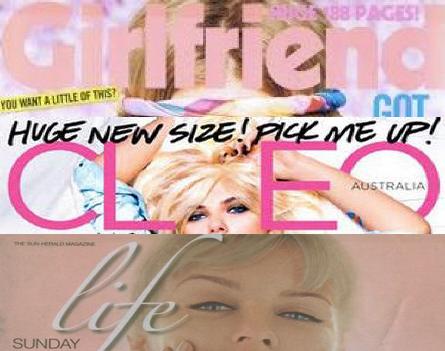
Sometimes I look back at some of my favourite editions of magazines like Girlfriend and Cosmopolitan and think, they’re not what they used to be.

Don’t get me wrong, they’re still great mags changing the glossy face of Australia, what with Girlfriend’s Girlfriend of the Year, Think. Do. Be. Positive and I Delete Bullies and Cosmo’s Body Love campaigns.

My favourite issue ever of Girlfriend (and at almost 23, should I even be reading this magazine anymore?!) was back in November 2007, with Indiana Evans fronting the mag.

And, while I will always be a Cosmo girl, I’m struggling to get as excited about the mag as I was when I first started reading it seven years ago. I was lucky enough to get a taste of Mia Freedman’s editorial skills before she left the mag soon after, and have been a sucker for her ever since.

Only now am I starting to put the pieces of the puzzle together as to why Girlfriend, in particular, meant so much to me during that time.

Erica Bartle, creator of Girl with a Satchel and former Girlfriend staffer herself (more on that in a minute), recently blogged about current Cleo editor Sarah Oakes’ resignation and subsequent appointment as Sunday Life (Fairfax’s Sunday newspaper supplement) editor, and thank God she did!

I am now able to prepare myself to love Cleo a little less, and Sunday Life a little more. Much like falling out of love with Girlfriend around the time Oakes left, and falling fast for Cleo, especially following its recent redesign.

For my money, Oakes is the next Freedman, and I will buy anything she puts her name to.

I became familiar with her whilst she was editing the teen mag, which I began to read again at about age 18. Admittedly, I was out of the mag’s target audience age range, but the left-of-centre features, quirky crafts and “Click It” pages exposed me to a whole new internet world, comprising of Etsy stores, Gossip Girl fashions, creative projects and so much more.

Back when I was pursuing my magazine dreams, Girlfriend was a mag I wanted to internand eventually be paid to workat.

Then Oakes moved over to Cleo, and I immediately felt the shift in the quality of the content. Cleo used to be a magazine I felt I’d wasted my money on after purchasing, but it slowly surpassed all other magazines on my must-have list. I’ll be sad to see her leave, but glad that I now get my Sarah fix weekly, and for free! (Well, at the low $2 price of The Age.)

It’s no secret that the aforementioned Girl with a Satchel is a blog I frequent regularly; a blog that I have written for, and a blog that inspired me to start my own.

I think Bartle is a clever, self-deprecating and an “everywoman” writer, perhaps in the vein of Oakes and Freedman. Considering Bartle worked on Girlfriend during Oakes’ editorship, it’s hardly a surprise. (As I said, I have a soft spot for the “Click It” pages, which Bartle was responsible for compiling.) She has a knack for making the reader feel like they’re besties, or BFFs, or whatever it is the cool kids call it, and although I would merely call us sometime-collaborators/fellow bloggers, I sometimes wish we were.

Its no surprise the magazine world is a small, incestuous little family, and the same names usually pop up all over the place, from ACP to Pacific, and now, to the blogosphere. (As Bartle writes, Cosmo features editor Caelia Corse is now heading over to Women’s Health, which is edited by fellow former Cosmo girl, Felicity Harley nee Percival.) And I think it’s safe to say that the output of quality writers that readers can relate to may be due to the nurturing and mentorship of some great editors; in addition to the Oakes-Bartle dynamic, Lisa Wilkinson was the editor of Cleo when Freedman got her break, who then went on to mentor Harley and Freedman’s successor Sarah Wilson at Cosmo, and Wilson’s successor, current Cosmo editor Bronwyn McCahon. Phew!

As much as many people who write-off the magazine industry as fashion, beauty, diet and pop culture poppycock (many of my friends do, but they read this blog anyway ’cause they love me!), there’s no denying that it does attract many of Australia’s best female (and male) writers, and with the help of the seasoned and talented editors who’ve come before them, there’s certainly a bloodline of glossy (and bloggy, and newspapery) flair that is being secreted by the Australian magazine industry.