Book Review: The Misogyny Factor by Anne Summers.

anne summers misogyny factor

“Misogyny” seems to be the word on everyone’s lips after newly ousted former PM Julia Gillard’s famous parliamentary lambasting of Tony Abbott last October. It was certainly on Anne Summers’ when she spoke at the University of Newcastle in August last year about the then-Prime Minister’s rights at work and how, “… if she were an ordinary worker, she would have a case for sex discrimination and sexual harassment.”

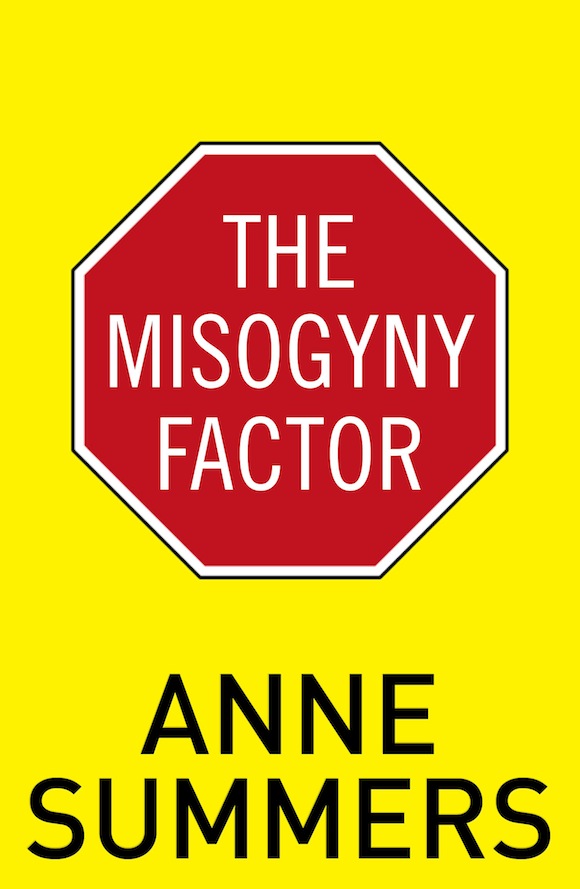
That quote appears on page five of Summers’ recently released The Misogyny Factor, born out of the above two speeches.

Gillard was quick to be criticised for intimating that Abbott is a misogynist; after all, how can you be a misogynist if you’re happily married and have three daughters? (That line of thinking was employed in a recent Facebook debate I had with a friend over Robin Thicke’s hit, “Blurred Lines”.) While the dictionary definition of misogyny is hatred of women, Summers explains the reasoning behind calling her book The Misogyny Factor:

“… [T]he misogyny factor is that set of attitudes and entrenched practices that are embedded in most of our major institutions (business, politics, the military, the media, the church, academia) that stand in the way of women being included, treated equally and accorded respect… I am not sidetracked by strict dictionary definitions of ‘misogyny’. Sure, it can mean, ‘hatred of women’ and we still see far too many instances of that. But it is more complicated and far more widespread than the prejudices of individuals, which is why I use the term ‘the misogyny factor’… I am talking about systemic beliefs and behaviour, which are predicated on the view that women do not have the fundamental right to be part of society beyond the home… Such views can be, and are, held by women as well as men… Why they defend misogyny is mystifying, yet plenty of women do.” [p. 7–8]

Essentially, “sexism goes hand in hand with misogyny. Sexism provides the rationale for misogyny.” [p. 8]

There is sexism and misogyny to be found almost everywhere you look, but The Misogyny Factor primarily focuses on the realms of politics and the economy. For example, we’re all (well, those who have a vested interest in the pay gap and who don’t buy into the misguided notion that we now have gender equality. If anything, we’ve regressed, and Summers addresses this specifically in the book, too.) familiar with the fact that a post-graduate degree-holding woman entering the workforce today will earn $2.49 million over her working lifetime, while her male counterpart earns $3.78 million [p 53–54]. For being a “young woman in Australia today,” “there is at least a million dollar penalty.” [p. 54]

And for those women who do manage to crack the glass ceiling and rise to the upper echelons of the corporate world, they mustn’t show an ounce of femininity lest they be deemed “too emotional” for the job:

“If women brought onto boards are expected to behave like men, what is the benefit of their presence? It is the worst of all possible worlds: the company is denied the different perspective women directors might bring to its governance…” (emphasis mine) [p. 89]

I’m glad Summers was sure to include “might”, as without it she might as well be buying into the very idea she’s trying to debunk: the belief that women are so inherently different from men that they can’t possibly execute jobs traditionally held by the opposite sex, or if they are granted employment in them, they’ll do a vastly different performance than the menz. They’ll “destroy the joint”, if you will.

Speaking of Destroy the Joint, the feminist social media movement, and now a book, born out of Alan Jones’s comments that female politicians and business leaders were “destroying the joint”, Summers explains:

“[Alan] Jones’s intended insult, that women were ‘destroying the joint’, was turned on its head. It wasn’t the first time that women had transformed what was intended to be a belittling comment into a triumphant battle cry. In 1905 the Daily Mail newspaper in Britain ridiculed the suffragists— those, mostly women, who were fighting to get the vote for women, by calling them ‘suffragettes’. The more radical of the suffragists embraced the term. They started using it with pride to describe themselves, and to differentiate themselves as radicals from those who used more moderate tactics. They created a publication, The Suffragette. More than a century later in another country, Australian women also took the disparagement and created the modern-day equivalent of a campaign newspaper, the Facebook page and the Twitter handle @JointDestroyer. Yes, that’s right, women responded. We are going to destroy the joint. We utterly reject a joint whose sexism and misogyny is so ingrained that far too many people see it as perfectly normal behaviour. We will no longer tolerate a joint that systematically excludes women from its ranks, that insults us as a matter of course when we stand up for ourselves, a joint that sees something wrong with spending money to stop violence against women. If that’s what the joint is, we don’t want it.” [p. 139]

The modern-day equivalent of the suffragettes? SlutWalkers and Joint Destroyers.

Some feminists have expressed concern that these movements are too radical and scare off more moderate feminists from the cause. When you look at the fact that “… In 2012… 21 per cent of people in Australia has been sexually harassed since the age of 15, a slight increase the previous report in 2008 (20%) and that a majority (68%) of those people were harassed in the workplace… [and] most of these were women.” [p. 97], it becomes pretty clear why we need such “radical” movements. Personally, I’ve been sexually harassed too many times to count, and a handful or two in the workplace. I need SlutWalk and Destroy the Joint.

Many of these grassroots campaigns occur online, to match the spate of online abuse women on the internet receive. I just received my first rape/death threat for views expressed (about To Kill a Mockingbird, no less!) on this blog: I can now officially call myself a feminist blogger. But when Kickstarter sees nary a problem with raising funds for a sexual assault manual, Twitter is used as a forum to berate women who don’t fit the mould, and Facebook bans breastfeeding photos but keeps rape memes and pages, misogyny is plain for all to see online. For example, former political cartoonist for The Australian, Larry Pickering, who most recently depicted Julia Gillard with a big black dildo, a strap on slung over her shoulder (“It seems that Pickering cannot envisage a Prime Minister without a penis—so he has to five Gillard a strap-on” [p. 125], Summers notes) and animations of the former PM topless, had the latter deleted by Facebook but the strap-on images were allowed to stay. Seems like Facebook has a women (or just female breast-) problem…

It’s not just online, as the sound bites from fellow politicians and menus from Liberal fundraisers will attest, that Gillard experiences sexual harassment. “It says something about our country and about us that we could subject our leader to such vile abuse” [p. 130], Summers writes. Look at the U.S.: while they arguably have more problems with misogyny than we do, at least the Office of the President is viewed with respect, regardless of the figurehead who occupies it.

Still with Gillard, “Can it really be the case that a tax—a carbon tax—could really spur so many people to such levels of hatred? I find that impossible to believe, so I have had to conclude that the persecution of Julia Gillard has to be about something else. Is it just the simple fact that she is a woman?” (p. 130-131)

In the fallout from Gillard’s ousting, and the subsequent gendered abuse I heard and saw thrown her way in the media and on Facebook and Twitter (which lead me to unfriend certain long-time-coming people), unfortunately I think Summers is right. The misogyny factor is alive and well in Australia.

If you’re after some similar content from Summers, check out her recent Emily’s List oration and this Meanjin piece.

Related: Ain’t Nothin’ Gonna Break My Slutty Stride.

Event: Midsumma Festival & Women Say Something’s Should We Destroy the Joint?

Elsewhere: [Do Something] CEO of Kickstarter: Refuse to Fund How-To Guide on Sexual Assault.

[Jezebel] If Comedy Has No Lady Problem, Why Am I Getting So Many Rape Threats?

[HuffPo] Breastfeeding Photos on Facebook Removed From “Respect the Breast” Page.

[Gawker] Facebook Removes Pro-Rape Pages, Kicking & Screaming.

[Anne Summers] Emily’s List Oration 2013.

[Meanjin] The Sexual Politics of Power.

Image via New South Books.

Book Review: Night Games by Anna Krien.

anna krien night games

Everywhere you look lately, there seems to be a promo for Anna Krien’s latest investigative tome, Night Games, and rightly so: it’s a fantastic, impeccably researched and hard-hitting look at misogyny and power in football. I might be a little biased having a vested interested in the topic and, as I told Krien when I got my copy signed at the Readings Carlton book launch last week, the rape statistics she rattled off in an excerpt reading at the event, unfortunately they’re nothing I haven’t heard before.

Having said that, though, Night Games is an absorbing read for those well versed in the misogynistic nature of “jock culture” as well as for those new to the topic. Krien makes sure not to alienate sports fans who may be wary of picking up the book:

“This book is not anti-sport. ‘”Jock culture” is a distortion of sports,’ the American author and sports journalist Robert Lipsyte once noted, warning that America was in danger of finding its values in the locker room. It’s not the game, the pleasure of the play, that’s dangerous. It’s the piss stains in the grass, the markings of men who use sport as power and the people—teammates, fans, coaches, clubs, doctors, police, journalists, groupies—who let them do whatever they want.” [p. 266]

However, “football is an abnormal society” [p. 70], and nothing reflects that more than the bulk of the book, which deals with “regrettable sex” [p. 73] or rape accusations, depending on who you ask, against AFL and NRL players; “Camel Nights”, in which players bring two women they don’t care for so “everyone gets a hump” [p. 71]; and that infamous Cronulla Sharks group-sex scandal from 2002 that came to light in a 2009 Four Corners exposé, amongst many other examples.

Speaking of Matthew Johns and Cronulla, Krien quotes an anonymous player who laments the stigma of group sex bonding sessions:

“It’s like saying you can’t be homosexual, or you can’t have such-and-such sexual preferences. How can he tell us what to do in our private lives?… We already have so many rules; we can’t drink on these days, we can’t go to these places, now we can’t have group sex. About the only thing we can do these days is go to club functions and just hang around with other players. That’s just isolating us more from the rest of the world, and it could lead to even more violent acts.” [p. 46]

While it’s easy to scoff at these privileged footballer comments, he does make a valid point. It’s kind of like the argument against restricting dangerous dog breeds: the more you isolate a pit bull, for example, the more likely it is to be aggressive to other dogs and humans when it does come into contact with them.

Oftentimes, the difference between a rape allegation and the aforementioned “regrettable sex” is treating a woman well. You know, like a human being:

“‘It’s not during the act, it’s the way you treat them after it. Most of them could have been avoided if they’d have put them in a cab and said, you know, thanks for that, sort of thing, not just kicked her out, call her a dirty whatever, that sort of thing. It’s how you treat them afterwards that can cover a lot of that sort of stuff up.” [p. 183]

But what Krien makes the reader understand is that groupie sex with a footballer is not about the woman, it’s about them:

“A footballer does not look at another human when he fucks a groupie. He’s looking at his glorified reflection—and when he performs, he’s doing it for ‘the boys’, not her.” [p. 200]

And:

“[Sam Newman] said it [the hazing of sports writer Caroline Wilson on The Footy Show] was a compliment of sorts, a sign that the Footy Show culture ‘accepted’ her. In other words, it wasn’t really about Wilson, it was about them. About a subculture of men trying to find a place—albeit a very lowly place—in their world for a woman. Considering that it’s all about the boys, they prey doesn’t even need to be present.” P. 72.

Going back to the group sex-as-bonding scenario, it makes sense that the woman/women would be used as a vessel to bring the teammates closer together. And further to the absence of a woman, we can see this in the social media shaming of the Steubenville victim, for example. The whole team—and, by extension, the town—we’re brought closer together by reliving the girl’s assault on YouTube and Twitter.

Obviously this is one of the more extreme and brutal examples of sexual assault in sport, but Night Games also talks about the “gulf of uncertainty between consent and rape” [p. 73] and the many sexual experiences that occur therein. Krien also comes across as sympathetic to the “… ongoing education about how to negotiate sexual encounters in a way which ensures informed consent is always obtained” [p. 47] amongst the codes, but there’s still a long way to go, baby. This is exemplified by an educational male-on-male rape video that is shown during a training session. Many of the players are noticeably upset, with one lamenting that “You don’t really ask for trouble if you have too much to drink and get raped by a bloke. You don’t ask for that.” I’ll just let the double standards marinate for a bit after you consider that the video shown prior to this was one of mistaken identity male-on-female rape to which the players were less than sympathetic. [p. 188–189]

The abovementioned “grey zone” that exists between the sexes “to explain what was lost in translation” [p. 259] takes the form of the rape trial of Justin Dyer (name changed), an amateur footballer accused of raping Sarah Wesley (also not her real name) the night Collingwood won the 2010 grand final rematch. Many of the reviews of Night Games seem to focus heavily on this “he said, she said”, but Krien expressed relief when facilitator of the Readings event, Sophie Cunningham, skirted that issue. While the trial beautifully bookends all the points Krien makes about the treatment of women in male team sports, it’s not the be all and end all of Night Games. Similarly, though Sarah declined to be interviewed by Krien, thus leaving “all those little erased bits, I thought, hovering around like question marks” [p. 245], I don’t think it does the book detriment. In fact, I can’t envisage how Night Games could get any better.

Related: In Defence of Mia Freedman.

Elsewhere: [The Vine] All Dogs Go to Seven.

This review has been submitted to The Australian Women Writers Challenge as part of their 2013 Challenge.

Image via Kill Your Darlings.

Book Review: Vagina—A New Biography by Naomi Wolf.

an-Vagina-20a-20new-20biography-20by-20Naomi-20Wolf-20120914122340310908-300x0

The title of Naomi Wolf’s latest, Vagina: A New Biography, promised great things, to my mind. I envisioned the book taking aim at the stigma, use and abuse of the female sex organ throughout history, both physically and ideologically, and why we still think of it as ugly, dirty, alien and taboo.

Vagina certainly analyses this for the bulk of the middle part of the book, talking about the actual chastity belt (p. 143) and the “similarly constructed device” called a “scold’s bridle”, “made of iron and leather, locked around a talkative or argumentative woman’s head” to “gag her mouth” (p. 144). Here, we see that the vagina has been a metaphor for the female voice, insinuating that headstrong and opinionated women are also “loose” women. Wolf goes on to mention William Shakespeare’s Titus Andronicus and the heroine “Lavinia’s mouth and vagina are both assaulted in repeated acts of silencing and control” (p. 144). When it comes to sexual assault, it seems not much has changed, then.

Wolf also touches on hysteria, which literally derives its meaning from the Greek word for uterus, hystera, but for the most part, Vagina is an excruciatingly heternormative and cisgendered look at what it means to be a woman. Wolf may claim that erotic literature such as 50 Shades of Grey portrays women as having “no existence separate from her vagina” (p. 178), but Vagina essentially makes the same statement: if you’re not having vaginal orgasms (presumably via the penetrative properties of a real, live penis!) and your “Goddess Array” (the things a woman needs to experience her best lovemaking: foreplay, respect, help around the house, understanding. On a side note, the nod to the “Inner Goddess” really is just like 50 Shades!) stimulated, you’re just not a real woman.

For example,

“… [I]t comes as no surprise, then, to discover that many women find that vibrators alone or masturbation alone do not do exactly what lovemaking does for them emotionally” (p. 74)

and

 “This ideology [women don’t need men] does nothing to help women of any sexuality understand why, often, the vibrator and a pint of Häagen-Dazs are pleasurable but that other longings for connections can remain strong” (p. 75).

Ladies without access to a peen, you’re out of luck: vibrators, ice cream and a rom-com won’t cut it. ’Cause isn’t that what all miserable single women resort to in between boyfriends?

Going back to loud mouth=loose vagina, it would seem the reverse is also true, as an uptight vagina also begets an outspoken woman:

“Straight men would do well to ask themselves: ‘Do I want to be married to a Goddess—or a bitch?’ Unfortunately, there is not, physiologically, much middle ground available for women. Either they are extremely well treated sexually, or, if solo, treat themselves well sexually—or else they are at risk of becoming physically uncomfortable and emotionally irritable” (p. 301).

We just can’t win.

Wolf also talks about the sympathetic and automatic nervous system and how stress contributes to unsatisfactory sex lives:

“Marital counsellors tell women and men to talk through their problems; fertility doctors send men into rooms to masturbate and then they inject the semen themselves into the vaginas of women who are suffering from irregular periods or with low fertility levels. Again, if you understand the profound nature of the animality of women, you see that these practices are incomplete. Marital counsellors should start by telling men to hug women; to stroke if the women are open to that; to take women, if they are willing, ballroom dancing. Fertility specialists should make sure, before anything else, that women are getting well and regularly cuddled and brought to orgasm by their men” (p. 314).

Coming from someone who insinuated that the women who accused Julian Assange of rape were “honey trapping” him, this sounds awfully like a “legitimate rape” apology…

Because we’re such paranoid creatures obsessed with talking our feelings out, “[t]his, I believe, is why so many marital fights take place just when both members of the couple have entered the house after a day’s work—her brain is agitated and desperate to talk things through, which is how it calms down and feels better, while his is desperate to have some downtime doing nothing, or in front of the TV, which is how his brain calms down and feels better” (p. 319). I don’t know about the rest of you ladies, but my brain tends to work the opposite of how Wolf says it should: after a particularly mentally grueling day, I need to veg out in front of the TV and speak to no one. Kind of like Carrie feels when Aiden moves in with her in that episode of Sex & the City.

But maybe us modern, Western women are just living with too many distractions in our lives that prevent us from connecting with our partners, our “Goddess Arrays” and whatever else Wolf thinks we’re lacking. Maybe we’d be better off in the Third World?

“In virtually every culture outside the West, many women spend some time, usually on a daily basis, only with other women (and children)… While women in these societies face immense hurdles and inequities, they often seem to be much less irritated with the men they live with than women tend to be in the West. (I am not addressing here physical abuse.) The burden is not on the husband to somehow, heroically, alone, fill that deep neural need for talk, which his brain chemistry makes difficult to impossible” (p. 320).

Speaking of the Third World, women often give birth at home there (through lack of access to medical practitioners, not necessarily by choice), and hardly anything goes wrong *cue sarcasm*!

“A low-stress environment of soft lighting, soothing music, caring attendants, and the loving presence of family, all actually helped the female body birth a baby, and then feed a newborn, successfully, in clinically measurable ways. Many studies also confirm that stressful hospital birthing environments, in which women in labour are hooked up to intravenous devices, or to fetal monitors that consistently shows false-positive ‘fetal distress’, causes so much ‘bad stress’ in the mother that the stress itself biologically—not just psychologically—arrests labour contractions and inhibits lactation” (p. 34).

Not all Wolf’s points are ignorant ones: she does talk about porn use and modern relationships, scientific studies about the Pill and how it affects the way women physically respond to their significant others and, as I said above, the parts where Wolf discusses the vagina throughout history are quite informative.

However, I kind of wish she had’ve continued the vagina’s “biography” throughout the rest of the book, instead of harping on about her own experience with her retarded pelvic nerve, the luxury operation she underwent to correct it, and that a vagina that’s getting a lot of penetrative action resulting in vaginal orgasms makes for a more creatively fulfilled owner.

Related: 50 Shades of Grey by E.L. James Review.

Image via The Age.

Book Review: Marilyn—The Passion & the Paradox by Lois Banner.

marilyn-the-passion-and-the-paradox-by-lois-banner

Marilyn Monroe as feminist icon? Who knew?

The best-known sex symbol of the 20th century (’cause we all know Beyonce’s got dibs on this century) is easily dismissed as just that, but as Lois Banner’s heftily researched tome on the woman born Norma Jeane Mortensen will attest, Monroe had some radical views for her time, embracing the ideals of the Communist movement, endeavouring to expand her mind even though Hollywood would rather her stick to her dumb blonde schtick, and engaging in activities unbecoming for a woman of her time. Banner is sure that had Monroe lived long enough, she would have been a keen supporter of the feminist movement.

Personally, I have always been an advocate of Monroe as feminist, refusing to take on my mother’s, amongst many others’, dislike of her for her bombshell image. As Banner maps out Monroe’s family history, her life as a sexually abused orphan, her first marriage at 16 to Jim Dougherty, her early days in Hollywood and the way she crafted herself into a star, the reader sees Monroe not as the ditzy Lorelei Lee from Gentlemen Prefer Blondes like so many others did, but as a gifted actress merely playing up to one of the many archetypes (sexy “Marilyn”, comedienne “Lorelei” and the glamourous star of later years [from p. 237]) she was perceived as when it was called for: there was much more to Marilyn Monroe than meets the eye, as is detailed in The Passion & the Paradox.

By interviewing a myriad of sources, some of which only fellow feminist biographer of Monroe, Gloria Steinem, had interviewed before, Banner debunks some common myths about Monroe, including those surrounding her death. By doing so, she delves much further into Marilyn Monroe’s psyche than any other book about her I’ve read.

I’m probably a bit biased, as Banner pretty much reinforces ideas about her that I already held, but if you’re only going to pick up one publication on Marilyn Monroe, let it be this refreshingly modern take on her as a person, not a sexual object.

Image via These Little Words.

Books: Marilyn Monroe as Manic Pixie Dream Girl?

Marilyn-Monroe---Glasses

As with yesterday’s post, this comes from Gloria Steinem’s Outrageous Acts & Everyday Rebellions in an article entitled “Marilyn Monroe: The Woman Who Died Too Soon”:

“[Marilyn Monroe disliked] to be interpreted by them [her male admirers] in writing because she feared that sexual competition made women dislike her… In films, photographs, and books, even after her death as well as before, she has been mainly seen through men’s eyes.”

Just like our favourite Manic Pixie Dream Girls Holly Golightly, Ruby Sparks, Annie Hall, and Zooey Deschanel.

Related: Procrastination Proclamation.

Posts Tagged “Ruby Sparks”.

Manic Pixie Dream Girly Girls & Not-So-Girly Girls.

Image via Discount Poster Sale.

Procrastination Proclamation.

From Outrageous Acts & Everyday Rebellions by Gloria Steinem:

“Writers are notorious for using any reason to keep from working: over-researching, retyping, going to meetings, waxing the floors—anything. Organising, fundraising and working for Ms. magazine have given me much better excuses than those, and I’ve used them. As Jimmy Breslin said when he ran a symbolic campaign for a political office he didn’t want, ‘Anything that isn’t writing is easy.’ Looking back at an article I published in 1965, even when I was writing full-time and in love with my profession, I see, ‘I don’t like to write. I like to have written.'”

I don’t want to make excuses for why The Scarlett Woman has been low on content lately, but if Gloria Steinem says it…

Book Review: Gone Girl by Gillian Flynn.

For the last few months, literary circles and feminist blogs have been raving about Gillian Flynn’s latest mystery, Gone Girl. I recommended it to a friend after reading a favourable review of the book, and it’s been sitting on my pile of “to read” tomes since she finished it.

With all the abductions of young, pretty women of late (Jill Meagher, Sarah Cafferkey), Flynn hits what we want to read on the head, both figuratively and literally speaking.

Gone Girl deals with the disappearance of a thirty-something wife in Missouri and the husband is the prime suspect amid marriage and money troubles. One chapter is written from the point of view of the disappeared Amy, the titular character of her parents’ iconic series of child psychology books several decades ago and all around “cool girl”, while the next is written by the husband-in-question, Nick Dunne, and so on and so forth.

There’s not much more I can say without giving away the myriad twists and turns up until the last third of the book, when the mystery seems to stall and the ending lacks the lustre of the rest of Gone Girl.

In the acknowledgements at the end of the story, Flynn thanks her editor for pushing her to move beyond being “82.6 per cent done” forever, and I have to say that doesn’t surprise me. The rest of the book is so well crafted, both from a plot and character point of view, that it seems like Flynn couldn’t figure out how to end the story or just rushed through it in order to meet deadline.

It’s disappointing because Gone Girl really had me thinking about the acts women put on and how sometimes we never realise who we truly are and what we want; how men see women; and whether the book was a feminist or anti-feminist one.

While some of the language used by Nick denoted a deep-down hatred of women despite his best efforts to be a “good man”, unlike his father, and Amy’s slut-shaming, rape-crying, graphic descriptions of sex and violence and her obsession with revenge questions whether victims are completely blameless, I think Flynn ultimately painted a picture of just how ugly humanity can sometimes be.

There’s a difference between writing misogyny for misogyny’s sake and pointing out that misogyny exists and is as insidious in fiction as it is in the real world, and that’s what Gone Girl gets right.

Related: Sexual Assault, Moral Panic & Jill Meagher.

Image via Good Reads.

Book Review: 50 Shades of Grey by EL James.

The title of this post is something I never thought I’d write. Ever since the 50 Shades phenomenon hit the mainstream, however many subsequent BDSM and erotica-filled pop cultural months ago that was, I vowed to never let EL James’ literary abomination come between me and an actual good read. However, after hearing the anti-feminist and abusive relationship aspects of the trilogy in blog post after book review after writers festival talk, I finally succumbed to the pull of Christian Grey and swallowed my pride. (It must be noted that I am coming at 50 Shades from a critical and research perspective. It must also be noted that having finished with the first instalment, I will not be returning to the Red Room of Pain.)

Firstly, let me start by saying that I had very low expectations for 50 Shades, and while I won’t go as far to say it’s not as bad as I thought it was going to be, I will say that the writing is not as bad as I thought it would be (using its inspiration, Twilight, as a benchmark). However, I still found the book deeply problematic.

There’s Christian’s obsession with making Anastasia eat, which is included in the contract she must sign upon entering into a sexual, submissive relationship with him. (Conveniently, at the end of the first book she has yet to sign it.) Also included is the wearing of clothes provided by Christian, the requirement of eight (begrudgingly downgraded to seven at Anastasia’s request) hours sleep a night, refraining from physical endangerment with regard for safety (New Moon!) and the way Anastasia must conduct herself in the company of Christian, and others.

It must be noted that I’m not opposed to submissive sexual relationships. They’re not for me personally, but I don’t find a problem with them in general. I’m under the impression that most of these relationships focus on dominance and submission in the bedroom, whilst out of it the participants go about their daily life in relative equality (correct me if I’m wrong). Certainly, there are a myriad of sexual relationships out there, and some of them do take the form of Christian and Anastasia’s. But they are not the subject matter of the highest selling book in the world; one that’s sold in supermarkets next to the celery, no less.

What I find most troubling about the worldwide embrace of James’ “clit lit” is that it’s completely archaic and conservative, for all the sex-positivity it claims (or champions of it claim) to spout. For example, it holds up the notion that bad boys can be tamed. Despite Christian’s repeated pleas early on in the book that “You should steer clear of me… I’m not the man for you… I’m not a hearts and flowers kind of guy… I don’t make love, I fuck,” the catch-cries of commitment phobes everywhere looking for quick, easy sex without attachment, Anastasia still thinks that if she just did more of this or less of that, he would love her:

… He needs to walk before he can run… You are making him mad—think about all that’s [sic] he’s said, all he’s conceded… I need to be able to show him affection—then perhaps he can reciprocate. [Original emphasis]”

Somewhere in the midst of the trilogy (apparently it’s not at the climax, as writer Susan Johnson revealed at the Melbourne Writers Festival a couple of weeks ago), Christian marries Anastasia (note how I—and many others who’ve written and spoken about the book—referred to the union not as “they get married” but as “he married her”, insinuating that marriage is something that happens to Anastasia, like pretty well everything else in the book. For someone who’s the central protagonist and first person narrator of this sordid love affair, she actually has no autonomy over her own story), demonstrating to millions of impressionable young (and no so young) women and any men out there reading it that you can change a bad boy!

But Christian’s not just your average bad boy. He’s a filthy rich, disarmingly handsome (James, living vicariously through Anastasia, never fails to mention this as if it’s his only redeeming quality—who am I kidding? It kinda is—and all red blooded humans of the XX chromosome persuasion fall weak at the knees in his glorious presence), “control freak with stalker tendencies”: yep, sounding more and more like Edward Cullen with every adjective. In essence, he is an abusive partner. As mentioned above, he tries to control Anastasia’s eating, sleeping, sex- and friend-having, and pretty well everything else in her life. After a fight, he barges, uninvited, into her apartment she shares with a friend, who tells him to get out and that he’s not welcome there. He persists and spends the night with Anastasia, something he has previously said he will “never do”. He finds out which flight she’s on to Atlanta, where she’s going to visit her mother and escape him, and changes her seat to first class. Later, he turns up at the hotel Anastasia and her mother are dining at. He expresses jealousy and anger when Anastasia hangs out with her male friend Jose who, incidentally, tried to sexually assault her. He buys her a new phone, laptop, car and clothes. He likes her plied with alcohol because she’s more open with her emotions in an inebriated state. She is not allowed to masturbate (not that she does that anyway. It’s icky in 50 Shades’ world), because he “want[s] all your pleasure”.  Anastasia cannot touch or look Christian in the eyes when they’re having sex. If she does, he will discipline her. That last one isn’t inherently damaging, but the fact that Anastasia herself refers to the physical debasement that occurs in Christian’s playroom/Red Room of Pain as a “beating” and him “hitting” her shows that she’s definitely not into it, and that’s what makes the sex problematic.

Anastasia is scared of Christian. She often tells him, “I’m sorry… Please don’t be angry/Please don’t hit me,” the hallmark of a battered spouse. At the end of book one, when he pushes her physical limits too far and she makes the decision to leave him, she tells him it’s her fault: “I asked for it.” “I’m a complete failure. I had hoped to drag my Fifty Shades into the light, but it’s proved a task beyond my meagre abilities,” she laments. From an abuser’s point of view, he’s got her right where he wants her. Anastasia lacks self-confidence to begin with, and often expresses disbelief that someone like him could want someone like her. She defends him to his detractors (namely the abovementioned roommate), shouting subconsciously, “I KNOW WHAT HE’S REALLY LIKE—YOU DONT!” After a fight, he makes puppy dog eyes at her or some such thing and she melts: “How can I resist him when he’s like this [emphasis mine]?” Her “innocence” and “naivety” which Christian loves so much blind her to the fact that this is a classic abusive relationship: as someone who grew up amongst one, I can vouch for it.

When it comes to Anastasia as the protagonist, her incessant whining about her “inner goddess” versus her “subconscious” is infuriating. While it makes for consistency in terms of character traits, it certainly doesn’t make her any more likeable. Her conservative personality (Anastasia’s literary heroines are all submissives—Tess Durbeyfield and Jane Austen’s female characters—not to mention her reaction to Christian having paid for sex in the past. So being shackled and whipped semi-unwillingly is fine, but prostitution isn’t? Perhaps it hints at Anastasia’s deep-seated  discomfort at having Christian buy her things as part of their contract), however, makes it less likely that she would so willingly enter into a contractual agreement to be Christian’s sex slave, essentially. Oh, but then there’s that “innocence” again…

And the sex. Don’t even get me started on the sex. Author John Flaus mentioned at the Bendigo Writers Festival last month that he thought the sex scenes were really “clinical” and written from an “outsider’s” perspective. Like a lot of sex scenes I’ve read and seen before, though never in real life, the virgin experiences orgasm her first time. She also comes quickly and without fail during each instance of vaginally penetrative sex, a highly unlikely occurrence, and when her clitoris is whipped with a riding crop. I don’t know about you, but that doesn’t connote the most warm and fuzzy feelings down there. (Oh, and “down there” and “sex” instead of vagina, vulva and clitoris, the latter of which is only mentioned once or twice, are repetitive, conservative euphemisms that are littered throughout.) Further to the dominance Christian seeks to exert over Anastasia, he repeatedly demands her to “sit still” when he performs sex acts on her. I, for one, don’t know many men who prefer a woman to be unresponsive to his touch, but then this book isn’t exactly based on reality. Despite James being the (seemingly biological) mother of two children, it’s as though 50 Shades was written by someone who’s never had sex before.

One last thing I want to add before I attempt to erase the experience of 50 Shades of Grey from my memory is that I can kind of understand where James is coming from when she writes about the tumultuous, sometimes physically and emotionally painful relationship between Christian and Anastasia. I have fantasised about being emotionally hurt by a lover and having him come back and make it all better again. I have also felt the need to be overpowered by a man, in the seemingly simple, harmless way of pulling me to him in an embrace when I don’t want to be. In that sense I think she taps into a biological need (and I hate to buy into the notion that men and women are evolutionally different and that’s why one hunts and gathers while the other tends to the “heart and home”. Ugh.) to be physically (not necessarily sexually) loved. Like, as a child, when you fall down or mum yells at you and you just want her to hug you and make it all better again. I think it’s also important to note that just because a fantasy occurs in the mind, doesn’t mean it has, needs or wants to be acted out in reality: rape fantasy, for example. That is the one tiny, take-away titbit that warrants merit in 50 Shades, I think. The rest can be filed under the severely abusive, gender- and hetero-normative guidelines that so much of popular culture is today. 50 Shades of Grey as sexual liberation for women? My ass.      

Related: Bendigo Writers Festival.

Melbourne Writers Festival: Notes on Women in Culture.

Melbourne Writers Festival: Censorship, The Body & Porn.

Elsewhere: [Good Reads] Katrina Lumsden’s Review of 50 Shades of Grey.

Image via November Grey.

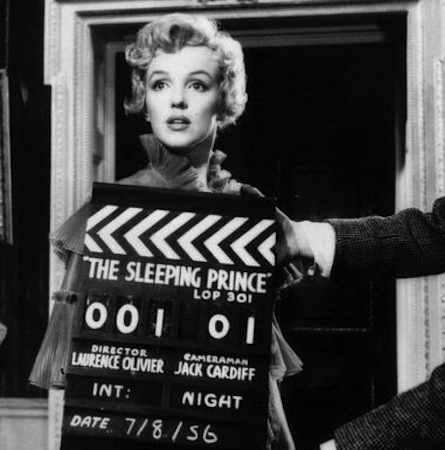
Books: Was This What Marilyn Monroe Was Really Thinking When She Was Filming The Prince & the Showgirl?

From Fragments: Poems, Intimate Notes, Letters by Marilyn Monroe edited by Stanley Buchthal & Bernard Comment:

“Fear of giving me the lines new

maybe won’t be able to learn them

maybe I’ll make mistakes

people will either think I’m no good or

laugh or belittle me or think I can’t act.

Women looked stern and critical—

unfriendly and cold in general

afraid director won’t think I’m any good.

remembering when I couldn’t do a god

damn thing.

then trying to build myself up with the

fact that I have done things right that

were even good and have had moments

that were excellent but the bad is heavier

to carry around and feel have no confidence

depressed mad”

According to archival information, this was actually written in 1951 while The Prince & the Showgirl was released in 1957. So perhaps these weren’t Marilyn’s exact thoughts during the filming of the movie that was the basis for this year’s My Week with Marilyn, but it just goes to show she was plagued by insecurities from the beginning.

Related: My Week with Marilyn Review.

Fragments of Marilyn Monroe’s Literary Life.

All Eyes on Marilyn.

Image via The Passionate Movie Goer.

Movie Review: The Hunger Games*.


Now, The Hunger Games is a lesson in how to do young adult with a female in the lead, Stephenie Meyer.

***

I was a bit apprehensive about buying into The Hunger Games hype but, as a blogger, I thought it imperative that I read the book and the see the movie to understand what all the hype was about and, at the very least, to get a blog post out of it. (That’s my reasoning for going to see American Pie: The Reunion next week, anyway!)

I’d read all the blog posts and cultural analyses of the film and book before I went to see it last Monday and finished it over this past weekend, respectively, so I had a pretty good idea of the storyline and the social commentary I’d be looking for. I don’t normally like to see the film version before I finish the original one (although my track record, with Twilight and, most recently, Water for Elephants and My Week with Marilyn, doesn’t bode well), but I actually found myself more immersed in The Hunger Games, as opposed to analysing each and every moment, when the film continued after where I’d reached in the book. (The pre-Hunger Games interviews, FYI.)

While the book is allegedly a commentary on the hell high school can be (like a post apocalyptic Buffy), I interpreted it more to be not only about capitalist life (the riches of the Capitol juxtaposed against the poverty and poor quality of life for the rest of Panem), but about advertising culture and the media.

The argument that seems to surround media today is that we should ban this, and censor that. Then we wouldn’t have eating disorders, negative stereotypes of women and minorities, obesity, gambling, domestic violence, blatant consumerism and pretty much anything else you can think of. Common sense would have us stop consuming the things we don’t feel align with our personal ethics. Don’t like the way animals are slaughtered in factory farms for our precious meat? Don’t eat it. Don’t like racism? Don’t be a racist. Don’t like leggings as pants? Don’t wear them. Don’t like children being chosen at random to fight to the death for the pleasure of the elite and the opportunity to make life a little more bearable for the underclass? Don’t watch it. If everyone adopted this attitude and no one watched, there wouldn’t be a product. As author Suzanne Collins notes her inspiration for the series as flicking television stations between war and reality TV, it’s not hard to come to this conclusion.

Despite the fact that no one really seems to be talking about the senseless mass murder of children by children (won’t somebody think of them?!), there is a point to “career tributes” like Cato and Glimmer, who are trained for the Hunger Games since birth.  As Laura Miller wrote in The New Yorker, “[W]hy isn’t it the poorer, hungrier districts that pool their resources to train Career Tributes, instead of the wealthier ones?”

I wasn’t as huge a fan as some others who’ve devoured the series in several sittings (I prefer to wait until the next filmic instalment is on the horizon to delve into the second book, as with Tomorrow, When the War Began, for example), but I did like it and look forward to seeing what the next two chapters bring; both book and film versions.

*Blanket spoiler alert.

Related: My Week with Marilyn Review.

Event: Should Meat Be Off the Menu?

Tomorrow, When the War Began by John Marsden Book/Movie Review.

Elsewhere: [The New Yorker] Fresh Hell.

Image via IMDb.