Event: Melbourne Writers’ Festival—Never, Ever, Again: Why Australian Abortion Law Needs Reform by Caroline de Costa Book Launch.

Last year’s Melbourne Writers’ Festival was pretty lackluster, and I didn’t attend any events.

This year, however, is jammed packed with hard-hitting seminars, news-related talks and all-day workshops. There are more events I’m interested in than there is money in my pocket.

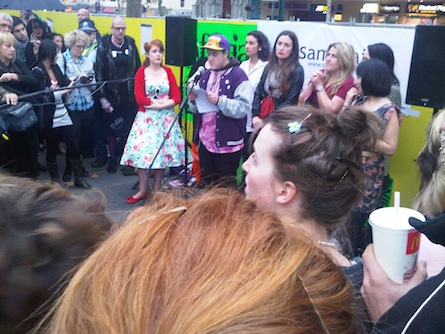
But to kick things off was a free, no-bookings-necessary book launch at ACMI’s The Cube on Friday afternoon for Caroline de Costa’s second edition of Never, Ever, Again: Why Australian Abortion Law Needs Reform (review to come in the next few weeks).

Honestly, I didn’t think I’d heard of de Costa before, and just saw the word “abortion” and knew I had to attend!

However, when the author began speaking about the abortion drug RU486, I remembered reading her work a few weeks ago on MamaMia, and featuring said article in “On the (Rest of the) Net”. It is an article I recommend checking out wholeheartedly.

In this article, De Costa asserts that we need to increase sex education and access to contraceptives in order to bring Australia’s high abortion rate down.

In de Costa’s address at the event, she said no woman enjoys having an abortion and that there’s “no such thing” as “pro-abortion”, an assertion that I don’t 100% agree with, but I do think it is a damaging label pro-lifers sometimes paint pro-choicers with.

Ultimately, de Costa says we “should be concerned about the health and safety of every pregnant woman” as opposed to the biologically dependent mass of “unwanted tissue” in her body.

The other speakers at the event—the MC whose name I didn’t catch, long-time pro-choicer Dr. Jo Wainer, former Minister for Women’s Affairs from 2007 to 2010, Maxine Morand, and Dr. Chris Bayly from the Royal Women’s Hospital—reiterated de Costa’s sentiments in her book, that the “hidden business that is women’s business” of abortion needs to be destigmatised and legalised in order to increase access to safe pregnancy terminations.

Finally, the revised edition of the book includes an extra chapter on the Queensland trial of Tegan Leach and Sergie Brennan, who were charged with procuring an illegal abortion in 2009 when they purchased the drug RU486.

Dr. Wainer noted that when Leach was on the stand being questioned as to why she felt the need to abort her baby, it was the “21st century equivalent of putting women in the stocks”. Or burning at the stake for her “crimes”, if you will.

It’s something that, as the book’s title suggests, should happen never, ever, again.

That’s why abortion law in Australia needs to be reformed.

Related: Grey’s Anatomy Final Asks “When Does Life Begin?”

Private Practice: Pro-Choice?

Elsewhere: [MamaMia] RU486, Sex Education & Contraception. That’s All We Need.

[MamaMia] The Couple Facing Jail Because They Tried to “Procure an Abortion”. Hello, Queensland? It’s 2010.

[Televisual] The Changing Economics of the TV Abortion.

Image via Melbourne Writers’ Festival.
Event: Identity—Yours, Mine, Ours at Immigration Museum.


It’s not often an exhibition is created based on racism in Australia.

Either we ignore it, or we sport t-shirts and bumper stickers saying “Fuck off, we’re full”.

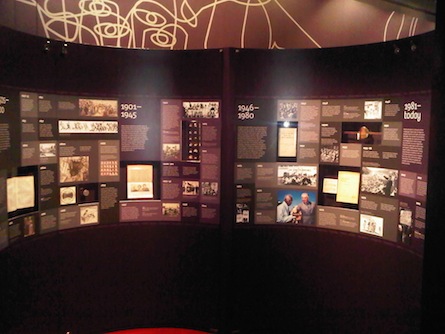
Well, a groundbreaking new exhibition at the Immigration Museum on Flinders Street has changed that, entitled Identity: Yours, Mine, Ours, part of general admission ($10 for adults, free for concession and children).

The first part of the exhibition deals with preconceived notions about people based on what they look like, what they wear, which cultural groups they (seemingly belong to), amongst other factors. While the exhibition has been designed with the utmost involvement with those who are featured in it (Kat Clarke, the Indigenous, hoodie-wearing teen poet and songwriter, for example), it’s the second half that really piqued my interest.

It begins with a simulated tram ride in which a white businessman hops on and expresses disdain and what can only be described as covert racism to an African man speaking in his native dialect on the phone.

There are then depictions of the abovementioned “Fuck off, we’re full” t-shirts, which leads into a timeline of racism and discrimination in Australia and around the world. There’s a lot of reading in this section, so my advice is to allow at least an hour and a half for the exhibition, and don’t take a heavy bag!

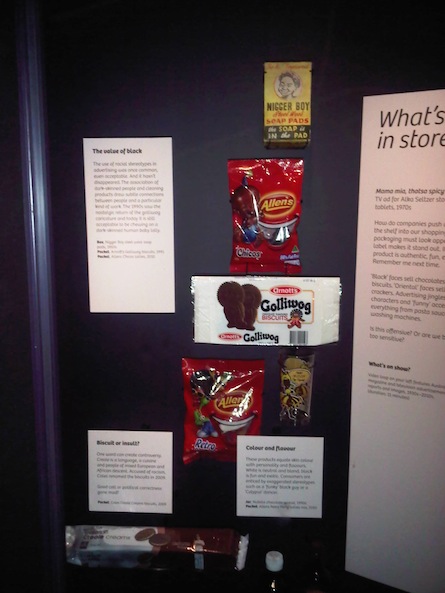
Towards the end there are displays of discriminatory and downright racist toys and food, such as golliwogs and Creole cream biscuits. Even Gwen Stefani’s range of L.A.M.B. perfumes are called into question! There are also videos of Pauline Hanson’s 1996 maiden speech and Kevin Rudd saying “sorry” to the Stolen Generations in February 2008.

A lot of complementary content can be found on the Identity website and blog.

I’m not sure how long it’s on for, but if you’ve got a spare $10 and a couple of hours, a visit is well worth it for the novel experience of an exhibition based on racism in Australia. In this day and age, it’s sad it is so novel…

Elsewhere: [Immigration Museum] Identity: Yours, Mine, Ours.

[Immigration Museum] Identity Blog.

Event: Rock of Ages Review.

The last few musicals I’ve been to I haven’t enjoyed. West Side Story, Hairspray… My friends keep telling me I need to stop comparing them to Wicked! Fair call.

So I went into Rock of Ages last Tuesday night with trepidation. I was looking forward to the music and the ’80s campy quality, but I wasn’t expecting a storyline and character development of Gregory Maguire proportions.

And I was right. While the music and the one liners are great, Lonny (to be played by Russell Brand in next year’s big screen adaptation), the chubby, mullet-sporting narrator, admits ten minutes into the production that they should “probably introduce a storyline” to keep the audience invested.

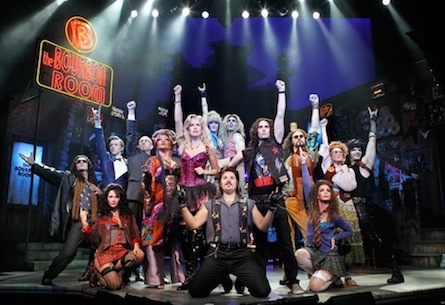
This is where Drew aka Wolfgang von Colt (played by Justin Burford), aspiring rock star and busboy at Dupree’s Bourbon Room on the Sunset Strip (a nod to The Viper Room, perhaps?), and Sherrie, a small town girl looking to make it big as an actress in Hollywood, come in.

While Sherrie is the most vapid character I’ve seen in a musical for a long time ever, her representation is typical of women in the male-dominated rock music industry at the time: just a piece of ass.

This is all mega rock star Stacee Jaxx sees her as, and acts accordingly. Jaxx seems to embody guys like Bret Michaels from Poison, Steven Tyler from Aerosmith and perhaps Jon Bon Jovi (but he just seems too nice!), as the quintessential egomaniac douchebag who forgets where he got his start (hello, Bourbon Room!). The role is a good one, and I can really see Tom Cruise excelling in it in the film version, however I thought Michael Falzon overplayed the role. If he’d just kicked in down a notch and acted like he took himself more seriously as the best front man to ever walk the earth, I think the character would have been more effective.

In fact, if the production itself employed this tactic, I would see nothing wrong with it.

But all in all, the costumes were fab, the majority of actors killed it, the set “broke down the fourth wall”, both literally and figuratively and, of course, the music was pure ’80s hair rock and power ballads.

It’s the best thing going in Melbourne at the moment and, since the last musical I saw at the Comedy Theatre, Avenue Q, for a while.

Image via Crikey.

Event: The Way We Wear Weekend.


On Saturday morning, after some technical difficulties (iPhone loss on the part of my friend, Linzie, and getting off at the wrong train stop!), we arrived at The Way We Wear’s bi-annual market at the Williamstown Town Hall.

This is the best—and only, after going to some other—lackluster—vintage fair(s) in Melbourne. Entry was $12 for adults, although we had some discount vouchers, so it made it an even $10 each. Upon entry, we got a program of the weekend’s festivities, a free voucher for Becky Sharp’s Vanity Fair Vintage Fashion Market in September, and an entry form to go into the draw to win some vintage loot.

Having been to The Way We Wear three times, the usual vendors were there again, with several more since the market started selling homewares this time around.

I ended up picking up a dainty green and cream animal print scarf and two bangles, while Linzie got a beetroot Tupperware container (images to come in Thursday’s “My Week in Pictures” post)!

I had beginners luck at my first market this time last year, but never again have I seen the same success. Nevertheless, I recommend the market to vintage lovers everywhere. Hell, clothes and accessories (don’t forget homewares!) lovers everywhere. Even if you don’t pick anything up, just looking at the range of authentic vintage from over a century ago, as stocked by Online Antiques (images to come on Thursday, as mentioned above), more recent items, such as a Burberry trench coat, pink Versace jacket and YSL logo-printed dress or, as Linzie described them, Diva jewellery and Dotti tops from a few years ago sold for more than they cost then, is well worth it.

The next market will be on the 19th and 20th of November, at the Williamstown Town Hall. Hope to see you there!

Related: The Way We Wear Vintage Fashion Fair.

The Way We Wear Vintage Market.

Elsewhere: [The Way We Wear Vintage Fashion Fairs] Homepage.

[Becky Sharp’s Melbourne Vanity Fair Market] Homepage.

[Online Antiques] Homepage.

Event: The Blogging Economy.

Last Tuesday night I attended the Meanland event, The Blogging Economy, at the Wheeler Centre.

The panel was hosted by Zora Sanders, deputy editor of literary journal Meanjin, and consisted of ThreeThousand editor Penny Modra, journalist for New Matilda and Crikey, among others, Ben Eltham, and Jacinda Woodhead, associate editor of Overland, who is working on a PhD in the politics of abortion. Count me in for that one when/if it gets published!

I was expecting a bit more content on how to make money from your own blog, in terms of advertising, but I was pleasantly surprised with the advice and opinions Modra and Woodhead, especially, had to give on writing for other blogs for money.

Modra said she insists on paying for contributions to her Melbourne city guide website, even if it’s just a small amount (around $25 for a 100 word review/preview), as that’s all she has to work with as editor of ThreeThousand.

But such a small amount of money for such a small amount of words doesn’t mean you can slack off: Modra’s had freelancers submit previews for gigs, in which they didn’t even Google the address of the venue to make sure it was correct! She muses that “words should cost more” to counteract this but, by the same token, “everything you do has to be good… I just want the writing to be good!” How else do you expect to make it in the freelance/blogging economy?

Woodhead brought up The Huffington Post, soon to launch in Australia, which sold to AOL for $315 million, and who doesn’t pay their contributors. She urged Australian freelancers and bloggers not to write for them, because if they can afford to be sold for mega millions, they can afford to pay their contributors. Fair’s fair.

Some of her other points, though, I didn’t agree with. I’ve always been someone to follow my dreams and find a way to “make it work”, as Project Runway’s Tim Gunn would say. Woodhead believes, however, that “just because you want to do something, doesn’t mean there’s an economic system to support it.” This didn’t go down too well with the audience, and one woman asked Woodhead to clarify her statement in the Q&A portion of the event.

She also asserted that the blogosphere is “evolving” into a “discussion”; it’s not like traditional print in that you pay the writer to actively inject their views and opinions into the passive audiences’ brains (if you were going with the high school media studies model of the hypodermic needle theory of consumption). At the Overland blog, they don’t—because they can’t afford to—pay their bloggers, but Woodhead wonders, if you pay bloggers, should you pay commenters for their contribution?

My money’s on no. Most of the comments I get here on The Scarlett Woman do further the discussion, but this isn’t true of a lot of other blogs. Also, I think the more successful the blog/blogger, the more it/they attract the psychos! Especially when it comes to the more controversial topics.

Eltham spoke about a recent study that showed that artists in Australia—including writers—earned less than $10,000 for their work. It’s a bleak outlook, indeed, but I refuse to be disheartened! It just means you might have to supplement your artistic income with a less-artistic day job. Or marry a rich sugar daddy!

But, seriously, the unpaid blogosphere is about “citizens engaging in democratic discussion” that doesn’t always happen in paid writing. For every Gala Darling, there are 10,000 (probably more!) languishing bloggers going nowhere. And that’s fine; maybe that’s the way they want it. Hobby blogging!

We didn’t get into writing for the money. If that were true, we’d be in the business of hedge fund managing or some other über-rich-sounding Americanised profession. We got into it for the love of the craft; for getting our voice out there and, for some, making a difference.

I refuse to hop on Woodhead’s bleak bandwagon, and subscribe more to Modra’s sunny outlook: if your work is good, recognition for said work will come.

Related: The Evolution of the Bookshop at the Wheeler Centre.

“Who the Bloody Hell Are We? The Sentimental Bloke at the Wheeler Centre.

Is There Really a Beauty Myth?

Elsewhere: [Meanjin] Homepage.

[The Thousands] Melbourne.

[Overland] Homepage.

[Girl with a Satchel] An Unpopular Culture Niche (+ HuffPo of Oz).

Event: The Way We Wear Vintage Fashion Fair.

Clear your schedules, girls (and guys), for this coming weekend is the biannual vintage fashion fair, The Way We Wear.

Commencing this Friday night at 6pm til 9pm, and continuing on Saturday at 10am til 5pm, and Sunday 10pm til 4pm, at the Williamstown Town Hall on Ferguson Street. To get there by train, take the Werribee line to Newport, then take the Williamstown line one stop to North Williamstown, and it’s a ten minute walk from there.

I’ve been to the market twice, and let me tell you: it’s the best vintage event in Melbourne.

Each year revolves around a theme: last year’s were bridal and the little black dress, and this winter’s is the Titanic. Perhaps they were inspired by the Titanic-themed restaurant nearby, or the Melbourne Museum’s Titanic exhibition last year?

At 2pm on Saturday and Sunday there’ll be a “Dressed for the Voyage” fashion parade of garments worn around the time the Titanic sunk on its maiden voyage.

In addition to the always fantastic selection of vintage fashion and accessories, ranging from $2 to $2000, this year will incorporate vintage homewares into the mix for the very first time.

I don’t know about you, but I’m psyched! Tickets are $12 for adults, $6 for kids and are available at the door on the day.

Hope to see you there!

Related: The Way We Wear Vinatge Market.

Elsewhere: [The Way We Wear Vintage Fashion Fairs] Homepage.

Image via The Way We Wear Vintage Fashion Fairs.

Event: FuckWalk—The Floodgates Have Opened.

SlutWalk seems to have opened the gates for a whole host of Walks, the latest being FuckWalk, a protest at Melbourne’s Flinders Street Station “in response to the government’s proposal of permanent legislation for on-the-spot fines for indecent, offensive or disorderly language,” on Saturday 25th June between 2pm and 3pm.

This is all well and good, as I think the legislation is bogus and the cops have a plethora of other illegal behaviours to worry about, but I worry that a Walk for any little movement that people happen to take issue with could undermine the larger issues Walks have been beneficial for, ie. SlutWalk. (So I might be a little biased… So what?!)

At the end of the day, as I have written before, words are just words. Fuck, shit, dick and in some cases, even cunt (though I know for most, it’s still a loaded one) have lost most of their meaning, and are mostly just said for added effect or emphasis.

It’s the “backwards and extremely offensive views that go along with” the words that we should be walking against.

Related: Event: Ain’t Nothin’ Gonna Break My Slutty Stride.

Event: SlutWalk.

Image via Frederik Hermann.

Event: Crepuscular at Melbourne’s City Gallery.

“Crepuscular adj.

1. Of or resembling twilight. 2. Of certain insects, birds, and other animals active at dusk.”

Crepuscular has been running since the start of May and will finish up next month in the Town Hall’s City Gallery, a small, free exhibition space in the heart of Melbourne. Which is fitting, really, as the exhibition shows off the artwork, historical photos and taxidermied specimens of the animals (some might say pests) that roam the city streets and gardens in the nighttime hours: crepuscular.

Crepuscular deals with “the origins of the wild animals that have found a niche in the city” , whether they are “a menace to our health” or if they “bring benefits”, and how we should “respond to their presence”. It features stuffed specimens of night owls, possums, rats, bats and insects (though technically you can’t stuff insects!), their introduction to Melbourne (if they’re not a native species) and their history in the city.

As a free exhibition that city-dwellers probably pass on their way home from work, there’s no excuse for missing it. On Tuesday to Friday, it’s opened til 6pm, and from 11am til 4pm on Saturdays. Mondays are 10am to 2pm. It’ll take you 20 minutes to have a browse through, and it’s quirky nature is well worth it.

Event: Cherchez la Femme Fatale, Take 2.

Geelong may seem like a world away for city slickers. At first, I was going to let its distance prevent me from attending the city’s latest exhibition, Femme Fatale: The Female Criminal, at the National Wool Museum. But if you take some friends and a good book (though not both at the same time. Take it from me; you’ll be stuck on the same page for the duration of the trip!), the hour’s train commute is worth it.

The exhibition juxtaposes “glamorous depictions of female felons in literature” with “the grim reality experienced by real women criminals”, such as Janet Wright, who was prosecuted for performing an abortion on a teenager who, after becoming ill, reported her, in 1928. Or “Sydney’s most beautiful prostitute”, Dulcie Markham, who probably got her fake name from Alfred Hitchcock’s Murder!, and whose real identity was never revealed. Or Louisa Collins, who poisoned—“poison was considered a particularly feminine murder weapon”—her husband in order to marry a boarder in their home just two months later, in 1887. She was sentenced to hang on 8th January, 1889, but the execution was botched by the hangman, “who was unable to open the trapdoor”. The execution was eventually carried out.

These were just some of the individuals profiled in the exhibition, which dealt with the supposed “empowered, cunning, unemotional woman who commits crime and uses her sexual allure to persuade men to sin on her behalf”—the quintessential “femme fatale”—and today’s understanding “that a wide range of factors may influence criminality including difficult childhood environments, mental illness and drug addiction.”

But back in the day, it was believed that “women lack moral fortitude and are easily tempted”, which allegedly stemmed from Sigmund Freud’s “penis envy” theory.

In 1893, Italian criminologist Cesare Lombroso wrote La Donna Delinquente (The Criminal Woman), in which he contended that masculine features, such as a “mannish jawline”, noticed in his photographical portraits of female criminals, were the “stigmata of degeneration”. Factors such as the menstrual cycle and the fables of Eve in the Garden of Eden, Medusa, and the Biblical Delilah, of Samson fame, were also taken into account when women “sinned”.

As was written in relation to the Salem witch trials in the early 1690s, “the fear of wicked women, whether real or imagined, can have horrific consequences.”

In Australia, though, in recent years “the number of female offenders incarcerated… has risen dramatically”. In the early days of female incarceration in Australia, psychological punishments such as head shaving were preferred to physical punishment. But at the State Reformatory for Women in Long Bay, Sydney, which opened in 1909, “the women were encouraged to reconnect with their ‘femininity’ and to adopt more refined, ‘ladylike’ behaviour.”

The abortion section, which I briefly mentioned above in relation to Janet Wright, was quite affecting but, as my friend Eddie pointed out, perhaps seemed out of place in the exhibition. Sure, abortion was (and still is in some parts of the country) illegal for a long time, but it kind of felt like a certain agenda was being pushed via its inclusion. Still, it is “one of the few crimes that always involves a woman”.

My favourite part of the exhibition, by far, was the genre of “femme fatale” paperbacks and films, which lured me to it in the first place. There was a highlight reel of some of the silver screen’s greatest female villains, such as Glenn Close in Fatal Attraction, next to this Italian proverb: “woman is rarely wicked, but when she is, she is worse than a man.” Another quote, from Raymond Chandler in Farewell My Lovely, which really resonated with me and my love for femme fatales, and which I posted last week: “I like smooth shiny girls, hardboiled and loaded with sin.”

But as much as the femme fatale is lauded, in her heyday the American Production Code stated that “ ‘the sympathy of the audience should never be thrown to the side of crime’. Censorship led to many implausible endings and a high level of mortality among femmes fatales.”

The exhibition finished up with crime memorabilia, which has reached fever pitch in recent years, with action figures, calendars, trading cards and true crime publications. (I, myself, have a penchant for true crime. Dominick Dunne, anyone?) This is a far cry from the assertion that “most people find it repellant that an individual can become a celebrity simply for being very good at being bad.” Reminds me of a certain Rihanna song

Overall, while each individual aspect of the exhibition was fascinating in its own right, Femme Fatale: The Female Criminal as a whole was a bit clunky and disjointed. I would still recommend seeing it, if “evil” women are your thing. But get in quick! It finishes next Monday.

Related: Cherchez la Femme (Fatale).

Raymond Chandler on the Femme Fatale.

The “Evil” Woman.

Another City, Not My Own by Dominick Dunne Review.

Minus Two & a Half Men.

Rihanna’s “S&M”: Is It Really So Much Worse Than Her Other Stuff?

Image via Art Geelong.

Event: Ain’t Nothin’ Gonna Break My Slutty Stride.

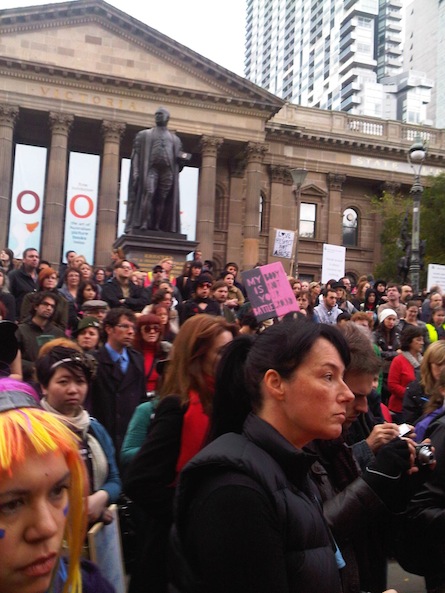
Ralliers outside the State Library on Swanston Street.

Best. Sign. Ever.

Last Saturday the highly anticipated SlutWalk occurred in several Australian cities, and I attended the Melbourne event with my fellow anti-slut-shamer friend Laura (both of us below).

We rocked up in our sluttiest outfits, which you can see above, complete with permanent marker declarations of our proud sluthood to boot. Some of the other outfits we noticed were short skirts with knee-high skull print socks and customised Doc Martins, worn by event organiser Clem Bastow (below), lace dresses and gym gear, the latter of which adorned a short-haired tattoo fan with a body Tracy Anderson would envy.

Clem Bastow.

Monica Dux.

As Bastow commented when she gave one of the opening addresses, along with fellow event organisers Karen Pickering and Lauren Clair, and noted feminists Monica Dux (above) and Leslie Cannold, amongst others: “thank you, God, it looks like you’re going to rain on me”. But no one was gonna rain on our parade and, despite the chilly temperatures, we still walked tall and proud in whatever get-ups we chose to wear.

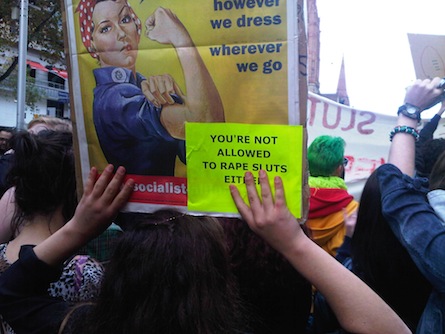
Dux said this is the beginning of a movement, which I have to disagree with. SlutWalk is not the beginning of a movement; it is part of the reignited battle to stop victim-blaming and slut-shaming based on one cop’s archaic musings on rape and how much a woman was “asking for it”. Here’s a fun fact: WE’RE NEVER ASKING FOR IT! (See Bastow’s sign, above). No matter how we are dressed, where we are, how much we’ve had to drink, or what we do for work.

Speaking of, I was really proud to see the representation of sex workers at the event, and president of the Australian Sex Workers’ Association, the Scarlet Alliance (represent!), Elena Jeffreys (above) spoke about her sexual assault and that even though she was paid for sex, she was not consenting to assault. Her opinions on the SlutWalk were really interesting and I hope they receive as much publicity as the negative perceptions of the rally have in the media.

In the days leading up to SlutWalk, I was embroiled in a heated debate on Facebook with a friend who disagrees with the SlutWalk. I think he confused—like a lot of people—the meaning of the SlutWalk with an excuse to get gussied up in a very risqué manner when, in fact, that was not at all what it was about. That didn’t stop protestors on the steps of Parliament House at the top of Bourke Street brandishing their “rape is horrifying, but so is immodesty” placards (above). Like one of the speakers (whose identity escapes me: should have used my BlackBerry voice recorder!) said: it’s not up to us to curb our behaviour (and that includes how we choose to dress) at the risk of potentially being sexually assaulted; it’s up to those who sexually assault to curb their behaviour!

I think most people against the SlutWalk had a problem with the use of the word slut. As Cannold said, “words matter…: … we won’t stand for one, the same one, being slung at us over and over again to demean and degrade us.” Lori Adelman, in a post on Feministing, said she didn’t agree with the term “slut” and that she “would much rather have attended a ‘Do Not Rape’ Walk”:

“I find that the term disproportionately impacts women of colour and poor women in order to reinforce their status as inherently dirty and second-class, and hence more rape-able.”

To me, “slut” is just a word. It meant as much to me to be called a slut when I was 12 as it does today; as they (and Rihanna) say, sticks and stones will break my bones but names can never hurt me. It’s not about the term “slut”, it’s about the backwards and extremely offensive views that go along with that word. As coordinator of the first SlutWalk in Toronto, Sonya Barnett, told Rachel Hills: “if he [the policeman] had said something else, we would have called it something else.”

The speaker who garnered the most attention, though, was transgendered man, Cody Smith (above), who had been raped both as a biological female, and as a trans man. There were tears a plenty during his speech!

It was nice to see such a welcoming, non-judgmental turnout of everyday men, women and children of all walks of life, wearing all sorts of garb, not just the fishnetted and cut-out body con dresses that certain attendees chose to wear (guilty as charged!). After all, rape is not about what you’re wearing, what you look like, what size you are, how old you are, what your sexual orientation or gender is, or any other denomination that you happen to belong to as a person. It is about the perpetrator, and nothing you can or cannot do will stop them from attempting to rape you.

As Smith said, it shouldn’t be the victims of sexual assaults’ responsibility to educate the general public on sexual assault and victim-blaming. And I thought the sexual revolution happened several decades ago: it shouldn’t be up to members of a fringe movement to educate the general public on the sexual rights of women to express themselves however they please without the threat of retaliation. In fact, feminism—which is what the SlutWalk was all about—shouldn’t be considered as on the fringe in 2011.

Related: SlutWalk.

So a Tattoo Makes Me Public Property, Huh?

Has Feminism Failed?

Rihanna’s “S&M”: Is it Really So Much Worse Than Her Other Stuff?

Elsewhere: [Feministing] SlutWalk: To March or Not to March.

[Musings of an Inappropriate Woman] Ask Rachel: What Are Your Thoughts on SlutWalk?

Black and white images via Ali Ryan Photography.