Following Bill Cosby & Hugh Hefner Down the Rabbit Hole.

hugh hefner bill cosby

In July it came out that in 2005 Bill Cosby admitted in a sworn deposition to buying Quaaludes with the intent to use them to rape women, not to “have sex with them” as headlines read.

Around the same time, former Playboy Playmate and Hugh Hefner’s “No. 1 Girlfriend” Holly Madison released an incriminating memoir, entitled Down the Rabbit Hole, about her time in the Playboy Mansion and how it often involved Quaalude-addled group sex with Hefner.

You might remember that late last year when we finally started to pay attention to the long-standing assault allegations against Cosby after a deluge more came to light, Hefner wrote in a statement that “Bill Cosby has been a good friend for many years and the mere thought of these allegations is truly saddening. I would never tolerate this kind of behaviour, regardless of who was involved”.

Putting aside the fact that Cosby and Hefner are friends (14% of Cosby’s accusers were employees or guests of Playboy at the time of their assaults), both men’s predilection for drugging women to better inure them to sex is a damning testament to their power in Hollywood.

It would seem that since last year reports of sexual and physical violence against women have begun to be taken more seriously. As of this writing, 2015 alone as seen 63 women be murdered by their intimate partners or killed in gendered attacks, according to Destroy the Joint’s Counting Dead Women project. The prevalence of these crimes doesn’t necessarily mean that women are experiencing more violence but perhaps that we’ve started to actually give a shit about it.

The striking similarities of the stories of the upwards of 40 Cosby accusers with nothing to gain should be enough to prioritise their safety and justice over the comedian’s legacy and power, but alas, it took the comedian’s own admission for reruns to be cut from networks and a statue in his likeness at Disneyland to be taken down. And even then, apologists such as The View co-hosts Whoopi Goldberg and Raven-Symoné urge us to resist making a “snap judgement” despite the “proof”. (Goldberg has since come around, saying on The View that “all off the information that’s out there kind of points to guilt.”)  

“What did these women do to get themselves in that situation?”, we ask, particularly in the case of apparently complicit women like Madison and others who frequented the Playboy Mansion.

Madison explains in Down the Rabbit Hole that “I was about to be homeless. I had no place to go and was panicking over what to do next when this opportunity with Hef just sort of fell into my lap. If I became a girlfriend, I would have somewhere to live. If I became part of Playboy’s inner circle, perhaps that could even help my career.”

“The Playboy Mansion… had been both my safe haven—and my prison,” she continues.

What further kept Madison trapped was her decreased confidence and self-worth upon becoming a girlfriend. Hefner’s six other girlfriends at the time Madison moved in were also plagued by insecurities which Madison says led them to bully her. And, in turn, “my shrinking violet personality was a sign of submission that [Hef] used to manipulate the other women.” When Madison tried to have an intelligent conversation with the man she supposedly loved and whom expressed love for her, “he would scoff at whatever I said. It didn’t matter if my remark was educated or even correct, because if I said it, it must be wrong.” In attempting to exert her independence and autonomy by getting a makeover, Hefner belittled Madison, calling her “old, hard and cheap”. After a seemingly throwaway comment from Madison about fellow girlfriend and Girls Next Door star Kendra Baskett (nee Wilkinson), Hefner screamed at Madison to “stop being such a fucking CUNT!”

“He frightened me,” she writes.

Just because young women seek out rich men to experience the fame and fortune they otherwise wouldn’t have access to doesn’t mean they consented to inebriated sex. On the same night she refused Quaaludes from Hefner in a scenario that made headlines upon publication of the book, “I can’t even begin to tell you how much vodka and champagne I consumed… While I patted myself on the back for turning down the pills, by the time we left the club, I couldn’t have been any more incoherent” for her first group sex encounter with Hefner.

The ostensibly compromised integrity of Madison and others who’ve written similar accounts of their time with Hef, like Hefner’s former girlfriend Izabella St. James, and their previous contributions to maintaining the glass curtain Hef and the Mansion are shrouded in makes them less likely to be believed.

Also making headlines for embellished claims was Rolling Stone’s damning article entitled “A Rape on Campus” at the University of Virginia in which reporter Sabrina Erdely failed to properly corroborate the alleged victim Jackie’s story by seeking out other sources before the story went to press. While the feminist and left-leaning media have made it clear that Erdely and Rolling Stone were at fault, a report was issued further blaming the very people it was supposed to protect: sexual assault victims.

“The editors and Erdely have concluded that their main fault was to be too accommodating of Jackie because she described herself as the survivor of a terrible sexual assault,” the report says, feeding all-too-perfectly into blame-the-victim rhetoric.

Chloe Angyal wrote at Feministing that “‘Jackie’ will become shorthand for people seeking to discredit future allegations of rape” just as Fatal Attraction’s “Bunny Boiler” has for unhinged women who trap and frame innocent men.

Even in the face of overwhelming evidence such as that surrounding the 2014 Isla Vista shooter, Elliot Rodger, society doesn’t believe women when we tell them that harassment and a general feeling of being unsafe is something that happens on a daily basis for many of us. The hashtag #yesallwomen was spawned in an effort to debunk that. Despite the fact that the killer sent an accompanying 140-page manifesto to former friends and family members outlining his murderous intentions, people were still willing to believe that Rodger and men like him (#notallmen) are “good blokes”, while “blonde sluts” are to blame for “starv[ing him] of sex” .

Going back to Hefner, in 2005’s Female Chauvinist Pigs, author Ariel Levy speaks at length with Hefner’s daughter Christie, then CEO of Playboy Enterprises. Like Cosby and his respectability politics, Levy also quotes from past interviews with Hef in which he claims to be a champion for women and, dare I say it, a feminist.

In the book, Christie is described as the founder of many women-friendly organisations, such as Emily’s List, which works to elect pro-choice Democratic candidates to office, and the Committee of 200, which runs a mentor program between successful business women and young women and girls. Levy writes,

“The Playboy Foundation also gave grant money to NOW’s Legal Defence and Education Fund and supported the ERA; Hefner personally hosted a fundraiser for it at the Playboy Mansion. ‘I was a feminist before there was such a thing as feminism!’ Hefner has said. A mutual friend even tried to set him up on a date with Gloria Steinem before she became famous.”

(Arguably the piece that made Steinem famous was an undercover exposé on the hostile and sexist conditions at New York City’s Playboy Club, including immediate dismissal for accepting a date with a customer.)

Just because someone calls themselves a feminist, does it make it so? Sarah Palin and Tony Abbott have done so, but their public policies and conversational faux pas would indicate that they are anything but.

The same could be said of Cosby’s respectability politics. On the surface it might look like Cosby is championing his race, but really it’s about minorities policing their own behaviour in an effort to prove how “good” and worthy they are of fair treatment by the powers that be. Cosby has done such an expert job of portraying himself as black America’s father figure that defenders like Raven-Symoné (in whose case Cosby literally played her grandfather on TV) are still in his corner.

https://twitter.com/caitlinstasey/status/619328007782555652

In Female Chauvinist Pigs, Levy quotes from a 1967 interview with Hefner that the self-professed feminist does “not look for equality between man and woman… I like innocent, affectionate, faithful girls.” Perhaps that’s why he challenged Madison’s post-Playboy life as not being “happy, healthy and productive”: because she, like the 41 women who kept Cosby’s secret for up to 49 years in the earliest reported case, didn’t play along with the socially prescribed rule to put up (or out) and shut up when it comes to powerful men.

Related: The Year of the Stalker.

Elsewhere: [Gawker] Who Wants to Remember Bill Cosby’s Multiple Sexual Assault Accusations?

[Vulture] A Timeline of the Abuse Charges Against Bill Cosby.

[HuffPo] Hugh Hefner Responds to Bill Cosby Sexual Assault Allegations.

[Jezebel] The Connection Between Bill Cosby’s Alleged Crimes & The Playboy Mansion.

[Facebook] Counting Dead Women.

[The Cut] “I’m No Longer Afraid”: 35 Women Tell Their Stories About Being Assaulted by Bill Cosby & the Culture That Wouldn’t Listen.

[ET] Bill Cosby’s Accusers: A Timeline of Alleged Sexual Assault Claims.

[TV Line] Bill Cosby Sitcoms Yanked from Centric, Bounce TV’s Schedules.

[WNEP] Bill Cosby Statue Removed from Walt Disney World.

[Us Weekly] Holly Madison: Hugh Hefner Offered Me Drugs, Tried to Buy Me in His Will.

[Rolling Stone] Rolling Stone & UVA: The Columbia University Graduate School of Journalism Report.

[Feministing] Rape, Rolling Stone & the Radical Notion That Women Are Trustworthy.

[ABC The Drum] Disability & Murder: Victim Blaming at Its Very Worst.

[The Guardian] Elliot Rodger’s California Shooting Spree: Further Proof That Misogyny Kills.

[The Hairpin] Life Lessons from the 1968 Playboy Club Bunny Manual.

[WaPo] The Fake Feminism of Sarah Palin.

[The Guardian] Tony Abbott Says His Three Daughters Helped Him “Turn Into a Feminist”.

[ET] Hugh Hefner Responds to Holly Madison’s Tell-All Book: She Has “Chosen to Rewrite History”.

Image via HuffPo.

World Wrestling Entertainment Will Never #GiveDivasaChance As Long As It Prioritises Bad Men.

aj lee wwe diva

A.J. Lee as Divas Champion.

After years of viewing the Divas (women’s wrestlers) matches as bathroom break time, it seems the time for women wrestlers to be cast in roles other than “eye-candy, crazy-person, or reality television shill” has finally come if recent social media campaigns are any indications.

Last week, the hashtag #GiveDivasaChance began trending, and some NXT (WWE’s developmental brand, with a weekly show airing on the online subscription service, the WWE Network) Divas were involved in a #LikeaGirl advertisement for the SuperBowl. This movement isn’t without its detractors, as NXT announcer Corey Graves took to Twitter to assert that the Divas don’t need a hashtag to make their own opportunities: yeah, ’cause that’s worked so well for them up to now.

This debate has emerged in the wake of WWE COO Triple H’s (real name: Paul Levesque) comments about the future of women’s wrestling on Stone Cold Steve Austin’s live podcast, broadcast on the WWE Network, a month ago. When asked about the trajectory of WWE moving forward, Levesque said, “I would like to see the women get more time and more dedication. We have a large fan base of women that watch and I think [the WWE Divas] are inspirational.” While it wasn’t until the last two minutes of the hour-long podcast that Levesque made reference to WWE’s female performers (instead calling the wrestlers “the guys” throughout the rest of the interview), it’s interesting that he thinks they should be given a higher priority in WWE when he’s arguably one of the only people who can make that happen.

chyna

Chyna as Intercontinental Champion, the first and only woman to ever hold that title.

Austin also asked Levesque if he thought Chyna—a pioneer in the world of wrestling, both women’s and otherwise—would be inducted into the WWE Hall of Fame. (Again, that’s a decision Levesque would have a lot of sway over.) Despite Chyna’s (real name: Joanie Laurer) status as Levesque’s ex-girlfriend, she’s also found a post-wrestling career in porn, which severely limits the likelihood of her induction. Levesque said:

“I’ve got an eight-year-old kid and my eight-year-old kid sees the Hall of Fame and my eight-year-old kid goes on the internet to look at, you know, ‘there’s Chyna, I’ve never heard of her. I’m eight years old, I’ve never heard of her, so I go put that in, and I punch it up,’ and what comes up? And I’m not criticising anybody, I’m not criticising lifestyle choices. Everybody has their reasons and I don’t know what they were and I don’t care to know. It’s not a morality thing or anything else. It’s just the fact of what it is. And that’s a difficult choice. The Hall of Fame is a funny thing in that it is not as simple as, this guy had a really good career, a legendary career, he should go in the Hall of Fame. Yeah… but we can’t because of this reason. We can’t because of this legal instance.”

Surely a nod to Chris Benoit’s double murder-suicide of 2007 there, but is porn really the equivalent of massacring your whole family? In addition to having abuse allegations made against him by Laurer, which Levesque denied, he is a also good friend of Laurer’s ex-partner and co-star in that porn video who also allegedly physically abused her, Sean “X-Pac” Waltman. While not a Hall of Fame inductee yet, he’s a member of the infamous Kliq, including Hall of Famers Shawn Michaels and Scott Hall, the latter of which was inducted last year.

stone cold steve austin nwo kevin nash scott hall sean x-pac waltman

All of these men—from left, Sean “X-Pac” Waltman, Kevin Nash, Stone Cold Steve Austin and Scott Hall—have been accused of or arrested for domestic abuse.

Furthermore, while Benoit may never be inducted, and rightly so, it’s not like the WWE flat out prohibits the induction of violent criminals: Jimmy “Superfly” Snuka is under suspicion for the accidental death of a woman he beat unconscious in a hotel room in 1983. While never charged, that investigation was reopened last year. Other criminals in the WWE Hall of Fame include convicted rapist Mike Tyson in the celebrity wing, the aforementioned Scott Hall, who has been arrested numerous times for domestic violence as well as the 1983 murder of a man in a bar, and the host of the very podcast in which Levesque made the comments that inspired this article, Stone Cold Steve Austin, a serial domestic abuser.

Recently, the WWE added a domestic violence, child abuse and sexual assault clause to their wellness policy, stating that “upon arrest for such misconduct, a WWE talent will be immediately suspended. Upon conviction for such misconduct, a WWE talent will be immediately terminated.” In the wake of other sporting codes’ embarrassingly lax attitude to domestic violence and crimes of a similar nature, this is a step in the right direction for WWE. The host of wrestlers who are or have been under contract to WWE with similar charges brought against them prior to this stipulation must be thankful for a time when they were swept under the rug.

Triple-H-Mayweather-Jr

mike tyson wwe hall of fame

Triple H (Paul Levesque) with, from top, Floyd Mayweather, Jr. and Mike Tyson, who’ve both served time for assaulting women.

To Levesque’s point, it’s easy enough to find out any of this information with a Google search. In the wake of the podcast, the first page of Google results yields nothing about Laurer’s adults-only post-WWE career. (Granted, you’d have to prefix Tyson, Austin et al.’s names with their respective crimes for those results to appear first.) If Levesque is as close to Hall, Waltman, Austin, Tyson (he and Shawn Michaels, as D-Generation X, inducted him into the Hall of Fame) and even Floyd “Money” Mayweather, who is also a serial woman abuser who was recently denied entry to Australia because of this, surely his children have met them. Why, then, is it so hard to talk to your children about Laurer’s choice when you associate with convicted criminals? Presuming Levesque and his wife, WWE’s Chief Brand Officer, Stephanie McMahon Levesque, have told them about the substance abuse problems Hall’s had of recent, they can talk to them about the travails of what you can find online. In this day and age, it’s never too soon to start.

total divas

Some of the cast of E! reality show, Total Divas.

It wasn’t so long ago that WWE unapologetically traded on the sexualities of its female performers such as Sable, Stacy Keibler and Laurer herself. Total Divas, the E! reality show charting the lives of eight WWE Divas, could arguably be said to be doing the same thing. And there’s nothing wrong with a woman using her body to her benefit if it’s consensual and she gains pleasure from it. What Levesque is saying, whether consciously or no, is that using women’s sexualities to sell a product is fine, as with the WWE’s mid-to-late 2000’s trend of Divas posing for Playboy, but getting pleasure (presuming porn was pleasurable for Laurer) from them is a no-no.

In addition, this promotion of legitimately dangerous and criminal men over women such as Laurer (it should also be noted that Laurer’s been charged with domestic violence against Waltman) indicates that despite Levesque’s lip service, the WWE prioritises bad men gone by over its current female roster. WWE may profit from the Divas’ physicality, but it’s dropped the ball when it comes to protecting them physically. For example, Debra Marshall (then Williams) was under contract to WWE when her partner Steve Austin, also under WWE contract, beat her. Debra was never again to be seen on WWE programming while Austin is still lauded as one of the greatest performers of all time.

So to #GiveDivasaChance may finally indicate a change in consciousness coming from wrestling fans but comments from within the company such as Graves’ and Levesque’s show that insider perceptions of women in wrestling still have a long way to go, baby.

Related: Baby, It’s a Wild World: Navigating Pop Culture as a Feminist.

Why Are Famous Men Forgiven for Their Wrongdoings, While Women Are Vilified for Much Less?

Elsewhere: [Bitch Flicks] The Choice to be a Total Diva.

[Bitch Flicks] Body Image on Total Divas.

[The Work of Wrestling] The Women Warriors of NXT.

[Pyro & Ballyhoo] Full Joanie “Chyna” Laurer Shoot Interview.

[E! Online] WWE Star Kevin Nash & Son, 18, Arrested for Domestic Violence After Fight at Home.

[The Morning Caller] Grand Jury to Review Death of Jimmy “Superfly” Snuka’s Girlfriend.

[Fox Sports] Ramon Charged with Domestic Violence.

[The Smoking Gun] Stone Cold Steve Austin Roughs Up Girlfriend.

[WWE] Talent Programs & Policies.

[Deadspin] The Trouble with Floyd Mayweather.

[Herald Sun] Floyd Mayweather’s Visa Application Rejected by Australian Authorities.

Images via The Outhouses, Jobu’s Rum, Shitloads of Wrestling, Zimbio, Sabrina Brand, Pro Wrestling.

International Women’s Day: Why I’m a Bad Feminist, or Women Can Be Misogynists, Too.

In honour of International Women’s Day and Roxane Gay’s book, Bad Feminist, which I’m going to hear her speak about tonight, I wonder whether I’m a “bad feminist” for asserting that women can be misogynists, too. 

I could be accused of being a “bad feminist” for the assertion I’m about to make. After all, feminists are supposed to support all women, right? Even women doing unfeminist things, like Sarah Palin, or women in traditionally male dominated industries, like Yahoo! CEO Marissa Mayer, and who throw feminism under the bus.

But in my experience women can be misogynists, too. And as I write this I’m thinking of one woman in particular.

A few years ago, one of my closest male friends started dating someone new. My friend later relayed to me that upon stalking his Facebook, as you do, said new paramour stumbled upon several photos of the two of us. Most of them were taken at costume parties or clubs, so my feminine façade was amplified perhaps more than usual. We were probably standing pretty close together in the photos, too, and our natural affection for each other would be evident. This led her to ask about me, “Who’s that slut?”

At first I gave her the benefit of the doubt. I wrote on my blog at the time that I could see where she was coming from: her insecurity at her date’s close relationship with a woman she didn’t know manifested itself as slut-shaming. It was slut-shaming as a defense mechanism, if you will.

Presently, that woman has now become a colleague; not someone I work with directly, but who has contact with many people I do both professionally and outside of work. Through this network I’ve come to find that it isn’t just me she’s made libelous comments about but many a female coworker who happens to fit the conventionally feminine and attractive mould.

I don’t know exactly what was said about these other women, but I’m pretty sure it was as unwarranted as what she said about me (although I am loathe to defend myself against her name-calling as that implies that some women are sluts and others aren’t). One of the women is ditzily endearing and while I don’t really know the other, she seems pleasant despite her bitchy resting face.

The first comment about me could be chalked up to the green-eyed monster rearing its head, but when such behavior begins to occur on a regular basis, it’s hard not to wonder whether this woman is actually a misogynist.

It could be that she thinks she’s “not like other girls”, which is inherently misogynistic; she doesn’t buy into feminine conventions that she implies other women do, and she’s “one of the boys”. Like Gone Girl author Gillian Flynn’s Cool Girl screed, or as Reign actress Caitlin Stasey tweeted, being “‘One of the guys’ implies that to resemble any kind of man is better than actually being any kind of woman.” But the very fact that she’s engaging in the stereotypical feminine act of “backstabbing” makes her just like these “other” women, no?

https://twitter.com/caitlinstasey/status/479735881238974465

Whatever the case, though, this woman has serious other-women-problems. And if we can accept that men can be feminists, it would stand to reason that women can be misogynists, right?

Related: Slut-Shaming as Defence Mechanism.

Elsewhere: [Feministing] Once More, with Feeling: Sarah Palin is Not a Feminist.

[Jezebel] Does it Matter if Marissa Mayer Doesn’t Think She’s a Feminist?

[Buzzfeed] Jennifer Lawrence & the History of Cool Girls.

The Worst Time I Was Street Harassed.

As a woman in the world, I’ve been harassed in public many times. Called a cunt by my next door neighbour, followed into shops, touched on public transport, you name it.

Perhaps the worst time I was street harassed was when I was jogging early one summer morning to escape the heat that would surface later in the day. I was residing with my mum at the time who lived near a lake. As I was rounding the imaginary finish line in my mind I encountered a flock of ducks waddling across the road. Further ahead, I also passed a motorhead who revved his gears (at 6am? Seriously dude, people are still sleeping.) and sped up when he saw me bounding along. Remembering the duck family moments before, I glanced back to make sure the driver saw them. Of course he a) didn’t and b) thought I was looking back at him, impressed by his hooliganism, and sped up even more… right into the flock!

Wanting to make sure the birds escaped unscathed, I jogged back to the scene of the crime where I saw that one of the ducks’ numbers had been up that day with its innards spread across the road, having bottomed out of its feathery body on impact.

And that’s the worst time I was street harassed.

Related: The Year of the Stalker.

To Live & Die in Brunswick.

The Harassed & the Harassed-Nots.

I Ain’t No Hollaback Girl: Street Harassment in Cleo.

There Are Far Worse Words in the World Than “Fuck”.

http://www.youtube.com/watch?v=9QZ44fmMAxs

Yesterday a video of girls dressed as princesses saying the word “fuck” went viral. While the apparent point of the video was to spread awareness of the inequalities and atrocities women and girls face in the world, it was actually made by for-profit t-shirt company FCKH8 who would donate $5 from each t-shirt sold to unspecified charities (presumably charities benefiting women). Capitalism aside, the video begs the question, what’s worse: little girls swearing or facing the likelihood that they’ll be raped or paid less than the men doing the same job?

If popular opinion is any indication it’s the former.

I was just thinking about this a few days ago. Why do we have to “watch our language” around elders or in professional settings when the same respect isn’t shown when it comes to sexism, racism and just generally being a decent person?

I swear “like a sailor” and have since I was the age of the girls in the video and even younger. At a third birthday party I yelled “fuck” while the guests were singing happy birthday. I got kicked out of kindergarten for swearing. My colleagues devised a swear jar to be mostly filled up by me. (I’ve never put a cent in it.)

What I want to know, though, is where’s the “problematic ideologies jar” that the same people who are offended by a word that has essentially lost all meaning other than to punctuate something or as a less formal way to say “make love” should be making deposits into? The same people who are offended by my refusal to burp under my breath or curb my fondness for the f-word but bang on about women who get raped shouldn’t get so drunk or go out with so little clothing, calling Adam Goodes a monkey isn’t racism because he does look like a monkey, when a man cheats on his wife it’s the other woman’s responsibility, and girls being inherently catty and bitchy.

Why should I have to watch what I say less an f-word pop out when people will freely volunteer that they think being gay is wrong, or that it’s not wrong, but at the very least it should be harder for them to have children as they “chose” that lifestyle.

What it comes down to is that women and girls should be seen and not heard. We don’t want little girls to say “bad” words because it offends the collective sensibility. We don’t want to know that women are more likely to face gender-based violence as long as they sit there, shut up and look pretty. The made-up princess aesthetic of the video is certainly fulfilling that aspect, but once the girls open their mouths they’re shamed for saying something that we’d rather not think about. Nay, saying anything.

It could be said that FCKH8 is only interested in making a profit from the t-shirts this video aims to sell. That may be the case but they have certainly got people talking. Just as the company has co-opted feminism for their own purposes feminism can appropriate their money-making ways in an effort to change the attitudes of the same people that are oh-so-offended by an f-bomb but are happy to espouse even more harmful ideologies.

Elsewhere: [The Belle Jar] FCKH8 Exploits Little Girls in Order to Sell T-Shirts.

Bad Feminist: All of My Favourite Songs Are By Men.

Roxane Gay writes in the feminist tome of 2014, Bad Feminist, about how her love for problematic music such as “Blurred Lines” makes her, well, a bad feminist:

“As much as it pains me to admit, I like these songs. They make me want to dance. I want to sing along. They are delightful pop confections. But. I enjoy the songs the way I have to enjoy most music—I have to forget I am a sentient being. I have to lighten up.”

Ahh, the catch cry of offensive joke tellers and sexist comment makers everywhere: lighten up.

I recently compiled a list of my favourite songs for personal purposes and while the list is only small it does consist solely of male artists, and not wholly unproblematic ones at that: INXS, Fine Young Cannibals, Justin Timberlake, Snoop Dogg, Pharrell Williams.

I’ve written here before about having to detach yourself from the more troublesome aspects of pop culture in order to consume it lest you become a hermit. Like Gay, this is the same attitude I have to take when it comes to music, especially the kind you want to get down to in the club (which I do when it comes to all of the above. To be more specific, they are “Need You Tonight”, “She Drives Me Crazy”, “Chop Me Up” and “Beautiful” respectively. The fact that they focus primarily on the sexual attraction of women or a particular woman is fodder for a whole ’nother blog post.). It’s unfortunate that the music that has the sickest beats also had the sickest attitude to women. And other minorities. And crime. And violence… The list goes on.

Related: Baby, It’s a Wild World: Navigating Pop Culture as a Feminist.

On Schrodinger’s Rapist.

I have a stalker.

I write that partly in jest, but I do have someone that has expressed an unwanted interest in me of late, despite no indications from me that I would be remotely interested in this person apart from being cordial when he asked me a work-related question, that could potentially turn into full blown stalking.

When I relayed this to a male friend, offhandedly saying that if I go raped in the near future he would be the most likely culprit, he initially expressed MRA-levels of outrage.

“It’s a bit unfair to automatically assume that this seemingly nice guy who probably just has a crush on you could be a rapist,” he offered.

This is not the first time I’ve received a similar response when bemoaning the unwanted male attention thrown my—and many other women’s—way.

“But what if a guy thinks you’re cute and just wants to come up and say hi and ask you out for a coffee?” one male friend asked.

There have been a few instances where that has happened, and when I’ve said thanks but no thanks, they’ve accepted that and let me go on my merry way. But we have to ask why men feel entitled to women’s bodies and time as they’re going about their business with no indication that they’re interested in being interrupted so some NiceGuy™ can air his feelings to you in the first place. Why is women’s privacy and right to be left alone less important than men’s? Patriarchal conditioning would be my best guess: boys and men are taught that they’re the gatekeepers of not only women’s bodies, but women’s happiness, too. Go out and get it/provide it, essentially.

Back to my friend who questioned my use of the stalker moniker. I agree that it is unfair to assume he’s going to rape me, but at some point, deep down, most women have to assume that all men are going to—or at the very least, can—rape them. Enter Schrodinger’s Rapist.

I’ve written about the fact that for the most part I personally don’t let fear prevent me from going out at night and, if it comes down to it, I won’t be afraid to tell my stalker where to go. But I also avoid certain areas where I know harassment is rife. Again, deep down, I know there’s always a chance I can be taken by surprise when my guard’s down because women can be harassed and raped and treated as second class citizens at any time or place.

And not only are women never truly physically safe, they’re not ideologically safe. Thankfully I’ve never been in the position to have to report a sexual assault to the police or take a sexual harassment claim further than nipping it in the bud in the first instance, but if I was, I’d surely be blamed for inciting it; abused all over again, as it were. I’m not trying to insinuate that my friend is a bad person for automatically jumping to my stalker’s defence, but even the fact that he didn’t believe my descriptions of his stalkerish ways illustrates that it takes a bit of convincing for a woman to have her claims believed.

As the husband of murdered Melbourne woman Jill Meagher, Tom Meagher, wrote for the White Ribbon blog, the myth of the rapist being a monster hiding in the bushes, as Meagher’s rapist and murderer Adrian Bayley was, blinds us to the fact that many rapes are carried out by people known to the victim. Partners, family members, friends, colleagues. So my deduction that my stalker could certainly become my rapist is not that far of a reach.

Related: The Harassed & the Harassed-Nots.

Sexual Assault, Moral Panic & Jill Meagher.

Walking While Female.

To Live & Die in Brunswick: Reflections on Jill Meagher.

On Stalking.

Elsewhere: [TheVine] Feeling Like a Stalker.

[Shapely Prose] Schrödinger’s Rapist: Or A Guy’s Guide to Approaching Strange Women Without Being Maced.

[White Ribbon] The Danger of the Monster Myth.

Robin Thicke’s “Paula”: He Still Hates Those “Blurred Lines”.

Robin Thicke, along with Pharrell and T.I., came out with arguably 2013’s most controversial song, “Blurred Lines”, about this time last year.

Now the son of Growing Pains actor Alan Thicke is back with a whole new album about his estranged wife, Paula Patton, entitled simply, Paula.

Thicke was caught with his hand on a female fan’s bottom and allegedly followed this up by cheating on his high-school sweetheart Patton, with whom he’d been involved for 21 years and has a son. The unflappable Patton seemed to take the split in her stride, at least compared to Thicke, who’s taken to social media and radio waves in an attempt to win his former ladylove back.

The fact that his forthcoming album’s tracklist consists entirely of breakup-and-makeup songs is supposed to be romantic, but to the discerning eye, Thicke’s predation that was front and centre in “Blurred Lines” has come to the fore yet again.

Not only does his public begging read as more desperate than romantic, it publicly shames the other party who’s chosen to deal with the dissolution of their marriage in private.

But we all know Thicke’s favourite pastime is to “degrade a woman” and that’s exactly what he’s doing with this ill thought out album. For some perspective, the titular woman filed for divorce from Thicke in February this year, and the album’s first single, “Get Her Back” was released in May, giving Paula a lead-time of three months. And it has only been a year since Thicke’s previous album, Blurred Lines, featuring the rape anthem of the same name, came out.

The actual Marvin Gaye medleys that Thicke has become so well known—and taken to court—for and that make up Paula aren’t the worst in the world, but it’s when listeners pay mind to Thicke’s lyrics that the album really starts to run into trouble. The calypso rhythm of “You’re My Fantasy”, for example, can’t rescue it from this little ditty: “Your legs on my walls/Your body’s on my ceiling”; while Thicke makes reference to the cheating rumours on the Motown-y “Black Tar Cloud”, crooning “I thought everyone was gonna eat the chips/Turns out I’m the only one who double dipped”. (Thanks for that visual.) The mumbly “Forever Love” is luckily accompanied by a lyric video because Thicke’s enunciation is so poor it’s hard to sing along like the 14-year-old sung along in Patton’s ear to Stevie Wonder’s “Jungle Fever” upon their first meeting as teens in early ’90s Los Angeles.

“Get Her Back”, the earwormy lead single is arguably the album’s only redeeming one however its problematic video, featuring scrolling text messages that we’re to believe were sent between Thicke and Patton atop close-up shots of a fake-bloodied and allegedly crying Thicke being groped by masked women who look marginally like Patton before they plunge head-first into cavities of water, references intimate partner violence, like much of the album.

Thicke carried out a thick (so to speak) and fast social media campaign for Paula, including the hashtags #GetHerBack and #AskThicke, which ultimately backfired in a flurry of negative feminist press. Thicke even went so far as to engage in a cross-promotion with 1800-Flowers, for which the “Get Her Back” bouquet will set you back a cool $350—but it comes with a free digital download of Paula, so you’re actually saving money. But it would seem that many music consumers are holding on to their pennies this time around: just 530 fans in the UK and a dismal 54 in Australia forked out for Paula.

Thicke might not be a one-hit wonder (remember his 2002 debut, the equally as rapey as “Blurred Lines”, come to think of it, “When I Get You Alone”?), he proves that perhaps sex was the only thing that sold “Blurred Lines”.

The Hollywood that Thicke grew up in would have us believe that male persistence is the way to a girl’s heart: “the boy keeps trying to get the girl until she says yes,” writes Jessica Valenti for The Guardian. “You need to look no further than the outrageously popular Twilight series—books and movies—to know that the stalker-as-romantic lead looms large in our cultural imagination.” Real life headlines about intimate partner violence suggest that stalking is more deadly than romantic.

Further to that, Alyssa Rosenberg writes over at The Washington Post that “the simple fact of male persistence ought to be enough to bring a woman around to loving him”, while Clem Bastow asserted on Daily Life that Thicke’s quest to “Get Her Back” is “about the feelings of the man in question, not the woman he is searching for or seeking to reconcile with”.

But that’s Thicke’s pattern (pardon the pun); he’s crafting a pop cultural narrative where he’s the ultimate NiceGuy™ and if Patton continues to reject him she’s a cold-hearted bitch. And if Thicke was hoping for a deluge of sales to help him convince Patton to take him back, he’s sorely underestimated the public’s keen nose for desperation.

Elsewhere: [HuffPo] Robin Thicke Cheated on His Wife, Claims Socialite Lana Scolaro.

[HuffPo] Marvin Gaye’s Family & Robin Thicke’s Label Settle in “Blurred Lines” Dispute.

[Time] Robin Thicke’s #AskThicke Hashtag Completely Backfired.

[1800-Flowers] Robin Thicke Flowers & Music Download.

[Vulture] Which Country Hates Robin Thicke the Most?

[The Guardian] Robin Thicke’s Video: Further Evidence That We’re Romancing the Stalker-Esque.

[WaPo] The Real Problem with Robin Thicke’s Creepy Attempts to Win His Wife Back? They’re Boring.

[Daily Life] The False Romance of “Winning Her Back”.

Leaning In to Grey’s Anatomy*.

ELLEN POMPEO, PATRICK DEMPSEY

Grey’s Anatomy is one of the more feminist shows currently on the air. Hell, it’s created by Shonda Rhimes (she of Scandal and Grey’s spin-off, Private Practice, fame), a big champion of woman-centric storytelling on TV.

Across its ten season run, Grey’s has dealt with parenting, childlessness, abortion, romantic relationships—both heterosexual and otherwise, illness, loss, friendship and career mostly through the eyes of its female protagonist, Meredith Grey, and her colleagues, friends and family: Cristina, Izzie, Lexie, Callie, Arizona, April, Addison, Bailey and so on. This season, though, seemed to really tap into the oft-mentioned feminist issue of “having it all” (meaning kids and career) and what happens when a woman shuns that path.

Early on this season tensions were brewing between Meredith and Cristina when Meredith gave birth to her second child, Bailey, named after Dr. Miranda Bailey who helped deliver him, and leant out of the surgery game. As Meredith’s life became increasingly family oriented, Cristina felt alienated from “her person”, with whom she used to compete for surgeries and get drunk on tequila at Joe’s bar. This is not to suggest that just because Cristina doesn’t want children (a character consistency since season one) she’s not involved in that part of Meredith’s life: Cristina is often shown caring for and engaging with Meredith’s daughter Zola. But this story arc illustrates that having two children is a lot different than parenting just one (cue Elizabeth Banks-style outrage over mothers of one child being less than mothers of more) and Meredith’s redirected attention certainly takes its toll on her friendship with Cristina.

This comes to a head in episode six of this season when Meredith chooses to continue her mother’s portal vein research using 3D printers (which Cristina later co-ops for one of her groundbreaking medical coups). This is partly because of Cristina’s recriminations in the previous episode, “I Bet It Stung”, that Meredith doesn’t do as many surgeries or as much research as Cristina because she chose to lean in to her children. There is much talk about “choosing valid choices” but ultimately Meredith identifies an impasse between the two friends and surgeons because Cristina doesn’t “have time for people who want things” that she doesn’t want.

meredith cristina april's wedding grey's anatomy

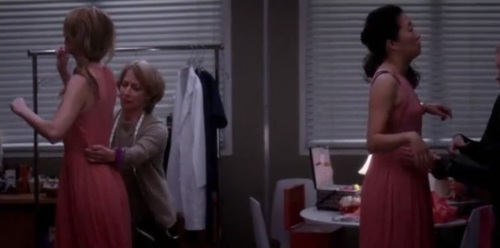
Business continues much this way until April’s wedding, in the episode “Get Up, Stand Up”, in which Meredith and Cristina are both featured as bridesmaids. During a dress fitting, Cristina takes issue with Meredith calling her “a horrible person, over and over… because I don’t want a baby”. Harkening back to their very first day on the job, Meredith accuses Cristina of sleeping her way to the top, while Cristina retorts that in her struggle to maintain work/life balance, Meredith’s “become the thing we laughed at.” By episode’s end, Meredith acknowledges her envy of Cristina’s surgical trial successes:

“I’m so jealous of you I want to set things on fire. You did what I tried to do and I couldn’t… I don’t want to compete with you… but I do.”

Come the shows’ mid-season return, Meredith and Cristina’s friendship is back on track, with them bonding over Meredith’s anger at her husband Derek reneging on their agreement to focus more on Meredith’s career upon her realisation that she doesn’t want it to slip by the wayside in the wake of motherhood. They do this while drinking wine and looking after the kids at Mere’s place while Derek’s out of town.

Derek’s absence throughout the season, in Washington D.C. on business at the behest of the President (I know!), is juxtaposed with Meredith’s desire to be an attentive mother, which she didn’t have growing up and was the cause of many of her ills, whilst balancing her first love of medicine. In last season’s “Beautiful Doom”, Meredith worries about leaving Zola in the care of others while she operates. Callie, a working mother herself, assures Meredith that “it’s good for Zola to see you work. It’s good for her to see you achieve. That’s how she becomes you.” The season finale sees Meredith decide to stay in Seattle despite Derek accepting a job in Washington D.C. She doesn’t want to become her father, who was a “trailing spouse” to her abovementioned mother.

grey's anatomy do you know cristina yang

As far as Cristina’s concerned, though, her ex-husband Owen’s desire for a family is what’s kept them in flux from on-again to off-again for the better part of the past three seasons. In the Sliding Doors-esque episode “Do You Know?” Cristina is given the option of two life paths: one in which she has children, whilst in the other she continues her focus on her career; both involve Owen, and both see Cristina becoming miserable. The married-with-children scenario elicits a certain empathetic desperation as it’s made clear Cristina’s only succumbing to it for her lover. And when Owen meets maternal-fetal surgeon, Emma, whom Cristina described as “picket fence; a dozen kids; fresh-baked goods,” it seems he’s found his happy ending. But Owen’s desire for Cristina, despite his better judgment, causes him to cheat on and subsequently end things with Emma who is befuddled at how her boyfriend went from house hunting to breaking up with her in the space of a day. Owen asserts it’s because Emma wanted to stay home with their kids when they had them and he wanted someone who is “as passionate about her work as I am.” Make up your mind, Owen!

While Owen’s indecisiveness is annoying, it’s refreshing to see a woman who doesn’t want children framed as desirable over the traditional portrait of womanhood. This is not to mention Cristina’s hardheaded drive. On the other hand, Emma represents the losing battle women face in the fight to “have it all” perpetually highlighted by the concern-trolling media: you’d better want to be a mother, but you’ve also got to be driven in your career; you have to be around to raise your children, but you’d also better be leaning in in the workplace.

Grey’s has always been a staunchly pro-choice show. Upon April and Jackson’s shotgun wedding, Jackson’s mother brings up the issue of April’s faith when it comes to raising their future children who will be on the board of the Harper Avery Foundation, but no pressure! Catherine Avery asks whether April believes in limiting reproductive rights, and whether she’ll raise her children with those views. If so, will that colour their judgment in providing funding to hospitals that perform abortions, like Seattle Grace/Seattle Grace Mercy West/Grey Sloan Memorial Hospital/whatever it’s called now?! And what about stem cell research?

Grey’s certainly doesn’t sweep these issues under the rug because it’s convenient for a storyline or for the show to remain politically unbiased. Rhimes has spoken about Cristina’s unintended pregnancy in a season one/two crossover storyline in which she was scheduled for an abortion but miscarried before she could have the procedure due to an ectopic pregnancy:

“… [T]he network freaked out a little bit. No one told me I couldn’t do it, but they could not point to an instance in which anyone had. And I sort of panicked a little bit in that moment and thought maybe this isn’t the right time for the character, we barely know her… I didn’t want it to become like what the show was about… And [Cristina’s miscarriage] bugged me. It bugged me for years.”

Come 2010/2011’s seventh season, Cristina again finds herself with an unwanted pregnancy to Owen. Rhimes said:

“I felt like we had earned all of the credentials with the audience. The audience knew these characters. The audience loved these characters. The audience stood by these characters. You know, we were in a very different place even politically, socially. Nobody blinked at the studio or the network when I wrote the storyline this time. Nobody even brought it up except to say, that was a really well written episode.”

With no signs of slowing down, but with perhaps one of TV’s most feminist characters departing, Grey’s Anatomy is sure to continue presenting women, work and the myriad choices in between in a positive and realistic way.

*Blanket spoiler alert.

Related: Grey’s Anatomy Final Asks “When Does Life Begin?”

Grey’s Anatomy: “You Killed Our Baby”.

Grey’s Anatomy: You’re Abnormal If You Don’t Want Children.

Cristina Yang as Feminist.

Elsewhere: [HuffPo] Elizabeth Banks Angers Parents of “Onlies”, Says She is “Really a Mom” After Having Two Kids.

[Time] Why 2014 Should Be the Year We Talk About Abortion on TV.

[Cosmopolitan] Why Cristina Yang Leaving Grey’s Anatomy Is So Devastating.

Images via TV.com, Grey’s Reviews.

Walk A Mile in Their Shoes.

In the wake of the Rolf Harris guilty verdict and sentencing, sexual abuse has been on the lips of many people.

Last week I happened to be privy to one such conversation, in which Oscar Pistorius, Ariel Castro and Harris were discussed. Pistorius was rightfully condemned but, as will happen when you’re in the company of much of the general public who take our patriarchal rape culture as gospel, these amateur sleuths discovered holes in the cases of Castro and Harris.

Because Harris wasn’t preying on children, but almost-of-age women, these people questioned the veracity of his victims’ stories. And the fact that another woman came forward with allegations against the former children’s entertainer after the verdict made them wonder why she would even bother or why she didn’t press charges.

Mia Freedman wrote last week of her encounter as a child with Harris, and how he tried to chat up her uninterested mother. She asserted that dirty old men have been rudely awakened in this day and age when what used to be excused as “touchy-feely” is now considered sexual assault.

The conversation then turned to Ariel Castro and his 11-year imprisonment of Michelle Knight (now known as Lily Rose Lee), Amanda Berry and Gina DeJesus. In addition to getting the facts of the case wrong (one person claimed the victims were all about 12 or 13 years old when they were kidnapped; in fact, DeJesus was the youngest at 14 years old, Berry was 17 and Lee was 21), victim-blaming was rife. They wondered why, if the victims were allowed free reign in the house and had been permitted outside (I don’t recall hearing or reading about this, but that’s not to say it didn’t happen), they didn’t just leave. From my understanding, Berry and DeJesus were given more freedom than Lee, who bore the brunt of Castro’s beatings, rape and torture. Plus, Berry had a child to Castro she would need to consider before attempting to escape. This is not to mention Stockholm Syndrome.

Someone wondered why the three women, upon rescue, seemed so normal; years of captivity would drive a person crazy, it was asserted. Firstly, I don’t believe the women seemed “normal” at all; we’ve hardly heard from DeJesus and Lee has been the most vocal about her abuse but it’s clear how affected she is by it. Secondly, when I interjected to say the women weren’t exactly children, so therefore had mental faculties that would serve them better in their fight-or-flight predicament, and that they had each other to lean on in the dire situation they found themselves in, I was shut down. Perhaps it was because I’ve heard this person say numerous times they hate to be alone and thrive in the company of others so couldn’t fathom only being in contact with three other people for 11 years, but the human body and mind have ways of adapting to such circumstances. Lee, Berry and DeJesus are a testament to that.

From here the conversation turned to domestic violence victims and, as we oft hear, “why they just don’t leave” and that “there would have to be some evidence of years of abuse” when victims are pushed to the brink and end up murdering their abusers. By this point I was livid and held myself back from saying what I am about to type lest I damage my at-arms-length but daily relationship with these people: intimate partner violence doesn’t just happen out of the blue. It’s not like one day your loving, equal partner snaps and hits you and that’s it: you leave them (although I’m sure there are a small amount of cases like this, the vast majority of abusers have a pattern of behaviour prior that results in violence).

While I’ve never been in an abusive relationship myself, I watched my parents engage in one for 22 years—a relationship that became violent long before that.

Abusers isolate their partner from their support system, severing contact with family, friends and the workplace, and thereby finances of their own, so that when the violence begins the victims have nowhere to turn. My mum was a stay-at-home parent and engaged in several small businesses with my father so she was completely financially dependent on him. My dad would even work three jobs while my mum stayed home which I’ve only just deduced was probably his attempt to keep her as his dependent. I watched my mothers’ friends and family come and go, oftentimes due to altercations about my father. She told barely anyone and never went to the cops or the emergency room; there was no point if she couldn’t leave. I think I remember Mum telling me once that her mother-in-law tended to her cut face and neck after my father glassed her. He abused her whilst she was pregnant with me, and I can count at least ten other times I witnessed violence before the age of 12.  Around that time it stopped, but that was when the years-long break-up, make-up back-and-forth began and didn’t end until I was 22 and my father finally moved out of the familial home. My sister and I followed soon after.

I blamed my mother a lot for “not just leaving”, as the abovementioned gaggle of armchair commentators would say, and I still harbour resentment towards her for exposing her children to a violent relationship. But as I’m exposed to more and more women’s stories of violence, I come to understand my mother’s circumstances more and more. I only hope that as these cases continue to come to light, the ignorant among us can become just a touch more enlightened about other people’s lives.

Elsewhere: [MamaMia] Mia: “I Met Rolf Harris When I Was About 8 or 9.”