Jennifer Hawkins VS. Miranda Kerr.

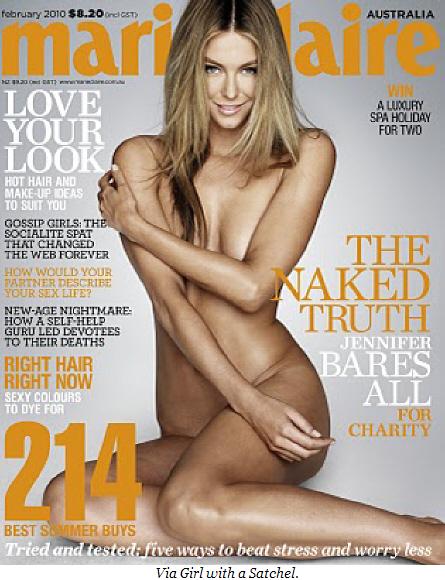
Following on from last week’s post reflecting on Jennifer Hawkins’ nude cover for Marie Claire, I started thinking about the flak Hawkins received for it.

Why was Hawkins vilified for daring to bare her unairbrushed body, knowing full well the potential criticisms that could come with it? Just because she’s a hot model doesn’t make her any less qualified to comment on the body image debate.

Another prominent Australian model who gets her kit off, but at a far more frequent rate than Hawkins, is David Jones ambassador Miranda Kerr.

While Hawkins’ employer Myer may have come out on top in the wake of the David Jones sexual harassment case, Kerr seems to be the model who came out on top, continuing to bare her baby belly in all the publications.

Demi Moore, Christina Aguilera et al. have proved that the pregnant female is a creature of beauty; one that should be celebrated on all the glossies. The same is true for Kerr, whose bump has spent a great deal of time in the limelight: she announced her pregnancy in Spanish Vogue in September, paraded down the Balenciaga runway at five months along, and was the first pregnant cover model for Vogue Australia. In addition, she shunned Demi and Christina’s cover-ups and went completely starkers for W’s December issue.

Frankly, I’m a bit sick of Kerr, her baby bump and her bits. It seems you can’t open a magazine or blog post without seeing her naked body plastered all over it, even before she got knocked up. Sure, she’s nice to look at, but if you’ve seen her once, you’ve seen her a million times.

So why is it that Kerr can get her kit off every second week and be celebrated for it, while Jennifer Hawkins, who posed for Marie Claire for charity, and whose private bits we are yet to see, was chastised and her star somewhat faded since the incident?

Can someone answer that for me?

Related: One Year On: The Jennifer Hawkins/Marie Claire Scandal.

One Year On: The Jennifer Hawkins/Marie Claire Scandal.


Here are my thoughts on the topic in the form of a (edited) comment on  a since-deleted post on Girl with a Satchel:

“This really is a double-edged sword, huh? All magazines are a medium that can make you feel bad about yourself only if you let them, which I agree with 100%.

“I don’t believe the media is the ‘hypodermic’ needle we all heard about in media studies at school; turn off the TV or don’t buy the magazine if you believe they facilitate negative body image.

“However, my first thought when seeing the Jennifer Hawkins cover, was ‘oh, her thighs are obviously her problem area. There are a few shadows there and some discolouration’. HORRIBLE, I know, but it just goes to show that I, along with almost everyone out there, am a product of our perfectionist culture and our unrealistic expectations of women.

“Now, in reality, Hawkins looks AMAZINGher face is stunning, her chest and torso look toned and terrific, and if I had her thighs, all my problems would be solved (according to the hypodermic theory, at least). I don’t agree with all the negative comments out there regarding Hawkins as unrealistic and damaging to women’s self-esteem. Nor do I agree with those who say porn stars, strippers, prostitutes, bikini and lingerie models, supermodels, catalogue models, plus sized models, regular girls on the beach or in the club or on the street who are scantily dressed or ANY WOMAN who enjoys flaunting her best assets are victims of objectification by the media and the male species’ desire to view women as sexy playthings and nothing more.

“I regard myself as a feminist, however, and feel that if any woman is proud to show off their bodies, faces, brains, WHATEVER, then that’s empowering and I say to them, ‘you go girl!’.”

My feelings have stayed much the same as I look back on the controversy from a more enlightened perspective, having been reading a lot more and writing blog posts on such topics in the past nine months (I could have had a baby in that time!) that The Scarlett Woman has been out there in the blogosphere.

Satchel Girl Erica Bartle responded to my comments above, saying that “I don’t think any woman should be excluded from the body image debate on the grounds of her appearance,” even a “hot model” like Hawkins.

This sounds a lot like the arguments that were put forth at the “Feminism Has Failed” debate which I attended a few months ago, and have blogged quite often about here:

“Controversially, [Gaye] Alcorn referenced the Body Image Advisory Board and its chairwomen, the ‘gorgeous’ Mia Freedman, Sarah Murdoch and Kate Ellis, saying that of course they had beautiful women to front the campaign, because it wouldn’t have gotten any publicity with Plain Janes. Out of everything the affirmative team said, this was the only thing I took issue with. ‘Like, sorry those women happen to be genetically blessed, but they have as much right to talk about body image and beauty as a less fortunate-looking woman does. You can’t help the way you’re born,’ I said to my friend, who satirically replied, ‘Well, it’s about beauty, hello?!’ Gold.”

Another argument from the affirmative team harkens back to Bartle’s point: Hawkins “can’t be all things to all women”, just as “feminists can’t be accountable for all feminist issues at all times”.

Again, just because Hawkins looks the way she does doesn’t give the general public the right to criticise her for her decision to pose un-airbrushed for Marie Claire, nor does it give them the right to speak about her body as if she is somehow disconnected from it; as if a celebrity’s body becomes public property.

I’m not sure what the “publicity stunt” has done for body image in Australia one year on, much like the publication of Lizzie Miller’s plus-sized tummy in UK Glamour last year. Personally, though, Hawkins’ show of body love has ignited in me the courage to stand up for others who are objectified for their smaller size (just as I would for a larger person), and Miller’s pot belly instilled acceptance of my own.

Related: Has Feminism Failed?

Body Image: Skinny-Shaming VS. Fat-Shaming.

Elsewhere: [Girl with a Satchel] Girl Talk: Glamour Gives Good Belly.

[Let’s Drink Tea & Get Laid] The Lies That Link Us Together.
Lindsay Lohan & Double Standards.


From Vanity Fair, October 2010:

“We started talking about the double standards for famous men and women who misbehave. ‘It’s the same with men being dominant in the world and getting the easy way out and getting a free pass consistently,’ Lindsay said. ‘Like, if a man cheats on his wife… It’s not okay… But they still keep their deals, they still keep their contracts, they still keep their roles, they still get their gigs…’

“‘With girls,’ Lindsay said, ‘you lose. You lose everything. You lose contracts, you lose…’ She shook her head.”

A certain Charlie Sheen comes to mind…

Related: Guilty Until Proven Innocent: Charlie Sheen’s Witness.

Good-Time Girls.

Poor Little Rich Girl: Lindsay Lohan in Who.

Why Are Famous Men Forgiven for Their Wrongdoings, While Women Are Vilified for Much Less?

Bad Boys, Whatcha Gonna Do? Host a Seven Family Show.

It’s All About Popular… Lar, Lar, Lar, Lar!

From this weekend’s Good Weekend in The Age, in an article by Tom Ballard entitled “Too Cool for School”:

“If Footyheads are the oafish kings of high school, Popular Girls are assuredly the vapid queens. Deemed ‘The Plastics’ in the 2004 film Mean Girls, this clique is made up of attractive females who are attractive and wear make-up and are attractive and giggle and are attractive and fully hot.

“The members of this group are often the first among their peers to produce any inkling of breast and to discover foundation. Their classroom catch cry“So, like… what are we doing?”is well known and feared.

“Popular Girls enjoy chewing gum, looking vacant and protesting about the confiscation of jewellery. They feed on expensive formal dresses. They’re really, really popular.”

Examples of the Popular Girl in Popular Culture include, as Ballard mentioned, the Plastics in Mean Girls; Cher Horowitz of Clueless, who sees the light in the end; Louise from ’80s cheese fest Teen Witch, who gains popularity from a supernatural amulet; and “good” witch Galinda from Wicked, who tries to make over the self-conscious and “green” Elphaba during the musical’s “Popular” tune, from which the title of this post was derived.

Related: Women in Fiction: My Favourite Fictional Females.

Women in Fiction: Are Our Favourite Fictional Females Actually Strong, or Stereotypes?

The Kim Kardashian Backlash.

I sense a backlash coming on. Specifically, a Kim Kardashian backlash.

Personally, I love the girl. I think she’s sweet, with good intentions and a savvy business sense. But seriously, I am over seeing her on every magazine cover every week. She’s like the new Jennifer Aniston.

We don’t care about how she’s 30 and single and desperate, Who. So is half the population (and this is based on actual statistics that I pulled from out of my ass). I’ve got my own problems; I’m 23 and single and desperate, but you don’t see me on the cover of a weekly moaning about it. (No, but I do moan about it on this here blog!)

Only a few short months ago, Kim was the apple of Famous’s eye, guest editing an issue in May. Now she’s on its cover again, which is espousing the alleged demise of their TV show (although, which TV show Famous is referencing is unclear. Could it be Keeping Up with the Kardashians, Kourtney & Khloe Take Miami or Kourtney & Kim Take New York? Oh, the possibilities!) in the wake of the release of their new book, Kardashian Konfidential.

On a side note, are the Kardashian’s really in the position to be releasing a self-help book of sorts? Khloe isn’t exactly the poster girl for responsibility; she was jailed for drink driving and married Lamar Odom after a month of dating (well, they are still together over a year later, so maybe irresponsibility is the key?). While Kourtney has been blessed with baby Mason, she will be forever cursed by baby daddy, Scott Disick, one of the forefathers of douchebaggery. (More on that to come tomorrow.) And Kim is 30 AND SINGLE! Who is she to be giving advice?

The Kardashian’s are famous for being famous. I think Kim’s biggest claim to fame before turning herself into an über-celebrity was her sex tape and being Paris Hilton’s BFF, who then later likened Kim’s ass to a garbage bad full of cottage cheese, which isn’t very BFF-like. And we all know what happened to Paris: she went to jail and while she was released just weeks later, her pop cultural relevance rotted there.

If you’re not careful, Kim K, you might suffer the same fate. And nobody likes cottage cheese that’s been left out too long.

Magazines: Goodbye TV Hits, It Was Nice Knowing You.


The first magazine I ever bought was TV Hits.

I remember sticking posters of Jonathan Taylor Thomas, George Michael and Dean Cain of Lois & Clark fame on the wall of the room I shared with my sister.

I remember knowing the words to every Top 40 song that was released from about 1996 to 1999 (when I graduated from primary school and onto Dolly), thanks to the lyric card cut-outs each edition came complete with, which comes in handy for ’90s themed dance nights.

I remember hiding my latest copy under my desk at school and reading it cover to cover during class, then again when I got home.

I remember friends commenting that they were jealous of me for being a walking Wikipedia for all things celebrity.

TV Hits was where my love affair with pop culture began, and I was known to lose sleep waiting for the latest issue to come out the next day. My mind was a sponge back then, and after much sorting, I can usually recall some of that info.

But Girl with a Satchel reports that TV Hits is to fold, and while it has become a shadow of the magazine Mecca it once was, its nostalgic influence makes me sad to see it go.

But with blogs and mobile phones and Twitter and what not, the tween music mag has become obsolete. While back when I was its number one fan, the mag was much more of a TV Week meets the entertainment section of Famous or NW publication, it had devolved (evolved?) to strictly music, with a little bit of light TV and movies on the side.

The news comes at a time when fellow Australian mag Notebook: has released its final issue, highlighting the fact that unless a magazine is selling desirable numbers year on year, month on month, week on week, and if similar content is available elsewhere (online), there’s no place for it on the newsstand.

So, in honour of TV Hits, let’s break out the Spice Girls-style platform sneakers, spin some Best of 1998 albums and trek to the Reject Shop for some hair mascara and butterfly clips, and party like it’s 1999.

Elsewhere: [Girl with a Satchel] TV Hits R.I.P.

[Girl with a Satchel] A TV Hits Clarification.

Magazines: Disturbing Behaviour—Terry Richardson Does Glee.


Über-inappropriate fashion photographer Terry Richardson has done it again, using his magic creepy touch on the cast of Gleeor rather, the most vanilla cast members from Glee, Cory Monteith (Finn Hudson), Dianna Agron (Quinn Fabray) and Lea Michele (Rachel Berry)to turn them into “porny” high schoolers to rival Britney Spears in “Baby, One More Time” (which Michele did a cover of, complete with schoolgirl tartan and feathers in her hair, on the “Britney/Brittany” episode) for the November cover of GQ.

Seriously, when will people stop employing him to work with subjects who, granted, aren’t underage but portray underage characters on a family show, when he is a known predator of underage and vulnerable women?

And does anyone else find Michele extremely offputting, in more ways than one? Or is it just me?

Related: The Underlying Messages of Glee’s “Britney/Brittany” Episode.

Food Fight.

Elsewhere: [GQ] Glee Gone Wild.

[Jezebel] Terry Richardson Makes Glee All Porny.

Magazines: Twenty-five to Life—Elle’s Favourite 20-Somethings.

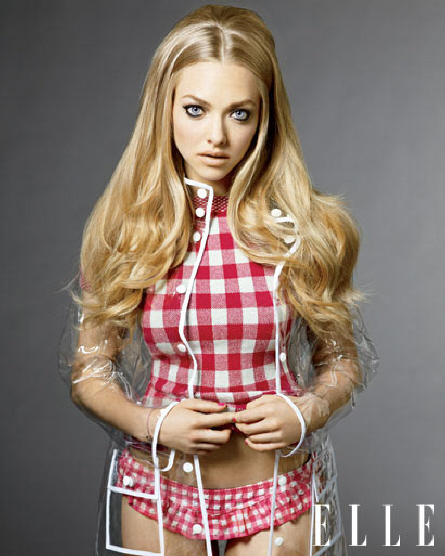
Needless to say, Lindsay Lohan won’t be making the list, but some others include Gabourey Sidibe (and the accompanying scandal), Lauren Conrad, Megan Fox, and Amanda Seyfried, who grace the cover of the mag in four separate newsstand editions, and then again inside. Here, take a look for yourself…

Related: Poor Little Rich Girl—Lindsay Lohan in Who.

Elsewhere: [Jezebel] Gabby Sidibe’s ELLE Cover is Another Reason Why Black Fashion Directors Are Necessary.

Magazines: Poor Little Rich Girl—Lindsay Lohan in Who.


Who’s feature on Lindsay Lohan’s fourth trip to jail (albeit for less than a day), and the accompanying four mug shots, paints a bleak picture.

While I think Lindsay is a great actress and has the promise to really shine onscreen, I do believe she has massive psychological issues stemming from her upbringing, the burden of a career as a child star and subsequent foray into the Hollywood drug and party scene.

She was obviously coddled by her parents and, later, her minders, managers and enablers so that, at age 24, “she can’t stand to be alone, ever” at a time in her life when she should be taking responsibility for her actions and turning into a true adult.

A recent article in The New York Times Magazine that deals with the Gen Y/“20-something” stigma, aptly titled “What is it About 20-Somethings?”, asserts that those “who don’t have an emerging adulthood” (from ages 18-25, which involves finishing school, moving out of home, becoming financially independent all of which Lohan has done and, traditionally, getting married and having children [factors which aren’t so paramount nowadays] but, especially, making mistakes and learning from them on your own), like Lohan, “might face developmental tasks identity exploration, self-focus, experimentation in love, work and worldview” may manifest themselves in later life, as a mid-life crisis, for example.

“Emerging adulthood must be both universal and essential,” because “if you don’t develop a skill at the right stage, you’ll be working the rest of your life to develop it when you should be moving on… The rest of your development will be unfavourable altered.”

Perhaps one of these skills is appreciating alone time, not only in superficial terms, like spending a day at home by yourself engrossed in a good book, a movie marathon, or spring cleaning, but in terms of reflecting on your experiences and, again, learning from them.

Clearly, Lohan has not learnt from her mistakes involving drugs and alcohol, with five stints in rehab in addition to her four in jail.

“What is it About 20-Somethings?” mentions the Yellowbrick residential program in Illinois, whose “philosophy is that young people must meet these challenges without coddling or rescue.”

While some rehab programs try to nip undesirable behaviour in the bud, Yellowbrick does the opposite: “We want the behaviour to unfold, and we want to be there in that critical moment, to work with that behaviour and help the emerging adult transition to great independence.”

A common belief in opposition to the “Lindsay Lohan needs help” mentality is that she’s still young, and for a lot of normal (re: out of the spotlight) young people, her behaviour is conventional. If so, this behaviour is unfolding naturally, and hopefully she will grow out of it. After all, she does have one more year left of “emerging adulthood”.

Elsewhere: [NYTimes] What is it About 20-Somethings?

[Jezebel] In Defence of Lindsay Lohan.

It’s All About Britney, Bitch!


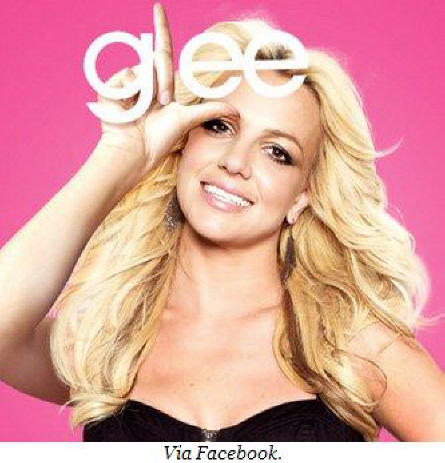
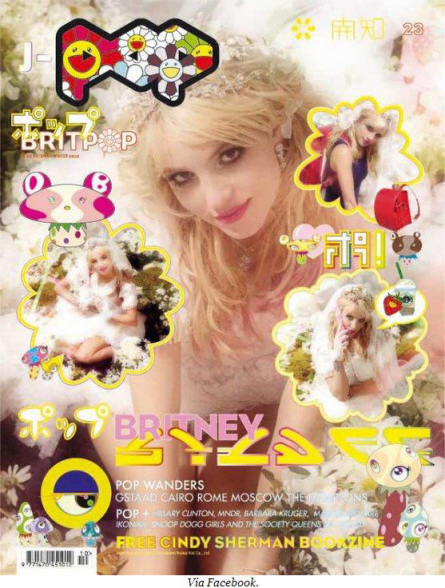
Britney Spears is everywhere at the moment: making a cameo on Glee tonight, and tarting it up, kinderwhore-style, on the cover of Japanese magazine Pop.

Maybe, if she had timed this exposure when she had “Circus” to promote, it would have lifted the tour from lip-syncing non-event to rival the Britney-hysteria that once engulfed the world.

But, being the only “diva” a Glee episode has been centred around (the others being Madonna and Lady Gaga) to actually appear on said episode, this is probably one of the best career moves Britney has made.

It is questionable, however, if Britney was fully aware of the social commentary she was engaging in when posing for Pop.

Elsewhere: [The Style Rookie] Kinderwhore Britney.