Magazines: Vogue Schmogue—Why US Vogue Ain’t Everything it’s Cracked Up to Be.


Lately I’ve been thinking about the conglomerate that is US Vogue.

If The Devil Wears Prada is anything to go by, hundreds of thousands of dollars are wasted on ample, professionally decorated office space, shoots that will never make it into the magazine, catering and gifts to pander to the fickle fashion industry.

Sure, Vogue is the foremost fashion magazine the world turns to to see what’s hot and what’s not, so they can afford to be a bit hoity-toity, right?

Well have you looked at a copy of US Vogue lately? The last one I bought was earlier this year, when I got a bit caught up in the hype of Sex & the City 2, with the movie’s star, Sarah Jessica Parker, on the cover. What a waste of money: if I’ve ever felt buyers remorse over a magazine, it was then.

The only other copies I own of the US edition is Blake Lively’s first outing on the cover, and the Michelle Obama edition, for obvious historical/social/cultural reasons, and both were fairly lacklustre.

So why does the title command such attention and reverence in the fashion industry, when other mags like rivals Harper’s Bazaar and Elle, and quirkier titles like NYLON, clearly possess higher qualities of writing and, oftentimes, fashion. Blasphemous, I know, but someone had to say it.

Personally, I think it might be time to employ a new editor. Anna Wintour has been at the helm for twenty years, and perhaps she’s overstayed her welcome. Sure, there have been some great fashion shoots by the likes of Peter Lindbergh and Annie Leibovitz, but if that’s all the mag has to offer (most of which you can access online), what’s the point of buying it?

A recent interview with Vogue creative director, the flame haired right-hand woman to Wintour, Grace Coddington, in Australian Vogue, made me wonder if she isn’t better suited to the editorship. She has an impeccable eye for composition and a quirky touch, something which the über-polished and stony Wintour does not.

But perhaps we should be looking to a younger, fresher take on the magazine, hence, a younger, fresher editor. Coddington is pushing 70 and god knows how old the elusive Wintour is. (A Wikipedia search reveals she turns 61 on November 3, one day after my birthday, but I liked the way the previous sentence sounds!) The staleness of the brand is evidenced by the same old cover girls, Lively, Sienna Miller (who fronted last year’s September issue) and Keira Knightly, actresses whom nobody really cares all that much about. The magazine’s effort to inject some much needed diversity saw the boring Halle Berry take the September issue’s cover, the first black woman to front it since Naomi Campbell in 1989! (Somewhat of a token gesture, perhaps?) Carey Mulligan is on the October cover, and while she’s definitely a step away from the usual Vogue-ette, she’s still a bit of a yawnfest.

Magazine retailer mag nation also laments the September issue, in that it is really the only popular edition of the title all year, and in order to make sure they have enough stock come August, they become overstocked with issues consumers don’t want because of three-monthly ordering increments.

While there’s no doubt US Vogue will always hold a spot on the newsstand, it seems as though today’s Vogue is a mere shadow of what the brand once was. A nice token, but if you’re looking for style and substance in your magazine, try Marie Claire.

Elsewhere: [Jezebel] Vogue Might Just Be Culturally Relevant Again.
[mag nation] Why is The September Issue a Big Deal?

Newspaper Clipping of the Week.


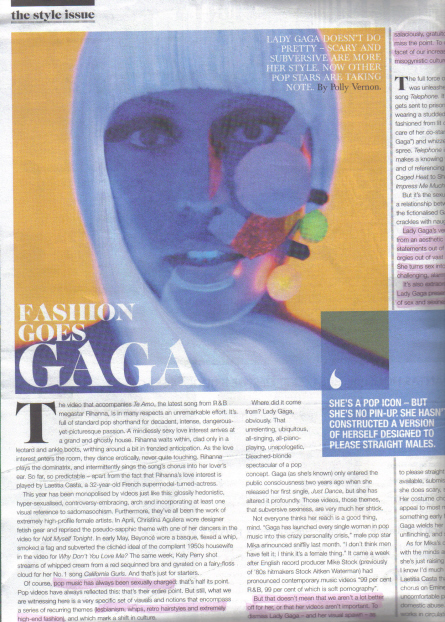
In Sunday Life’sStyle Issue, new editor Sarah Oakes’ Midas touch is already evident.

Especially in commissioning the piece “Fashion Goes Gaga” by Polly Vernon, in which Vernon argues that “pop music has always been sexually charged”, referencing Rihanna’s “Te Amo” and Gaga wannabe (which I don’t agree with) Christina Aguilera, just not in the way that Lady Gaga has revolutionised it. Vernon says, “To dismiss Lady Gagaand her visual spawnas salaciously, gratuitously, unnecessarily sexual is… just plain wrong.”

True, because “Gaga’s version of sexuality is extraordinary from an aesthetic perspective. She makes fashion statements out of gimp masks and gaffer tape, and orgies out of vast synchronised dance segments. She turns sex into camp theatre, and the result is challenging, alarming, powerful and exciting”: a far cry from “the cynical, soulless titillation of your average Britney Spears video.”

But with the mention of gaffer tape and gimp masks, it sounds more like a certain Aguilera effort than Britney, doesn’t it? ;)

Related: Everything They Touch Turns to Gold.

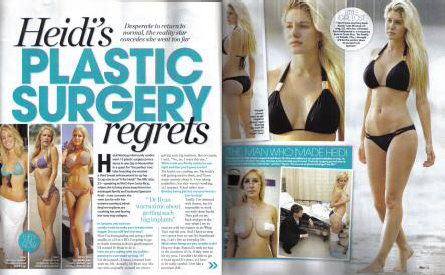
Magazines: Poor Little Rich Girl—Who Cover Girl Heidi Montag.


I’ve blogged in the past about how sorry I feel for Heidi Montag. And now, apparently, she feels sorry for herself after undergoing ten completely unnecessary plastic surgery procedures in one day.

It was only a matter of time before regret seeped into her consciousness and , once again, Montag’s expressing it publicly.

Seen on the cover of Who with bandages covering her nose, Michael Jackson-style (whom she references in the accompanying article, saying “I don’t want my face to fall off like Michael Jackson’s), and dark roots (“I’m just done worrying about my looks. I haven’t died my hair for months and I hardly even put on makeup anymore.”), it seems Montag has had a change of heart.

Unfortunately, there’s no going back, and with her plastic surgeon, Dr. Ryan, dying in a car accident last month, it looks like there’ll be no amending the work of her beloved surgeon by the man who created Heidi 2.0 (well, actually, 3.0, as she had a nose and boob job a few years ago after she first started on The Hills and, incidentally, met über-douche estranged husband Spencer Pratt).

Related: Why Are Famous Men Forgiven for Their Wrongdoings, While Women Are Vilified for Much Less?

The Hills Have (Dead) Eyes.

Is RUSSH the New Vogue? A Comparative Analysis of Their September Issues.


I’m not much of a RUSSH fan; I find it a bit too pretentious for it’s own good. Vogue, however, can afford to be pretentious because it backs itself up with flawless fashion and high quality essays. However, I don’t usually find it to be so.

But this month I swallowed my pride and purchased RUSSH, primarily because of its review on Girl with a Satchel, but also because a small-time Australian magazine landed one of fashion’s (okay, lingerie modelling’s) hottest commodities, Alessandra Ambrosio, for its cover, and because of the “Come Back Kerouac” feature on books and reading.

While nothing beats Alice Cavanagh’s musings on the survival of novels “in the age of the small screen” (worth the $9.95 cover price if only for that), other Vogue-esque long-form essays include “Bohemian Like You” on the gypsy jet-setthe gypset; in an ode to “The Art Issue”, Danielle Top illustrates “The Artist’s Way”, “a practical guide to making your mark” which I don’t necessarily think works for me, but some acquaintances have had success with in the past; a profile on RUSSH’s favourite artists, including Anaïs Nin, Allen Ginsberg and Robert Mapplethorpe in “We Want You To Love Them Like We Do”, as well as “the most ground-breaking and… sought-after artist of our generation”, Ryan McGinley; and finally, in very Vogue-like fashion, Jess Blanch deals with burning the candle at both ends inwhat else?“Both Ends Burning”.

In terms of fashion, there is a small accessories feature in the front of the book, followed by Alessandra Ambrosio’s shoot, which merges “street chic with a ballet-esque fragility”, but it’s got nothing on Vogue in this respect. Cover star Catherine McNeil is rife throughout Vogue, channelling a ’50s sex kitten in Louis Vuitton, Prada and Dolce & Gabbana’s figure-hugging frocks in “A Fine Romance”, and a punk rockabilly meets West Side Story meets Grease charm in “Pretty Baby”.

And article-wise, Vogue takes the cake yet again, with “Is Fashion Art?” (an inadvertent dig at RUSSH, perhaps?), the pros and cons of having close male friends and if it can ever just be platonic, in “The Opposite of Sex” and, my favourite (as I always love a beauty debate), “The Beauty Bubble”, in which beautiful women like Nicole Trunfio and Noa Tishby discuss the perils of being beautiful. Seriously, though, it is a though-provoking essay, and Trunfio comes up with some surprisingly deep insights on being a model: “I do think models get away with a lot, but it’s not necessarily the important things in life… But not for long, because outer beauty does not last…”

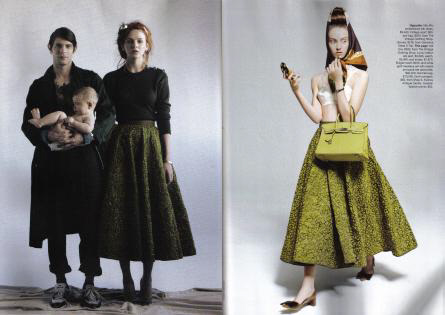
And how’s this for a coincidence? Both RUSSH and Vogue feature the same patterned green Louis Vuitton skirt this month. I have to say, I prefer RUSSH‘s take on the garment (left), but the Bible’s version is quintessentially quirky Vogue (right).

The overall winner is, hands down, Vogue, for its flawlessly executed fashion, impeccable features and it’s ability to “feed”, as Carrie Bradshaw would say, but I was surprisingly impressed by RUSSH’s take on art, fashion and knowledge.

Newspaper Clipping of LAST Week.

So I’ve been a bit behind the eight ball this week, what with moving to my new digs in Richmond and all. But I thought the time had come to stop staring out the window at my fabulous view of the city and catch up on some work.

This last week’s newspaper clipping comes from Sarah Wilson’s Sunday Life column. In it, she discusses the perils of sitting down with a good book and actually reading it, as opposed to skimming, which the internet has taught us, what with emails, blogs and the infinite amount of useless information out in cyberspace.

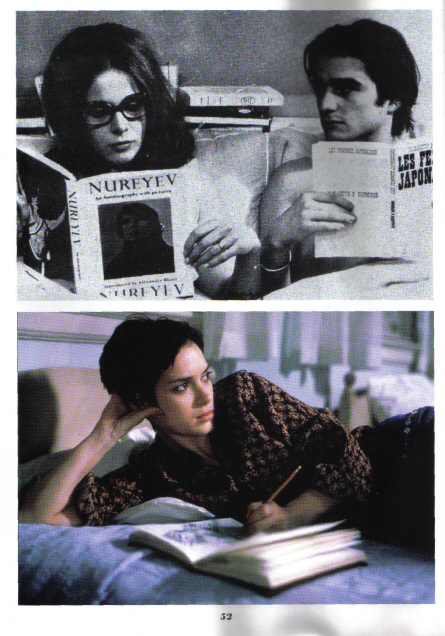
In the vein of “slow cooking”, “slow reading” doesn’t involve “reading words at a snail’s pace with a ruler”, but “reading fully… and allowing time for dissecting arguments and reflective response”.

This is something I sometimes struggle with, as I feel there is just so much knowledge to be absorbed, and I’m never going to take it all in. Recently, I had so much on my mind (read: moving house) I managed to read the whole of One Flew Over the Cuckoo’s Nest without actually comprehending any of it. Dismal review pending.

In other clippings news, I loved The Age’s resident “Bookmarks”compiler Jason Steger’s take on Bret Easton Ellis’ talk in Melbourne recently. Instead of asking about the “inspiration” behind is disturbed characters, which he famously prefers not to divulge, audience members asked such off-beat questions as, “Who… would win in a tag team wrestling match between Christian Bale and Patrick… Bateman [of American Psycho] and Ellis and James van der Beek, the actor who played Patrick’s brother in the film of Ellis’ novel, The Rules of Attraction.”

No wonder tickets sold out in seven minutes!

Review: Time Magazine’s “What Animals Think” Issue—August 16, 2010.


I’m a sucker for a puppy, which adorns this week’s Time cover.

And the accompanying article, “Inside the Minds of Animals” by Jeffrey Kluger, doesn’t disappoint.

It opens with the author’s “coffee date” with Kanzi, a talking bonobo with a vocabulary of officially 384 words, “though he probably knows dozens more”. Kanzi is able to asks for hugs and kisses, which he likes, and understand the concept of pointing which, aside from humans, really only dogs “understand innately” and “seems simple, but only because we’re born with the ability”, which bonobos are not. Kanzi also understands tenses in words (“concept words like from and later”), which is a breakthrough in itself, aside from the fact that AN ANIMAL IS SPEAKING!

The article asserts that humans treat animals differently because they can’t “understand” and are possibly not even conscious (potentially the butterfly, cockroach and bivalve [oysters, muscles, clams]); but now that certain species are mastering human language how does our perception of them change?

Most agree that dolphins and great apes are the smart ones, being able to recognise their image in a mirror, which indicates a degree of social awareness, in addition to social carnivores like pack dogs. The proof is in the pudding when it comes to some of the experiments the article mentions, as well as in everyday life in the example of aid dogs. I was particularly touched by the mourning expressed by elephants when one of their herd dies, and the “respect” they exhibit “when they encounter elephant bones, gently examining them, paying special attention to the skull and tusks”.

But don’t just take my word for it; pick up a copy for yourself or see the online extract. Trust me, food for though.

Elsewhere: [Time] Inside the Minds of Animals.

Newspaper Clipping(s) of the Week.

This week’s choice newspaper clippings come from The Age‘s Sunday Life supplement (Eye of the Beholder, August 8, 2010) and Good Weekend (Calendar Girl, August 7, 2010), respectively.

Calendar Girl, written by Virginia Heffernan, deals with hard-copy diaries like Filofax and the like versus the iPhone and Blackberry’s digitised versions. This is something I struggle to consolidate in my life, as I am an über-fan of stationary, but I just don’t have room in my life for physical lists, schedules etc., when the digital option is right there.

Sometimes I get a bit sick of talking about body image (what with the multitude of blogs, magazines and articles I read each week, as well as the issue being a common theme in my blog posts), but William Leith’s article, Eye of the Beholder, looks at it from a different angle. Why do women look “at a model and fall apart”, while men “shrug off [their] own belly”? Thought provoking stuff.

(Sorry about the crappy formatting—my scanner prefers A4 sized documents.)

Magazines: Everything They Touch Turns to Gold.


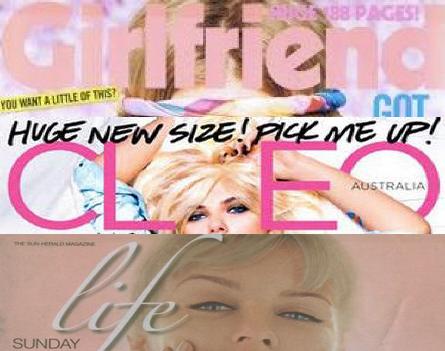
Sometimes I look back at some of my favourite editions of magazines like Girlfriend and Cosmopolitan and think, they’re not what they used to be.

Don’t get me wrong, they’re still great mags changing the glossy face of Australia, what with Girlfriend’s Girlfriend of the Year, Think. Do. Be. Positive and I Delete Bullies and Cosmo’s Body Love campaigns.

My favourite issue ever of Girlfriend (and at almost 23, should I even be reading this magazine anymore?!) was back in November 2007, with Indiana Evans fronting the mag.

And, while I will always be a Cosmo girl, I’m struggling to get as excited about the mag as I was when I first started reading it seven years ago. I was lucky enough to get a taste of Mia Freedman’s editorial skills before she left the mag soon after, and have been a sucker for her ever since.

Only now am I starting to put the pieces of the puzzle together as to why Girlfriend, in particular, meant so much to me during that time.

Erica Bartle, creator of Girl with a Satchel and former Girlfriend staffer herself (more on that in a minute), recently blogged about current Cleo editor Sarah Oakes’ resignation and subsequent appointment as Sunday Life (Fairfax’s Sunday newspaper supplement) editor, and thank God she did!

I am now able to prepare myself to love Cleo a little less, and Sunday Life a little more. Much like falling out of love with Girlfriend around the time Oakes left, and falling fast for Cleo, especially following its recent redesign.

For my money, Oakes is the next Freedman, and I will buy anything she puts her name to.

I became familiar with her whilst she was editing the teen mag, which I began to read again at about age 18. Admittedly, I was out of the mag’s target audience age range, but the left-of-centre features, quirky crafts and “Click It” pages exposed me to a whole new internet world, comprising of Etsy stores, Gossip Girl fashions, creative projects and so much more.

Back when I was pursuing my magazine dreams, Girlfriend was a mag I wanted to internand eventually be paid to workat.

Then Oakes moved over to Cleo, and I immediately felt the shift in the quality of the content. Cleo used to be a magazine I felt I’d wasted my money on after purchasing, but it slowly surpassed all other magazines on my must-have list. I’ll be sad to see her leave, but glad that I now get my Sarah fix weekly, and for free! (Well, at the low $2 price of The Age.)

It’s no secret that the aforementioned Girl with a Satchel is a blog I frequent regularly; a blog that I have written for, and a blog that inspired me to start my own.

I think Bartle is a clever, self-deprecating and an “everywoman” writer, perhaps in the vein of Oakes and Freedman. Considering Bartle worked on Girlfriend during Oakes’ editorship, it’s hardly a surprise. (As I said, I have a soft spot for the “Click It” pages, which Bartle was responsible for compiling.) She has a knack for making the reader feel like they’re besties, or BFFs, or whatever it is the cool kids call it, and although I would merely call us sometime-collaborators/fellow bloggers, I sometimes wish we were.

Its no surprise the magazine world is a small, incestuous little family, and the same names usually pop up all over the place, from ACP to Pacific, and now, to the blogosphere. (As Bartle writes, Cosmo features editor Caelia Corse is now heading over to Women’s Health, which is edited by fellow former Cosmo girl, Felicity Harley nee Percival.) And I think it’s safe to say that the output of quality writers that readers can relate to may be due to the nurturing and mentorship of some great editors; in addition to the Oakes-Bartle dynamic, Lisa Wilkinson was the editor of Cleo when Freedman got her break, who then went on to mentor Harley and Freedman’s successor Sarah Wilson at Cosmo, and Wilson’s successor, current Cosmo editor Bronwyn McCahon. Phew!

As much as many people who write-off the magazine industry as fashion, beauty, diet and pop culture poppycock (many of my friends do, but they read this blog anyway ’cause they love me!), there’s no denying that it does attract many of Australia’s best female (and male) writers, and with the help of the seasoned and talented editors who’ve come before them, there’s certainly a bloodline of glossy (and bloggy, and newspapery) flair that is being secreted by the Australian magazine industry.

Event: Get Him to Rod Laver.

Who, out today, features a double-page spread on comedic bad-boy and star of upcoming Get Him to the Greek, Russell Brand, whom I was lucky enough to see live at the Rod Laver Arena, Melbourne, on Wednesday night.

As my hairdresser said, she’ll “wait for the DVD” to come out to get specifics on his hilariously inappropriate show, which I think is wise for all you Rusty fans, as I could never do his jokes justice.

However, here’s a taste: his 2008 and 2009 MTV VMAs hosting gigs, the rivalry between Melbourne and Sydney, and Twilight and it’s relationship to “that time of the month” were all taboo topics on the cards.

Brand also used his fiancée, Katy Perry, as comedic fodder, which the Who article centres on.

Of how the pair met, Brand says, “She was so rude… I was showing off in front of some people and she threw a bottle at me! I didn’t understand. Who was this girl taking the piss out of me in front of all my friends? It was hypnotic.”

“His romance with Perry ‘has brought out the protective side in me… I had no idea I had it in me’.”

Brand continues, “as long as she’s happy, I will be happy… It’s part of my agenda to make this woman extraordinarily happy. Most things that I really want, I’m pretty diligent about getting.”

As for the woman who pointed her daughter out to him as he made his way through the crowd, Brand asked, after this extremely graphic closing skit centred around anal sex, “aren’t you glad you pointed her out to me now?!”

The Seventeen Magazine Project


This one came to my attention via daily e-newsletter I Heart Daily, as well as Girl with a Satchel, and I thought it was such a novel idea that I just had to check it out.

The premise of the blog is to track Pennsylvania teen Jamie Keiles’ “final month of high school, my prom and my graduation,” while hopefully prompting her readers to think “critically about beauty, media and the role they play in our society… If I can foster a discussion that broadens someone’s view even slightly I’d be satisfied.”

Those are some big ambitions for someone so young, and I have to applaud Keiles for coming up with this social experiment, much less expanding it to a global audience.

The actual blog is updated daily, with posts ranging from prom preparations, manicure advice and trying the “tribal trend” to original pieces on depictions of race in Seventeen, for which Keiles actually crafted her own statistics and pie charts, and relations between adults and teens.

My favourite post is “The Opposite of Tanning”, in which Keiles takes Seventeen’s advice on which is the right swimsuit for you (“I took bathing suit inspiration from a photo of Annalynne McCord… Like her, I wore a ruffled top and frilly bottom. Unlike her, I refused to pose for a photo like I was in the midst of a spontaneous frolic”), reading The Purity Myth by Jessica Valenti, and ignoring Seventeen’s call to “take some beach time to flirt with boys on adjacent blankets, but the beach I go to is mostly middle aged Jewish men”.

Keiles comes across as witty, snarky and savvy. How many 18-year-olds do you know who read “feminist prose” (á la Kat in 10 Things I Hate About You) and attend Conan O’Brien gigs (“The opportunity to see this show came to me at the last minute, and I wasn’t going to turn it down just because no one wanted to go with me. Not sure if this makes me lame or awesome, but I’m excited either way”)? I know I certainly didn’t do those things at that age.

I bet many Seventeen readers don’t either.

Related: Is There Really a Beauty Myth?