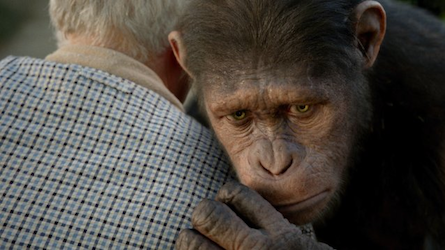
Movie Review: Rise of the Planet of the Apes*.


Proposition me with a trip to the movies to see Rise of the Planet of the Apes and, ordinarily, I wouldn’t be interested. Sci-fi, James Franco… not a fan of either.

But show me the trailer, with a heavy focus on the humanity of apes and how they’re  “just like us!” and hella yeah, I’m down to see it.

The film begins with James Franco as a scientist, who has been working on an anti-Alzheimer’s drug by injecting it into apes to see if their brains can repair themselves. Not only does the drug A-1-12 do this, it also creates new pathways in the brain, which means the recipient knows and can do things they couldn’t before.

Bright Eyes, the ape who produced such results, goes ape-shit, so to speak, and is put down. What was thought to be the drug’s fault is attributed to Bright Eyes’ unknown pregnancy and birth, and “she was just being protective” of the baby ape hidden in her enclosure.

The experiment is shut down and Franco’s character, Will Rodman, sees no option but to take the baby ape home to the San Francisco house he shares with his Alzheimer’s-inflicted father, Charles, played by John Lithgow.

Fast forward three years and Caesar, whom they’ve named the now-super ape, has had the A-1-12 transferred to him at birth, it is discovered. He has his own play area in the attic, and he gazes down at the human world below him, aching to experience life outside the confines of the Rodman home.

During this time, Will steals some vials of the A-1-12 drug and secretly gives them to the ailing Charles. The results are overnight and miraculous. With the introduction of Freida Pinto’s veterinarian Caroline, who barely has five lines in the movie and is literally the only female character, bar Bright Eyes who is killed off in the first five minutes to further the story for the male characters, it’s all one big happy family.

Five years later, Will is struggling to care for his dad, whose body has developed immunity to A-1-12, and to wrangle the increasingly smart, inquisitive, lonely and strong Caesar, who attacks a neighbour for roughing up Charles when he tries to drive away in his luxury car in a dementia-induced stupor.

Will is forced to send Caesar away, to a primate enclosure in the city. Unbeknownst to Will, Caesar and the other apes are treated like crap by the attendants, who are the first victims when the apes stage a revolution.

Each time Will and Caroline come to visit Caesar, he gradually wants nothing to do with them. He begrudges Will for abandoning him and allowing him to be treated “like an animal”.

This notion is really at the crux of the film. We treat animals like beings less than ourselves, even though we know more than ever about their thinking and feeling capacities, and we will live to suffer the consequences.

There are consequences when we treat them too much like humans, too. (Paging Paris Hilton.) We can see that when Caesar leads the motley crew of apes freed from “sanctuaries”, like the one Caesar and the other apes escape from, laboratories and the zoo, and when he tells (yes, apes can speak now. The miracle of A-1-12.) Will he’s “home” with his own species.

This is after the climactic Golden Gate Bridge fight scene, where man versus ape in an overwhelming victory for the latter. This scene perfectly illustrates the “pack mentality” we accuse sports stars of, and is illustrated by the London riots and the gang-rape of Lara Logan.

Other subtle and not-so-subtle metaphors in the film include the dichotomy of war, racism, prison, how we treat refugees, how we treat those we don’t understand, testing on animals (which, in this film, is null and void: Franklin, a lab technician who dies towards the end of the film after being exposed to the virus strain of A-1-12, A-1-13, proving it may work on apes, but it certainly doesn’t on humans) and, of course, the aforementioned way we treat animals.

I’m a sucker for an animal movie, and cried pretty much through the whole thing! And these “animals” weren’t even real! But, in retrospect, the flawless special effects and underlying meaning weren’t enough to save the dismal character development and non-ape related storyline. Pretty much all the characters were interchangeable.

I’m not a big fan of James Franco, and in this movie he didn’t annoy me with his James Franco-ness but, having said that, I would rather that than a repeat of his Oscars coast-through, which his performance in Rise of the Planet of the Apes was a mirror image of.

In terms of Pinto being the only woman in the movie, perhaps her no-character Caroline could have been spared in favour of one other female character with a bit of substance, a backstory, and a driving force in the storyline: mother Charlotte instead of father Charles.

But really, this reasoning is clutching at straws, as Rise of the Planet of the Apes is really all about the… erm… apes. Humans are merely transposable caricatures.

*It has come to my attention that I give away too much in my movie reviews, so the asterisk will now serve as a blanket *spoiler alert* from now on.

Related: Time’s “What Animals Think” August 16, 2010 Review.

Asylum Seekers: Have a Little Compassion.

Image via IMDb.
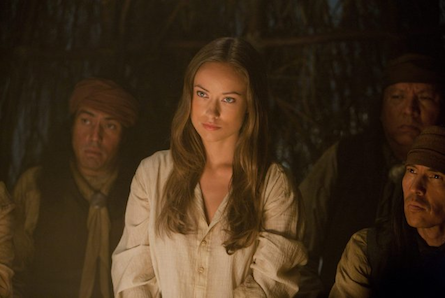
 

Movies: Cowboys VS. Aliens & Indians… Does it Really Matter? They’re All the Same Anyway, According to the New Movie.


Yesterday I wrote that I was sick of seemingly every new release movie these days incorporating aliens into their plotlines, none more so than the latest Jon Favreau effort, Cowboys & Aliens, starring Daniel Craig, Harrison Ford and Olivia Wilde.

I have no interest in seeing the film. Super 8, Thor and Green Lantern have taken up my alien quota for the year. So I can’t comment fully on the nature of the representation of Native Americans in Cowboys & Aliens, but I think the title and the trailer tell me pretty much all I need to know. I also did some sneaky spoiler reading, so I’ll put up *spoiler alert* where applicable.

Being of Native American heritage myself, my initial viewing of the trailer grated on me. Taking the place of “Indians” in the Western genre were “aliens”—other—, which Indigenous peoples have been seen as for centuries. At ComicCon, the creators and stars of the film defended it, saying that both are genres that have been “done to death”.

I wondered if I was the only one who read it this way, and came across this brilliant article from Ms. Magazine, which asserts that the aliens and the Indians are seen as “them”, versus “us”: the white male main characters of the film, Craig’s Jake Lonergan and Ford’s Colonel Woodrow Dollarhyde. Cowboys & Aliens goes on to further stereotype the members of the Apache tribe featured in the film into categories: “the good Native”, the “savage warrior” and the “exotic” “Indian princess”, played by Wilde.

Wilde’s Ella Swenson is revealed to not be of Native American heritage, but *SPOILER ALERT* descendent from the other “others” in the film. Further to the assertion that people who aren’t white are interchangeable, Swenson is still characterised as “exotic” and not from the world of Lonergan and Dollarhyde. They’re all the same right?

After all, the central premise of the movie is that the whites have already raped and pillaged the Native people of the land, so they need a new enemy. Why not do the same to the invaders?

I’d be interested to know what others’ think of the depictions of race (the Ms. article points out that given the film is set in Arizona, there is an absence of Latino characters), come Cowboys & Aliens’ release date in Australia on Thursday.

Related: Green Lantern Review.

Super 8 Review.

Thor Review.

Elsewhere: [Ms Magazine] White Cowboys & Alien Indians.

Images via IMDb.

Movie Review: Green Lantern*.


When I met my brand new roommate Eddie about a year ago, we bonded over Green Lantern, amongst other things.

I’m not a huge fan of the comic book series, other than the fact that Ryan Reynolds and Blake Lively are in the big screen adaptation, released last Thursday in Australia to the similar lacklustre reviews it received in the States. My only exposure to the superhero before I met Eddie was that he was professional wrestler Gregory “The Hurricane” Helms’ favourite superhero, revealed by his Green Lantern symbol tattoo and the t-shirt he gave Stone Cold Steve Austin during his “appreciation night” storyline back in 2001.

Even though I wasn’t super keen on the latest version, especially after seeing the previews (why must every movie be about aliens?! Super 8, Thor, Green Lantern, Cowboys and Aliens… Perhaps some fodder for a potential blog post…?), we’d bonded over it.

Going into films with low expectations usually winds up with me enjoying it much more than I thought I would, and this was true with Green Lantern.

As the comic book nerd to rule all comic book nerds, Eddie pointed out some holes in the plotline and amalgamations made especially for the movie that don’t exist in the comics, like Reynolds’ Hal Jordan’s nemesis Hector Hammond being able to read minds by physical contact after contracting the powers of Paralax.

As a non-comic book nerd, I thought some parts of the movie weren’t resolved, like Jordan getting beat up in a parking lot behind a bar he was having drinks with Lively’s Carol Ferris at, but nothing coming of it (Carol coming to his rescue, the cops arriving, any arrests being made) apart from being the catalyst for Hal to use his willpower, the energy that the Green Lantern Corps use to fight space crime and whatnot.

I was initially excited about Lively’s role in the film, but she’s as boringly saccharine in this as she is in Gossip Girl. The only part of the movie where I see a glimmer of potential in her acting abilities is when she is approached by Hal, in his Green Lantern costume, and exclaims, “You think I wouldn’t recognise you because I can’t see your cheekbones?!” It was both funny (perhaps the funniest part of the movie, which isn’t saying much) and the closest Lively’s ever going to get to an Oscar nomination any time soon.

Considering Green Lantern was one of the most anticipated premieres of the year, it failed to live up to the hype. Not only was its release date almost two months behind the U.S., which is unheard of these days, Reynolds was supposed to attend the Melbourne and Sydney premieres, but pulled out at the last minute. (We were going to stalk him at Jam Factory!)

A sequel has been greenlit (get it?), which is promising, as the Green Lantern saga has a lot more to offer. Three more human Lanterns, a black Superhero, a heel turn (sorry, wrestling speak; good guy turns into a bad guy) from one of the main characters, the scene that sparked the Women in Refrigerators feminist movement. Let’s hope the second instalment brings some of this to the table.

*It has come to my attention that I give away too much in my movie reviews, so the asterisk will now serve as a blanket *spoiler alert* from now on.

Related: Super 8 Review.

Thor Review.

The Problem with Serena van der Woodsen.

Elsewhere: [Women in Refrigerators] Homepage.

Image via IMDb.

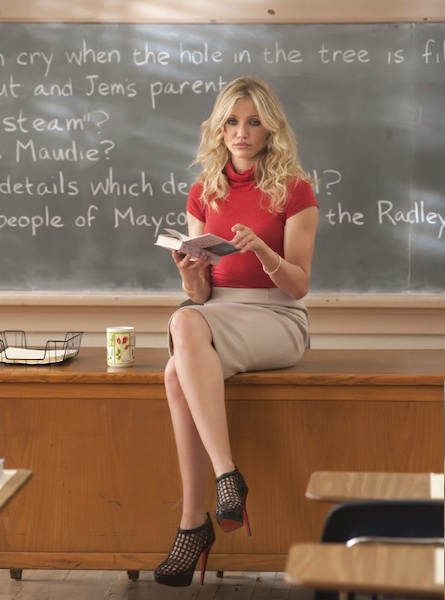
Movie Review: Bad Teacher*.


Bad Teacher was released at an inopportune time, having to follow in the footsteps of Bridesmaids, a movie that has been deemed revolutionary for the simple “fact that two women hav[e] a realistic conversation about sex in a café,” as Caitlin Moran told Rachel Hills in her Sunday Life profile last weekend.

In comparison to Kristen Wiig’s “realistically weak female character” in the Judd Apatow hit, who acts exactly how a real down-on-her-luck woman would act, Cameron Diaz’s Elizabeth Halsey has been called “a lazy, lying, scheming, slutty, and obstinately materialistic [character], whose sole redeeming virtue is her hard body… who is so delusional that she thinks her ostentatious assholery is rock-star sexy, and whose delusions are essentially validated by narrative resolution,” by Karina Longworth in Los Angeles Weekly.

And while this was true (she gets away with stealing the results to the state test in order to win money to get a boob job, and gets the sweet and goofy guy she’d been treating like shit the whole movie), it was no way near as bad as I envisioned it to be in terms of it being anti-women, or at least anti-Bridesmaids-esque-feminism.

It was horrifically racist and downright disturbing in some parts, though. Unhinged goody two-shoes Amy Squirrel is forced to transfer to one of the most dangerous and underprivileged schools in the state, Malcolm X High School. Her boyfriend, Justin Timberlake’s pathetic character, Scott Delacorte, praises Elizabeth for teaching her kids that they should never stop working on themselves by getting a boob job. He also has a thing for “oriental” food. And don’t even get me started on the dry hump scene. It was as pointless as Timberlake’s appearance in The Love Guru. Or his whole acting career in general.

It was hilariously funny in some parts, but if you’re looking for a strong narrative with diverse and realistic female characters, maybe seek out Bridesmaids again. If you’re looking for some mind-numbing 90-minute escapism (as opposed to all these two-and-a-half-hour wastes of time), Bad Teacher’s your movie.

*It has come to my attention that I give away too much in my movie reviews, so the asterisk will now serve as a blanket *spoiler alert* from now on.

Related: Bridesmaids Review.

Elsewhere: [Musings of an Inappropriate Woman] Caitlin Moran Cover Story Sunday Life.

[LA Weekly] You Want a Raunchy Comedy Starring Women? Be Careful What You Wish For.

Aliens’ Ellen Ripley as Everywoman.


From “Sigourney Weaver on the Legacy of Aliens & Her Sequel That Hollywood Won’t Make” by Eric Larnick on Moviefone:

“I feel like Ripley is all of us; I don’t feel like she’s an action hero. She is called to reach down and find the resources to fight in every way possible. To me it’s about all of us. There’s a Ripley in all of us. I think that’s why people love the movie and the series. She’s not a special person, she’s an every-person, and we are put into these circumstances where we have to protect others and not give up…

“What’s so exciting about women in action is that women bring a different focus to the action and it comes from a different source… Every woman you see, in her kitchen or wherever else, has a secret action heroine in her; just wait til something happens to her children or husband, then you’ll see it.”

Women in the kitchen. Hmm…

Elsewhere: [Moviefone] Sigourney Weaver on the Legacy of Aliens & Her Sequel That Hollywood Won’t Make.

Image via Moviefone.

Movies: Male Body Image in Captain America.


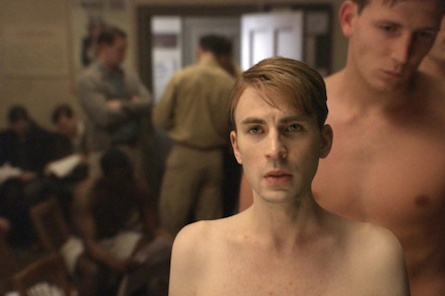
Captain America begins with the runty little Steve Rogers getting knocked back again and again for army enlistment because of his size. The CGI was done so well that a lot of people commented that they didn’t even know it was Chris Evans’ head seemingly Photoshopped onto a scrawny body.

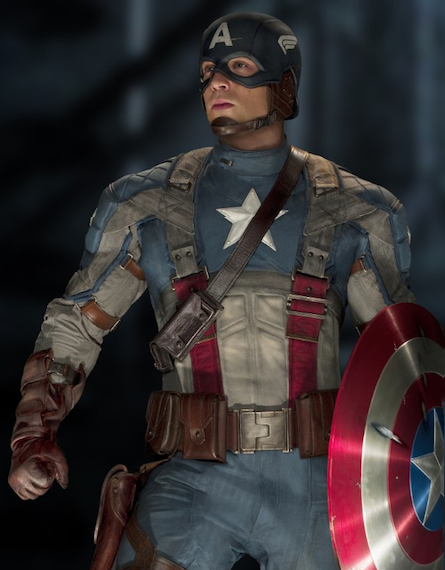
It’s hard to rectify the pre-Captain America Rogers with the post-Stanley Tucci experiment Captain America. Evans looked so odd for the first half an hour or so, which is a far cry from the other films we’ve seen him in: Not Another Teen Movie and Fantastic Four, where he was predominantly shirtless and acting like an arrogant douchebag.

And as much as I preach that looks don’t matter, once I’d seen CGI-Chris Evans, I could not get that image out of my head!

It seems Peggy Carter had no problem forgetting Rogers’ humble beginnings, though. Carter had only a short interaction with Rogers before he became a muscle-bound superhero, and only began to show interest in him after the fact. Granted, five minutes of conversation, which Rogers admits is the longest amount of time he’s ever spoken to a woman for, isn’t enough to get to know anyone. But the look in Carter’s eyes was noticeably different after he emerged from the super-soldier machine (lust, awe), than before he went into it (pity).

If we want to send the message that women should be valued for more than just what they look like, shouldn’t we be sending the same one about men? Indeed, all people should be assessed based on what they offer the world and the people around them besides eye candy.

Sure, the reason Rogers was allowed to enter the military after the experiment is because his physical capabilities were enhanced. Fair’s fair. But it seems Carter fell in love with the man behind the Captain America mask; the exact same man Rogers was before the experiment. The man Dr. Erskine chose for the experiment because of these traits. The baby blue eyes and the muscles just enhanced that.

I’m not going to pretend that physical attraction doesn’t matter; it does. But psychological attraction is the connection that will stand the test of time.

Anyone will tell you that the archetype of the comic book nerd identifies with superheroes because they’re usually the underdog. People walk all over them, not recognising them for who they are until they get a magic ring, or bitten by a spider, or made into a super-human in an experiment and can show the world what they’re made of.

But why do they have to undergo a physical transformation for these traits to be acknowledged? If comic book heroes teach us anything, it’s that courage comes from within. Captain America certainly teaches us that. If only Hollywood adopted this strategy, too.

Related: Captain America Review.

Will Boys Be Boys When it Comes to Objectifying Women?

Elsewhere: [MamaMia] Male Models. Inside Their Straaange World.

Images via IMDb.

Ten Things I Love About Shrews.


From “Why Shrews Should Never Be Tamed” on Pamflet:

“… We are all, by Shakespeare’s definition, shrews!

“We demand, we assert, we argue, we’re unruly, we believe our opinions are as valid as our partners. We poke fun at them, boss them about, and it seems they love us for it. Life with a shrew will never be easy—expect tears, shouting, ominous silences, door slamming and probably regular existential crises—but it will never ever be boring. Life with a shrew means impassioned debates (whether about world politics or Mad Men season 4), adventure, passion, a unique perspective on the world and much more besides. Smart men understand that if you want a quiet life, you go for a nice girl like Bianca, but if you want a rollercoaster ride, always opt for a Kat… There are men out there who are willing to embrace our shrewish tendencies—they’re as feminist as we are. Of course being a shrew shouldn’t mean being cruel, allowing a sharp tongue to wound just because you can, nor should it mean being intolerant of other people’s failings and frailties. It just means not being afraid to use your voice. So on this one, I have to say Mr. Shakespeare, I think you got it wrong. Embrace your inner shrew.”

Related: Do Nice Girls Finish Last?

Elsewhere: [Pamflet] Why Shrews Should Never Be Tamed.

Image via DVD Active.

Movie Review: Captain America*.


I haven’t seen Iron Man. Or Iron Man 2. Or The Incredible Hulk. I hated Thor. I’m not looking forward to The Avengers, other than the fact it has the Chris’s (Evans and Hemsworth) in it.

So I went into Captain America with a little trepidation, but from the previews, I liked what I saw: minimal alien action. Hypereal World War II setting. Chris Evans.

And I wasn’t disappointed.

It was easy to get behind Evans (or, as I joked after the movie, for him to get behind me!) as the good-hearted and brave protagonist and title character.

And it was funny, too: my comic-book-geek friend Eddie laughed intermittently at jokes that only he got (we were in the Director’s Suite with about three other people). There was an enjoyable fondue shtick that we laughed at for about five minutes, missing the ensuing dialogue.

I quite enjoyed the imagery. I love mid-20th century Americana, and Captain America didn’t disappoint, with his humble beginnings as a cotton wool cartoon hero who performed for the troops rather than being one.

Ultimately, it was a no-frills story about good vs. evil. Who magazine’s review said that it “isn’t out to dig deep”. Perhaps not consciously, but I did notice some underlying messages when it came to male body image, which I’ll be blogging about this week. Without giving the ending away, I was thoroughly surprised by it, which perfectly sets up the interlude to 2012’s The Avengers which, dare I say, made me a tiny bit excited for it. You know, besides the Chris factor.

Related: Thor Review.

Super 8 Review.

*It has come to my attention that I give away too much in my movie reviews, so the asterisk will now serve as a blanket *spoiler alert* from now on.

Image via IMDb.

Do “Strong Female Characters” Remind You of You?

From “A Plague of Strong Female Characters” by Carina Chocano in The New York Times Magazine:

“… Few cultural tropes get under my skin like ‘strong female character,’ and it still surprises me when like-minded people use it. Maybe the problem is semantic. Maybe what people mean when they say ‘strong female characters’ is female characters who are ‘strong,’ i.e., interesting or complex or well written—‘strong’ in the sense that they figure predominantly in the story, rather than recede decoratively into the background. But I get the feeling that what most people mean or hear when they say or hear ‘strong female character’ is female characters who are tough, cold, terse, taciturn and prone to scowling and not saying goodbye when they hang up the phone.

“… Characters like these… do serve as a kind of gateway drug to slightly more realistic—or at least representational—representations of women. On the other hand, they also reinforce the unspoken idea that in order for a female character to be worth identifying with, she should really try to rein in the gross girly stuff. This implies that unless a female character is ‘strong,’ she is not interesting or worth identifying with.”

Chocano then goes on to talk about Kristen Wiig’s seemingly “weak” character in Bridesmaids, and how she is actually an empowering character for women:

“We don’t relate to her despite the fact that she is weak, we relate to her because she is weak.

“… This makes me think that the problem is not that there aren’t enough ‘strong’ female characters in the movies—it’s that there aren’t enough realistically weak ones. You know what’s better than a prostitute with a machine gun for a leg or a propulsion engineer with a sideline in avionics whose maternal instincts and belief in herself allow her to take apart an airborne plane and discover a terrorist plot despite being gaslighted by the flight crew? A girl who reminds you of you.”

This article is well worth the read.

Related: Bridesmaids Review.

“With a Gun Between Her Legs,” Take 3.

“With a Gun Between Her Legs,” Take 2.

“With a Gun Between Her Legs”: Why “Strong (AKA “Sexy” Whilst Being “Strong”) Female Characters Are Bad For Women.

Strong Female Characters in the Land of Oz.

Women in Fiction: Are Our Favourite Fictional Females Actually Strong, Or Stereotypes?

Elsewhere: [The New York Times] A Plague of Strong Female Characters.

Image via Movies Bizz.

Fictional Friends.

Last week, Alissa Warren on MamaMia listed her top five fictional friends. You know, people you’d be friends with… “if they were real.”

Let me know in the comments who you’d be fictional friends with but, until then, here are my top picks:

Elphaba Thropp, Wicked.

It’s no secret Elphaba is my favourite fictional female: someone you can look up to, who rises above hatred and discrimination, and who will stand up for her beliefs no matter what. Plus, she’s a witch! Galinda wouldn’t be too bad either…

Elle Woods from Legally Blonde.

She’s fun, she’s quirky, she’s got a cute little dog and an awesome wardrobe. And underneath it all, she’s not as ditzy as she seems. Awesome friend material.

Cher Horowitz, Clueless.

Again, someone who seems carefree and Clueless on the outside, but whose heart is in the right place. Maybe she’ll let you come over and program your wardrobe into her computer. Just think of the outfit-planning time you’ll save.

Gus Bailey.

The fictional version of the late Vanity Fair columnist and man about town Dominick Dunne, Gus Bailey, would always give you the inside scoop, and probably feature you in his gossip columns! Anonymously, of course. You’ve got to keep up appearances.

Blair Waldorf/Dan Humphrey, Gossip Girl.

I’m not sure which one I’d like better as, personality-wise, they’re pretty much the same person. They exchange emails and phone calls whilst ploughing through their identical Netflix queues. They enjoy art, foreign films, being “in” with the “in crowd” and bygone eras. You could borrow Blair’s clothes, but Dan’s nice to look at… I can’t choose!

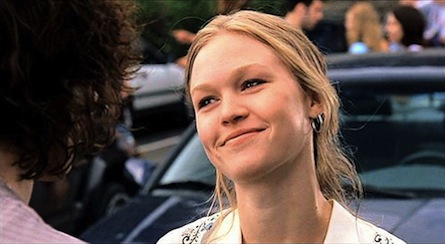
Kat Stratford, 10 Things I Hate About You.

She’s everything I’m not. She’ll shun the prom (but actually ends up going!) due to its patriarchal confines. She’s musical. She loves the riot grrl scene. She ploughs through feminist literature whilst listening to Spiderbait. And she don’t give a rats what anyone thinks of her. Total. Feminist. Icon.

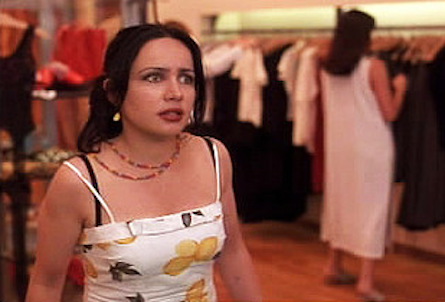
Heather Mooney, Romy & Michele’s High School Reunion.

Anyone who openly tells people they don’t like to “fuck off” is someone I want to get to know! Plus she’s hilarious despite her best efforts to come across as cold and callous.

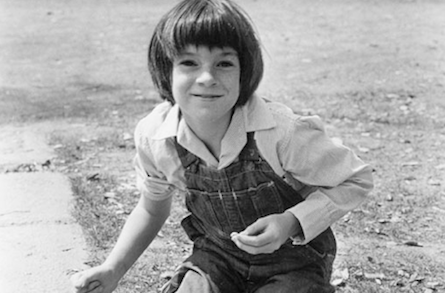
Scout Finch, To Kill a Mockingbird.

Sure, she’s a little young to be best buds with, but maybe I could be her babysitter?!

Related: Women in Fiction: My Favourite Fictional Females.

Women in Fiction: Are Our Favourite Fictional Females Actually Strong, or Stereotypes?

It’s All About Popular… Lar, Lar, Lar, Lar.

Strong Female Characters in the Land of Oz.

Pop Culture Power Women.

So Misunderstood.

Pop Culture Role Models.

In Defence of To Kill a Mockingbird.

Another City, Not My Own by Dominick Dunne Review.

Images via Freewebs, IG Style, Abhishek Tiwari, USA Today, TV.com, Inspired Ground, Flickr, The Hero Construction Company.