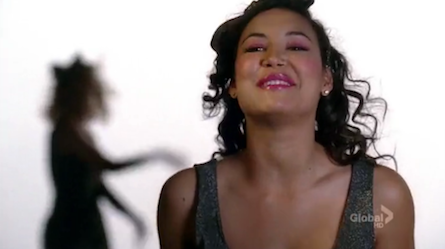
TV: The (Belated) Underlying Message in Glee’s “Choke” Episode.


As someone who has witnessed her mother being choked by her father, using that action as a metaphor for intimate partner violence on Glee is sick.

Not only that, but in desperately trying and dismally failing to, for some reason, raise awareness of domestic violence (actually, I’ve decided I hate that phrase, so I’m taking to using the more all-encompassing “intimate partner violence”), Glee has gone back to its old ways by being especially misogynistic and racist.

The intimate partner violence storyline opens with Santana observing Coach Beiste’s black eye and remarking that “it looks like Mr. Beiste went all Chris Brown on Mrs. Beiste… [Did] Cooter put the smackdown on [her] ’cause [she] wouldn’t let him be on top?” Troublingly, women of colour Mercedes and Tina, and LGBTQ woman Brittany, all snicker. I wonder if the writers were aware (oh wait, this is Glee: of course they weren’t!) that African American women are 35% more likely to experience intimate partner violence than white women, 60% of Korean women have been beaten by their partners, and violence in same-sex relationships is gravely underreported and misunderstood.

Enter Cheerios co-coach and “black Sue”, Roz Washington, who overhears Santana’s bad taste musings. She tells the girls that “violence against women” and “men hitting women” is never okay, buying into the perception that women are the only victims in intimate partner violence. Granted, women are the overwhelming victims, but that’s not giving equal opportunity to non-heterosexual relationships (for shame, considering the abundance of LGBTQ characters on the show) and the fact that a woman can hit a man. Instead of insinuating that it’s intimate partner violence only that we should be concerned about, how about violence against women in general? Including rape.

Anyway, I’m sure the writers wanted Roz to mean well, but her racial and sexist slurs directed at Mercedes (“Lil Oprah”), Tina (“Asian Horror Story”), Sugar (“Rojo Caliente”) and Santana (“Salsa Caliente”) undermine this.

In a following scene, Sue coins the aforementioned nickname, “Black Sue”, for Roz, telling her that “ivory poachers could make a fortune selling your enormous white teeth on the black market”, and refers to Coach Beiste as John Goodman, perhaps insinuating that Beiste’s masculinity should have prevented her from being a victim. This way of thinking seems to be adopted by Santana, too, when she says she doesn’t think Coach Beiste actually got hit because she’s “a wall”. What if the roles were reversed and Beiste had hit Cooter, who is considerably smaller than Shannon?

The racial stereotyping continues when Roz admonishes the girls for their joke. As Autostraddle points out, Glee gave the “‘my aunt got beat up by her man’” monologue to the one black woman on the show,” claiming it took her five years to escape the relationship. It took my mum nigh on thirty to get out.

Shannon initially denies her husband hit her, but uses her experience to inspire the girls, who—up until this point— have never really had anything to do with the Coach, to sing a song about empowering women to leave abusive relationships. According to Sue,

“The American songbook is chock full of songs making light about men hitting women.”

Chris Brown, anyone?

Beiste is so moved by the girls’—who, again, she’s had nothing to do with up to now—apathetic show of indifference to intimate partner violence, that she confesses to them—jeopardising her reputation at the school (remember what happened the last time she got too close to McKinley students?)—that she was actually the victim of intimate partner violence, and that they effectively “saved her life”, because she forgot to do the dishes all weekend. Yes, perpetrators of intimate partner violence can be set off by the slightest thing, and we all know that beating the person you love isn’t the means of someone who’s mentally balanced, but dishes?! Glee, really?! If you’re going to make one of your characters, perhaps the most underutilised, exploited and maligned of them all, the victim of a serious issue like intimate partner violence that will never be addressed again, can you at least make it for a reason less trivial than dishes?!

Two realistic things to come out of the storyline, though: that Shannon stays with Cooter and gives him a second chance, and lies about it to Sue and the girls. And finally, that Beiste fears that if she leaves him, “no one else will ever love me”. Painfully sad, true to actual victims of intimate partner violence who are made to feel worthless and unlovable by their abuser, and ties in with a past storyline on the show!

Related: The Underlying Message in Glee’s “Never Been Kissed” Episode.

My Thoughts on Chris Brown.

Elsewhere: [Women of Colour Network] Domestic Violence Facts & Stats Collection.

[Autostraddle] Glee Recap: Choke-a-Joke.

Image via Putlocker.

TV: Dominick Dunne Makes a (Re)Venge-ful Return to the Small Screen.


When Mason Treadwell, the man who sold out to the Graysons and published a book full of lies about alleged terrorist David Clarke fifteen years ago, resurfaced last night on Revenge, I couldn’t help but notice the similarities with fellow society (hell, Treadwell’s book is called Society Connection) writer, Dominick Dunne.

Just a few weeks ago, Serena van der Woodsen was channelling him over on Gossip Girl, and now it seems the late, (arguably, but definitely in my mind) great Dunne is making an appearance on a show that bears similarities with the real life sideshow that was Dunne’s existence.

Dunne became famous when his daughter was murdered by her boyfriend, who got off scot free, which inspired him to write about the injustices of crime amongst the rich and famous, which parlayed itself into a top-rating TV show. Granted, Dunne was never involved in the takedown of a terrorist, but perhaps his most high profile case was covering that of O.J. Simpson.

Dunne was adept at loss: he was an alcoholic shunned from Hollywood during his first career as a producer, several of his children died in infancy, in addition to daughter Dominique’s death, his wife left him and despite his successes amongst some celebrities, he was outcast by others.

How will Mason Treadwell cope with losing everything?

Related: Gossip Girl—Is Serena Our Generation’s Dominick Dunne?

Another City, Not My Own by Dominick Dunne Review.

The Mansions of Limbo by Dominick Dunne Review.

Images via Sockshare, Deadline.

TV: Glee “Dance with Somebody” Review.


This was one of the best Glee episodes I’ve seen in a long time.

I’ve never been a big Whitney Houston fan, so I was a bit iffy about how they’d integrate her songs into the show’s storyline (or lack thereof. Did you notice Quinn was only in one scene last week? Maybe she wasn’t coping physically with her newfound paralysis, but they could have at least mentioned it.), but it was done perfectly. Glee managed to address the issue of holding troubled stars up as idols (Michael Jackson, anyone?), the changing relationships of the Glee kids as they near graduation, and Quinn’s disability, and sew Whitney’s songs seamlessly into the story.

Part of the reason I’ve never liked Whitney is because her music seemed to bypass me. “I Will Always Love You” was getting airplay when I was young and I discovered “I Wanna Dance with Somebody (Who Loves Me)” on the club scene in my later years, but other than that I never got what all the fuss was about. Glee’s versions of “I Have Nothing”, “So Emotional”, “Saving All My Love for You” and “It’s Not Right But It’s Okay” gave me a new appreciation for Whitney’s music. Who knew she had so many songs?

My favourite aspect of the episode, though, was Quinn being brought back into the fold, this time with a new love interest.

Quinn’s paralysis is something that has the potential to go horribly wrong. I was disappointed that in the first episode after her accident, she was all optimistic and grateful to be alive. From the dismal tidbits we’ve been given about Quinn as a character (her obsession with being prom queen, her former life as Lucy, and her scheme to win back her adopted daughter), it wasn’t realistic. Now that Quinn’s struggling with her physical therapy and dealing with feelings of worthless- and hopelessness, I’m starting to get behind this plotline a bit more.

Could there be an unlikely romance brewing between the dreadlocked Christian homeschooler Joe (I always thought his name was actually Jesus!) and  Quinn?

Related: Glee “Michael” Review: Oh My God Can’t Believe What I Saw When I Turned On the TV This Evening.

The Underlying Message in Glee’s “Original Song” Episode.

The Underlying Message in Glee’s “Born This Way” Episode.

Images via PutLocker.

TV: The Problem with Smash.


Smash, the Steven Spielberg-produced musical-serial about a Marilyn Monroe Broadway show, debuted with promise. I quite enjoyed the first few episodes, with Debra Messing as one of the musical’s writers, Angelica Huston as its producer, and Broadway star Megan Hilty as the number one contender for the role of Marilyn. But then Smash kind of plateaued.

Clem Bastow, writing for TheVine, seems to think it’s because of Katharine McPhee’s inclusion as the other competitor vying for the lead, and I have to agree. Bastow writes:

“The trouble with McPhee’s performance in Smash is that it jolts me out of my suspension of disbelief… [B]ut whenever Karen/Katharine opens her mouth, the fourth wall comes crashing down around me. Her voice is thin, her performance mannered, she acts with her chin like a young Gwyneth Paltrow, and self-consciously holds her mouth in such a way to suggest a very pretty female version of Jack Nicholson’s Joker.”

I’m all for Hilty’s Ivy Lynn, who’s spent ten years in the chorus and lives and breathes Marilyn through and through. But I just can’t get behind McPhee’s Karen Cartwright who, as Ivy rightfully observes, got to New York five minutes ago, hasn’t paid her dues and is already getting callbacks for lead roles. She can’t act (McPhee as Karen nor Karen as Marilyn), complains about everything and is an ineffable dolt.

But in the last few weeks, Smash has been looking up. I immensely enjoyed the episode when Ivy lost the plot after being replaced as Marilyn by Uma Thurman’s major movie star, Rebecca Duvall, and had to go back to being an angel in the chorus line of Bombshell’s (the name they’ve settled on for the fictional—but very well could be a real Broadway show if Smash’s commercial success continues—musical) writers’ other Broadway show, Heaven on Earth. Ivy loses it, mixes her throat medication with alcohol, goes on stage high, and ends up singing Rihanna’s “Cheers (Drink to That)” with Karen in Times Square (video above. Please excuse the horrid quality, but I wanted a clip that actually showed the scene rather than just the audio).

I still can’t stand Karen and Ellis, the sneaky assistant to Huston’s Eileen and, formerly, Bombshell writer Tom Levitt but, if it’s about Marilyn Monroe, I’m willing to let Smash go out with a bang.

Are you watching Smash? What do you think of it?

Elsewhere: [The Vine] You Ain’t Gettin’ 88 Cents From Me, Smash.

Image via IMDb.

TV: Gossip Girl—Is Serena Our Generation’s Dominick Dunne?


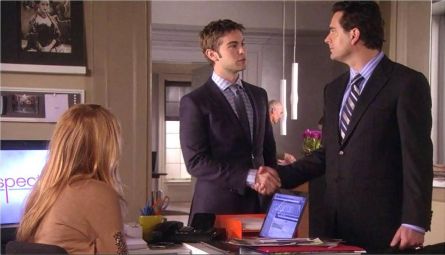
That’s according to Nate, anyway, who talks up Serena’s expose on Ivy Dickens’ stealing her family’s money for The Spectator to a potential investor for the newspaper. “Serena’s writing from the inside. She’s our generation’s Dominick Dunne.”

Like Packed to the Rafters’ Julie penning a chapter for a romance novel competition and suddenly she’s a writer, Serena exploits her social butterfly standing to write a gossip column and she’s hailed as the society writer du jour. Is that my bitter blogger coming through…?

Related: Gossip Girl Thinks Bloggers Aren’t Good Enough.

The Problem with Serena van der Woodsen.

The Beautiful & the Damned: Serena Settles for Second Best.

Pretty But Dumb: Serena’s Tertiary Education Predicament.

Another City, Not My Own by Dominick Dunne Review.

The Mansions of Limbo by Dominick Dunne Review.

Image via SerenavanderWoodsen.com.

TV: New Girl—Sexual Harassment is a Myth. You Just Need to Give People a Chance to Show You How Good They Are.


This is according to New Girl, the purveyor of upholding gender stereotypes.

When Jess invites the landlord to dinner as a thanks for fixing some things around the loft, Nick is certain he’s trying to hit on her because people are generally jerks. I tend to stick with Nick on this one, but Jess isn’t so sure.

Nick is 100% right when it turns out the landlord wants to have a threesome with Jess and Nick. While there’s nothing wrong with this if all parties are consenting, Jess agrees to go along with it in the hopes that it will all work out for the best (ie. no threesome occurs) and Nick refuses to back out until Jess does.

To me, this whole scenario not only reeks of perpetrator-sympathising* (Maybe he slipped and fell. Maybe he was going through a bad breakup. Maybe he was stressed at work.**), but that the way a woman acts determines how she will be treated by the opposite sex.

Granted, in my experience and the experiences of those close to me, the female is deemed “too friendly” and that’s why she was harassed, whereas here, Jess thinks being nicer to people will lead to less bad things happening (like Nick getting a gun pulled on him in the parking lot). I believe there was also a reference in there about the way Jess looks (ie. über-feminine) influencing how she’s treated by the opposite sex. Like I haven’t heard that one before…

*To be sure, Remy the landlord is not committing sexual assault or harassment here, but I think he serves as a good metaphor.

**This refers to strictly male-on-female harassment and assault, ignoring the fact that women can be perpetrators, too.

Related: Manic Pixie Dream Girly Girls & Not-So-Girly Girls.

New Girl Should Attend a SlutWalk Sometime…

Body Acceptance on the New Girl.

Who’s That Girl? It’s the New Girl.

The Harassed and the Harassed-Nots.

The Taboos of Sexual Harassment.

I Ain’t No Hollaback Girl: Street Harassment in CLEO.

Image via VidXDen.

TV: Gossip Girl—Dair: It’s On!


When sparks began to fly between Dan and Blair last season, I wasn’t too keen on the prospect of them getting together.

But, as Dan became her confidante during her pregnancy loss and aftermath of the wedding from hell, I warmed to the idea. I thought I’d forever be a Chair (Chuck & Blair) girl, but suddenly, I’m batting for Team Dair (Dan & Blair).

I’m not sure what turned me, exactly, but I think it might have had something to do with Blair finally succumbing to her feelings for Dan, and addressing him by his first name, as opposed to the disdainful “Humphrey”. Also, Dan insisting she keep saying his name as they kiss in his doorway didn’t hurt!

Related: Gossip Girl: Blair Channels the Tragic Life of Princess Di & Gossip Culture is to Blame.

Gossip Girl Takes Inspiration from Yet More Royals. This Time It’s the Grimaldis.

Image via Fan Pop.

TV: New Girl—Manic Pixie Dream Girly Girls & Not-So-Girly Girls.


I was pleasantly surprised to see New Girl seemingly dealing with the hullabaloo surrounding Zooey Deschanel’s manic pixie dream girl status and the feminist media uproar that occurred late last year.

Now, New Girl has touched on some pertinent issues in its past episodes, but I’m wondering if this was done intentionally. Writer Liz Meriwether is part of the feminist writing “fempire”, so who knows if this was something she incorporated into the show consciously, or if it’s just a meditation on “how girls can be”.

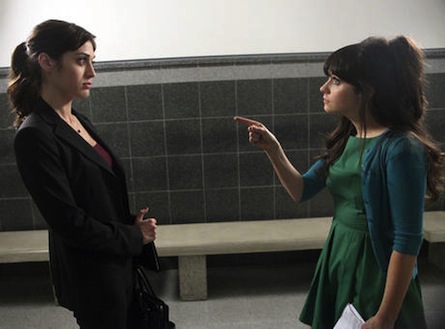
Nick’s new girlfriend Julia, played by Mean Girls alum Lizzy Caplan, can’t stand Jess and makes it very clear when she criticises her “blankie”, the (manic pixie dream girl) “thing” Jess has going on, and the cupcakes Jess bakes, saying she’s “not a dessert person”. Jess takes issue with this, finding it hard to believe that anyone (much less a woman!) “isn’t a dessert person” and doesn’t like her ribbon hats. I have to say I don’t find it that hard to believe…

When Jess brings up Julia’s dislike of her to Nick, he rationalises it by saying Julia’s never had many girl friends and she’s not really a “girly girl”. Jess’ girl friends, CeCe and June, whom we’ve never met up til now, get on the defensive, marveling at how she couldn’t like Jess (again, not that hard to believe…).

By episode’s end, Julia has come around (both literally and figuratively) and joins Jess et al in a yarn group, lamenting how she’s never been good with girls. CeCe says her and Jess used to hide in the bathroom throughout high school because “girls can be so mean to each other”. Um, wasn’t it CeCe who just five minutes before was saying Julia was a bitch for not liking Jess?

Just because someone doesn’t like someone else doesn’t make them a bitch. It makes the two non-compatible. Isn’t it bitchier of CeCe to say things behind Julia’s back and then welcome her into the fold when Julia changes her opinion of Jess? I’m all for loyalty, but…

So, did you watch New Girl? What did you think about Jess’ struggle to find acceptance from Julia as a metaphor for Deschanel to find acceptance in the feminist blogosphere? Or don’t you think that’s what the episode was trying to get across?

Related: Manic Pixie Dream Girl Bitch.

New Girl Should Attend a SlutWalk Sometime…

Body Acceptance on New Girl.

Who’s That Girl? It’s The New Girl.

Image via Wet Paint.

TV: The Underlying Message in Glee’s “On My Way” Episode.


Well, if last night’s Glee episode wasn’t an after-school special, I don’t know what is.

The writers had the opportunity to really shock with Dave Karofsky’s suicide attempt and actually have him die, whilst also getting the oft-heard message across that gay teen suicides are rampant in our culture.

Not only that, but the epidemic of cyber bullying in general. Warbler Sebastian threatens New Directions with the online publication of a risqué photoshopped image of Finn if Rachel doesn’t drop out of regionals, and Sugar remarks, “If someone posted a picture like that of me online I’d probably kill myself.” Not only is that an example, on the one hand, of Glee’s insensitivity to a myriad of diversity issues, it also hit the nail on the head: many young people do kill themselves when incriminating pictures of them, real or not, hit the net. Tyler Clementi, anyone?

What really irked me, though, was self-righteous Quinn and how, in Bible group, she admonishes Karofsky for putting his family through something so “selfish”.

“I feel sorry for Karofsky but I feel worse for his family. He didn’t just want to hurt himself he wanted to hurt everyone around him. I went through the ringer, but I never got to that place…”

Kurt, who despite not believing in God crashes the meeting to pay tribute to Karofsky, tells Quinn that teen pregnancy and pink hair hardly qualify as going through the same ringer as gay kids. “You really want to try to compare…?” Quinn says. “I just can’t imagine things getting so messed up that you would consider taking your own life.”

While I think what Quinn says does have some truth to it, what gay kids go through during school, and in society at large, is incomparable to most of us. But everyone has their line to cross, and if we remember back to last season, it was revealed that Quinn left her first high school because she was bullied for being fat and ugly. I think we can all relate to that; even if we aren’t actually fat or ugly, we’ve all been called those things at some stage!

Apparently, Mr. Shue’s line was his dad catching him cheating on a math test, so he went up to the roof and was about to jump. I’m sorry; I know I just said everyone has their cross to bear, but I think that piece of the storyline served to diminish real problems, like Kurt and Santana’s struggle with their sexuality, and Artie’s disability, and solidify Will as the worst character on the show.

Not to worry, though: New Directions wins regionals with a medly of “It Gets Better”-esque songs, like “Fly/I Believe I Can Fly” and “Stronger”, whilst burying the hatchet with Sebastian and the Warblers, who are equally after-school specialish, singing “Stand” and “Glad You Came”. Oh, and of course they dedicated their performance to Karofsky, who Sebastian met once when he rejected him at a gay bar and the rest of the Warblers don’t even know. Makes sense!

But the real shocker of the episode came right at the very end (and you can see it coming for about 10 minutes prior): Quinn’s car gets hit by a truck. I guess that’s what you get for texting and driving and comparing your white girl problems to those of people with actual problems.

Related: The Underlying Message in Glee‘s “Original Song” Episode.

The Underlying Message in Glee‘s “Grilled Cheesus” Episode.

The Underlying Message in Glee‘s “Born This Way” Episode.

The Underlying Message in Glee’s “I Kissed A Girl” Episode.

Image via While Not Making Other Plans.

TV: Gossip Girl Takes Inspiration from Yet More Royals. This Time It’s the Grimaldis.


The 100th episode of Gossip Girl brought the much anticipated wedding of Blair Waldorf and Prince Louis Grimaldi, with interference by Chuck, Dan and Georgina thrown in there for good measure.

I didn’t think Blair would actually go ahead with the wedding, but she did, and it provided a chance for the show to channel yet more royals after Blair lost her baby in a car accident à la Princess Diana a few weeks ago and now, taking inspiration from Princess Grace Kelly’s progeny Prince Albert and Princess Charlene’s tear-soaked wedding last year.

The (fictional) fact that Louis is a Grimaldi is not lost on Gossip Girl, who sees Blair as somewhat of a modern day Grace Kelly. Louis tricked her into marrying him after she clearly expressed love for Chuck (Blair is not completely blameless; she “did the right thing” in marrying someone she thought she could “grow into” loving) and will force her to uphold her end of the bargain or risk her family’s bankruptcy in paying her dowry (what century is this again?) if she reneges on the marriage. Could a similar storyline be at play in Prince Albert and Princess Charlene’s real-life marriage?*

*Pure speculation.

Related: Gossip Girl: Blare Channels the Tragic Life of Princess Di & Gossip Culture is to Blame.

Images via International Business Times, Putlocker.