You Can Ring My Belle.

From Disney’s Dreams Come True: The Art of Disney’s Classic Fairytales:

“Arthur Rackham, the famed British illustrator of children’s fairytale books, said that there is no doubt that ‘we should be behaving ourselves very differently if Beauty had never been united to her Beast.’

“In Belle, Disney had its first independent female character, one who enjoyed reading and learning, and who lived her life according to her standards. Longing for substance in her life, she shunned the vacuous Gaston, over whom all the other ladies in town swooned. Belle’s genuine selflessness also distinguished her from the other women in town, including, most particularly, the ladies who pursued Gaston.

“While anyone else would have been overcome with fear, Belle’s devotion to her father gave her the courage to stay alone with the fearsome Beast in his remote castle.

“Her strong will earned the respect and devotion of the Beast.”

While some would say the Beast is the Disney equivalent to an emotionally abusive boyfriend (watch this space), this description of Belle shows that you have to love yourself before someone else will.

Plus, it proves that Belle is the most bitchin’ of the Disney princesses.

Related: Drug of Choice: The Disney Heroine.

Women in Fiction: My Favourite Fictional Females.

Women in Fiction: Are Our Favourite Fictional Females Actually Strong, or Stereotypes?

The Representation of Trees in the World of Walt Disney.

On the (Rest of the) Net.

How to “cure” a feminist.

Zoe Foster at her absolute best in her ode to “second day spaghetti”. Perhaps she should consider penning a food column in addition to relationship and beauty advice?

Overthinking It on the differences, but more so, similarities, of “California Gurls and California Girls”. One choice titbit: “The popsicle melting part means that California girls are sufficiently attractive that, under the right circumstances, they will cause men to ejaculate. Just in case Katy Perry didn’t make it obvious enough with her coy and artful wordplay, ‘popsicle’ means penis.”

More on Katy Perry and how she’s now claiming to be a gay icon. If you think back to her first song, before the success of “I Kissed a Girl” (“which panders to my least favourite cliché ever, that of the straight girls who make out at frat parties to turn on frat boys”), entitled “Ur So Gay”, it was insinuating that being gay “was the ultimate, be-all, end-all putdown to someone that treated her wrong.”

Matriarchy in Glee.

Also at Overthinking It, the likeability of male characters versus female characters is discussed. Hint: female characters aren’t likeable, even if the male characters they’re being compared to are sociopaths.

Jezebel on owning your sluthood:

“… Sluthood isn’t an action, it’s a state of mind.

“I’m telling you this because my sluthood saved me. Sluthood gave me the time and space to nurse a shattered heart. It gave me a place where I could exist in pieces, some of me craving touch, some of me still too tender to even expose to the light. Sluthood healed the part of me that felt my body and my desires were grotesque after two years in a libido-mismatched partnership. Now I felt hot, wanted, powerful. My desire and enthusiasm was an asset, not an unintended weapon.”

You go, girl!

Lifehacker offers up the “Top 10 Tips for Better Writing”.

Hugo Schwyzer on “The Problem With Being ‘Sexy But Not Sexual’”.

“The Televised Guide to Teen Girl Friendships”, featuring My So-Called Life, Full House and Popular.

Jezebel explains our (but not my) interest in the royal wedding by way of Disney:

“For me, an American pop-culture junkie, Prince William and Kate Middleton’s engagement means one thing: She gets to be a Princess. And seriously, some part of me, formed when I was three or four, believes that this means she will be dressed by birds, wear clothes sewn by tiny mice, and have woodland creatures as friends. Oh, sure, there’s a handsome Prince, but more important are the jewels! And the singing! And the castles! And the woodland creatures.”

Apparently positive people live longer. Good news for me, then!

“Do All of Us Need ‘The One’?” at The Ch!cktionary.

A rant on the annoyance of ignorance:

“… In our infoculture, it takes work not to expose yourself to interesting ideas, facts, news and points of view… the average person online spends seventy seconds a day reading online news. Ouch.”

New York, I Love Hate You:

“New York, I won’t miss your fierce morning halitosis exhaled from your subway grates along Third Avenue.

“I won’t miss you drooling on me from your high-rise air-conditioners in the burning heights of summer.

“I won’t miss how… to me you always smelled like Camel Lights, and warming urine, and the No. 14 busa perfume I never could quite embrace.

“New York, I’ll never forget how dating you made me so poor that when I wanted to read I had to unscrew a bulb from the bedroom and carry it to the living room.”

On the (Rest of the) Net.

Millennials Magazine profiles the beauty of the to-do list, Daniel D’Addario gets nostalgic for Daria Morgendorffer, while Katie Baker wishes she was an orphan:

“Orphans are adored by their peers, but tormented by evil guardians, stay cool under pressure and abuse, and rarely fail to win true familial love and affection in the end.”

Also at Millennials Mag, the awesomeness of The O.C. was that “it was just fucking dramatic”:

“Kirsten’s an alcoholic. Marissa almost dies in an alley in Tijuana. Luke’s dad turns out to be gay. Luke and Julie Cooper hook up, grossly. Seth, who’s supposed to be this huge nerd, nabs the most popular girl in school. Summer gets into Brown, which is actually kind of realistic considering her money, but that’s another story. Obviously some lesbian stuff happens. Marissa shoots Trey. Marissa dies. Ryan and Taylor go into a parallel universe while in a coma. And yet everyone keeps on being rich and impossibly well dressed and extremely easy on the eyes.”

“The 9 Most Racist Disney Characters.”

Continuing with the “Why Don’t You Love Me?” theme, Tiger Beatdown discusses the cultural relevance of Beyonce’s anthem, in relation to buying access to a stripper’s body via a $10 lap dance:

“I was able to buy access to this woman’s body and (very convincing) pretend affections for less than I would spend picking up a couple of last-minute things at the grocery store. It was worth almost nothing. Less than an oil change. Less than someone cutting my hair. Less than getting a decent tailor to hem a pair of pants. Less than a bouquet of roses.

“And that’s the day that I realized we were all the victims of a sick joke. A despicable charade where so much is demanded of women, so much compliance and poking and prodding, so much effort to make ourselves beautiful and radiant and perfect, so much forcing of square pegs into round holes, just so we could meet it all, do it all, get close to the apex of perfection and still be worth nothing. We would be left with alienation from our own bodies, our bodies that we squeezed into stilettos and shaved and waxed and whittled into tiny silhouettes at the gym, always striving for more perfect, thinner, prettier, more alluring. Working so hard to satisfy the cultural imperative toward female perfection—how could we have time for our own desires except to be desired?

“Latoya Peterson writes about the video that ‘Once again, Beyoncé’s lyrics define her positive attributes in the context of why she should be desirable to some fool that doesn’t appreciate her. The video, however, is a lot more interesting since, with Beyoncé playing the role of “B.B. Homemaker”, it is openly mocking a lot of the ideals and tenets of womanhood’. I’d go much further than that. I’d say that the song and the video together form a radical critique of femininity, full stop. Because this is what femininity is about: making yourself appealing to men by adhering as closely possible to cultural ideals of perfect womanhood. Her lyric is not ‘when I am so damn easy to love’, but ‘when I make me so damn easy to love’. It’s effort, it’s a construct, it is something she does and not something that she is. It is performative.”

“Man up” seems to be a fairly frequently used phrase in my vernacular, and The New York Times ponders its true meaning:

“But man up isn’t just being used to package machismo as a commodity. Its spectrum of meanings runs from ‘Don’t be a sissy; toughen up’ all the way to ‘Do the right thing; be a mensch,’ to use the Yiddishism for an honourable or upright person. The Man Up Campaign, for instance, is a new global initiative that engages youth to stop gender-based violence: ‘Our call to action challenges each of us to “man up” and declare that violence against women and girls must end,’ its mission statement reads.”

Now that is something we can all certainly man up stand up for.

The top ten reasons why anyone follows anyone who’s anyone on Twitter.

Uplift Magazine on those Crystal Renn food photos.

In defence of books:

“Many books are screwy, a great many are dull, some are irredeemable, and there are way too many of them, probably, in the world. I hate all the fetishistic twaddle about books promoted by the chain stores and the book clubs, which make books seem as cozy and unthreatening as teacups, instead of the often disputatious and sometimes frightening things they are. I recognize that we now have many ways to convey, store, and reproduce the sorts of matter that formerly were monopolized by books. I like to think that I’m no bookworm, egghead, four-eyed paleface library rat. I often engage in activities that have no reference to the printed words. I realize that books are not the entire world, even if they sometimes seem to contain it. But I need the stupid things.”

The perils of HalloSlut-o-Ween, at Rabbit White.

Meet Me at Mike’s Pip Lincolne writes about what makes a successful blog.

More on the Glee/GQ photo shoot scandal, this time from NPR and the girls at Go Fug Yourself.

The Representation of Trees in the World of Walt Disney.

This is an edited version of a research article I wrote in 2008; one of the most inspiring and fun essays to write for uni, which was reflected in my mark. It’s a left of centre topic, and maybe a bit left of centre for this blog, but it’s just something I’m trying out. Go with it.

When we think of the wonderful world of Disney, trees aren’t usually the first thing that comes to mindunless you’re a horticulturalist!

You might think of the magic of such classics that bring back childhood memories, like Peter Pan or Dumbo; the crown jewel of Disney that is Snow White and the Seven Dwarfs: or the somewhat negative public perception of Disneyland, Disney World and the subsequent “Disneyfication” of the Western world. The one thing we definitely don’t immediately associate with Disney is trees.

But the tree is a very important aspect of not only Disney films, but the whole universe that Walt Disney created. Did you know that there are over 5,000 different types of trees at Anaheim, California’s Disneyland theme park, including Australia’s own eucalyptus tree?

And in almost every movie the action, at some point, takes place in a forest or woodland area, abundant with lush growth. In Snow White, the title character is stalked by the huntsman and seeks solace in the Seven Dwarves’ cottage in the woods. Sleeping Beauty’s Aurora ponders her future love in the forest amongst her animal friends. Beauty and the Beast’s heroine Belle and her noble steed are attacked by wolves in the snow-covered wilderness surrounding the Beast’s castle.

So where did the mastermind Walt Disney gain his inspiration for the use of trees? Some of his first fairytales he adapted into feature films came from the Brothers Grimm, who wrote Snow White and Cinderella, undoubtedly two of the most popular and well loved fairytales and, thereby, characters.

The Brothers Grimm, writing about the lush green countryside of the European settings for these stories, inspired Disney through their gift of writing. Walt Disney also had a fascination with animals (from crickets in Pinocchio to lobsters in The Little Mermaid ), so much so that he produced a series of documentaries on the animal kingdom and nature, called True Life Adventures. Titles in this series included “Seals Island”, “In Beaver Valley”, and “The Living Desert”. An article on Walt Disney in a 1963 edition of Modern Mechanix magazine said that, “Walt’s early edict for… all the True Life Adventure pictures was to get the complete natural history of the animals with no sign of humans: no fences, car tracks, buildings, or telephone poles.”

Disney wasn’t only interested in portraying animals on film, but also conserving species and their environments for future generations. This is evident in the construction of the Tree of Life at Orlando, Florida’s Disney World Animal Kingdom sub-park. While the tree is fake (it consists of about 100,000 silk leaves sewn onto over 8,000 branches), it has carvings of numerous animals on it, allowing children to experience an African Safari with illustrated depictions of animals that may not be around for much longer.

The “Tree of Life” was drawn directly from the incredibly successful 1994 movie, The Lion King. In the movie, the tree is shown only a few times, where the mandrill Rafiki draws symbols of Simba when his life seems to be in danger.

Gail Krause says that, “… Rafiki is the wise ‘shaman’ of the animal community; he writes the image of the lost and then found king, Simba, on a central tree, making real for himself the ‘death’ and ‘resurrection’ of the true leaderan interesting parallel to the Jesus myth. The Disney company then created the park Animal Kingdom with a majestic Tree of Life…”.

The Tree of Life in The Lion King also serves as a marker for where Simba left his old life as heir to the King of the Jungle and his new life in exile with the feisty meerkat, Timon, and Pumbaa the rotund warthog. The fact that the Tree is in the middle of the desert where scarcely any animal roams signifies the neutrality of the Tree: the halfway point between the corrupt leadership of Scar and the carefree new life that Simba leads.

But the Tree of Life isn’t the only perennial woody plant in The Lion King. The other tree that acts as a signpost for where the action picks up is the almost half-dead, lone branch in the gorge. This tree is the framing point for the stampede that Simba gets caught up in; the stampede in which his father, Mufasa, is killed. It’s not a full, live tree, but its skeleton-like appearance is parallel to the dark, cold soul of Scar and his hyena followers, and the subsequent reign of darkness the animal kingdom is ruled by.

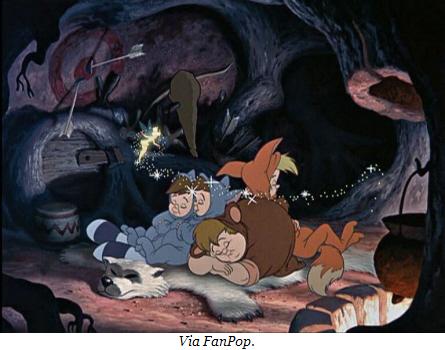
The Tree of Life shows that trees are not only markers for where certain actions will take place or where the central protagonist should turn, but they are somewhat characters in their own right. Trees are key characters/motifs in the Disney films Pocahontas, Peter Pan and Alice in Wonderland, as they provide turning points or revelations in the story.

Mark I. Pinsky, author of The Gospel According to Disney: Faith, Trust and Pixie Dust, says, “Providence will show up in the form of a fairy, wizard [or] talking willow tree,” if ever you should lose your way. Or rather, in Alice’s case, stumbling down the rabbit hole underneath the tree she falls asleep in is how she begins her wayward journey.

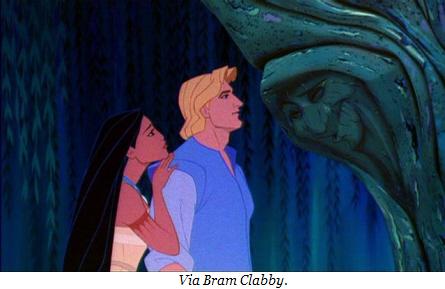
Pocahontas, the story of a Native American girl who promotes acceptance between white settlers and her own people, is the obvious example of a Disney film with a tree as an actual, personified character in Grandmother Willow. According to the Living Arts Originals website, “Willow tree symbolism includes magic, healing, inner vision and dreams… Forests are the abode for the nature spirits”. A lot of research probably went into the character of Grandmother Willow, as these classic Native American qualities of the tree are evident in her. She acts as Pocahontas’s “fairy godmother”. Although Grandmother Willow could be personified as any nationality, she is fittingly a Native American like Pocahontas and her people, because that’s who Pocahontas identifies with (as evident in the conflict between Pocahontas’s tribe and John Smith’s men). When Pocahontas brings John Smith to Grandmother Willow, she shows him her magic and opens up the Native American culture to him, and thereby the settlers, as Pocahontas did in reality many centuries ago. Grandmother Willow, using her virtues of inner vision and dreaming, encourages Pocahontas to follow her path, shown to her by the spinning arrow of John Smith’s compass, thus orchestrating great change in conflict between the “savages” and the whites.
Alice in Wonderland, the most eccentric of all Disney’s films, uses trees in a number of ways. Firstly, the tree in which Alice is studying in at the beginning of the story is the tree under which the white rabbit escapes, and she follows. A magic mushroom (perhaps a reflection of the author Lewis Carroll’s drug use?), makes Alice grow to the height of a tree, where a nosey pigeon refuses to believe she’s “just a little girl!”.

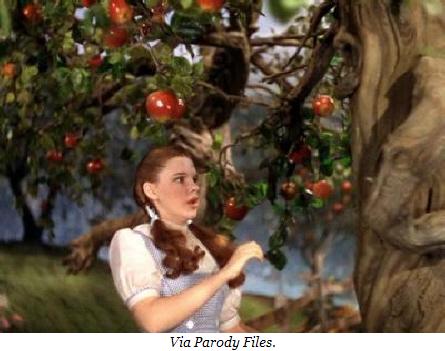
One image of the tree, or woods/forest, that rampant not only in Disney films, but many other contemporary movies, is the personification of the treetaking on human characteristics, such as eyes and arms, to give off a menacing vibe. In Alice in Wonderland, the Tulgey Woods’ trees observe Alice as eyes appear , which then turn out to be a gathering of characters with eyesducks with horns, flamingos with umbrella bodies, and glasses that seem to resemble the fake-nose-and-moustache disguise that children are fond of. Treebeard, in J. R. R. Tolkien’s Lord of the Rings trilogy, both text and film is another, non-Disney example. The forest in The Wizard of Oz comes to life and the trees throw their apples at Dorothy, Scarecrow and little Toto. If I listed the numerous other movies that show trees in this way, we’d be here all day.

But, they’re all derived from one Disney flick in particular: Snow White and the Seven Dwarfs. The first ever feature length animated film was also one of the first to depict a forest coming to life in such a way, where the trees grow arms and eyes, and bark floating in the river turns into crocodiles! No doubt other Hollywood productions have used Snow White and Disney as inspiration, especially The Wizard of Oz, with it’s out-of-this-world plot and unmistakably Disney-esque characters.

Even before Snow White, though, was the Disney short animated film Flowers and Trees, shown in 1932, which won the first ever Academy Award for an animated short. This undoubtedly would have been the starting point for trees as more than just “trees”, not only in Disney, but in film in general.

If ever there was a documentary explaining all about the depiction of trees in Disney films, it’s Four Artists Paint One Tree, a special feature that can be accessed via the 2003 special edition DVD release of Sleeping Beauty. In the doco, Walt Disney narrates as four animators go out into the field to demonstrate how they would paint an old oak tree. The first artist, Walt Peregoy, views the tree as an architectural monument, and his finished painting is evidence of the animation of the backdrop of Sleeping Beauty. Josh Meador, an effects artist for Sleeping Beauty, references the Druids, who believed trees had personalities. Maybe he was a key artist in personifying trees and bringing them to life? The next painter, Eyvind Earle, is primarily interested in the trunk, and uses watercolours to fill in the fine detail. Finally, Marc Davis represents the tree as an explosion out of the earth, with branches spraying out from the body of the trunk. After watching this documentary, you can see which aspects of each artists tree, or their style of painting scenery, that has gone into creating Sleeping Beauty. Walt ends the documentary by paraphrasing the artist Robert Henri: “The great painter has something to say. He does not paint men, landscapes or furniture, but an idea.” This seems to be the consensus amongst not just Disney’s approach to filmmaking, but the studio’s approach to letting audiences believe what they want to believe (some would beg to differ on this point).

M. Lynne Bird backs this theory up in her article titled “Ecological Ambivalence in Neverland from The Little White Bird to Hook in the tome Wild Things: Children’s Culture and Ecocriticism. She discusses the idea that trees are just treesnature is just naturein Disney films, but it’s the children’s imaginations, and in turn, Walt Disney’s child-at-heart imagination that makes a tree something more, such as in the films mentioned above. She writes, “‘The Neverland is always more or less an island, with astonishing splashes of colour here and there’… This mix drops nature and privileges both imagination and society. The island can only become real as children look for it.”
Though not a “tree” specifically, the Smoke Tree Ranch, Walt Disney’s holiday home in Palm Springs, California, was used as collateral in the funding of Disneyland. While it was hard for him to part with the ranch, it turns out Disney made the right choice: sacrificing a symbolic and sentimental place in his personal life to create a symbolic and sentimental place for millions of others.

Walt Disney was obviously a kid at heart, as can be seen in the tales he chose to adapt and bring to a worldwide audience. Tarzan’s Treehouse, from the movie Tarzan (and was also adapted from the tree house in Disney’s Swiss Family Robinson) and located in the Disneyland theme park as an attraction, and the creation of the Hangman’s Tree, the home of Peter Pan and the Lost Boys, are more blatant examples of trees in the world of Walt Disney. Hangman’s Tree exemplifies everything a child could want in a tree house.

While, once again, trees are definitely not the first thing Disney-enthusiasts think of when sitting down to watch their favourite film, but the next time you do, keep an eye out for the trees: after all, that’s what a horticulturalist would do!

Elsewhere: [Modern Mechanix] The Magic Worlds of Walt Disney Part 1.

[MSMC] The Cipher: The Mythological Tree in Various Cultures.

[Living Arts Originals] Find Your Tree: The Deep-Rooted Symbolism of Trees.

[Google Books] Ecological Ambivalence in Neverland from The Little White Bird to Hook.

On the (Rest of the) Net.


After my Mick Foley rant last week, I’ve started reading his blog, Countdown to Lockdown, and I’m loving it. Here are some choice articles:

Remembering female pro-wrestling pioneer, Luna Vachon, who passed away on August 27 this year.

“That Time I Met… Tina Fey… and Alec Baldwin!”

“That Time I Met… President William Jefferson Clinton!” (I really love this one; some heart-warming stuff.)

“Mick’s Favourite Things: Top Ten Matches”, three of whichCactus Jack VS. Randy Orton at Backlash 2004 (above), Mankind VS. The Undertaker in Hell in a Cell in June, 1998, and Mick Foley VS. Edge in a Hardcore Match at WrestleMania XXII (that’s WrestleMania 22 in 2006 for you wrestling laymen)I 100% agree with.

In defence of Buffy’s whining.

“To the Teenage Boy in Your Life”:

“An important thing to remember is that girls are not from a different planet, nor are they even a different species. They’re just people, they’re just like boys, except with vulvas instead of penises.

“Mainly you need to remember this when you’re trying to figure out what a girl is thinking. See, if you didn’t know what a BOY was thinking, how would you go about finding out? You might ask him, right? The same goes for girls.”

I’m a bit behind the eight-ball on this one, as No Make-Up Week was a month ago, but Alle Malice’s guest post on Rabbit Write goes over the reasons “Why We Wear Make-Up”. I especially like this one:

“It makes me look good in photos. Almost everything we do now is documented by someone and posted in Facebook albums for the world to see, because if you aren’t having fun on Facebook, you aren’t really having fun. And if you aren’t pretty on the internet, you aren’t pretty in real life. Enter makeup.”

Nick Sylvester, on Riff City, discusses “How Kanye West’s Online Triumphs Have Eclipsed Kanye West”:

“Maybe there are people working with him… but I get the sense that Kanye is generating the [sic] lot of these ideas. I imagine he likes being in control of every aspect of the production, the medium being the message and so on. Online he is a wise fool, first playing into people’s perceptions of ‘Kanye West’, then off those very perceptions, sending himself up, pulling back his own veil… Despite many attempts, Kanye West is incapable of being parodied, largely because Kanye West has already figured out a way to be a parody of Kanye West.”

Much like Megan Fox in this New York Times Magazine article. Could I even go as far as to say that blonde bombshell Pamela Anderson has employed this strategy? I believe I could. And for that matter, Lindsay Lohan sending herself up on Funny or Die and promos for the MTV VMAs are along the same lines.

Sylvester goes on to say that “artists like Kanye West have to be ‘good at Twitter’ in order to put a dent in the zeitgeist.”

Furthermore,

“‘Nowadays rappers, they like bloggers,’ is what Swizz Beatz says… Slowly the work itself becomes secondary, less ambitious; slowly people becomes ‘really proud of their tweets’.”

Is it “The End of Men”?

Disney’s latest offering, Tangled, based on the story of Rapunzel, takes us back to a time when the Disney Princess reigned supreme, according to io9.

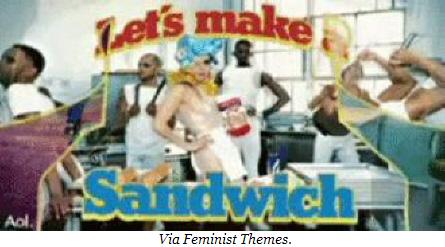
Feminist Themes examines Lady Gaga’s “Telephone” clip:

“… the objectification, glamorising of lesbian fetishism, and excessive girl-on-girl violence… [are aspects of the video that] feminist Gaga fans can try to justify… as another example of how she subversively turns what we usually find hot into something that leaves a nasty taste in our mouths and therefore makes a statement, but if any other artist (particularly any male artist) incorporated this much objectification and violence against women we would be outraged. Is it any different just because it’s a woman, or because it’s specifically Gaga?

“… What sets Gaga apart from other sexpot pop stars for me is that I just can’t imagine men being honestly turned on by hernot because she isn’t gorgeous (she is), but because she is so avant-garde, aggressive and self-driven which takes that arousal and turns it into something atypical, uncomfortable, and threatening.”

Also at Feminist Themes, the cause of the she-blogger in “Why I Blog”.

In other Gaga news, The Cavalier Daily reports that the University of Virginia is now running Lady Gaga classes! This sooo makes me want to re-enrol in university in a post-grad, transfer to UV, and take this kick-ass class!

The Daily Beast puts forth two differing opinions on Glee’s stereotypes: Andy Dehnart discusses the show’s “Harmful Simplicity”, while Thaddeus Russell applauds the walking stereotype that is Kurt Hummel, as “history tells us that those unafraid to be ‘too gay’ won far more freedomsfor all of usthan those who dressed the part of straights.”

Beautifully satiric The Frenemy reveals the recipe to “The Teen Romantic Comedy”, which “does not work for Mean Girls, 10 Things I Hate About You, or John Hughes films”, unfortunately. The truth about Disney Princes is also profiled, in which Eric from The Little Mermaid “wanted to kiss a girl who doesn’t speak words and doesn’t know how to use a fork. What the hell are you, caveman?”, while Mulan’s Captain Shang is in truth, a “gay liar” who made young, susceptible viewers the girls who have “crushes on a lot of her gay friends. [A] big Will & Grace fan.” Hey, that’s me!

Rachel Hills discusses intersectionality in feminism:

“For those of you who aren’t familiar with the term, ‘intersectionality’ is a way of talking about power and privilege that recognises that recognises that these things operate on multiple axes. People aren’t just female, or Black, or Asian, or straight, or working class, or trans, or a parent, or prone to depressioneveryone falls into a number of different categories that colours their experience of the world in specific ways. In the feminist context, it serves as a useful reminder that not all women have the same experiences, and calls into question the still dominant notion that the neutral ‘female’ experience is one that is white, heterosexual and middle-class.

“I’m also a fan because it just makes feminism a whole lot more interesting.”

Girl with a Satchel profiles Melissa Hoyer’s media career, which is a must-read for any budding wordsmith.

I am staunchly pro-choice when it comes to the abortion debate. In fact, I lean so far to the left that I’m borderline pro-abortion. (I’m sure that’ll ruffle some feathers!) But no matter what your feelings on the subject, MamaMia’s post, “The Couple Facing Jail Because They Tried To ‘Procure an Abortion’. Hello, Queensland? It’s 2010” is worth checking out.

Jezebel’s “5 Worst Mean (Little) Girls of All Time” includes Willy Wonka’s Veruca Salt and, from one of the most heart wrenching films of all time, A Little Princess, Lavinia, who looks a lot like modern-day mean girl, Angelina Pivarnick, from Jersey Shore.

“Why Strawberry Shortcake Was a Progressive Pioneer.”

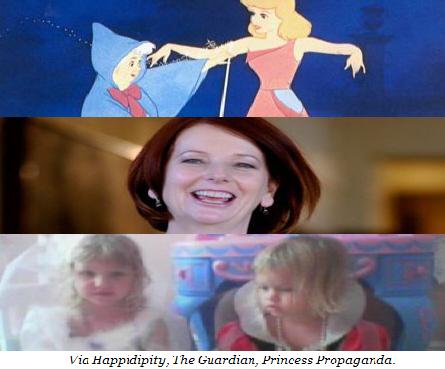
Julia Gillard as Feminist Fairy Godmother?

In an article about Disney Princesses and the effect they have on young girls, this paragraph really resonated with me:

“The princess as superhero is not irrelevant. Some scholars I spoke with say that given its post-9/11 timing, princess mania is a response to a newly dangerous world. ‘Historically, princess worship has emerged during periods of uncertainty and profound social change,’ observes Miriam Forman-Brunell, a historian at the University of Missouri-Kansas City.

“‘The original folk tales themselves,’ Forman-Brunell says, ‘spring from medieval and early modern European culture that faced all kinds of economic and demographic and social upheaval—famine, war, disease, terror of wolves. Girls play savoir during times of economic crisis and instability.’ That’s a heavy burden for little shoulders. Perhaps that’s why the magic wand has become an essential part of the princess get-up. In the original stories—even the Disney versions of them—it’s not the girl herself who’s magic; it’s the fairy godmother…”

While we may not be in times of “economic and demographic and social upheaval”rather, we’re just emerging from themPrime Minister Julia Gillard has certainly taken the reigns of our country and is steering it in a new direction.

Some of her policies (namely the outmoded same-sex marriage ban) I don’t agree with, but she is certainly a beacon of aspiration for young Australian girls, who now realise they could “end up becoming lawyers, doctors, mothers or princesses…”or Prime Minister.

In that way, Gillard surely is a feminist fairy godmother for us all.

P.S. Happy 49th Birthday, Julia!

Elsewhere: [NYTimes] What’s Wrong With Cinderella?

Men in Fiction: My Most Loved Made-Up Males.

Last week I featured my favourite fictional females, and this week I thought I’d give the guys a go.

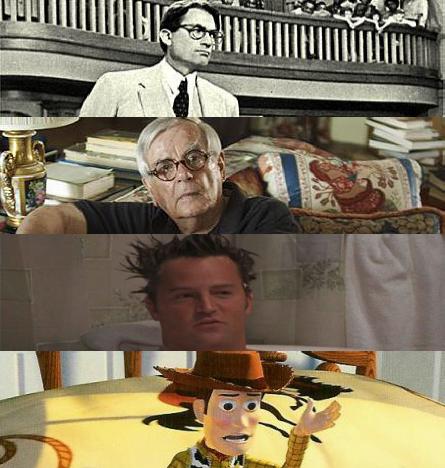
In the vein of Scout Finch from To Kill a Mockingbird, her father Atticus is way up there. He represents “the father figure I never had”, guiding Scout, her brother Jem, and their friend Dil through the last summer of their naïve childhood and how judging a book by it’s cover (or skin colour) is not the way to go. Plus, he has a kick ass name!

Similar to my obsession with To Kill a Mockingbird is my love of Dominick Dunne and any of his books, specifically Another City, Not My Own, in which Dunne’s alter-ego Gus Bailey acts as the fictional narrator of Dunne’s real-life O.J. Simpson trial experiences. It is hard to separate the two men, which is what I love about Dunne’s stories; a reader familiar with Dunne’s experiences doesn’t know where real-life ends and fiction begins.

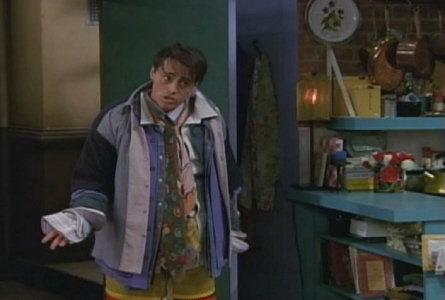
Every fan of Friends has a favourite character, and mine has always been Chandler Bing. He gets the funniest storylines, and Matthew Perry has great comedic timing. There are many episodes I could ramble on about, but my two favourite Chandler moments are when Phoebe attempts to seduce him into admitting his relationship with Monica, and when Chandler kicks up a stink about Joey stealing his chair before Ross’s benefit, and in a check-mate move, Joey puts on every item of clothing in Chandler’s possession, quipping in true Chandler fashion, “Could I be wearing any more clothes?”

It’s been a Disney-centric year, what with Beauty & the Beast about to be re-released in 3D, the Melbourne Symphony Orchestra performing Disney songs in December (which I’m so going to, FYI), the first African American Disney Princess in the lacklustre The Princess & the Frog, and the much anticipated release of Toy Story 3, with one of my all-time favourite characters, Woody. The pull-string sheriff is inspirational in that he’ll never “leave a man behind”, he exists primarily for the pleasure of his owner, Andy, but discovers that there’s more to life, like making friends and other people happy, than what he thought his true purpose was; to be with Andy. I loved the third instalment of the saga, but it can never top the first one. So quotable, so timeless, so child-at-heart. ♥

Other inspirational men of fiction include Dan Brown’s Robert Langdon; Shia LaBeouf’s character in Disturbia, and the character who inspired him, L.B. Jeffries from Alfred Hitchcock’s Rear Window; Fiver, Bigwig and Hazel from Watership Down; Woody’s space ranger counterpart, Buzz Lightyear; the Beast in Beauty & the Beast; and Holden Caulfield in A Catcher in the Rye.

Women in Fiction: My Favourite Fictional Females.

A recent post on Girl with a Satchel (which was reblogged here) inspired me to assess my favourite fictional female characters.

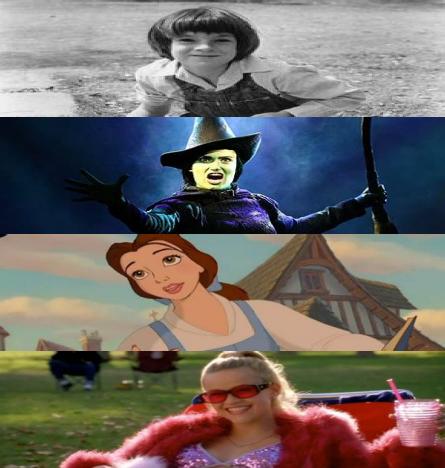
One of my favourite books is To Kill a Mockingbird, and protagonist Scout Finch is one of my favourite characters of the written word. Her innocence and naivety are super-endearing, and her past-tense narrating allows the reader to put themselves in her shoes easily.

Wicked is a niche book and musical that theatre buffs can’t get enough of, but the general public are a bit oblivious to because it hasn’t derived from/been made into a movie, like Melbourne’s current season of musicals, West Side Story, Mary Poppins and Hairspray, all of which are on my theatre-going agenda in the coming months.

I’ve seen the production three times in Melbourne, and many a friend has seen it in its various international incarnations on Broadway and the West End… oh, and Sydney! I was so touched by the story and its messages of friendship, good versus evil and judging a book by its cover, and even more so by Elphaba, better known as The Wicked Witch of the West from The Wizard of Oz. Unlike in the original story, Wicked’s Elphaba is fiercely loyal to her disabled sister Nessarose, and those who become close to her like Glinda, Doctor Dillamond and Fiyero, misunderstood because of the colour of her skin and the slander spread about her when she discovers the Wizard of Oz is a fraud and seeks revenge.

In the vein of fairytale musicals, Beauty & the Beast (which is being re-released in selected theatres in 3D from 2 September) is by far my favourite, and I love its heroine Belle so much, I have been known to fight with my friends and children alike over the fact that I AM BELLE! Hello, I have brown hair, like burly men, read a lot and have a penchant for yellow gowns! While there have been arguments circulating that the Disney princesses are beacons of anti-feminism, I maintain my stance that Belle doesn’t need a man to rescue her (in fact, she does the rescuing, helping the Beast when he is attacked by wolves, attempting to make the townspeople see the error of their ways in going after him, and ultimately, setting his heart free) and sees the Beast for who he truly is, not for what he looks like or what he can do for her. She’s a kick-ass beauty in the vein of Buffy, The Vampire Slayer and Angelina Jolie’s Lara Croft: Tomb Raider.

I’ve blogged (or reblogged) a little bit lately about Elle Woods. She’s an everywoman. Rachel Hills identifies with her, as does Satchel Girl Erica Bartle. A law-studying friend of mine recently compared herself to Miss Woods, also. And I won’t lie; I’ve fantasised about wearing a Playboy bunny suit whilst purchasing an Apple Mac! Elle Woods proves that you can take pride in your appearance and have fun whilst pursuing your dreams and making a name for yourself separate from the name of the man in your life.

There are plenty of other made-up women who I have an affinity for, including the aforementioned Buffy Summers, and Daria Morgendorffer for their kick-ass feminist mentalities; ditto for the Charmed sisters; Gossip Girl’s Blair Waldorf, who can be a psycho bitch at times, but she’s THE psycho bitch; for similar reasons as Elle Woods, Cher Horowitz; and Barbie.

Related: Guest Post—Pop Culture Power Women.

In Defence of To Kill a Mockingbird.

Event: The Way We Wear Vintage Market.

Elsewhere: [Girl with a Satchel] Women of Pop Culture & the Unashamed Use of Cutesy Clichés.

[Musings of an Inappropriate Woman] Have You Ever Seen Yourself Through Someone Else’s Eyes?