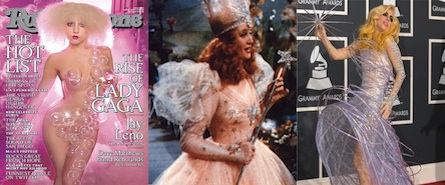
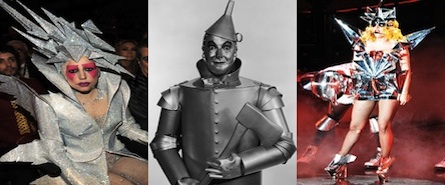
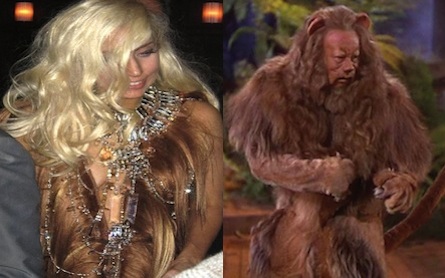
Lady Gaga: Taking Inspiration from The Wizard of Oz.

With the release of “Born This Way”, critics are wondering if Lady Gaga isn’t as original as they once thought she was. The song blatantly rips off takes inspiration from Madonna’s “Express Yourself”, and a lot of Gaga’s past works are heavily influence by Her Madgesty.

But Lady Gaga has always been about much more than just her music. It’s all about the fashion, hello?!

But even her outrageous outfits—bar the meat dress and a couple of others—aren’t that original when you come to think of it. Juxtaposed against The Wizard of Oz‘s Cowardly Lion, Good Witch of the South, Tin Man et al., Gaga proves that imitation is the sincerest form of flattery.

Images via Amy Grindhouse, Wired, Billboard, Just Nuggets, The Examiner, Leopard Print & Lace, Pony & Pink, Pollsb, TV Tropes, Beauty & the Feast, Wikia, Wendy’s World of Oz.

On the (Rest of the) Net.


The difference between truly Mean Girls and the just plain Clueless:

“In the end, Cher’s altruism may be what saves her reign, for unlike Regina, Cher tries to live up to her end of the social contract. If Regina can’t rule, she decides that no one can. She hurts her society by pulling a wiki-leaks and releasing the contents of the Burn Book, thereby causing complete anarchy…

“In essence, the reason Regina was overthrown is the same reason any dictator is eventually overthrown: the monarch breaks the social contract with his or her people and those people have been prepped by cultural illuminati with new ideas about government rule.”

“Fashion’s Fascists.”

And, in the same vein:

“Fashion people everywhere rushed to check their hair before joining the chorus of dismay, almost as if racism and sexism were not the stock-in-trade of their industry. In fact, it is an open secret in high fashion that black and minority ethnic faces… are not welcome.”

When having “a great personality” is code for “fat” and/or “ugly”.

It’s taken me a little while to get around to reading this, but check out Girl with a Satchel’s Erica Bartle in “JC & the Cool Gang”.

“How Rachel Zoe Became Hollywood’s Most Powerful Fashion Player.”

Glee’s Lauren Zizes: badass or fat bitch?

The myth of Bart Simpson’s birthday.

Jihad Cosmo:

“We had been thinking that what Cosmo was really missing was a healthy dose of religious fanaticism and a few passionate exhortations to violence, so we can’t wait to read the article ‘that urges readers to give their lives for the Islamist cause.’”

UK sculptor Jamie McCartney’s “Great Wall of Vagina” (semi-NSFW).

How to be a mermaid.

Elective C-section or vaginal birth?

How to move to New York City, according to Gala Darling.

Images via Overthinking It, The Hollywood Reporter, YouTube.

On the (Rest of the) Net.


Eight-year-old yellow wunderkind Lisa Simpson has her own book club.

Sarah Ayoub addresses Eddie Maguire’s racist comments in The Sydney Morning Herald.

Paula Joye at Girl with a Satchel on declining mag circulation.

How Hugh Hefner got his groove back at The New York Times.

I never thought there was a “link between autism and vaccinations” until my sister told me the story of how her boyfriend’s brother went from normal, happy and healthy baby to severely disabled after a vaccination. That made me think differently. This article will challenge your beliefs either way.

If “at least 40% of your diet consists of pre-packaged food”, “you don’t sleep enough for proper brain function” and “your boss knows you’re gullible”, you most likely work a 16-hour workday.

On stripping (take two):

“… the brotherly succor would partially exist in the form of shared ambivalence. I would venture to say that this how a majority of men feel about strippers… Do I enjoy strippers? Not really. Do I frequent tithouses often? No. Nor have I any close friends who do… I think men would be willing to renounce strippers if women renounced the Sex and the City franchise. I mean cut all cords. Shit’s gotten out of hand. No reruns. None of the third-wave dime store psychology. A complete effacement out of pop culture. You’re not even allowed hearken back to the simpler days when it meant something to you. Do we have a deal?”

Speaking of Sex & the City, is there a double standard between the second movie and lad flick Get Him to the Greek?

Is it possible to be a feminist and like fashion, too?

“I still get thrilled and impressed by bold, lovely, and often expensive fashion. And I still feel like I’m a person of worth, whether I’m wearing vintage Chanel or ‘vintage’ sweatpants. But I can’t seem to reconcile these two (competing?) impulses; on the one hand, a value in ‘art for art’s sake[’], beauty, style, and other intangibles; on the other, an investment in valuing substance over style, actions over appearances, and real justice over flamboyant showmanship.”

“What Your Favourite Magazine Says About You (Part II).”

Zoë Foster espouses the benefits of the “Better Man, Better Dan” theory.


Images via The Lisa Simpson Book Club, The Frisky.

On the (Rest of the) Net.

Flavorwire celebrates the Chinese New Year with “40 Culturally Relevant Rabbits”.

Ryan Gosling as feminist icon?

Jennifer Aniston controversially embraces her inner Lolita for Allure.

Speaking of… The allure of Mormon housewife blogs.

Chad Woody on “The Oprahverse”:

“This gets at my perennial problem with Oprah. She’s all about the self-determined destiny. This comes from hanging out constantly with celebrities, the cultural lottery winners of the world, and asking them about their origins and beliefs. Sure, some of them say they were lucky in some way, but what Oprah really digs for is that little gold nugget of ego in everyone that says, “I did it my way, and I always knew I would!” But success woven from big dreams is an easy pattern to discern if you’re only interviewing winners…”

While I don’t agree with Erica Bartle’s comments—I believe that Stefani Joanne Angelina Germanotta was “born this way” as Lady Gaga, and everything she does is an extension of herself—the girl with the satchel raises some interesting points about not needing “an alter ego when you’re happy with who you really are”.

Also at GWAS, Bartle laments the demise of The Saturday Age’s A2 supplement in favour of “the more generic Fairfax Life & Style moniker). I feel your pain :(.

“Why I (Really, Seriously, Truly) Hate Carrie Bradshaw”:

“…If I ever saw a woman dressed like that either here in the city, or anywhere else in the world, I’d throw a Twinkie at them, tell them to take a long look in the mirror and eat a damn carb for a change. Yes, I keep Twinkies on me for such occasions… Carrie once threw a Big Mac at Big, so throwing things have been all the rage ever since, right?”

Not only do strong women get branded “the bitch” for knowing what they want and standing up for themselves (if I can be so cavalier, I consider myself a strong woman who is often called “bitch”), but apparently it’s hardest for us to find equally as strong, if not stronger, men in the dating market. Woe is us.

Some more thoughts from Sarah Wilson:

“… Men aren’t happy because they’re not being real men. They’re denied the opportunity to pursue, to go after the woman they reckon is perfect for them. That’s because they’re being pursued by women. Why? Cos everything is out of whack (women are used to chasing things and get impatient when men don’t approach, but also because the men aren’t pursuing… cos they don’t have to… and it goes around and around). And so men feel emasculated by this. Because men are meant to be the hunters.  The peacocks who do dances and display their prowess to women, to earn female trust and affection. Since the cost of partnering is higher for women, they must be fussier and sit back and weigh up their options. This is a biological imperative.”

In a similar vein, “The Sexual Cost of Female Success”:

“…What’s important is getting women to question every decision they make on the grounds of what insecure men might potentially think about it, men you’d never want to date anyway because their insecurities would make the relationship hell. And, more importantly, because you’re not physically attracted to them—something no amount of data or bullshit studies on the internet will ever change. Yes, women are ruining everything by not planning their lives expressly according to men’s biological clocks and wishes.”

Gender Agenda and Melinda Tankard-Reist get their wordplay on in the fight against Kanye West’s Monster video.

Can everyone get over Michelle Obama’s clothing choices already?:

“Michelle Obama is a Princeton and Harvard-educated lawyer and former executive at the University of Chicago Hospitals system who happens to dress pretty well and be married to the president of the United States of America. But what are the stories about her that have dominated the media? They’re not about her skills, her experience, her mind, or even about her almost disgustingly uncontroversial pet issue, fighting childhood obesity. The Michelle Obama News is about whether her eyebrows are ‘angry.’ Whether her clothes mark her as a ‘new Marie Antoinette’… [or a] ‘new Jackie Kennedy.'”

The straight guy’s guide to Glee.

In response to Natasha Vargas-Cooper’s “Hardcore”, Tana Ganeva debunks “The Anti-Male, Anti-Sex Falsehoods That Rule Discussions About Porn and Sexuality”.

Shut up, Mark Latham!

I disagree with most of Miranda Devine’s views in “Buying a Baby—Not a Pair of Shoes”, but one thing’s for sure: Nicole Kidman’s surrogacy is one contentious issue.

The secret diary of a call girl.

The private lives of Pippa Lee public people.

The dating game according to the ladies of the Jersey Shore.

“The Baby-Sitters Club: Where Are They Now?”

Image via Sassi Sam.

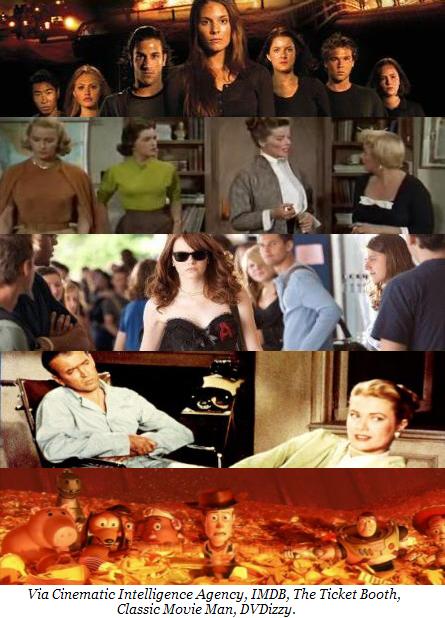
Movies: The Best Movies I’ve Seen This Year.


Tomorrow, When the War Began. Check out my review to see how strongly I feel about it.

Desk Set. This 1957 romantic comedy starring Katharine Hepburn and Spencer Tracy takes place in a reference library, and deals with the incorporation of computers to help the ladies in their cataloguing. With a healthy dose of the trademark ’50s slapstick rom-com dynamic and TDF fashion, I loved this one.

Easy A. Again, another I’ve done a review on. While I had high hopes for this one, it didn’t live up to them fully, but it is one of the smarter teen movies in recent memory. On par with Mean Girls, perhaps?

Rear Window. What took me so long, right? I watched this one for the first time last Christmas, and continued the tradition again this holiday season. Grace Kelly is luminous as “his girl Friday” to James Stewart’s L.B. Jeffries, who is the ultimate leading man. Hitchcock at his best.

Toy Story 3. It is unanimous that Toy Story 3 is one of the best movies released in 2010. Perhaps the best of the Toy Story franchise? Nah, my money’s on the first instalment.

Desperately Seeking Susan. So bad it’s good. The fashion is fabulous (on Madonna’s part, anyway) and Her Madgesty is surprisingly likable in it.

Sorry about the dismal effort in this post, but seriously; there were no good movies this year! You only have to look at Sex & the City 2 (which I quite liked, but will admit was baaad), The Expendables and Killers for proof of that.

That’s why I spent a lot of my cinema-going money on the classics, such as Gentlemen Prefer Blondes and Beauty & the Beast in 3D. That counts as a movie I haven’t seen before this year, right? Right…?

Related: Tomorrow, When the War Began by John Marsden Review.

Easy A Review.

Sex & the City 2 Review.

The Expendables Review.

Elsewhere: [Jezebel] Is Easy A The Next Mean Girls?

[Jezebel] I Went to See Killers & It’s All Your Fault.

On the (Rest of the) Net.

Just a short one this week, as I haven’t had a lot of time for reading. L

Rabbit White ponders the things she learnt about her own sexuality from the men at Mr. International Rubber:

“It is being put in a sexual situation when you are non-sexual. It’s being introduced to a new world all at once. But it’s not long before I feel comfortable here, basking in male sexuality that is totally not directed at me. I think I finally getting the draw to being a ‘fag hag’or ‘fairy princess’. I get to gawk and join in the lust without fear of being pulled in or anxiety of protecting myself. In the view from here, human sexuality is a celebration and male sexuality is valid and uniquely cool.

“I don’t know how many times I’ve read advice columns where girls write in, worried about their smell or unable to enjoy sex because they are self conscious. Perhaps it’s because girls are taught to please everyone else, putting themselves last, but there just seems to be something in female sexuality that is uncomfortable with receiving pleasure. Look at all the women’s mags, obsessed with ‘how to please a man’.

“But maybe the ‘pig’ concept could lessen fears around receiving pleasure. What if your partner liked you sweaty, smelly, just the way you are right now? And just wanted more and more and more of that.”

Sady Doyle, of Tiger Beatdown (lots of feminist goodness from them this week) discusses “The Fantasy of Girl World”:

“The fantasy of girl world often feels like the feminist imagination taken to its most self-indulgent, hypocritical extremes. We stand for tolerance and egalitarianism, whereas the people who disagree with us are IGNORANT WIFE-BEATING MONSTERS. Women, if left on their own, would eliminate war, poverty, heartbreak and pets that are not cats. But, here’s a question for you: Why shouldn’t it look like this? What’s wrong with a wish-fulfilment fantasy that tells women they could do well with power and without oppression? What’s wrong with girls geeking out over the idea that they’re special?”

Glee’s Rocky Horror episode failed to touch-a, touch-a, touch-a, touch Garland Grey at Tiger Beatdown:

“Early on in the episode Mike volunteers to play Dr. Frank-N-Furter, but a few scenes later he says his parents won’t allow him to play a ‘tranny’. Mercedes takes the role, delivering a show stopping version of ‘Sweet Transvestite’, but the word ‘transsexual’ is replaced by ‘sensational’. For Glee, transpeople are punch lines, not anyone the show needs to fucking think about. While doing Rocky Horror Picture Show, a musical whose entire message is about accepting people’s sexuality and gender.

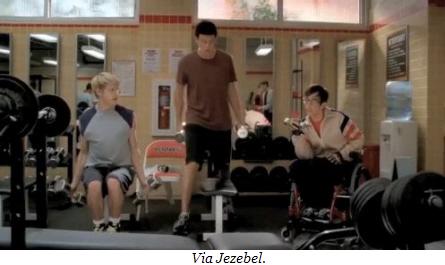
“Can we just cut out losses and rename this show Chord Overstreet in Tiny Gold Shorts? Clearly, he is fanservice and I don’t even care… However, as much as I appreciated seeing his abs, I didn’t care for the oddly-specific diet regimen he blurts out before showing them or the comically small weights Artie was holding. Artie’s a paraplegic, pushing himself everywhere in his wheelchair, lifting himself in and out of it dozens of times a day, and THAT is the biggest weight he’s lifting? That weight is a clear signal to the audience that Artie doesn’t belong in the locker room and is only there to provide comic relief…”

The four types of Facebook friends, according to Susan Orlean.

The Pervocracy on the “Slut, Deconstructed”:

“I’m 25. I lost my virginity at 15. So 26 partners is only two or three a year. It’s hardly going home with a new guy every night. To break it down further, 6 of those partners were serious romantic relationships, and you can’t call a girl slutty for sleeping with her own boyfriend, right? So now it’s 20 casual partners over 10 years—a raging, wild, man-eating two per year. I’m so cock-crazy I need it every six months, baby…

“Oh, and a woman in ‘my god, you can see her everything’ clothing dancing on tables and flirting with every guy in the bar might be a virgin for all you know about her.”

It’s the wrong time of year here, but there’s not many things I love more than trawling through the gossip magazines in summer, style-stalking the celebrities in Aspen and New York, longing for cool weather again to break out the beanies, woollen cardigans and shearling coats (okay, wrong continent for shearling!).

Men on Chapel Street.

Even though I live quite close to Chapel Street in Melbourne, I try to avoid going there as it is not my scene at all.

The other night I ventured as far down as I’ve been in years, to Lucky Coq, on High Street, for drinks with a friend.

The outing reminded me of the last time I’d been that far down, which was back in 2008 for a uni project. Odd, I know, but stay with me.

One of my final units was a media subject entitled Men & Masculinities. I was hesitant to take on the course, but it was my final year and I’d already done all the good ones. Aside from my inept teacher, the unit was really fun, and some of the topics I studied have influenced me to this day.

The reason my study group and I trekked to Chapel Street was to examine the different types of masculinities we observed there. With the National Institute of Circus Arts and the multitude of gyms and boutiques located there, I was expecting to see a lot of buff, fashionable men concerned with their appearance. In short, I expected to see the “metrosexual” in his natural habitat.

After a bit of rummaging through my hard drive, and a quick Google search, I managed to find the articlean interview with Professor of English, Sociology & Women’s Studies at the University of California, Toby Miller, by Jenny Burton and Jinna Tayby which I used to establish some theories about men on Chapel Street.

Keep in mind that these observations were collected two years ago, and I have tried to keep my notes as close to the originals as possible (present day annotations in italics). A lot of the subject matter discussed then has entered our current vernacular; or at least, the vernacular of this here blog, and the ones I frequently read.

Metrosexuality.

“… The phenomenon of the new man, which tends to annex beauty to the wider theoretical works of fashion, with grooming making fleeting, untheorised appearances.”

That’s not so true anymore, as fashion and grooming are becoming as equally important to men who want to look good and take pride in their appearance. Even something as simple as shaving is classed as grooming, and most men we observed on Chapel Street were clean shaven, or at least were doing something different with their facial hair (such as “designer stubble” and goatees instead of a full beard). [Had it been November when the study was done, perhaps I would have seen some mo’s out there?]

“Is the metrosexual a middle- rather than working-class phenomenon?”

I think typically the metrosexual is viewed as upper- to middle-class, and we certainly did see men of these demographics whom you could call metrosexual. However, the working class (tradies, construction workers) could also be seen as metrosexual, because even though they were engaged in manual labour and had “hard” bodies [muscly; evidence of working out], they were still well-groomed and took pride in their appearance.

“Taking pleasure in one’s body, nurturing it, caring for it, protecting it from the elements and so on kind of loosens those old bonds of conventional masculinity, which forbade these behaviours for men and made them taboo.”

The theory here is that men taking pleasure in their bodies and wanting to look physically attractive, for example by going to the gym, is taboo. Do the men we see going to the gym look ashamed of, thereby succumbing to the taboo, or proud of, their hard or soft bodies? (Hard bodies at the gym; soft bodies in certain subcultures like emo, punk, grunge etc.) I wasn’t expecting to see men ashamed of their bodies, especially in a trendy, affluent place like Chapel Street. However, older, out of shape men were a bit more self-conscious than their younger, better-looking counterparts because they tended to look at the ground when they were walking and didn’t make eye contact as much as the more confident men.

“Given all the effort women make to look okay, it seems only fair that men should have to go through something approximating to that level.”

As we expected, there weren’t really any significantly out of shape, badly-groomed or badly-dressed people on Chapel Street. The women took great pride in their appearance, both in their body shapes as well as how they dressed and groomed themselves. This was echoed in the male population, who all were well-dressed, mostly in shape, and well-groomed. In that respect, it could be seen that men are taking a leaf out of the females species’ book.

“… I think it’s [metro sexuality] pretty peculiar to Australia.”

The typical Australian man is seen as a “blokey bloke” in footy shorts and a bluey, doing manual labour and playing sport recreationally. The younger generation of Australian men are challenging this stereotype by being well-dressed, well-groomed and having more unconventional jobs (according to the stereotype) like consulting, fashion, etc. There wasn’t a typical “blokey bloke” that I saw on Chapel Street; even the construction workers, who have the most “Australian” occupation, weren’t physically reflective of the stereotype. In terms of metrosexuality being unique to Australia, it’s true in that a lot of younger men are taking care of themselves, but false in the way that Australia isn’t the only country that has metrosexuals: the US does with Queer Eye for the Straight Guy and the abundance of men in the media who take pride in their appearance and endorse beauty and fashion products, like George Clooney endorsing watches, and Matthew Fox from Lost is the face of a new L’Oreal beauty range for men. I’m not so sure about the UK, because on one hand you’ve got really metrosexual men like Hugh Grant and Jude Law, but on the other there are quite scruffy men like Rhys Ifans, who was engaged to Sienna Miller, and the downright disgusting, like Pete Doherty.

Queer Eye for the Straight Guy.

“… One way to analyse Queer Eye [for the Straight Guy] is as a professionalisation of queerness; a form of management consultancy for conventional masculinity.”

This can be seen in some of the shops on Chapel Street (and Church Street). We saw gyms and health food stores selling protein shakes, etc. in clusters, as well as a beauty salon specifically for men on Church Street.

“… Queer Eye for the Straight Guy is actually about re-asserting, re-solidifying very conventional masculinity.”

Because it separates the “queer” guys, who are fashionable, neat, well groomed, from the “straight” guys, who are messy, unkempt, in need of “styling” by the “queer” guys. Men on Chapel Street challenged this idea. You could speculate about which men were straight and which men were gay, but the stereotypically “straight” ones weren’t messy or “blokey”. There were a lot of business men who needed to look tidy and well-groomed for their jobs, but there were also construction workers whom you would think were typically very masculine and therefore untidy, but even they were taking pride in their appearance, both in terms of their physically hard bodies as well as their grooming.

Sport.

“… While it’s still about toughness, sport is equally about beauty, with the NFL now marketing its players as sex symbols.”

While there weren’t really any “sports” men on Chapel Street (apart from the circus/dance performers), the masculinities we observed were as much about being physically attractive to attract a mate as they were about looking tough and hard-bodied.

Eating Disorders.

“… Clearly there are big problems with eating disorders and performance enhancing drugs amongst men… These are partly narcissistic, psychological worries to do with an image to the outside world in general… Male beauty consciousness is primarily a marketing creation… Do men use toiletries and cosmetics because advertising tells them to?”

There were a lot of advertisements on Chapel Street that would support this notion, specifically the ad in the window of a gym/health food store that promotes an unachievable body type for most men. There weren’t as many hard bodies as we expected to see, however the ones that we did see in no way reflected the extreme ideal that that specific advertisement promoted. The men who worked in fashion stores on Chapel Street succumbed to the ideal that that specific store promoted.

“… Eating disorders, insecurity about looks and image, men now being oppressed by the ‘beauty trap’ and so on, but for me this doesn’t allow for the possibility that this may also be a good thing for individual men and conventional masculinity, allowing men to indulge in some self nurture.”

The men on Chapel Street who were well-groomed obviously took pride in their appearance, and weren’t ashamed of the fact that they looked after themselves. The majority of men looked healthy, which therefore supports the claim that male grooming and “metrosexuality” (men taking care of themselves) is a good thing.

Related: The Underlying Message in Glee’s “The Rocky Horror Glee Show” Episode.

Elsewhere: [Media Culture] Metrosexuality: What’s Happening to Masculinity?

[MamaMia] Male Models: Inside Their Straaaange World.
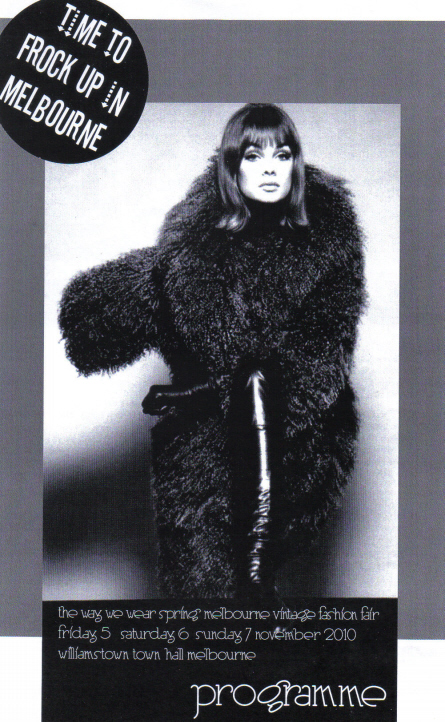
Event: Go Get Frocked—The Way We Wear Spring Vintage Fashion Fair.

It’s that time of year again, when The Way We Wear vintage market rolls around again.

Six months ago I cleaned up, picking up a gorgeous yellow dress, some jewellery and some postcards.

This time, however, I had my heart set on an A-line floral skirt and/or dress, and maybe some more jewellery, but to my chagrin, the items that caught my eyea red, Victoria Beckham-esque shift and a navy and white floral A-line dress with matching bolerowere way out of my price range.

Instead, I got a scarf with a Hermes air about it, and a black satin poodle skirt for my Mum. As Clueless’s Cher would say, “It is a far, far better thing doing stuff for other people.”

In accompaniment to the vintage wares on sale, the event hosted a “Little Black Dress” exhibition, with authentic dresses from the likes of Chanel. In an ode to this week’s “Outfit Envy”, Lauren Conrad was also featured as a LBD aficionado!

Related: Event: The Way We Wear Vintage Market.

Magazines: Goodbye TV Hits, It Was Nice Knowing You.


The first magazine I ever bought was TV Hits.

I remember sticking posters of Jonathan Taylor Thomas, George Michael and Dean Cain of Lois & Clark fame on the wall of the room I shared with my sister.

I remember knowing the words to every Top 40 song that was released from about 1996 to 1999 (when I graduated from primary school and onto Dolly), thanks to the lyric card cut-outs each edition came complete with, which comes in handy for ’90s themed dance nights.

I remember hiding my latest copy under my desk at school and reading it cover to cover during class, then again when I got home.

I remember friends commenting that they were jealous of me for being a walking Wikipedia for all things celebrity.

TV Hits was where my love affair with pop culture began, and I was known to lose sleep waiting for the latest issue to come out the next day. My mind was a sponge back then, and after much sorting, I can usually recall some of that info.

But Girl with a Satchel reports that TV Hits is to fold, and while it has become a shadow of the magazine Mecca it once was, its nostalgic influence makes me sad to see it go.

But with blogs and mobile phones and Twitter and what not, the tween music mag has become obsolete. While back when I was its number one fan, the mag was much more of a TV Week meets the entertainment section of Famous or NW publication, it had devolved (evolved?) to strictly music, with a little bit of light TV and movies on the side.

The news comes at a time when fellow Australian mag Notebook: has released its final issue, highlighting the fact that unless a magazine is selling desirable numbers year on year, month on month, week on week, and if similar content is available elsewhere (online), there’s no place for it on the newsstand.

So, in honour of TV Hits, let’s break out the Spice Girls-style platform sneakers, spin some Best of 1998 albums and trek to the Reject Shop for some hair mascara and butterfly clips, and party like it’s 1999.

Elsewhere: [Girl with a Satchel] TV Hits R.I.P.

[Girl with a Satchel] A TV Hits Clarification.

On the (Rest of the) Net: Short & Sweet Edition.

I’ve been a little too busy this week to do much blog reading but, alas, here are my picks of the week.

Can you like fashion and, like, be smart? That is the debate circulating around the blogosphere of late, and Jezebel sums up its instigation by Paper editor Kim Hastreiter and The New York Times: T editor Sally Singer. You can contribute to the discussion at fashademic (combining the words “fashion” and “academic” is so, like, smart!).

Mia Freedman imparts more of her wisdom, this time on the Stephanie Rice/Twitter incident. She writes: “I have long had a massive problem with the way we elevate sports stars to be heroes… But surely it’s time to stop raising these individuals to the heights of real heroes. Because surely when they disappoint us and show their ordinariness or, in some cases, their prejudices, it’s a very long way to fall.” Indeed.

The Onion has a satirical take on the “cult” (my emphasis) of New York City. In a faux-news story, in which the entire population of NYC stages a mass exodus, “at press time, some 10 million Los Angeles-area residents… had already begun repopulating the city.”

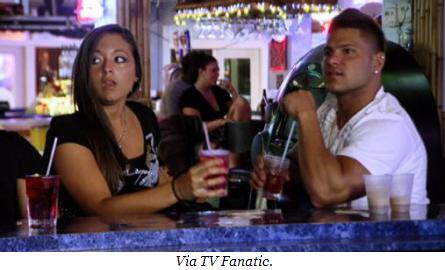
In the latest season of Jersey Shore, Sammi and Ronnie seem to break up and get back together at least once every episode (so what’s the difference between season one and season two, then?). In between that, Ronnie goes to the club, “creeps on girls”, gets wasted, and calls Sammi “a c*nt or a bitch directly to her face”. If they were your friends, what would you do?

“How to Get a Raise At Work? Clean Your Vagina.” The title says it all.