On the (Rest of the) Net.


Eight-year-old yellow wunderkind Lisa Simpson has her own book club.

Sarah Ayoub addresses Eddie Maguire’s racist comments in The Sydney Morning Herald.

Paula Joye at Girl with a Satchel on declining mag circulation.

How Hugh Hefner got his groove back at The New York Times.

I never thought there was a “link between autism and vaccinations” until my sister told me the story of how her boyfriend’s brother went from normal, happy and healthy baby to severely disabled after a vaccination. That made me think differently. This article will challenge your beliefs either way.

If “at least 40% of your diet consists of pre-packaged food”, “you don’t sleep enough for proper brain function” and “your boss knows you’re gullible”, you most likely work a 16-hour workday.

On stripping (take two):

“… the brotherly succor would partially exist in the form of shared ambivalence. I would venture to say that this how a majority of men feel about strippers… Do I enjoy strippers? Not really. Do I frequent tithouses often? No. Nor have I any close friends who do… I think men would be willing to renounce strippers if women renounced the Sex and the City franchise. I mean cut all cords. Shit’s gotten out of hand. No reruns. None of the third-wave dime store psychology. A complete effacement out of pop culture. You’re not even allowed hearken back to the simpler days when it meant something to you. Do we have a deal?”

Speaking of Sex & the City, is there a double standard between the second movie and lad flick Get Him to the Greek?

Is it possible to be a feminist and like fashion, too?

“I still get thrilled and impressed by bold, lovely, and often expensive fashion. And I still feel like I’m a person of worth, whether I’m wearing vintage Chanel or ‘vintage’ sweatpants. But I can’t seem to reconcile these two (competing?) impulses; on the one hand, a value in ‘art for art’s sake[’], beauty, style, and other intangibles; on the other, an investment in valuing substance over style, actions over appearances, and real justice over flamboyant showmanship.”

“What Your Favourite Magazine Says About You (Part II).”

Zoë Foster espouses the benefits of the “Better Man, Better Dan” theory.


Images via The Lisa Simpson Book Club, The Frisky.

On the (Rest of the) Net.

Flavorwire celebrates the Chinese New Year with “40 Culturally Relevant Rabbits”.

Ryan Gosling as feminist icon?

Jennifer Aniston controversially embraces her inner Lolita for Allure.

Speaking of… The allure of Mormon housewife blogs.

Chad Woody on “The Oprahverse”:

“This gets at my perennial problem with Oprah. She’s all about the self-determined destiny. This comes from hanging out constantly with celebrities, the cultural lottery winners of the world, and asking them about their origins and beliefs. Sure, some of them say they were lucky in some way, but what Oprah really digs for is that little gold nugget of ego in everyone that says, “I did it my way, and I always knew I would!” But success woven from big dreams is an easy pattern to discern if you’re only interviewing winners…”

While I don’t agree with Erica Bartle’s comments—I believe that Stefani Joanne Angelina Germanotta was “born this way” as Lady Gaga, and everything she does is an extension of herself—the girl with the satchel raises some interesting points about not needing “an alter ego when you’re happy with who you really are”.

Also at GWAS, Bartle laments the demise of The Saturday Age’s A2 supplement in favour of “the more generic Fairfax Life & Style moniker). I feel your pain :(.

“Why I (Really, Seriously, Truly) Hate Carrie Bradshaw”:

“…If I ever saw a woman dressed like that either here in the city, or anywhere else in the world, I’d throw a Twinkie at them, tell them to take a long look in the mirror and eat a damn carb for a change. Yes, I keep Twinkies on me for such occasions… Carrie once threw a Big Mac at Big, so throwing things have been all the rage ever since, right?”

Not only do strong women get branded “the bitch” for knowing what they want and standing up for themselves (if I can be so cavalier, I consider myself a strong woman who is often called “bitch”), but apparently it’s hardest for us to find equally as strong, if not stronger, men in the dating market. Woe is us.

Some more thoughts from Sarah Wilson:

“… Men aren’t happy because they’re not being real men. They’re denied the opportunity to pursue, to go after the woman they reckon is perfect for them. That’s because they’re being pursued by women. Why? Cos everything is out of whack (women are used to chasing things and get impatient when men don’t approach, but also because the men aren’t pursuing… cos they don’t have to… and it goes around and around). And so men feel emasculated by this. Because men are meant to be the hunters.  The peacocks who do dances and display their prowess to women, to earn female trust and affection. Since the cost of partnering is higher for women, they must be fussier and sit back and weigh up their options. This is a biological imperative.”

In a similar vein, “The Sexual Cost of Female Success”:

“…What’s important is getting women to question every decision they make on the grounds of what insecure men might potentially think about it, men you’d never want to date anyway because their insecurities would make the relationship hell. And, more importantly, because you’re not physically attracted to them—something no amount of data or bullshit studies on the internet will ever change. Yes, women are ruining everything by not planning their lives expressly according to men’s biological clocks and wishes.”

Gender Agenda and Melinda Tankard-Reist get their wordplay on in the fight against Kanye West’s Monster video.

Can everyone get over Michelle Obama’s clothing choices already?:

“Michelle Obama is a Princeton and Harvard-educated lawyer and former executive at the University of Chicago Hospitals system who happens to dress pretty well and be married to the president of the United States of America. But what are the stories about her that have dominated the media? They’re not about her skills, her experience, her mind, or even about her almost disgustingly uncontroversial pet issue, fighting childhood obesity. The Michelle Obama News is about whether her eyebrows are ‘angry.’ Whether her clothes mark her as a ‘new Marie Antoinette’… [or a] ‘new Jackie Kennedy.'”

The straight guy’s guide to Glee.

In response to Natasha Vargas-Cooper’s “Hardcore”, Tana Ganeva debunks “The Anti-Male, Anti-Sex Falsehoods That Rule Discussions About Porn and Sexuality”.

Shut up, Mark Latham!

I disagree with most of Miranda Devine’s views in “Buying a Baby—Not a Pair of Shoes”, but one thing’s for sure: Nicole Kidman’s surrogacy is one contentious issue.

The secret diary of a call girl.

The private lives of Pippa Lee public people.

The dating game according to the ladies of the Jersey Shore.

“The Baby-Sitters Club: Where Are They Now?”

Image via Sassi Sam.

Event: Bad Taste Foxymorons.

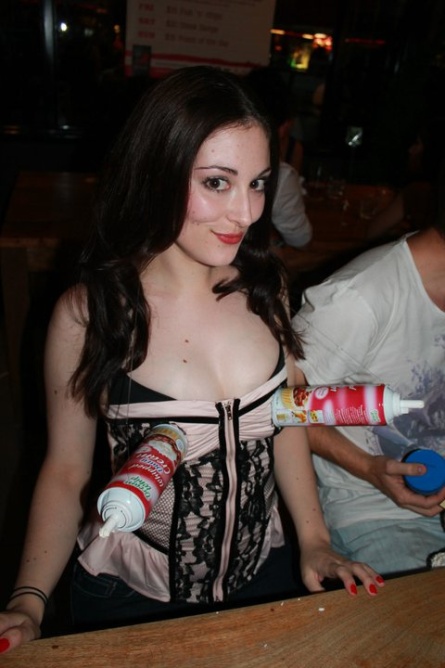
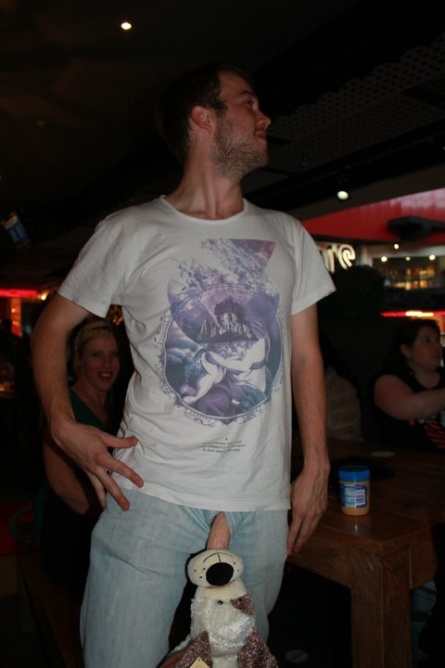
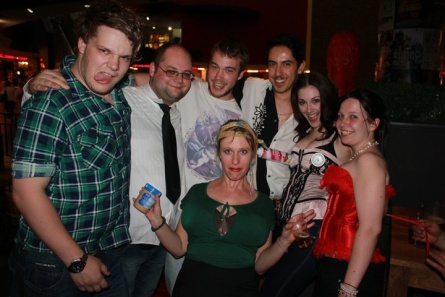
Okay, so there were no Kath & Kim wannabes at my friend Eddie’s bad taste 25th birthday party last weekend, but there were some Ab Fab throwbacks, in the form of Clare and Zoe.

For more on how our my costume was oxymoronic, stay tuned tomorrow for my take on “whipped cream feminism”, but for now, savour the bad taste.

“This is where all us round Broady keep our ciggies.”

Patsy Stone and Katy Perry flank the birthday boy.

Give a dog a bone.

Katy, Cyndi and D.O.M.

“Whaddaya mean in comes in a glass?!”

California Gurl VS. Broady Bogan.

Feminists in arms: Katy Perry & Sarah Palin.

A special thanks to April for (unbeknownst to her) the use of her Facebook captions!

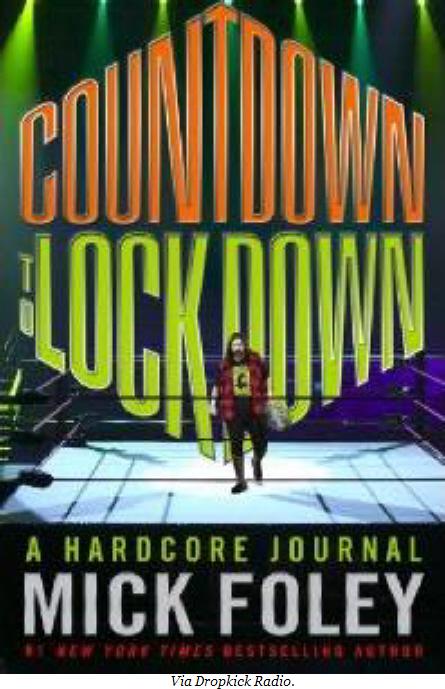
Book Review: Countdown to Lockdown—A Hardcore Journal by Mick Foley.


Midway through Countdown to Lockdown, wrestler Mick Foley’s fourth memoir and ninth published work, the author says that “June 24, 2007, had been a disaster, probably one of the worst days of my year, possibly even my life” (p. 215). And that was before he’d heard the news that colleague Chris Benoit and his family had been murdered.

Of course, it was later revealed that Benoit had committed a double murder-suicide, murdering his wife and son in their home. Foley uses the tragedy as a cautionary tale to others in the business, warning of the affects of not only drugs, but the lonely business professional wrestling can be if you aren’t one of the lucky few to be on top of it.

Aside from the small portion of the book that deals with Benoit, death, drugs and Foley’s unhappiness with his final stint as an announcer in World Wrestling Entertainment in 2008 (which you can find some funny anecdotes about on pages 143–144), the rest is a riot.

Countdown to Lockdown is very much all about family, as are all of Foley’s books in some way or another. Another strong emblem of the memoir is Tori Amos. Odd, I know, but hear him out.

Foley was touched by “Winter” by Tori Amos, and it helped him get through one of his most brutal matches in Japan, in which he lost an ear via barbed wire hanging:

“And then there’s Mick Foley, who took the most beautiful song ever written and turned it into his own twisted ode to suffering and woe…” (p. 72).

Readers of Slate, Jezebel or this here blog from time to time will know that Mick Foley has been named man of the year by the Good Men Project, is a volunteer for Amos’ charity, RAINN and labels himself a feminist, amongst many other good deeds he’s used his wrestling career for.

I can’t recommend this—nor any of Foley’s books—enough. It’s got the perfect combination of violence and morbidity, family and fun, humour and intelligence, and empathy and charity.

Related: The Ten Books I Wanted to Read This Year But Didn’t.

In Appreciation of Mick Foley.

Another City, Not My Own by Dominick Dunne Review.

Elsewhere: [Slate] The Wrestler & the Cornflake Girl.

[Jezebel] Wrestling Star Mick Foley Blows Our Collective Mind.

[The Good Men Project] Top 10 Good Men of 2010: Mick Foley.


On the (Rest of the) Net.

“Christina Aguilera: Always the Second Fiddle.”

I don’t believe in New Years resolutions anymore, namely because I could never realise mine. But I like Rachel Hills’ idea of writing an obituary for the year passed. In this case, her 2008 in review.

HuffPo on the absence of modern technology in modern literature:

“The average fictional character is either so thoroughly disinterested in email, social media, and text messages he never thinks of it, or else hastily mentions electronic communications in the past tense. Sure, characters in fiction may own smart phones, but few have the urge to compulsively play with the device while waiting to meet a friend or catch a flight. This ever-present anachronism has made it so that almost all literary fiction is science fiction, a thought experiment as to what life might be like if we weren’t so absorbed in our iPhones but instead watched and listened to the world around us at a moment’s rest.”

Girl with a Satchel ponders the price of a pretty picture.

“Caring for Your Introvert” is one of the best articles I’ve read all year (and considering it was written in 2003, that’s saying something). Here, an excerpt:

“With their endless appetite for talk and attention, extroverts also dominate social life, so they tend to set expectations. In our extrovertist society, being outgoing is considered normal and therefore desirable, a mark of happiness, confidence, leadership. Extroverts are seen as bighearted, vibrant, warm, empathic. ‘People person’ is a compliment. Introverts are described with words like ‘guarded’, ‘loner’, ‘reserved’, ‘taciturn’, ‘self-contained’, ‘private’—narrow, ungenerous words, words that suggest emotional parsimony and smallness of personality. Female introverts, I suspect, must suffer especially. In certain circles, particularly in the Midwest, a man can still sometimes get away with being what they used to call a strong and silent type; introverted women, lacking that alternative, are even more likely than men to be perceived as timid, withdrawn, haughty.

“The worst of it is that extroverts have no idea of the torment they put us through. Sometimes, as we gasp for air amid the fog of their 98-percent-content-free talk, we wonder if extroverts even bother to listen to themselves. Still, we endure stoically, because the etiquette books—written, no doubt, by extroverts—regard declining to banter as rude and gaps in conversation as awkward. We can only dream that someday, when our condition is more widely understood, when perhaps an Introverts’ Rights movement has blossomed and borne fruit, it will not be impolite to say ‘I’m an introvert. You are a wonderful person and I like you. But now please shush.’”

Furthermore, The Los Angeles Times notes that despite the introverted minority, television doesn’t reflect their existence very well. (Does television reflect anything very well?):

“Watch Seinfeld or Friends or Sex & the City or Community or Men of a Certain Age—the list is endless—and you’ll see people who not only are never ever alone but people whose relationships are basically smooth, painless, uninhibited and deeply, deeply intimate—the kind of friendships we may have had in college but that most of us can only dream about now. How many adults do you know who manage to hang out with their friends every single day for hour after hour?”

On that, Gossip Girl is notorious for misrepresenting reality. While she knows I love her, GG often makes me feel guilty about the clothes I’m not wearing, the sex I’m not having, and the events I’m not going to. Apparently, it’s not true to the books, either.

Check out The Washington City Paper for their musings on masculinity over the past decade, with a special focus on boy bands, metrosexuals, hipsters and guidos, à la Jersey Shore.

Gwyneth Paltrow: You either love her or hate her. I hated her with a passion until I saw her on Glee, in which she came across as carefree, cool and sexy and made her a tiny bit more relatable to the general populus who don’t subscribe to her Goop musings. Mia Freedman writes hilariously on this conundrum, with a focus on a related article from Salon.

Also at MamaMia, “17 Arguments Against Gay MarriageAnd Why They’re Bullocks” is brilliant.

Tangled will be the last fairytale Disney releases in a while.

Can you still be a feminist and dress in a bra top? (Of course you can; stay tuned for more on this next week.) Or espouse archaic notions of heterosexual relations, for that matter?

“The Ongoing, Albeit Amusing, Battle to Save Bristol” on Dancing with the Stars:

“‘This seems like a case of the rich, popular cheerleaders looking like they’ve sucked on a lemon when they learn that the poor girl in school, the one in the home-made clothes and religious family, gets elected Prom Queen.’

“I’ve rarely seen such a clean-cut example of the conservative tendency to say up is down and black is white. Or, more precisely, to bemoan how oppressed white, rich, and highly privileged people are.

“… But Bristol Palin hasn’t really done squat. She is literally famous for having a baby at an inopportune time. And now she continues to get promoted over more talented people than her because she was born into the right family… Bristol Palin is a hero to wingnut America because she’s a great example of rewarding someone for being born into privilege instead of on their merits.

“… I just find it extremely funny that the wingnutteria is backing someone with no talent on a show with no real importance to stick it to liberals who by and large don’t really care, and they’re doing so because they’re intoxicated by privilege and kind of wish they had a monarchy, but they’re pretending that they’re doing it because they want to see the oppressed rise above. I suppose after Dancing with the Stars is done, they should start sticking it to the liberals by defending poor, oppressed Paris Hilton, who is definitely the weird girl with handmade clothes that is picked on by cheerleaders.”

Mel Gibson and the curse of the “Sexiest Man Alive” tag.

On Stieg Larsson and the “disturbing”, “torturous” patriarchy of his Millennium trilogy.

Women are funny, too.

On the (Rest of the) Net.

How to “cure” a feminist.

Zoe Foster at her absolute best in her ode to “second day spaghetti”. Perhaps she should consider penning a food column in addition to relationship and beauty advice?

Overthinking It on the differences, but more so, similarities, of “California Gurls and California Girls”. One choice titbit: “The popsicle melting part means that California girls are sufficiently attractive that, under the right circumstances, they will cause men to ejaculate. Just in case Katy Perry didn’t make it obvious enough with her coy and artful wordplay, ‘popsicle’ means penis.”

More on Katy Perry and how she’s now claiming to be a gay icon. If you think back to her first song, before the success of “I Kissed a Girl” (“which panders to my least favourite cliché ever, that of the straight girls who make out at frat parties to turn on frat boys”), entitled “Ur So Gay”, it was insinuating that being gay “was the ultimate, be-all, end-all putdown to someone that treated her wrong.”

Matriarchy in Glee.

Also at Overthinking It, the likeability of male characters versus female characters is discussed. Hint: female characters aren’t likeable, even if the male characters they’re being compared to are sociopaths.

Jezebel on owning your sluthood:

“… Sluthood isn’t an action, it’s a state of mind.

“I’m telling you this because my sluthood saved me. Sluthood gave me the time and space to nurse a shattered heart. It gave me a place where I could exist in pieces, some of me craving touch, some of me still too tender to even expose to the light. Sluthood healed the part of me that felt my body and my desires were grotesque after two years in a libido-mismatched partnership. Now I felt hot, wanted, powerful. My desire and enthusiasm was an asset, not an unintended weapon.”

You go, girl!

Lifehacker offers up the “Top 10 Tips for Better Writing”.

Hugo Schwyzer on “The Problem With Being ‘Sexy But Not Sexual’”.

“The Televised Guide to Teen Girl Friendships”, featuring My So-Called Life, Full House and Popular.

Jezebel explains our (but not my) interest in the royal wedding by way of Disney:

“For me, an American pop-culture junkie, Prince William and Kate Middleton’s engagement means one thing: She gets to be a Princess. And seriously, some part of me, formed when I was three or four, believes that this means she will be dressed by birds, wear clothes sewn by tiny mice, and have woodland creatures as friends. Oh, sure, there’s a handsome Prince, but more important are the jewels! And the singing! And the castles! And the woodland creatures.”

Apparently positive people live longer. Good news for me, then!

“Do All of Us Need ‘The One’?” at The Ch!cktionary.

A rant on the annoyance of ignorance:

“… In our infoculture, it takes work not to expose yourself to interesting ideas, facts, news and points of view… the average person online spends seventy seconds a day reading online news. Ouch.”

New York, I Love Hate You:

“New York, I won’t miss your fierce morning halitosis exhaled from your subway grates along Third Avenue.

“I won’t miss you drooling on me from your high-rise air-conditioners in the burning heights of summer.

“I won’t miss how… to me you always smelled like Camel Lights, and warming urine, and the No. 14 busa perfume I never could quite embrace.

“New York, I’ll never forget how dating you made me so poor that when I wanted to read I had to unscrew a bulb from the bedroom and carry it to the living room.”

TV: Let Them Eat Cake… And Wear Headbands.


It has been a Gossip Girl-heavy week here on The Scarlett Woman, and today is no exception.

Blair Waldorf is known for her Upper East Side opulence and her stop-at-nothing mindset to becomeand staythe Queen B. But now she’s more concerned with being taken seriously as an academic Columbia student and an “empowered” woman.

And who was more empowered than Marie Antoinette, one of Blair’s idols, whom she adorns her bedroom with images of? While some view her as a decadent, frivolous vixen, others (including me) see her as the ultimate emblem of grace, class and power. Kind of like a latter-day Joan of Arc, but with bigger hair. Plus, she has the same birthday as me.

Both misunderstood in some respects, the vision of Marie Antoinette as everything that was wrong with the French monarchy persists to this day, as does the common perception of Blair as one-dimensionally vindictive and conniving. That’s why she and Chuck make such a good couple!

However, anyone who’s done their research or is committed to the guilty pleasure that is Gossip Girl, will know that this is not entirely true. Accounts of the Queen’s true persona by those close to her say that she was generous, kind and courageous. While the first two adjectives aren’t usually applied to Blair, fragments of her nature underneath all the hating, haute couture and headbands show that she’d do anything for her closest friends, family and lovers.

Marie Antoinette is even alleged to have carried on a sordid affair with Count Axel Fersen, similar to her Gossip Girl counterpart’s on-again-off-again trysts with Chuck Bass.

While the character of Blair Waldorf has been compared to such female fictional greats as Scarlett O’Hara (who also has a penchant for the Queen) and Holly Golightly, who both have certain Antoinetteisms, Blair is one of the only characters who is modelled so closely on the French queen. This is evident most recently in the episodes “Juliet Doesn’t Live Here Anymore” and “The Witches of Bushwick”, in which Blair tries to distract herself from Chuck with macaroons, Marie’s dessert of choice, and decides she can’t be with him until she makes something of herself first.

If Blair does follow in the footsteps of Marie Antoinette, this surely won’t be a problem for her. Who remembers her husband, anyway?

Related: Gossip Girl Proves There’s No Such Thing as Wonder Woman.

Sexual Healing: Gossip Girl Takes a Page Out of John Irving’s Book.

Women in Fiction: My Favourite Fictional Females.

Women in Fiction: Are Our Favourite Fictional Females Actually Strong, or Stereotypes?

On the (Rest of the) Net.

A new discovery of mine, Millennials Mag, publishes quirky, up-to-the-minute features on everything from Mad Men to youth crises to Lindsay Lohan. In fact, here’s one on Lindsay, as well as the hilarious “Bylines & Boyfriends” and “The Myth of the Plugged In Millennial”:

“Do you find that you have friends your age who still don’t understand blogs/blogging? And that it’s actual work/writing?… In a way it’s like, really dispiriting, because I have friends who still can’t understand why I’m a journalism major if I don’t want to work for The New York Times… Like I have a friend who wants to be a fashion blogger, but told me she would never get a Twitter account… Well they will clearly never be a blogger…”

Gah! I guess I’ll never be a blogger then, either. Oh wait, I am! Twitter Schmitter (Shitter?).

Rachel Hills discusses the (pop) cultural virtues of Sweet Valley High, and how Gossip Girl relates to real-life. I particularly like the latter, as it deals with the breakdown of friendships, which is something I’m dealing with at the moment. Hills says:

“… When I think about my own anger, about grudges I’ve been unable to let go of, often it has little to do with the original offence. Instead, it’s about a residual feeling I can’t get rid of, a new framework I’ve built up in my head…”

Halloween is just around the corner (more on that to come later today/next week), and Gala Darling ventured to the 20th Annual Tompkins Square Halloween Dog Parade. Check out the dressed-up dogs that were out in full force. And while you’re there, see her case for adopting rescue animals.

Britney Spears, now Miley Cyrus: Eat the Damn Cake writes about how growing up = “Girls, Take Off Most of Your Clothes”.

Betty Talk’s musings on “Western Feminism & Global Gender Justice” harkens back to the Feminism Has Failed debate I attended about a month ago, in that “Western feminists are characterised by being somewhat ethnocentric,” and trying to prevent genital mutilation in some lesser-developed parts of the world, for example, is a little bit ignorant when such societies have “practised these customs for centuries”.

Becky Sharper, on The Pursuit of Harpyness, discusses The Guardian journalist Sarah Churchwell’s rant on Bridget Jones and how the myth of the single girl stereotype affects actual single girls.

Published two years ago, Racialicious’s Latoya Peterson ponders “The Not Rape Epidemic” in the form of her own sexual assault when she was fourteen. Powerful stuff.

MamaMia defends Helen Mirren’s right to bare breasts. When you look that good at 64, all I have to say is: you go, girl!

Mad Men’s Betty Francis (nee Draper) exemplifies the cycle of abuse on Tiger Beatdown.

Is curvy Christina Hendricks getting the Kate Winslet treatment?

The male motivational power of the pinup.

In a similar vein, the consensus circulating around the blogosphere is that Hugh Hefner is to blame for all that is wrong in the world today, which is an issue I beg to differ on, however it’s not all Playmates and flamingos at the Playboy Mansion, either, according to The Washington Times.

Following on from Rachel Hills’ post on intersectionality, Hoyden About Town profiles the “squishy bits” of “Intersectionality and Privilege”.

It has never been a better time to be an out-and-proud gay man, in my opinion. This is evidenced by all my straight and single friends who are also desperate and dateless (myself included!), while my gay friends flourish in the dating world, with the added bonus of the iPhone app Grindr. If only the straight folk had an online dating service to present potential suitors to usoh wait, we do. It’s called online dating, which still has a stigma attached to it (if the disappearance and suspected murder of Zara Baker, whose stepmotherwhom her father met onlineis a suspect, is anything to go by), the likes of which Grindr has never seen.

Women in Fiction: Are Our Favourite Fictional Females Actually Strong, or Stereotypes?

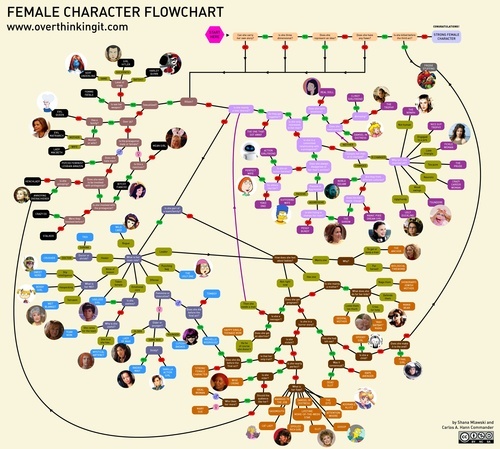
I’ve been wanting to write a post on Overthinking It’s “Female Character Flowchart” since I saw it on both Jezebel and Musings of an Inappropriate Woman about two weeks ago, and the time has finally come I’ve finally gotten around to compiling a list of my favourite fictional female characters and whether they qualify as “strong” ones.

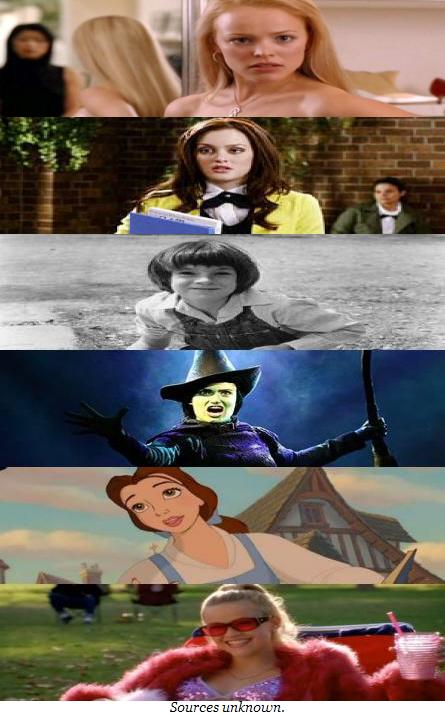
Without compromising the quality of the image, I wasn’t able to enlarge the chart, nor add my own annotations as per the below characters of my choosing. Instead, I’ve reproduced their equations below, as well as Mean Girls’ Regina George, who appears on the chart, and Blair Waldorf, whom Rachel Hills believes is a “girl Hitler”, but who I find to be much more of a genuine strong female character.

Regina George (Mean Girls): Can she carry her own story? YES. Is she three dimensional? NO. Villain? YES. Sexualised? NO. (I would argue yes. Hello? Have you seen her Halloween getup?) Over 35? NO. Is the protagonist male or female? FEMALE. Is this a rom/com? NO=Mean Girl.

Blair Waldorf (Gossip Girl): Can she carry her own story? YES. Is she three dimensional? YES. Does she represent an idea? NO. Does she have any flaws? YES. Is she killed before the third act? NO=Strong female character.

Belle (Beauty & the Beast): Can she carry her own story? YES. Is she three dimensional? NO. Villain? NO. Is she mainly a love interest? YES. Do they get together? YES. Is she only interested in her man? NO. Is she in a committed relationship with a protagonist? NO. Changes her man or is changed? CHANGES. Are they from different cultures? YES=Nobel Squan, whatever the hell that is! (Looks like something out of Avatar, though.)

Scout Finch (To Kill a Mockingbird): Can she carry her own story? YES. Is she three dimensional? YES. Does she represent an idea? YES. Villain? NO. Is she mainly a love interest? NO. Is she part of a team/family? YES. What is her main role? LEADER. How does she feel about babies? NOT RIGHT NOW. Does she get pregnant? NO. Is she in a horror story? NO. Is she violent? NO. Is she nearly perfect? NO. What is her flaw?=sassmouth, which I guess is true, but Scout is so much more.

Elphaba (Wicked): Can she carry her own story? YES. Is she three dimensional? YES. Does she represent an idea? YES, many. Villain? NO. Is she mainly a love interest? NO. Is she part of a team/family? YES. What is her main role? ROGUE=wildcard.

Elle Woods (Legally Blonde): Can she carry her own story? YES. Is she three dimensional? YES. Does she represent an idea? YES. Villain? NO. Is she mainly a love interest? NO. Is she part of a team/family? YES. What is her main role? LEADER. How does she feel about babies? NOT RIGHT NOW. Does she get pregnant? NO. Is she in a horror story? NO. Is she violent? NO. Is she nearly perfect? YES. Is she older? NO. Should the audience like her? YES. Who likes her more? WOMEN=Mary Sue.

Related:  Women in Fiction: My Favourite Fictional Females.

Elsewhere: [Overthinking It] The Female Character Flowchart.

[Overthinking It] Why Strong Female Characters Are Bad for Women.

[Jezebel] Flowchart: Know Your Female Character Stereotypes.

[Musings of an Inappropriate Woman] Flowchart: Know Your Female Character Stereotypes.

On the (Rest of the) Net.


After my Mick Foley rant last week, I’ve started reading his blog, Countdown to Lockdown, and I’m loving it. Here are some choice articles:

Remembering female pro-wrestling pioneer, Luna Vachon, who passed away on August 27 this year.

“That Time I Met… Tina Fey… and Alec Baldwin!”

“That Time I Met… President William Jefferson Clinton!” (I really love this one; some heart-warming stuff.)

“Mick’s Favourite Things: Top Ten Matches”, three of whichCactus Jack VS. Randy Orton at Backlash 2004 (above), Mankind VS. The Undertaker in Hell in a Cell in June, 1998, and Mick Foley VS. Edge in a Hardcore Match at WrestleMania XXII (that’s WrestleMania 22 in 2006 for you wrestling laymen)I 100% agree with.

In defence of Buffy’s whining.

“To the Teenage Boy in Your Life”:

“An important thing to remember is that girls are not from a different planet, nor are they even a different species. They’re just people, they’re just like boys, except with vulvas instead of penises.

“Mainly you need to remember this when you’re trying to figure out what a girl is thinking. See, if you didn’t know what a BOY was thinking, how would you go about finding out? You might ask him, right? The same goes for girls.”

I’m a bit behind the eight-ball on this one, as No Make-Up Week was a month ago, but Alle Malice’s guest post on Rabbit Write goes over the reasons “Why We Wear Make-Up”. I especially like this one:

“It makes me look good in photos. Almost everything we do now is documented by someone and posted in Facebook albums for the world to see, because if you aren’t having fun on Facebook, you aren’t really having fun. And if you aren’t pretty on the internet, you aren’t pretty in real life. Enter makeup.”

Nick Sylvester, on Riff City, discusses “How Kanye West’s Online Triumphs Have Eclipsed Kanye West”:

“Maybe there are people working with him… but I get the sense that Kanye is generating the [sic] lot of these ideas. I imagine he likes being in control of every aspect of the production, the medium being the message and so on. Online he is a wise fool, first playing into people’s perceptions of ‘Kanye West’, then off those very perceptions, sending himself up, pulling back his own veil… Despite many attempts, Kanye West is incapable of being parodied, largely because Kanye West has already figured out a way to be a parody of Kanye West.”

Much like Megan Fox in this New York Times Magazine article. Could I even go as far as to say that blonde bombshell Pamela Anderson has employed this strategy? I believe I could. And for that matter, Lindsay Lohan sending herself up on Funny or Die and promos for the MTV VMAs are along the same lines.

Sylvester goes on to say that “artists like Kanye West have to be ‘good at Twitter’ in order to put a dent in the zeitgeist.”

Furthermore,

“‘Nowadays rappers, they like bloggers,’ is what Swizz Beatz says… Slowly the work itself becomes secondary, less ambitious; slowly people becomes ‘really proud of their tweets’.”

Is it “The End of Men”?

Disney’s latest offering, Tangled, based on the story of Rapunzel, takes us back to a time when the Disney Princess reigned supreme, according to io9.

Feminist Themes examines Lady Gaga’s “Telephone” clip:

“… the objectification, glamorising of lesbian fetishism, and excessive girl-on-girl violence… [are aspects of the video that] feminist Gaga fans can try to justify… as another example of how she subversively turns what we usually find hot into something that leaves a nasty taste in our mouths and therefore makes a statement, but if any other artist (particularly any male artist) incorporated this much objectification and violence against women we would be outraged. Is it any different just because it’s a woman, or because it’s specifically Gaga?

“… What sets Gaga apart from other sexpot pop stars for me is that I just can’t imagine men being honestly turned on by hernot because she isn’t gorgeous (she is), but because she is so avant-garde, aggressive and self-driven which takes that arousal and turns it into something atypical, uncomfortable, and threatening.”

Also at Feminist Themes, the cause of the she-blogger in “Why I Blog”.

In other Gaga news, The Cavalier Daily reports that the University of Virginia is now running Lady Gaga classes! This sooo makes me want to re-enrol in university in a post-grad, transfer to UV, and take this kick-ass class!

The Daily Beast puts forth two differing opinions on Glee’s stereotypes: Andy Dehnart discusses the show’s “Harmful Simplicity”, while Thaddeus Russell applauds the walking stereotype that is Kurt Hummel, as “history tells us that those unafraid to be ‘too gay’ won far more freedomsfor all of usthan those who dressed the part of straights.”

Beautifully satiric The Frenemy reveals the recipe to “The Teen Romantic Comedy”, which “does not work for Mean Girls, 10 Things I Hate About You, or John Hughes films”, unfortunately. The truth about Disney Princes is also profiled, in which Eric from The Little Mermaid “wanted to kiss a girl who doesn’t speak words and doesn’t know how to use a fork. What the hell are you, caveman?”, while Mulan’s Captain Shang is in truth, a “gay liar” who made young, susceptible viewers the girls who have “crushes on a lot of her gay friends. [A] big Will & Grace fan.” Hey, that’s me!

Rachel Hills discusses intersectionality in feminism:

“For those of you who aren’t familiar with the term, ‘intersectionality’ is a way of talking about power and privilege that recognises that recognises that these things operate on multiple axes. People aren’t just female, or Black, or Asian, or straight, or working class, or trans, or a parent, or prone to depressioneveryone falls into a number of different categories that colours their experience of the world in specific ways. In the feminist context, it serves as a useful reminder that not all women have the same experiences, and calls into question the still dominant notion that the neutral ‘female’ experience is one that is white, heterosexual and middle-class.

“I’m also a fan because it just makes feminism a whole lot more interesting.”

Girl with a Satchel profiles Melissa Hoyer’s media career, which is a must-read for any budding wordsmith.

I am staunchly pro-choice when it comes to the abortion debate. In fact, I lean so far to the left that I’m borderline pro-abortion. (I’m sure that’ll ruffle some feathers!) But no matter what your feelings on the subject, MamaMia’s post, “The Couple Facing Jail Because They Tried To ‘Procure an Abortion’. Hello, Queensland? It’s 2010” is worth checking out.

Jezebel’s “5 Worst Mean (Little) Girls of All Time” includes Willy Wonka’s Veruca Salt and, from one of the most heart wrenching films of all time, A Little Princess, Lavinia, who looks a lot like modern-day mean girl, Angelina Pivarnick, from Jersey Shore.

“Why Strawberry Shortcake Was a Progressive Pioneer.”