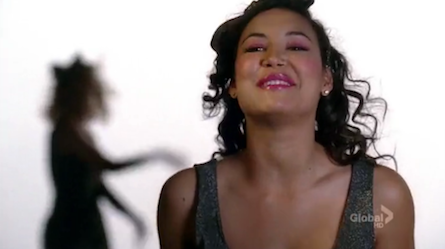
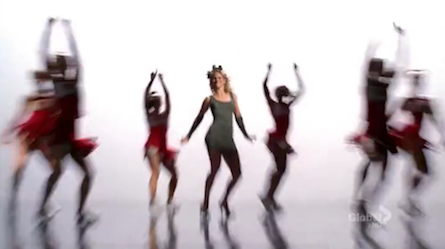
TV: The Underlying Message in Glee’s “Sadie Hawkins” Episode.

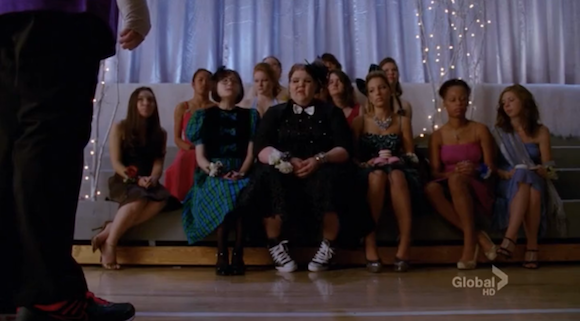
glee sadie hawkins dance

And that is: empowerment! Yay! ’Cause nothing is more empowering than a heteronormative school dance where the women ask the men to be their dates, right?

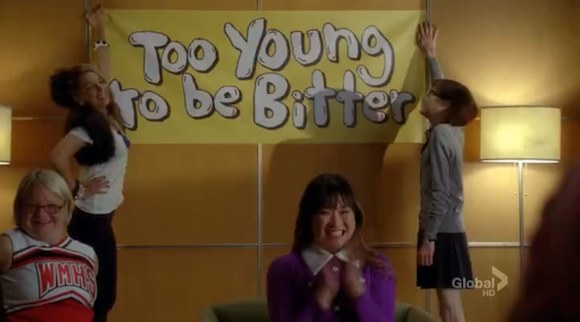
glee sadie hawkins too young to be bitter club

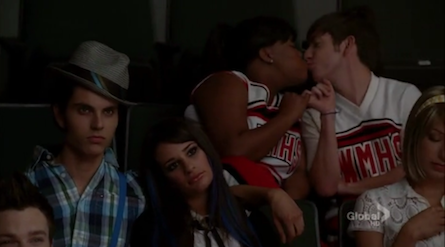
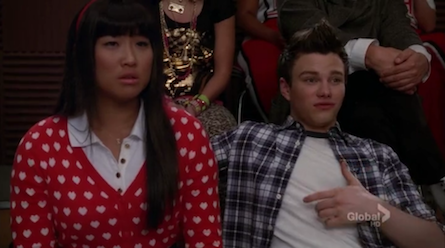
That’s according to Tina Cohen-Chang, at least, who comes up with the idea for a myriad of reasons: a prelude to the upcoming prom, an excuse to get close to gay crush Blaine, and something for her fellow “Too Young to Be Bitter” club members to get behind in their quest to become, um…, less bitter.

Coach Beiste is all for the dance, because Sadie Hawkins is a metaphor for empowerment, duh, as we’ve already established in the opening paragraph. But it’s not just about socio-sexual empowerment, Beiste says it’s also about gaining the strength to follow your dreams, as she did after her first Sadie Hawkins dance when she decided to follow her passion for football.

glee sadie hawkins lauren zizes

Beiste’s overweight and unconventionally unfeminine student counterpart, Lauren Zizes (who, by the way, hasn’t been seen since the end of season two. Way to go with the continuity, Glee writers), is part of the “Too Young to Be Bitter” club, too, and by the end of the episode has the courage to both ask Joe to dance at Sadie Hawkins and apply for a wrestling scholarship at Harvard. This, along with the other members’ success at the dance, apparently calls for the disbanding of the club because everyone’s empowered now.

But the undercurrent flowing through this episode was Blaine and Sam’s sleuthing regarding the Warblers: Sam seems to think the team is using human growth hormones because of their energetic stage presence, a video of Hunter Carrington allegedly ‘roid raging in a coffee shop, the Warblers’ suddenly larger physical appearance, and the testimony of former Warbler, sunshiney Trent.

Apart from being a suspiciously similar plotline to Pitch Perfect, it just goes to show that “Sadie Hawkins” was about completely superficial lipstick feminism and it was the boys who really saved the day.

Images via Ch131.

TV: Modern Family is Anything But.

modern family mud portrait

After a recent spat with my housemate about the apparent modernity of Modern Family, in which he defended the show for its gay couple with an adopted Vietnamese baby and a strong Latino presence while I cried stereotyping, I decided I should actually watch an episode or two of it before I denounce Modern Family as an archetype perpetuating farce.

Now, with three and a half seasons and some informed opinions under my belt, I can wholeheartedly say I abhor the sexist tropes of the fiery Latina, Gloria, and the shrill, controlling housewife, Claire, and Modern Family’s blatant racism, homophobia and slut-shaming. Let me count the ways…

Right off the bat in the sixth episode of season one, “Run for Your Wife”, there were some troubling stereotypes about stay-at-home mums. When the Dunphy kids head off to their first day of school for the year, mum Claire looks forward to some downtime to get started on a new book. Phil, who’s supposed to be the breadwinner of the family, is also home and wants to hang out with his wife. After blowing off some open-houses he’s supposed to be putting on as part of, you know, his job as a real estate agent, Phil gets embroiled in a mid-afternoon jogging race with Claire.

As a child who grew up with a stay-at-home mum, I can tell you that I never once saw her sitting down to read a book in the middle of the day or challenge my dad to a childish competition. There was too much cooking, cleaning, washing, shopping and picking up to do. In fact, my dad was barely home and often working more than one job in order to put food on the table and keep us in a home one fifth of the size of the Dunphy’s, which is more than we can say for Phil who is rarely shown at work.

While the acting of Ty Burrell (Phil) and Julie Bowen (Claire) is something to write home (or at least the awards shows) about, their characters leave a lot to be desired. Phil is always dropping the ball (or getting it thrown into his face, as in “Door to Door” in season three) on being a functioning human being, let alone a good husband and father, and Claire often refers to him as her fourth child (she technically only has three: Haley, Alex and Luke). The trope of wife-as-replacement-mother is a tired one, but that doesn’t stop Modern Family for milking it for all it’s worth.

This brings us to Gloria, who is anything but. She’s young, sexy and, most notably, a loud, sassy Latin woman who’s always getting arked up about something. In season one’s “Up All Night”, Gloria’s son Manny’s dad comes to visit. While Gloria is now remarried to the older and dependable Jay, ex-husband Javier is a fellow fiery Latino who tries to make up for his absence by showering Manny with extravagant gifts. In the episode, Javier takes Jay and Manny to a baseball field in the middle of the night, and the next day comes bearing motorbikes. Gloria becomes audibly incensed that Jay’s falling for Javier’s tricks, like she used to, and storms off, yelling in Spanish. Every portrayal of a Hispanic woman in pop culture doesn’t have to be that of the “hot blooded” Latin mama; just look at the gay, Latina orthopedic surgeon Dr. Callie Torres in Grey’s Anatomy, a show that is far more modern than one with that word in its title, for example.

Speaking of the gays, what portrayal of contemporary American life would be complete without the requisite homosexual couple with an adopted Asian baby? Certainly not Modern Family, which turns the gay dial up to eleven with stay-at-home dad, former farm-dweller and part-time clown Cam, the uptight, dogmatic (unsurprisingly the brother of Claire) lawyer Mitchell and their über inappropriate ways. For example, in “Run for Your Wife”, Mitchell accidentally bumps baby Lily’s head against a door frame, and they take her to the doctor. The doctor happens to be Asian-American, so Cam embarks on a sermon about how he and Mitchell intend to raise Lily with influences from her Asian roots, completely disregarding the fact that the doctor was born and raised somewhere in middle America and identifies first and foremost as an American.

Later on, in season two’s “Unplugged”, Cam and Mitchell try to get Lily into a preschool. When they realise Lily’s going up against an adopted African-American boy with disabled-lesbian parents for the last spot at a prestigious private school, Cam flubs the interview by emphasising his 1/16th Cherokee heritage and speaking in pidgin English. As someone who is also 1/16th Cherokee, I’m sure you can imagine my offence at this.

Cam, as I’m sure you can imagine if you don’t already watch Modern Family, is the flamboyant half of the couple, and enjoys dressing Lily up as famous gay icons and encouraging her creative side. In the episode “Chirp”, in season two, Cam goes against Mitchell’s wishes and has Lily film a commercial for a furniture store. The ad is completely racist, using emphasised Asian accent voiceovers and Godzilla, and when Mitchell points this out, Cam uses the defence of hipsters the world over: “It’s ironic.” I suppose because they have an Asian kid, they’re allowed to be racist…?

While there are some redeeming qualities throughout the show’s run, such as the “Mother’s Day” (season two), “After the Fire” (season three), and “Schooled” (recently aired as part of season four) episodes which seek to unpack gay parenting and stereotypes of femininity, masculinity and homosexuality, it’s also rife with slut-shaming (Jägermeister is a magic potion that puts girls to sleep but instead of waking up “in a castle, you wake up in a frat house with a bad reputation” in “Moon Landing”, whilst Phil marvels in “Travels with Scout” that with his “emotionally distant father” it’s a miracle he didn’t end up as a stripper), homo- and transphobia (dad Jay insinuates that Mitchell is a cross-dresser because he’s also gay in “Starry Night”), and jokes about domestic violence (when Mitchell asks his dad to teach him how to fight in “Game Changer”, Jay asks if he’s having problems with Cam).

As I’m sure Glee can attest, an after school special-esque episode here and there doesn’t make up for Modern Family’s utter lack of modernity the majority of the time.

Related: The Underlying Message in Glee‘s “On My Way” Episode.

Elsewhere: [Chica & the City] Casting Call for “Hot Blooded” Latina Moms Makes My Blood Boil.

Image via BuddyTV.
TV: The Underlying Message in Glee’s “Makeover” Episode.

With the U.S. presidential election taking place one day before Glee’s “Makeover” episode—in which McKinley High’s class presidential election occurred—aired in Australia, Glee showed that it is capable of some self-awareness and social commentary every now and then.

Shades of Brittany’s bid for last year’s class presidency can be seen, but where that episode dealt more with the feminism of both the 2008 and McKinley’s elections, last night was about the celebrity culture that surrounds voting.

Blaine tries to make this clear when he admonishes Brittany for using her popularity to influence the glee club members to vote for her. “This isn’t a popularity contest; it’s about who’s got the best ideas.” That may be so, but the creators saw fit to milk this angle for all it’s worth with a “Celebrity Skin” by Hole montage.

While Brittany chooses to run with “part-robot” Artie, whom she forgot she dated several seasons ago and broke up with because he called her stupid, as her vice presidential candidate, a category which Sue Sylvester points out has been introduced “for no discernible reason whatsoever”, she suggests Blaine pick Sam as running mate. Sam assures Blaine he’ll bring in the “sympathy” and “not-gay vote[s]” because his family is on food stamps and he’s not gay: kind of like John McCain picked his “granddaughter” (according to Brittany) Sarah Palin as vice presidential candidate in 2008 to seemingly ensure the “female” vote to no avail.

Brittany’s influence on her opposition seemed to work to her disadvantage, as at the end of the episode we see Blaine and Sam (“Blam” as they are collectively called on the congratulations banner) celebrating their victory. Blaine is experiencing some self-doubt and displacement at McKinley when Kurt is more focused on his new intern-career at Vogue.com with guest star Sarah Jessica Parker (who herself is heavily involved in politics and the campaign to get Obama reelected, serendipitously enough) than him, but Sam says being the school’s “first gay-guy president” whose place of birth is brought into question by Brittany is something to be proud of, just like Obama was America’s first black president whose birthplace was also called into question by a fellow “celebrity” perhaps bitter about Obama’s influence in Hollywood: Donald Trump.

Related: The Underlying Message in Glee’s “Asian F” Episode.

Image via AllMyVideos.

TV: The Underlying Message in Glee’s “Britney 2.0” Episode.

Did Glee really need to do another Britney Spears episode? As Artie pointed out, “we’ve scraped the bottom of that Britney barrel” but Britney’s made a comeback as judge on The X Factor broadcast on the same channel as Glee—Fox—so both shows are running with the Britney theme no matter how uninspiring she’s become.

Apparently New Directions “really came into your own during the last Britney week”, according to Mr. Shue, and what he says goes. Coincidentally, Brittany S. Pierce is undergoing a meltdown the same week the glee club resurrects her idol and namesake’s back catalogue. She’s feeling rejected by her long-distance lady love Santana, was kicked off the Cheerios and subsequently lost her high pony. Channeling Britney circa 2008, Brittany says if she can’t have her high pony then she doesn’t want any hair at all, and attempts to shave it off before attacking McKinley High’s resident paparazzo, Jacob Ben Israel, with an umbrella.

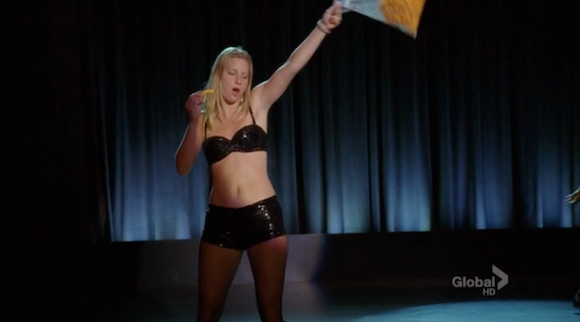
I appreciate the satire Glee is trying to undertake here, revealing that Brittany’s crisis—which culminates in Brittany getting busted for leading New Directions in a lip-syncing rendition of “Gimme More”, replete with Britney’s junk food of choice, orange soda and Cheetos—was her “intentionally hitting rock bottom… so I can make a comeback like Britney”, but they either push it too far bordering on racist, ableist, homophobic, sexist, inappropriate crap (case in point: resident Jesus-lover, Joe, singing Britney’s song about a threesome, “3”) or not far enough, as with last night’s episode as a whole.

Britney Spears’ tragic life is ripe for the picking—the recent revelation from former paparazzo turned Britney’s manager turned collaborator with Courtney Love on a musical about her and Kurt Cobain’s life together that Britney used to do crystal meth—so much so that Christie Whelan’s turn in Britney Spears: The Cabaret was the exemplar of how to do a Britney satire. Glee’s “Britney 2.0” was not.

Related: The Underlying Message in Glee’s “Britney/Brittany” Episode.

The Underlying Message in Glee’s “The Spanish Teacher” Episode.

The Underlying Message in Glee’s “Yes/No” Episode.

Glee: The Right & Wrong of It.

Glee: T.G.Inappropriate.F.

“This is a Story About a Girl Named Britney… I Mean Lucky!” Britney Spears: The Cabaret Review.

Images via Ch131.com.

Event: The Golden Age of Television.

I thought a panel about how great American television is was a bit of a misnomer for the Wheeler Centre’s “America” week. I mean, has anyone seen Here Comes Honey Boo Boo or any of the Real Housewives series?

But once the panel, consisting of pop culture expert Jess McGuire, television reviewer Debi Enker and producer Amanda Higgs and emceed by the director of the Wheeler Centre, Michael Williams, got started on their favourite American feats of TV, I warmed to the notion.

I mean, don’t get me wrong: American TV is the type I consume the most. I usually only watch Aussie shows in case I can get some blog or freelance fodder, and British television? Fugedaboutit! But the shows the panel named as their top idiot box must-sees are some real high-brow shit, most of which I’ve never seen an episode of in my life. Think Mad Men, The Soprano’s, The Wire, Six Feet Under. I like my TV a bit fluffier.

Having said that, though, the panellists got me thinking about my favourite shows. While they struggled to whittle down their favourite to just five, I realised I can only count two faultless series: Grey’s Anatomy and Law & Order: SVU. Most of the other shows I watch (Glee, for example) infuriate me to no end with their racist, sexist, classist, ableist and homophobic undertones. Grey’s and SVU don’t always have happy endings, at least, and aren’t afraid to push the boundaries, get rid of popular characters if it strengthens the story (or they cause trouble on set, like Isaiah Washington, or can’t settle their pay disputes, as with Chris Meloni’s departure), and portray really real characters.

I love the way Grey’s has unlikeable characters who still get as much screen time and storylines as the title character, and their personality quirks are those that people in real life actually have. For example, April’s uptight, shrill virgin character bordered on stereotype, but at the same time everyone else’s obsession with her sexless existence is what you would expect from unenlightened real people. Alternatively, you have Cristina, who always looks out for number one and refuses to discuss the possibility of having children with her husband. Ordinarily that would make for a hateful character, but Sandra Oh portrays the nuances of Cristina perfectly. The medical storylines always have a synergy with the doctors’ personal ones, and while it sometimes gets a bit after-school special-y when Miranda has to give a “long speech” or a patient makes a doctor realise something, I don’t think it never not works. Except for that whole Gizzie/Izzie sees dead people thing…

In terms of Special Victims Unit, though, you’d think watching a weekly police procedural about sexual assault for fourteen seasons would be morbid but, for me, I find it one of the most enjoyable shows to sit through. I love how the beginning of an episode is set up so that the audience thinks it’s going to be about one crime but, oftentimes, there can be two or three criminal storylines by the time the forty minutes is up. While it’s almost always about the crime first, character storylines second, you never lose sight of Munch’s conspiracy theorist paranoia, Elliot’s (when he was still in it. Sob!) fiery temper and Olivia’s feminist heroics. And they have some top notch guest stars portraying the lowest of the low and the creepiest of the creepy. Some memorable performances include Cynthia Nixon as a fake sufferer of multiple personality disorder, John Ritter as a distraught husband who attacks his pregnant wife when he finds out the baby might not be his, and Chloe Sevigny as a bored housewife who cries rape.

Both shows deal with things like disability, sexual politics and mental illness in a sensitive and true way which they have to be commended for.

In terms of what television does wrong, though, the discussion turned to Aussie networks. We seem to have a penchant for “flogging” successful shows to death, as both McGuire and Higgs noted. The success of Underbelly meant copious amount of spin-offs with links so tenuous to the original premise that they might as well be standalone shows. And using the success of an overseas import, like Modern Family, The Big Bang Theory, Two & a Half Men and, earlier, Friends, to flog the show to death in double-episode reruns is another hallmark of Aussie networks.

There was also talk of our modern viewing habits. While Vanity Fair may have declared movies usurped by television in a recent issue, which served as the jumping off point for the panel, not a lot of people sit down at the same time each week to watch their shows ritualistically. McGuire admitted to watching “box sets” illegal downloads and streams of her favourite shows, because Australia still has a ways to go when it comes to airing shows consistently and on par with American air dates. I liked it last year when Ten aired Glee the same week it premiered in the U.S., however with events like Thanksgiving, Christmas and the Superbowl interrupting the schedule north of the equator, this means that repeats and “returning in two weeks” promos take the place of consistency Down Under. And don’t even get me started on the treatment of SVU: new episode followed by repeat followed by months of nothing followed by new episode without promotion so most loyal viewers miss it. No wonder there’s an epidemic of illegal interwebs watching: the networks are just so unreliable.

So while it may be the “golden age” of television, it seems to be edging closer to a golden age of twenty-to-forty (or fifty for HBO productions) minute feats of film to be watched on the laptop or iPad, not so much the silver screen.

Related: Glee: The Right & Wrong of It.

What’s Eating April Kempner?

The Underlying Message in Grey’s Anatomy‘s “Superfreak” Episode. 

Cristina Yang as Feminist.

Grey’s Anatomy Final Asks “When Does Life Begin?”

TV: Glee—“Props” for the Body-Switching Dream Sequence.


In a rare moment of actual self-awareness (none of this Sue-hiring-racially-diverse-midgets-for-New-Directions-to-perform-with-at-Nationals-in-a-show-of-inclusivity—or something—stuff), Glee dared to put Tina in a dream sequence in which she was Rachel and everyone else had swapped bodies, too.

In the “here’s what you missed on Glee” intro, the narrator (who sounds a lot like Finn, but have we ever really been told who it is?) draws attention to Tina’s status as a “prop” at best, so of course the episode was going to be all about her, like the first episode back after Quinn’s accident and the wedding-that-wasn’t was all about Quinn, and then the character is never to be seen or heard from again. I’m not sure what the show has planned for next season, when Rachel, Finn, Kurt et al. head off to college, but perhaps they were trying to introduce Tina as the main player next year.

Anyway, Tina cracks it after having to sit through one too many of Rachel’s solo tantrums. Afterwards, when she’s shopping for fabric for Rachel’s Nationals costume, Tina slips and falls into a fountain at the mall, hitting her head.

For ten glorious minutes, Glee is transformed into an alternate reality, where Finn is Kurt and Puck is Blaine (here’s the homoerotic moment we’ve all been waiting for!) and so on and so forth. With some spot on performances by Naya Rivera as Santana as Artie and Vanessa Lengies as Sugar as Quinn, I’m actually disappointed that Glee didn’t carry this scene on for the rest of the episode! But then Glee’s never been one for pushing the boundaries…

In other, storyline continuity-related Glee news, Shannon Beiste’s domestic violence arc was tied up when she got the courage from, of all people, Puck, to leave Cooter for good.

What did you think of the body-switching experiment? Yay or nay?

Related: The Underlying Message in Glee’s “Choke” Episode.

Images via Putlocker.

TV: The Underlying Message in Glee’s “Prom-asaurus” Episode.


Three episodes before the end of the season, the issue of Brittany’s class presidency is finally addressed, because she the show seems to have forgotten she was elected earlier in the season. Brittany addresses this herself, when she says she’s been a bit out of the loop this year, and “even stopped speaking” for a period.

In her first prom committee meeting, for which the board has sent Brittany ten prior memos, she fires the team and monopolises the choosing of the theme (she did like the unicorns featured in the diorama for the original Castle in the Sky theme): dinosaurs.

When explaining her choices to New Directions, she compares her presidency to the corrupt nature of the U.S. government, and is determined hers won’t turn out that way. She also imposes a ban on hair gel, sending Blaine into meltdown!

Last year, Kurt was humiliatingly crowned prom queen, a memory he still struggles with in this episode. It seems Glee has learned nothing from the tokenisation of gay people as somehow not being of the gender they identify as, as Brittany is nominated as prom king. Maybe it’s that undercut that had people confused…

Also troublingly, the show pitted the two “disabled” girls, Becky and Quinn, against each other. Becky was sure she’d get a nomination as prom queen, but when Quinn gets one in place of her, Coach Sylvester tells her there’s only room for one “sympathy vote”. Helen Mirren’s voice (shoutout to The Queen) makes another cameo as Becky’s inner monologue, adding to the “difference” between her and the other characters on the show. (That Quinn manages to walk at the prom after months of intense physical therapy widens this gap.)

Becky wonders why no one realises that not all prom queens “have to look the same; they can be different.”

And Glee tries to tie Becky’s concerns up nicely in a bow of equality with Puck crowning her “the anti-prom queen” and the boys of New Directions crooning One Direction’s “What Makes You Beautiful”.

Related: The Underlying Message in Glee’s “I Am Unicorn” Episode.

Glee Gets Down on Friday at the Prom.

Image via Gleerific News Stop.

TV: The (Belated) Underlying Message in Glee’s “Choke” Episode.


As someone who has witnessed her mother being choked by her father, using that action as a metaphor for intimate partner violence on Glee is sick.

Not only that, but in desperately trying and dismally failing to, for some reason, raise awareness of domestic violence (actually, I’ve decided I hate that phrase, so I’m taking to using the more all-encompassing “intimate partner violence”), Glee has gone back to its old ways by being especially misogynistic and racist.

The intimate partner violence storyline opens with Santana observing Coach Beiste’s black eye and remarking that “it looks like Mr. Beiste went all Chris Brown on Mrs. Beiste… [Did] Cooter put the smackdown on [her] ’cause [she] wouldn’t let him be on top?” Troublingly, women of colour Mercedes and Tina, and LGBTQ woman Brittany, all snicker. I wonder if the writers were aware (oh wait, this is Glee: of course they weren’t!) that African American women are 35% more likely to experience intimate partner violence than white women, 60% of Korean women have been beaten by their partners, and violence in same-sex relationships is gravely underreported and misunderstood.

Enter Cheerios co-coach and “black Sue”, Roz Washington, who overhears Santana’s bad taste musings. She tells the girls that “violence against women” and “men hitting women” is never okay, buying into the perception that women are the only victims in intimate partner violence. Granted, women are the overwhelming victims, but that’s not giving equal opportunity to non-heterosexual relationships (for shame, considering the abundance of LGBTQ characters on the show) and the fact that a woman can hit a man. Instead of insinuating that it’s intimate partner violence only that we should be concerned about, how about violence against women in general? Including rape.

Anyway, I’m sure the writers wanted Roz to mean well, but her racial and sexist slurs directed at Mercedes (“Lil Oprah”), Tina (“Asian Horror Story”), Sugar (“Rojo Caliente”) and Santana (“Salsa Caliente”) undermine this.

In a following scene, Sue coins the aforementioned nickname, “Black Sue”, for Roz, telling her that “ivory poachers could make a fortune selling your enormous white teeth on the black market”, and refers to Coach Beiste as John Goodman, perhaps insinuating that Beiste’s masculinity should have prevented her from being a victim. This way of thinking seems to be adopted by Santana, too, when she says she doesn’t think Coach Beiste actually got hit because she’s “a wall”. What if the roles were reversed and Beiste had hit Cooter, who is considerably smaller than Shannon?

The racial stereotyping continues when Roz admonishes the girls for their joke. As Autostraddle points out, Glee gave the “‘my aunt got beat up by her man’” monologue to the one black woman on the show,” claiming it took her five years to escape the relationship. It took my mum nigh on thirty to get out.

Shannon initially denies her husband hit her, but uses her experience to inspire the girls, who—up until this point— have never really had anything to do with the Coach, to sing a song about empowering women to leave abusive relationships. According to Sue,

“The American songbook is chock full of songs making light about men hitting women.”

Chris Brown, anyone?

Beiste is so moved by the girls’—who, again, she’s had nothing to do with up to now—apathetic show of indifference to intimate partner violence, that she confesses to them—jeopardising her reputation at the school (remember what happened the last time she got too close to McKinley students?)—that she was actually the victim of intimate partner violence, and that they effectively “saved her life”, because she forgot to do the dishes all weekend. Yes, perpetrators of intimate partner violence can be set off by the slightest thing, and we all know that beating the person you love isn’t the means of someone who’s mentally balanced, but dishes?! Glee, really?! If you’re going to make one of your characters, perhaps the most underutilised, exploited and maligned of them all, the victim of a serious issue like intimate partner violence that will never be addressed again, can you at least make it for a reason less trivial than dishes?!

Two realistic things to come out of the storyline, though: that Shannon stays with Cooter and gives him a second chance, and lies about it to Sue and the girls. And finally, that Beiste fears that if she leaves him, “no one else will ever love me”. Painfully sad, true to actual victims of intimate partner violence who are made to feel worthless and unlovable by their abuser, and ties in with a past storyline on the show!

Related: The Underlying Message in Glee’s “Never Been Kissed” Episode.

My Thoughts on Chris Brown.

Elsewhere: [Women of Colour Network] Domestic Violence Facts & Stats Collection.

[Autostraddle] Glee Recap: Choke-a-Joke.

Image via Putlocker.

TV: Glee “Dance with Somebody” Review.


This was one of the best Glee episodes I’ve seen in a long time.

I’ve never been a big Whitney Houston fan, so I was a bit iffy about how they’d integrate her songs into the show’s storyline (or lack thereof. Did you notice Quinn was only in one scene last week? Maybe she wasn’t coping physically with her newfound paralysis, but they could have at least mentioned it.), but it was done perfectly. Glee managed to address the issue of holding troubled stars up as idols (Michael Jackson, anyone?), the changing relationships of the Glee kids as they near graduation, and Quinn’s disability, and sew Whitney’s songs seamlessly into the story.

Part of the reason I’ve never liked Whitney is because her music seemed to bypass me. “I Will Always Love You” was getting airplay when I was young and I discovered “I Wanna Dance with Somebody (Who Loves Me)” on the club scene in my later years, but other than that I never got what all the fuss was about. Glee’s versions of “I Have Nothing”, “So Emotional”, “Saving All My Love for You” and “It’s Not Right But It’s Okay” gave me a new appreciation for Whitney’s music. Who knew she had so many songs?

My favourite aspect of the episode, though, was Quinn being brought back into the fold, this time with a new love interest.

Quinn’s paralysis is something that has the potential to go horribly wrong. I was disappointed that in the first episode after her accident, she was all optimistic and grateful to be alive. From the dismal tidbits we’ve been given about Quinn as a character (her obsession with being prom queen, her former life as Lucy, and her scheme to win back her adopted daughter), it wasn’t realistic. Now that Quinn’s struggling with her physical therapy and dealing with feelings of worthless- and hopelessness, I’m starting to get behind this plotline a bit more.

Could there be an unlikely romance brewing between the dreadlocked Christian homeschooler Joe (I always thought his name was actually Jesus!) and  Quinn?

Related: Glee “Michael” Review: Oh My God Can’t Believe What I Saw When I Turned On the TV This Evening.

The Underlying Message in Glee’s “Original Song” Episode.

The Underlying Message in Glee’s “Born This Way” Episode.

Images via PutLocker.

TV: The Underlying Message in Glee’s “On My Way” Episode.


Well, if last night’s Glee episode wasn’t an after-school special, I don’t know what is.

The writers had the opportunity to really shock with Dave Karofsky’s suicide attempt and actually have him die, whilst also getting the oft-heard message across that gay teen suicides are rampant in our culture.

Not only that, but the epidemic of cyber bullying in general. Warbler Sebastian threatens New Directions with the online publication of a risqué photoshopped image of Finn if Rachel doesn’t drop out of regionals, and Sugar remarks, “If someone posted a picture like that of me online I’d probably kill myself.” Not only is that an example, on the one hand, of Glee’s insensitivity to a myriad of diversity issues, it also hit the nail on the head: many young people do kill themselves when incriminating pictures of them, real or not, hit the net. Tyler Clementi, anyone?

What really irked me, though, was self-righteous Quinn and how, in Bible group, she admonishes Karofsky for putting his family through something so “selfish”.

“I feel sorry for Karofsky but I feel worse for his family. He didn’t just want to hurt himself he wanted to hurt everyone around him. I went through the ringer, but I never got to that place…”

Kurt, who despite not believing in God crashes the meeting to pay tribute to Karofsky, tells Quinn that teen pregnancy and pink hair hardly qualify as going through the same ringer as gay kids. “You really want to try to compare…?” Quinn says. “I just can’t imagine things getting so messed up that you would consider taking your own life.”

While I think what Quinn says does have some truth to it, what gay kids go through during school, and in society at large, is incomparable to most of us. But everyone has their line to cross, and if we remember back to last season, it was revealed that Quinn left her first high school because she was bullied for being fat and ugly. I think we can all relate to that; even if we aren’t actually fat or ugly, we’ve all been called those things at some stage!

Apparently, Mr. Shue’s line was his dad catching him cheating on a math test, so he went up to the roof and was about to jump. I’m sorry; I know I just said everyone has their cross to bear, but I think that piece of the storyline served to diminish real problems, like Kurt and Santana’s struggle with their sexuality, and Artie’s disability, and solidify Will as the worst character on the show.

Not to worry, though: New Directions wins regionals with a medly of “It Gets Better”-esque songs, like “Fly/I Believe I Can Fly” and “Stronger”, whilst burying the hatchet with Sebastian and the Warblers, who are equally after-school specialish, singing “Stand” and “Glad You Came”. Oh, and of course they dedicated their performance to Karofsky, who Sebastian met once when he rejected him at a gay bar and the rest of the Warblers don’t even know. Makes sense!

But the real shocker of the episode came right at the very end (and you can see it coming for about 10 minutes prior): Quinn’s car gets hit by a truck. I guess that’s what you get for texting and driving and comparing your white girl problems to those of people with actual problems.

Related: The Underlying Message in Glee‘s “Original Song” Episode.

The Underlying Message in Glee‘s “Grilled Cheesus” Episode.

The Underlying Message in Glee‘s “Born This Way” Episode.

The Underlying Message in Glee’s “I Kissed A Girl” Episode.

Image via While Not Making Other Plans.