Magazines: The “Evil” Woman.


From “Women Behaving Badly” by Gabriella Coslovich in The Saturday Age’s “Life & Style” supplement, 30th April, 2011:

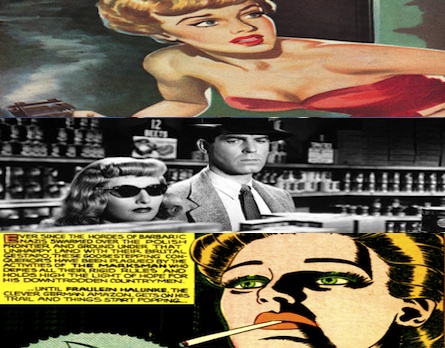
“The classic bad girl of popular culture is the femme fatale, a cunning criminal with a vixen-like beauty, usually pouty, platinum-haired, buxom and arch—from her stiletto heels to her finely plucked and penciled eyebrows…

“Meanwhile… there remain lingering assumptions about the way a woman should behave. One need only look at Prime Minister Julia Gillard, whose childlessness is often used to demean her, most recently by former Labour leader Mark Latham, who viciously accused her of lacking empathy and love (because having children has clearly given Latham copious quantities of both).

“In short, women whose ambitions waver from the ‘norm’, who have the temerity, say, to become prime minister, without having fulfilled their ‘God-given’ role of procreation, are still treated with suspicion. Audacity, it seems, is fine, to a point, especially if it adheres to the stereotype of woman as fashion-loving sex-object: Lady Gaga and her outlandish garb, Madonna and her extreme muscles. But try bucking convention in perhaps more profound ways—wanting to run the country, or fight for it—and female nonconformity suddenly becomes threatening. Which is why bold and rule breaking women are still worth celebrating.”

Images via Art Geelong, Yunch Time, unknown.

Music Videos: Who’s the Copycat Now, Katy Perry?

Lady Gaga copped a lot of flak for reappropriating everything from Madonna’s “Express Yourself” to Hieronymus Bosch to Michael Jackson’s white gloves, but at least she waited more than five minutes to use them as inspiration. What’s Katy Perry’s excuse for blatantly ripping off Gaga’s “Born this Way” video, replete with mythical equine figures, rebirth and alien-esque cheekbones, for her “E.T” video?

And so the feud between Perry and Gaga rages on.

Related: Lady Gaga: Taking Inspiration from The Wizard of Oz.

Whipped Cream Feminism: The Underlying Message in Katy Perry’s “California Gurls” Video.

Katy P. VS. Lady G.

Elsewhere: [FlavorWire] A Guide to Signs & Symbols in Lady Gaga’s “Born This Way” Video.

Images via YouTube.

UPDATED: Lady Gaga—Taking Inspiration from The Wizard of Oz.

Lady Gaga on her influences, from Vogue, March 2011:

“Gaga herself is very open about her influences. ‘It’s not a secret that I have been inspired by tons of people,’ she says. ‘David Bowie and Prince being the most paramount in terms of live performance.’ She also seems to have made peace with the fact that she is compared to—or, less charitably, accused of ripping off—nearly every artist of the last 50 years. ‘I could go on and on about all of the people I have been compared to—from Madonna to Grace Jones to Debbie Harry to Elton John to Marilyn Manson to Yoko Ono—but at a certain point you have to realise that what they are saying is that I am cut from the cloth of performer, that I am like all of those people in spirit’… ‘She was born this way.'”

With the release of “Born This Way”, critics are wondering if Lady Gaga isn’t as original as they once thought she was. The song blatantly rips off takes inspiration from Madonna’s “Express Yourself”, and a lot of Gaga’s past works are heavily influence by Her Madgesty.

But Lady Gaga has always been about much more than just her music. It’s all about the fashion, hello?!

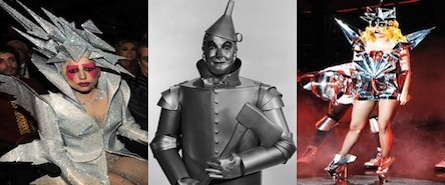
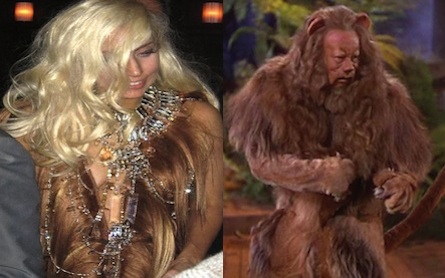
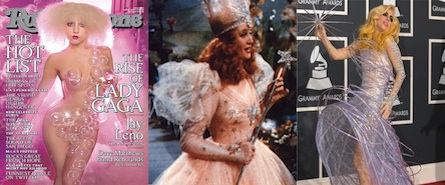
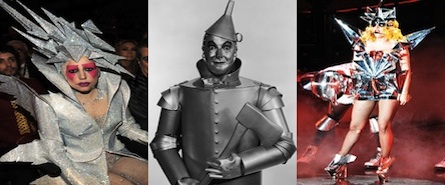
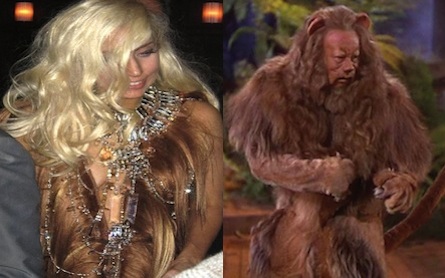
But even her outrageous outfits—bar the meat dress and a couple of others—aren’t that original when you come to think of it. Juxtaposed against The Wizard of Oz‘s Cowardly Lion, Good Witch of the South, Tin Man et al., Gaga proves that imitation is the sincerest form of flattery.

Related: Lady Gaga: Taking Inspiration from The Wizard of Oz.

Pop Culture Role Models.

Chase You Down Until You Love Me, Paparazzi…

Lady Gaga’s “Telephone” & 21st Century Noise.

Katy P. VS. Lady G.

Lady Most Likely: Time Magazine’s 100 Most Influential People.

Images via Amy Grindhouse, Wired, Billboard, Just Nuggets, The Examiner, Leopard Print & Lace, Pony & Pink, Pollsb, TV Tropes, Beauty & the Feast, Wikia, Wendy’s World of Oz.

Lady Gaga: Taking Inspiration from The Wizard of Oz.

With the release of “Born This Way”, critics are wondering if Lady Gaga isn’t as original as they once thought she was. The song blatantly rips off takes inspiration from Madonna’s “Express Yourself”, and a lot of Gaga’s past works are heavily influence by Her Madgesty.

But Lady Gaga has always been about much more than just her music. It’s all about the fashion, hello?!

But even her outrageous outfits—bar the meat dress and a couple of others—aren’t that original when you come to think of it. Juxtaposed against The Wizard of Oz‘s Cowardly Lion, Good Witch of the South, Tin Man et al., Gaga proves that imitation is the sincerest form of flattery.

Images via Amy Grindhouse, Wired, Billboard, Just Nuggets, The Examiner, Leopard Print & Lace, Pony & Pink, Pollsb, TV Tropes, Beauty & the Feast, Wikia, Wendy’s World of Oz.

The Underlying Message in Madonna’s “Like a Prayer” Video.

About a month ago, I posted a quick revision of a presentation I did at uni on Madonna’s most controversial videos. In it, I wished to go into further detail on “Madonna’s influence on the music video and religion in pop culture”. Here I attempt to do so.

Another pop culture icon who’s had a big influence on modern religion is Oprah, who pushes her brand of “pick and mix religion” to her millions of followers. Funnily enough, Shmoop comes to a similar conclusion about the “Like a Prayer” video:

“The blending of Italian American and African American traditions and cultures should also be considered a postmodern choice. It resists interpretation. Where a critic might try to understand the video as an endorsement of Catholicism, the blending of Catholicism with the African Methodist Episcopal choir Madonna meets in her dream prevents such a simple interpretation. The video is neither here nor there on particular religions, only communicating the power of some force of faith to empower her.”

But when the video was released in 1989, that was the least of its critics’ problems. Perhaps it was the rape scene at the beginning, the depicition of a “black Christ”, who was in actuality the black Saint Martin de Porres, to critique racism, or—my pick—the burning crosses in the field behind Madonna, who prances around in black negligee. It could have been any combination of these factors that made Pepsi back out of its $5 million deal with the star in the aftermath of the video’s release.

Granted, the film clip was made more than twenty years ago, and it was groundbreaking for its time. However, fast-forward to 2011, and what we’ve seen since then makes “Like a Prayer” seem positively tame.

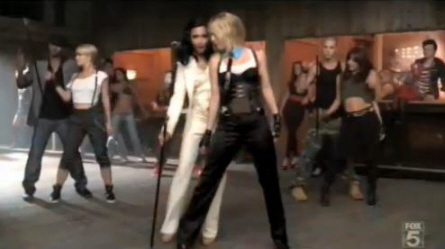
Madonna herself has been responsible for some of these, like her clip the following year for “Justify My Love”, her Sex book or, on the tamer side of things, kissing Britney Spears and Christina Aguilera onstage at the MTV Video Music Awards in 2003, which seems to be an enduring image of ranch culture in this day and age.

But you don’t go about these things without thinking of them seriously, and that’s why Madonna’s legacy has persisted all these years. She knew exactly what she was doing in that clip, and all other clips that followed. The fact that at the end of the song the events of the clip are revealed to be a performance indicates that “we all play a part in this little scenario”. What part, exactly?

While religious groups trying to get the video banned could be interpreted as the Church being unwilling to accept square pegs that don’t fit into round holes, Pepsi backing out of their deal with the star is an example of big conglomerates being scared to buck the system and take a risk less they lose customers.

Someone who isn’t afraid to buck the system and is accepting of all walks of life (except, perhaps, those whose body parts were used in the assembling of her meat dress) is Lady Gaga, who is a huge Madonna fan, if some of her recent videos are anything to go by. Last year I blogged about Gaga’s film clip for “Alejandro” and how it emulated “Like a Prayer” and other Madonna videos almost to a tee.

While we would like to think that we have grown as a society and have become more accepting of different people in the twenty years since “Like a Prayer” was banned, “Alejandro”’s critical reception from religious and parenting groups may indicate otherwise…

Related: More Madonna.

Katy P. VS. Lady G.

Madonna (and Her Brand of “Feminism”) On the Rocks.

Elsewhere: [Shmoop] Like a Prayer Meaning.

Images via YouTube.

Rihanna’s “S&M”: Is it Really So Much Worse Than Her Other Stuff?

Rihanna said it herself: “They watched ‘Umbrella’… I was full nude.”

So why so much fuss about her latest offering, “S&M”?

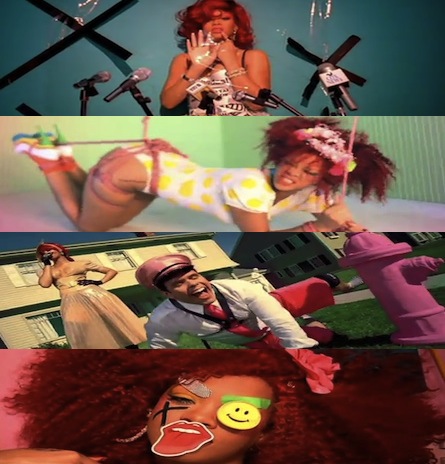
Sure, the title, lyrics and film clip are controversial at best, but once they are unwrapped and their true meaning is revealed, the song is more a dig at the press and Rihanna’s sadomasochistic relationship with them, hence Perez Hilton’s appearance.

The video does deal with sexual violence also, which Rihanna is no stranger to, but this time around it’s consensual violence. Jezebel explains:

“It’s notable, though, following her assault by Chris Brown, that in the video for ‘S&M,’ she’s interested in exploring consensual acts of violence and aggression, and finding pleasure in pain. Although she does appear bound in the video (as well as literally restrained by the media), mostly she plays the role of a dominant, perhaps to prove (or remind us) that she’s the one in control. Is this the desire of one who’s been called a victim? To recast oneself as authoritative and commanding?”

The film clip—the aspect of the song that has drawn the most controversy—is actually not that bad, in my opinion. It’s got a bright, pop-arty feel (a direction which the singer seems to be heading in these days), and “shows us a bright, vivid, eye-popping adult playground of her own imaginative making, exciting chains and whips [just happen to be] included.”

Where “Madonna and Lady Gaga have cornered the market on the black pleather and whips on white backgrounds of the S&M-themed music-video world… Rihanna is refusing to cede them the entire territory: She’ll do S&M if she wants to, she’s just going to make it really, really goofy.”

Granted, both Madonna and Lady Gaga’s videos and music are a cut above Rihanna’s, who is somewhere between Katy Perry’s “California Gurls” and Gaga’s “Telephone”, but you’ve got to admit: “S&M” is something a bit different, and something that’s getting people talking. And that’s the aim of the game, right?

Think of Rihanna’s other videos for a moment: “Te Amo” featured Laetitia Casta as Rihanna’s lesbian love interest; “Rude Boy” shows the singer peeking down the pants of a male dancer; her collaboration with Eminem in “Love the Way You Lie” dealt with domestic violence; and the aforementioned “Umbrella” marked her transition from “good girl” to “gone bad”.

Lyric-wise, “S&M” (Sex in the air, I don’t care, I love the smell of it/Sticks and stones may break my bones/But whips and chains excite me) is probably equally as graphic as “Rude Boy” (Come here rude boy, boy, can you get it up?/Come here rude boy, boy, is you big enough?). But officials in the UK don’t think so, with the song being completely reworked and renamed (“Come On”) so it can get radio play.

I do see their point—that they’re trying to protect the children or something—but if that’s the case, just don’t play the video on Video Hits; save it for cable television or late-night music programs. But that’s also the combined beauty and curse of the internet age: tech-savvy kids are just going to access the video online.

Related: Whipped Cream Feminism: The Underlying Message in Katy Perry’s “California Gurls” Video.

Elsewhere: [Digital Spy] Rihanna Video Labeled Inappropriate.

[Billboard] Sneak Peak of Rihanna’s “S&M” Video.

[Jezebel] Rihanna’s New Video Celebrates Ball-Gags, Whips & Latex.

[The New Gay] Yes, Master: Rihanna’s S&M World.

[New York Magazine] Rihanna Gets Tied Up in Technicolour for S&M Video.

Images via YouTube.

Music Videos: More Madonna.

A revised version of a third year media studies group presentation on obscenity and race in Madonna’s music, and more specifically, her music videos:

Our topic is “Pop Music, Obscenity and Race”, and we chose to speak about Madonna, and her controversial career in music and as a pop culture icon. While the reading, “Expert Witnesses and the Case of Rap” by Houston A. Baker, Jr., is more about rap music and the 1990s rap group 2 Live Crew, we have taken some aspects of the article and applied them to Madonna’s works.

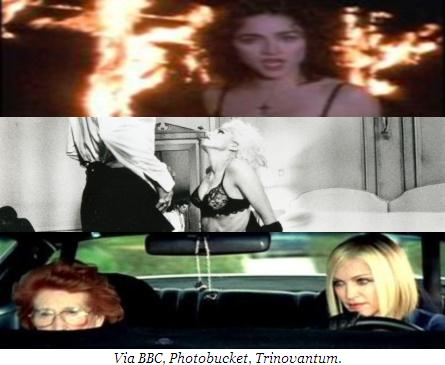
Firstly, we chose to analyse some music videos by Madonna, namely “Like a Prayer” (1989), “Justify My Love” (1990) and “What it Feels Like for a Girl” (2001), for their controversial nature.

“Like a Prayer” depicts images such as an attack on a woman in an alley, burning crosses, stigmata, Madonna’s revealing outfit as she sings in a church, and her love affair with the black Saint Martin de Porres, who some have interpreted as being a black Jesus Christ. Here she deals not only with race, but also religion.

One of Madonna’s most controversial and heavily censored videos is “Justify My Love”, in which Madonna and the actors in the clip engage in sadomasochism, bondage, domination, voyeurism, same-sex and group-sex relations, cross-dressing and possibly prostitution. Baker, Jr. speaks of voyeurism in the reading, and relates it to the fact that such taboo subject matter in videos by 2 Live Crew, and also Madonna, doesn’t allow viewers to critically and objectively view them. This leads to our focus question: “If religious groups, conservatives, feminists etc. weren’t condemning and censoring Madonna’s videos, would the public find them shocking and controversial, or at least as shocking and controversial?”

Finally, we briefly discussed Madonna’s video for “What it Feels Like for a Girl”. We personally didn’t find the video offensive or overly violent, however that was the reason given for banning it. In the video, Madonna kidnaps an old woman and goes on a crime spree with her, robbing banks and stealing cars. Madonna openly defended the video, saying that if she were a man, the violence wouldn’t be an issue, because they get away with the same or worse in their videos. Similarly, she defended the “Justify My Love” video’s content, even though the banning of it made her more money than if it was aired freely. This once again relates back to our focus question and what Baker, Jr. contends about 2 Live Crew.

Funnily enough, in an interview with Adam Lambert about his controversial same-sex kiss on-stage at the American Music Awards whilst performing “For Your Entertainment”, he got fired up how his actions were vilified because he was a man, while female pop stars have been behaving sexily since the dawn of time the music video. Hello, “Like a Virgin” at both the inaugural MTV VMAs in 1984 and with Britney and Christina in 2003!

I intended to elaborate more in this post on the points briefly mentioned here, however due to time constraints, I thought maybe I could use this post as a sort of “jumping off point to start negotiations”, as fellow Madonna-lover Cher Horowitz would say. I hope to put up more posts in the future on Madonna’s influence on the music video and religion in pop culture.

Related: Madonna (and Her Brand of “Feminism”) On the Rocks.

Katy P VS. Lady G.

Whipped Cream Feminism: The Underlying Message in Katy Perry’s “California Gurls” Video.

Elsewhere: [MTV] Adam Lambert Says AMA Kiss Was “In the Moment”.
Madonna (and Her Brand of “Feminism”) on the Rocks.


From “The Revival of Feminism: Cher VS. Madonna” by Ginger Glynn:

“Madonna seemed to market toward, and target young girls, tweeners, prepubescent girls. So many ate it up and asked for more. The new feminism. The pretty girls feminism. Where do these sexy, sexualized young girls utilize this inspiration? How do they use their purchased, packaged sexuality for power? Britney Spears was mentored by and followed Madonna, the not quite so innocent tease. Oops, we did it again, we targeted young girls and taught them that being attractive is all we have to offer, that being intelligent is not feminine. We are supposed to believe Britney was able to use her sex appeal intelligently. She sold it, gained millions and with that, power? She got married, divorced and married again. She divorced again. Partied every night and shaved off her hair. Oh, and her ex-husband got the kids. All that sexuality and feminism, so little power. But wait, she grew back her hair, she lost weight, she may or may not have found her panties and for this we may love her again. We continue to give our daughters the financial means to support and emulate these images and models.”

Elsewhere: [More] The Revival of Feminism: Cher VS. Madonna.

Movies: The Best Movies I’ve Seen This Year.


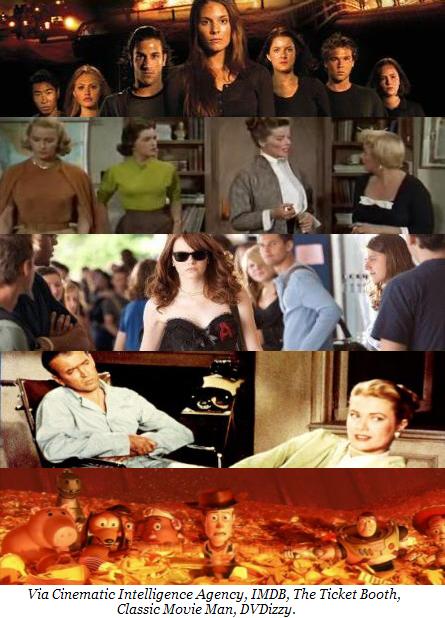
Tomorrow, When the War Began. Check out my review to see how strongly I feel about it.

Desk Set. This 1957 romantic comedy starring Katharine Hepburn and Spencer Tracy takes place in a reference library, and deals with the incorporation of computers to help the ladies in their cataloguing. With a healthy dose of the trademark ’50s slapstick rom-com dynamic and TDF fashion, I loved this one.

Easy A. Again, another I’ve done a review on. While I had high hopes for this one, it didn’t live up to them fully, but it is one of the smarter teen movies in recent memory. On par with Mean Girls, perhaps?

Rear Window. What took me so long, right? I watched this one for the first time last Christmas, and continued the tradition again this holiday season. Grace Kelly is luminous as “his girl Friday” to James Stewart’s L.B. Jeffries, who is the ultimate leading man. Hitchcock at his best.

Toy Story 3. It is unanimous that Toy Story 3 is one of the best movies released in 2010. Perhaps the best of the Toy Story franchise? Nah, my money’s on the first instalment.

Desperately Seeking Susan. So bad it’s good. The fashion is fabulous (on Madonna’s part, anyway) and Her Madgesty is surprisingly likable in it.

Sorry about the dismal effort in this post, but seriously; there were no good movies this year! You only have to look at Sex & the City 2 (which I quite liked, but will admit was baaad), The Expendables and Killers for proof of that.

That’s why I spent a lot of my cinema-going money on the classics, such as Gentlemen Prefer Blondes and Beauty & the Beast in 3D. That counts as a movie I haven’t seen before this year, right? Right…?

Related: Tomorrow, When the War Began by John Marsden Review.

Easy A Review.

Sex & the City 2 Review.

The Expendables Review.

Elsewhere: [Jezebel] Is Easy A The Next Mean Girls?

[Jezebel] I Went to See Killers & It’s All Your Fault.

TV: The Underlying Messages of Glee’s “Britney/Brittany” Episode.


In what was one of the most anticipated episodes of Glee, alongside the Madonna and Lady Gaga episodes, Britney Spears made all of a minute’s appearance on the show last week.

I was expecting a lot more, but we all know acting is not one of Britney’s strong suits (Crossroads, anyone?). However, Brittany S. Pierce, played by Heather Morris, stole the show and cemented her reign as my favourite Glee character.

While Britney’s lacklustre performance was the drawcard for the episode, there were a few underlying messages about fame using Spears as the beacon for what can go wrong if young stars abuse their fame.

“The episode opens with Kurt informing Mr. Schue that there’s a five person Facebook group campaigning for New Directions to sing Britney Spears songs at the homecoming assembly. But Schue shoots down this movement (even [though] these kids have already performed “Push It” in front of the whole school, for the purposes of our story, Brit Brit is too trashy or something).” [Jezebel]

The kids fought for their right to perform Britney, as she’s an inspiration to all of them, and the reason they want to be stars. Perhaps this way of thinking was better suited to the Lady Gaga episode, as she truly is an inspiration. On the other hand, if Mr. Schue let them perform songs by Madonna, Lady Gaga and, as Jezebel mentioned, Salt N Pepa, Britney is probably the most tame and PG-rated of them all. But I could see Schue’s point: while Britney may be an inspiration, she’s also one of the least talented pop stars who permeated the late ’90s/early ’00s zeitgeist and “not suited” to New Directions.

But, when Brittany goes to see guidance counsellor Emma Pillsbury’s new boyfriend and the school dentist Carl, played by guest star John Stamos, and is put under anaesthesia, she has a Britney Spears fantasy, which makes her realise her true potential as a star, and she demands to have all the solos from now on.

Santana wants to have a Britney fantasy too, so they both go to see the dentist and demand to be put under. Santana uses her doctor father’s health insurance to bribe Carl into succumbing. This could be seen as a reference to the enablers in young stars’ lives (Lindsay Lohan comes to mind) and the drug use that many such stars (again, Lindsay) are rumoured to have engaged in.

In a scene from last week, Sue Sylvester kicks Santana off the Cheerios for defacing her young and still-growing body with breast implants. This seems to be a specific dig at Britney, and a prelude to this week’s episode. Santana is probably only 17 years old, perhaps even 16, which is the age Britney is rumoured to have gotten implants.

Finally, the episode culminates in most of the Glee club having had hallucinations and a “Britney Spears sex riot”, caused by Sue. Britney has been criticised her whole career for being too sexy, which is evident in the opening Britney/Brittany video mash-up of “Slave 4 U”, “Toxic” and “Oops… I Did It Again”, as well as Brittany and Santana channelling “Me Against the Music”, which would have had far more impact, I think, if Britney was used in the whole montage, instead of just at the very end for about .5 seconds.

Related: Poor Little Rich Girl—Lindsay Lohan in Who.

Elsewhere: [Jezebel] Glee: The Britney Spears Stuff You Want to See.