Following on from 60 Minutes’ story on selective reduction of foetuses conceived via IVF, Kass Hall examines the issue. I don’t agree with IVF personally (not because I don’t think it shouldn’t be available because it messes with “God’s intentions” or some anti-science crap, but because I think there are other—or should be more readily available—ways to have a child, and that not being able to or not wanting a child shouldn’t be stigmatised) and I’m pro-choice all the way. Awkward situation all ’round, I think. [MamaMia]
So Rihanna had a relationship with Chris Brown and is rumoured to have slept with Ashton Kutcher and Drake. That means she’s a slut, right? Two greatpieces deal with the one-sided hypocrisy that is slut-shaming in the R’n’B and hip hop community, not to mention patriarchal culture as a whole, in addition to this equally awesome shoutout from Russell Simmons to Brown, Drake et al., telling them to “Get Off Rihanna’s Dick!”
I just don’t get this “she’s a slut” mentality if a woman expresses her sexuality in the same or similar way to any number of men. A woman’s a slut if she sleeps with someone outside of a committed relationship (or even if she only has sex with someone inside a relationship; if she has sex with a woman; gives the perception that she wants sex and then reneges; is deemed “too sexy”; is raped… Nay, a woman’s a slut no matter what.), but a man is a player, a stud, a lothario.
Here’s something to ponder: if women weren’t “sluts”, men wouldn’t have anything to put their dicks into apart from other men or fleshlights. (Well, there are other things, but we won’t go there!) [Jezebel, Ebony, Global Grind]
Andrew Clifton writes beautifully about Joe Hockey’s anti-same sex marriage stance, and that progressive types should refrain from vitriol-spewing when a social conservative has an opinion we don’t agree with:
“We (accurately) believe ourselves to be on a higher moral ground for knowing exactly why legislating in favour of same-sex marriage is important, but we should not judge those who disagree with us, we should only try to help them understand as well.” [MamaMia]
Remember in health class when you were given chickens or robotic babies to look after for a few days? Well, now you can have your very own chicken-cross-Tamagotchi in the form of the “Pregnancy Text” campaign, which is aimed at teenagers in an attempt to show them a fraction of what it’s like to raise a baby. Me want one. [Jezebel]
Shonda Rimes’ latest female-based creation, Scandal, also has a black female lead. The best thing about the character is that her race is a non-issue. The same can’t be said for her non-relatability as a person, though. [New Yorker]
Rachel Bilson has been caught slut-shaming in the latest issue of Lucky magazine. From Jezebel:
“It would appear that Rachel Bilson has taken up some part-time work with the purity police after she took a dig at any woman who dare expose her slutty back, chest and thigh skin. Sitting down to discuss the important things in life with Lucky magazine – shopping, of course! – she confessed that she’s not a fan of wearing dresses that are short and backless with a plunging neckline because she’s afraid of looking like a filthy harlot. ‘I guess I’m not too crazy about slutty dresses,’ she said. ‘You try something on, and if you feel like a slut, you probably look like one.'”
Mmm, because the dress she’s wearing above isn’t slutty at all…*
*I don’t actually think the dress Bilson is wearing in the picture above is “slutty” at all, whatever that means. I think she looks very nice and classy, but it was the “sluttiest” picture of her I could find in which she was representing herself, not a character or a brand for a magazine.
Hugo Schwyzer responds to Bettina Arndt’s assertion that women who dress provocatively and then complain about attention from the “wrong” type of men are teases:
“The calculus of entitlement works like this: if women don’t want to turn men on, they need to cover up. If they don’t cover up, they’ll turn men on. If they turn men on, women are obligated to do something to assuage that lust. Having turned them on, if women don’t give men what they want, then women are cruel teases who have no right to complain if men lash out in justified rage at being denied what they’ve been taught is rightfully theirs.” [Jezebel]
In the spirit Christmas, I’ve decided to revisit some of my favourite posts of the year in the twelve days leading up to December 25th.
I’m taking this final 12-Posts-of-Christmas opportunity to squeeze two Rachel Berry-related posts into the one. Think of it as one last Scarlett Woman gift to you.
The first post was written “In Defence of Rachel Berry”, while the second explores the character as a feminist one. You can access the original posts here and here, respectively.
In the first season of Glee, Rachel Berry was introduced as an attention- and approval-seeking know-it-all diva, who sticks a gold star next to her name on the New Directions’ sign-up sheet because that’s what she sees herself as. Season two showed the glee clubber soften her resolve a bit, realising that she’s still only in high school, and has her post-high school years to carve out a Broadway career and have the world see her as the star she knows she is. The season final saw her choose a relationship with Finn Hudson in her senior year at McKinley High, despite having to leave him to head to New York when she graduates.
Not all young girls have to wrangle their feelings for the school jock whilst contemplating a move to the big city to make their dreams come true, but many of Rachel’s problems are shared by the show’s audience.
In the most recent Lady Gaga-themed episode, Rachel struggles to accept her “Jewish nose” and considers rhinoplasty. She also strives for the acceptance of her New Directions band mates, and to be seen as fashionable and popular.
It’s in the character’s nature to be highly-strung, goal-oriented and ambitious, so it’s not likely she’ll change any time soon. And why should she? While there are certainly other young women out there who identify more with the saccharine Quinn Fabray, the sassy soul sisters Santana Lopez and Mercedes Jones, or badass Lauren Zizes, there are plenty who see Rachel as their Glee counterpart, myself included.
A recent New York Times article by Carina Chocano praised the “relatable” and “realistically weak female character”, like Kristen Wigg’s Annie in Bridesmaids—“a jumble of flaws and contradictions”—over the “strong” one. “We don’t relate to [the weak character] despite the fact that she is weak, we relate to her because she is weak,” Chocano writes.
But what exactly does she mean by “weak”?
Pop culture commentator Dr. Karen Brooks notes that talented, beautiful, popular and successful female characters need to be broken down before they can be seen as relatable. “The more talented and beautiful you are, the greater the threat you pose and so ‘things’ are introduced to reduce that threat,” she says. Just look at the “women falling down” video on YouTube.
While Rachel’s had her fair share of setbacks, it seems Glee’s audience is finally beginning to understand her. “We’ve been given time to understand Rachel’s initially painful personality and to identify both her strengths and weaknesses. Her ambitions and drive haven’t shifted, but the context for understanding them has,” Brooks says.
“Rarely are unpleasant characters redeemed, they are simply ‘punished’, while the ‘good’ characters soar to impossible heights, not on the back of hard-work and self-belief, but usually [because of] a love interest and wishing hard. Rachel is a healthy and welcome exception to that,” Brooks continues.
So she’s an unlikely heroine we can all get behind, you might say? “A girl who reminds you of you,” as Chocano opines. An everywoman, if you will?
If Rachel Berry encourages more young women to see themselves as gold stars striving to have their accomplishments recognised, then so be it!
I wrote that audiences have come to know and love Rachel not because her obnoxious know-it-all persona has changed, but because “We’ve been given time to understand Rachel’s initially painful personality and to identify both her strengths and weaknesses. Her ambitions and drive haven’t shifted, but the context for understanding them has,” as Dr. Karen Brooks reiterates.
“I… have trouble with the vilification of Rachel Berry on a feminist level. How often do we dismiss women as ‘bossy,’ ‘know-it-all[s],’ or ‘control-freaks’ when their behavior would be interpreted as leadership, assertiveness, or courage if they were men?
“… In the right context, Rachel Berry’s personality would not seem ‘intolerable’ or ‘annoying’ so much as bad-ass, renegade, and hardcore.”
And Lady T, who used Rachel as her “Female Character of the Week” on The Funny Feminist, said:
“… The show wanted us to root for a girl who was ambitious, daring, and driven.”
It might be because I have been known to be seen as bossy, a know-it-all, a control-freak (just ask my new housemate!) and ambitious that I’m standing up for her, but just think of another feminist heroine in modern pop culture who could also be described using these words: Hermione Granger. The only difference is, she isn’t vilified for these attributes.
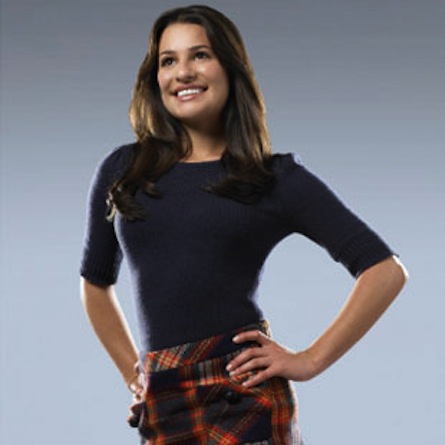
If you look back to the beginning of Glee, especially, Rachel was often deemed ugly. Now, anyone who’s seen Lea Michele knows she’s not exactly unconventionally attractive, but Rachel is characterised as this because she’s annoying. And she’s annoying because she stands up for herself, knows what she wants and how to get it. (From a racial point of view, she could also be seen as being “ugly” because of her Jewishness.)
Despite these inherently “unattractive” qualities, Rachel manages to snag her man, Finn, in what can be seen as typical Glee sexism and discrimination:
On the other hand, it can be seen as a poignant take on teenage life that the underdog is always being compared to the most popular girl in school: Quinn Fabray.
If Rachel is Glee’s feminist heroine, Quinn is her polar opposite. She has had next to no character development, which leads to her motivations changing week to week.
In “Original Song” she tore Rachel down, telling her to get over her “schoolgirl fantasy happy ending” with Finn, who would never leave Lima, taking over Burt Hummel’s mechanics business, with Quinn, a real estate agent.
But in “Born This Way”, she was “broken down” by her fat past coming back to haunt her, to come across as more “relatable”.
Sure, Rachel’s had her fair share of being “broken down” (being dumped and subsequently egged by Jesse St. James, being publicly broken up with by Finn, getting slushied… I sense a food theme here.), but in the grand Glee scheme of things, she’s actually doing pretty well for a female character.
In the spirit Christmas, I’ve decided to revisit some of my favourite posts of the year in the twelve days leading up to December 25th.
I love watching Jersey Shore because, like Glee, I know I’m always going to get a blog post out of it. The gender issues that run rampant on the show were inspiration for the following post, the original version of which you can find here.
This notion has been on my mind since the start of the year, and watching season three of Jersey Shore got me thinking about it again. So, are the fake-tanned, fake-boobed and fake-nailed women of Seaside feminists?
“… so much of what these people do actually challenges old school notions about gender-appropriate behavior: Men who wax their eyebrows? Men who place that much of an importance on hair products? Women who fistfight? Women who drink so heavily?”
But on the other, JWoww, for example, subscribes to the stereotypical sexualised female body: fake boobs, fake hair, and done up to the nines when she hits the clubs. If she’s got it, should she flaunt it?
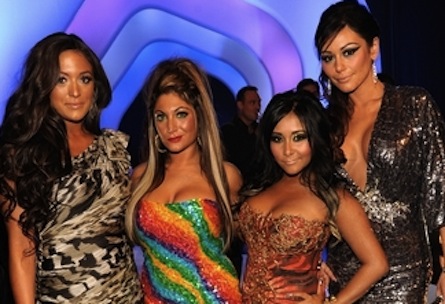
In strapping their boobs up and wedging their short-shorts further into their buttcracks, the mating dance the guidettes perform each night (which has nothing on the aforementioned regimen of the boys!) seems to subvert the very look they’re trying to achieve: sexiness. I don’t believe this is done purposefully, so in that sense it’s not very feminist-like, however the brazen bedroom talk the girls engage in—or rather, lamenting the lack of bedroom action, especially when it comes to Snooki—makes them highly relatable. As Sady Doyle writes, “we are all Snooki”.
I’m sure all women can relate to slut-shaming, regardless of how many sexual partners they’ve had, and that’s something the Jersey Shore females have to deal with on a seemingly episodic basis. Egan Morrissey puts it best, after Pauly D voices his views on sexual double standards (“She’s [Angelina] brought all these random people home. She’s a girl. You don’t do that. That’s a guy thing. Guys do that, not girls.”):
“Shouldn’t Pauly and The Situation be grateful for sluts? If there were no sluts then they would never be able to have sex. Do they think for one minute that they would even want to live in a world in which all girls acted the way that they’re ‘supposed’ to?”
Still with sex, feminists are either viewed as sex-negative man-haters, or insatiable sex machines who throw away men once they’ve got theirs. JWoww certainly falls into the latter category, who says in the opening credits, “I’m like a Praying Mantis: after I’ve had sex with a guy, I will rip their head off.” If Jersey Shore were a scripted show, JWoww’s bad breakup with Tom, who steals her hard drive, which contained naked pictures of the reality star, amongst other things, would be payback for her independent woman status. How dare a woman step outside of the stringent guidelines The Patriarchy has set for her?!
Speaking of bad breakups, if there’s one guidette who falls furthest from the feminism tree, it’s Sammi. While she finally plucked up the courage to leave Ronnie after their tumultuous on-off relationship ended in a very realistic fight in season three, in which Ronnie trashed Sammi’s bedroom and her belongings, including breaking her spectacles, reports about the fourth season seem to indicate that Sammi took Ronnie back.
While we can never understand the dynamics of each individual abusive relationship, and feminism can’t realistically be applied to them when a woman (sometimes a man, but mostly women) has had all of her resources—family, friends, employment, finances, access to a car etc.—taken away from her and therefore has limited means to escape, Ronnie and Sammi’s relationship may have some benefits to viewers of the show. Because Jersey Shore is marketed as “reality TV” (although, after The Hillsand the revelation this week that one of the “geeks” on Australia’s version of Beauty & the Geek is an actor, its dubious how “real” the show is), female viewers who may be involved in an abusive relationship at some stage in their life can see that the relationship is being portrayed in a negative light, that Sammi’s housemates, friends and family are telling her it’s not healthy, and that she should get out. We can only hope that the one in four women who will have an abusive partner will take heed.
A little too deep? How can we derive all that from something as asinine as Jersey Shore, a show that, grammatically, should have a “The” at the beginning of its title?
Take what conclusions you want from the overtly sexual show, but one thing’s for sure: the guidettes are “empowered sexually, that’s what I’m seeing on Jersey Shore… The women seem to be making their own decisions about who they sleep with [Scarlett Woman note: or don’t sleep with] and when.
“Almost by definition ‘guidette’ is a derivative term. It is a male-based subculture… The women were always defined as sex objects. And I think that’s something that they’re reversing.”
So, guidettes as sex subjects? If talking about “hairdos, shoes and body image snafus” and “preen[ing] and put[ting] on lipgloss” is a stereotypically female—and therefore weak—trait, then the guidos are certainly the background characters of Jersey Shore.
In the spirit Christmas, I’ve decided to revisit some of my favourite posts of the year in the twelve days leading up to December 25th.
Sexual harassment seems to be the theme of my (and a lot of those around me) life lately, and the blog has had a heavy focus on it in recent months. The original article can be found here.
The other day at work I was sexually harassed by a customer.
I was just standing there, and a short (probably around my height), bald, fat man in a dirty navy blue polo shirt, who was about 50–55, came up to me and asked me where the toilets were. I told him, then he asked “how’ve you been”, with a tone that implied he knew me. I said fine, and he looked me up and down and said in a sleazy voice, “Ooo, I’d like to take you home.” I immediately walked away and told three of my colleagues who were stationed nearby. As I left, he said something to the effect of, “I probably shouldn’t have said that.”
I’ve been harassed at work before, not as blatantly as Sunday’s episode, but I’ve never felt comfortable enough to eject myself from the situation. As someone who works in customer service, I think I placed not being rude above keeping myself safe. But, post-SlutWalk, I now have the confidence not to put up with that shit.
But I didn’t report it.
I told a few colleagues, until I eventually mentioned it several hours later to a security guard, who also happens to be a close friend of mine. He sternly asked me if I’d reported it to my manager. I told him no, and he asked me what I would do if he came back? If he stalked me? If he attacked me? If he attacked someone else? His older-brother protectiveness made me decide to report it.
It’s funny that I didn’t think to report it the moment it happened. I guess that’s the stigma of sexual harassment (and don’t even get me started on the stigma of sexual assault!). I think I thought that because I can handle myself and I won’t put up with that shit, that it wasn’t a big deal.
It was.
I filed a report with my manager, security know about it and have footage of the man, and it’s been forwarded to the appropriate department.
The responses I got from fellow colleagues were at each end of the spectrum. Some expressed outrage and encouraged me to report it, others asked me if he touched me, as if that would be the only thing to warrant filing a report. No, he didn’t, because that would be sexualassault. (Why do we not bat an eyelid when verbal harassment occurs, but are quick to leap into action when the physical barrier is breached? Both are violations of a person based on the fact that their harasser thinks they’re public property, or available for them to make comments on/touch.)
But these responses really illustrate the abovementioned taboo of sexual harassment. That boys will be boys. That as a young, pretty woman, you just have to suck these things up. That it doesn’t really count because you were only verbally violated.
I am somewhat ashamed that I was so quick to brush it off. (Let’s be clear: I’m not ashamed that I was harassed. I’m ashamed that I didn’t take it seriously to begin with. Rape is my biggest fear, but if I was ever raped, you can be damn sure I wouldn’t keep quiet about it because I was ashamed.) This is 2011. This kind of thing shouldn’t be happening. But it does. So as modern women, we should be able to say that making comments about our physical appearance without our consent is a no-go. Just like making physical contact with our bodies without our consent is.
In the spirit Christmas, I’ve decided to revisit some of my favourite posts of the year in the twelve days leading up to December 25th.
This one’s about the good ol’ slut-shaming most girls experience at some stage in their life and how it is often, at the hands of other women, a defence mechanism. Original post is here.
A good male friend of mine has recently started dating someone new.
When I asked him how it was going, he said fine, blah blah blah, but that one thing she said really offended him. I was intrigued, so I asked him to tell me more. She must have been looking through his Facebook photos, and came across several in which we’re tagged together. She confronted him about it, saying, “Who’s that Scarlett girl, huh? She looks like a bit of a skank.” He proceeded to set her straight and defend my honour.
Upon going through the photos we’re tagged in myself, I have to say she made a fair call! They’re mostly from costume parties where my skank switch is on full throttle.
But, more than that, it is not uncommon for me to be called names like this. I’m not going to deny it, because if SlutWalk taught me anything, it’s that denying you’re a slut means that you’re acknowledging that other women are. What is a slut/skank, anyway?
But I know why she called me that: she’s jealous. Instead of asking nicely who I was and why my friend looked so chummy with me in the photos she saw, she was threatened by our relationship, so in lieu of admitting this, she questioned the relationship by insinuating that he shouldn’t be hanging around with someone (who seemed) so skanky.
I don’t begrudge her for this; I kind of think it’s funny and a bit sad. In this day and age, people are going to have to start accepting that men and women can be platonic friends. This is why I wrote on my online dating profile that if a man wants to date me, they have to be comfortable with the other men in my life. Especially since my new roommate come Saturday is one of my closest (male) friends.
What to you think? Have you ever experienced this kind of jealousy from another woman, manifesting itself as slut-shaming?
I think a little bit of competition between women is healthy. My default emotion when I meet new people is wariness. I gradually begin to like people as I get to know them.
The same is true of the first impression I make. I’m kinda shy, which comes off as cold and bitchy, and I’m very territorial. No after work drinks with my friendship group til I learn whether you can be trusted. I’m not a likeable person to begin with and, some would argue, at all.
It is those that I’d like to focus on here.
A few weeks ago I had to take one of my co-workers to Human Resources for harassment and bullying. I haven’t gotten along with this person from day one, when she returned from some leave, during which time I’d become employed at our workplace. Never before had my department had such a youthful, outgoing and eclectic bunch of new recruits, so when she returned, I think it was quite a culture shock. She was the alpha female when she left and, not to toot my own horn (but toot toot!), when she came back I was the alpha female.
Two years have passed and it’s been an awkward working environment to say the least, but we’ve both/all (I’m not the only one she’s had a run-in with) managed to deal with it.
After another leave of absence, this person came back to work with what seemed like a vendetta against me. Prior to the few weeks she was away, our working relationship had become somewhat pleasant, surprisingly.
As soon as she saw me, she made some jibe about a co-worker’s party I went to that weekend, followed by some comments to a friend of mine about said co-worker and our (purely platonic, though I do think he’s cute!) relationship.
This was followed by some more bitchy comments to other co-workers about my birthday celebrations, about the way I dress, and about my reputation in the workplace, amongst other things. She even swerved towards me in the carpark!
At this point I took her to H.R., and was told there was nothing they could do because it was all “hearsay”. Correct me if I’m wrong, but I’d say the threat of grievous bodily harm with a vehicle is a little more than hearsay!
She’s backed way off since then, but when one drama ends, another begins.
I’ve been struggling with just about everything lately. Work, love life, money, family, friends. You name it. So the last thing I need is people talking shit about me. But hey, I’m Scarlett, and people love to hate me! More on why I think this is a bit later.
My work Christmas party is coming up in less than a week, and if you were a reader of this blog a year ago, you will know that the event is an absolute extravaganza! The theme is heroes and villains and I’m going as Eve, with the aforementioned object of the rumour mill as Adam. (Yeah, I’m probably asking for it with that one, aren’t I?!) Upon hearing about this on the grapevine (some people are more guilty of tending to the vine than others), a female colleague who now works in a different department called me attention seeking.
I’ll pay that: I will be the first to admit that I am an attention seeker. I’m a writer with a blog; attention seeking goes with the territory. And when it comes to costumes, I’ll go all out in an effort to have the baddest ass costume in the joint.
My problem is with the blatant jealousy in these comments.
If you think I’m attention seeking and you want to realign the spotlight back on you, strive for an even more out there costume than mine.
If you think I dress like a slut, how is that any concern of yours? So what if I do? If you wanna dress like a slut, too, go right ahead. I don’t have the monopoly on sluttiness.
If you think I’m “all over” someone, try to peel me away and you yourself can be all over them if that’s what you really want. If it’s not, then why worry?
Honestly, I actually feel sorry for these women who have nothing better to do than bitch about me. Worry about your own lives and less about mine. You must really not have much going on (one of these women is a mother, for crying out loud! You’d think she would have better things to do.) if I’m all you’ve got to talk about. Get a life!
But I believe the reason people, nay women, have such a problem with me is because, as the divine miss Catherine Deveny puts it, “I don’t lay down in the chalk outline drawn for me.” Sure, she was talking about body image, but I think as a woman who refuses to comply with outdated “socially acceptable” norms, it is particularly fitting.
Perhaps people would like me better if I were more agreeable, demure and didn’t voice my opinions. If I strived less for achievement in the areas that are important to me, and more in the areas others’ think are important. If I was less threatening by being more concerned with what people think of me. But then I wouldn’t be me. Oh, sorry, that’s what they want!
I’ve always thought religion is bullshit, so when I saw a debate with the topic sentence “the Catholic Church is a force for good in the world” as part of the Intelligence2 debate series, I bought a ticket with my friend Laura immediately.
Going in, we’d both had our minds made up that the Catholic Church certainly wasn’t a force for good in the world, as did 34% of our fellow debate-goers, a door poll reflected.
The affirmative side didn’t do much to sway anyone’s opinion, as lawyer Julian McMahon and Sister Libby Rogerson were pretty poor debaters.
McMahon spoke about how love is the driving force behind the Church and Jesus’ teachings, which has obviously been lost in a lot of hot-button religious topics such as gay rights, and instead we have the “language of The Simpson’s”. I’d say this was true even ten years ago, but the language of today is very much a cyber one, which is perhaps why the Church is losing influence and followers. (Albeit, speaker for the opposition, Anne Summers A.O., pointed out that followers of Catholicism have increased less than one percent in recent years.)
Sister Libby went on to talk about Catholics who volunteer and work in Indigenous communities and in prisons. I don’t know too much about how the Catholic Church has been more of a hindrance than a help in Indigenous Australia, but Laura was obviously upset by the Sister’s assertion, rolling her eyes and groaning. My beef with volunteering being a primarily religious domain is that yes, perhaps a lot of Catholics volunteer, but a lot of non-Catholics volunteer, too. For example, I’m agnostic and I used to volunteer at the RSPCA. As event facilitator Simon Longstaff said, quoting Thomas Aquinas, “Not even the pope has sovereignty over a well-informed conscience.” Amen to that.
In the face of criticism, Sister Libby said the Church is a “flawed, human institution” and makes mistakes just like anyone else. Where have we heard that before?
The affirmative’s only saving grace was Helen Coonan, who actually read from her notes instead of waffling on about dot points. She said there is no excusing the past injustices of the Church, but we need to focus on the present. Coonan spoke at length about the Occupy movement, using their non-hierarchy (un)structure and myriad of messages to undercut all anti-establishment movements. (SlutWalk comes to mind.) That’s the trouble with Occupy: those in opposition to it judge all movements by its measuring stick. But that’s another post for another time.
She spoke at length about wealth in the Catholic Church and using it as a metaphor for how the world should structure its monetary dealings. Hmm… To be honest, as well as Coonan spoke, her focus on economics kind of bored me.
To rebut this, Father Peter of the opposition said the Church favours the idea of “pray, pay, obey” and doesn’t give its followers a voice.
Still with the opposition—debating for the notion that the Catholic Church isn’t a force of good—consisting of Summers, the excommunicated Father Peter Kennedy and writer David Marr, they brought the house down with their poignant points.
Summers spoke about the women’s movement in relation to the Church which, when Summers and fellow Catholic school-educated feminists such as Germaine Greer were at school, consisted of either “being a nun or a mother of six”. She spoke about abortion, birth control and choosing whether and when to become a mother.
During the floor debate, one woman about my age tried to debunk Summers’ theory that women who subscribe to the teachings of the Church don’t make their own choices. The fact that her mother was born in the ’30s, has several (Catholic school?) degrees and NINE CHILDREN leads me to believe that she wasn’t making a choice to do these things so much as she was brainwashed to do them. As Marr said during his time, sex as a non-reproductive act is frowned upon by the Church.
Speaking of Marr, he was by far the best debater and is my new favourite person! He talked about sex as a sin and that followers of the Catholic Church are supposed to engage in “no sex at all, ever!” unless it’s between a married, heterosexual man and woman for the purpose of procreation. How boring!
He pointed out four main problems with the view the Catholic Church has of sex:
2. Condoms being outlawed. When Marr asked the affirmative panel if they support the banning of condoms to stop the spread of disease, like HIV/AIDS in Africa, McMahon awkwardly and roundaboutly agreed with the Church’s position. He said that abstinence and sex only within marriage would stop the spread of disease in Africa, forgetting that in countries like the Democratic Republic of Congo rape is rife and abstinence only sex education doesn’t work. His response was laden with racism and rape-apologist attitudes, in my opinion. For all his accomplishments, this debate illustrated that McMahon is severely out of touch with the realities of our world.
3. Homosexuals are bad, okay? I think we all know the Church’s stance on homosexuality, despite most Catholics, according to Marr, believing in granting the right of marriage to the gays.
4. Shame. That sex, being sexual and looking sexy is shame-worthy. I would argue that this attitude has permeated secular society, but that secular society also laughs in the face of point #1, and also prude-shames those who aren’t having sex, being sexual or looking sexy. You can’t win either way.
By the end of the debate, in which Coonan rebutted that “ordinary Catholics”—those who acknowledge and agree with most points from both sides of the argument, and who aren’t caricatures of fanatical militant Catholics—“need a voice”, which I certainly agree with, 57% of the audience was against the Catholic Church as a force for good in the world. Hope for atheism—or at least agnosticism, which is the philosophy I subscribe to—isn’t dead yet, which is more than I can say for the Catholic Church.
“For too long, it was the anti-feminists who owned that brand: Katie Roiphe, Camille Paglia, Caitlin Flanagan.
“And this bold style might have been lost forever, if it weren’t for the web. Lacking editors (whose intolerance for insanity tends to sand off pointy edges), lacking balance (as any self-publishing platform tends to), laced with humor and fury (emotions intensified by the web’s spontaneity), the blogosphere has transformed feminist conversation, reviving in the process an older style of activism among young women. It’s a renaissance that began around 2004, when feminist blogs were rare. Left-wing blogging was on the rise, a phenomenon that was strikingly male…
“Then, during the 2008 presidential campaign, the Net exploded with debate about Barack Obama and Hillary Clinton, not to mention Sarah Palin and Michelle Obama. At the time, the website Jezebel—the flamboyant ‘Girlie Gawker’ founded by Anna Holmes—got the biggest numbers it had seen since its launch.
“As the volume of posts increased, subjects recurred from early feminism, including outrage at sexual violence. But there were also striking differences: While seventies feminists had little truck with matrimony, feminist bloggers lobbied for gay marriage. There were deconstructions of modern media sexism, including skeptical responses to the ‘concern-trolling’ of older women who made a living denouncing the ‘hookup epidemic.’ There was new terminology: ‘slut-shaming,’ ‘body-snarking,’ ‘cisgender.’ And there were other cultural shifts as well: an acceptance (and sometimes a celebration) of porn, an interest in fashion, and the rise of the transgendered-rights movement, once seen as a threat, now viewed as a crucial part of sexual diversity.
“Perhaps most strikingly, there was a freewheeling fascination with celebrity culture and reality television, even on the most radical sites. Instead of viewing pop culture as toxic propaganda, bloggers embraced it as a shared language, a complex code to be solved together, and not coincidentally, something fun. In an age of search engines, it was a powerful magnet: Again and again, bloggers described popculture posts to me as a ‘gateway drug’ for young women—an isolated teenager in rural Mississippi would Google ‘Beyoncé’ or ‘Real Housewives,’ then get drawn into threads about abortion. Some of the best memes out there are the least categorisable, like Feminist Ryan Gosling, a blog that features the adorable star of Drive ‘citing’ poststructuralist philosopher Judith Butler. Is it a joke? A turn-on? A sly carrier for theory? It doesn’t really matter, because it’s the perfect viral pass-around.”

 The Scarlett Woman