TV: Glee Gets Down on Friday at the Prom.


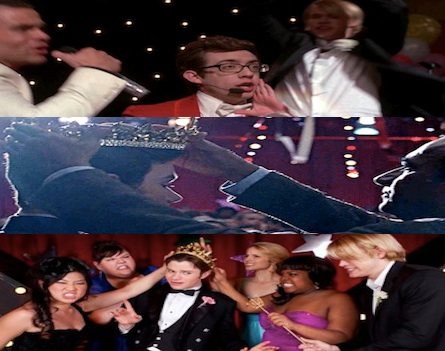
So Rebecca Black has officially permeated the zeitgeist, with “Friday” being performed by Puck, Artie and Sam at McKinley High’s junior prom on last night’s episode of Glee.

And despite Quinn’s monotonous efforts to be crowned prom queen, along with Finn as her king, she lost out to “queen” Kurt.

Kurt’s date Blaine told Kurt of what happened to him at his last prom (he and another gay friend were set on by the school homophobes and gang bashed) and that he wasn’t 100% comfortable with attending, but he went for Kurt anyway.

Kurt’s dad, Burt, was concerned that Kurt’s “royal wedding-inspired” tux, which he handmade himself, wasn’t appropriate and that Kurt shouldn’t draw any extra attention to himself and Blaine.

Kurt thinks, despite Santana and Karofsky escorting him to and from classes as part of their Bully Whips anti-bullying squad, that McKinley is really coming around to the idea of gay acceptance, because he hasn’t been physically or verbally abused since returning from Dalton Academy.

Hatred builds up inside if we can’t let it out, and it seems that the kids at McKinley let it out sneakily and quietly, by “secret ballot” for prom queen.

But you know Kurt: he sucked it up and went out there in front of the school to tell them… “Kate Middleton, eat your heart out.” Okay, I was expecting something a little more inspirational than that, considering the “gay prom” issue is one that’s rampant in the U.S., and also here, as a recent episode of SBS’s Insight will attest.

But I suppose we have Chris Colfer’s Golden Globes speech to comfort us.

And, as is Glee’s trademark, the controversy was wrapped up nicely into one 42-minute episode and McKinley’s homophobia will live to fight another day.

Until then, let’s get down on “Friday”!

Related: The Underlying Message in Glee’s “Born This Way” Episode.

The Underlying Message in Glee’s “Original Song” Episode.

Gwyneth Paltrow Addresses Tabloid Culture & Her Haters.

Glee “Sexy” Review.

The Underlying Message in Glee’s “Blame it on the Alcohol” Episode.

How to Make a Woman Fall in Love With You, Glee Style.

Glee “Silly Love Songs” Review.

The Underlying Message in Glee’s “Furt” Episode.

The (Belated) Underlying Message in Glee’s “Never Been Kissed” Episode.

The Underlying Message in Glee’s “The Rocky Horror Glee Show” Episode.

The Underlying Message in Glee’s “Duets” Episode.

The Underlying Message in Glee’s “Grilled Cheesus” Episode.

The Underlying Message in Glee’s “Britney/Brittany” Episode.

Elsewhere: [SBS] Gay in School: SBS Insight.

Images via Showbiz Nest, I Am Thea 07, Maurissa Weiner.

Breaking the Mould.

A recent post on MamaMia by Rick Morton revealed that although he is a gay man, he has no sense of rhythm and cannot dance. He also liked sports. Anyone who’s seen the stereotypical gay man on Sex & the City, Desperate Housewives or Modern Family knows that gay men always have rhythm and hate sports. Therefore, Morton breaks the stereotype.

The post, entitled “What Stereotype Do You Break?” got me thinking about… erm… what stereotypes I break!

One misconception about me that I struggle with constantly is people thinking I’m dumb because of the way I look, dress, speak and the things I’m interested in. If people looked a little deeper, they would see that yes, I sleep in curlers, dress up to go to and from my workplace, at which I wear a uniform, am in tune with the “OMG” zeitgeist and am partial to a copy of Famous and a gossip session.

But yes, I also have a degree, a blog and a keen interest in secondhand book shopping. I also like to read books I pick up at secondhand bookstores. In fact, reading is my favourite pastime and is like oxygen to me. I love nothing more than bumming around the house in pyjamas and no makeup for days on end preferably. I also like guys who like these things. I am a feminist.

And yes, I have volunteered at the RSPCA scooping up poop for hours on end because I like animals and try to lend a helping hand to charities where I can. I enjoy cleaning, can’t stand listening to private school kids on public transport, and hate people who are entitled and who haven’t had to work for everything they have. I don’t really like shopping and if I’ve committed to more than two social outings per week, I start to get anxious.

I could go on forever about the many ways people prejudge me, and the many ways in which I let them because I don’t like letting people too close.

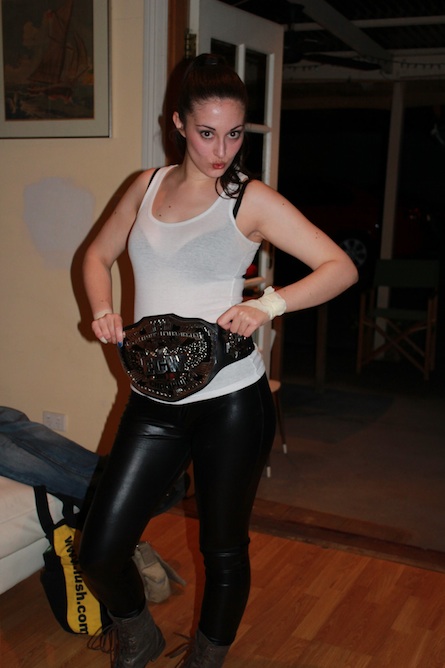
But the largest stereotype I break is that I’m an educated, girly girl (on the surface) who just happens to be a fan of wrestling. Those who’ve read The Scarlett Woman for an extended amount of time will know that I am partial to my wrestling; preferably World Wrestling Entertainment, but I will settle for TNA or some independent action. I have been to nine live events in Australia, met ten wrestlers, been within a metre of three others, and have scores of old school VHS tapes under my bed.


What stereotypes do you break?

Related: So Misunderstood.

Clunes Back to Booktown.

Book Now, Bendigo.

Girls Night In.

Nine Lives.

Conservativism Reigns Supreme in The Sunday Age’s Opinion Section.


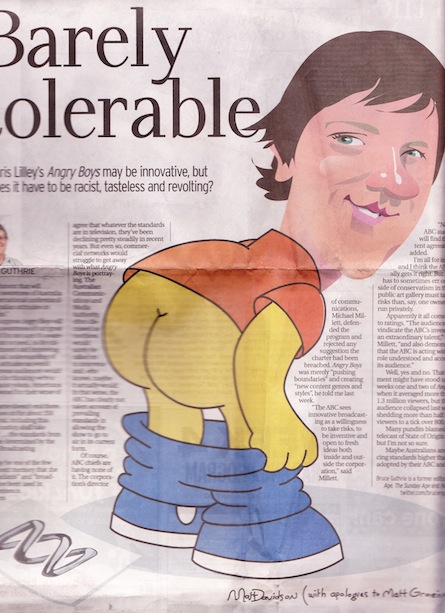
I was pleasantly surprised to see an article on Chris Lilley’s Angry Boys juxtaposed against one on the SlutWalk in The Sunday Age’s Opinion columns this past weekend.

What I wasn’t so pleasantly surprised to find was that they were both championing the censorship of a show “many critics and some intellectuals have applauded… for [its] brave comedy” and of women’s rights to wear what we want when we want where we want without the risk of sexual assault.

On that, Nicole Brady, author of “It Makes Sense to Be Aware of What You Wear” actually sides with the Toronto policeman, Michael Sanguinetti, writing, “The word ‘slut’ was probably overkill, but that policeman was onto something… Boiled down, and stripped of the inflammatory ‘slut’, his argument was ‘be careful about what you wear’. Advice as dull as your mother telling you to wear a coat on a cold morning.”

I don’t want to go into why what the cop said was wrong and why Brady’s likening of “not dressing like a slut” to wearing “a coat on a dull morning” is an archaic way of thinking (for that, you can go here).

In the article to the left of Brady’s, Bruce Guthrie continues in his argument against the ABC/HBO partnership, saying that the ABC’s charter may be in conflict with the success of and American market for the show. “I’m not sure if the cable network has a charter, but if it did it would probably say this: ‘Our goal is to make as much money from our programming as possible’,” he writes. Guthrie specifically takes issue with Lilley’s portrayal of rapper S.Mouse, a role for which the actor and creator appears in blackface. “Why is it okay for Lilley to wear blackface, but the guys from Hey, Hey, It’s Saturday are vilified for it?” I’ve heard it asked.

Unlike Brady’s, I can see Guthrie’s point. I think Angry Boys has a lot of potential, and it is damn funny, but I feel that it has gone a bit downhill from the first episode, which focused heavily on the Sims twins, Daniel and Nathan, and their Gran’s workplace, a juvenile detention centre, to last week’s third, which “explained—and showed, needlessly and graphically—how surfer Blake Oldfield became a eunuch.”

But it does portray Australian “bogan” life to a tee, and I think if the show focused a bit more on the juvenile detention centre, and the classism and racism that surrounds it, Angry Boys would not only be a funny show, it would also be an apt dialogue on Australian society.

Related: Ain’t Nothin’ Gonna Break My Slutty Stride.

Event: Ain’t Nothin’ Gonna Break My Slutty Stride.

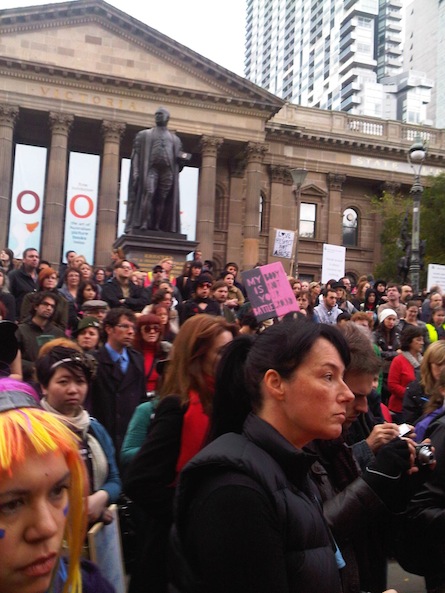
Ralliers outside the State Library on Swanston Street.

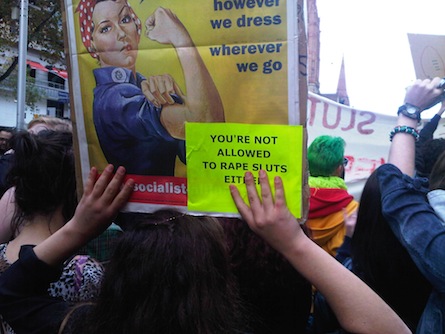
Best. Sign. Ever.

Last Saturday the highly anticipated SlutWalk occurred in several Australian cities, and I attended the Melbourne event with my fellow anti-slut-shamer friend Laura (both of us below).

We rocked up in our sluttiest outfits, which you can see above, complete with permanent marker declarations of our proud sluthood to boot. Some of the other outfits we noticed were short skirts with knee-high skull print socks and customised Doc Martins, worn by event organiser Clem Bastow (below), lace dresses and gym gear, the latter of which adorned a short-haired tattoo fan with a body Tracy Anderson would envy.

Clem Bastow.

Monica Dux.

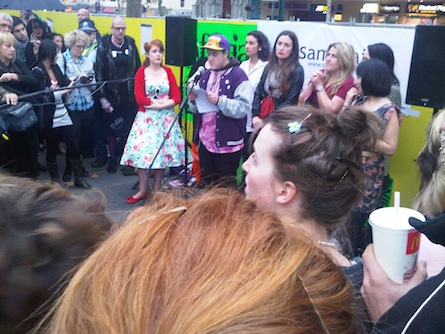
As Bastow commented when she gave one of the opening addresses, along with fellow event organisers Karen Pickering and Lauren Clair, and noted feminists Monica Dux (above) and Leslie Cannold, amongst others: “thank you, God, it looks like you’re going to rain on me”. But no one was gonna rain on our parade and, despite the chilly temperatures, we still walked tall and proud in whatever get-ups we chose to wear.

Dux said this is the beginning of a movement, which I have to disagree with. SlutWalk is not the beginning of a movement; it is part of the reignited battle to stop victim-blaming and slut-shaming based on one cop’s archaic musings on rape and how much a woman was “asking for it”. Here’s a fun fact: WE’RE NEVER ASKING FOR IT! (See Bastow’s sign, above). No matter how we are dressed, where we are, how much we’ve had to drink, or what we do for work.

Speaking of, I was really proud to see the representation of sex workers at the event, and president of the Australian Sex Workers’ Association, the Scarlet Alliance (represent!), Elena Jeffreys (above) spoke about her sexual assault and that even though she was paid for sex, she was not consenting to assault. Her opinions on the SlutWalk were really interesting and I hope they receive as much publicity as the negative perceptions of the rally have in the media.

In the days leading up to SlutWalk, I was embroiled in a heated debate on Facebook with a friend who disagrees with the SlutWalk. I think he confused—like a lot of people—the meaning of the SlutWalk with an excuse to get gussied up in a very risqué manner when, in fact, that was not at all what it was about. That didn’t stop protestors on the steps of Parliament House at the top of Bourke Street brandishing their “rape is horrifying, but so is immodesty” placards (above). Like one of the speakers (whose identity escapes me: should have used my BlackBerry voice recorder!) said: it’s not up to us to curb our behaviour (and that includes how we choose to dress) at the risk of potentially being sexually assaulted; it’s up to those who sexually assault to curb their behaviour!

I think most people against the SlutWalk had a problem with the use of the word slut. As Cannold said, “words matter…: … we won’t stand for one, the same one, being slung at us over and over again to demean and degrade us.” Lori Adelman, in a post on Feministing, said she didn’t agree with the term “slut” and that she “would much rather have attended a ‘Do Not Rape’ Walk”:

“I find that the term disproportionately impacts women of colour and poor women in order to reinforce their status as inherently dirty and second-class, and hence more rape-able.”

To me, “slut” is just a word. It meant as much to me to be called a slut when I was 12 as it does today; as they (and Rihanna) say, sticks and stones will break my bones but names can never hurt me. It’s not about the term “slut”, it’s about the backwards and extremely offensive views that go along with that word. As coordinator of the first SlutWalk in Toronto, Sonya Barnett, told Rachel Hills: “if he [the policeman] had said something else, we would have called it something else.”

The speaker who garnered the most attention, though, was transgendered man, Cody Smith (above), who had been raped both as a biological female, and as a trans man. There were tears a plenty during his speech!

It was nice to see such a welcoming, non-judgmental turnout of everyday men, women and children of all walks of life, wearing all sorts of garb, not just the fishnetted and cut-out body con dresses that certain attendees chose to wear (guilty as charged!). After all, rape is not about what you’re wearing, what you look like, what size you are, how old you are, what your sexual orientation or gender is, or any other denomination that you happen to belong to as a person. It is about the perpetrator, and nothing you can or cannot do will stop them from attempting to rape you.

As Smith said, it shouldn’t be the victims of sexual assaults’ responsibility to educate the general public on sexual assault and victim-blaming. And I thought the sexual revolution happened several decades ago: it shouldn’t be up to members of a fringe movement to educate the general public on the sexual rights of women to express themselves however they please without the threat of retaliation. In fact, feminism—which is what the SlutWalk was all about—shouldn’t be considered as on the fringe in 2011.

Related: SlutWalk.

So a Tattoo Makes Me Public Property, Huh?

Has Feminism Failed?

Rihanna’s “S&M”: Is it Really So Much Worse Than Her Other Stuff?

Elsewhere: [Feministing] SlutWalk: To March or Not to March.

[Musings of an Inappropriate Woman] Ask Rachel: What Are Your Thoughts on SlutWalk?

Black and white images via Ali Ryan Photography.

Guest Post: Life Below the Poverty Line is a Horrible Place.

My Shopping List:

Penne pasta: $0.78

Jasmine rice: $1.29

Can of beans: $0.89

Can of spaghetti: $0.89

Oats: $0.99

Bag of carrots: $0.99

Can of tomato soup: $0.74

1 onion $0.41

Sultanas: $1.03

Milk: $1.09

5 small pears: $0.92

Total: $10.02

Day 1:

Breakfast: Bowl of oats in hot water and a pear.

Lunch: Canned spaghetti (this was an operations error. I meant to buy two cans of beans to mix with rice for protein but came home by mistake with spag.). Handful of sultanas.

Dinner: Rice with onion, carrots and beans. A carrot.

It’s not so bad. I thought this would be far more difficult, although I am surprised that I feel hungry already, because I am still eating three meals a day.

Day 2:

Breakfast: Bowl of oats with milk and sultanas.

Lunch: Remaining canned spaghetti and a pear.

Dinner: Pasta with tomato soup on it.

I have a headache, and I am hungry and grumpy and anxious. My body is simultaneously withdrawing from caffeine, sugar, nicotine, and quite possibly any other number of food- and wine-related chemical addictions. My body feels as though it’s put together all wrong and I am having difficulty focusing on anything for any length of time.  Woe begets any person who wakes, disturbs, annoys , or—let’s face it—even talks to me right now. My final 18,000-word thesis for a masters degree in International Development is due in two and a half weeks and I am supposed to be focussing and working hard, but all I can think about right now is coffee, coffee, coffee! It is strange, because this is not the first thesis I have written, nor the hardest academic challenge I have faced, but it is the first time I have faced any of it without coffee. This is my Everest!

Day 3:

Breakfast: Bowl of oats with milk and sultanas.

Lunch: Rice with carrot and onion pieces and beans and a pear.

Dinner: Pasta with tomato soup on it.

I ‘m going to be honest with you: I want to cheat.  I want to eat a tub of fried food, drink two gallons of coffee, and finish off with a 1kg slab of Cadbury’s finest. But I won’t, partly because so many people have paid money to see me suffer, but mostly because I want to have a better idea of what it feels like to live in extreme poverty.

If I were truly living off this two-dollar budget, then I would have no toothpaste, no shampoo, no soap, no (eek!) makeup. I would not be living in my lovely light-filled, fully furnished open-plan apartment 10 minutes from the beach, with polished floorboards and a security gate. I wouldn’t be typing on this computer. I wouldn’t be warm, and safe.

Take it from me, who has only lived here for three days: life below this line is a hungry, headachey, horrible place. And I sleep at night in a secure apartment, in a queen-sized bed, with thick blankets to fend of the cold, and electricity and plumbing and a fridge and any other number of comforts. The police are a phone call away if I feel scared or threatened, and so are my family and friends if I feel lonely. I live in the knowledge that if I get sick or injured, I will have a choice of doctors who will treat me. If I lose my job, I will have help from my government, a government who I have a hand in electing, and a chance of holding accountable if required, and a government who has real authority. Hunger is no real threat to me here; I am hungry now, only because I have chosen to be. I am so lucky. But the most important thing is, now I know it; it’s a small insight, but an important one.

Maybe the hunger is making me sentimental, but I think half of the challenge is to understand what it is like for those who suffer below the line; it is knowing the physical limitations of living there.  But the other part is understanding that the people we are trying to help are not fictitious, or lesser, or abstract, or really all that different from ourselves.  The people who live there are not faceless or nameless, though often they are depicted as so. They are young people, old people, women, children and men, who have dreams and ambitions, who have extreme determination to survive. The people who live there are wilful, funny, and intuitive; they have great capacity for innovation and great instincts for survival. They are all different kinds of things: hardworking, honest, reliable, efficient. They are human, and come in as many varieties as the people we know and love.  And I think one of the most important things about Living Below the Line (aside from raising money) is that we understand this, not remove ourselves from those who suffer by painting abstract images or pretending the problem doesn’t exist.  Because it becomes too easy to accept the status quo; to say, “there is nothing I can do; this is just the way it is.” Because it is not true! By changing the way we think, by looking at the way we live, we can make a difference.

Day 4:

Breakfast: Bowl of oats with milk and sultanas.

Lunch: Rice with carrot, onion pieces,  and beans, and a pear.

Dinner: Rice with carrot, onion pieces and beans.

I hate oats.

Day 5:

Breakfast: Bowl of oats with milk and sultanas.

Lunch: Rice with carrot and onion pieces, and a pear.

Dinner: Pasta with tomato soup and a carrot.

In just one week, we have raised enough money to build 7.8 remote classrooms in Papua New Guinea and also provided six full time scholarships to first time students in Cambodia. In just one week, we have made a real and tangible difference to the lives of others, by providing education to people who would certainly not get it otherwise.It is not too late to sponsor me, or someone else, if you have not already. If not now, it is certainly worth considering taking the challenge yourself. Please donate kindly; any amount can go a long way to helping in the fight against poverty. Or think of taking the challenge yourself next year!

On a final note, I also swear to never pay out Aldi supermarket again! For $10 I got more than I hoped for. My advice to anyone thinking of doing this next year is: don’t waste your time and money trying to get some variety. You won’t have variety, and the more things you get the worse quality they will be. If I did it again next year, I would forget the pasta, which tasted like glue, and the tomato soup, which tasted like salt and smelled like vinegar and made me want to gag. This money would have been better spent on eggs or more vegetables for nutrition, which would do more to feed the hunger. (It’s not that there is not enough to eat, the food is just not nutritious so you don’t feel good or satisfied after most meals.) I thought the onion was a cheap way to put flavour in the meals, but forgot that I wouldn’t have any oil to cook it in, so had to either boil, or grill it, which didn’t help much on the flavour front. I wouldn’t waste my time with that either next time.  The pears were a great find, the oats were bearable (they were cheap and powdery, but they were still oats) and the rice was, well, rice; you can’t really go wrong there!

Thank you to everyone who supported me! I hope I wasn’t too much of a pain to anyone who had to put up with me and my constant whinging Facebook status updates!

—Tessa Keane.

Related: Living Below the Line.

Sucker Punch’s Emily Browning on Slut-Shaming in Hollywood.


From an interview with the cast of Sucker Punch, “Fight Club”, in NYLON:

“I had a very tame and mild love scene with Jon Hamm. It was like, heavy breathing and making out. It was hardly a sex scene. Baby Doll has been sexually taken advantage of by her stepfather, and the idea of the scene is that, at the end, she’s finally taking control of her own sexuality because she’s realised how she needs to find her own freedom. And it correlates with that sex scene. It’s her essentially coming on to him.

“[Jenna Malone, who plays Rocket in the movie says] ‘She’s in control!’

“Exactly! And I think that it’s great for this young girl to actually take control of her own sexuality. Well, the MPAA [Motion Picture Association of America] doesn’t like that. They don’t think a girl should ever be in control of her own sexuality because they’re from the Stone Age…”

The scene was cut.

Maybe if it had remained, Sucker Punch could have lived up to its girl-power hype and not amounted to what it did.

Related: Sucker Punch Review.

Image via IMDb.

On the (Rest of the) Net.


“The Class Boundaries of Veronica Mars.”

Why the Body Image Advisory Group’s voluntary code of conduct didn’t work.

Rachel Hills on the internet, artifice and being fake.

“The New Middleton Class”.

Speaking of the Middleton’s, Melinda Tankard Reist takes issue with the admiration of Pippa’s ass online:

“The FB site provides an opportunity for men everywhere to share their sexual fantasies for the young maid of honour. Knock her up, bash her in, cause her injury such that she would not be able to walk. Wrecking and shredding a woman’s anus is a popular porn script.

“And all this is supposed to be accepted as a compliment. Of course there are no ‘Pippa the Wonderfully Supportive Sister Appreciation Societies’ or other pages lauding her gifts and character and other non-body related attributes.”

Bret Easton Ellis on the spectacle that is Charlie Sheen.

“Filling the Gaps” in the online feminist community’s “call-out culture”.

In what was Elizabeth Taylor’s last interview, with Kim Kardashian for US Harper’s Bazaar, she divulges her thoughts on living like a queen, the Krupp diamond and Twitter. I was never a fan of Taylor, but this interview made me one.

What does it mean to be a feminist today?

Is the male body “Repulsive or Beautiful?”

Ever been hollered at in the street as you walk past a construction site? “Why Men Cat Call” sounds interesting, but is disappointingly dismal.

Amélie sex (noun): intercourse undertaken in the classic missionary position which, by itself, is not objectionable—during which the male is impervious to the female’s lack of enjoyment.”

The bromance VS. Bridesmaids“Homance”.

Don’t give up your day job: “Freelancing on the Side.”

Images via I Just Have So Many Feelings, Sydney Morning Herald.

“With a Gun Between Her Legs,” Take 3.


From “Gosh, Sweetie, That’s a Big Gun”, a dialogue between The New York Times’  chief film critics, A.O. Scott and Manohla Dargis, on The New York Times website:

“The question is why are so many violent girls and women running through movies now, especially given that the American big screen hasn’t been very interested in women’s stories, violent or not, in recent decades, an occasional Thelma, Louise and Jodie Foster character notwithstanding. There are other exceptions, of course, usually romantic comedies that are so insipid and insulting I want to kill everyone on screen. Wait a minute—is it female rage fueling this trend?

“It is interesting how frequently the violence of these girls is overseen or inculcated by a father figure who is not always a literal dad: Nicolas Cage in Kick-Ass, training his killer pixie to use sharp blades, big-caliber guns and foul language; Scott Glenn in Sucker Punch, urging his girl warriors into battle; and Eric Bana in Hanna, sending his darling out to fight the wicked witch (Cate Blanchett). Are these paternal figures reassuring or creepy?

“The bad seed isn’t new, but what seems different is that young women and girls can kill today without being necessarily and fatally pathologised.

“It used to be easier to make movies with women. You could put them on a pedestal and either keep them there (as revered wives, virginal girls) or knock them down, as with femmes fatales.

“[David Fincher’s The Girl with the Dragon Tattoo]… movie will be better than the Swedish model because he’s the superior director, but I also hope he will more forcefully engage the theme that was blatant in Larsson’s book, as evident in its blunt original title: Men Who Hate Women.

“I think the first [Lisbeth] Salander movie ran into a serious problem when it tried to translate Larsson’s anger about pervasive sexual violence into cinematic terms. It is in the nature of the moving image to give pleasure, and in the nature of film audiences—consciously or not, admittedly or not—to find pleasure in what they see. So in depicting Salander’s rape by her guardian in the graphic way he did, the director… ran the risk of aestheticizing, glamorizing and eroticizing it…

“The risk is not dissolved but rather compounded when the answering, avenging violence is staged and shot in almost exactly the same kind of gruesome detail, since the audience knows it is supposed to enjoy that. In other words, even though the earlier violation can be said to justify the later revenge, that logic turns out to be reversible. You could call this the I Spit on Your Grave paradigm. It is definitely at work in Sucker Punch, which gains in sleaziness by coyly keeping its rape fantasies within PG-13 limits and fairly quivering with ecstasy as it contemplates scenes of female victimization.

“The gun-toting women and girls in this new rash of movies may be performing much the same function for the presumptive male audience: It’s totally ‘gay’ for a guy to watch a chick flick, but if a babe is packing heat—no worries, man!

“Jean-Luc Godard posited that all he needed to make a movie was a girl and a gun… To put the gun in the hands of the girl may be a way to cut out the middleman, as it were, and also, as you suggest, to maximize commercial potential by providing something for everyone…”

Related: Sucker Punch Review.

“With a Gun Between Her Legs,” Take 2.

“With a Gun Between Her Legs”: Why “Strong” (AKA “Sexy” Whilst Being “Strong”) Female Characters Are Bad for Women.

Elsewhere: [NY Times] Gosh, Sweetie, That’s a Big Gun: Women as Violent Characters in Movies.

Images via The Independent, The New York Times.

Magazines: All the Single Ladies.


I’m in the process of shopping around a freelance article on Coupledom VS. Singledom. Partly because I actually believe in the benefits of flying solo, and partly to make myself feel better as a long-term single!

But reading Georgia Clark’s article in Sunday Life this weekend was just what I needed to hear. Or see. You know what I mean.

She quotes the poster-girl for single life, Carrie Bradshaw (God help us all!), who once said, “Being single used to mean that nobody wanted you. Now it means you’re pretty sexy and you’re taking your time deciding how you want your life to be and who you want to spend it with.” Wise words indeed.

But Clark raises another very interesting and valid point: what makes someone’s single status gossip fodder for everyone they know?

She writes:

“We know that when you tell us we must be too smart, or too funny, or even too damn attractive for most men—to the point it sends them running screaming in fear—you are trying to flatter us.

“But the majority of such comments are rooted in the assumption that there’s something wrong with us. We’re too picky. We’re too independent. We’re not out there enough. Or we’re out there too much—we need to relax and let it happen. We’re not doing that. We’re not letting it happen.

“You know what? There’s nothing wrong with us. Actually, we’re just fine.”

Personally, I think long-term singles make the coupled up, or the perpetually-boyfriended (jumping from one boyfriend to the next), nervous. We’re not “normal”, according to someone’s warped idea of what constitutes “normal”. We don’t conform to societal norms, and quite frankly, we’ve got more important things going on in our lives than who’s going to keep us warm at night. I keep my own damn self warm at night!

But if you really want to get back at those who seem so invested in your personal (read: love) life, why don’t you try what Clark suggests:

“So while single people may not have a partner, this means we have time to excel in other areas: pursuing our dream job, hobby or bod. (Anecdotally, it seems that singles hit the treadmill more often than their coupled-up counterparts.)

“If you’re still convinced that our singledom needs to be constantly referenced and lamented, imagine this: svelte Liz joins you at lunch, and in the whisper of a co-conspirator says, ‘I just don’t know why you’re a little pudgy.’ Her brunette head shakes in disbelief. ‘You just don’t seem like a size 14. So, really, when do you think you’ll lose those few extra kilos?’ You glance nervously at the Kit Kat in your hand and stutter out, shocked, that you don’t know.

“‘Don’t worry,’ Liz says, patting your hand gently. ‘It’ll probably happen when you least expect it.’”

Cruel, but oh so effective!

Related: My Name’s Scarlett, And I’m a Fat-Shamer.

I Scream, You Scream, We All Scream for Feminism!


Scream 4 marked the most recent installment of the horror franchise, which ended in much the same similar way as the past three chapters.

The killer comes back from the dead, gun-wielding Gale Weathers fires a bullet and central scream queen Sidney Prescott gets the last laugh, with fellow original Woodsboro survivor Dewey fumbling around on the sidelines.

Fifteen years after the original, it is still unbelievable as to how Dewey is on the police force, Gale is still a ball-busting rogue sleuth, albeit with a lot more Botox than the last time we saw her, and Sidney has finally wiped that weepy-eyed look off her face and is kicking ass and taking names.

In the first instalment, Sidney is an ineffectual twit who berates horror movie starlets for “running up the stairs when they should be going out the front door” when, only moments later, she does exactly the same thing!

But as I watched each movie, I slowly started to root for Sid. Not only was she dealing with the fallout of her mother’s death and the wrongful allegation against Cotton Weary for the crime in the first film, but she was also dealing with a rat of a boyfriend, Billy, friends, high school and trying not to crumble under the pressure of it all. So I’ll cut her a break.

In the second film, Sidney undergoes remarkable growth due, in part, to going off to college, but the audience can see in the way Sidney carries herself that she believes the murders are over. Oh, how wrong she was! I especially love the final scene in Scream 2, with Sidney outsmarting (one of) the killer(s), Mrs. Loomis, with the help of Cotton. Gale’s there, too, holding on til the bitter end.

The Scream franchise, after all, is about the women. It could be argued that most horror movies are about the women; female victims make for easy targets and garner more of a reaction from the audience. But Scream was one of the first mainstream horrors to advocate for equal-opportunity killing: where the men are as fair game as the girls, and two out of the seven killers have been women. More than that, they’ve been the masterminds of the whole operation; using the clueless and fame-hungry men as pawns in their bloody chess game.

Traditional horror operates on the premise that “she alone looks death in the face”. Not Scream, though.

Ashley Smith in “Final Girl(s) Power: Scream, writes of not only Sidney, but Gale and Dewey, staring death in the face:

“The success of the narrative is predicated now on not an individual woman, extraordinary and significantly boyish, but on the cooperation of two women who together stab, shoot and electrocute the two killers into oblivion. This moment is also notable because it is one of the many instances in Scream that utilizes very self-referential language, not only does it rework the figure of the Final Girl, it talks about itself reworking the figure of the Final Girl. This moment is an example of how the film explicitly works on behalf of the female spectator. Sydney/Campbell is speaking for and speaking as one of the girls in the horror audience who want to see active female characters fighting for each other, and significantly not even bound by a sentimentalised friendship.”

Sidney and Gale start out as sworn enemies (as murdered bestie Tatum Riley says after Sidney punches Gale: “‘I’ll send you a copy.’ Bam! Bitch went down! Sid: super bitch! You’re so cool!”), but I suppose bonding over the murders of pretty much everyone you know will solidify your connection, whether or not it’s one of mutual affection for each other, or mutual hatred for the killer(s).

And then there’s Dewey. He’s a funny character and David Arquette plays him to perfection, but the sum of his survival involves him always arriving to the party 10 seconds late and missing all the action. Sure, he’s been stabbed a few times, but he’s more of the token surviving male than a fully well-rounded character. As Smith writes, “the text allows for powerful and active female figures [that] it compensates [for] with weak, ineffective male ones”.

Before Scream, to survive as a “final girl” you had to be a virgin. This works well for high school victims, as a lot of high school students are virgins. And hey, this is the movies, so so what if it doesn’t reflect real life?

The first Scream begins with Sidney as a virgin, but in the height of the killings, she throws caution her virginity to the wind and has sex with Billy. In any other horror film, this would mean she dies. (Casey Becker, Drew Barrymore’s character, and her boyfriend, Steve, die in the opening scene, as does Tatum, girlfriend of Stu, later on in the movie in the doggy-door scene, above. You might imagine these kids to be non-virgins, as they’re in seemingly committed, loving relationships, but this is never directly addressed.) But Scream, being the “meta-text” that it is, takes a page out of Buffy’s book, and the non-virgin fights to live another day.

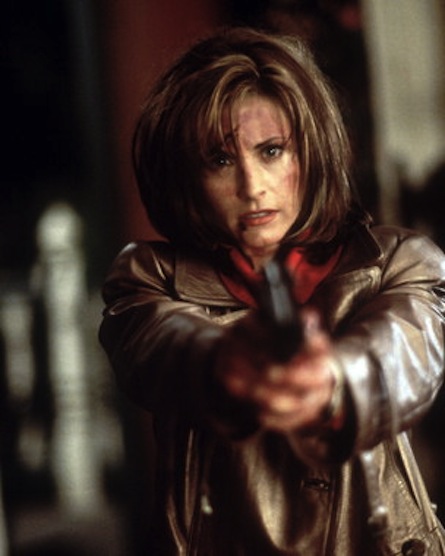
But the exemplar of a strong female character in Scream is Gale. She’s not only a ball-busting, high-powered tabloid journalist who fights to see an innocent man go free but, as I mentioned above, she’s always the last one standing, alongside reluctant partner-in-crime Sidney.

In Scream 4, she’s a struggling stay-at-home novelist with writer’s block, so when Sidney—and the subsequent murders—return to Woodsboro, she jumps at the chance to help with the investigations. Dewey, and his lovesick underling Deputy Judy, don’t want her interfering with the case, so Gale goes rogue.

It is Gale who uncovers most of the developments in the case, including who the killer is. And, according to Melissa Lafsky at The Awl, she’s breaking a lot of other ground, too :

“She [Courteney Cox] slashes her way out of the 40-something female stereotype, and takes over this movie with a flick of her scorn-ready… brow. Let’s face it: Few film archetypes are more brutal than the ‘older woman in a horror movie’—either you’re the psycho nutcase… or you’re the pathetic victim… And no matter what, you’re ALWAYS an obsessive mother.

“Cox pulls off a pretty impressive coup, upstaging not only the cute flouncing teens, but also her 15-years-younger self. Her character—now successful, childless(!), and utterly bored with the ‘middle-aged wife’ role—shrugs off all orders to ‘stay out of it’ and leaps back into the murderous fray, husbands, younger blondes and kitchen knives be damned. She takes nothing for granted, and thinks not a second about sneaking into dark corners to catch homicidal fruitcakes (and bitch is 47!!!). While Arquette and Campbell slide into their ’90s cliché groove, Cox reinvents and one-ups, kicking this meta-fest to life and providing the only sexy thing onscreen, gelatinous lips and all. Gale Weathers is shrewd, aggressive, cunning, but never heartless; despite it all, she still loves that stupefied ass clown Dewey. And she does it all while sporting a better ass than the 20-somethings. And… she doesn’t even have to die for it!”

You go, Gale!

Related: Scream 4 Review.

Elsewhere: [Girl Power: Feminism, Girlculture & The Popular Media] Final Girl(s) Power: Scream.

[Wikipedia] Scream Queen.

[Wikipedia] Final Girl.

[The Awl] Scream 4: The First Mainstream Feminist Horror Film.

Images via The Mary Sue, Dinoray, IMDb.