TV: The Underlying Message in Glee’s “Duets” Episode.


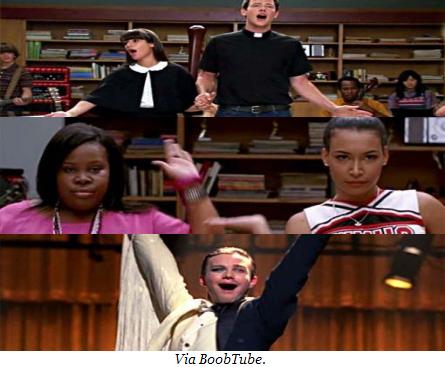
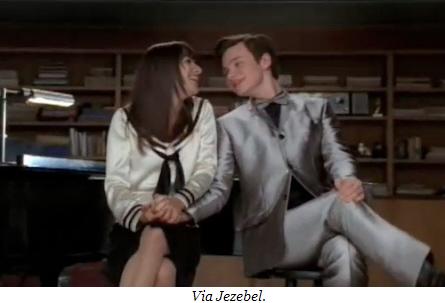
Following on from last week’s controversial episode, this week’s Glee deals with the students pairing off into couples for “Duets”. All except Kurt, of course, who is unable to find a partner, not only to sing with, but also to be with in the romantic sense.

This theme is timely after the suicide of gay teen Tyler Clementi, who was filmed having sex with another man by his roommate, who was then going to broadcast the footage online, and the subsequent campaigning by Ellen DeGeneres and her fellow celebrities to stop gay bullying, and that life does get better.

Kurt expresses interest in duetting with the new kid, Sam, but Finn warns him against it, as the “ensuing beatings” will force Sam out of glee. Of course, Kurt thinks Finn still has issues with his homosexuality, but Finn retorts that they live in a (homophobic) man’s, man’s, man’s world, and breaks out the “no means no” shtick.

Later on, Burt Hummel, who is out of the hospital after last week’s stint in ICU, reiterates Finn’s sentiments, and Kurt asks, “So a gay guy can’t be friendly to a straight guy without it being predatory… You’re saying I shouldn’t sing with this Sam guy because it might upset a couple [of] homophobes?”

The episode also deals with the other kinds of pairings the glee club members engage in. There’s Brittany and Santana, whose lesbian relationship is taken to new levels this week when they’re shown kissing on screen; the proverbial straights, Rachel and Finn and Sam and Quinn; the (perhaps stereotypical) strong black women, Mercedes and Santana, singing “River Deep, Mountain High”; the “Asians”, Tina and Mike, who are having relationship issues and will attend “Asian couples therapy”; and the sensitive issue of Artie’s disability, how it relates to his sex life, and his deflowering by Brittany in this episode.

Thus, this leaves us with loner Kurt, who has more than enough personality and pizzazz to pull off “‘Le Jazz Hot!’ from Victor/Victoria” and steals the show.

Kurt is a strong enough character that he doesn’t let his peers’ (albeit not is glee club peers) discrimination get to him, and thus he comes across as a teenager who has the courage of his convictions to stay true to himself, a stance which can only serve to encourage and enable other young people struggling with their sexuality to stand up and own it.

Oh, and in a rare show of compassion, Rachel offers to do a duet with Kurt in the final scene, asserting that they’re more alike than they think. Perhaps a straight wife-gay husband relationship to rival Carrie Bradshaw and Stanford Blatch is blooming?

Related: The Underlying Message in Glee’s “Grilled Cheesus” Episode.

Elsewhere: [Jezebel] Everyone’s Duetting It (Except Kurt).

[Jezebel] Why Glee’s Brittany & Santana Are My Queer Icons.

Chase You Down Until You Love Me, Paparazzi…

The following is based on a 2006 uni essay I wrote about the camera as an intruder, so sorry for any overly academic phrasing. I have attempted to bring it into the modern day with less formal language after reading an article on Jezebel, “The Day I Trailed a Paparazzi” in which—what else?—one of the blog’s writers trailed a paparazzo for a day.

Is the camera an intruder? Some would say that, in this day and age, with advanced photographic technology and increased access by photojournalists to worldwide events, it is. However, others assert that because of this advanced photographic technology and increased access, paired with the public’s growing need, and right, to know and see, that the camera it is not.

In terms of the cult of celebrity and the growing phenomenon of the paparazzi, privacy is a major issue. Peter Howe, in his book Paparazzi, provides this definition of the occupation:

“It refers to those photographers who seek out and follow celebrities… in order to photograph them in their most unguarded moments. In short, it’s taking photographs you shouldn’t take in places you shouldn’t be”.

However, some might argue that in becoming a movie star or rock star, and thereby a celebrity, you give up your right to privacy. Privacy laws in the US, specifically in Los Angeles where most paparazzi dwell, state that “if the subject of the photograph can reasonably expect privacy in a specific situation, such as inside his home, photographs of such situations cannot be published without permission”. And, as is evident in any glossy tabloid, most paparazzi shots are taken in public places, such as shopping strips and restaurants. “The consensus of opinion among the paparazzi is that the celebrities get the privacy they deserve, and that if you really don’t want to be photographed, then you don’t go to eat at Mr. Chows or the Ivy, where there are always photographers,” says Howe.

French theorist Roland Barthes states that “people change when they’re aware they’re being photographed.” So “when long lenses can ‘trespass’”, “the traditional definitions of privacy may not apply”.

The paparazzi are viewed as the most morally and ethically irresponsible photographer in the business but, “if everyone hates their work, why are they the best-paid and busiest photojournalists in the world?” asks Howe.

Our obsession with celebrity has only grown since I originally wrote this article back in 2006, a time which was already seeing the tabloid market explode, causing “the number of paparazzi to quadruple”, explains co-owner of L.A. paparazzi firm Bauer and Griffin, Randy Bauer, in an article from Cosmopolitan that same year.

Increasingly, blogs have become the stratosphere through which paparazzi pics circulate, however magazines still pay the big bucks. The first pictures of Brad Pitt, Angelina Jolie and their adopted son Maddox on a beach in Africa sold for $100,000; a far cry from the $6.68 million People magazine paid for the exclusive photographs of Pitt, Jolie and their first biological child, Shiloh.

In the five years since Pitt & Jolie got together and were hunted by the paparazzi (Wagner, a paparazzo who participated in a story on Jezebel, asserts that family pics of the couple are still the highest fetching shots), reality TV has reached its pinnacle, with celebs like Kim Kardashian milking their celebrity for all its worth; sad sacks like Lindsay Lohan and Heidi Montag tipping off the paparazzi in order to sell shots of themselves and keep their names in the media; and those in a league of their own, like Lady Gaga, whose song “Paparazzi” and albums “The Fame” and “The Fame Monster” take the piss out of the very machine that made them and creating a new definition of the über-celebrity/icon.

As above, though, the paparazzi are predominantly viewed in a negative light, not only by serious art photographers and the general public but, obviously, the stars they photograph. Kristen Stewart, for example, is one star who has been vocal in her dislike for the paparazzi; those in opposition to her stance might use the argument above, that to have success in the acting world is to accept the constant presence of photographers. Especially when you’re one half of the most talked about couple since the Jolie-Pitts. Elsewhere, the Jezebel article, written by Dodai Stewart, has a focus on Michael Douglas, who is receiving treatment for throat cancer, and the unremitting swarm of photographers outside his house every day. Is hounding a sick man taking our obsession with celebrity too far? American author and journalist Nathaniel Parker Willis says that, “the idea [is] that to really know someone, we must know their private life”.

From the Cosmo article: “[the paparazzi] can make celebrities feel anxious, depressed, and even mildly agoraphobic” That explains the notorious picture of Cameron Diaz, with then-boyfriend Justin Timberlake, attacking a paparazzo, then!
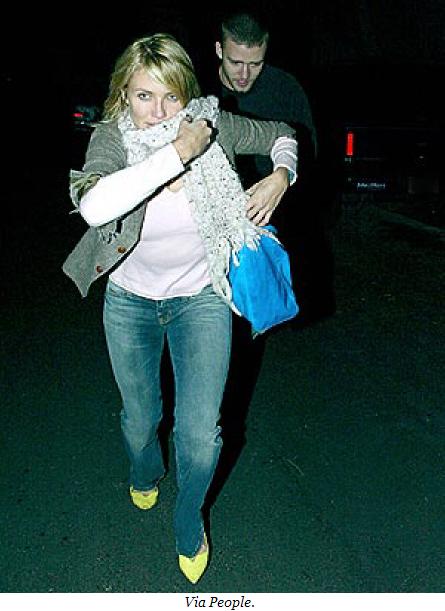
But, increasingly celebs are embracing the paparazzi, realising that if they work in cooperation with them, their public lives will be less tumultuous.

Stewart relays her story about Wagner trailing Liev Schreiber and his son with Naomi Watts, into the subway. After talking to the subject for several minutes, Wagner tells Schreiber that he’s “gotta get a picture of you”, and “Liev said sure, put the kid on his shoulders and let Wagner snap away… No other photographers were around, so it’s an exclusive shot.” Wagner gets paid, Schreiber comes across as a cool family man; it’s a win-win situation.

Celebs with kids can get a bit weird about them being photographed, understandably, and in the same article, when Wagner encounters Watts with the kids, she kindly asks him not to take pictures, and he obliged. See, Hollywood dwellers? There’s no need to get violent with the paps. (Granted, the pics of Schreiber and Watts were taken in New York City, where the paparazzi scene is less brutal than in Los Angeles, and there seems to be a certain air of respect between subject and object.)

Other NYC dwellers such the cunning Sarah Jessica Parker, have some up with ways of making themselves less desirable targets:

“‘[SJP] wears the same thing everyday,’” he [Wagner] says. ‘On purpose. Because you talk about this today, then she wears it tomorrow, then what do you have to say? Nothing.’”
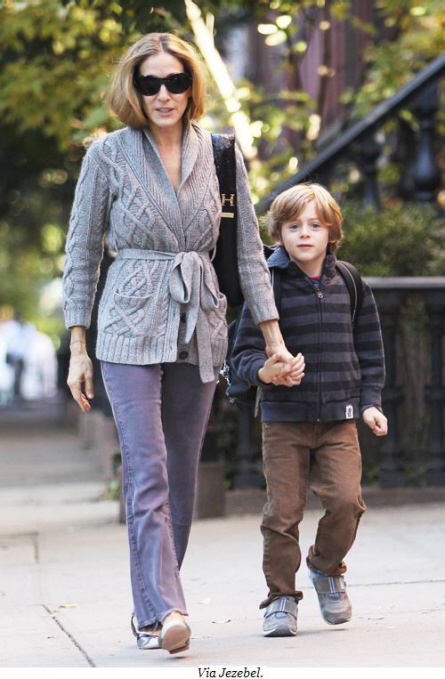
There is almost an element of protection there, too: provided both parties behave themselves and there exists a certain professional relationship, when your every move is recorded on camera, it’s got to be mighty hard to be mugged or attacked. Although, the victims of Alexis Neiers and her young-Hollywood burglary bling ring probably don’t subscribe to this school of thought.

Still, the opinion among the stars, the paps and the consumers who view their snaps on blogs and in magazines and newspapers, is that celebrities need the paparazzi to generate publicity around them, and the paps need to earn a buck. “An interdependency develops between them,” says Howe.

Stewart sums the cycle up nicely:

“We’re interested in celebrity minutiae. Despite ourselves. It is possible to be fascinated and repulsed at the same time. You can find celebrities appealing while finding the gossip culture appalling. We buy the magazines, hate them for lying to us, critique them, laugh at them, talk about them with our friends and buy the magazines again the next week. If you’ve ever read a gossip site or flipped through a celebrity weekly, you’re part of the system: the paparazzi take pictures for the mags and blogs, the mags and blogs exist because there is an audience.”

Related: Poor Little Rich Girl: Lindsay Lohan in Who.

Poor Little Rich Girl: Who Cover Girl Heidi Montag.

Elsewhere: [Jezebel] The Day I Trailed a Paparazzo.

[Vanity Fair]: The Suspects Wore Louboutins.

Drug of Choice: The Disney Heroine.

Last weekend’s The Age supplement, A2, was jammed packed full of goodness , including a feature on the recent spate of fairytale-inspired exhibitions.

One of the exhibitions talked about in the article is the Bendigo Art Gallery’s “Looking for Faeries: The Victorian Tradition”, which I saw yesterday, and ACMI’s “Dreams Come True: The Art of Disney’s Classic Fairy Tales”, about the fairytales adapted for the screen by Walt Disney, with the groundbreaking (for the time) Snow White & the Seven Dwarves being a key component.

As you know, I can’t get enough of my Disney princesses, especially the constant discourse surrounding their affect on young girls, so this passage from the article took my fancy:

“In the past, and particularly in the 1950s, Disney fairytale heroes and, above all, heroines, were insubstantial figures, despite their predicaments, and energy and comedy were provided by the sidekicksthe dwarves in Snow White, for example. You can see a change in 1991’s witty, thoroughly engaging Beauty & the Beast: Belle was a more dynamic heroine than Snow White, and there was a character in the film who thought he was a handsome prince, but definitely wasn’tthe vain and vicious Gaston.

“[Tangled producer Roy] Conli credits John Lasseter, producer, director and chief creative officer at Disney/Pixar, for an insistence that central characters have to be the emotional and the comic core of a film. So, Rapunzel, the girl with 20 metres of blonde hairwho has been shut up in a tower her whole life, or, “like, grounded, like, forever”isn’t simply set free, end of story. In Tangled, she has a male counterpart, a foil, he says, a worldly, dashing thief called Flynn Rider whose adventure of discovery takes place alongside hers.

“… Whatever we make of these new fairytale dynamics, whether we regard them as retrograde or progressive, misguided or inventive… fairytales are often more appealing to adults than children.”

Perhaps that’s why I still can’t get enough of Belle… and it’s nice to see a modern-day Rapunzel adopting, like, a modern-day vernacular.

Related: Women in Fiction: Are Our Favourite Fictional Females Actually Strong, or Stereotypes?

Elsewhere: [Bendigo Art Gallery] Looking for Faeries: The Victorian Tradition.

[Australian Centre for the Moving Image] Dreams Come True: The Art of Disney’s Classic Fairy Tales.

Magazines: Disturbing Behaviour—Terry Richardson Does Glee.


Über-inappropriate fashion photographer Terry Richardson has done it again, using his magic creepy touch on the cast of Gleeor rather, the most vanilla cast members from Glee, Cory Monteith (Finn Hudson), Dianna Agron (Quinn Fabray) and Lea Michele (Rachel Berry)to turn them into “porny” high schoolers to rival Britney Spears in “Baby, One More Time” (which Michele did a cover of, complete with schoolgirl tartan and feathers in her hair, on the “Britney/Brittany” episode) for the November cover of GQ.

Seriously, when will people stop employing him to work with subjects who, granted, aren’t underage but portray underage characters on a family show, when he is a known predator of underage and vulnerable women?

And does anyone else find Michele extremely offputting, in more ways than one? Or is it just me?

Related: The Underlying Messages of Glee’s “Britney/Brittany” Episode.

Food Fight.

Elsewhere: [GQ] Glee Gone Wild.

[Jezebel] Terry Richardson Makes Glee All Porny.

Women in Fiction: Are Our Favourite Fictional Females Actually Strong, or Stereotypes?

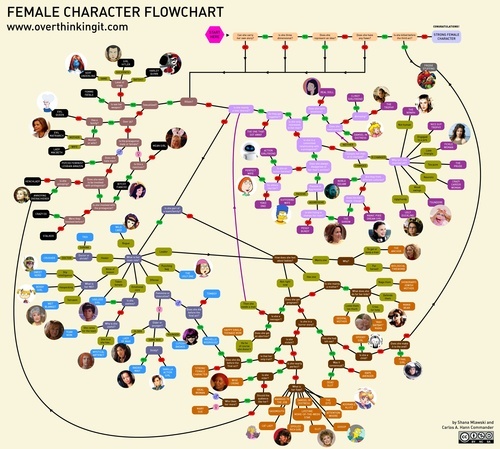
I’ve been wanting to write a post on Overthinking It’s “Female Character Flowchart” since I saw it on both Jezebel and Musings of an Inappropriate Woman about two weeks ago, and the time has finally come I’ve finally gotten around to compiling a list of my favourite fictional female characters and whether they qualify as “strong” ones.

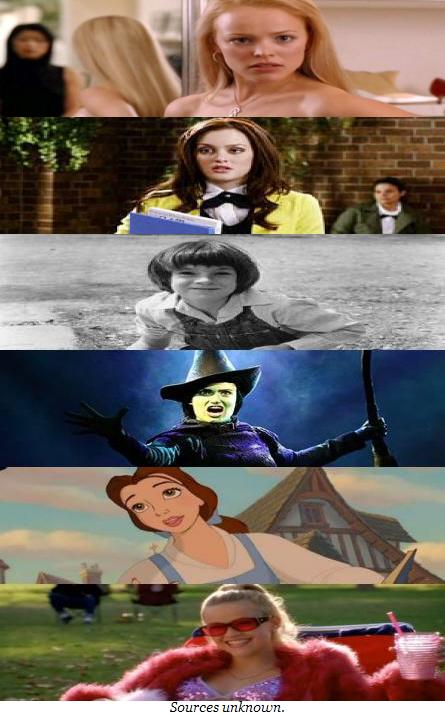
Without compromising the quality of the image, I wasn’t able to enlarge the chart, nor add my own annotations as per the below characters of my choosing. Instead, I’ve reproduced their equations below, as well as Mean Girls’ Regina George, who appears on the chart, and Blair Waldorf, whom Rachel Hills believes is a “girl Hitler”, but who I find to be much more of a genuine strong female character.

Regina George (Mean Girls): Can she carry her own story? YES. Is she three dimensional? NO. Villain? YES. Sexualised? NO. (I would argue yes. Hello? Have you seen her Halloween getup?) Over 35? NO. Is the protagonist male or female? FEMALE. Is this a rom/com? NO=Mean Girl.

Blair Waldorf (Gossip Girl): Can she carry her own story? YES. Is she three dimensional? YES. Does she represent an idea? NO. Does she have any flaws? YES. Is she killed before the third act? NO=Strong female character.

Belle (Beauty & the Beast): Can she carry her own story? YES. Is she three dimensional? NO. Villain? NO. Is she mainly a love interest? YES. Do they get together? YES. Is she only interested in her man? NO. Is she in a committed relationship with a protagonist? NO. Changes her man or is changed? CHANGES. Are they from different cultures? YES=Nobel Squan, whatever the hell that is! (Looks like something out of Avatar, though.)

Scout Finch (To Kill a Mockingbird): Can she carry her own story? YES. Is she three dimensional? YES. Does she represent an idea? YES. Villain? NO. Is she mainly a love interest? NO. Is she part of a team/family? YES. What is her main role? LEADER. How does she feel about babies? NOT RIGHT NOW. Does she get pregnant? NO. Is she in a horror story? NO. Is she violent? NO. Is she nearly perfect? NO. What is her flaw?=sassmouth, which I guess is true, but Scout is so much more.

Elphaba (Wicked): Can she carry her own story? YES. Is she three dimensional? YES. Does she represent an idea? YES, many. Villain? NO. Is she mainly a love interest? NO. Is she part of a team/family? YES. What is her main role? ROGUE=wildcard.

Elle Woods (Legally Blonde): Can she carry her own story? YES. Is she three dimensional? YES. Does she represent an idea? YES. Villain? NO. Is she mainly a love interest? NO. Is she part of a team/family? YES. What is her main role? LEADER. How does she feel about babies? NOT RIGHT NOW. Does she get pregnant? NO. Is she in a horror story? NO. Is she violent? NO. Is she nearly perfect? YES. Is she older? NO. Should the audience like her? YES. Who likes her more? WOMEN=Mary Sue.

Related:  Women in Fiction: My Favourite Fictional Females.

Elsewhere: [Overthinking It] The Female Character Flowchart.

[Overthinking It] Why Strong Female Characters Are Bad for Women.

[Jezebel] Flowchart: Know Your Female Character Stereotypes.

[Musings of an Inappropriate Woman] Flowchart: Know Your Female Character Stereotypes.

On the (Rest of the) Net.


After my Mick Foley rant last week, I’ve started reading his blog, Countdown to Lockdown, and I’m loving it. Here are some choice articles:

Remembering female pro-wrestling pioneer, Luna Vachon, who passed away on August 27 this year.

“That Time I Met… Tina Fey… and Alec Baldwin!”

“That Time I Met… President William Jefferson Clinton!” (I really love this one; some heart-warming stuff.)

“Mick’s Favourite Things: Top Ten Matches”, three of whichCactus Jack VS. Randy Orton at Backlash 2004 (above), Mankind VS. The Undertaker in Hell in a Cell in June, 1998, and Mick Foley VS. Edge in a Hardcore Match at WrestleMania XXII (that’s WrestleMania 22 in 2006 for you wrestling laymen)I 100% agree with.

In defence of Buffy’s whining.

“To the Teenage Boy in Your Life”:

“An important thing to remember is that girls are not from a different planet, nor are they even a different species. They’re just people, they’re just like boys, except with vulvas instead of penises.

“Mainly you need to remember this when you’re trying to figure out what a girl is thinking. See, if you didn’t know what a BOY was thinking, how would you go about finding out? You might ask him, right? The same goes for girls.”

I’m a bit behind the eight-ball on this one, as No Make-Up Week was a month ago, but Alle Malice’s guest post on Rabbit Write goes over the reasons “Why We Wear Make-Up”. I especially like this one:

“It makes me look good in photos. Almost everything we do now is documented by someone and posted in Facebook albums for the world to see, because if you aren’t having fun on Facebook, you aren’t really having fun. And if you aren’t pretty on the internet, you aren’t pretty in real life. Enter makeup.”

Nick Sylvester, on Riff City, discusses “How Kanye West’s Online Triumphs Have Eclipsed Kanye West”:

“Maybe there are people working with him… but I get the sense that Kanye is generating the [sic] lot of these ideas. I imagine he likes being in control of every aspect of the production, the medium being the message and so on. Online he is a wise fool, first playing into people’s perceptions of ‘Kanye West’, then off those very perceptions, sending himself up, pulling back his own veil… Despite many attempts, Kanye West is incapable of being parodied, largely because Kanye West has already figured out a way to be a parody of Kanye West.”

Much like Megan Fox in this New York Times Magazine article. Could I even go as far as to say that blonde bombshell Pamela Anderson has employed this strategy? I believe I could. And for that matter, Lindsay Lohan sending herself up on Funny or Die and promos for the MTV VMAs are along the same lines.

Sylvester goes on to say that “artists like Kanye West have to be ‘good at Twitter’ in order to put a dent in the zeitgeist.”

Furthermore,

“‘Nowadays rappers, they like bloggers,’ is what Swizz Beatz says… Slowly the work itself becomes secondary, less ambitious; slowly people becomes ‘really proud of their tweets’.”

Is it “The End of Men”?

Disney’s latest offering, Tangled, based on the story of Rapunzel, takes us back to a time when the Disney Princess reigned supreme, according to io9.

Feminist Themes examines Lady Gaga’s “Telephone” clip:

“… the objectification, glamorising of lesbian fetishism, and excessive girl-on-girl violence… [are aspects of the video that] feminist Gaga fans can try to justify… as another example of how she subversively turns what we usually find hot into something that leaves a nasty taste in our mouths and therefore makes a statement, but if any other artist (particularly any male artist) incorporated this much objectification and violence against women we would be outraged. Is it any different just because it’s a woman, or because it’s specifically Gaga?

“… What sets Gaga apart from other sexpot pop stars for me is that I just can’t imagine men being honestly turned on by hernot because she isn’t gorgeous (she is), but because she is so avant-garde, aggressive and self-driven which takes that arousal and turns it into something atypical, uncomfortable, and threatening.”

Also at Feminist Themes, the cause of the she-blogger in “Why I Blog”.

In other Gaga news, The Cavalier Daily reports that the University of Virginia is now running Lady Gaga classes! This sooo makes me want to re-enrol in university in a post-grad, transfer to UV, and take this kick-ass class!

The Daily Beast puts forth two differing opinions on Glee’s stereotypes: Andy Dehnart discusses the show’s “Harmful Simplicity”, while Thaddeus Russell applauds the walking stereotype that is Kurt Hummel, as “history tells us that those unafraid to be ‘too gay’ won far more freedomsfor all of usthan those who dressed the part of straights.”

Beautifully satiric The Frenemy reveals the recipe to “The Teen Romantic Comedy”, which “does not work for Mean Girls, 10 Things I Hate About You, or John Hughes films”, unfortunately. The truth about Disney Princes is also profiled, in which Eric from The Little Mermaid “wanted to kiss a girl who doesn’t speak words and doesn’t know how to use a fork. What the hell are you, caveman?”, while Mulan’s Captain Shang is in truth, a “gay liar” who made young, susceptible viewers the girls who have “crushes on a lot of her gay friends. [A] big Will & Grace fan.” Hey, that’s me!

Rachel Hills discusses intersectionality in feminism:

“For those of you who aren’t familiar with the term, ‘intersectionality’ is a way of talking about power and privilege that recognises that recognises that these things operate on multiple axes. People aren’t just female, or Black, or Asian, or straight, or working class, or trans, or a parent, or prone to depressioneveryone falls into a number of different categories that colours their experience of the world in specific ways. In the feminist context, it serves as a useful reminder that not all women have the same experiences, and calls into question the still dominant notion that the neutral ‘female’ experience is one that is white, heterosexual and middle-class.

“I’m also a fan because it just makes feminism a whole lot more interesting.”

Girl with a Satchel profiles Melissa Hoyer’s media career, which is a must-read for any budding wordsmith.

I am staunchly pro-choice when it comes to the abortion debate. In fact, I lean so far to the left that I’m borderline pro-abortion. (I’m sure that’ll ruffle some feathers!) But no matter what your feelings on the subject, MamaMia’s post, “The Couple Facing Jail Because They Tried To ‘Procure an Abortion’. Hello, Queensland? It’s 2010” is worth checking out.

Jezebel’s “5 Worst Mean (Little) Girls of All Time” includes Willy Wonka’s Veruca Salt and, from one of the most heart wrenching films of all time, A Little Princess, Lavinia, who looks a lot like modern-day mean girl, Angelina Pivarnick, from Jersey Shore.

“Why Strawberry Shortcake Was a Progressive Pioneer.”

TV: The Underlying Message in Glee’s “Grilled Cheesus” Episode.


I have been quite impressed with Glee’s second season thus far, as evidenced by my last review of the show.

Last night’s episode, which aired two weeks ago in the States, due to Ten’s commitment to the Commonwealth Games, dealt with Kurt’s dad Burt having a heart attack and lapsing into a coma, and how the members of the glee club felt about using religion to comfort Kurt and themselves.

Unlike many of last season’s episodes, “a nuanced discussion of religion prevent[ed] Glee from slipping into After School Special mode,” with creator Ryan Murphy explaining that “every time somebody said something anti-religion, we made sure somebody said something pro[-religion]”.

While I’m not so pro-religion myself, and definitely took Kurt’s side when he said “… the reason I don’t go to church is because most churches don’t think very much of gay people. Or women. Or science,” the show “accomplished a prime-time first: an episode that was… sympathetic to both believers and non-believers” and didn’t risk potentially alienating a subset of its audience.

Surprisingly, though, Sue Sylvester was in agreement with Kurt’s plight, “because she finds signing religious songs on school property inappropriate” and believes that “pushing religion on Kurt is amoral,” needless to say, because of her own experiences being angry with God for her sister’s disability.

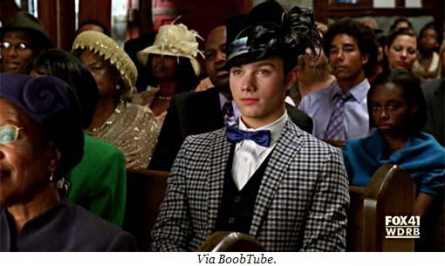
While I shared Kurt’s discomfort at having his friends pray for Burt in his hospital room without Kurt’s consent, and Mercedes luring him into God’s house with the promise of wearing a “fabulous hat”, the overall message was that even if you don’t believe in religion (can I get an amen?), you’ve got to believe in something.

And Kurt did realise that he believes in something: he believes in his father. Echoing his beautifuland dare I say, betterrendition of The Beatles’ “I Want To Hold Your Hand”, which harkened back to Burt holding Kurt’s hand at his mother’s funeral, Kurt takes his dad’s hand and, if by some sort of miracle, Burt’s hand twitches.

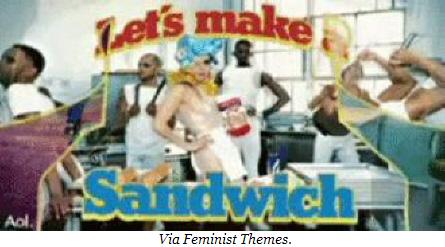
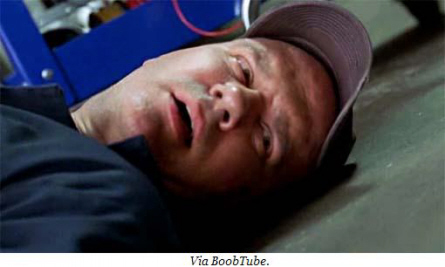
I suppose I should also mention that all this religion is brought about by Finn seeing Jesus’ likeness in his burnt grilled cheese sandwich, which he believes has magical powers because everything he wishes for comes true. But at this point, I’m so over Rachel and Finn; it’s all about Brittany, bitch!

Related: The Underlying Messages of Glee’s “Britney/Brittany” Episode.

Elsewhere: [Jezebel] Glee: You’ve Got to Have Faith… In Grilled Cheese.

[Jezebel] How Glee Can Save Itself Next Season.

[BoobTube] Glee in Pictures: Grilled Cheesus.

Event: This is a Story About a Girl Named Britney… I Mean Lucky! Britney Spears Cabaret Review.

I’ve been busting to see Britney Spears: The Cabaret (formerly known as Britney Spears: ’Tegrity ) since I first read about it God knows where about a year ago, and last Wednesday, I finally saw it.

I was expecting big things from Christie Whelan, whose one woman cabaret (albeit with piano player and somewhat of a therapist/shoulder to cry on for Britney, Mathew Frank) deals with the ups and downs of Britney’s career, with a whole lot of satire and tragicomedy thrown in there.

According to faux-Britney’s Facebook page, the Sydney Morning Herald called it “hilariously sad and sadly hilarious”, which I think sums it up nicely.

The show began with Whelan singing “Circus”, with wild psych-ward Britney eyes. She went over Britney’s early career, using props such as a hula hoop and twirling baton, “learning… that crossing your legs is pretty important during a ballad on a stool” and incorporating the signature Britney “-ayy” (as in, “Oh bab-ay, bab-ayy”).

Most of the show is actually hilariousmy favourite line from the night was from the aforementioned “Lucky”: “If there’s nothing missing in my life, then why do I attack the paparazzi with an umbrella… at night?”but towards the end, in signature cabaret style, Whelan discussed the trials and tribulations of Britney’s later life and it is genuinely saddening. The show ends on this note, which at first left an undesirable taste in my mouth, but I think that was Whelan’s goalwhile Britney Spears is über-spoofable in all her white trash glory, what with dropping her kids while accessorising with Ed Hardy and Daisy Dukes, but underneath it all, she’s a deeply sad and scared girl who’s not yet a woman. And whose Dad controls her money… at night.

[Facebook] Britney Spears: The Cabaret.

TV: Surfing the Third Wave—Second Wave VS. Third Wave Feminism on Gossip Girl.


Not only was last week’s Gossip Girl one of the best episodes I’ve ever seen, with one of the most gorgeous dresses I’ve ever seen (see above), but it also addressed some feminist issues that have been rotating around the blogosphere of late: second wave versus third wave feminism and slut-shaming.

*Spoiler alert* The episode dealt with a Gossip Girl blast suggesting that Serena might have an STI, and the turmoil the rumour created amongst the group. Of course, Little Miss Juliet was the one who tipped Gossip Girl off, in the hopes of taking Serena down and getting her kicked out of Columbia. After all, the episode is titled “Goodbye, Columbia”…

Without giving too much away (What’s that you say? I already have? Whoops!), Serena comes face to face with the dean, who says of Serena’s (alleged) wayward behaviour:

“Women of my generation had to fight for every opportunity. And to be taken seriously, and your attitude, Miss van der Woodsen, makes a mockery of that.”

Now if that isn’t the second wave looking down upon the third wave for our apparent flippancy about “activism”, our “obsession with technology” (Gossip Girl’s blasts are a prime example of this), our “unwilling[ness] to challenge sexual exploitation for fear of pissing off men” (hello, Serena), and our infatuation with Lady Gaga (well, Gossip Girl did feature the Lady herself in an episode…), I don’t know what is.

Susan Faludi recently wrote about this phenomenon in “American Electra: Feminism’s Ritual Matricide”, Amanda Marcotte responded to the article on Pandagon (from which the above quotes were taken), and I featured a link to the latter in last week’s “On the (Rest of the) Net”.

In the article, Faludi asserts that

“despite its [feminism’s] many victories, it seems to falter along a ‘motherdaughter’ divide. A generational breakdown underlies so many of the pathologies that have long disturbed American [or, rather, Western] feminism… its bitter divisions over sex… [and] alongside the battle of the sexes rages the battle of the ages.”

Faludi feels that second wavers ask questions and make comments such as “Why does it feel like we’re sliding backwards?”, “Young women are narcissists who don’t care about politics”, and “We’re really furious with these young women, aren’t we?”

Indeed, this seems to be the attitude of Dean Reuther towards Serena who, granted, isn’t the best feminist role model, but perhaps doesn’t deserve to have such comments hurled at her. Vanessa Abrams is probably the most feminist-y of all the characters on Gossip Girl, and I could almost take her seriously, if she wasn’t so damn annoying. Even Blair could be seen as a third-waver; she refuses to be held down by Chuck, rolls with the boys, strives for academic excellence by conniving her way into becoming Miss Chamberlain’s student assistant, and dumped Chuck for using her sexuality as a bargaining chip. Plus, she’s feisty and rocks a headband.

Of course, I’m not sure Gossip Girl consciously chose to comment on the debate, and no doubt this will be the last we hear of it, but it would be interesting to see Serena fight back and declare herself “sick to death of hearing about the glory days of Seventies feminism”, whilst older women, like Dean Reuther, “decalring themselves sick to death of being swept into the dustbin of history.” However, being the dean at an Ivy League university is hardly being “swept into the dustbin”.

On a final note, Faludi spends a lot of time criticising (via her second wave subjects) the technology third wavers use, specifically blogging: “All they want to do is sit at their computers and blog.” Ouch.

I’m sure Gossip Girl would have something to say about that.

Elsewhere: [Harpers] American Electra: Feminism’s Ritual Matricide.

On the (Rest of the) Net.


“A Guide to Eating Food Off the Floor.”

Feminist Themes’ regular “Wait… What?” column features The View co-host, Elisabeth Hasselbeck, and her take on the pro-choice versus pro-life debate.

In The Atlantic’s thought provoking piece on “The End of White America?”, Hua Hsu “discuss[es] Obama, football, hip-hop, and the elusive notion of a ‘post-racial’ society.”

Pandagon responds to Susan Faludi’s piece on third-wave feminism (which I haven’t read yet, but expect it to be included in an upcoming On the [Rest of the] Net), in which “she puts out evidence that younger feminists are sometimes unfair and ungrateful to older feminists, and that older feminists are sometimes so afraid of younger women that they go out of their way to exclude them… complaining that younger women don’t care.” Furthermore:

“… she reinforces a jumble of often conflicting stereotypes on younger feminists to discredit us: that we’re obsessed with navel-gazing over activism, that our obsession with technology comes at the expense of actual work, that we don’t know our history and don’t care about systemic issues, that we’re materialist[ic] and unwilling to challenge sexual exploitation for fear of pissing off men, that we’re so busy cultivating our graduate degrees writing about Lady Gaga… that we can’t be bothered to worry about real world issues.”

I do agree with some of this summary of Faludi’s piece, but Lady Gaga’s meat dress drew attention to vegetarianism, animal welfare and gay rights. They’re, like, real world issues, aren’t they?

Liz Greene delivers some particularly poignant points on parental relationships and “the family triangle” in “The Eternal Triangle”.

Buffy is “The Third Wave’s Final Girl”.

Jezebel reasons “Why Glee Still Needs to Work on Diversity”, while Brittany and Santana are “Queer Idols”:

“It wasn’t even until halfway through Glee’s first season that the first hint of queerness was even mentioned… Maybe you’d call it bisexual, maybe you’d call it heteroflexible, maybe you’d call it bicurious: whatever they are, it’s definitely a bit queer… Brittany is, if you will, an equal opportunity slut: one who’s willing to make out with whatever hotness crosses her path, regardless of gender… And among fellow fans of the show, my designation of Brittany and Santana as queer icons has met with some derision: their relationship is played for laughs, I’ve been told. They’re just straight girls making out for male attention… [But]… with the exception of their joint date with Finn, Brittany and Santana have hardly been shown using their relationship to win over boys… For me, Brittany and Santana represent a new mode of queer figure… : fluidly sexual, comfortable with same sex contacts, and more interested in finding happiness than finding the right label. They may not fit into the rigid structures of traditional sexual identities, but they’re comfortable enough with themselves not to care.”

More Jezebel: They’ve really been getting on the “slut-shaming bandwagon”, especially with their endorsement of Easy A. Now, they give their take on the “Ancient Slut-Shaming” of Cleopatra, as well as the “sexual double standards” on Jersey Shore. About the latter, they say:

“… The slut-shaming of Angelina… revealed their thoughts on sexual double standards. (The ‘thoughts’ being that sexual double standards exist, and that’s just the way it is.)… Pauly said about Angelina: ‘She brought all these random people home. She’s a girl. You don’t do that. That’s a guy thing. Guy’s do that, no girls.’… Shouldn’t Pauly and The Situation be grateful for sluts? If there were no sluts then they would never be able to have sex. Do they think for one minute that they would even want to live in a world in which all girls acted the way they’re ‘supposed’ to?”

“Who Stole Feminism?”, asks The Nation. Sarah Palin, Christine O’Donnell and all those right-wing extremists, that’s who!

“Sarah Palin opposes abortion and comprehensive sex education. While mayor of Wasilla she made sexual assault victims pay for their own rape kits. She also calls herself a feminist. Delaware GOP Senate nominee Christine O’Donnell has said that allowing women to attend military academies ‘cripples the readiness of our defence’ and that wives should ‘graciously submit’ to their husbandsbut her website touts her ‘commitment to the women’s movement. Pundits who once mocked women’s rights activists as ugly bra burners are abuzz over the ‘new conservative feminism’, and the Tea Party is lauding itself as a women’s movement.

The right once disparaged feminism as man-hating and baby-killing, but now ‘feminist’ is the must-have label for women on the right.”

“Geeks Versus Hipsters” is the equivalent of the passionate versus the apathetic, respectively, according to Gizmodo. And from the hipsters I’ve come into contact with, I’m inclined to agree.

Can Newsanchor Barbie be both hot and a feminist?

Jessica Rudd (yes, Kevin’s daughter) discusses the differences between chick-lit and (the nonexistent) dick-lit in a guest post on MamaMia.

Beneath the “campy sensationalism” of True Blood lies “the weird, seemingly reactionary politics” of “the right’s worst nightmare about post-gay-liberation America come to life.”