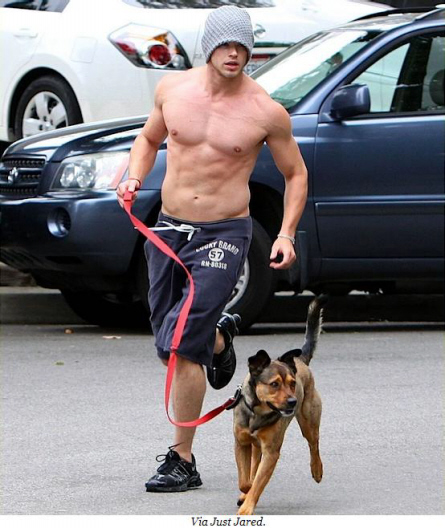
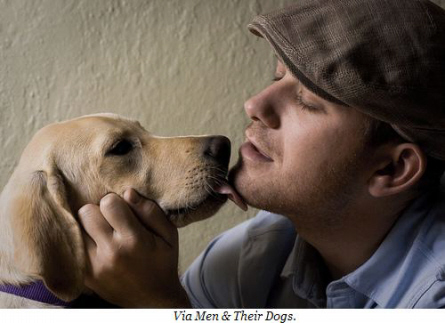
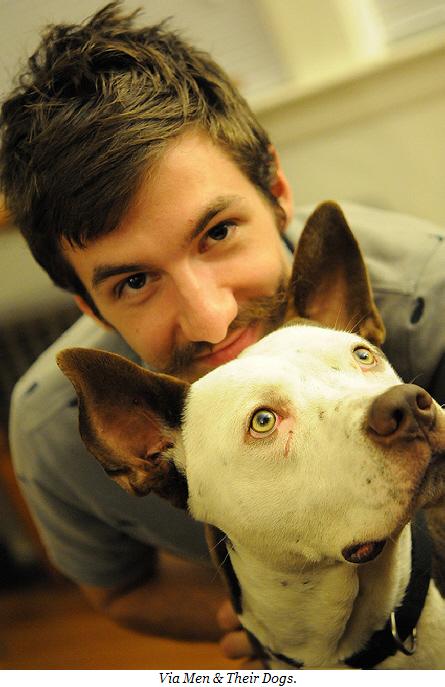
Men Who Actually Love Their Dogs.

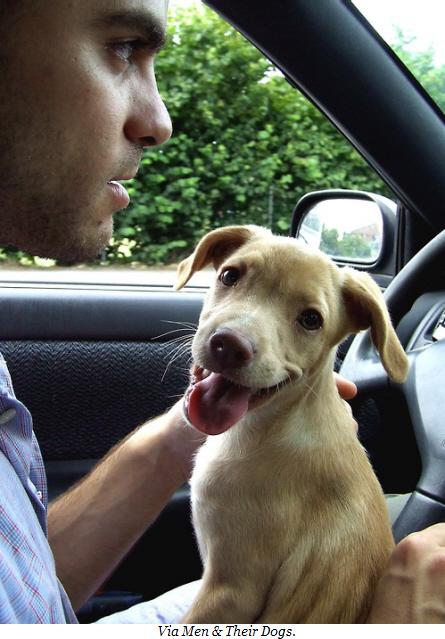
Following on from today’s earlier post, the only thing hotter than men with books is men with dogs. Just as long as they demonstrate their love appropriately. Joel Monaghan, take note.

Related: Beauty & the Bestiality.

Beauty & the Book.

Elsewhere: [Men & Their Dogs] Homepage.

Women in Fiction: Are Our Favourite Fictional Females Actually Strong, or Stereotypes?

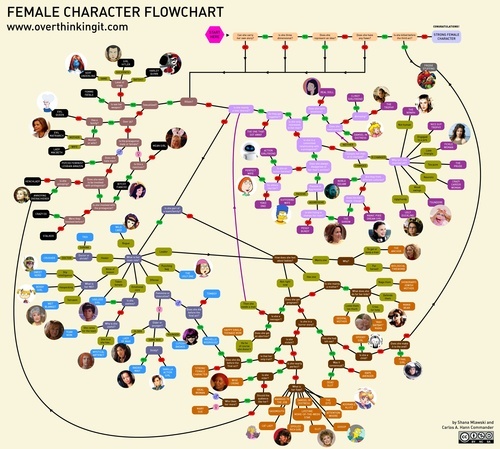
I’ve been wanting to write a post on Overthinking It’s “Female Character Flowchart” since I saw it on both Jezebel and Musings of an Inappropriate Woman about two weeks ago, and the time has finally come I’ve finally gotten around to compiling a list of my favourite fictional female characters and whether they qualify as “strong” ones.

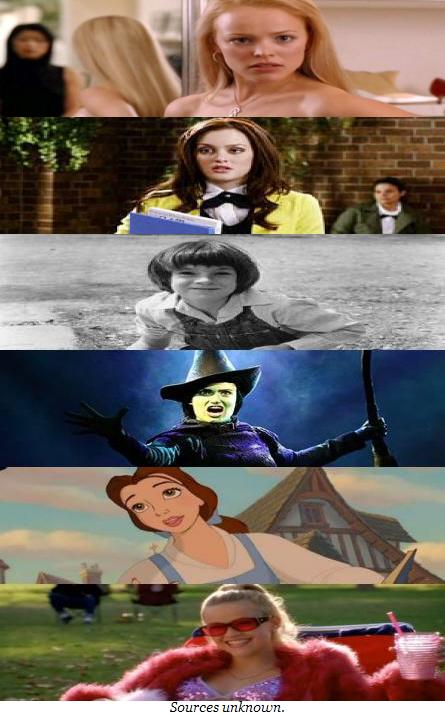
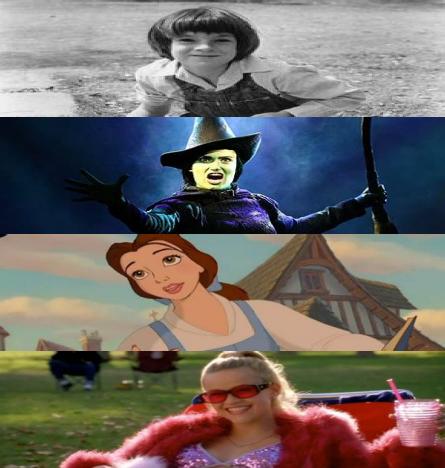
Without compromising the quality of the image, I wasn’t able to enlarge the chart, nor add my own annotations as per the below characters of my choosing. Instead, I’ve reproduced their equations below, as well as Mean Girls’ Regina George, who appears on the chart, and Blair Waldorf, whom Rachel Hills believes is a “girl Hitler”, but who I find to be much more of a genuine strong female character.

Regina George (Mean Girls): Can she carry her own story? YES. Is she three dimensional? NO. Villain? YES. Sexualised? NO. (I would argue yes. Hello? Have you seen her Halloween getup?) Over 35? NO. Is the protagonist male or female? FEMALE. Is this a rom/com? NO=Mean Girl.

Blair Waldorf (Gossip Girl): Can she carry her own story? YES. Is she three dimensional? YES. Does she represent an idea? NO. Does she have any flaws? YES. Is she killed before the third act? NO=Strong female character.

Belle (Beauty & the Beast): Can she carry her own story? YES. Is she three dimensional? NO. Villain? NO. Is she mainly a love interest? YES. Do they get together? YES. Is she only interested in her man? NO. Is she in a committed relationship with a protagonist? NO. Changes her man or is changed? CHANGES. Are they from different cultures? YES=Nobel Squan, whatever the hell that is! (Looks like something out of Avatar, though.)

Scout Finch (To Kill a Mockingbird): Can she carry her own story? YES. Is she three dimensional? YES. Does she represent an idea? YES. Villain? NO. Is she mainly a love interest? NO. Is she part of a team/family? YES. What is her main role? LEADER. How does she feel about babies? NOT RIGHT NOW. Does she get pregnant? NO. Is she in a horror story? NO. Is she violent? NO. Is she nearly perfect? NO. What is her flaw?=sassmouth, which I guess is true, but Scout is so much more.

Elphaba (Wicked): Can she carry her own story? YES. Is she three dimensional? YES. Does she represent an idea? YES, many. Villain? NO. Is she mainly a love interest? NO. Is she part of a team/family? YES. What is her main role? ROGUE=wildcard.

Elle Woods (Legally Blonde): Can she carry her own story? YES. Is she three dimensional? YES. Does she represent an idea? YES. Villain? NO. Is she mainly a love interest? NO. Is she part of a team/family? YES. What is her main role? LEADER. How does she feel about babies? NOT RIGHT NOW. Does she get pregnant? NO. Is she in a horror story? NO. Is she violent? NO. Is she nearly perfect? YES. Is she older? NO. Should the audience like her? YES. Who likes her more? WOMEN=Mary Sue.

Related:  Women in Fiction: My Favourite Fictional Females.

Elsewhere: [Overthinking It] The Female Character Flowchart.

[Overthinking It] Why Strong Female Characters Are Bad for Women.

[Jezebel] Flowchart: Know Your Female Character Stereotypes.

[Musings of an Inappropriate Woman] Flowchart: Know Your Female Character Stereotypes.

Movie/Book Review: Tomorrow, When the War Began by John Marsden.


At the risk of sounding bogan-esque, I recently read the first book in John Marsden’s Tomorrow series, Tomorrow, When the War Began, in anticipation of the movie version.

While a lot of my peers read the books as part of their school curriculum, I never did, but after seeing the trailer during New Moon, I was intrigued to say the least.

For a young adult book, it was really good. I loved the suspense Marsden created, and I felt it was very true to the way Australian teenagers talk and act.

For those of you who haven’t read the book or seen the film, I won’t spoil the ending, but I raced to finish the last couple of chapters last Wednesday before I went to see it that night. I wasn’t planning on reading the whole series because I just don’t have time, but once you get to the end of book one, it’s impossible not continue on to book two.

Reading the book and seeing the movie within hours of each other, it’s hard to reconcile what happened in each, respectively. But I loved that the film stayed almost completely true to the book, with the exception of Flip, Kevin’s dog, staying with the gang as they attempted to take back their country, the exclusion of the Hermit in Hell and, *spoiler alert*, a certain religious member of the team who refused to kill anyone shooting up the soldiers at the very end.

I was pleasantly surprised by the book, and if I can say just one thing about the movie, it’s this cliché little ditty: if you see only one movie this year, make it Tomorrow, When the War Began.

Bragging right: My cousin and housemate went to acting school with Deniz Akdeniz, who plays Homer.

Book Review: One Flew Over the Cuckoo’s Nest By Ken Kesey.


As previously mentioned, I struggled through this book.

Not because it wasn’t well writtenin fact, I loved the narration of protagonist Chief Bromden and the way author Ken Kesey continually used misspelling to take the reader into Bromden’s mindbut because I was so preoccupied with other things, that I didn’t really take notice of what was occurring.

But in a nutshell, the novel deals with patients in a mental hospital, and centres around Bromden, a half-Native American who has been pretending to be deaf and dumb, and fellow resident of the ward Randle McMurphy, the fiery redhead who shakes things up when he is transferred from a prison work farm. Questions arise, specifically from antagonist Nurse Ratched and the doctors, as to whether McMurphy is actually mentally ill, or just uses his pasts crimes to live out the rest of his life in, what he believes is, the cushy Pendleton asylum.

The hospital is anything but, and the antics of its patients conjure up memories of Shawshank Redemption, Prison Break, The Longest Yard and even Toy Story 3! And while none of these films are set in a mental institution per se, they just might have borrowed some inspiration from Cuckoo’s Nest.

McMurphy acts as a sort of vicarious thrill-seeker, and the other patients live their lives through his rebellion. He is also the catalyst for Bromden to reveal he can actually speak and hear, and his fellow patients to stand up for themselves and buck the system.

McMurphy and Nurse Ratched become involved in a power struggle, with McMurphy taking on the role of leader to the patients, and ultimately, he attacks Ratched, strangling her and taking away her most powerful toolher voiceand McMurphy is given a lobotomy.

During the absence of both the nurse and their leader, most of Pendleton’s residents check out, and those who do stay to witness their returnthe nurse unable to speak, and thus control her patients, and McMurphy in a “chronic” vegetative statesoon leave. But not before Bromden suffocates McMurphy in his sleep, so that he can die with some dignity. Bromden then leaves to rejoin his tribe.

Kesey uses the residents to illustrate the injustices of mental patients, having spent time working as an orderly in one, where he took LSD and Peyote as part of Project MKUltra, an illegal CIA human research program to “manipulate individual mental states”.

Nurse Ratched, in particular, is so craftily subtle in how she goes about controlling the men, that most of them aren’t even aware she is doing so. In Foucaultian terms, this type of manipulation can be damaging on a “broad social scale”, as it encourages censorship of one’s actions.

All in all, I quite liked (what bits I did pick up through a distracted reading of) the book, and I’m a bit of a sucker for a story with a message. Unlike A Clockwork Orange or something along those obscure lines, the story was written in a straightforward manner and was (mostly) a pleasure to read.

Related: Newspaper Clipping of LAST Week.

One Flew Over the Cuckoo’s Nest by Anthony Burgess Review.

Elsewhere: [Wikipedia] Project MKUltra.

[Wikipedia] One Flew Over the Cuckoo’s Nest (novel).

Men in Fiction: My Most Loved Made-Up Males.

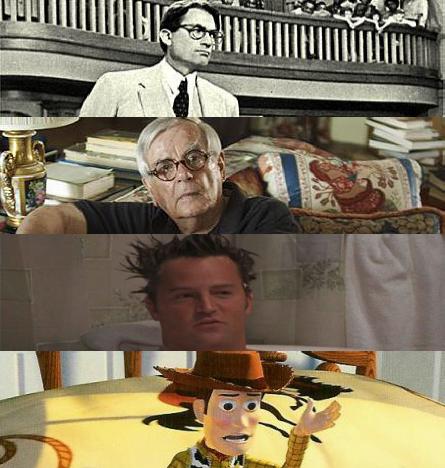
Last week I featured my favourite fictional females, and this week I thought I’d give the guys a go.

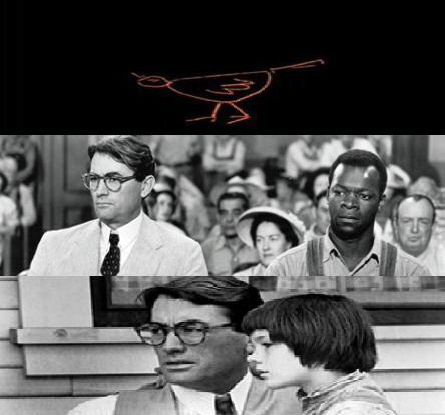
In the vein of Scout Finch from To Kill a Mockingbird, her father Atticus is way up there. He represents “the father figure I never had”, guiding Scout, her brother Jem, and their friend Dil through the last summer of their naïve childhood and how judging a book by it’s cover (or skin colour) is not the way to go. Plus, he has a kick ass name!

Similar to my obsession with To Kill a Mockingbird is my love of Dominick Dunne and any of his books, specifically Another City, Not My Own, in which Dunne’s alter-ego Gus Bailey acts as the fictional narrator of Dunne’s real-life O.J. Simpson trial experiences. It is hard to separate the two men, which is what I love about Dunne’s stories; a reader familiar with Dunne’s experiences doesn’t know where real-life ends and fiction begins.

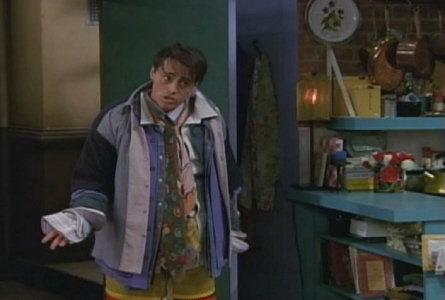
Every fan of Friends has a favourite character, and mine has always been Chandler Bing. He gets the funniest storylines, and Matthew Perry has great comedic timing. There are many episodes I could ramble on about, but my two favourite Chandler moments are when Phoebe attempts to seduce him into admitting his relationship with Monica, and when Chandler kicks up a stink about Joey stealing his chair before Ross’s benefit, and in a check-mate move, Joey puts on every item of clothing in Chandler’s possession, quipping in true Chandler fashion, “Could I be wearing any more clothes?”

It’s been a Disney-centric year, what with Beauty & the Beast about to be re-released in 3D, the Melbourne Symphony Orchestra performing Disney songs in December (which I’m so going to, FYI), the first African American Disney Princess in the lacklustre The Princess & the Frog, and the much anticipated release of Toy Story 3, with one of my all-time favourite characters, Woody. The pull-string sheriff is inspirational in that he’ll never “leave a man behind”, he exists primarily for the pleasure of his owner, Andy, but discovers that there’s more to life, like making friends and other people happy, than what he thought his true purpose was; to be with Andy. I loved the third instalment of the saga, but it can never top the first one. So quotable, so timeless, so child-at-heart. ♥

Other inspirational men of fiction include Dan Brown’s Robert Langdon; Shia LaBeouf’s character in Disturbia, and the character who inspired him, L.B. Jeffries from Alfred Hitchcock’s Rear Window; Fiver, Bigwig and Hazel from Watership Down; Woody’s space ranger counterpart, Buzz Lightyear; the Beast in Beauty & the Beast; and Holden Caulfield in A Catcher in the Rye.

Women in Fiction: My Favourite Fictional Females.

A recent post on Girl with a Satchel (which was reblogged here) inspired me to assess my favourite fictional female characters.

One of my favourite books is To Kill a Mockingbird, and protagonist Scout Finch is one of my favourite characters of the written word. Her innocence and naivety are super-endearing, and her past-tense narrating allows the reader to put themselves in her shoes easily.

Wicked is a niche book and musical that theatre buffs can’t get enough of, but the general public are a bit oblivious to because it hasn’t derived from/been made into a movie, like Melbourne’s current season of musicals, West Side Story, Mary Poppins and Hairspray, all of which are on my theatre-going agenda in the coming months.

I’ve seen the production three times in Melbourne, and many a friend has seen it in its various international incarnations on Broadway and the West End… oh, and Sydney! I was so touched by the story and its messages of friendship, good versus evil and judging a book by its cover, and even more so by Elphaba, better known as The Wicked Witch of the West from The Wizard of Oz. Unlike in the original story, Wicked’s Elphaba is fiercely loyal to her disabled sister Nessarose, and those who become close to her like Glinda, Doctor Dillamond and Fiyero, misunderstood because of the colour of her skin and the slander spread about her when she discovers the Wizard of Oz is a fraud and seeks revenge.

In the vein of fairytale musicals, Beauty & the Beast (which is being re-released in selected theatres in 3D from 2 September) is by far my favourite, and I love its heroine Belle so much, I have been known to fight with my friends and children alike over the fact that I AM BELLE! Hello, I have brown hair, like burly men, read a lot and have a penchant for yellow gowns! While there have been arguments circulating that the Disney princesses are beacons of anti-feminism, I maintain my stance that Belle doesn’t need a man to rescue her (in fact, she does the rescuing, helping the Beast when he is attacked by wolves, attempting to make the townspeople see the error of their ways in going after him, and ultimately, setting his heart free) and sees the Beast for who he truly is, not for what he looks like or what he can do for her. She’s a kick-ass beauty in the vein of Buffy, The Vampire Slayer and Angelina Jolie’s Lara Croft: Tomb Raider.

I’ve blogged (or reblogged) a little bit lately about Elle Woods. She’s an everywoman. Rachel Hills identifies with her, as does Satchel Girl Erica Bartle. A law-studying friend of mine recently compared herself to Miss Woods, also. And I won’t lie; I’ve fantasised about wearing a Playboy bunny suit whilst purchasing an Apple Mac! Elle Woods proves that you can take pride in your appearance and have fun whilst pursuing your dreams and making a name for yourself separate from the name of the man in your life.

There are plenty of other made-up women who I have an affinity for, including the aforementioned Buffy Summers, and Daria Morgendorffer for their kick-ass feminist mentalities; ditto for the Charmed sisters; Gossip Girl’s Blair Waldorf, who can be a psycho bitch at times, but she’s THE psycho bitch; for similar reasons as Elle Woods, Cher Horowitz; and Barbie.

Related: Guest Post—Pop Culture Power Women.

In Defence of To Kill a Mockingbird.

Event: The Way We Wear Vintage Market.

Elsewhere: [Girl with a Satchel] Women of Pop Culture & the Unashamed Use of Cutesy Clichés.

[Musings of an Inappropriate Woman] Have You Ever Seen Yourself Through Someone Else’s Eyes?

Book Review: American Psycho by Bret Easton Ellis.


When I heard Bret Easton Ellis was coming to Melbourne for the Writers Festival, I was intrigued to hear him speak in person, to say the least.

My first, and only, exposure to Easton Ellis prior to reading American Psycho was his 1998 release, Glamorama. I had high expectations for that book, and I was sorely disappointed. I found it too fast paced and celebrity-obsessed which, granted, was the point of the story. However, the graphic depictions of violence (a plane crash with flying pieces of sheet metal decapitating whole rows of passengers, anyone? Or how about a massive miscarriage followed by internal haemorrhaging and subsequent death of the main character’s, Victor Ward, girlfriend?) and sex were far too much.

So needless to say, I was very apprehensive about entering into a literary relationship with American Psycho, but I wanted to at least have read Easton Ellis’ most famous work before seeing him live. (Alas, this is not meant to be, as tickets to his talk sold out within minutes of going on sale! As he, and Buffy creator Joss Whedon, whose talk also sold out, are the only writers I’m interested in seeing at this years surprisingly uninspiring Melbourne Writers Festival, I guess I’ll be giving it a miss this year.)

This time around, however, I was pleasantly surprised.

Again, American Psycho is hard to get into initially, as it jumps straight into a boys night out with protagonist Patrick Bateman and his equally materialistic and über-boring posse of yuppie acquaintances (Bateman is too narcissistic to have actual “friends”). But after persevering up to the first kill, I liked what I read.

Even squirming along Struggle Street during the gory descriptions of the murderson public transport, no less!was still a fairly enjoyable literary journey. To give you a taste of just how well Easton Ellis does horrific homicide in print, here’s a description of Bateman’s first kill:

“… I reach out and touch his [the bum’s] face gently once more with compassion and whisper, “Do you know what a fucking loser you are?” He starts nodding helplessly and I pull out a long, thin knife with a serrated edge and , being very careful not to kill him, push maybe half an inch of the blade into his right eye, flicking the handle up, instantly popping the retina.

“The bum is too surprised to say anything. He only opens his mouth in shock and moves a grubby, mittened hand slowly up to his face. I yank his pants down and in the passing headlights of a taxi can make out his flabby black thighs, rashed because of his constantly urinating in the pantsuit. The stench of shit rises quickly into my face and breathing through my mouth, down on my haunches, I start stabbing him in the stomach, lightly, above the dense matted patch of pubic hair. This sobers him up somewhat and instinctively he tries to cover himself with his hands and the dog starts yipping, really furiously, but it doesn’t attack, and I keep stabbing at the bum now between his fingers, stabbing the backs of his hands. His eye, burst open, hangs out of its socket and runs down his face and he keeps blinking which causes what’s left of it inside the wound to pour out like red, veiny egg yolk. I grab his head with one hand and push it back and then with my thumb and forefinger hold the other eye open and bring the knife up and push the tip of it into the socket, first breaking its protective film so the socket fills with blood, then slitting the eyeball open sideways, and he finally starts screaming once I slit his nose in two, lightly spraying me and the dog with blood, Gizmo blinking to get the blood out of his eyes. I quickly wipe the blade clean across the bum’s face, breaking open the muscle above his cheek. Still kneeling, I throw a quarter in his face, which is slick and shiny with blood, both sockets hollowed out and filled with gore, what’s left of his eye literally oozing over his screaming lips in thick, webby strands. Calmly, I whisper, “There’s a quarter. Go buy some gum, you crazy fucking nigger.” Then I turn to the barking dog and when I get up, stomp on its front legs while it’s crouched down ready to jump at me, its fangs bared, immediately shattering the bones in both its legs, and it falls on its side squealing in pain, front paws sticking up in the air at an obscene, satisfying angle. I can’t help but start laughing and I linger at the scene, amused by this tableau. When I spot an approaching taxi, I slowly walk away.”

Now if that didn’t make you wince and writhe vicariously, there’s also the attacks of several other dogs, the tortures of countless prostitutes, the dissolving of several friends’ bodies in lime, cannibalism, the murder of a child, the capture of a sewer rat to use in later tortures, and in a comical scene that illustrates just how sad and detached Bateman has become in his life of depravity, he feeds his girlfriend (just one of many he has on the go at any given time) a frozen urinal cake coated in chocolate and served in a decadent Godiva chocolate box.

If the reader needs more proof of Bateman’s derangement and obsessive compulsive consumerism, they need only to look at the chapters interspersed throughout the narrative on business cards, sound systems and musical artists of the time (1991), like Genesis, Whitney Houston and Huey Lewis & the News.

Here is another example:

“Another choir, on Lexington, sings ‘Hark the Herald Angels’ and I tap-dance, moaning, in front of them before I move like a zombie to Bloomingdale’s, where I rush over to the first tie rack I see and murmur to the young faggot working behind the counter, “Too, too fabulous,” while fondling a silk ascot. He flirts and asks if I’m a model. “I’ll see you in hell,” I tell him, and move on.

“… vases and felt fedoras with feather headbands and alligator toiletry cases with gilt-silver bottles and brushes and shoehorns that cost two hundred dollars and candlesticks and pillow covers and gloves and slippers and powder puffs and hand-knitted cotton snowflake sweaters and leather skates and Porsche-design ski goggles and antique apothecary bottles and diamond earrings and silk ties and boots and perfume bottles and diamond earrings and boots and vodka glasses and card cases and cameras and mahogany servers and scarves and aftershaves and photo albums and salt and pepper shakers and ceramic-toaster cookie jars and two-hundred-dollar shoehorns and backpacks and aluminium lunch pails and pillow covers…

“Some kind of existential chasm opens up before me while I’m browsing in Bloomingdale’s and causes me to first locate a phone and check my messages, then, near tears, after taking three Halcion (since my body has mutated and adapted to the drug it no longer causes sleepit just seems to ward off total madness), I head toward the Clinique counter where with my platinum American Express card I buy six tubes of shaving cream…”

This kind of stream-of-consciousness and disjointed conflict between the Patrick Bateman that is presented to the outside worldthe one that manages to convince a cop investigating the murder of one of Bateman’s lime victims that he has nothing to do with the disappearanceand the inner workings of his own mind, and even again with the superhuman he becomes when killing, continues and only becomes more frequent as the tale continues.

While there is no finite conclusion to the storyone might guess that Bateman was caught during the murder of a taxi driver, when the tone switches from first person to third person, however it is later revealed that he escaped, but is recognised by another cab driverthat only makes it all the more disturbing.

Easton Ellis is a very cleverthough slightly disturbed; you would have to be to write as graphically and as convincingly as he doesauthor, and I would have loved to hear him speak about his most prolific work.

However, while I rate this one highly, I probably won’t return to, nor enjoy, his other novels.

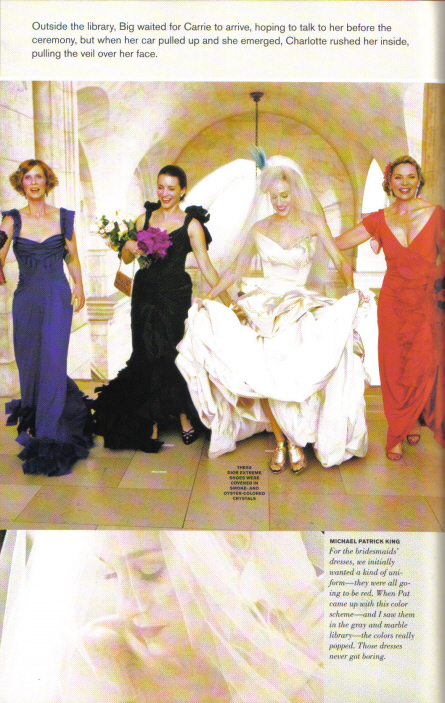
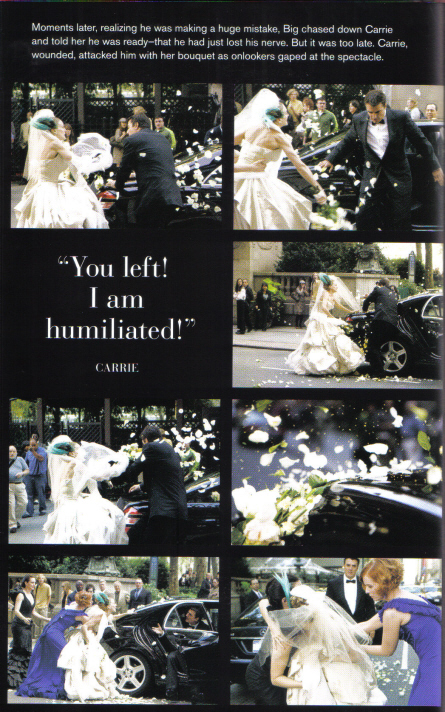
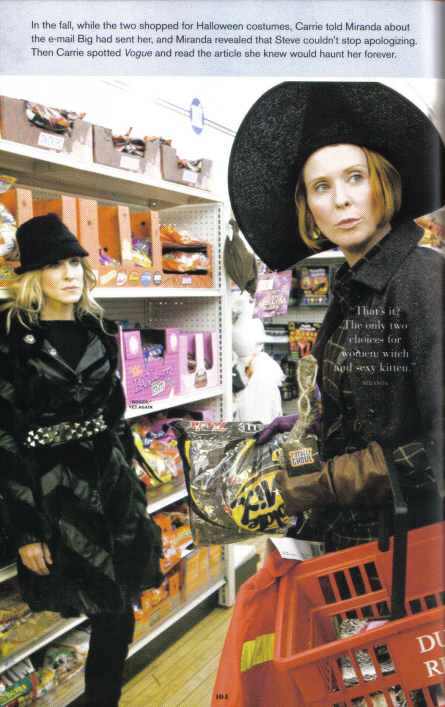
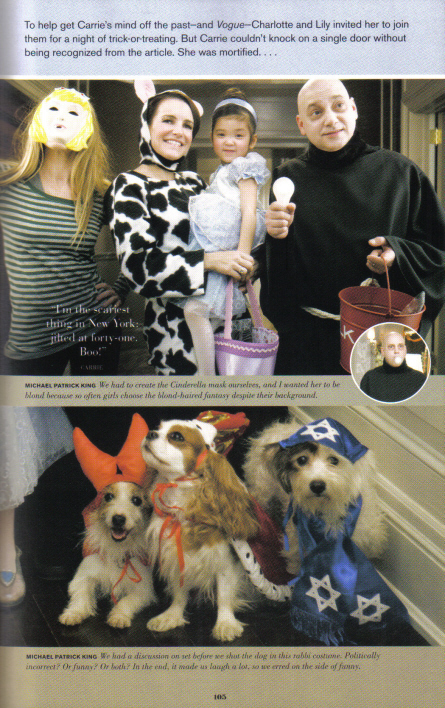
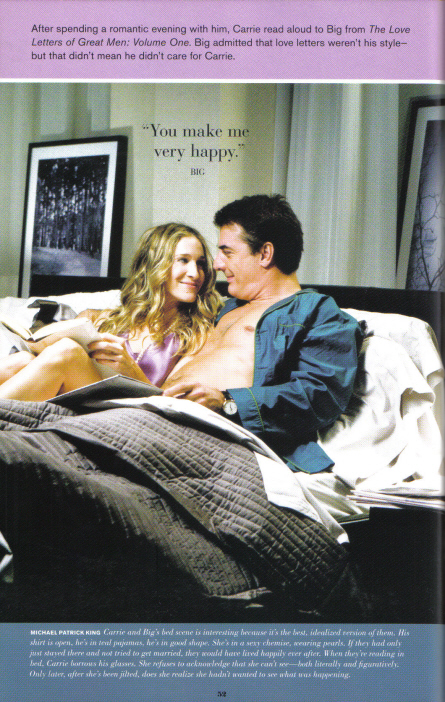
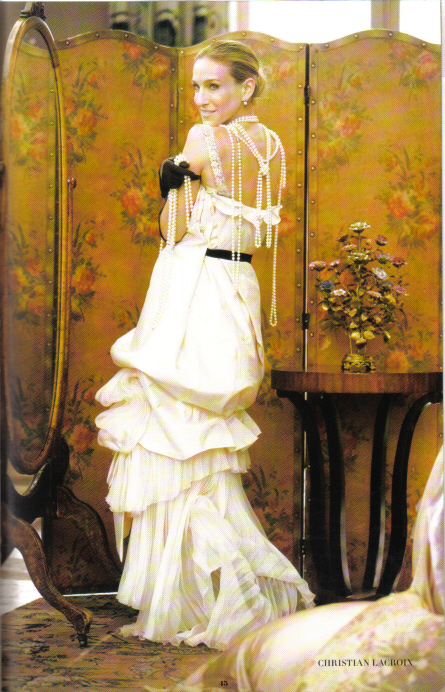
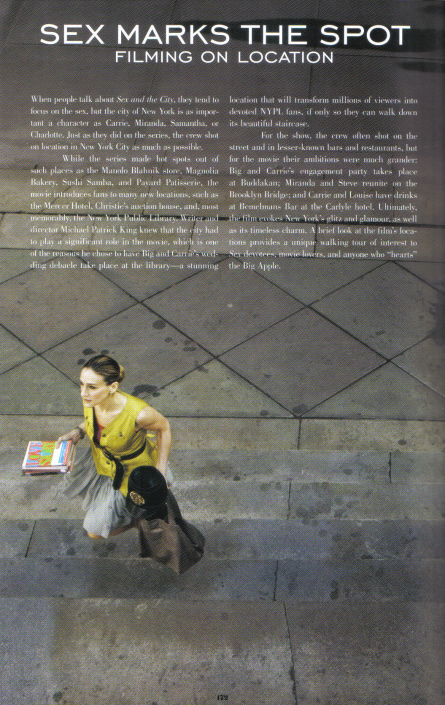
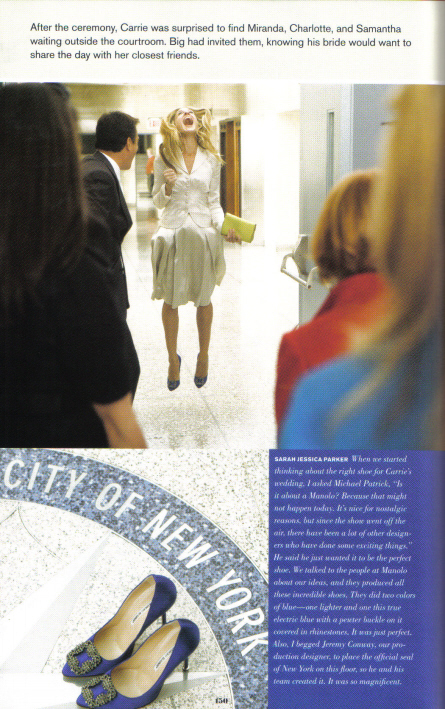
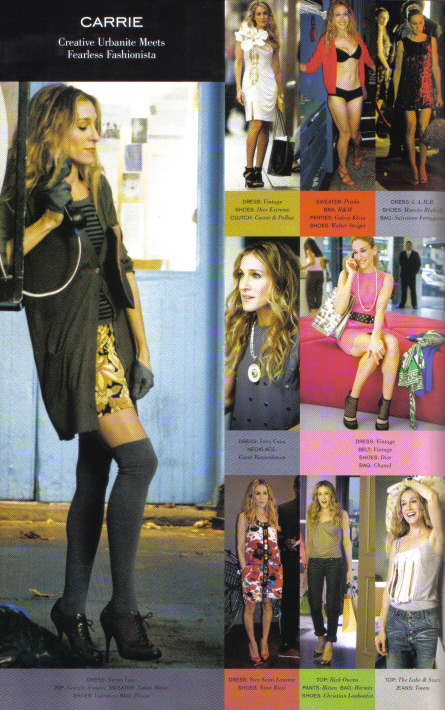
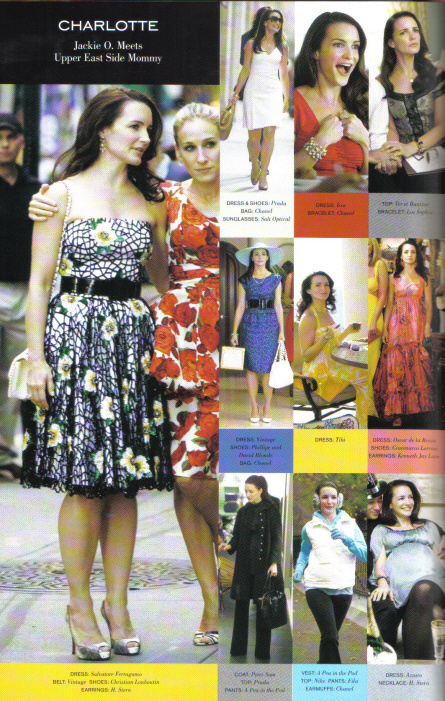
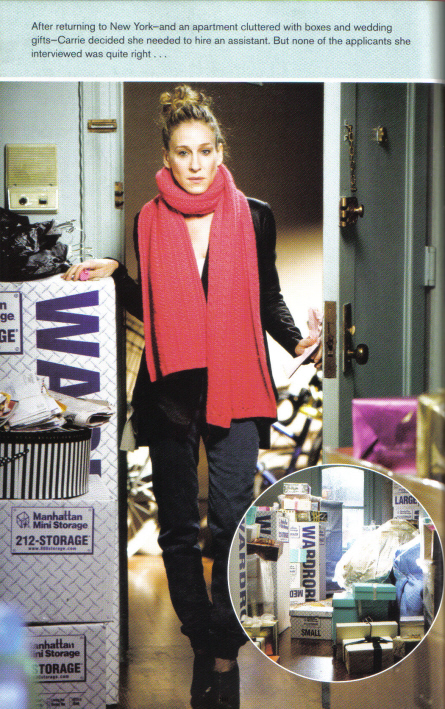
Book Review: Sex & the City: The Movie Coffee Table Book.


A few weeks ago I reviewed the Sex & the City 2 coffee table book in accompaniment to the movie.

There was quite a lot of controversy surrounding the second film, and while I still maintain my stance that it wasn’t that bad, I will state for the record that the first film shits all over the second.

In terms of coffee table books, though, I think I prefer the second book to this one.

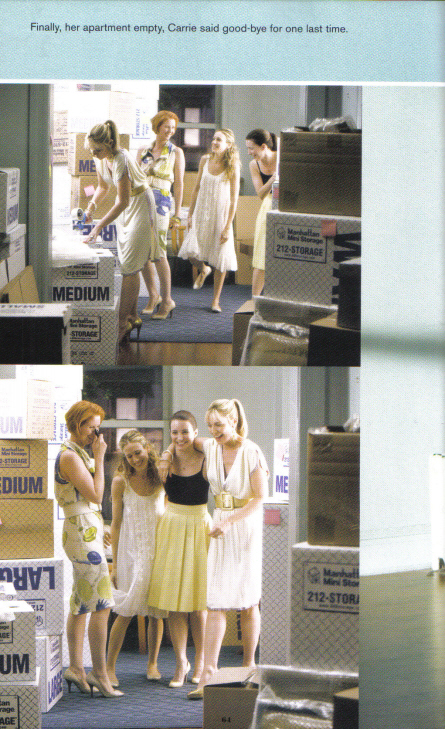
Nonetheless, it is a beautiful exercise in film photography. The fashions, the furnishings, the friends!

I Get By With A Little Help From My Friends.

“How often do you ‘colour’?”

“Charlotte Poughkeepsie’d in her pants!”

Big Man on Campus.

In Vogue.

The hero dress.

The hero shoe that saved Manolo Blahnik from going out of business.

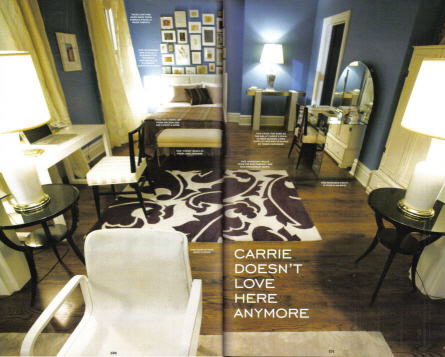
Apartment Therapy.

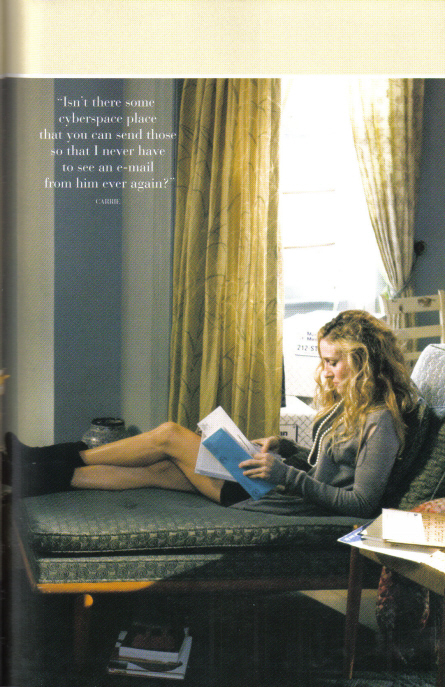
Carrie’s apartment is the quintessential single girl’s digs.

How dreamy… even though Carrie is in the midst of depression!

Books: Happy Anniversary!

This week marks the 50th anniversary of the release of To Kill A Mockingbird. Fittingly, there has been a lot of hullabaloo in the media of late about the canonical status of the book and whether it is deserving of this status.

And we all know I think it is.

Happy anniversary, Mockingbird! Knowing you has made me a better person!

Related: In Defence of To Kill a Mockingbird.

In Defence of To Kill A Mockingbird.


By now loyal Scarlett Woman readers will know my affection for To Kill A Mockingbird, so I couldn’t resist, after seeing a recap on Jezebel, responding to Allen Barra’s assertion in The Wall Street Journal that Harper Lee “doesn’t really measure up to the others in literary talent, but we like to pretend she does” and her Pulitzer-winning work is “virtuously dull”.

Well, I never!

Out of everyone I’ve ever spoken to about To Kill A Mockingbird, only one person said they didn’t like it, but she also didn’t finish the book, so she missed the part of the book I think is most poignant: the final paragraphs where Scout recounts the events of the summer from Boo Radley’s front porch, citing her father Atticus’ wise words that “you never really know a man until you stand in his shoes.” For Scout, “Just standing on the Radley porch was enough,” and I think that is one of the most beautiful pieces of imagery that brings the story full circle.

Atticus is the quintessential beloved father figure, and beacon of “all the best lines”, who, funnily enough, Lee crafted to oppose the attitudes of her own father, who allegedly “once remonstrated a preacher in the family’s hometown… for sermonising on racial justice”. Barra mocks Atticus’ juvenile explanation of the Ku Klux Klan (he is speaking to a CHILD, where a certain amount of sensitivity is required) and his dialogue, as seeming to have been written “to be quoted in high-school English papers”. God knows I had a field day with quotes from the book in my Year 11 English Literature essays, and perhaps the reason I feel so affectionately towards Atticus is that he reminds me of my grandfather, who passed away several days before I started Year 11. I don’t think I’m alone in saying that Atticus could be representative of the father figure I never had.

For Mockingbird’s haters, there is the defence that it is a novel for children (Barra quotes “fellow Southerner” and author Flannery O’Connor on her observation of To Kill A Mockingbird: “It’s interesting that all the folks that are buying it don’t know they are reading a children’s book.”) something that I was not aware of until reading the Jezebel article, which should say something about Lee’s writing skills (or my reading skills?).

Nonetheless, I stand by my belief that Mockingbird is one of the best books ever written. Barra might say that, “In all good novels there is some quality of moral ambiguity… There is no ambiguity… at the end of the book , we know exactly what we knew at the beginning: that Atticus Finch is a good man, that Tom Robinson was an innocent victim of racism, and that lynching is bad.” But I think there is some moral ambiguity: was it right of Atticus to “collaborate with the local sheriff to ‘obstruct justice in the name of saving their beloved neighbour…’”? And, as Jezebel asks, “Is Atticus’ evisceration of Mayella Ewell permissible because she is making a false rape claim in the knowledge that it will likely cost an innocent man his life? Is Mrs. Dubose a cranky old racist or ‘the bravest woman I have ever known,’ as Atticus says? Did Boo Radley truly kill Bob Ewell in self-defense? Are Atticus and the sheriff, in their willingness to protect the social status quo, contributing to the system of white male privilege that subjugates women and blacks—and the secrecy on which it depends?

And what did happen to Boo Radley, whom Scout “never saw again”?

Related: Taking a Leaf Out of Amazon’s Book: Bad Customer Reviews.

[Jezebel] Re-Evaluating To Kill a Mockingbird.

[Wall Street Journal] What To Kill a Mockingbird Isn’t.