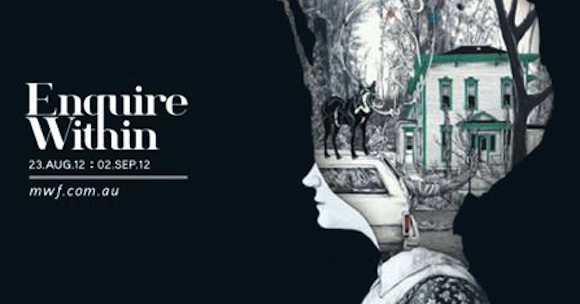
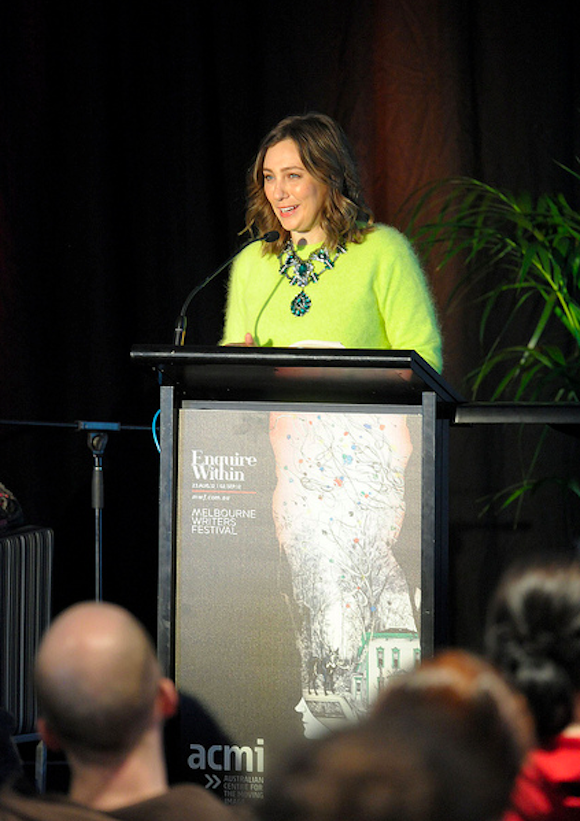
Event: Melbourne Writers Festival — In Conversation with Zoe Foster.

Former Cosmo and Harper’s Bazaar beauty writer turned “chick lit” novelist Zoe Foster has always been someone I’ve looked up to: since reading Comso from age 15, her and Mia Freedman are two writers I’ve tried to emulate, not so much career-wise but more style-wise.

Foster appeared at one of the first events of the Melbourne Writers Festival on Friday morning, in conversation with freelancer and Crikey literary columnist, Bethanie Blanchard.

Dressed in pink sparkly pants and looking flawless as usual, Foster, who now writes from home and whom I remember writing about spending a “working” holiday in New York City a few months (or maybe it was a year? Time flies!) ago, managed to make me believe that there is hope for me as a successful, stay-at-home writer yet.

Granted, Zoe writes the kind of prose I try to avoid: beauty and chick lit. Foster explained how she got the job as beauty editor of Cosmo because Freedman liked that Foster had no beauty knowledge whatsoever and that she’d be writing from a readers’ perspective. Zoe said she never reads the beauty pages, and I have to concur with her there: unless it’s written by Zoe, beauty is the most mundane thing in the world to me.

But where chick lit is concerned, Foster gave an anecdote from Puberty Blues author Kathy Lette who, when Foster told her that she writes in that genre, spat her drink out and said, “No, don’t ever call it that. It’s commercial first-person narrative.”

I have to admit, when I see that phrase or a book cover with a suspiciously chick litty-esque cover, I steer clear. However, when I heard Foster read from her latest effort, The Younger Man, the following morning at The Morning Read (from which the above photo was taken), along with the hilarious Sloane Crosley, I had a hankering to pick it up and give it a whirl. From the excerpt Zoe read, her fiction writing sounds exactly like her beauty columns for MamaMia and her dating advice for Cosmo.

But that’s something I have a whole different issue with: in this month’s Cosmo, Zoe advises not to make an effort in the early stages of courtship: it’s his job to chase you. Firstly, this advice doesn’t work for me because I much prefer the chase (maybe I should take some of Zoe’s advice and perhaps I wouldn’t be single!). And secondly, it’s a bit backwards, which Foster concedes to in the article. She also mentioned that she sometimes “cops a bit of shit” for her… traditional would be a nice way of putting it… views on dating.

Finally, another valuable thing I got out of the session was a glimpse into Zoe’s writing schedule and how she plans her day. While she doesn’t read in the genre she writes in whilst she’s in the drafting process lest she start writing another version of 50 Shades of Grey, she does get up at 6am to get a few hours of non-interrupted fiction time in before email, Twitter and other distractions hit. Ahh, I remember those days. You know, when I was bright eyed and bushy tailed and responsible. Interestingly, Zoe also favours a solitary drafting process in which she doesn’t let anyone read her work before the first draft is submitted to her editor. One conscientious audience member asked how, or more pertinently why, she only relies on herself and doesn’t seek outside insight. Zoe replied that she’s on her fourth novel at the moment, so she’d kind of an old hand and should know what she’s doing by this point. But also, I think, some people are just better at assessing their own work than others. I know I don’t like to have any input from anyone, or even tell people what I’m working on. Once it’s out there, I know it’s mine and mine only; good or bad. The writers’ life is a solitary one, after all.

Images via The Vine, MWF Flickr.

Event: The Reading Hour.

In celebration of the National Year of Reading, today marks the National Reading Hour. While the exact time frame for the event is sketchy, and anyone who knows me knows I’ll be spending much more than one hour reading today (or on any day, for that matter), the aim of the event is to instill the importance of reading in children. From my point of view, reading is important at all ages and it’s never too late to start. The only downside is there’s less time to read all the fantastic books out there.

So, I’ve decided to get in on the action by going over all the books I’ve read this year and whether I found them good, bad or otherwise and if you should read them, too.

I haven’t read this many books since my uni days, I don’t think, when I was traveling up to six hours a day from country Victoria to Deakin in Burwood. Needless to say, there were a lot of public transport hours that needed filling, and reading was the perfect way to do that. Aside from primary school, of course, when nightly “readers” were a must and I got through several, if not up to a dozen, books a week, uni really got me back in touch with my love for reading; a love without which I wouldn’t be who I am today.

So, without further ado…

My Booky Wook 2 by Russell Brand.

If I if I didn’t have to give this book back to a friend before she moved interstate at the start of the year, I think it would still be sitting in my stack of to-be-read books (like some other borrowed tomes). While it didn’t change my world, and I much preferred Brand’s first memoir, I’m glad to have read it and moved on. Much like Katy Perry. Burn!

The Barbie Chronicles: A Living Doll Turns 40 edited by Yona Zeldis McDonough.

While Barbie is now 53 and there is now thirteen more years of fodder for a compilation of feminist musings on the doll, I really enjoyed this book and ponder it often. Aforementioned interstate friend, Laura, currently has it in her possession. I believe it is out of print now, so I was quite lucky to have happened upon it at my local secondhand bookstore. Pick it up if you get the chance.

Big Porn Inc. edited by Melinda Tankard Reist & Abigail Bray.

I was so looking forward to reading this conservative collection on why porn is bad, and it didn’t disappoint. I didn’t agree with anything in the book, but it was an eye opening look at just how anti-sex (not to mention anti-choice, anti-feminism, anti-vaccination) some people can be. What scares me is that Tankard Reist and Bray’s ideologies could be rubbing off on the susceptible with the release of this book.

The Book of Rachael by Leslie Cannold.

Feminist crusader Cannold looks at what could have been the life of Jesus’ sister, Rachael. What’s more, the book focuses on her relationship with the ultimate betrayer, Judas. It wasn’t mind blowing, but if you’re looking for something to read and want to support local, female writers, this is one for you.

The Black Dahlia by James Ellroy.

To be honest, I had lots of things on my mind when I read this so it’s almost like I never read it at all. I found it really hard to get into and to focus on the words on the page. Maybe I’ll watch the movie in an effort to more fully understand the storyline. Shameful, I know.

We Need to Talk About Kevin by Lionel Shriver.

If you haven’t read this book yet, you need to get on it, like, yesterday! So well written, so emotional, so involving and with a massive twist at the end. And please, if you’re thinking about watching the movie (which I haven’t seen yet, so don’t take my word for it: it might even be better than the book), read the book first. Looking back, this is probably the best book I’ve read this year and, dare I say it, ever.

The Hunger Games by Suzanne Collins.

Not the worst teen trilogy out there (I’m looking at you, Twilight Saga), but not the greatest, either. I found the book easy to read and also well written which, again, is more than I can say for Stephenie Meyer.

Fragments by Marilyn Monroe, Bernard Comment & Stanley Buchthal.

This part-coffee table book, part-Marilyn musings tome had been sitting in my pile of to-be-reads for almost a year and a half before I decided to actually read about one of my favourite icons. I enjoyed a rare insight into the mind of the sex symbol herself, but honestly, I think there are probably better books about her out there.

Hitman: My Real Life in the Cartoon World of Wrestling by Bret Hart.

This is the book I spent the most amount of time reading; or rather, it took me the most amount of time to read. It is a hefty memoir, but it’s not exactly written in a challenging tone, either. I quite enjoyed it, all in all, and while you probably need a background knowledge of professional wrestling to get into the book, it was kind of sad reading about all the tragedies in Hart’s life.

Remarkable Creatures by Tracy Chevalier.

I love me some historical fiction and Remarkable Creatures didn’t disappoint. Easy to get into with a bit of fluff, but it has nothing on Girl with the Pearl Earring.

11.22.63 by Stephen King.

This was my first encounter with King, and I quite liked it. He obviously has the suspense/mystery/horror (though you won’t catch me dead with one of his books—nor the movie adaptations—in this genre. I hate horror!) formula down pat. While the title and cover lines were a bit misleading (JFK doesn’t come into it until right near the end, and even then it’s anticlimactic), I really liked it and found out some historical tidbits I didn’t know previously.

The Informers by Bret Easton Ellis.

Easton Ellis is one of those writers who is good in theory, not so good in practice. I still plan on reading all of his efforts, no matter how gory and gratuitously sexy and druggy they are (this one had a central theme of sex, drugs and rock ’n’ roll in ’80s L.A.… with a side-serving of vampirism!), but sometimes I think he’s a bit over hyped. As was The Informers.

Fables: The Deluxe Editions Volumes 1 & 2 by Bill Willingham.

These are the comics Once Upon a Time is allegedly inspired by, and let me tell you, these are much better than the show. I’m not usually a fan of the comic book format, but I really enjoyed these two. Bring on the next two installments!

Drowned by Therese Bowman.

When I read Drowned, I actually had no idea what the storyline was. I remembered reading an enticing review in The Age a month or two before I convinced a friend to buy it in order for me to borrow it, but other than that, I was clueless. After reading it, it seemed there was no storyline; it was more high-concept literary fiction to my mind. But it was very evocative. Short and sweet.

Never Let Me Go by Kazuo Ishiguro.

I just finished this one on a trip away and I loved it. Similarly to The Black Dahlia, it took me awhile to get into it, concentration-wise, but once I did I found it very enjoyable. The storyline is unique and interesting, and the character development and style were some of the best I’ve had the pleasure of reading.

Music for Chameleons by Truman Capote.

So does reading one short story in the collection count as actually reading the whole of Music for Chameleons?! I bought this book from a secondhand store with the sole intention of reading the Marilyn Monroe chapter and that’s all. Kind of a waste, I suppose, but I like to support small, local businesses!

50 Shades of Grey by EL James.

I have oh-so-ashamedly left this one til last as it is by far the worst, but it’s also the one I’m currently reading. I always said I would never be caught dead reading this mediocre tripe, but after hearing John Flaus and Jess Anastasi (a coincidence her surname is practically the same as the first name of 50 Shades’ protagonist?) discuss the book at the Bendigo Writers Festival, I finally succumbed. The way I look at it, I’m approaching it with a critical eye for the purposes of research. It’s better to have an informed opinion, right? More to come.

What are you going to be reading for the National Reading Hour?

Related: Big Porn Inc. Edited by Melinda Tankard Reist and Abigail Bray Review. 

The Book of Rachael by Leslie Cannold Review.

Bendigo Writers Festival.
Event: Bendigo Writers Festival.

The month of August is chock full of writers festivals (okay, two, but I’m going to a lot of sessions!), so much so that I’ve taken time off paid work to further my currently unpaid writing career.

Over the weekend I ventured to Bendigo for their writers festival, which boasted big names like Ita Buttrose. I decided to give her talk a miss as it coincided with another talk I wanted to go to about blogging and writing online which is more relevant to me, and frankly, some of the things Ita’s said recently have really rubbed me the wrong way. I think I like her better as portrayed by Asher Keddie than in real life!

While Megan Burke (my new idol) and ABC Open’s Jane Curtis were great speakers (and great bloggers), I felt the audience were all middle aged aspiring mummy bloggers and the content was relevant to them, who are interested in starting a blog, not me. Maybe three years ago, but not now.

The second talk I went to on Saturday was “Are We There Yet?”, featuring Indigenous writer Alexis Wright, astrophysicist turned lawyer turned writer Sulari Gentill, Muslim writer Hanifa Deen, and author Arnold Zable, and facilitated by Shannon Kerrigan, was promising in theory but failed to live up to the hype in practice. I thought all the writers were great and had valuable things to say about how writing contributes to social change but the format of the session was all wrong: I’m not a fan of each speaker telling a story about their take on the subject for a third or a quarter of the time and then it’s over. I much prefer pre-determined questions being posed to the panel and then opening them up for discussion. Suggestion for further panels: use social media to tally up the questions and thought threads attendees want to hear about and incorporate those into the talk, instead of stuffing them into a ten minute question and answer session at the end.

Speaking of, the last talk I went to on Sunday afternoon was about “His & Hers” writing, which had the potential to really delve into the notion that women write about shopping and sex and men write about serious things. When the facilitator, Sofia Ahlberg, asked if women can write a “great Australian novel” and insinuated that they can’t (not because that’s her personal view, I don’t think, but because our society just doesn’t allow for that with, perhaps, the exception of Kate Grenville), a man from the audience and his wife audibly retorted and rudely told Ahlberg to open the discussion up to questions from the audience.

What I got out of the session was an interest in 50 Shades of Grey that I didn’t have before, thanks to John Flaus’ comments that he didn’t think it was written by a woman due to its “clinical”, “outsider” perspective on sex. Either that, or an incredibly narcissistic woman. Interesting.

Also on Sunday was the “What Makes a Hero” session, with Janine Bourke, sports writer Gideon Haigh (sportspeople as heroes is one of my pet topics), Ned Kelly biographer Ian Jones and Hanifa Deen, who asked where minorities get their heroes from if they’re a primarily “conservative construct”, as Haigh asserted. Deen also talked about “cultural amnesia” which I found interesting as we so often put people on a pedestal after—and sometimes despite—committing indiscretions (Ned Kelly, Chopper Reid, and countless football players, to name some Australian “heroes”): “we remember and admire the things we want to”.

Finally, there was a horror panel featuring horror writers Brett McBean and Cameron Oliver, reviewer Lucy Sussex and president of the Australian Horror Writers Association, Geoff Brown. This was probably the best panel in terms of actually addressing the topic and opening the discussion up to questions and comments about “what scares us”. Interestingly, Bendigo is one of the most haunted cities in the world, with more ghosts per person than anywhere else! They talked about the canonical horror films of the late ’70s and ’80s like Carrie, The Shining and The Exorcist and how filmmakers are “scared to scare people” now and that the current zombie, vampire and werewolf trend reflects our xenophobia and fear of the “other”; more so, that they will “turn us into them”. If that doesn’t some up what we’re scared of, I don’t know what does.

Related: Paper Giants: The Birth of Cleo Review.

In Defence of Mia Freedman.

Elsewhere: [MamaMia] Was “Girls on Show” Slut-Shaming?

Event: Grace Kelly—Style Icon Exhibition at the Bendigo Art Gallery.


Yesterday I attending the much-hyped (both in the media and in my mind) Grace Kelly: Style Icon exhibition at the Bendigo Art Gallery.

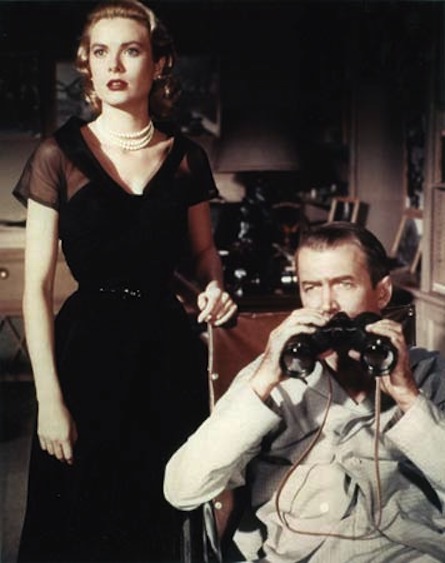
I’ve been a fan of Kelly since I first saw her in Rear Window three Christmas’ ago, and when my mum showed me the gallery’s brochure on upcoming events this time last year, I was wetting my pants with excitement to see an exhibition based around one of the most beautiful and talented actresses of the golden age of Hollywood.

In preparation, I watched High Society and To Catch a Thief (still have to check off Dial M for Murder on my list of Grace must-sees), but Rear Window will forever remain in my heart as my favourite Kelly film (and one of my favourite films, period).

While the exhibition disappointingly didn’t feature Kelly’s signature Rear Window dress, the black and white cocktail length ballgown from her opening scene in the movie, it did have on display the black mid-length dress from the film, which is so classic and timeless it could be seen on the street today.

The dearth of clothes from her first ten films were made up for in the several pieces from High Society, her last film and one from which she was allowed to keep her wardrobe. These were followed up with the dress she met Prince Rainier in, the famous Hermès Kelly bag, her bridal trousseau and, of course, a replica of her wedding gown (the original’s fabric is too delicate to travel).

The rest of the exhibition consisted of a myriad of Grace’s own clothes after she became a princess: a powder blue gown to conceal her baby bump and some elegantly embellished suits were my favourites. Despite references to the Princess’ reluctance to embrace the sky high hemlines of the sixties, there was an Yves Saint Laurent Mondrian dress, a staple of the times, and some flowing seventies-style gowns.

From the fairytale exhibition I had dreamed up in my head, I had much higher expectations than what was presented at the gallery. This is not to say that Grace Kelly: Style Icon isn’t an exhibition worth seeing, if fashion and movies and Kelly are your thing. But, compared with some of the other exhibitions Bendigo Art Gallery has hosted, it might be their most hyped one but certainly not their best.

Related: Bendigo Art Gallery: Giving the Metro Museums a Run for Their Money.

Loving… Grace Kelly as Lisa Fremont in Rear Window.

Images via Grace Kelly Bendigo, Clothes on Film, Costumerism, YouTube.

Event: Should Meat Be Off the Menu?

That was the topic of Intelligence2’s debate, in conjunction with the Wheeler Centre, last Tuesday night.

Going in, I voted that meat should be on the menu, as although I think vegetarianism and veganism is great and I fully support those movements, I personally love the taste of (some, mainly chicken, fish and beef) meat and don’t think I could give it up. I still believe this, although I have recently made the switch from dairy to almond milk in a bid to become more ecotarian, which you can read a bit more about in this link I posted last week.

But I based my final vote for the night, which is a staple of Intelligence2 debates, on which team presented better arguments. That team was the affirmative, claiming that animals should be off the menu.

That team consisted of the author of Animal Liberation, Peter Singer, jet-setting former banker turned staunch animal rights activist Philip Wollen, and Veronica Ridge, food writer, whose argument about the myriad of non-meat-based dishes was the weakest, and was challenged by those in the audience who claimed that while the meals she listed may have been meat-free, they still used a lot of animal by-products like dairy.

However, she did make some good points about hypocrisy and the ways we treat certain animals. For example, why do we butcher pigs and cows but lavish affection on our domestic cats and dogs? The special needs dog-in-training in attendance hammered this point home.

Opening for the affirmative team was Singer, who started off rather weakly but listed the three main topics his team would take on: our health, the impact meat production has on the planet (Wollen followed this up with the fact that it takes 50,000 litres of water to produce 1kg of beef. The irony that I’d had two beef-based meals the day before and the day of the debate was not lost on me.), and the ethical treatment of animals.

But if I thought Singer presented poorly right out of the gate, he had nothing on the dismal points of Fiona Chambers of the opposing team, who raises organic pigs on her Daylesford farm. It could probably be attributed to nerves, but most of what Chambers had to say seemed to get lost in translation. All I got was that human consumption of animal meat keeps their species alive and away from extinction, and that animals cannot be raised humanely for human consumption. Either she misread her notes, or her argument completely flies in the face of the work she does on her farm. Puzzling.

The second speaker for the opposing team wasn’t much better. Animal scientist Bruce McGregor talked about “natural loss” and the ecological impact not eating animals would have. There’s nothing “natural” about factory farming, and to answer McGregor’s question about what to do with all the surplus stock, that’s easy: stop using female cattle and poultry as baby-making machines and we wouldn’t have two billion animals killed per week, as Wollen told us.

Wollen went on to say that 10,000 species go into extinction every year because of humans, and we are facing the sixth mass extinction right now. (2012, anyone?) Wollen concluded his ominous but standing ovation-receiving speech with this:

“The axis of evil runs through our dining tables… [and] our weapons of mass destruction are our knives and forks.”

I don’t necessarily agree that this is always true, but I do think Wollen’s segment was responsible for the affirmative’s win on the night.

Almost retaining my vote for the opposing team, Good Chef, Bad Chef star Adrian Richardson said that meat consumption is all about choice: you can make the personal choice not to eat meat, or to eat meat that’s ethically produced. In his Melbourne restaurant, La Luna, he only serves organic meat, which is promising, but we all know that what it says on the packet isn’t always the case. For example, unless your “free range” eggs have a stamp of approval from a recognised animal welfare authority, “free range” could mean the hen gets 20cms to exist in as opposed to 20cms for it and four other hens in which to live. If people still buy cage eggs and factory farmed meat, there’ll always be a demand for it, making it harder for the regular supermarket shopper to discern and easier to justify the cheap cost of cage eggs versus the steeper cost of free range.

Annoyingly, though, Richardson appealed to the Aussie bogan (of which I don’t think there were many in attendance. Meat is the dietary staple of the bogan, didn’t you know?), opening by saying that not eating meat is un-Australian and that when we do, we’re closer to our savage ancestors. Or an AFL player (his words [paraphrased], not mine).

When the debate went to the floor, there was a (keeping with the animal theme) menagerie of viewpoints and arguments, but a few really resonated with me, whether I agree with them or not. A couple of people said those in the West have the luxury of eliminating meat from their diets and supplementing it with other forms of protein, while those in developing countries don’t. Following on, either someone from the affirmative team, someone from the audience, or both, said the 1.2 billion people who populate India don’t have a problem with a meat-free diet, so it shouldn’t be that hard for Australian population to adopt.

Richardson mentioned that he’s killed animals with his bare hands before. While hunting’s not for me, personally, I don’t have a problem with it in general, so long as the animal is killed swiftly and all of its viable by-products are consumed. Someone in the audience concluded that this is just another example of how we assert our dominance over animals because they can’t defend themselves or tell us how they feel. Interestingly, a boy no older than 13 in a private school uniform took to the mic and said choosing the kind of meat we feel comfortable consuming is all well and good, but animals don’t have a choice.  (The women behind me promptly dismissed the boy’s opinion because of his private school duds. Now, I’m not a fan of private school myself, but there are a few good eggs amongst the entitled and bratty ones. I support the kid.) As far as we know, they’re sentient beings who have feelings, self-interest and self-preservation instincts. Who are we to assert our superiority over them because we don’t understand them and we like the way they taste?

Related: Time’s “What Animals Think” Issue, August 16th 2010 Review.

Apocalypse Now: 2012 Come Early?  

“Who the Bloody Hell Are We?” The Sentimental Bloke at The Wheeler Centre.

Elsewhere: [Wheeler Centre] If You Missed Our Recent Debate…

[Wheeler Centre] From Chicken to Egg: A Journey From Vegan to Ecotarian.

[MamaMia] The Truth About the Eggs You Eat.

Glee—The Right & Wrong of It.


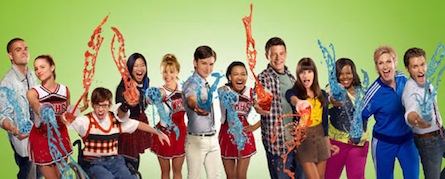
In lieu of a new episode of Glee last week, I attended a debate about the pros and cons of McKinley High and its glee club.

I was super excited, because I assumed the debate would entail a for Glee side, and an against. And it did. But while I thought the against side, consisting of Clem Bastow and Jess McGuire, would discuss the blatant sexism, racism, homo/transphobia, ableism, fatism and the many other phobias and -isms the show incorporates (feel free to add them in the comments), both panelists ultimately praised Glee for it’s inclusiveness and handling of the tough issues.

I’ve heard this rationalisation about Glee before. When my tuba-playing gay friend finally got into the show this season and fell hard for it, he thought I would sing its praises with him because he knew I watched it. (Evidently, he does not read this blog as he would know the main reason I like Glee is because I know I’ll always get a blog post out of it!) When I invited him to the debate, he had something else on but wondered what they would be debating, exactly. I referred to the list of problems I have with it (above and elaborated on below) and he replied, “But I thought Glee was about acceptance.” That’s what it wants you to think, and it blinds you to all the other issues with Katy Perry songs. As panelist for the “pro-Glee” side, Mel Campbell, said, “It’s best not to ask questions.”

While McGuire did touch on Glee’s pro-gay stance, and perhaps its best, and most underutilised, storyline of Brittany and Santana’s forbidden love, I was expecting SlutWalk Melbourne organiser and noted feminist Bastow to knock Glee out of the park for its anti-women portrayals. I was also sorely disappointed, as Bastow, a keen musical aficionado, chose to focus on the shows’ butchering of classic musical numbers.

So, I thought I’d take this opportunity to write about the issues I wished the panel had discussed last Thursday night.

Sexism.

I’ve written about feminism in Glee before, specifically as it’s embodied in the character of Rachel Berry. It annoys me to no end that Rachel is deemed “ugly” (though Lea Michele is anything but) because she’s annoying. And she’s annoying because she eschews traditional gender roles that are perhaps embodied by Quinn by being ambitious, voicing her opinions and unapologetically going after what she wants.

In a clip shown at the debate of the inaugural Glee mash-up in which Mr. Shuester separates the girls from the boys, Kurt attempts to join the girls’ side. Since when did being a gay man amount to the equivalent of a straight female?

Finally, I wouldn’t say sexism is the main problem in Mercedes’ perpetual (okay, she seems to have a boyfriend this season, but more on that later) bachelorettehood, rather some other issues I will address later in the piece.

Racism.

Now is as good a time as any to discuss Mercedes’ aforementioned singleness. Was she literally the only character in season two who didn’t have a significant other because she’s black? (Or because she’s fat?) Sure, she dated Sam for all of a few minutes in the season two final, but before that the only action she got was Kurt condescendingly suggesting she should date one of the guys on the football team because he was black and, like, they’d probably have heaps in common.

If that’s not enough proof of Glee’s insensitivity to race, all you need to do it look at any one episode for a myriad of references to Tina and Mike’s “Asianness”, Roy Flanagan’s “Irishness” (or leprechaunnes, as Brittany might refer to it) and Puck and Rachel’s “Jewishness” (though that also falls under religious prejudice as well).

Homophobia & Transphobia.

Sure, Glee’s pretty much a vehicle for Kurt and, increasingly, Blaine, to showcase their voices, fashion sense and flamboyance. McGuire chose to speak at length about how sensitively the show handled Kurt coming out to his dad and Kurt and Blaine’s first time, and I have to agree with her. And yes, seeing two men make gay love (okay, the implication of them making gay love) on primetime network television without a stink being kicked up is pretty groundbreaking, as panelist for Glee and MC, Tim Hunter, noted. But they still single out Kurt for his gayness (“Single Ladies [Put a Ring on It]” and “Le Jazz Hot!”, anyone?), not to mention how Finn went about outing Santana in “Mash Off”.

They’ve handled the Brittany/Santana thing the best out of every relationship in the show, so that’s one point for lesbianism, but at the expense of other sexual orientations and gender identities, perhaps?

Just look at “The Rocky Horror Glee Show”, for example. Not only to Mike’s parents make him pull out because they don’t want him associated with a “tranny” musical, but the show even substitutes the lyrics “I’m just a sweet transvestite from transsexual Transylvania” for “sensational Transylvania”. Pardon me, but I don’t see what all the fuss is about in using the word “transsexual”.

Finally, we can’t forget Coach Beiste. When she debuted on the show, her sexuality and gender was thrown up in the air, when she’s really just an unconventionally attractive, masculine straight woman who happens to coach a men’s football team. But of course attention is drawn to her 40-year-old virgin status every time there’s a virginity-themed episode. Because, you know, she’s old and funny-looking and has never been on a date! Riotous!

Ableism.

Where do I start? There’s Emma’s OCD, which is made fun of by everyone from Gwyneth Paltrow’s Holly Holiday to her own parents (not to mention Will trying to come to her rescue by attempting to “cure” her). Artie’s wheelchair-bound way of life, which was even pointed out during the debate, only for the panelists to laugh at Artie wanting to give Blaine a standing ovation, “because he can’t”, and a whole episode, “Wheels”, insensitively dedicated to his disability.

I will applaud the show for their inclusion of, and remarkable sensitivity to, Down’s syndrome sufferers. But then they go and use undiagnosed Asperger’s syndrome as an excuse for anti-social and selfish behaviour. Cutting off their nose to spite their face…

Fatism.

Puck’s rendition of “Fat Bottomed Girls” was a clip played at the talk, and was received by audible groans. To see Lauren so uncomfortable as Puck serenaded her was awkward for the audience, and the patronisation was palpable. Like, oh Glee has a plus-sized girl who doesn’t hate herself and is being chased by the hottest guy in school; we’ve come so far.

But when Mercedes is relegated to backing vocals in favour of the slim lined Rachel, can’t get a date and suffers from an alleged eating disorder which is swept under the rug with some sage advice and a granola bar from Quinn, it’s all just tokenism.

So there you have it: the debating of the issues I wished had’ve been brought up by the panel. As my friend, housemate and fellow debate-goer put it: “It was just like Glee: it slightly touched on the issues, but ultimately didn’t add anything new to the discourse.” So feel free to add anything I, or the panel, didn’t cover in the comments.

Related: The Underlying Message in Glee’s “Original Song” Episode.

Brown Eyed Girl.

The Underlying Message in Glee’s “Duets” Episode.

The Underlying Message in Glee’s “The Rocky Horror Glee Show” Episode.

Glee: T.G.Inappropriate.F.

Ain’t Nothin’ Gonna Break My Slutty Stride.

Rachel Berry as Feminist.

Is Lea Michele Too Sexy?

In Defence of Rachel Berry.

Boys Will Be Boys, Revisited.

Glee Season 2 Final in Pictures.

The Underlying Message in Glee’s “Asian F” Episode.

The Underlying Message in Glee’s “The First Time” Episode.

Glee: Santana is Forced Out of the Closet.

The (Belated) Underlying Message in Glee’s “Never Been Kissed” Episode.

Glee “Sexy” Review.

Glee Back in Full Force.

Elsewhere: [Bitch Magazine] The Transcontinental Disability Choir: Glee-ful Appropriation.

[Xhibit P] Fat Girls Singing Backup: Body Images in Glee.

[TV.com] Is It Okay to Find Glee’s Plus-Sized Character, Lauren Zizes, Gross?

[Jezebel] Why Won’t Glee Give Mercedes a Boyfriend?

Image via Meg. All Things Me.

Event: The Catholic Church Is Not a Force For Good in the World.

I’ve always thought religion is bullshit, so when I saw a debate with the topic sentence “the Catholic Church is a force for good in the world” as part of the Intelligence2 debate series, I bought a ticket with my friend Laura immediately.

Going in, we’d both had our minds made up that the Catholic Church certainly wasn’t a force for good in the world, as did 34% of our fellow debate-goers, a door poll reflected.

The affirmative side didn’t do much to sway anyone’s opinion, as lawyer Julian McMahon and Sister Libby Rogerson were pretty poor debaters.

McMahon spoke about how love is the driving force behind the Church and Jesus’ teachings, which has obviously been lost in a lot of hot-button religious topics such as gay rights, and instead we have the “language of The Simpson’s”. I’d say this was true even ten years ago, but the language of today is very much a cyber one, which is perhaps why the Church is losing influence and followers. (Albeit, speaker for the opposition, Anne Summers A.O., pointed out that followers of Catholicism have increased less than one percent in recent years.)

Sister Libby went on to talk about Catholics who volunteer and work in Indigenous communities and in prisons. I don’t know too much about how the Catholic Church has been more of a hindrance than a help in Indigenous Australia, but Laura was obviously upset by the Sister’s assertion, rolling her eyes and groaning. My beef with volunteering being a primarily religious domain is that yes, perhaps a lot of Catholics volunteer, but a lot of non-Catholics volunteer, too. For example, I’m agnostic and I used to volunteer at the RSPCA. As event facilitator Simon Longstaff said, quoting Thomas Aquinas, “Not even the pope has sovereignty over a well-informed conscience.” Amen to that.

In the face of criticism, Sister Libby said the Church is a “flawed, human institution” and makes mistakes just like anyone else. Where have we heard that before?

The affirmative’s only saving grace was Helen Coonan, who actually read from her notes instead of waffling on about dot points. She said there is no excusing the past injustices of the Church, but we need to focus on the present. Coonan spoke at length about the Occupy movement, using their non-hierarchy (un)structure and myriad of messages to undercut all anti-establishment movements. (SlutWalk comes to mind.) That’s the trouble with Occupy: those in opposition to it judge all movements by its measuring stick. But that’s another post for another time.

She spoke at length about wealth in the Catholic Church and using it as a metaphor for how the world should structure its monetary dealings. Hmm… To be honest, as well as Coonan spoke, her focus on economics kind of bored me.

To rebut this, Father Peter of the opposition said the Church favours the idea of “pray, pay, obey” and doesn’t give its followers a voice.

Still with the opposition—debating for the notion that the Catholic Church isn’t a force of good—consisting of Summers, the excommunicated Father Peter Kennedy and writer David Marr, they brought the house down with their poignant points.

Summers spoke about the women’s movement in relation to the Church which, when Summers and fellow Catholic school-educated feminists such as Germaine Greer were at school, consisted of either “being a nun or a mother of six”. She spoke about abortion, birth control and choosing whether and when to become a mother.

During the floor debate, one woman about my age tried to debunk Summers’ theory that women who subscribe to the teachings of the Church don’t make their own choices. The fact that her mother was born in the ’30s, has several (Catholic school?) degrees and NINE CHILDREN leads me to believe that she wasn’t making a choice to do these things so much as she was brainwashed to do them. As Marr said during his time, sex as a non-reproductive act is frowned upon by the Church.

Speaking of Marr, he was by far the best debater and is my new favourite person! He talked about sex as a sin and that followers of the Catholic Church are supposed to engage in “no sex at all, ever!” unless it’s between a married, heterosexual man and woman for the purpose of procreation. How boring!

He pointed out four main problems with the view the Catholic Church has of sex:

1. Celibacy as purity. And we all know how damaging that is to young sexuality, in particular.

2. Condoms being outlawed. When Marr asked the affirmative panel if they support the banning of condoms to stop the spread of disease, like HIV/AIDS in Africa, McMahon awkwardly and roundaboutly agreed with the Church’s position. He said that abstinence and sex only within marriage would stop the spread of disease in Africa, forgetting that in countries like the Democratic Republic of Congo rape is rife and abstinence only sex education doesn’t work. His response was laden with racism and rape-apologist attitudes, in my opinion. For all his accomplishments, this debate illustrated that McMahon is severely out of touch with the realities of our world.

3. Homosexuals are bad, okay? I think we all know the Church’s stance on homosexuality, despite most Catholics, according to Marr, believing in granting the right of marriage to the gays.

4. Shame. That sex, being sexual and looking sexy is shame-worthy. I would argue that this attitude has permeated secular society, but that secular society also laughs in the face of point #1, and also prude-shames those who aren’t having sex, being sexual or looking sexy. You can’t win either way.

By the end of the debate, in which Coonan rebutted that “ordinary Catholics”—those who acknowledge and agree with most points from both sides of the argument, and who aren’t caricatures of fanatical militant Catholics—“need a voice”, which I certainly agree with, 57% of the audience was against the Catholic Church as a force for good in the world. Hope for atheism—or at least agnosticism, which is the philosophy I subscribe to—isn’t dead yet, which is more than I can say for the Catholic Church.

Related: Feminism Respects Women More Than Anything, Including the Catholic Church!

“Who The Bloody Hell Are We?”: The Sentimental Bloke at the Wheeler Centre.

Ain’t Nothin’ Gonna Break My Slutty Stride.

The Underlying Message in Glee‘s “The First Time” Episode.

Elsewhere: [The Telegraph] Tiger Woods Says “I’m Only Human” After Mystery Crash.

Event: Melbourne Writers’ Festival—Beyond White Guilt.

The final day of the Melbourne Writers’ Festival brought Beyond White Guilt, taken from the name of author Sarah Maddison’s Beyond White Guilt: The Real Challenge for Black-White Relations in Australia and hosted by Tony Birch.

Maddison and Birch spoke about the crux of Maddison’s book, published in June—guilt and shame—and how they can both be “deeply personal experiences” in the way we look at race relations in Australia.

The absence or a certain “whitewashing” of black history in Australia can induce guilt, a feeling of “sick” and “anxiety”, and can “immobilise” us in striving for a more equal Australia.

On this, Birch spoke about being honoured by the Victorian East Timorese community* for doing not a whole lot other than sitting in front of the TV and thinking, “how awful”.

I think a lot of Australians feel this way, whether it be watching World Vision ads on TV, seeing homeless people begging in the street, or watching boats crash and people perish as they try to seek asylum in Australia (although, from the barrage of “fuck off, we’re full” jibes in response to that tragedy, perhaps it is the minority of Australians).

Maddison spoke of Australia’s roots as “a land of people who dig stuff up and chop stuff down”; an “Aussie battler” sentimentality, if you will. And I think that mentality lends itself to the bigotry we express towards the “other”, ie. people trying to get a “free ride” as asylum seekers, the poor and Indigenous on welfare, the homeless, the disabled, etc.

Unfortunately, when this kind of attitude rears its ugly head, such as in the Redfern and Cronulla riots, and the inaugural Indigenous protesting of Australia Day in 1988, as Maddison mentioned, it usually pits “true blue Aussies” against un-Australians. (Birch wrote a 2001 article entitled “The Last Refuge of the Un-Australian”, which is available for download from the University of Melbourne’s website.)

Whichever way you put it, none of us are truly happy with our country. Lefties abhor the way our environmental and human rights sensibilities are heading, whilst conservatives want to stop the boats, abortions, taxing the rich etc. One thing I think we all can agree on, as Maddison noted, is that our current government sucks.

Birch asked, “How are we going to love our country wholly?” An Aboriginal elder in the audience suggested Maddison’s book become compulsory reading for all Australians as a solution. One thing’s for sure: like feminism, we’ve got a long, long way to go, baby.

*Updated 09/09/11: The original version of this post cited Birch as being honoured by a Papua New Guinean community. In actual fact, it was the East Timorese community of Victoria.

Related: Cowboys VS. Aliens & Indians… Does It Really Matter? They’re All the Same Anyway, According to the New Movie.

My Response: Go Back to Where You Came From.

It’s Not Easy Being Green: The Latest Trend in Discrimination.

Melbourne Writers’ Festival: A Long, Long Way to Go—Why We Still Need Feminism.


Event: Melbourne Writers’ Festival—Journalists & Trauma.

Journalists & Trauma was a free event that occurred on Saturday morning.

I had originally planned to go to an advanced screening of The Help and associated brunch put on by Sunday Life magazine, however tickets sold out way in advance, so I thought I might as well fill my morning with something else worthwhile.

The event was hosted by Margaret Simons, and featured Dennis Miller, author of a new book on Black Saturday and the role of the media in it, and Di James, a survivor of the Marysville bushfires.

The talk focused on a report by the Centre for Advanced Journalism entitled “In the Media Spotlight: The Survivor Series”, which studies the role of the media in gathering material in the event of a tragedy, consent from those they gather material from, and the problems faced by both the media and the public affected in those situations.

There was a heavy focus on the first 48 hours of a tragedy, in which Di recounted her story of fleeing to a neighbour’s home to watch her house, car and business (the famed Marysville lolly shop) go up in flames, being cut off from communication and being unable to tell her children she was okay, having the a media chopper arrive before the authorities, and using the media to her advantage to get the message out that a) there were people there who needed to be evacuated, and b) she was alive.

James was, understandably, a bit teary in recounting these events, but all in all, she agreed with Miller’s findings that the media needs to be more sensitive when covering tragedies and trauma.

While I can see where James is coming from, having been involved in Black Saturday and seeing images of herself and her friends (some of whom didn’t make it) plastered on newspapers and being shown on television two years later (without her consent), I do believe the public has a right to know about these things.

Mia Freedman wrote in her most recent Sunday Life column about suicide and its coverage in the media. Personally, I am a sucker for details, and will go to extreme lengths to find them out. (Googling crime scene pictures of Nicole Brown Simpson and Ron Goldman wasn’t my finest moment.) Enquiring minds want to know. But do they need to?

And in this day and age of Twitter, blogs and live streaming (Journalists & Trauma was live Tweeted and streamed), most details do get out. Like anything, I think we should have the option of seeking this information out if we so wish, and shunning it if we have no interest in it.

I understand the hardships of those who are involved in tragedies, and wouldn’t wish any undue stress to them, but in the long run, I think if said enquiring minds are satisfied, they will move on to something else, leaving those affected to grieve in peace.

Thoughts?

Elsewhere: [MamaMia] Suicide Contagion. Does it Exist?

Image via Melbourne Writers Festival.

Event: Melbourne Writers’ Festival—A Long Long Way to Go: Why We Still Need Feminism.

We’re in a post-feminist era. Feminism is dead. Has feminism failed?

From the arguments presented by Sophie Cunningham in her Melbourne Writers’ Festival address, titled after the line in Helen Reddy’s “I Am Woman” (and the title of a book I thought Cunningham mentioned she’d had/is having published, but upon further inspection, this doesn’t seem to be the case), these post-feminism assertions are null and void.

While Cunningham stated at the beginning, after her introduction by Monica Dux, that she’d be focusing purely on feminism as it relates to Western women, but to keep the big picture in mind, I was disappointed that she kept her key points to the lack of women (or recognition of women) in writing, music, film and the arts in general.

Having said that, though, she made some pertinent points: that in 2009 and 2011, the Miles Franklin Award shortlists were all male; that for a woman in Australia to be paid the same as a man in the same job, she would have to have a PhD to his Bachelor degree; that a 25-year-old woman will earn $1.5 million over the next 40 years, whereas a male will earn $2.4 million (to which Dr. Anne Summers responded, “There’s a $1 million penalty for being a woman in Australia today.”); it’s safer to be a soldier in one of the most dangerous countries in the world, the Democratic Republic of Congo, than to be a woman; women do two thirds of the world’s work for 10% of the pay; that when literary submissions are read blind, the inclusion/choosing of women increases sevenfold. (This is epitomised in The Big Issue’s latest fiction edition, in which six competition pieces were read without names attached, and five [possibly six; it isn’t clear if Nic Low, whose piece Slick appears in the anthology, is male or female] are from women writers.)

To really illustrate the “invisible woman” syndrome in the “writing culture crisis”, and amongst many other industries, Cunningham used an anecdote about a female reporter who attended a Liberal rally organised by Tony Abbott and was taunted by the crowd for daring to question Malcolm Turnbull (I think; don’t quote me on this)*. To escape the abuse that threatened to get physical, she disappeared into the crowd, becoming “invisible”. If only Lara Logan, whom Cunningham spoke about, was able to do this in Tahrir Square.

Cunningham brought up the notion that in terms of women’s equality and feminism, our society is regressing somewhat. This is a contention I agree with. Therefore the “invisibility” of women has become “normalised”.

Aimless Panther writes on Feminaust:

“Yay, Aussie women now make up 12% of board members! Wait… seriously, is 12% something to CELEBRATE?!?!”

My sentiments exactly.

In film, Cunningham talked about the Bechdel test and how the feminist movie of the year, Bridesmaids, makes the cut, whereas Cowboys & Aliens doesn’t. Not to toot my own horn (okay, I’ll toot away!), but has Cunningham been reading The Scarlett Woman?!

She also mentions Pixar’s first film featuring a female protagonist, 2012’s Brave, about a strong, assertive and “brave” (duh!)—hence “ugly”—redhead. My, how far we’ve come!

Where Cunningham saw a sort of “bottleneck” in modern feminism, where white, privileged feminists like myself don’t understand the problems facing feminists of colour, feminists with sexual orientation other than straight, feminists with gender other than cis, and feminists with disabilities, she praised the “grassroots” feminism sprouting in the young feminist community, epitomised by SlutWalk. (SlutWalk has been criticised by non-white, non-middle-class feminists for excluding them. Cunningham defended the protest, but by only speaking about issues that affect the feminists SlutWalk caters to, perhaps she could be seen as contributing to this bottleneck?)

She longs for a fourth wave feminism, and finished the talk with this. Some would say we are in/entering a fourth wave, where sexual liberation and reproductive rights still reign supreme, but there is more of a focus on the needs of different types of feminists, as mentioned above, and “serious”, Third-World feminism, where some view the movement is most needed.

Those who are instigating these grassroots movements; this fourth wave; these feminist blogs; are arguably the 25-year-olds who “don’t get feminism”, as Cunningham asserted. While I don’t wish to demonise her for questioning my, and my peers’, motivations and understanding of the movement we so lovingly work towards, I was thoroughly offended by this comment. If Cunningham, and an elderly audience member who spoke up during question time by reiterating that young people don’t “get” what “real” feminism is all about, took a look around the function room at BMW Edge at Federation Square, they would have realised that the majority of people in attendance were under or around 25. Some of them were men, which signifies that yes, while we do still have “a long long way to go”, there are people on our side.

Furthermore, I remember last year there was a bit of tension in the ranks between second- and third-wave feminists, which has also contributed to the bottleneck Cunningham speaks of.

I think we, as feminists, need to be careful about who we call a “real feminist”. Is she the man-hating “HLL (Hairy Legged Lesbian)” stereotype? The woman who shuns all pain-killers to have a natural, home birth, and shames all those who don’t? The “expert”? The grassroots SlutWalk organisers? According to Cunningham, perhaps it’s not the young, beautiful women who “don’t understand” the real issues of concern for feminism because, well, they’re 25 and still have men drooling at their feet. (I’m paraphrasing here, but this is basically the gist of what I interpreted Cunningham to mean). There’ll be more on this to come throughout the week. In the meantime, what do you think?

*Updated 05/09/11: It was actually Alan Jones, at the Rally of No Confidence in Canberra, who lead the crowd in a verbal barraging of journalist Jacqueline Maley after she asked him if he had been paid to speak. I have added the link to this information below.

Related: Has Feminism Failed?

“Who the Bloody Hell Are We?”: The Sentimental Bloke at the Wheeler Centre.

Witch Trial: Burning at the Stake on Charmed.

Bridesmaids Review.

Cowboys VS. Aliens & Indians… Does it Really Matter? They’re All the Same Anyway, According to the New Movie.

Rachel Berry as Feminist.

Ain’t Nothin’ Gonna Break My Slutty Stride.

Melbourne Writers’ Festival: Never, Ever, Again—Why Australian Abortion Law Needs Reform by Caroline de Costa Book Launch.

Surfing the Third Wave: Second-Wave VS. Third-Wave Feminism on Gossip Girl.

Elsewhere: [ABC’s The Drum] A Prize of One’s Own: The Case for an Aussie Orange.

[Feminaust] Welcome to Monday August 29 2011.

[Sydney Morning Herald] The Fee, Me & Alan Jones: How Question of Money Turned Crowd Nasty.

Image via Melbourne Writers’ Festival.