12 Posts of Christmas: Cristina Yang as Feminist.

In the spirit Christmas, I’ve decided to revisit some of my favourite posts of the year in the twelve days leading up to December 25th.

It’s no secret I love underdogs and Grey’s Anatomy, so what better way than to combine the doctor drama with one of its most dramatic doctors, Cristina Yang, in a post about—what else?—feminism? The original post is here.

When it comes to “likeable” female characters on TV, you might think of Buffy Summers. Or Rachel Green. Or the Gilmore girls. But Grey’s Anatomy’s Cristina Yang probably isn’t one of them.

She’s abrasive, unfeeling, career-driven, ruthless and selfish. Everything a woman shouldn’t be, according to patriarchal norms.

Perhaps she could be more like the ousted Izzie Stevens, who was bubbly and sexy and baked cookies. Or the virginal and highly-strung April Kempner, whom Cristina praises for having “virgin super powers”, enabling her to be super-organised.

But I like Cristina just the way she is. She’s got her eye on the prize, won’t compromise her personal beliefs or goals to be liked or for a man, and she’s got “tiny little genius” hands that enable her to roll with the big guns.

This is why Cristina Yang is one of the only “feminist”—or “strong female”—characters on television. Nay, in all of fiction.

For one thing, she refuses to rely on her looks or her feminine wiles to get ahead. In “This is How We Do It” in season seven, she rejects Owen’s compliment about her beauty, saying, “If you want to appease me, compliment my brain.”

And in last week’s final, we saw Cristina exercise her right to choose, and schedule her second abortion on the show, after much (mostly solo) deliberation. While excluding the opinion of her significant other and father of the future child wasn’t the most respectful thing to do, ultimately it came down to her choice, and she chose to terminate the pregnancy.

In season two, Cristina divulges that she’s pregnant to Dr. Burke and, again, makes the decision to get an abortion on her own. Whereas a character like Izzie seems to serve the pro-life agenda (she gave up her own baby for adoption when she was a teenager growing up in a trailer park, and convinced a HIV-positive woman to carry her pregnancy to term), Cristina resists the societal pressures to tap into her maternal instincts and give birth to a child she does not want.

Regardless of whose agenda could be seen as being served by Cristina’s character, she acts without fear of what other people will think of her.

As a person, no matter what gender, it is seemingly second nature to want others to like us, and to portray our best selves to them. Just look at the ritual of the date or the job interview. That Cristina defies this action (though we have seen her star struck when meeting surgeons like Tom Evans, and Preston Burke for the first time) makes her not just a feminist character, but a truly humanist one.

There are people in this world who challenge us, grate on us, and whom we genuinely don’t like or approve of. But that’s what makes the world go around. Cristina Yang being one of these kinds of people, and being portrayed to us as a whole person on television, with hopes and dreams and trials and tribulations and relationships and a career and no desire for children, and not just as the bitchy mother-in-law who lives off her husband’s money and needs a good fuck, is truly a sight to behold.

Related: Cristina Yang as Feminist.

Grey’s Anatomy Final Asks “When Does Life Begin?”

The Underlying Meaning in Grey’s Anatomy’s “Superfreak” Episode.

Sookie as Feminist? Hear Her Roar.

Are Our Favourite Fictional Females Actually Strong, or Stereotypes?

Elsewhere: [The Feel of Free] Cristina Yang + You Can’t Compromise on a Baby.

[Marinagraphy] Motherhood, Cristina Yang & Grey’s Anatomy.

12 Posts of Christmas: Slut-Shaming as Defence Mechanism.

In the spirit Christmas, I’ve decided to revisit some of my favourite posts of the year in the twelve days leading up to December 25th.

This one’s about the good ol’ slut-shaming most girls experience at some stage in their life and how it is often, at the hands of other women, a defence mechanism. Original post is here.

A good male friend of mine has recently started dating someone new.

When I asked him how it was going, he said fine, blah blah blah, but that one thing she said really offended him. I was intrigued, so I asked him to tell me more. She must have been looking through his Facebook photos, and came across several in which we’re tagged together. She confronted him about it, saying, “Who’s that Scarlett girl, huh? She looks like a bit of a skank.” He proceeded to set her straight and defend my honour.

Upon going through the photos we’re tagged in myself, I have to say she made a fair call! They’re mostly from costume parties where my skank switch is on full throttle.

But, more than that, it is not uncommon for me to be called names like this. I’m not going to deny it, because if SlutWalk taught me anything, it’s that denying you’re a slut means that you’re acknowledging that other women are. What is a slut/skank, anyway?

But I know why she called me that: she’s jealous. Instead of asking nicely who I was and why my friend looked so chummy with me in the photos she saw, she was threatened by our relationship, so in lieu of admitting this, she questioned the relationship by insinuating that he shouldn’t be hanging around with someone (who seemed) so skanky.

I don’t begrudge her for this; I kind of think it’s funny and a bit sad. In this day and age, people are going to have to start accepting that men and women can be platonic friends. This is why I wrote on my online dating profile that if a man wants to date me, they have to be comfortable with the other men in my life. Especially since my new roommate come Saturday is one of my closest (male) friends.

What to you think? Have you ever experienced this kind of jealousy from another woman, manifesting itself as slut-shaming?

Related: Slut-Shaming as Defence Mechanism.

When Girl-Hate Turns Into Obsession.

’Tis the Season…

SlutWalk.

12 Posts of Christmas: I Scream, You Scream, We All Scream for Feminism.

In the spirit Christmas, I’ve decided to revisit some of my favourite posts of the year in the twelve days leading up to December 25th. 

When Scream 4 came out earlier this year, it immediately solidified its spot in my heart as one of my favourite movies and franchises, and not just because of its feminist nature, discussed below, and in the original post.

Scream 4 marked the most recent installment of the horror franchise, which ended in much the same similar way as the past three chapters.

The killer comes back from the dead, gun-wielding Gale Weathers fires a bullet and central scream queen Sidney Prescott gets the last laugh, with fellow original Woodsboro survivor Dewey fumbling around on the sidelines.

Fifteen years after the original, it is still unbelievable as to how Dewey is on the police force, Gale is still a ball-busting rogue sleuth, albeit with a lot more Botox than the last time we saw her, and Sidney has finally wiped that weepy-eyed look off her face and is kicking ass and taking names.

In the first instalment, Sidney is an ineffectual twit who berates horror movie starlets for “running up the stairs when they should be going out the front door” when, only moments later, she does exactly the same thing!

But as I watched each movie, I slowly started to root for Sid. Not only was she dealing with the fallout of her mother’s death and the wrongful allegation against Cotton Weary for the crime in the first film, but she was also dealing with a rat of a boyfriend, Billy, friends, high school and trying not to crumble under the pressure of it all. So I’ll cut her a break.

In the second film, Sidney undergoes remarkable growth due, in part, to going off to college, but the audience can see in the way Sidney carries herself that she believes the murders are over. Oh, how wrong she was! I especially love the final scene in Scream 2, with Sidney outsmarting (one of) the killer(s), Mrs. Loomis, with the help of Cotton. Gale’s there, too, holding on til the bitter end.

The Scream franchise, after all, is about the women. It could be argued that most horror movies are about the women; female victims make for easy targets and garner more of a reaction from the audience. But Scream was one of the first mainstream horrors to advocate for equal-opportunity killing: where the men are as fair game as the girls, and two out of the seven killers have been women. More than that, they’ve been the masterminds of the whole operation; using the clueless and fame-hungry men as pawns in their bloody chess game.

Traditional horror operates on the premise that “she alone looks death in the face”. Not Scream, though.

Ashley Smith in “Final Girl(s) Power: Scream, writes of not only Sidney, but Gale and Dewey, staring death in the face:

“The success of the narrative is predicated now on not an individual woman, extraordinary and significantly boyish, but on the cooperation of two women who together stab, shoot and electrocute the two killers into oblivion. This moment is also notable because it is one of the many instances in Scream that utilises very self-referential language, not only does it rework the figure of the Final Girl, it talks about itself reworking the figure of the Final Girl. This moment is an example of how the film explicitly works on behalf of the female spectator. Sydney/Campbell is speaking for and speaking as one of the girls in the horror audience who want to see active female characters fighting for each other, and significantly not even bound by a sentimentalised friendship.”

Sidney and Gale start out as sworn enemies (as murdered bestie Tatum Riley says after Sidney punches Gale: “‘I’ll send you a copy.’ Bam! Bitch went down! Sid: super bitch! You’re so cool!”), but I suppose bonding over the murders of pretty much everyone you know will solidify your connection, whether or not it’s one of mutual affection for each other, or mutual hatred for the killer(s).

And then there’s Dewey. He’s a funny character and David Arquette plays him to perfection, but the sum of his survival involves him always arriving to the party 10 seconds late and missing all the action. Sure, he’s been stabbed a few times, but he’s more of the token surviving male than a fully well-rounded character. As Smith writes, “the text allows for powerful and active female figures [that] it compensates [for] with weak, ineffective male ones”.

Before Scream, to survive as a “final girl” you had to be a virgin. This works well for high school victims, as a lot of high school students are virgins. And hey, this is the movies, so so what if it doesn’t reflect real life?

The first Scream begins with Sidney as a virgin, but in the height of the killings, she throws caution her virginity to the wind and has sex with Billy. In any other horror film, this would mean she dies. (Casey Becker, Drew Barrymore’s character, and her boyfriend, Steve, die in the opening scene, as does Tatum, girlfriend of Stu, later on in the movie in the doggy-door scene. You might imagine these kids to be non-virgins, as they’re in seemingly committed, loving relationships, but this is never directly addressed.) But Scream, being the “meta-text” that it is, takes a page out of Buffy’s book, and the non-virgin fights to live another day.

But the exemplar of a strong female character in Scream is Gale. She’s not only a ball-busting, high-powered tabloid journalist who fights to see an innocent man go free but, as I mentioned above, she’s always the last one standing, alongside reluctant partner-in-crime Sidney.

In Scream 4, she’s a struggling stay-at-home novelist with writer’s block, so when Sidney—and the subsequent murders—return to Woodsboro, she jumps at the chance to help with the investigations. Dewey, and his lovesick underling Deputy Judy, don’t want her interfering with the case, so Gale goes rogue.

It is Gale who uncovers most of the developments in the case, including who the killer is. And, according to Melissa Lafsky at The Awl, she’s breaking a lot of other ground, too :

“She [Courteney Cox] slashes her way out of the 40-something female stereotype, and takes over this movie with a flick of her scorn-ready… brow. Let’s face it: Few film archetypes are more brutal than the ‘older woman in a horror movie’—either you’re the psycho nutcase… or you’re the pathetic victim… And no matter what, you’re ALWAYS an obsessive mother.

“Cox pulls off a pretty impressive coup, upstaging not only the cute flouncing teens, but also her 15-years-younger self. Her character—now successful, childless(!), and utterly bored with the ‘middle-aged wife’ role—shrugs off all orders to ‘stay out of it’ and leaps back into the murderous fray, husbands, younger blondes and kitchen knives be damned. She takes nothing for granted, and thinks not a second about sneaking into dark corners to catch homicidal fruitcakes (and bitch is 47!!!). While Arquette and Campbell slide into their ’90s cliché groove, Cox reinvents and one-ups, kicking this meta-fest to life and providing the only sexy thing onscreen, gelatinous lips and all. Gale Weathers is shrewd, aggressive, cunning, but never heartless; despite it all, she still loves that stupefied ass clown Dewey. And she does it all while sporting a better ass than the 20-somethings. And… she doesn’t even have to die for it!”

You go, Gale!

Related: I Scream, You Scream, We All Scream for Feminism.

Scream 4 Review.

Elsewhere: [Girl Power: Feminism, Girlculture & The Popular Media] Final Girl(s) Power: Scream.

[Wikipedia] Scream Queen.

[Wikipedia] Final Girl.

[The Awl] Scream 4: The First Mainstream Feminist Horror Film.
Movies: Breaking Dawn—Sex is Bad, Okay? And You Will Be Punished for Having It With a Life-Sucking Vampire Foetus. Sorry, Life-Sucking Vampire BABY!*


Much has been made of Stephenie Meye’s Mormon ways in the Twilight saga.

Breaking Dawn was the first installment in the franchise I’d seen since I started this blog and steering it in a more feminist, gender studies-related direction, so I was thoroughly looking forward to all the anti-feminist sentiment the film would be imbued with.

Sure, there was the inspiration for the title of this post—that sex is bad—along with pro-life and abusive partner-sympathising messages, but all in all, the movie bombed. Big time.

The first half was meant to fulfill diehard fans’ fantasies of Bella and Edward’s wedding, which was filled with angsty Bella’s fear as her father walked her down the aisle, which dissipated when she saw Edward because, you know, she’s nothing without him who keeps her grounded and ready to face her life-altering circumstances, and their first bed-breaking love making session, which I will return to momentarily.

The second half consisted of talking CGI werewolves, a life-sapping foetus—sorry, “baby!” as Rosalie so adamantly reminds us—turning Bella into a shell of her former self (who was fairly shell-like to begin with) and her transformation into a vampire.

I have many problems with Bella and Edward’s relationship, but I’ll try to confine them to the bounds of Breaking Dawn’s storyline.

On their honeymoon, Edward and Bella have sex for the first time. Even though Stephenie Meyer did her darndest to save the consummation of the relationship til the confines of marriage, she makes clear, by Bella getting pregnant, that any kind of sex that’s not solely for reproductive purposes is bad. And if a wife tries to seduce her husband, who is so selfless that he forgoes his own pleasure so as not to hurt his new bride, she will be punished with a fast-growing, nutrient-depleting, monster foetus—sorry, baby! On her very first try at lovemaking! Talk about anti-sex sentiments!

(I will say that the role reversal here was interesting; when do you see the female essentially begging for sex from a withholding husband?)

The bruises and the broken bed that occurs from Bella and Edward’s first night together seem a little too close to what might eventuate from a domestic violence incidence. Bella has been brainwashed by her emotionally abusive partner so that she rationalises that his violent behaviour was somehow her fault that he couldn’t control himself. Classic Stockholm syndrome if ever I saw it.

And, of course, there’s the pro-life proselystisation that comes with Renesmee’s accelerated conception and birth. Fitting, considering the hullabaloo in the States, particularly, over abortion and “personhood”. (Does “personhood” apply when the foetus—sorry, BABY!—is only half human?) Under the failed personhood amendment, abortion would be outlawed, even in the case of rape, incest and when the life of the mother is threatened. Stupidity reigns supreme. I would like to think anyone in their right mind would terminate a life-threatening pregnancy, especially when the baby could potentially be a monster. At the very least, I’m sure a rich doctor who has an operating room (albeit one with floor to ceiling windows. Privacy much?) could have delivered the baby prematurely and placed it in an incubator.

Finally, what is up with Jacob imprinting on a newborn? And does Renesmee even have a say in Jacob’s undying love for her? Does Jacob’s imprinting mean that Renesmee essentially imprints on him, too? Or does she have to go about her life with Jacob waiting in the wings, whether she wants him there or not? If you though Edwards stalker tendencies were bad, you ain’t seen nothing yet!

Thank God there’s only one more movie left!

*Blanket spoiler alert.

Related: The Catholic Church is Not a Force for Good in the World.

Elsewhere: [Nightmares & Boners] Feminism, Sex, Abortion & Twilight’s Breaking Dawn.

[The Vine] Twilight Saga: Breaking Dawn, Part 1 Review.

Image via IMDb.

Does Gloria Steinem Think the Victoria’s Secret Fashion Show is Feminist?


From “Gloria Steinem… at Glamour’s Women of the Year Awards” on New York Magazine’s Party Lines website:

“‘Well, it’s employing those women… But women’s bodies are not just ornaments, they’re instruments… Walk around the street and look at real people. That’s much more helpful than those ads.’ Does she think average women wear sexy lingerie? ‘You know, somebody must be buying it in the stores, but I don’t think they’re wearing wings.’”

Elsewhere: [New York Magazine] Party Lines: Gloria Steinem, Emma Stone & Karlie Kloss at Glamour’s Women of the Year Awards.

Image via Fashionizers.

TV: Rihanna Upholds Traditional Gender Roles.


Rihanna was a guest on The Ellen Degeneres Show this past week and she had this to say about the kind of man she goes for and what she’s like in a relationship:

“I can’t have guys that are intimidated by me. I like men that are more aggressive… I like them to be sure of themselves and know that [they’re] the man. I’m the lady and the only way for us to make this work is for us to play our role. You know, I can’t really be the man for you—I don’t want to have to be—I’m the man at work all the time.”

Related: Rihanna’s “Man Down”: Revenge is a Dish Best Served in Cold Blood.

“Whips & Chains Excite Me” Take 2.

“Chains & Whips Excite Me…”: The Underlying Message in Music Videos.

Rihanna’s “S&M”: Is It Really So Much Worse Than Her Other Stuff?

Elsewhere: [Jezebel] Jay-Z Says He Won’t Make the Same Mistakes His Father Did.

Image via YouTube.

The Harassed & the Harassed-Nots.

I was harassed on the way to work the other morning.

A youngish (25–30 years old, I suppose) man ran up behind me and said hello and asked me how I was. I replied, and stupidly told him where I work because I couldn’t think of a lie quickly enough when he asked me. I was quickly approaching my bus stop and had to think of a diversion lest he wait with me for it. He was asking me if I like my job and I said no. He said if I was looking for work he knows of some jobs going. I pleasantly tried to get rid of him as I stepped into the news agency, but he followed me in asking if he could have my email to send me the jobs. I said I wasn’t interested and told him goodbye, but he said he’d like to get to know me better, and could he have my number. I said no. He asked if he could give me a compliment, and told me I was beautiful. I begrudgingly said thanks and tried to bury myself in a magazine as he exited the store.

CAN’T A GIRL JUST GO TO WORK IN PEACE?!

When I told some co-workers/friends about this later that morning, one of them complained that no one ever harasses her in the street, and the other said she’d love for someone to harass her on the way to work.

Um, I didn’t tell them that some lovely man approached me on the way to work and was super-polite when he paid me compliments and asked me for my number. I told them that I repeatedly said I wasn’t interested, yet he still followed me into a shop and invaded my personal space. I was HARASSED. How is that something to be envious of?

Friend #1, who lamented that she never gets harassed, later explained to me her reaction and shed some light on Friend #2’s reaction. She said a few years ago she was very self-conscious and hated the way she looked. The fact that strange men didn’t approach her whilst she was going about her business, or wolf whistle and honk from moving cars, only added to her bad body image. She said she felt that Friend #2 was where she was several years ago.

I tend to agree, but I certainly don’t understand. Being approached with no invitation, being asked personal questions and being repeatedly asked for your contact details when you’ve already told them no is in no way a confidence booster. The fact that our society encourages us to see women as public property and the only measure of their (self-)worth is if they appeal to the opposite sex is abhorrent and a reflection on Friend #2’s reaction.

Even when I was blatantly sexually harassed in my workplace a few months ago, Friend #2 exclaimed that if it was a young, hot guy who had said to me, “I’d like to take you home,” I wouldn’t have complained. Actually, I would have.

Firstly, I would never go for a guy who would say something like that to me, regardless of age and appearance, without any prior contact. Secondly, I was just standing there, minding my own business. Since when (okay, since forever) did a woman just being in your general vicinity make it okay to approach her with rude comments? And lastly, harassment is harassment regardless of the body it comes in.

A few weeks ago I was going to meet my housemate for a movie. On the way, a young guy, about 19, came up to me and told me he just had to talk to me because I stopped him in his tracks. He asked me if he could have my number, and I said no because I’d just started seeing someone (I can finally use that as an excuse without it being a lie!) and didn’t feel comfortable giving my number out to him. I said I was really flattered, though, and he told me to have a nice day and enjoy the movie. Now, that’s how you approach someone without it being deemed harassment. That’s how my friend would like to be “harassed”.

I’m all for confident men going up to someone they find attractive and would like to get to know, paying them a compliment and asking for their number and, when rebuffed, go about their business—and let us go about ours—in a respectful way. But if some young women are so starved for affection and approval by our predominantly looks-based society that they would be happy to be harassed if it means being acknowledged by the opposite sex, there is something seriously wrong.

I’m calling for more education on harassment for both men and women.

Related: The Taboos of Sexual Harassment.

I Ain’t No Hollaback Girl: Street Harassment in CLEO.

So a Tattoo Makes me Public Property, Huh?

Image via YouTube.

Pop-Feminism.

From “How the Blogosphere Has Transformed the Feminist Conversation” by Emily Nussbaum in New York Magazine:

“For too long, it was the anti-feminists who owned that brand: Katie Roiphe, Camille Paglia, Caitlin Flanagan.

“And this bold style might have been lost forever, if it weren’t for the web. Lacking editors (whose intolerance for insanity tends to sand off pointy edges), lacking balance (as any self-publishing platform tends to), laced with humor and fury (emotions intensified by the web’s spontaneity), the blogosphere has transformed feminist conversation, reviving in the process an older style of activism among young women. It’s a renaissance that began around 2004, when feminist blogs were rare. Left-wing blogging was on the rise, a phenomenon that was strikingly male…

“Then, during the 2008 presidential campaign, the Net exploded with debate about Barack Obama and Hillary Clinton, not to mention Sarah Palin and Michelle Obama. At the time, the website Jezebel—the flamboyant ‘Girlie Gawker’ founded by Anna Holmes—got the biggest numbers it had seen since its launch.

“As the volume of posts increased, subjects recurred from early feminism, including outrage at sexual violence. But there were also striking differences: While seventies feminists had little truck with matrimony, feminist bloggers lobbied for gay marriage. There were deconstructions of modern media sexism, including skeptical responses to the ‘concern-trolling’ of older women who made a living denouncing the ‘hookup epidemic.’ There was new terminology: ‘slut-shaming,’ ‘body-snarking,’ ‘cisgender.’ And there were other cultural shifts as well: an acceptance (and sometimes a celebration) of porn, an interest in fashion, and the rise of the transgendered-rights movement, once seen as a threat, now viewed as a crucial part of sexual diversity.

“Perhaps most strikingly, there was a freewheeling fascination with celebrity culture and reality television, even on the most radical sites. Instead of viewing pop culture as toxic propaganda, bloggers embraced it as a shared language, a complex code to be solved together, and not coincidentally, something fun. In an age of search engines, it was a powerful magnet: Again and again, bloggers described pop­culture posts to me as a ‘gateway drug’ for young women—an isolated teenager in rural Mississippi would Google ‘Beyoncé’ or ‘Real Housewives,’ then get drawn into threads about abortion. Some of the best memes out there are the least categorisable, like Feminist Ryan Gosling, a blog that features the adorable star of Drive ‘citing’ poststructuralist philosopher ­Judith Butler. Is it a joke? A turn-on? A sly carrier for theory? It doesn’t really matter, because it’s the perfect viral pass-around.”

Related:  Yet Another Way in Which Madonna & Lady Gaga Are Alike.

Surfing the Third Wave: Second-Wave VS. Third-Wave Feminism on Gossip Girl.

Beyonce: Countdown to Overexposure.

Elsewhere: [New York Magazine] How the Blogosphere Has Transformed the Feminist Conversation.

[Feminist Ryan Gosling] Homepage.

Boys Will Be Boys, Revisited.

From “It’s Not Your Fault You’re a Mean Girl” by Hugo Schwyzer on Jezebel:

“… ‘Maybe this is just how women are with each other’… This is something we hear over and over again from young (and not so young) women: the assumption that a propensity for jealousy, judgment, and ‘drama’ is part of being female… Cattiness comes with the ovaries.

“(Of course, men can be bitter about other men’s good fortune. It was Gore Vidal who famously remarked that ‘whenever a friend succeeds, a little something in me dies.’ Then again, Vidal is also famously gay—and gay men are both expected and permitted to have ‘womanly’ emotions. Straight guys are expected to be rivals in sport, but loyal ‘bros’ off the field.)”

I’m so sick of this “boys will be boys” and “girls are made from sugar and spice” (but struggle to be nice to one another) bullshit!

The other day, when the subject of a guy I used to date (funnily enough, the one who started the whole “rating” of female colleagues thing, which I wrote about in the original “Boys Will Be Boys…” musings) came up with one of my gay friends, I told him one of the myriad of reasons I’m not a fan of him is because he doesn’t really have a personality. He’s more of a robot-like Ken doll.

My friend replied, “But he’s a guy.”

I was horrified that he would liken all men to having the personalities of sea anemones. All my male friends have fantastic personalities, and I am offended on their behalf. I listed some of them, including my gay friend.

He replied, “Yeah, but I’m gay.”

This is not the first time I’ve been met with the “(straight) boys will be boys” analogy.

When I complained to some mutual friends that my male housemate didn’t assemble the blender properly and the next time I went to use it my smoothie leaked all over the floor, they replied, “Yeah, but he’s a guy.”

So, straight men are boring, no-personality morons who can’t pick up a vacuum or dry a dish, gay men are flamboyant almost-women who only care about looks, and women are just there to field these dichotomies. Not to mention that in this analogy, gender and sexuality are basically the same thing, and that gay and straight men are worlds apart, as with gay and straight women, and that gays are closer to their opposite gender than they are to their own.

Oy vey.

Also in Schwyzer’s post, I noticed somewhat of a reference to the oft-repeated “girl code/guy code” in Jersey Shore. That even though at least one of the guidettes hates another one of the guidettes at any given point in time, they still honour “girl code” over the “code” between people they actually like. That women should stick with women no matter what, and vice versa.

I’m all for sisters sticking together in the interests of feminism and what not, but I think valuing personality traits, similar interests, morals, and goddamn gumption is more important than gender segregation. What year are we in again?

Related: Will Boys Be Boys When it Comes to Objectifying Women?

Snooki & the Jersey Shore Girls as Feminists?

Elsewhere: [Jezebel] It’s Not Your Fault You’re a Mean Girl.

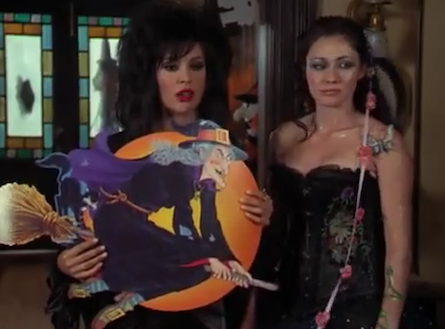
TV: Charmed—Making a Protest Statement… With Cleavage!


“Hook-nosed hags is what we’re celebrating on Halloween. Personally, I’m offended by the representation of witches in popular culture.”

“Right, which is why you dressed as the Mistress of the Dark [Elvira]?”

“This costume happens to be a protest statement.”

“I am so impressed that you can make a protest statement and show cleavage all at the same time.”

That’s what costumes are all about, aren’t they?!

Related: Charmed: “It’s the 21st Century, It’s the Woman’s Job to Save the Day.”

“What? A Woman Can’t Rescue a Man?”

Witch Trial: Burning at the Stake on Charmed.

’Tis the Season…

Images via YouTube.